Mathematical foundations for calculating the long-term average of random variables across multiple trials. Addresses discrete probability distributions and applications in game theory and financial forecasting.
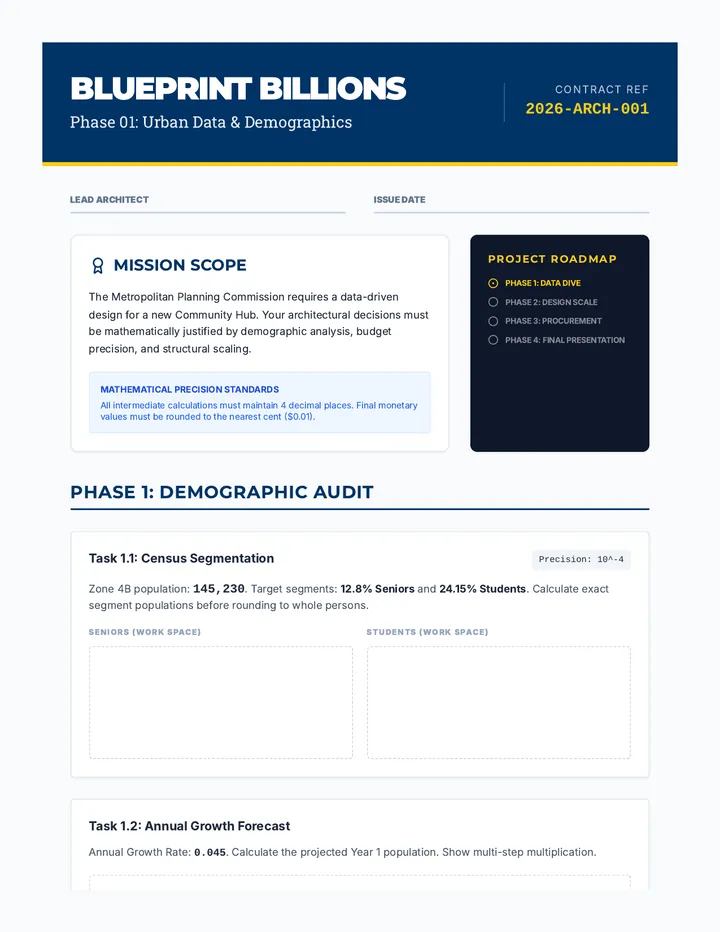
A month-long architectural design and statistical analysis project for high school students, focusing on precision decimal operations through real-world urban planning, budgeting, and data synthesis.
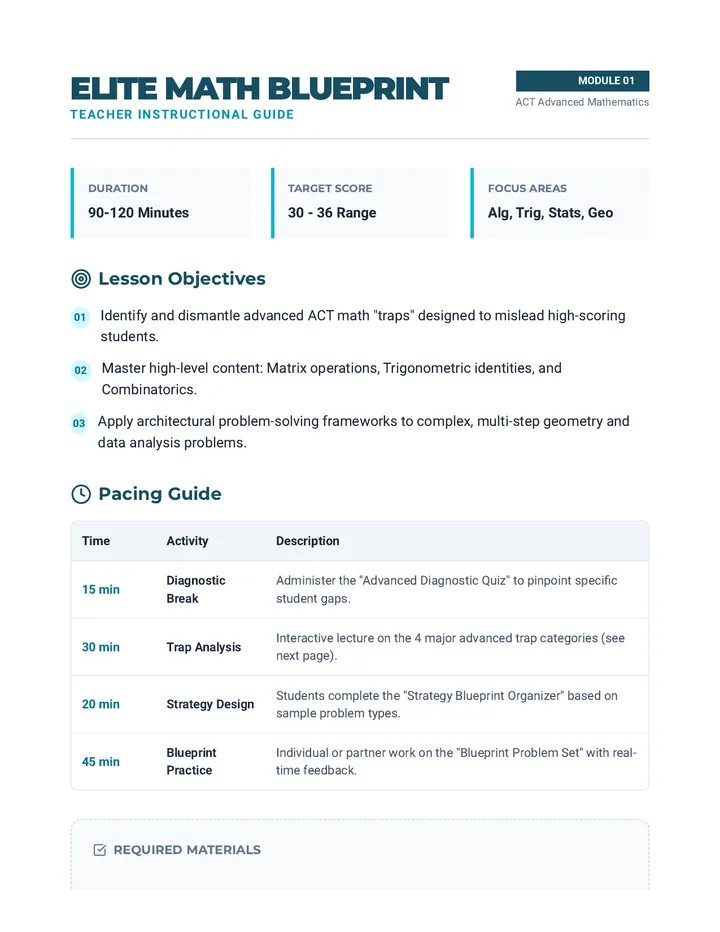
A comprehensive prep sequence for the most challenging questions on the ACT Math and Science sections. It focuses on high-level conceptual blueprints for math topics like complex numbers and matrices, alongside speed-reading and data-interpretation strategies for the Science section.
A high-stakes dive into the mathematics of probability, risk assessment, and expected value, teaching students how to analyze games of chance and skill through a professional lens.
A two-part, 90-minute sequence designed for French Terminale Section Européenne (Maths in English) students, exploring probability models, expected value, decision trees, and game theory with a strong emphasis on oral communication.
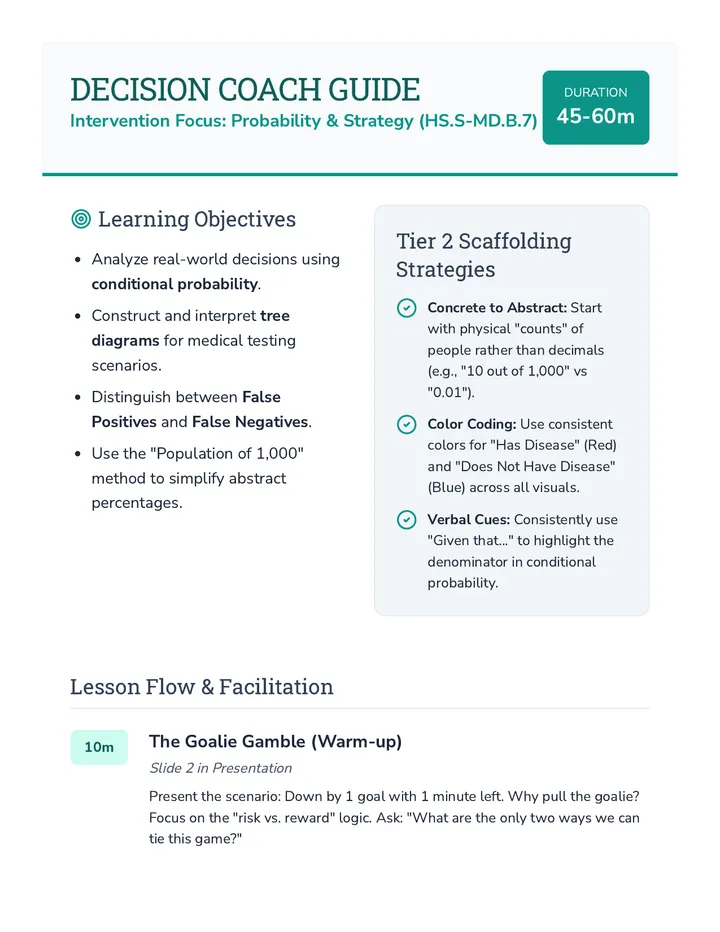
A Tier 2 intervention sequence focused on using probability to analyze decisions, specifically targeting medical testing (false positives/negatives) and game-time strategies. Students learn to use tree diagrams and contingency tables to navigate complex conditional probability scenarios.
A Tier 2 statistics intervention focusing on calculating and interpreting expected values in games of chance. Students transition from intuitive guesses to formal probability distributions and compare experimental data to theoretical outcomes.
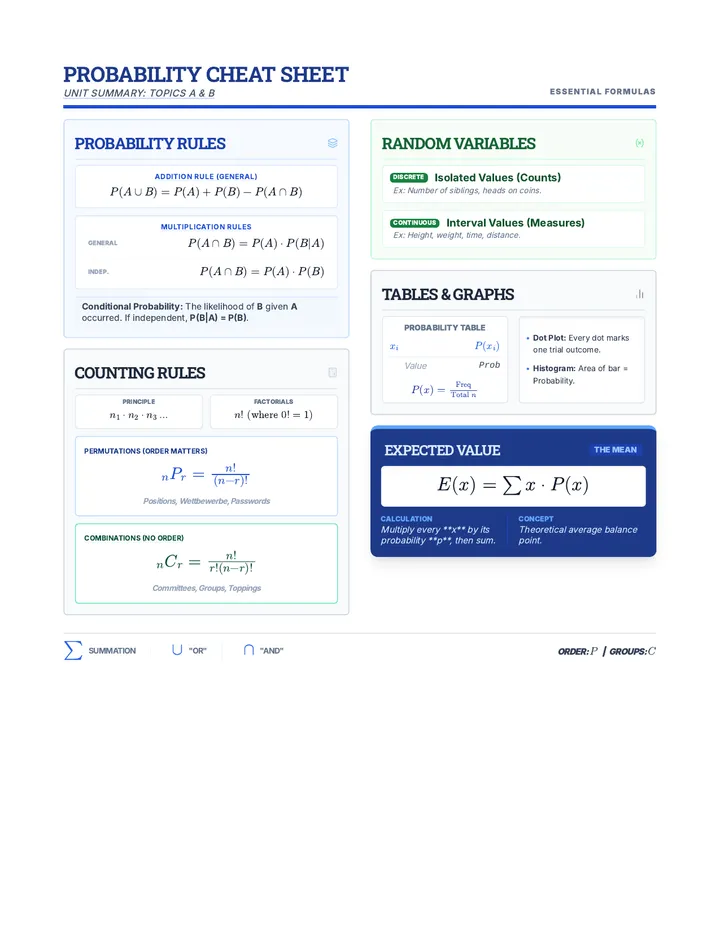
A comprehensive lesson covering probability rules, counting principles, discrete random variables, and empirical distributions. Includes a condensed reference sheet and a practice review worksheet.
An introduction to random variables, distinguishing between discrete and continuous types, graphing probability distributions, and calculating mean and standard deviation.
A lesson focused on calculating the mean, variance, and standard deviation of binomial probability distributions in real-world contexts.
Master planning resources, pacing guides, and curriculum frameworks for advanced high school mathematics courses.
A focused lesson on the binomial distribution, covering the BINS criteria, identifying parameters, and calculating probabilities using digital spreadsheet tools.
A comprehensive assessment covering discrete random variables, permutations, combinations, and the binomial probability distribution based on real-world statistical data.