Lenny.com
Explore
Create
ActivitiesNewMathEnglish Language ArtsScience & EngineeringSocial StudiesGlobal LanguagesHealth & Physical EducationSpecial EducationCounseling & Life SkillsArts & CreativityESL
Lenny.com
Lenny.com
Explore
Create
ActivitiesNewMathEnglish Language ArtsScience & EngineeringSocial StudiesGlobal LanguagesHealth & Physical EducationSpecial EducationCounseling & Life SkillsArts & CreativityESL
Lenny.com
Lenny.com

Solutions

Lenny for EducatorsLenny for SchoolsLenny for Districts

Product

ExploreSign inCreateSupportAbout

Resources

Getting startedMTSS Acceleration Program

© 2026 Lenny Learning Inc.

TermsPrivacyAccessibility
LinkedInInstagramX
Lenny

Multiplication and Division Properties

Commutative, associative, and distributive properties alongside the inverse relationship between multiplication and division. Builds mental math fluency and prepares students for algebraic manipulation.

MathNumbers & CountingCounting ObjectsNumber NamesComparing NumbersNumber OperationsCounting SequenceNumbers 0-10Place Value Understanding and SystemAdd and Subtract Within 20Addition and Subtraction ConceptsAddition and Subtraction EquationsAddition and Subtraction ProblemsFoundations for MultiplicationMultiplication and Division PropertiesMultiply and Divide Within 100Multiplication and Division ProblemsFactors and MultiplesProperties of OperationsPatterns and RelationshipsGenerate and Analyze PatternsMulti-Digit ArithmeticPlace Value OperationsMulti-Digit and Decimal OperationsNumerical ExpressionsFour Operations and PatternsFour Operations Problem SolvingMeasurement & DataMeasurable AttributesMeasuring LengthsMeasure and Estimate Lengths in Standard UnitsRelate Addition and Subtraction to LengthClassifying and Counting ObjectsTime and MoneyArea Concepts and MeasurementPerimeter and Area MeasuresAngle Concepts and MeasurementTime, Volume, and MassMeasurement Unit ConversionsGeometryIdentifying ShapesShapes and AttributesShape Attributes and ReasoningShapes and CompositionClassifying 2D FiguresGeometric Figures and RelationshipsLines, Angles, and ShapesAngle, Area, and VolumeGeometric MeasurementVolume of 3D ShapesCoordinate Plane ApplicationsTransformations in the PlaneCongruence and SimilarityUnderstand congruence in terms of rigid motionsSimilarity and TransformationsProve Theorems Involving SimilarityPythagorean TheoremTrigonometry for General TrianglesMake Geometric ConstructionsProve Geometric TheoremsTheorems About CirclesFind Arc Lengths And Areas of Sectors of CirclesVolume FormulasRelationships Between Two-Dimensional and Three-Dimensional ObjectsProve Simple Geometric Theorems AlgebraicallyTranslate Between Geometric Description and Equation for Conic SectionApply Geometric Concepts in Modeling SituationsFractions & DecimalsFractions as NumbersBuilding FractionsFraction Equivalence and OrderingAdding and Subtracting FractionsMultiplying and Dividing FractionsDividing FractionsDecimal FractionsMulti-Digit Computation and FactorsAdd, Subtract, Multiply, and Divide Rational NumbersRational Number SystemIrrational Numbers and ApproximationsRatiosRatios and ProportionsProportional RelationshipsUnit RateAlgebraAlgebraic ExpressionsGenerate Equivalent ExpressionsQuantitative RelationshipsProportional Relationships and Linear EquationsEquations and InequalitiesEquation Solving and ReasoningLinear Equations and SystemsGraph Equations and InequalitiesSystems of EquationsReal-World Algebraic ProblemsQuantitative Reasoning with UnitsExpression StructureEquivalent Expression FormsRadicals and Integer ExponentsRational ExponentsRational and Irrational NumbersPolynomial OperationsPolynomial IdentitiesPolynomial Zeros and FactorsRational ExpressionsComplex Number OperationsComplex Numbers in PolynomialsComplex Numbers on PlaneStatistics & ProbabilityRepresent and Interpret DataData DistributionsStatistical VariabilityProbability ModelsCompound Event ProbabilitiesStatistical SamplingInterpret Categorical and Quantitative DataBivariate Data PatternsInterpret Linear ModelsComparing Two PopulationsRandom Processes in StatisticsIndependence and Conditional ProbabilityExpected ValuesProbability-Based Decision MakingStatistical Inference and ConclusionsFunctionsFunction Concepts and NotationDefine and Compare FunctionsInterpret Functions in ContextAnalyze Function RepresentationsModel Relationships with FunctionsIdentify Linear vs Exponential GrowthDistinguish Between Function TypesCompare Growth RatesInterpret Function ExpressionsBuild Functions from RelationshipsConstruct and Model FunctionsTransform and Combine FunctionsModel Comparison and SelectionSolve Exponential EquationsTrigonometryTrigonometric Ratios Involving Right TrianglesTrigonometric Functions and Unit CircleModel with Trigonometric FunctionsTrigonometric IdentitiesVectors & MatricesIntroduction to Vectors and MatricesVector QuantitiesVector OperationsMatrix OperationsCalculusLimits and ContinuityDerivative Concepts and NotationDerivative Rules and TechniquesApplications of DerivativesOptimization ProblemsRelated RatesCurve Sketching and AnalysisIntegration Concepts and NotationAntiderivatives and Indefinite IntegralsDefinite Integrals and AreaFundamental Theorem of CalculusIntegration TechniquesApplications of IntegrationDifferential EquationsSequences and SeriesParametric and Polar FunctionsVector-Valued Functions

Videos

How to Multiply Positive and Negative Integers

How to Multiply Positive and Negative Integers

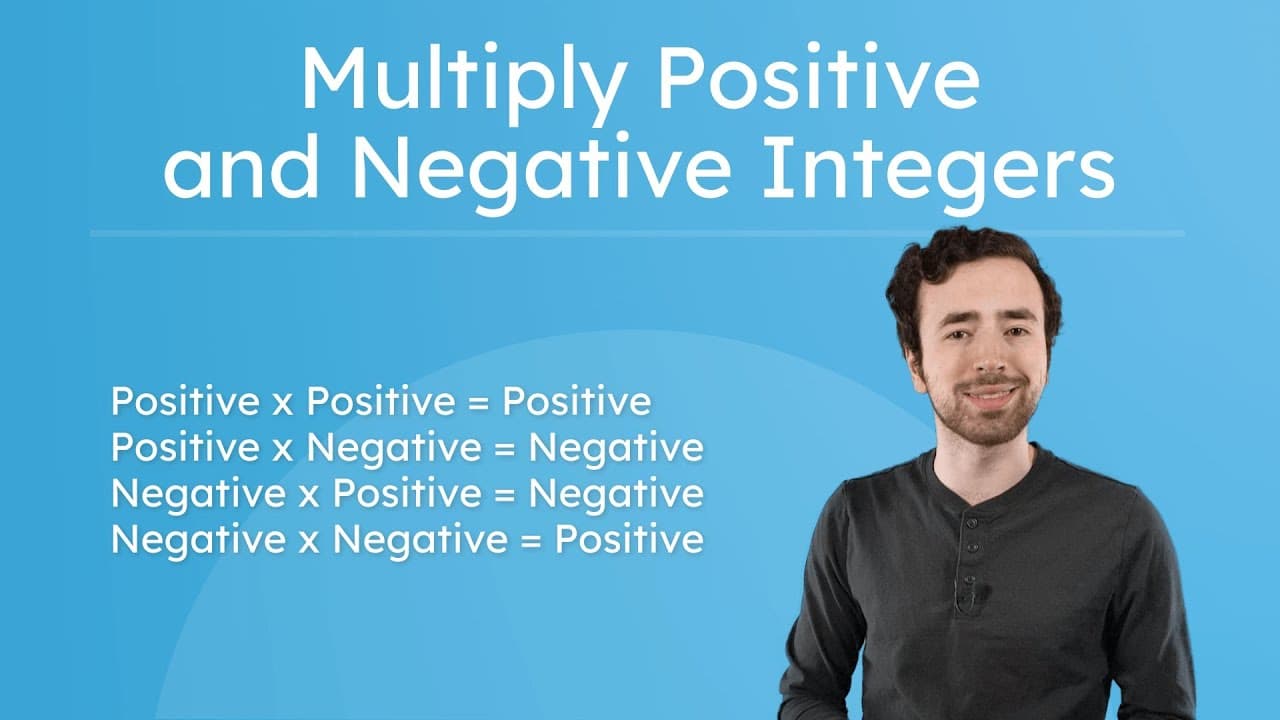
This video provides a comprehensive guide to multiplying positive and negative integers, moving beyond rote memorization to explain the underlying logic of integer operations. The narrator, Justin, systematically breaks down four scenarios: positive times positive, negative times positive, positive times negative, and negative times negative. By connecting multiplication to repeated addition and subtraction concepts, the video demonstrates *why* certain sign rules exist, such as why two negatives equal a positive product. The video covers key themes including repeated addition, the relationship between subtraction and adding negatives, and standard algorithms for multi-digit multiplication. A significant portion of the video is dedicated to a step-by-step walkthrough of a complex multi-digit problem (-132 x 24), showing students how to ignore signs during calculation and re-apply the correct sign to the final product. For educators, this resource bridges the gap between conceptual understanding and procedural fluency. It is excellent for introducing integer rules in middle school or reviewing them in pre-algebra. The video includes built-in pause points for student practice, mental math checks, and clear visual summaries of the rules (Same Signs = Positive; Different Signs = Negative), making it ready-to-use for direct instruction or independent learning stations.

Miacademy & MiaPrep Learning ChannelMiacademy & MiaPrep Learning Channel

12mins 39s

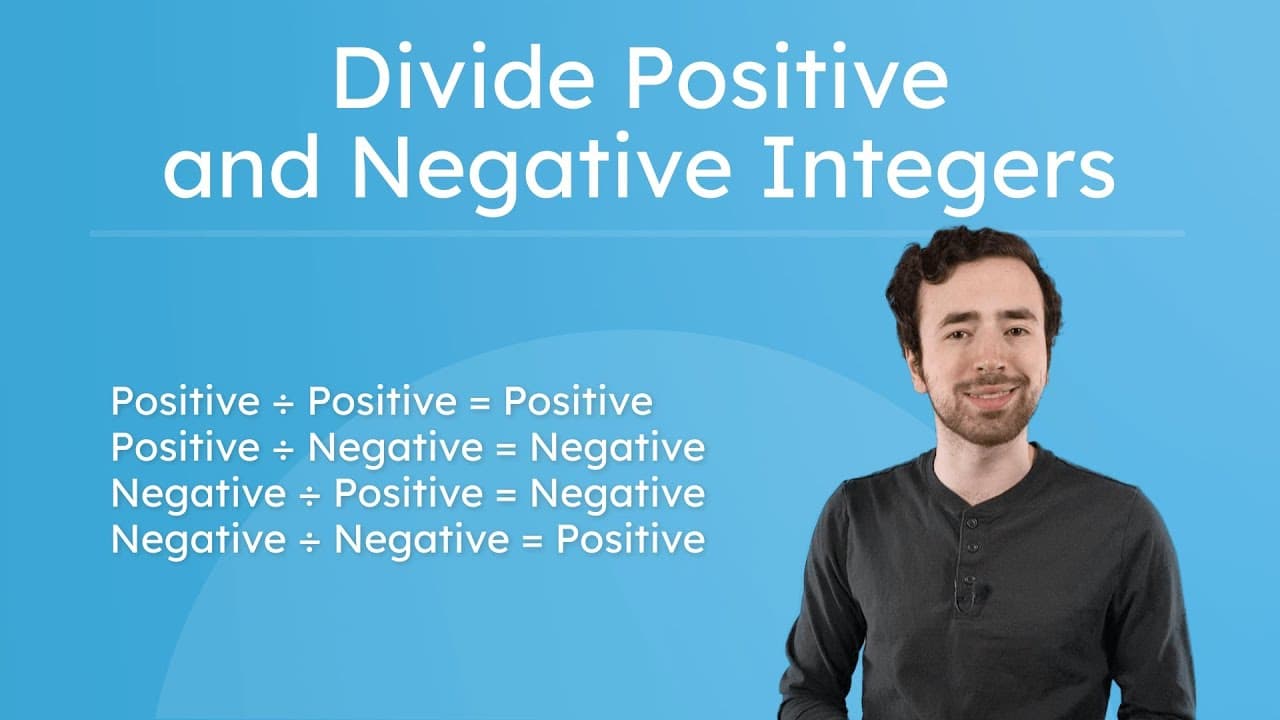
Mastering Division with Positive and Negative Integers

Mastering Division with Positive and Negative Integers

This educational video provides a comprehensive guide to dividing positive and negative integers, serving as both a conceptual introduction and a procedural tutorial. The narrator, Justin, begins by grounding the concept of division in its relationship to multiplication, defining them as inverse operations that "undo" each other. The video explicitly outlines the rules for determining the sign of a quotient: if signs are the same, the result is positive; if signs are different, the result is negative. This foundation prepares students for the more complex procedural work that follows. Key themes include the inverse relationship between operations, the rules for signed numbers, and the step-by-step algorithm for long division with multi-digit numbers. The video also covers essential vocabulary such as dividend, divisor, and quotient. A significant portion is dedicated to a detailed walkthrough of a long division problem (12,584 divided by 52), demonstrating estimation strategies and place value alignment. The lesson concludes by addressing how to handle remainders, moving beyond "R" notation to expressing remainders as fractions, supported by a clear visual representation. For educators, this video is an excellent resource for a flipped classroom model or for reinforcing integer rules and long division mechanics. It addresses common stumbling blocks, such as forgetting to align place values or misinterpreting the sign of the answer. The clear, step-by-step visualization of long division helps demystify the algorithm for struggling learners, while the section on fractional remainders helps bridge the gap between elementary arithmetic and middle school algebra concepts.

Miacademy & MiaPrep Learning ChannelMiacademy & MiaPrep Learning Channel

10mins 46s

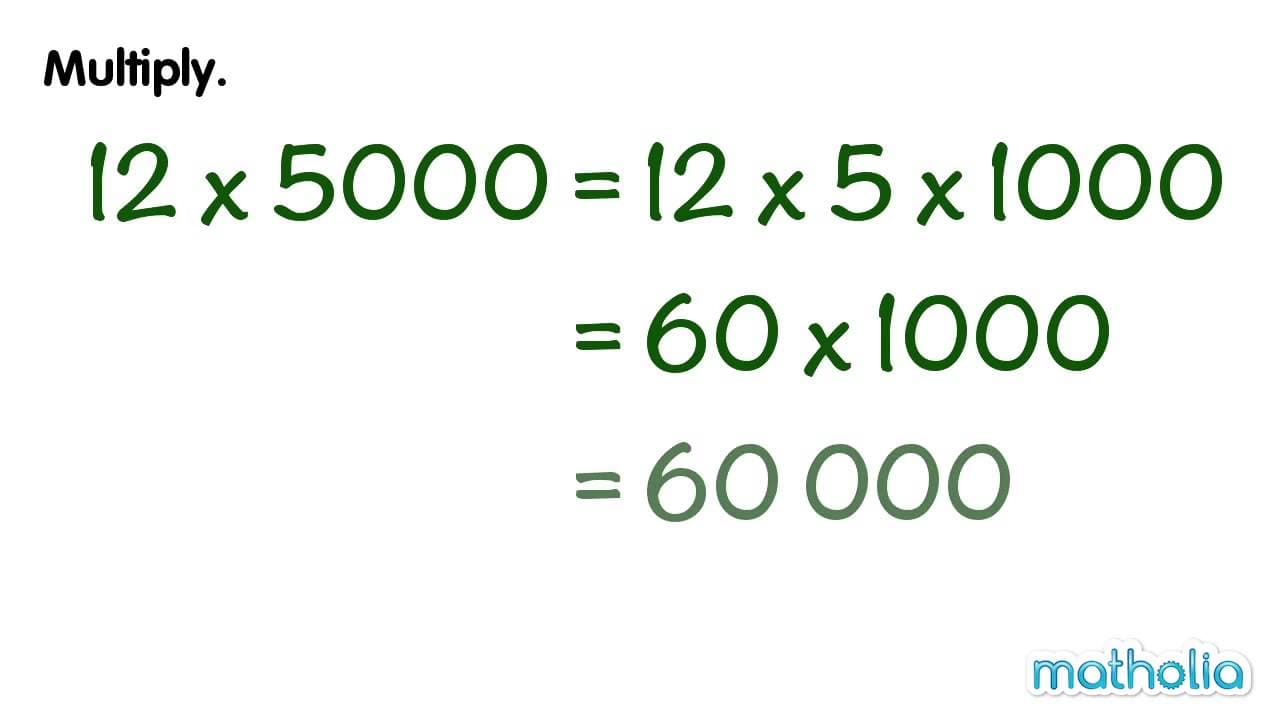
Multiplying Whole Numbers by Multiples of 1000

Multiplying Whole Numbers by Multiples of 1000

This educational video provides a clear, step-by-step tutorial on multiplying whole numbers by multiples of 1,000 (e.g., 4,000, 5,000, 9,000). The video demonstrates the concept using the associative property of multiplication, breaking down larger numbers into factors to simplify the calculation process. It serves as a visual guide for mental math strategies involving large numbers. The content focuses on three specific examples of increasing difficulty: multiplying a single-digit number by thousands (7 x 4,000), a double-digit number by thousands (12 x 5,000), and a more complex double-digit multiplication (23 x 9,000). Through these examples, the video explores key arithmetic themes such as decomposition of numbers, column multiplication for intermediate steps, and the patterns involved when multiplying by powers of ten. For educators, this video is an excellent resource for teaching 4th and 5th-grade math students how to handle multi-digit multiplication without getting overwhelmed by zeros. It visually reinforces the strategy of ignoring the zeros, performing the core multiplication, and then re-attaching the zeros—mathematically justifying why this 'trick' works. It is ideal for introducing the topic, reviewing mental math strategies, or supporting students who struggle with large number arithmetic.
MatholiaChannelMatholiaChannel

2mins 9s

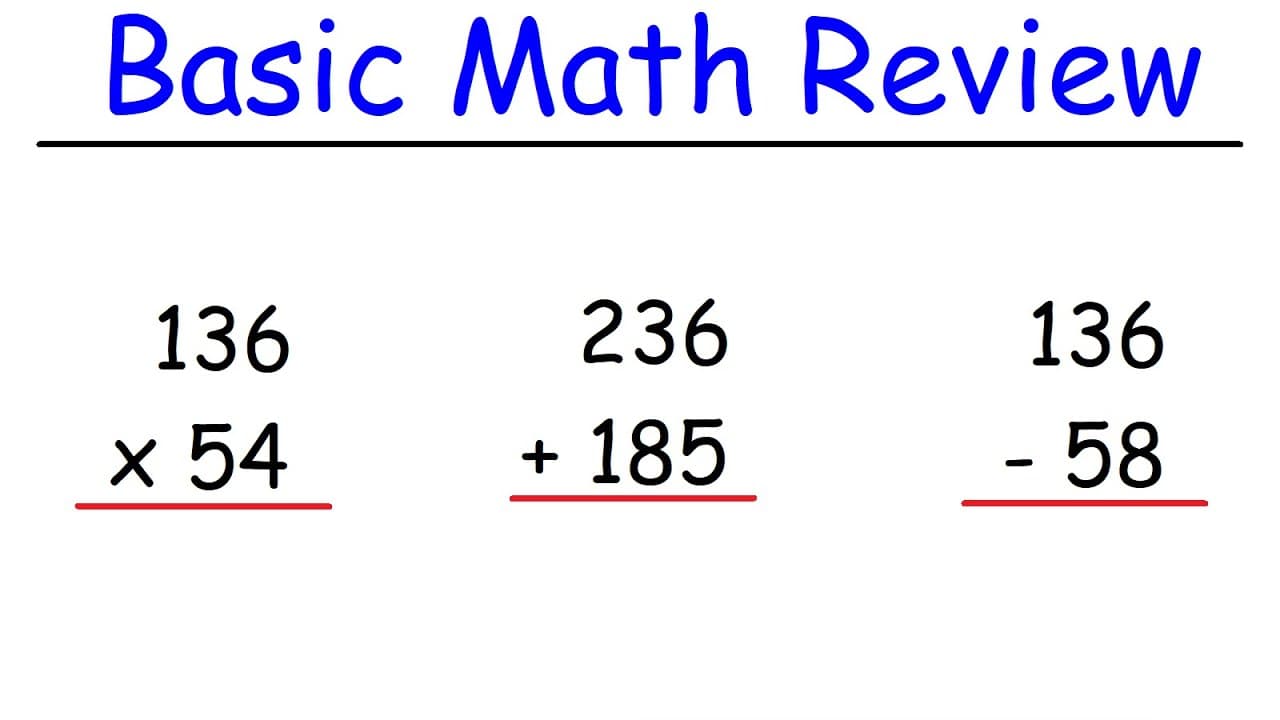
Mastering Basic Arithmetic: Operations, Fractions, and Percentages

Mastering Basic Arithmetic: Operations, Fractions, and Percentages

This comprehensive video tutorial provides a thorough review of fundamental arithmetic concepts essential for middle school math success. It begins by grounding students in the basics of addition and subtraction using number lines to explain integer operations, before progressing to multi-digit column arithmetic with carrying and borrowing. The video systematically covers all four major operations—addition, subtraction, multiplication, and division—using varied strategies like standard algorithms, mental math tricks, and real-world analogies involving money to make abstract concepts concrete. Beyond basic operations, the video transitions into more complex topics including operations with decimals, long division leading to decimal answers, and operations with fractions having unlike denominators. The instructor demonstrates clear, step-by-step methods for finding common denominators and converting improper fractions to mixed numbers. The visual style mimics a blackboard, allowing students to follow the handwriting and procedural flow of each problem naturally. The final section of the video focuses on practical applications of percentages, specifically calculating tips and sales tax. It teaches powerful mental math strategies—such as finding 10%, 5%, and 1% separately to build up to complex percentages like 15% or 18%—which are invaluable life skills. This video serves as an excellent refresher for students transitioning to pre-algebra or for those needing remediation in core numeracy skills.

The Organic Chemistry TutorThe Organic Chemistry Tutor

37mins 42s

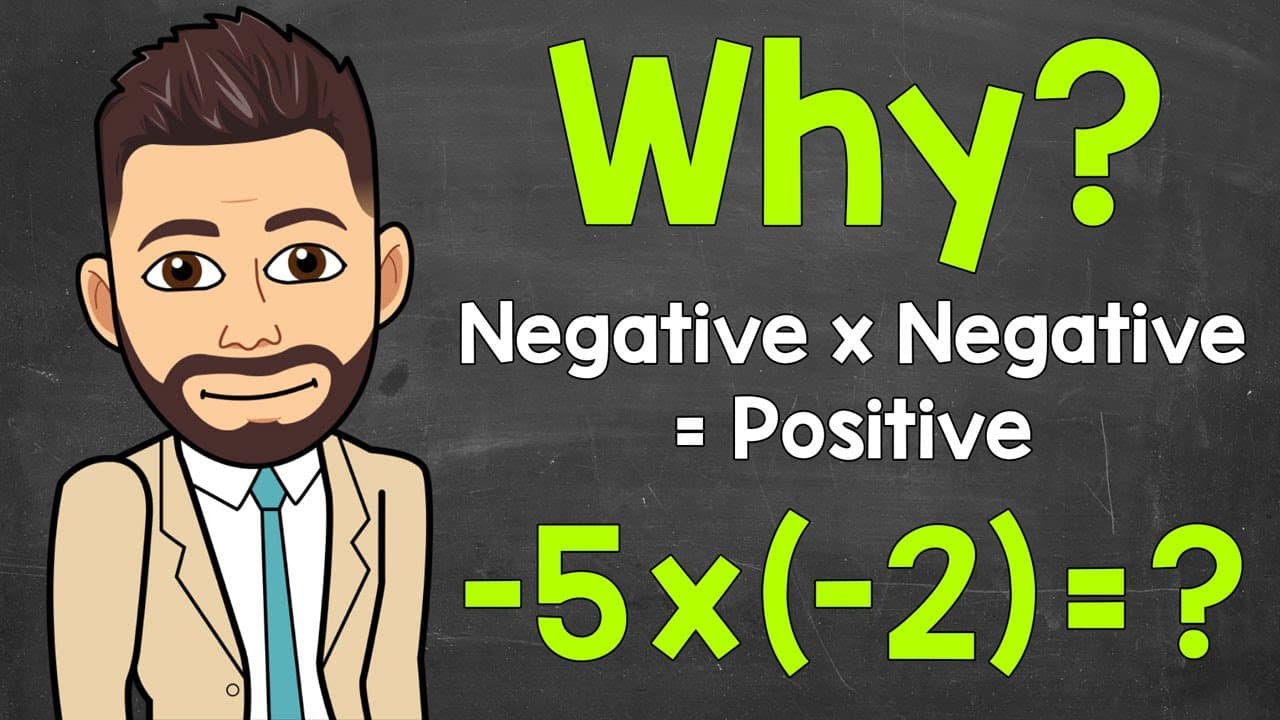
Why Multiplying Two Negatives Equals a Positive

Why Multiplying Two Negatives Equals a Positive

A clear and accessible mathematics tutorial that explains the logic behind why multiplying two negative numbers results in a positive answer. The video moves beyond simply memorizing rules (like "two negatives make a positive") and offers three distinct methods for understanding the concept: two mathematical proofs involving grouping/subtraction and pattern recognition, and one linguistic analogy involving double negatives.

Math with Mr. JMath with Mr. J

8mins 30s

Solving Percent Problems Using the Percent Equation

Solving Percent Problems Using the Percent Equation

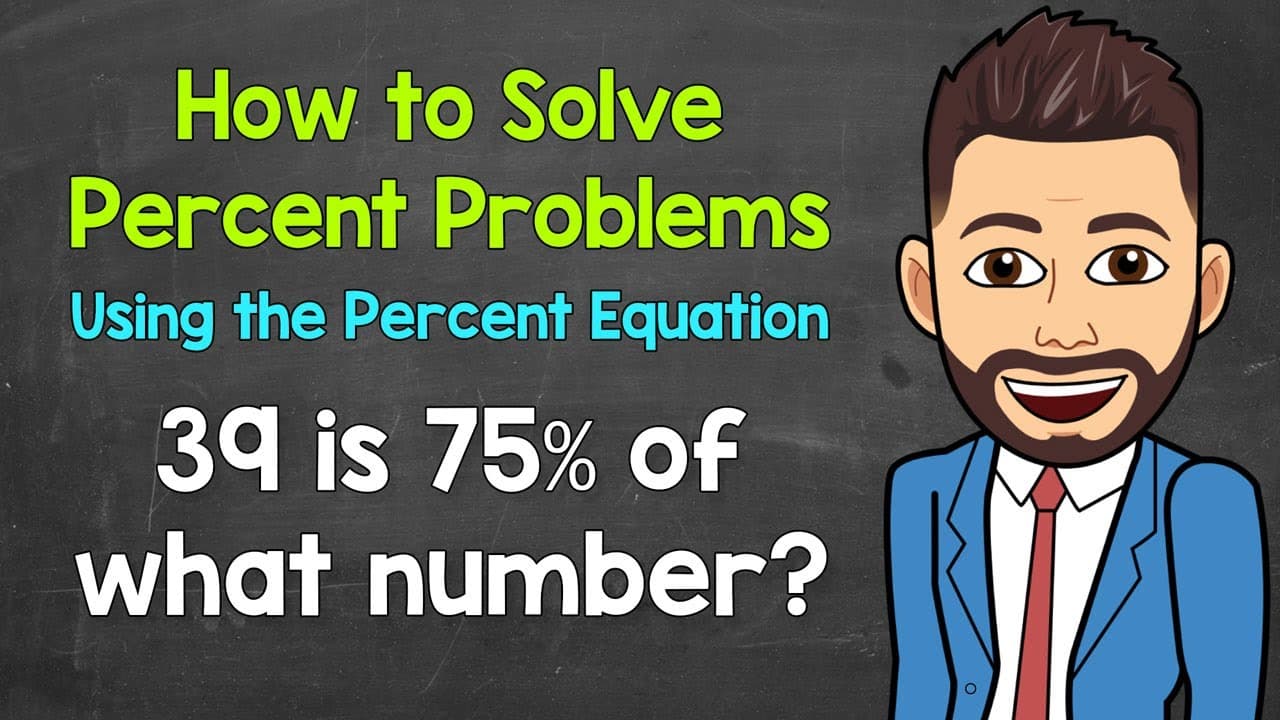
This instructional video provides a comprehensive guide to solving percent problems using the percent equation (Percent w Whole = Part). The instructor, Mr. J, breaks down the process into three distinct sections: finding the whole, finding the part, and finding the percent. Each section includes two detailed examples that demonstrate how to set up the equation, substitute known values, and solve for the unknown variable using algebraic steps. The video emphasizes key algebraic concepts such as isolating the variable using inverse operations (division and multiplication) and converting between percentages and decimals. Mr. J explicitly models how to interpret word problems by associating the word "of" with multiplication/the whole and "is" with the equal sign/the part. He also addresses interpreting repeating decimals and rounding, providing a complete procedural framework for students. For educators, this resource serves as an excellent direct instruction tool or review material for middle school math units on ratios and proportional relationships. It supports learning by visualizing the step-by-step algebraic process on a digital chalkboard, making it ideal for students transitioning from visual models to abstract algebraic methods for solving percent problems.

Math with Mr. JMath with Mr. J

16mins 25s

Materials

Pumpkin Patch Math Review Worksheet

Pumpkin Patch Math Review Worksheet

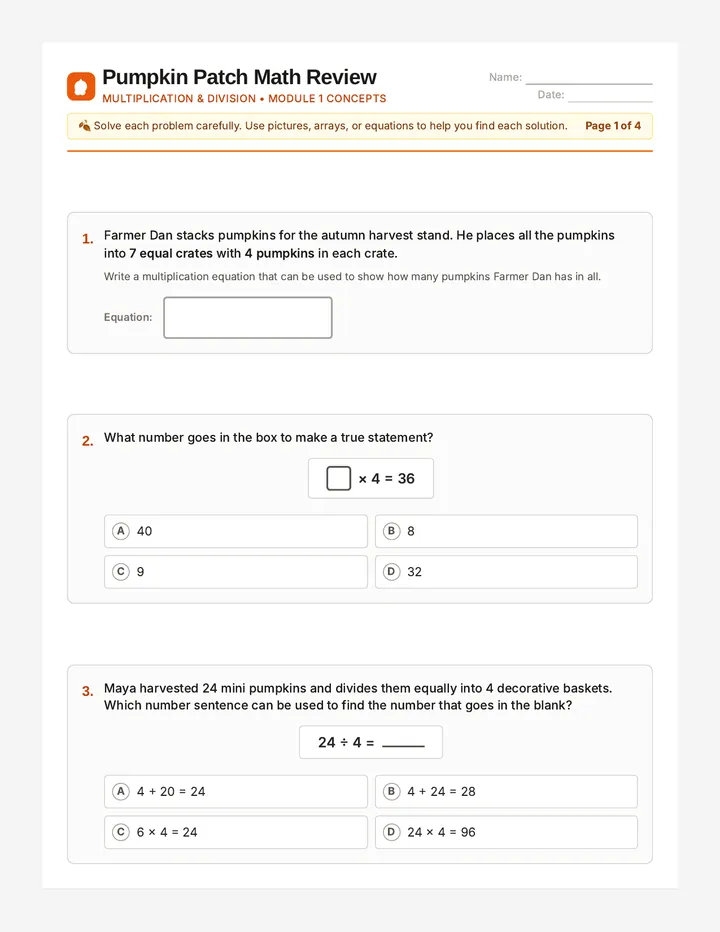
A 4-page fall-themed math review worksheet covering 3rd grade multiplication and division concepts, with Question 2 updated to [ ] × 4 = 36 and authentic multiple-choice options.

L

llocascio

Factor Power CFU Worksheet

Factor Power CFU Worksheet

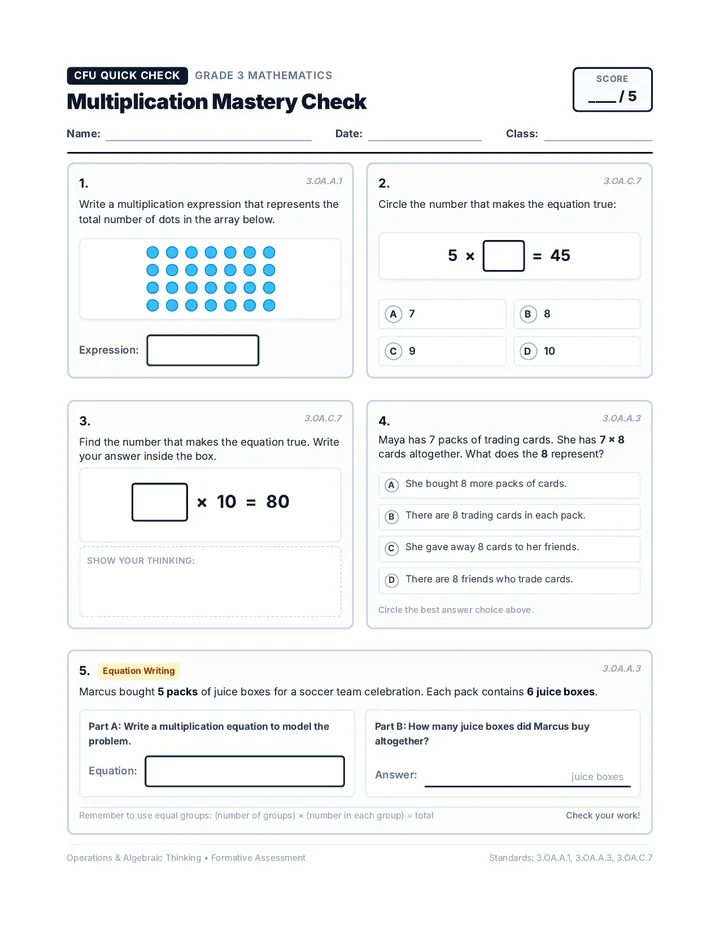
A print-ready, five-question Grade 3 Check for Understanding (CFU) worksheet assessing multiplication concepts (3.OA.A.1, 3.OA.A.3, 3.OA.C.7). Features array modeling, missing factor equations with products of 5 (5 x [ ] = 45) and 10 ([ ] x 10 = 80), factor meaning in context, and equation writing from a real-world word problem.

TD

Taylor Doucet

Figurative Patterns Slides Orientation Fix

Figurative Patterns Slides Orientation Fix

Fixed Slide 6 where the visualization of two paired triangular numbers forming a rectangle was missing. Replaced the previous layout with explicit flex rows to ensure the dots render correctly and clearly show how $T_4$ and its twin create a $4 \times 5$ rectangle. Label positioning and container sizing were also refined for better clarity. Adjusted Slide 4 to fill vertical space more effectively.

BC

Brenda Coombs

Array Architects Worksheet

Array Architects Worksheet

A comprehensive two-page 3rd-grade math worksheet on arrays. Page 1 guides students to identify rows, columns, repeated addition, and multiplication equations from visual arrays, then sketch their own models. Page 2 covers commutative turnarounds, fact families, and real-world word problems with sketching areas.

CB

Caroline Beaumier

Array Breakers Worksheet

Array Breakers Worksheet

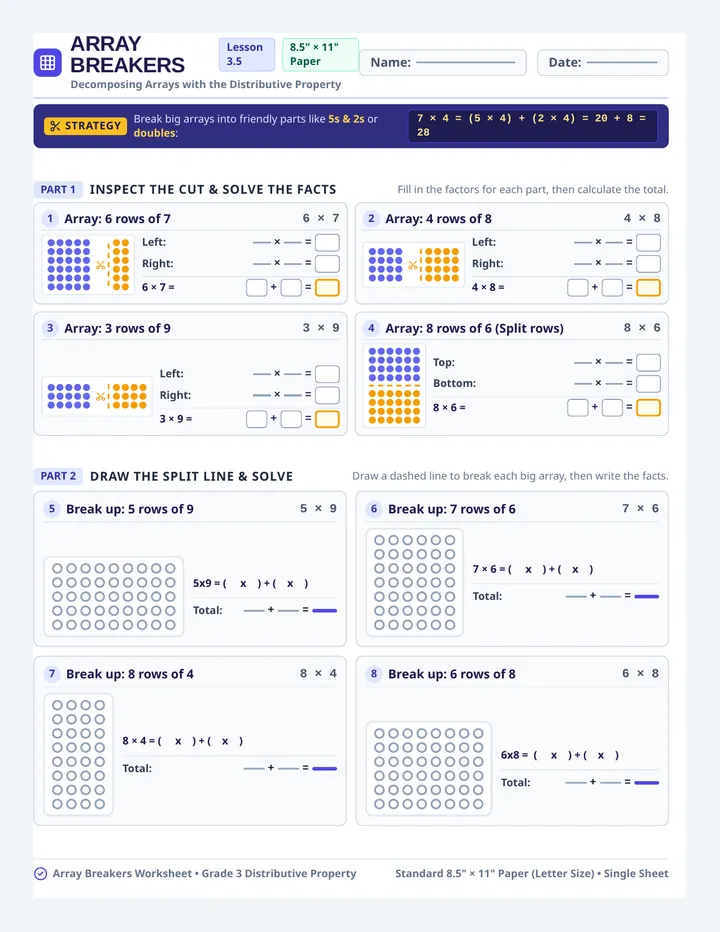
A single-page 8.5 × 11-inch math worksheet featuring enlarged arrays in Part 2 for students to divide easily, with clean student factor blanks and matching equations.

C

ckelly

Array Detective Game

Array Detective Game

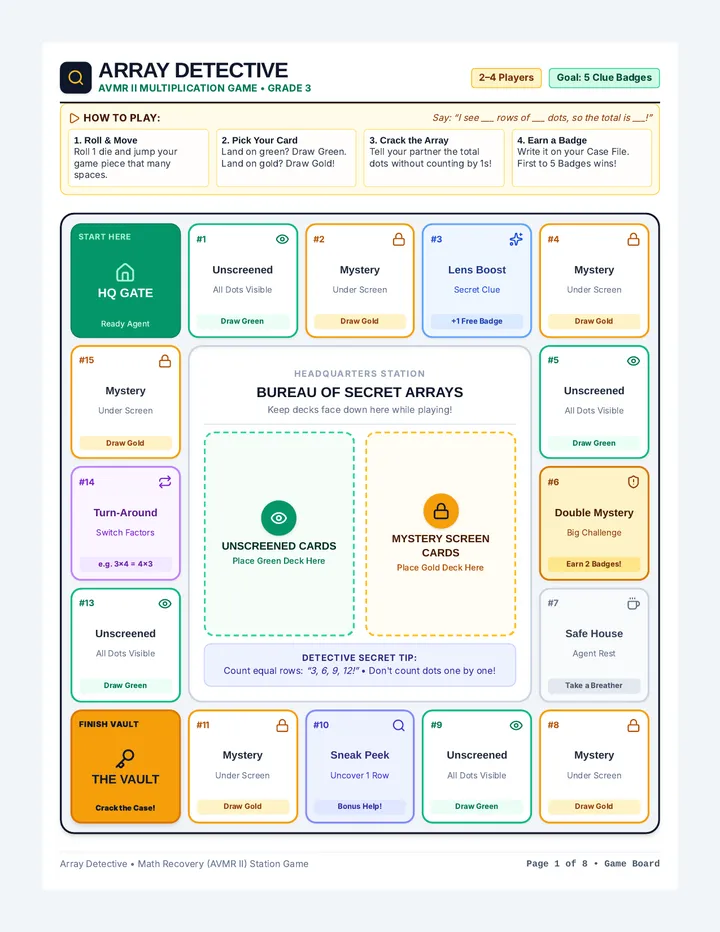
An expanded 8-page print-and-play math station game for Grade 3 AVMR II multiplication arrays. Features 32 array challenge cards in total (16 unscreened and 16 screened with corner reveals and single row/column screens), an enlarged game board, kid-friendly directions, a student case log, and two teacher observation charts. All tall cards like U16 and U7 are precisely proportioned to fit comfortably inside the card outlines without overlapping.

JW

Julie Whitehead

Sequences

Blueprint Basics Teacher Guide

Master Builders Math Lab

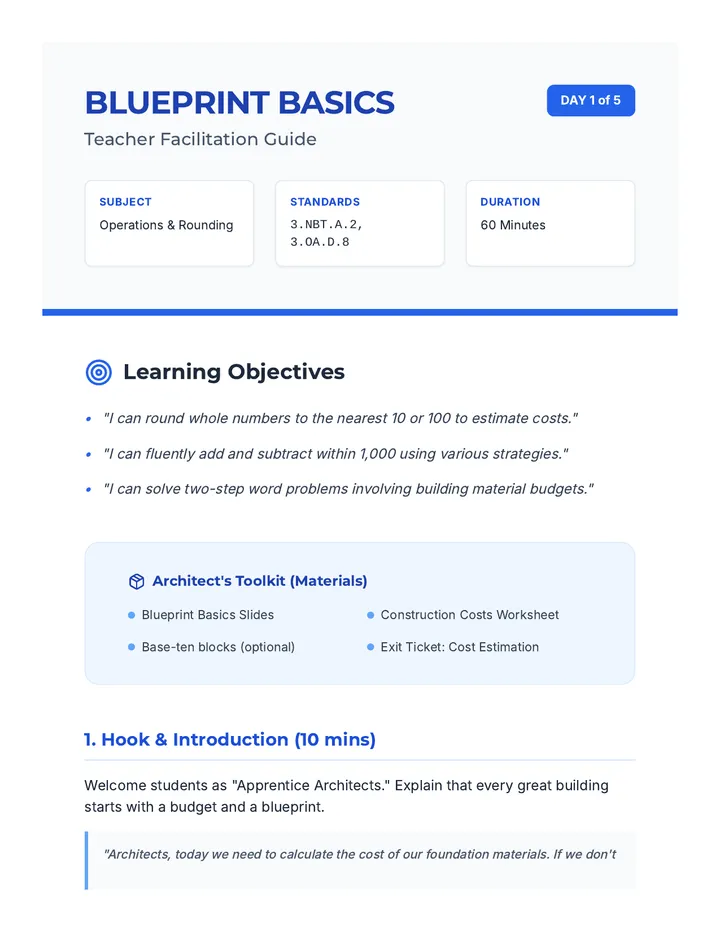
A 5-day intensive math sequence for 3rd grade covering multiplication, division, multi-digit operations, fractions, area, and rounding through a "Master Builder" architectural theme. Students act as apprentice architects solving construction-themed math challenges.

TD

Taylor Doucet

25
Math Blueprint Week 1 Booklet (Definitive)

Math Blueprint Spiral

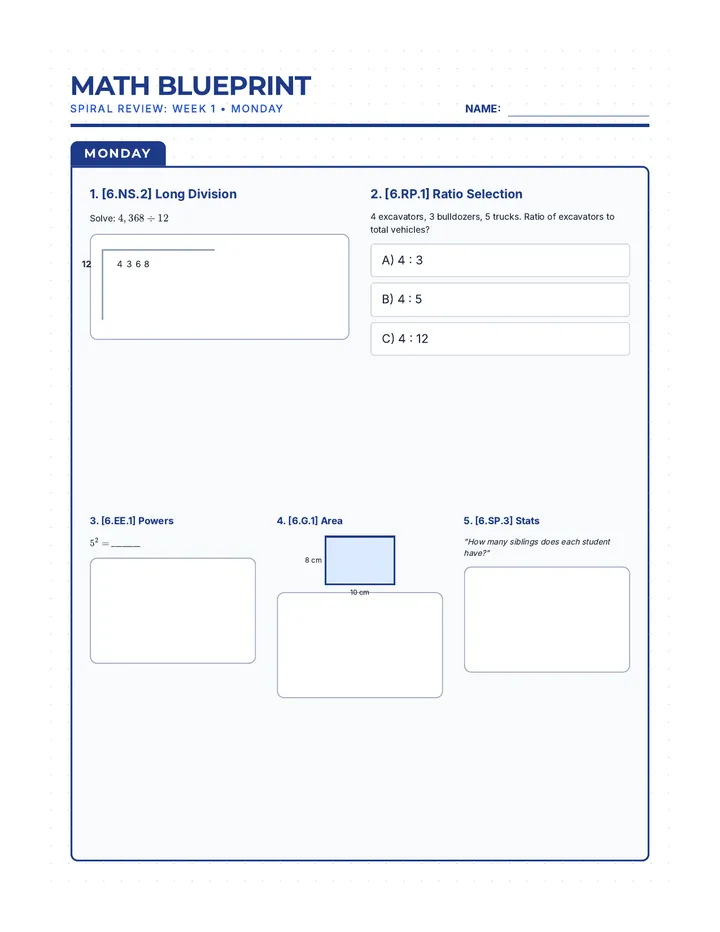
A 7-week comprehensive math review sequence designed to prepare 6th-grade students for North Carolina state testing, covering Number Systems, Ratios, Expressions, Geometry, and Statistics.

MK

Michell Kisler

27
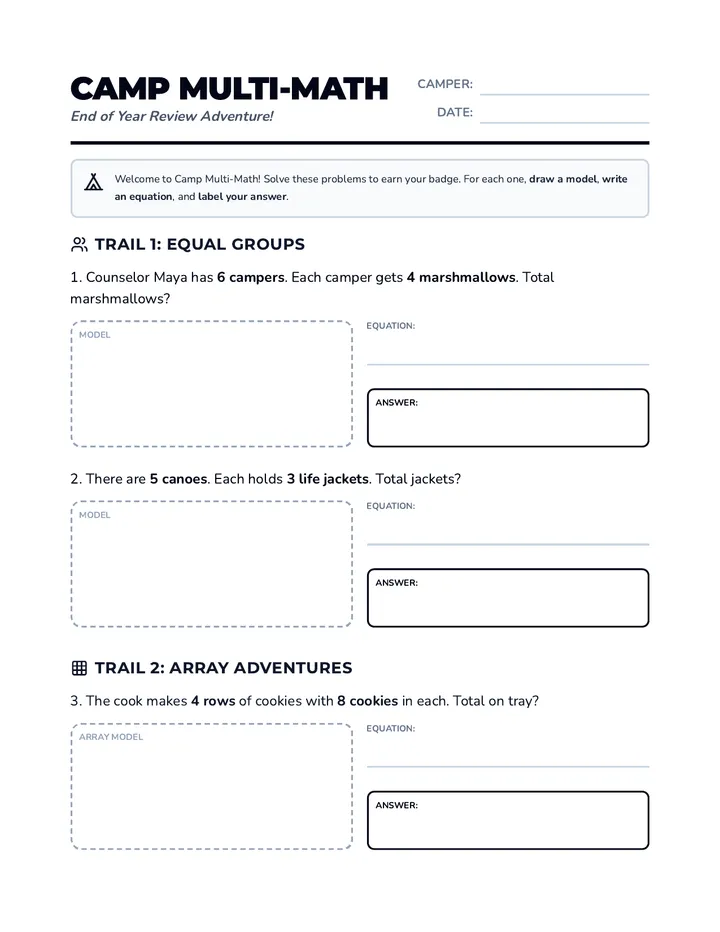
Camp Multi-Math Worksheet

Math Review Adventures

A collection of themed end-of-year math review adventures for different grade levels, focusing on spiraling key standards and problem-solving.

DB

Deborah Burton

21
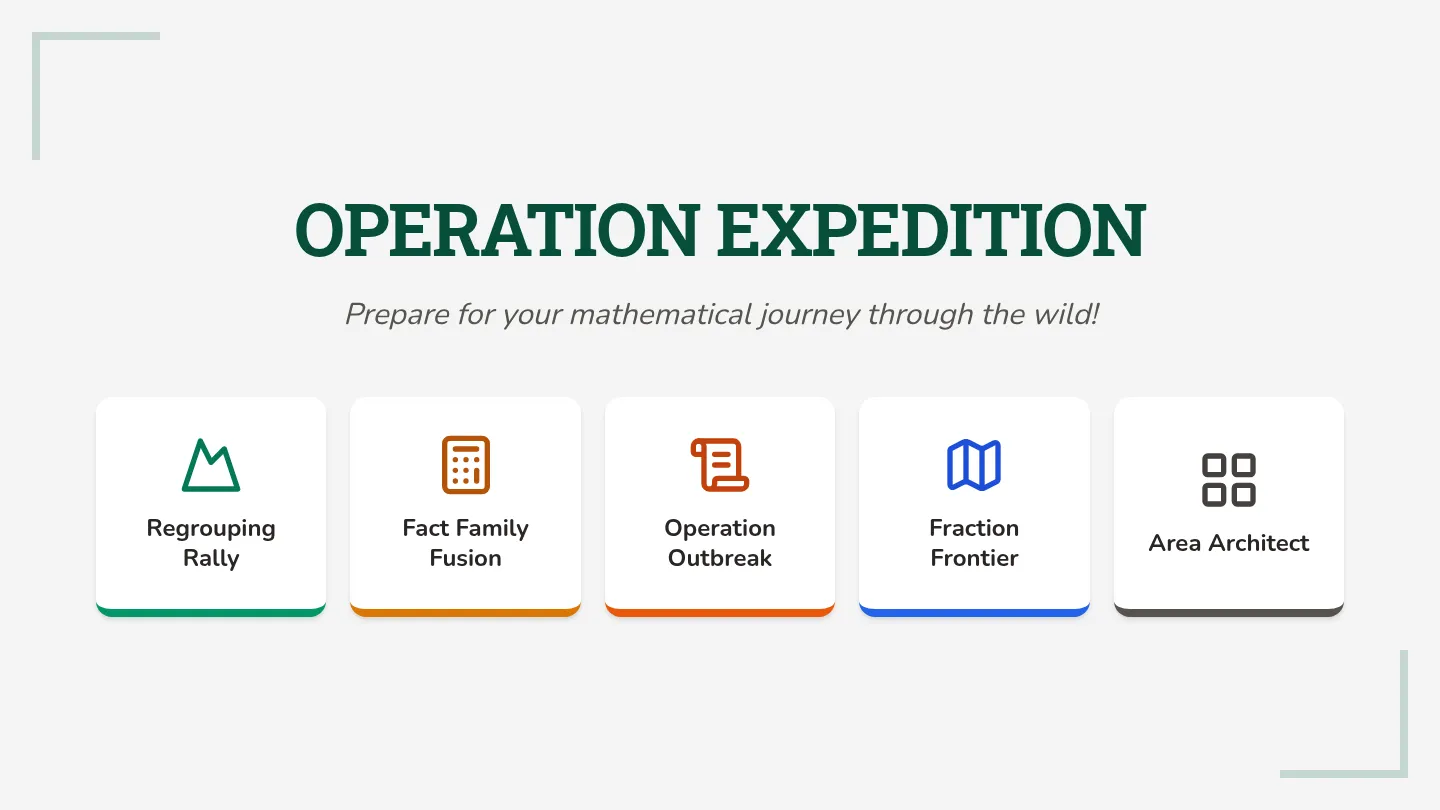
Expedition Timer Slides

Math Expedition Rotations

A series of 3rd-grade math rotation stations focusing on key curriculum standards including regrouping, fact families, word problems, fractions, and area. Designed for 15-minute rotations with an expedition theme.

KB

Krista Bodkin

8
Sixes Daily Practice Worksheet

Factor Forge Fluency

A three-week intensive unit focusing on multiplication and division fact families for factors 6, 7, and 8, using a blacksmith 'Factor Forge' theme to build math fluency and conceptual understanding.

W

wohlfordc

10
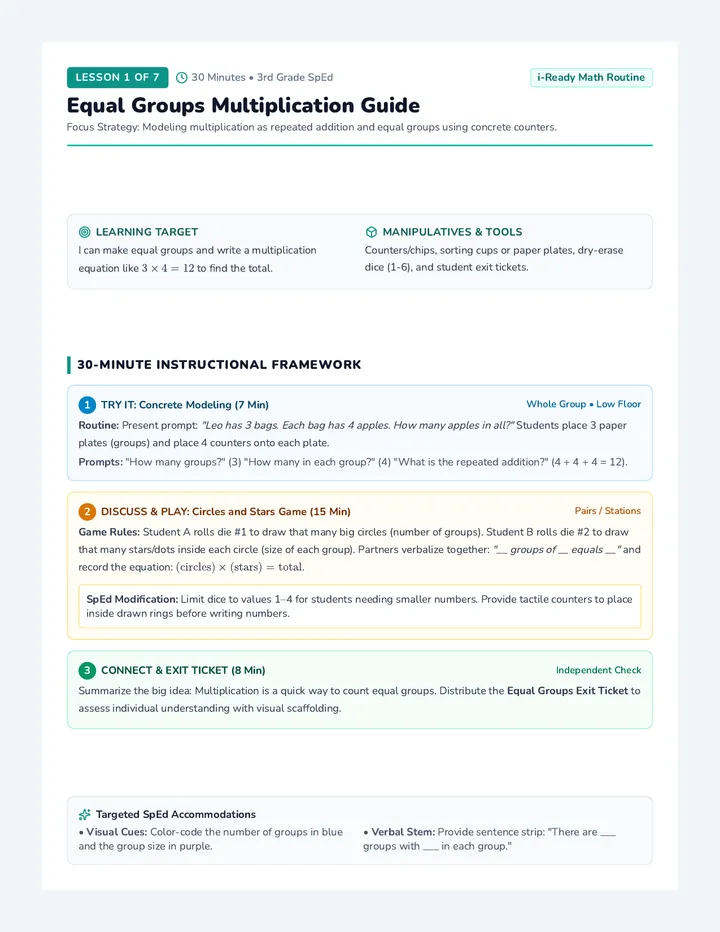
Equal Groups Lesson Guide

Strategy Champions

A 7-lesson targeted mathematics intervention sequence for 3rd grade special education students, focusing on concrete and representational multiplication and division strategies adapted from the i-Ready Try-Discuss-Connect framework.

KW

Katherine Wright

18

Lessons

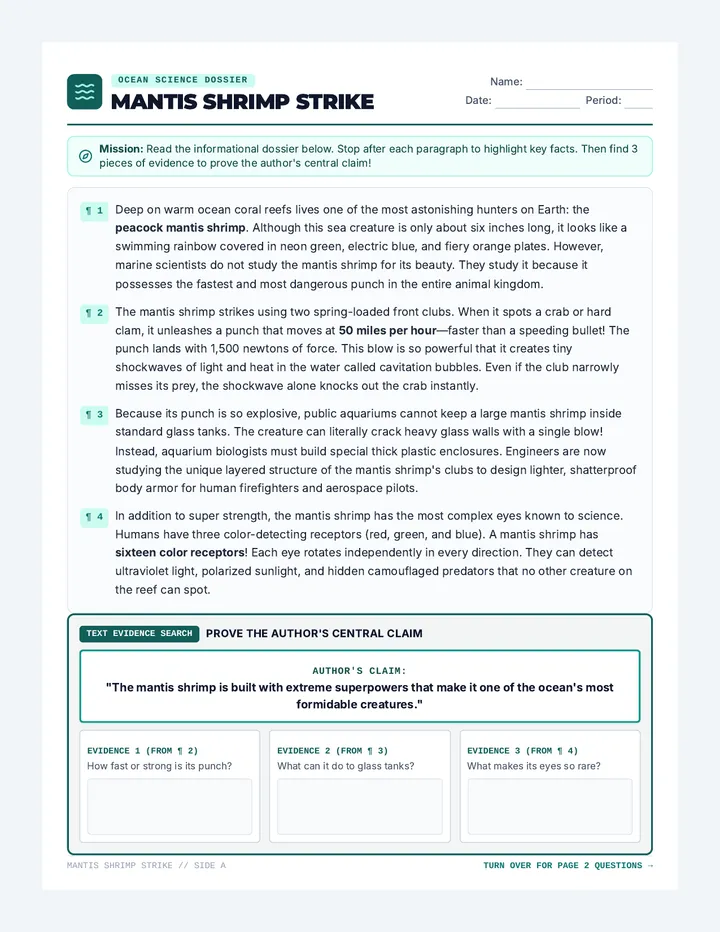
Mantis Shrimp Strike Evidence Worksheet

Sub Day Sleuths

An engaging third-grade substitute teacher lesson pack featuring an informational text evidence investigation and a word-problem-free math logic puzzle.

KS

Kathleen Suther

9
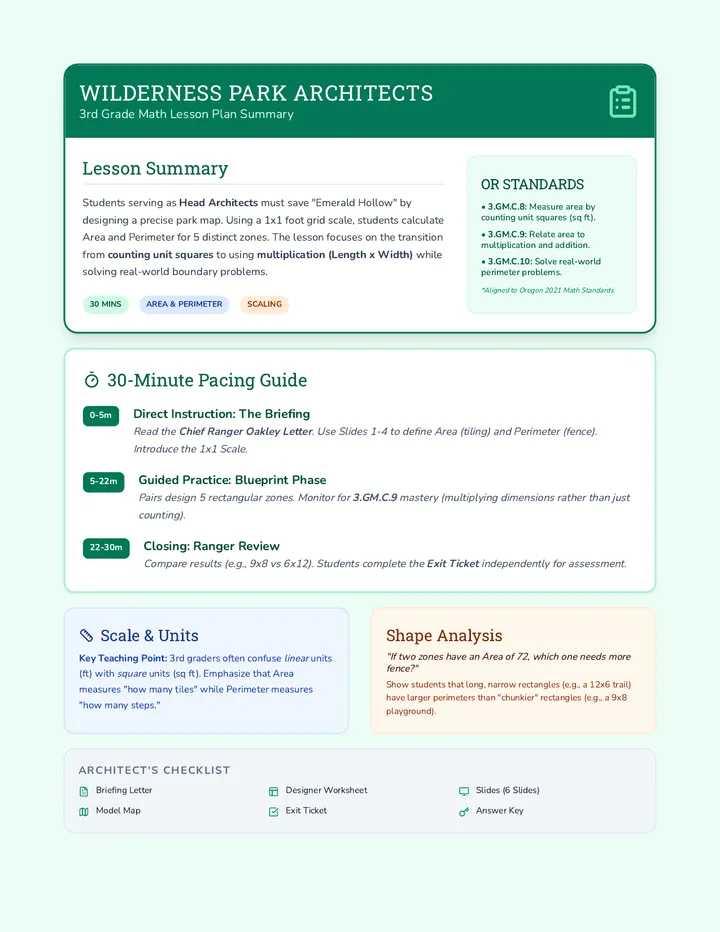
Wilderness Park Architects Teacher Guide

Wilderness Park Architects

A 30-minute interactive lesson where 3rd graders design a Wilderness Park, applying their knowledge of area and perimeter to create specific park zones on a 1x1 foot grid scale.

AJ

Alexander Jacinto

7
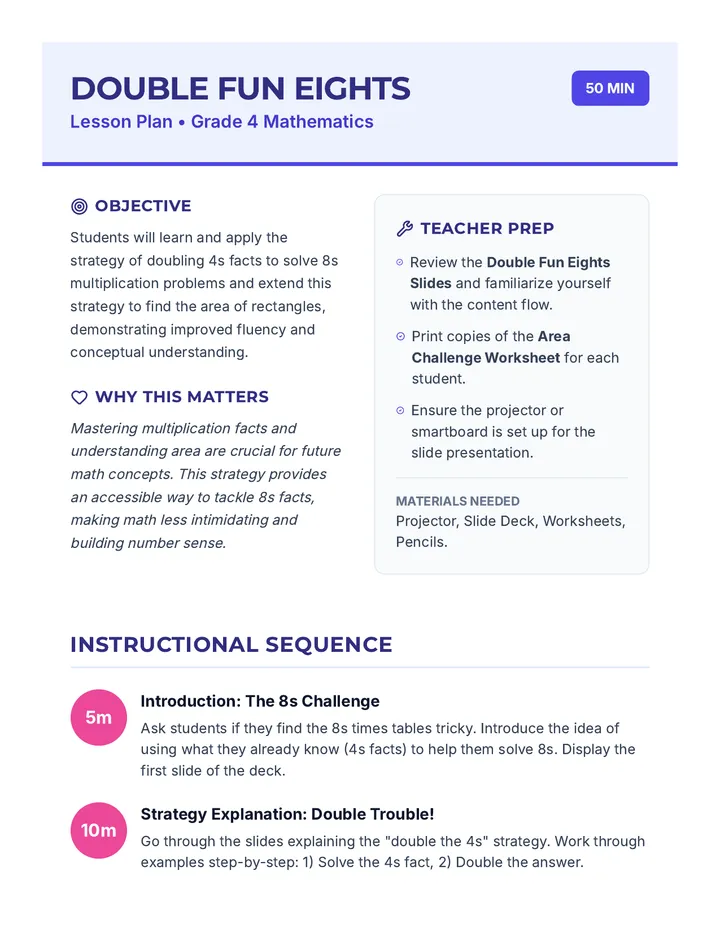
Double Fun Eights Lesson Plan

Double Fun Eights

This lesson introduces 4th-grade students to the doubling strategy for mastering 8s multiplication facts and applying them to find the area of rectangles.

DG

Diana Gordon

4
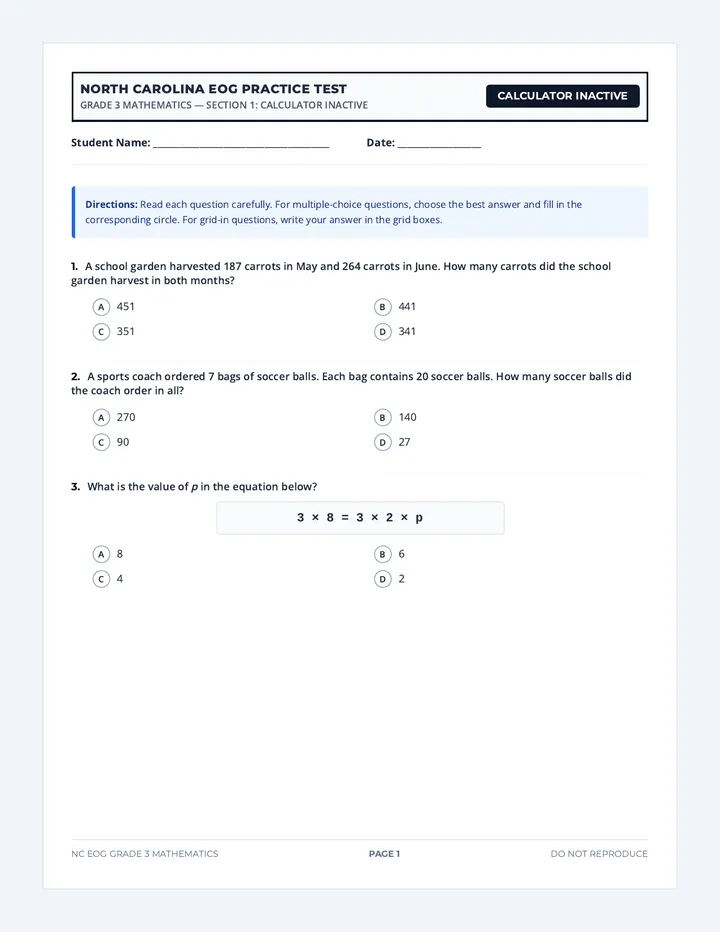
Grade 3 Math Practice Test

Tar Heel Math Mastery

A comprehensive practice package designed for 3rd-grade students preparing for the North Carolina End-of-Grade (EOG) Mathematics assessment. It includes a complete 48-question exam covering all highly-tested standard course of study domains, an interactive student grid, an item-to-standard alignment map, and a full explanatory answer key.

SP

sashagaye Panton

3
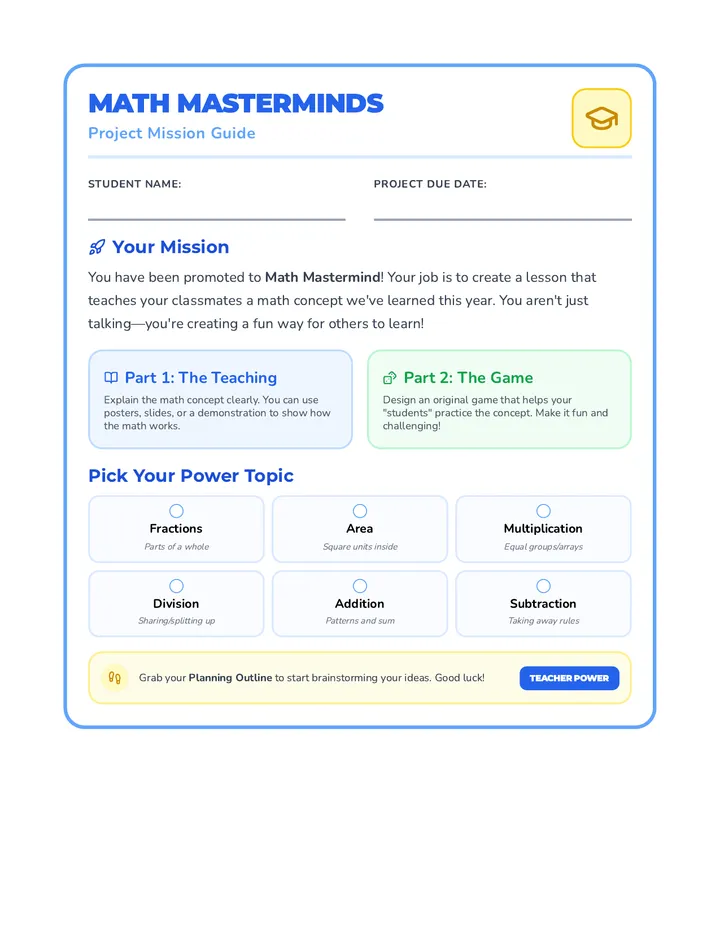
Math Mastermind Project Guide

Math Mastermind Academy

A project-based lesson where 3rd grade students become the teachers, creating a math lesson and a corresponding game on key concepts like fractions, area, and operations.

KB

Krista Bodkin

7
Problem Marathon Handout

Operation Math Mastery

A collection of STAAR-aligned multi-step word problems for 4th-grade math, focusing on multiplication, division, fractions, and decimals using the RDW (Read, Draw, Write) strategy.

MC

Melinda Cortez

4