Lenny.com
Explore
Create
ActivitiesNewMathEnglish Language ArtsScience & EngineeringSocial StudiesGlobal LanguagesHealth & Physical EducationSpecial EducationCounseling & Life SkillsArts & CreativityESL
Lenny.com
Lenny.com
Explore
Create
ActivitiesNewMathEnglish Language ArtsScience & EngineeringSocial StudiesGlobal LanguagesHealth & Physical EducationSpecial EducationCounseling & Life SkillsArts & CreativityESL
Lenny.com
Lenny.com

Solutions

Lenny for EducatorsLenny for SchoolsLenny for Districts

Product

ExploreSign inCreateSupportAbout

Resources

Getting startedMTSS Acceleration Program

© 2026 Lenny Learning Inc.

TermsPrivacyAccessibility
LinkedInInstagramX
Lenny

Multiplication and Division Problems

Multi-step word problems involving equal groups, arrays, and area models. Strengthens computational fluency and the ability to interpret remainders in real-world contexts.

MathNumbers & CountingCounting ObjectsNumber NamesComparing NumbersNumber OperationsCounting SequenceNumbers 0-10Place Value Understanding and SystemAdd and Subtract Within 20Addition and Subtraction ConceptsAddition and Subtraction EquationsAddition and Subtraction ProblemsFoundations for MultiplicationMultiplication and Division PropertiesMultiply and Divide Within 100Multiplication and Division ProblemsFactors and MultiplesProperties of OperationsPatterns and RelationshipsGenerate and Analyze PatternsMulti-Digit ArithmeticPlace Value OperationsMulti-Digit and Decimal OperationsNumerical ExpressionsFour Operations and PatternsFour Operations Problem SolvingMeasurement & DataMeasurable AttributesMeasuring LengthsMeasure and Estimate Lengths in Standard UnitsRelate Addition and Subtraction to LengthClassifying and Counting ObjectsTime and MoneyArea Concepts and MeasurementPerimeter and Area MeasuresAngle Concepts and MeasurementTime, Volume, and MassMeasurement Unit ConversionsGeometryIdentifying ShapesShapes and AttributesShape Attributes and ReasoningShapes and CompositionClassifying 2D FiguresGeometric Figures and RelationshipsLines, Angles, and ShapesAngle, Area, and VolumeGeometric MeasurementVolume of 3D ShapesCoordinate Plane ApplicationsTransformations in the PlaneCongruence and SimilarityUnderstand congruence in terms of rigid motionsSimilarity and TransformationsProve Theorems Involving SimilarityPythagorean TheoremTrigonometry for General TrianglesMake Geometric ConstructionsProve Geometric TheoremsTheorems About CirclesFind Arc Lengths And Areas of Sectors of CirclesVolume FormulasRelationships Between Two-Dimensional and Three-Dimensional ObjectsProve Simple Geometric Theorems AlgebraicallyTranslate Between Geometric Description and Equation for Conic SectionApply Geometric Concepts in Modeling SituationsFractions & DecimalsFractions as NumbersBuilding FractionsFraction Equivalence and OrderingAdding and Subtracting FractionsMultiplying and Dividing FractionsDividing FractionsDecimal FractionsMulti-Digit Computation and FactorsAdd, Subtract, Multiply, and Divide Rational NumbersRational Number SystemIrrational Numbers and ApproximationsRatiosRatios and ProportionsProportional RelationshipsUnit RateAlgebraAlgebraic ExpressionsGenerate Equivalent ExpressionsQuantitative RelationshipsProportional Relationships and Linear EquationsEquations and InequalitiesEquation Solving and ReasoningLinear Equations and SystemsGraph Equations and InequalitiesSystems of EquationsReal-World Algebraic ProblemsQuantitative Reasoning with UnitsExpression StructureEquivalent Expression FormsRadicals and Integer ExponentsRational ExponentsRational and Irrational NumbersPolynomial OperationsPolynomial IdentitiesPolynomial Zeros and FactorsRational ExpressionsComplex Number OperationsComplex Numbers in PolynomialsComplex Numbers on PlaneStatistics & ProbabilityRepresent and Interpret DataData DistributionsStatistical VariabilityProbability ModelsCompound Event ProbabilitiesStatistical SamplingInterpret Categorical and Quantitative DataBivariate Data PatternsInterpret Linear ModelsComparing Two PopulationsRandom Processes in StatisticsIndependence and Conditional ProbabilityExpected ValuesProbability-Based Decision MakingStatistical Inference and ConclusionsFunctionsFunction Concepts and NotationDefine and Compare FunctionsInterpret Functions in ContextAnalyze Function RepresentationsModel Relationships with FunctionsIdentify Linear vs Exponential GrowthDistinguish Between Function TypesCompare Growth RatesInterpret Function ExpressionsBuild Functions from RelationshipsConstruct and Model FunctionsTransform and Combine FunctionsModel Comparison and SelectionSolve Exponential EquationsTrigonometryTrigonometric Ratios Involving Right TrianglesTrigonometric Functions and Unit CircleModel with Trigonometric FunctionsTrigonometric IdentitiesVectors & MatricesIntroduction to Vectors and MatricesVector QuantitiesVector OperationsMatrix OperationsCalculusLimits and ContinuityDerivative Concepts and NotationDerivative Rules and TechniquesApplications of DerivativesOptimization ProblemsRelated RatesCurve Sketching and AnalysisIntegration Concepts and NotationAntiderivatives and Indefinite IntegralsDefinite Integrals and AreaFundamental Theorem of CalculusIntegration TechniquesApplications of IntegrationDifferential EquationsSequences and SeriesParametric and Polar FunctionsVector-Valued Functions

Videos

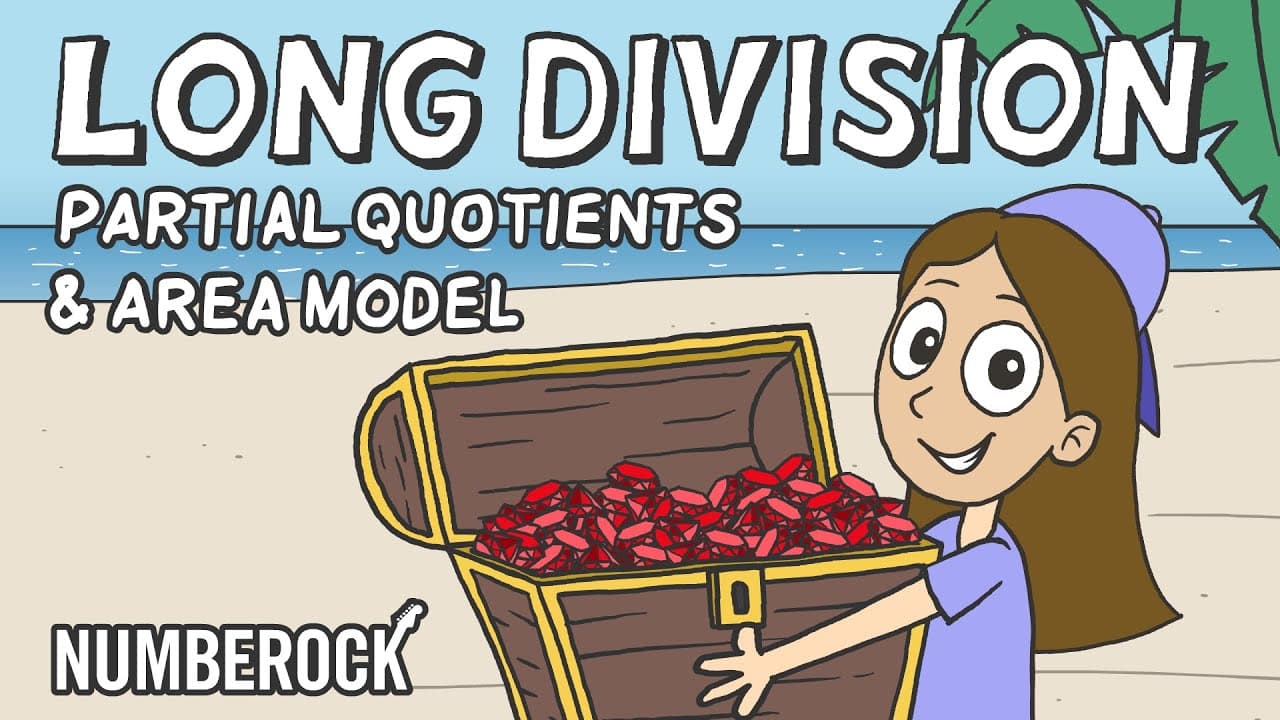
Long Division Strategies: Partial Quotients and Area Models

Long Division Strategies: Partial Quotients and Area Models

This engaging animated musical video teaches two specific strategies for solving long division problems: the Partial Quotients method (often called the "Big 7") and the Area Model. Through a narrative about a group of nine children who discover a treasure chest containing 225 rubies, the video walks viewers step-by-step through dividing the treasure equally among themselves. The video explores key mathematical themes including division as equal sharing, place value understanding, subtraction in the division process, and the relationship between multiplication and division. It explicitly demonstrates how to break down a large dividend into manageable "chunks" or partial quotients, subtract those chunks, and sum the results to find the final quotient. The second half of the video transitions into a rap that applies the same problem to an Area Model, reinforcing the geometric connection to division. For educators, this video is an excellent tool for introducing or reinforcing division strategies that are alternatives to the standard algorithm. It is particularly useful for students who struggle with the abstract nature of traditional long division, as it emphasizes conceptual understanding and flexible thinking. The catchy song and clear visual representations make complex multi-step procedures memorable and easier to visualize.

Math Songs by NUMBEROCKMath Songs by NUMBEROCK

4mins 43s

Calculating Speed, Distance, and Time

Calculating Speed, Distance, and Time

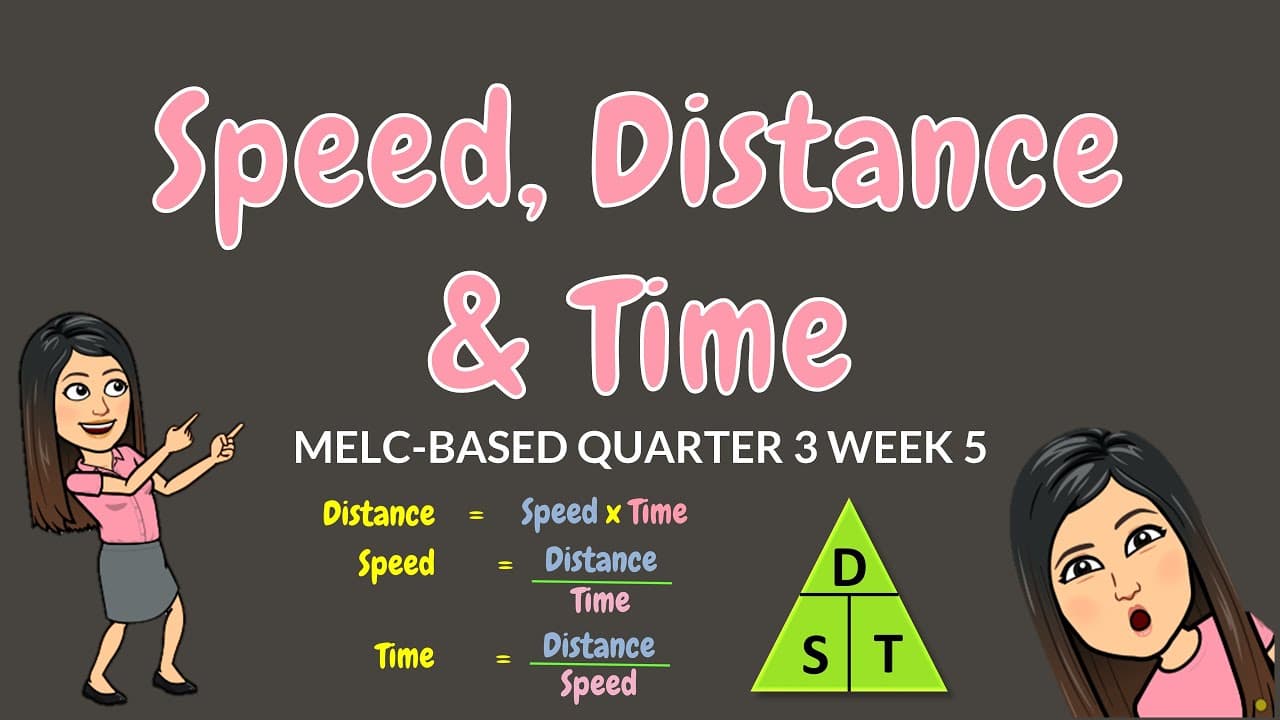
This educational video provides a clear, step-by-step guide on how to calculate the three fundamental variables of motion: speed, distance, and time. Through a series of six progressive word problems, an animated teacher guides students through the formulas for each variable, demonstrating not just the arithmetic but also the importance of unit analysis and cancellation. The video utilizes the popular "DST triangle" mnemonic to help students memorize the relationship between the variables. The content is structured into three distinct sections, with two examples provided for each concept: calculating distance (Speed × Time), calculating speed (Distance ÷ Time), and calculating time (Distance ÷ Speed). Specific attention is given to defining each term—explaining speed as a scalar quantity, distance as total length, and time as duration—and verifying the correct units of measurement for the final answers. For educators, this resource serves as an excellent direct-instruction tool for upper elementary or middle school math and science classes. It effectively models problem-solving behaviors, such as identifying given values, selecting the correct formula, substituting numbers, and checking units. The video's pacing allows for "pause-and-solve" interactivity, making it ideal for introducing the concepts or reviewing them before a test.
Sheena DoriaSheena Doria

8mins 42s

Mastering Whole Number Multiplication: A Self-Check Challenge

Mastering Whole Number Multiplication: A Self-Check Challenge

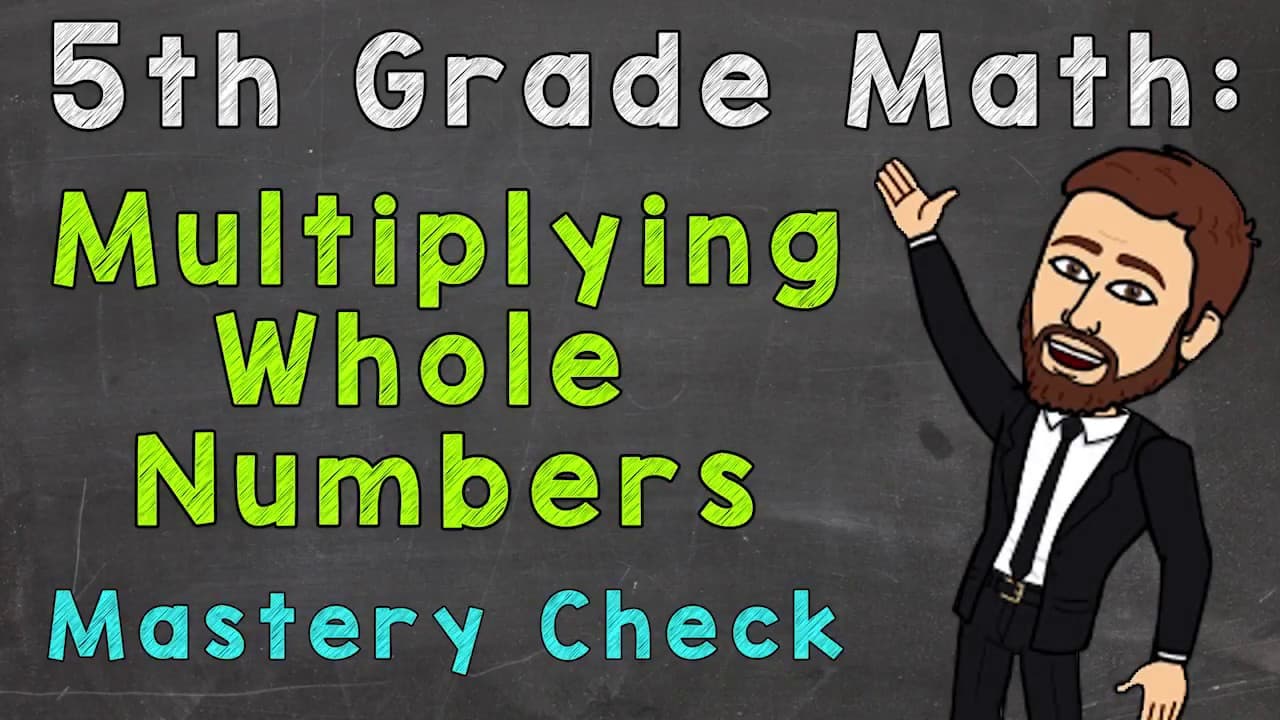
This educational video serves as a "Mastery Check" for 5th-grade students learning to multiply whole numbers. Unlike an instructional tutorial that introduces concepts from scratch, this video challenges students to test their existing knowledge by independently solving six increasingly difficult multiplication problems. The problems range from 3-digit by 1-digit multiplication up to complex 3-digit by 3-digit equations, covering standard algorithms and multi-step processes. The content focuses heavily on procedural fluency and accuracy with the standard algorithm for multiplication. Key themes include the importance of place value, the necessity of placeholder zeros when multiplying by tens or hundreds, and the discipline of checking one's work. The narrator, Mr. J, emphasizes that identifying and correcting mistakes is a critical part of the learning process, framing errors as opportunities for growth rather than failure. For educators, this video is an excellent formative assessment tool or independent practice station. It promotes self-regulation by asking students to pause, work independently, and then verify their answers immediately. It can be used in the classroom to gauge student readiness before a test, as a remediation tool for students struggling with multi-digit multiplication, or as a structured review activity that models clear, step-by-step problem-solving techniques.

Math with Mr. JMath with Mr. J

7mins 7s

How to Calculate Speed: Distance Divided by Time

How to Calculate Speed: Distance Divided by Time

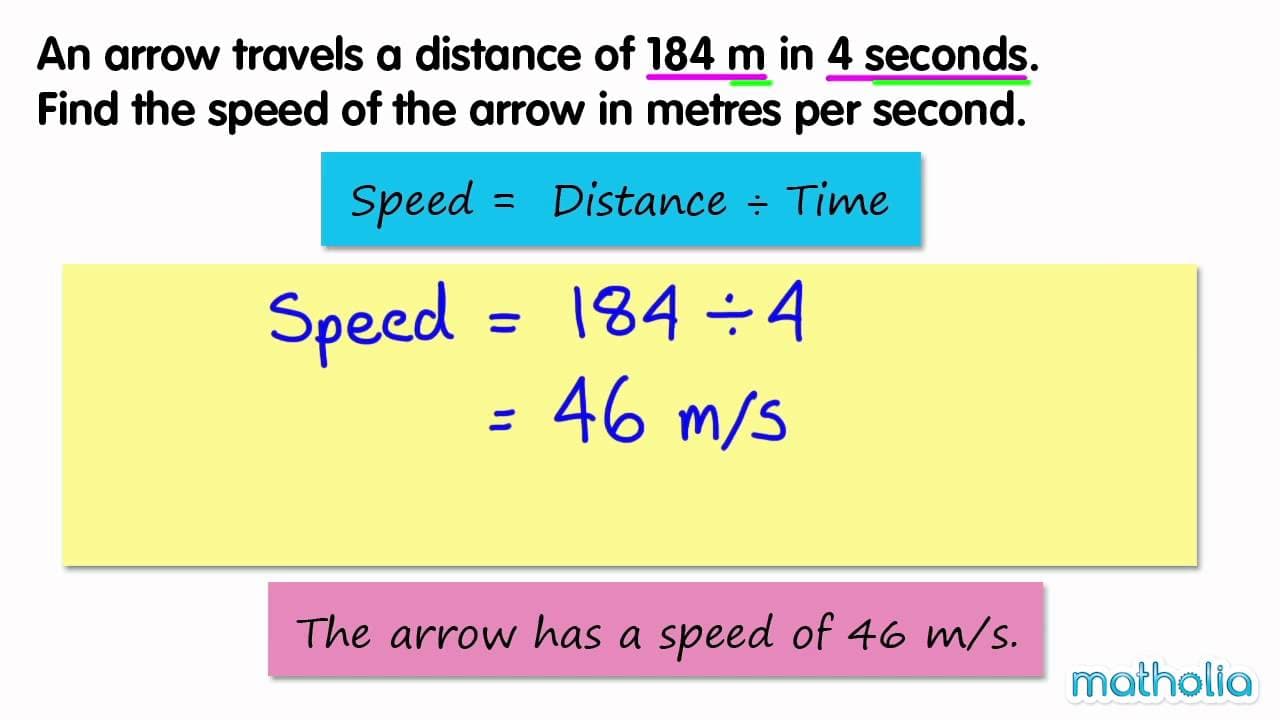
This educational math video provides a clear, step-by-step tutorial on how to calculate speed using the formula Speed = Distance ÷ Time. Through three distinct word problems, the narrator demonstrates how to identify the relevant information (distance and time), apply the formula, and perform the necessary division to find the solution. The video covers different units of measurement, including meters per second (m/s) and kilometers per hour (km/h), and addresses a variety of scenarios such as the flight of an arrow, a person walking, and a cyclist riding. The key themes explored include the mathematical relationship between speed, distance, and time, as well as the practical application of division skills in real-world contexts. The video specifically tackles the concept of rates and unit rates. A notable mathematical moment occurs in the second example, where the video explains the specific rule for dividing by fractions (dividing by one-half is the same as multiplying by two), reinforcing arithmetic rules alongside the physics concept. For educators, this video serves as an excellent modeling tool for upper elementary and middle school math classes. It visualizes the problem-solving process by highlighting key numbers in the text and writing out the equation clearly on a virtual whiteboard. It can be used to introduce the concept of speed, review long division in a practical context, or help students understand the importance of including correct units in their final answers.

MatholiaChannelMatholiaChannel

1min 53s

Solving Word Problems by Multiplying Decimals

Solving Word Problems by Multiplying Decimals

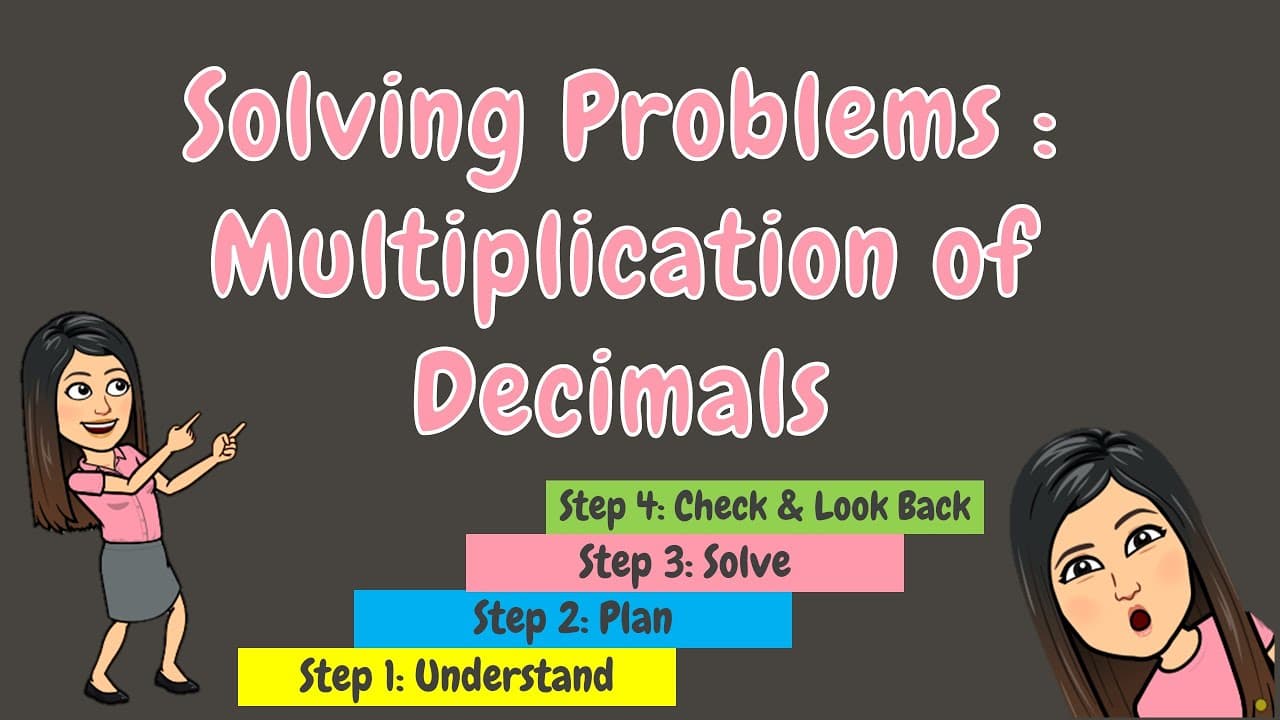
This educational video provides a clear, step-by-step guide on how to solve word problems involving the multiplication of decimals. Using a relatable real-world scenario about a bag store, the narrator demonstrates a structured "4-Step Method" (Understand, Plan, Solve, Check) to break down complex word problems into manageable parts. The video visually walks students through identifying key information, creating a number sentence, performing the vertical multiplication algorithm with regrouping, and verifying the final answer.

Sheena DoriaSheena Doria

4mins 21s

How to Convert Fractions to Percentages

How to Convert Fractions to Percentages

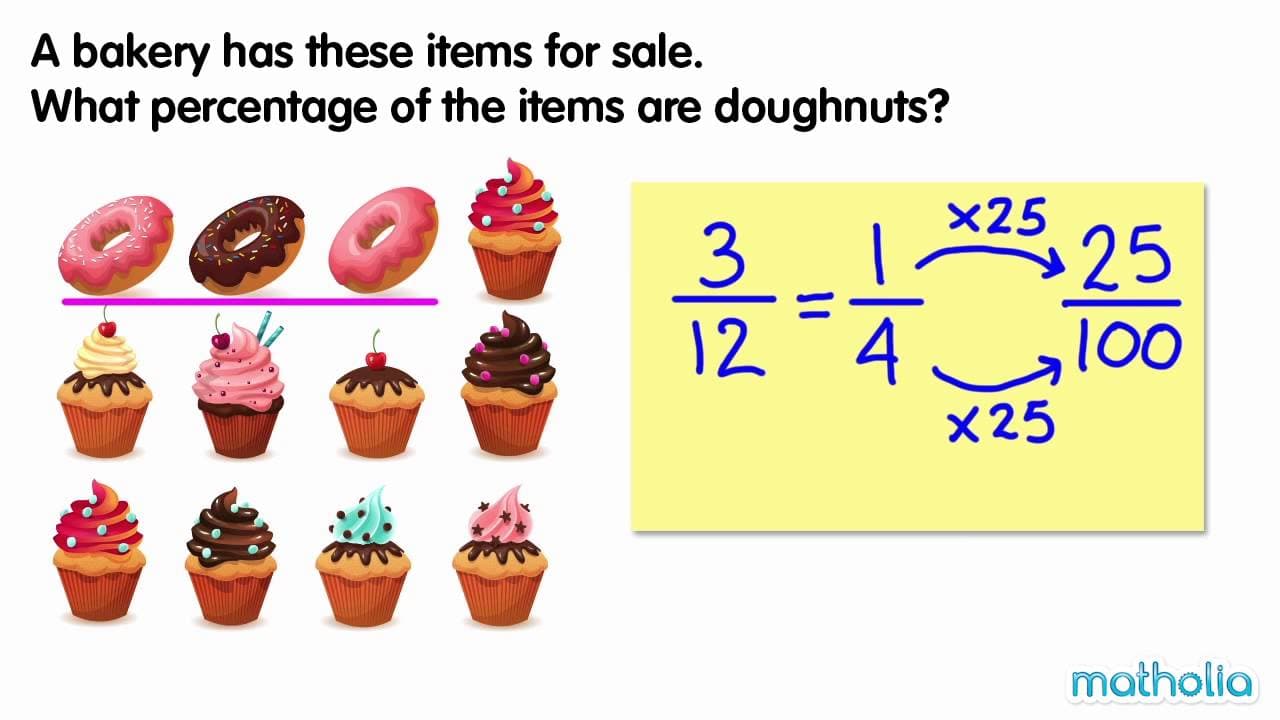
This educational video provides a clear, step-by-step tutorial on converting fractions to percentages using equivalent fractions. The lesson begins with a real-world scenario set in a bakery, asking students to determine what percentage of total items are doughnuts. It visually demonstrates counting a total set, creating a fraction, simplifying that fraction, and then scaling it up to find an equivalent fraction with a denominator of 100. The video explores key mathematical themes including fraction simplification, finding equivalent fractions, and the fundamental definition of a percentage as a part per hundred. After the contextual bakery example, the video transitions to abstract practice problems, guiding viewers through converting 3/5 and 17/25 into percentages by identifying the appropriate multiplication factor to turn the denominator into 100. For educators, this video serves as an excellent instructional model for introducing the relationship between fractions and percentages. The visual method of drawing arrows to show multiplication factors helps scaffold the process for students who struggle with mental math. It is particularly useful for visual learners and can be used as a direct instruction tool or a review station for upper elementary students mastering rational numbers.

MatholiaChannelMatholiaChannel

1min 40s

Materials

Pumpkin Patch Math Review Worksheet

Pumpkin Patch Math Review Worksheet

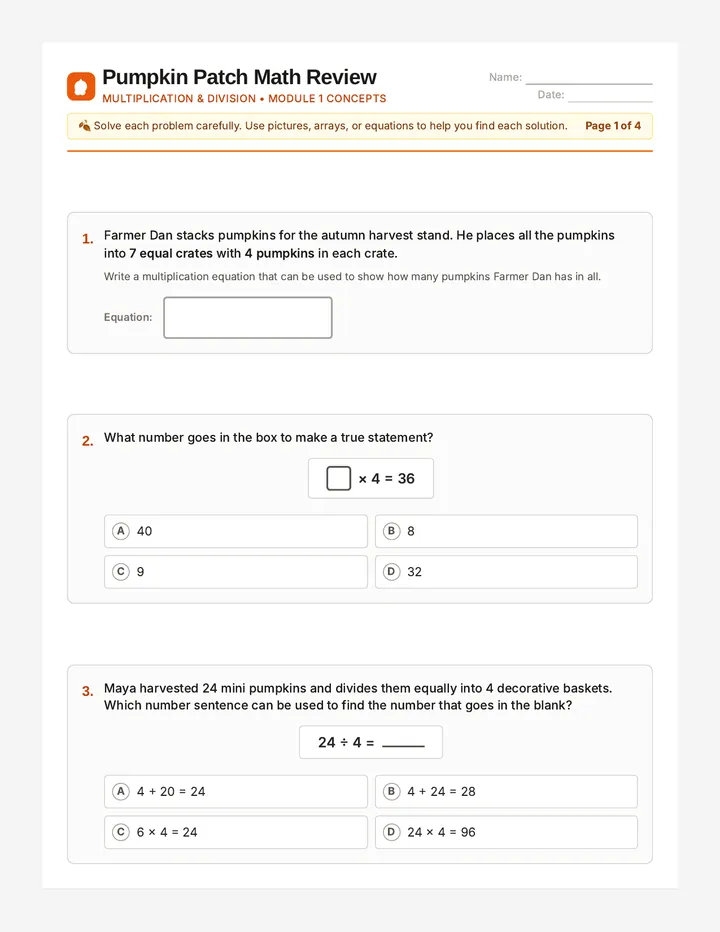
A 4-page fall-themed math review worksheet covering 3rd grade multiplication and division concepts, with Question 2 updated to [ ] × 4 = 36 and authentic multiple-choice options.

L

llocascio

Factor Power CFU Worksheet

Factor Power CFU Worksheet

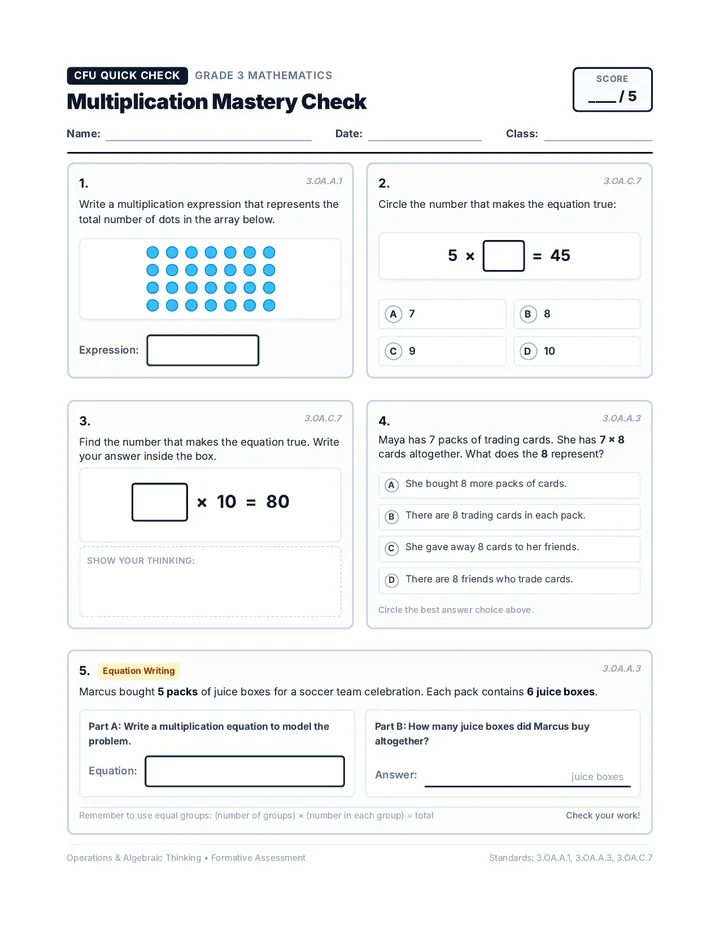
A print-ready, five-question Grade 3 Check for Understanding (CFU) worksheet assessing multiplication concepts (3.OA.A.1, 3.OA.A.3, 3.OA.C.7). Features array modeling, missing factor equations with products of 5 (5 x [ ] = 45) and 10 ([ ] x 10 = 80), factor meaning in context, and equation writing from a real-world word problem.

TD

Taylor Doucet

Array Architects Worksheet

Array Architects Worksheet

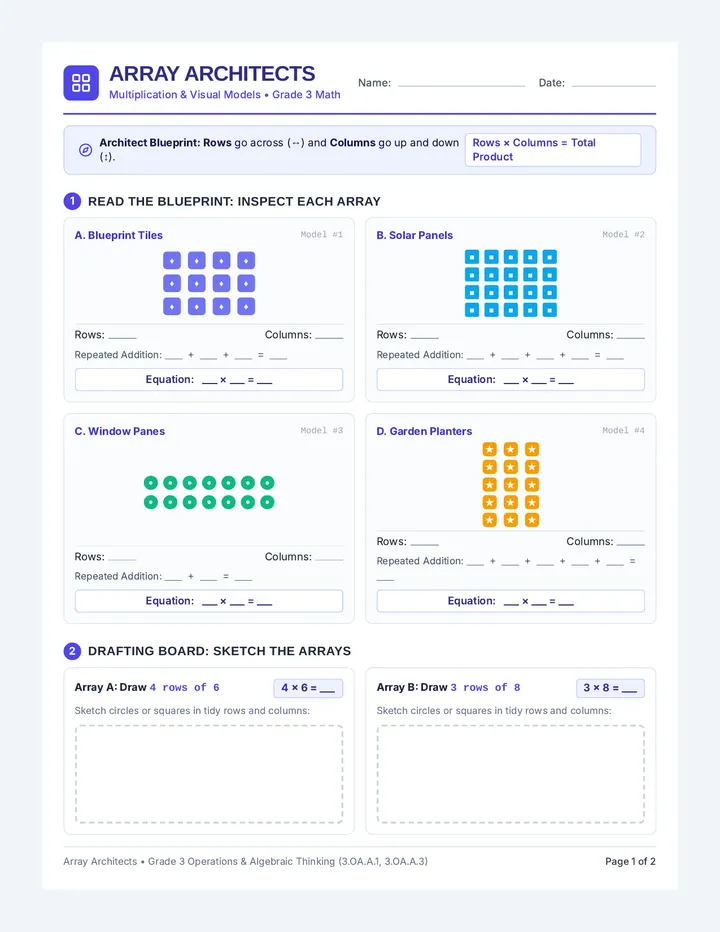
A comprehensive two-page 3rd-grade math worksheet on arrays. Page 1 guides students to identify rows, columns, repeated addition, and multiplication equations from visual arrays, then sketch their own models. Page 2 covers commutative turnarounds, fact families, and real-world word problems with sketching areas.

CB

Caroline Beaumier

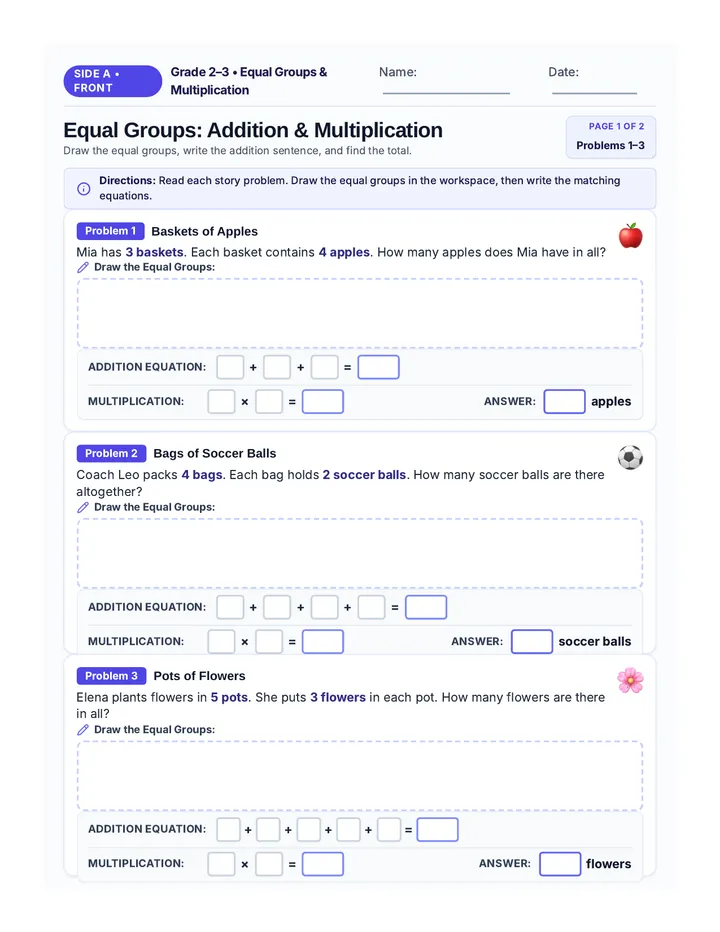
Equal Groups Math Worksheet

Equal Groups Math Worksheet

A 2-page front-and-back printable math worksheet for Grade 2–3 students with larger, high-legibility fonts, featuring six equal-groups word problems with spacious drawing workspaces and clearly defined equation boxes.

B

Bhoovaragavaswamym

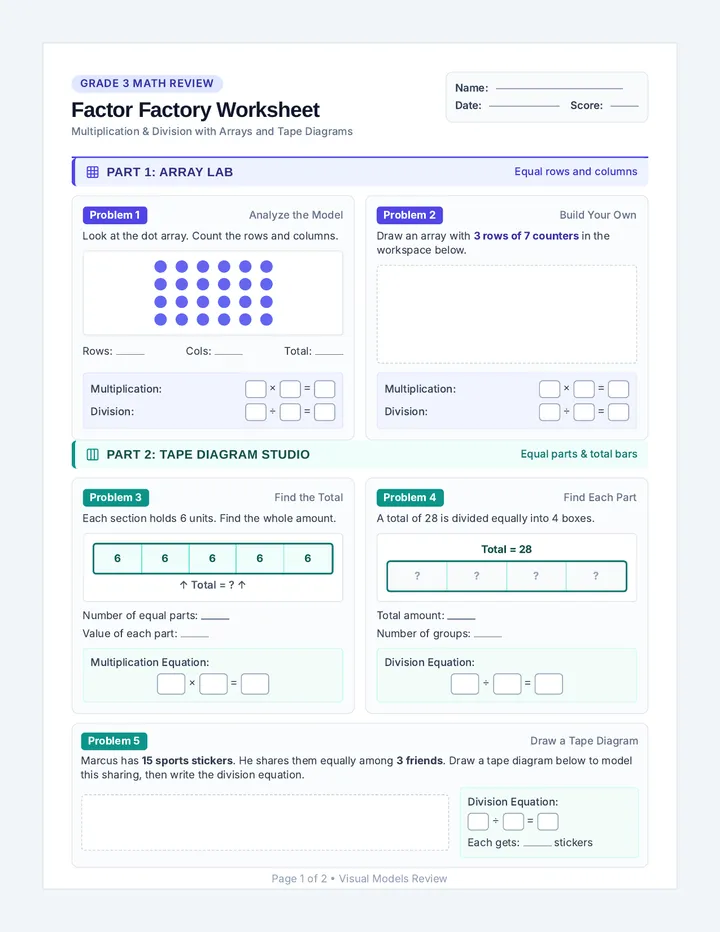
Factor Factory Worksheet

Factor Factory Worksheet

A comprehensive 3rd grade math review worksheet focused on multiplication and division concepts using arrays and tape diagrams. Includes visual models, student drawing spaces, word problems, and connection challenges.

K

kebushey

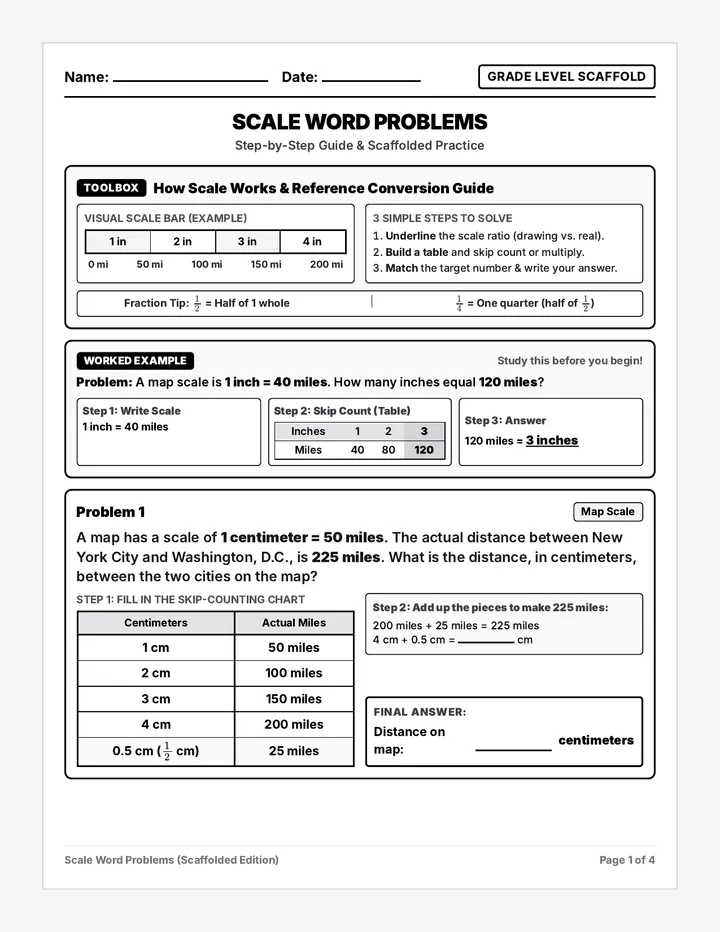
Scale Word Problems Scaffolded Worksheet

Scale Word Problems Scaffolded Worksheet

A 4-page black and white scaffolded worksheet of the 8 scale word problems designed for learners reading and computing at 2nd-3rd grade instructional levels. Features large print, a visual reference conversion scale, step-by-step ratio tables, benchmark skip-counting ladders, and spacious white handwriting areas.

MJ

Meg Jones

Sequences

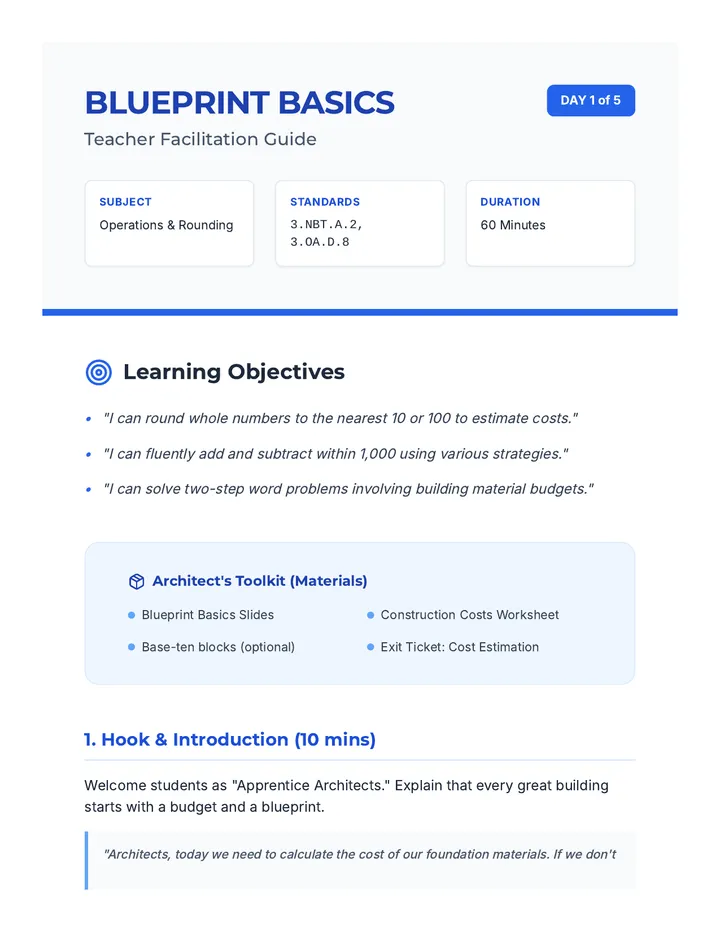
Blueprint Basics Teacher Guide

Master Builders Math Lab

A 5-day intensive math sequence for 3rd grade covering multiplication, division, multi-digit operations, fractions, area, and rounding through a "Master Builder" architectural theme. Students act as apprentice architects solving construction-themed math challenges.

TD

Taylor Doucet

25
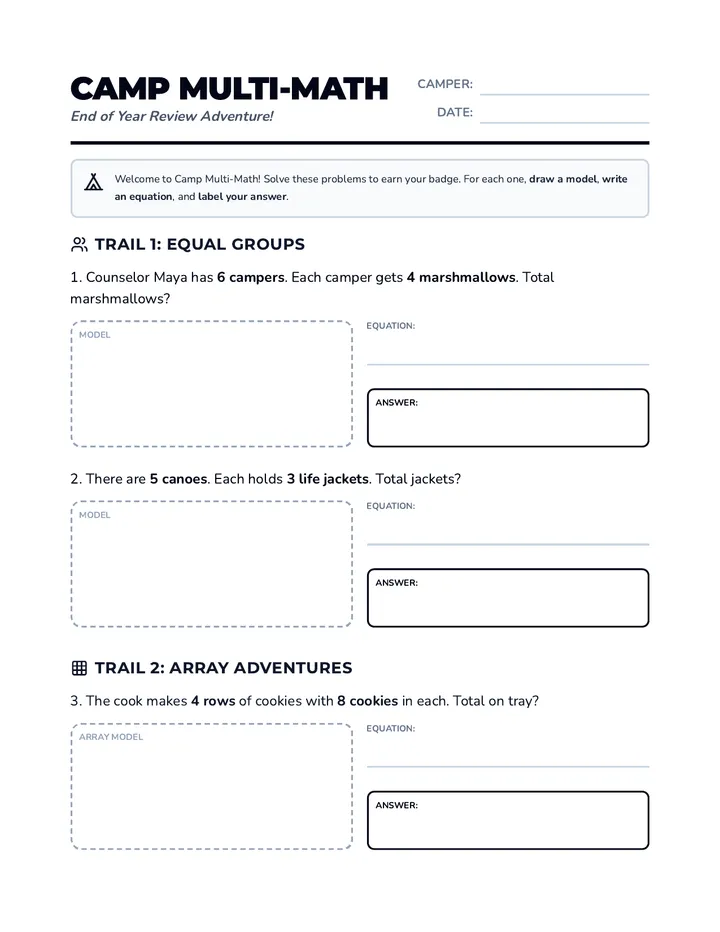
Camp Multi-Math Worksheet

Math Review Adventures

A collection of themed end-of-year math review adventures for different grade levels, focusing on spiraling key standards and problem-solving.

DB

Deborah Burton

21
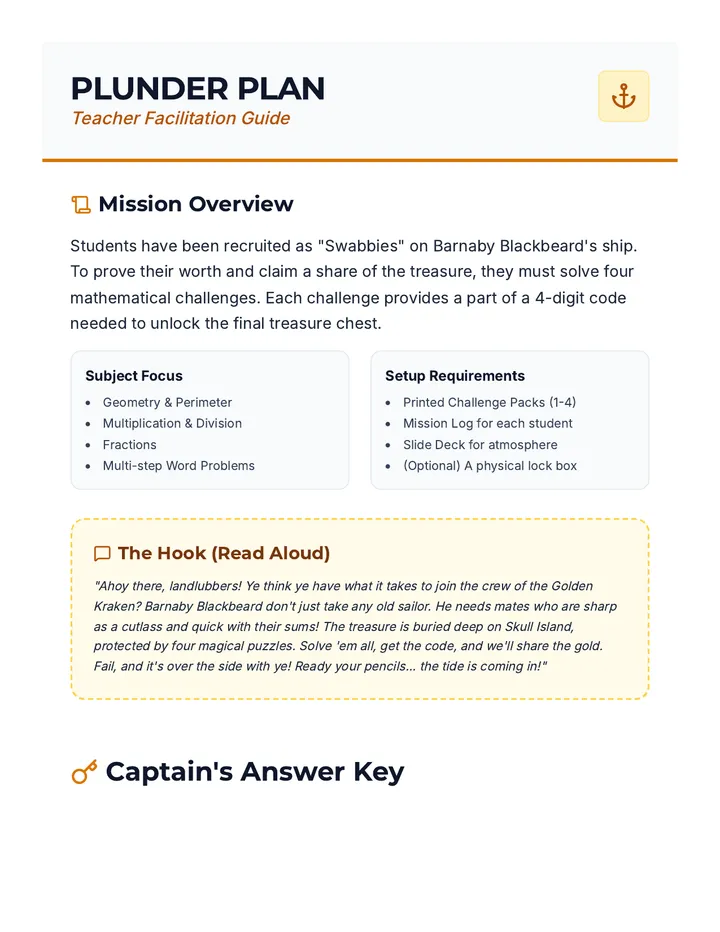
Plunder Plan Teacher Guide

Pirate Math Plunder

A pirate-themed 3rd grade math review escape room where students solve puzzles involving geometry, multiplication, division, fractions, and word problems to find the hidden treasure.

DG

Danielle Garland

12
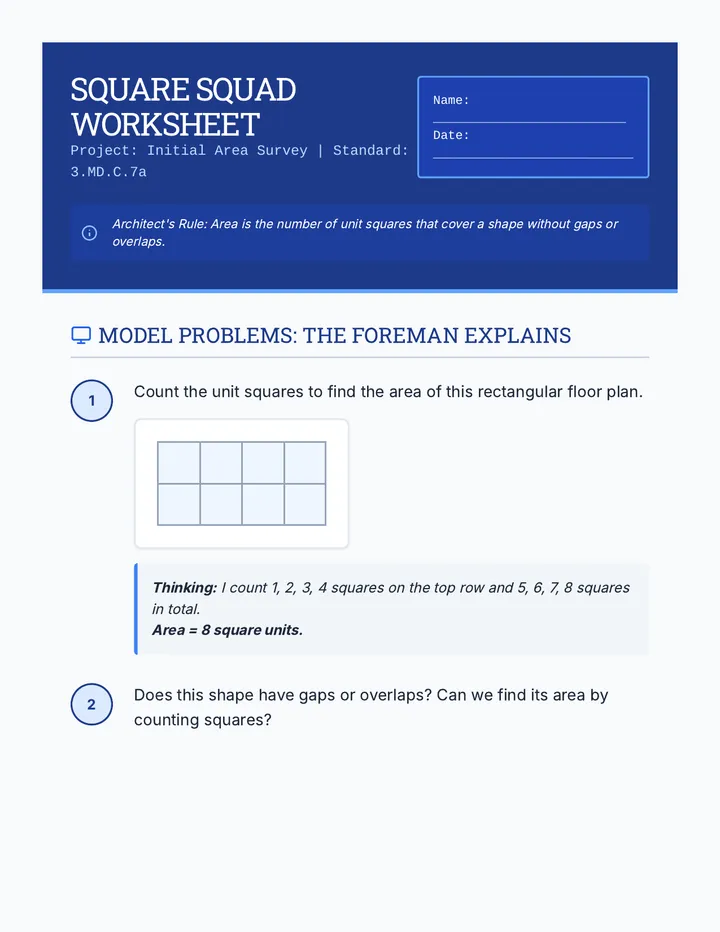
Square Squad Worksheet

Blueprint Builders

A 4-day unit on area measurement for 3rd grade students, covering tiling, the relationship between multiplication and addition, and decomposing rectilinear shapes. Designed with a 'Blueprint Builders' architectural theme.

TD

Taylor Doucet

10
The Two Sprint Quiz

Factor Frenzy

A comprehensive set of multiplication fact fluency quizzes covering facts from 0 to 12, including individual fact sprints and mixed reviews. Each material is designed as a half-page "sprint" to save paper and allow for quick daily practice.

TC

Tracey Craft

15
Tile Town Instructional Slides

Blueprint Builders Area Unit

A 5-day unit exploring area through the lens of architectural design. Students move from physical tiling to multiplication and finally to decomposing complex rectilinear shapes, aligned with Arizona 3.MD.C.7 standards.

TD

Taylor Doucet

11

Lessons

Muffin Madness Worksheet

Bakery Batch Division

A comprehensive series of fifteen bakery-themed math worksheets focusing on multi-digit multiplication using area models (both 2-digit by 2-digit and 3-digit by 2-digit) and multi-digit long division (up to 5-digits by 1-digit), complete with a consolidated answer key. Worksheets 10-15 feature advanced word problems with extraneous numerical information to build critical thinking, offered in both scaffolded and independent practice formats.

N

nmack

19
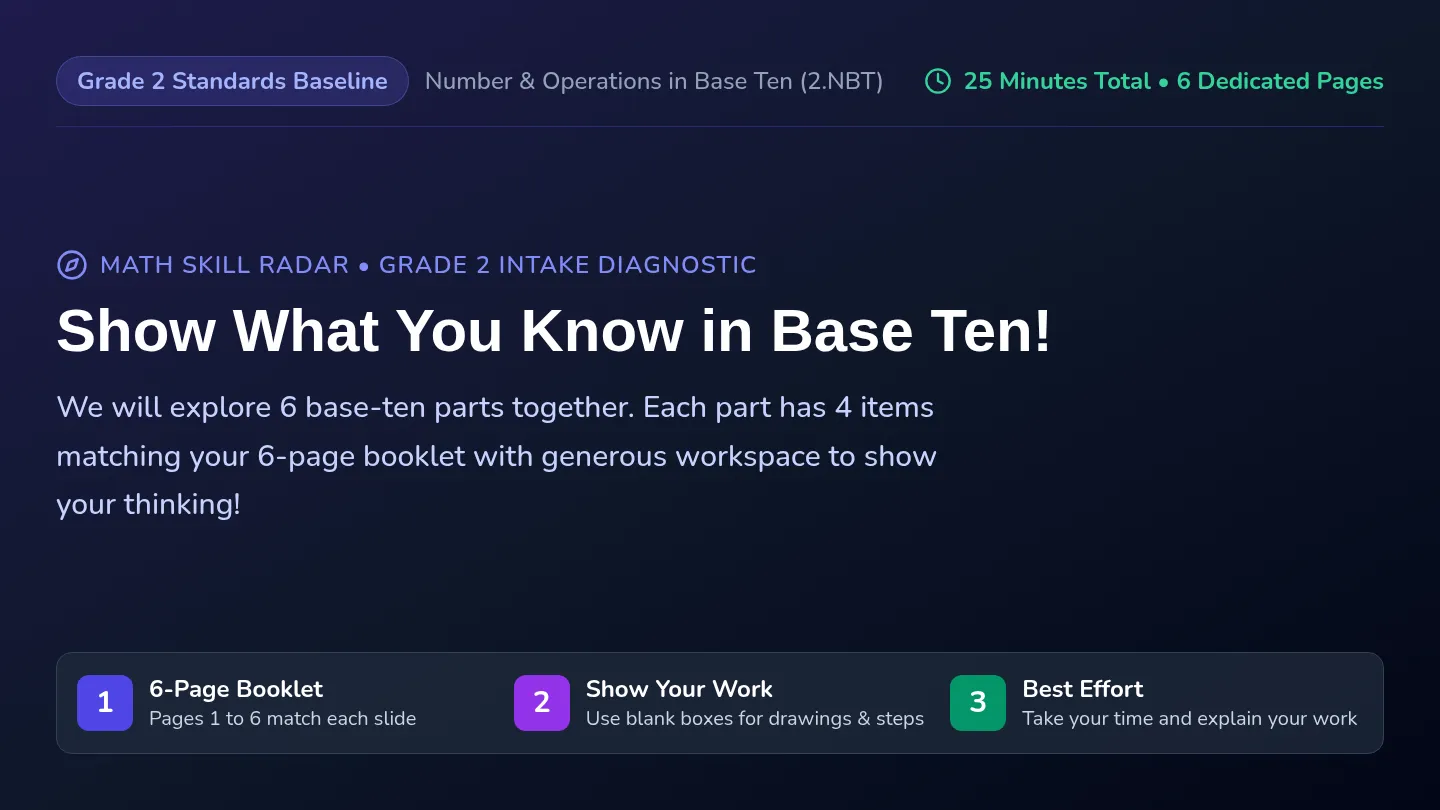
Math Radar Intake Slides

Math Skill Radar

A comprehensive baseline math diagnostic and intervention suite for special education spanning early numeracy through Grade 4. Features complete tiered intake assessments, practice packets, manipulative work mats, and master scoring keys for both 1st Grade Base Ten (1.NBT) and 2nd Grade Base Ten (2.NBT), alongside K-1 early number sense tools.

S

Sara

20
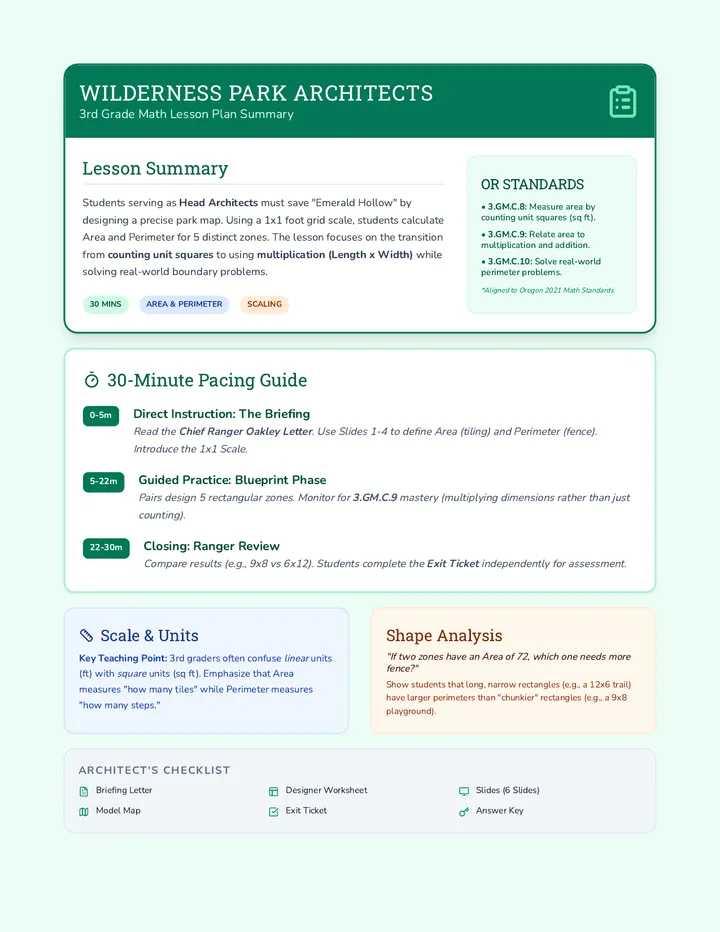
Wilderness Park Architects Teacher Guide

Wilderness Park Architects

A 30-minute interactive lesson where 3rd graders design a Wilderness Park, applying their knowledge of area and perimeter to create specific park zones on a 1x1 foot grid scale.

AJ

Alexander Jacinto

7
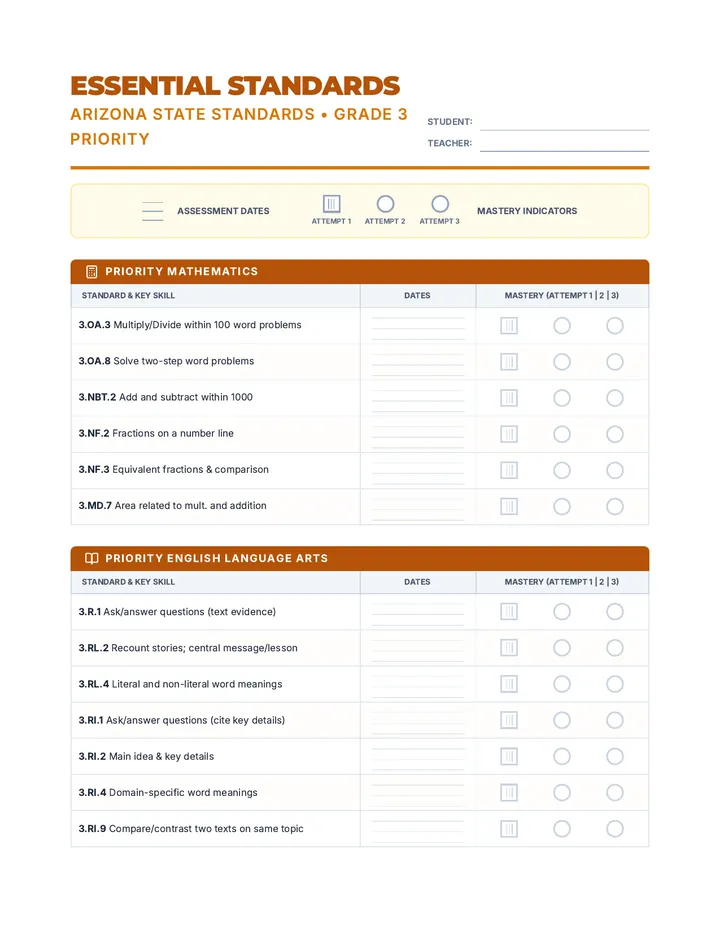
Essential Standards Tracker Document

Arizona Mastery Trackers

A collection of standards mastery tracking cards for Grade 3 Arizona students, covering Math and ELA with a consistent multi-attempt tracking system.

KB

Krista Bodkin

3
Bakery Blitz Worksheet

Whisk and Wonder Math

A collection of word problems centered around a bakery theme, focusing on mixed operations with whole numbers and addition/subtraction of fractions with like denominators.

DG

Danielle Gagnon

10
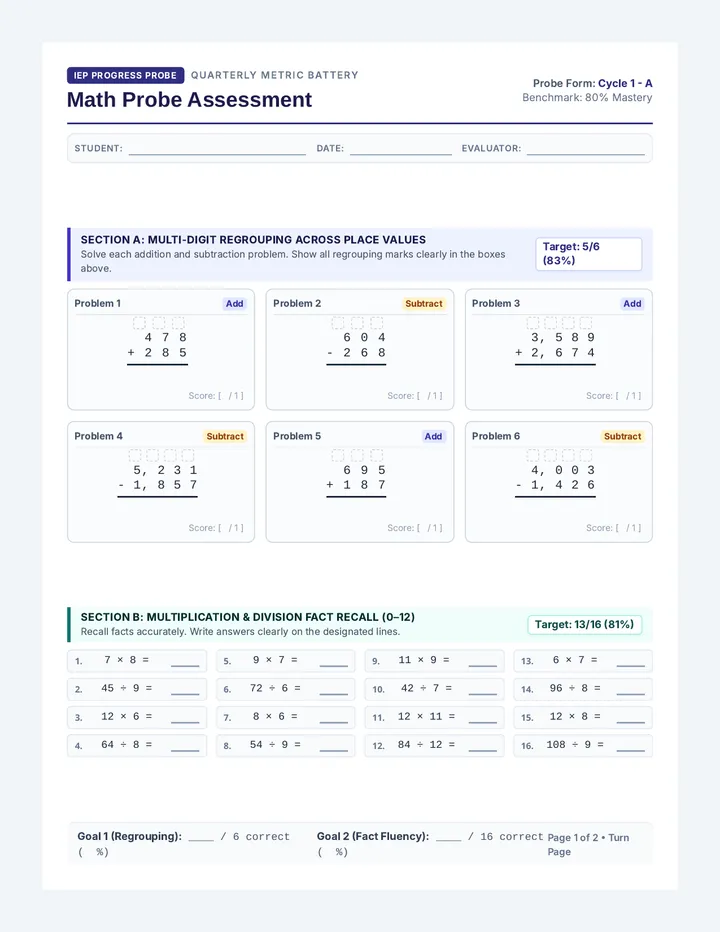
Math Probe Assessment

Math Metric Tracker

A complete IEP progress-monitoring system designed to assess and track student mastery across four core annual goals: multi-digit regrouping computation, multiplication and division fact fluency, structured word problem solving, and written mathematical reasoning. Includes reproducible student assessment probes, clinical scoring guides, longitudinal data sheets, and comprehensive exemplar answer keys.

N

ntobin

4