Lenny.com
Explore
Create
ActivitiesNewMathEnglish Language ArtsScience & EngineeringSocial StudiesGlobal LanguagesHealth & Physical EducationSpecial EducationCounseling & Life SkillsArts & CreativityESL
Lenny.com
Lenny.com
Explore
Create
ActivitiesNewMathEnglish Language ArtsScience & EngineeringSocial StudiesGlobal LanguagesHealth & Physical EducationSpecial EducationCounseling & Life SkillsArts & CreativityESL
Lenny.com
MathNumbers & CountingCounting ObjectsNumber NamesComparing NumbersNumber OperationsCounting SequenceNumbers 0-10Place Value Understanding and SystemAdd and Subtract Within 20Addition and Subtraction ConceptsAddition and Subtraction EquationsAddition and Subtraction ProblemsFoundations for MultiplicationMultiplication and Division PropertiesMultiply and Divide Within 100Multiplication and Division ProblemsFactors and MultiplesProperties of OperationsPatterns and RelationshipsGenerate and Analyze PatternsMulti-Digit ArithmeticPlace Value OperationsMulti-Digit and Decimal OperationsNumerical ExpressionsFour Operations and PatternsFour Operations Problem SolvingMeasurement & DataMeasurable AttributesMeasuring LengthsMeasure and Estimate Lengths in Standard UnitsRelate Addition and Subtraction to LengthClassifying and Counting ObjectsTime and MoneyArea Concepts and MeasurementPerimeter and Area MeasuresAngle Concepts and MeasurementTime, Volume, and MassMeasurement Unit ConversionsGeometryIdentifying ShapesShapes and AttributesShape Attributes and ReasoningShapes and CompositionClassifying 2D FiguresGeometric Figures and RelationshipsLines, Angles, and ShapesAngle, Area, and VolumeGeometric MeasurementVolume of 3D ShapesCoordinate Plane ApplicationsTransformations in the PlaneCongruence and SimilarityUnderstand congruence in terms of rigid motionsSimilarity and TransformationsProve Theorems Involving SimilarityPythagorean TheoremTrigonometry for General TrianglesMake Geometric ConstructionsProve Geometric TheoremsTheorems About CirclesFind Arc Lengths And Areas of Sectors of CirclesVolume FormulasRelationships Between Two-Dimensional and Three-Dimensional ObjectsProve Simple Geometric Theorems AlgebraicallyTranslate Between Geometric Description and Equation for Conic SectionApply Geometric Concepts in Modeling SituationsFractions & DecimalsFractions as NumbersBuilding FractionsFraction Equivalence and OrderingAdding and Subtracting FractionsMultiplying and Dividing FractionsDividing FractionsDecimal FractionsMulti-Digit Computation and FactorsAdd, Subtract, Multiply, and Divide Rational NumbersRational Number SystemIrrational Numbers and ApproximationsRatiosRatios and ProportionsProportional RelationshipsUnit RateAlgebraAlgebraic ExpressionsGenerate Equivalent ExpressionsQuantitative RelationshipsProportional Relationships and Linear EquationsEquations and InequalitiesEquation Solving and ReasoningLinear Equations and SystemsGraph Equations and InequalitiesSystems of EquationsReal-World Algebraic ProblemsQuantitative Reasoning with UnitsExpression StructureEquivalent Expression FormsRadicals and Integer ExponentsRational ExponentsRational and Irrational NumbersPolynomial OperationsPolynomial IdentitiesPolynomial Zeros and FactorsRational ExpressionsComplex Number OperationsComplex Numbers in PolynomialsComplex Numbers on PlaneStatistics & ProbabilityRepresent and Interpret DataData DistributionsStatistical VariabilityProbability ModelsCompound Event ProbabilitiesStatistical SamplingInterpret Categorical and Quantitative DataBivariate Data PatternsInterpret Linear ModelsComparing Two PopulationsRandom Processes in StatisticsIndependence and Conditional ProbabilityExpected ValuesProbability-Based Decision MakingStatistical Inference and ConclusionsFunctionsFunction Concepts and NotationDefine and Compare FunctionsInterpret Functions in ContextAnalyze Function RepresentationsModel Relationships with FunctionsIdentify Linear vs Exponential GrowthDistinguish Between Function TypesCompare Growth RatesInterpret Function ExpressionsBuild Functions from RelationshipsConstruct and Model FunctionsTransform and Combine FunctionsModel Comparison and SelectionSolve Exponential EquationsTrigonometryTrigonometric Ratios Involving Right TrianglesTrigonometric Functions and Unit CircleModel with Trigonometric FunctionsTrigonometric IdentitiesVectors & MatricesIntroduction to Vectors and MatricesVector QuantitiesVector OperationsMatrix OperationsCalculusLimits and ContinuityDerivative Concepts and NotationDerivative Rules and TechniquesApplications of DerivativesOptimization ProblemsRelated RatesCurve Sketching and AnalysisIntegration Concepts and NotationAntiderivatives and Indefinite IntegralsDefinite Integrals and AreaFundamental Theorem of CalculusIntegration TechniquesApplications of IntegrationDifferential EquationsSequences and SeriesParametric and Polar FunctionsVector-Valued Functions

Shape Attributes and Reasoning

Identification of properties including sides, vertices, and angles in two-dimensional and three-dimensional shapes. Classifies and sorts objects based on shared attributes to build foundational geometric reasoning.

Lenny.com

Solutions

Lenny for EducatorsLenny for SchoolsLenny for Districts

Product

ExploreSign inCreateSupportAbout

Resources

Getting startedMTSS Acceleration Program

© 2026 Lenny Learning Inc.

TermsPrivacyAccessibility
LinkedInInstagramX
Lenny

Videos

Learning Positional Words: On, Under, Above, and More

Learning Positional Words: On, Under, Above, and More

This animated video provides a clear and engaging introduction to positional words (prepositions of place) for early learners. Set in a child's bedroom, the video follows a character named Hallie and asks viewers to identify the location of various objects like books, a ukulele, a toy rabbit, and a school bag. By isolating these objects and pairing them with clear text labels, the video visually demonstrates spatial relationships. The content focuses on key vocabulary concepts including "on," "below," "under," "in front of," "behind," and "above." Each term is introduced through a question-and-answer format, where the narrator asks for the location of an object, pauses, and then provides the answer while displaying the specific word on screen. This repetition helps reinforce the connection between the object's physical placement and the vocabulary word used to describe it. For educators, this video serves as an excellent visual aid for teaching spatial awareness in math or prepositions in language arts. The clean animation and isolation of objects make it easy for students to focus on the specific spatial relationship being demonstrated. It is particularly useful for establishing the foundational vocabulary needed for geometry, following directions, and describing scenes.

MatholiaChannelMatholiaChannel

2mins 5s

Exploring the Fundamentals of 3D Figures

Exploring the Fundamentals of 3D Figures

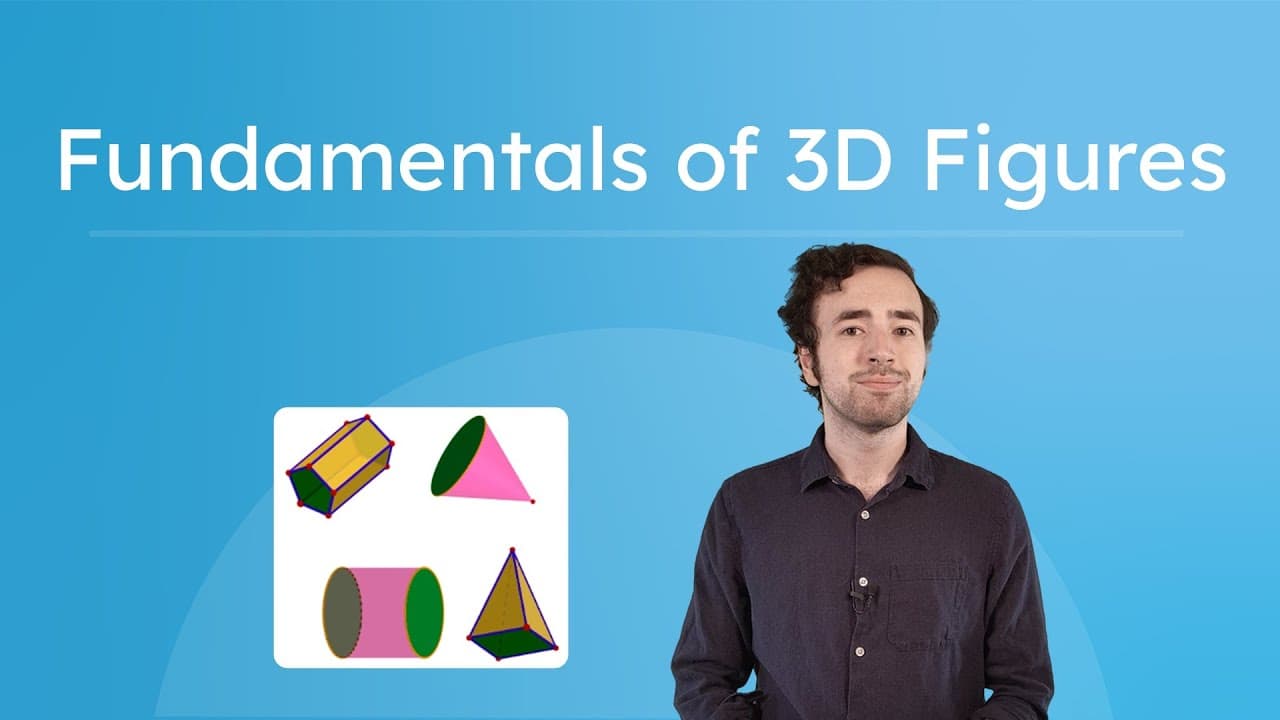
This educational video provides a comprehensive overview of the fundamental properties of three-dimensional figures, specifically focusing on prisms, cylinders, pyramids, cones, and spheres. Hosted by a friendly presenter named Justin, the lesson breaks down complex geometric vocabulary into digestible concepts, teaching students how to identify shapes based on their specific features such as bases, faces, vertices, edges, and curved surfaces. The video emphasizes distinguishing between similar shapes and clarifies specific rules regarding the bases of prisms and cylinders versus pyramids and cones. A significant portion of the video addresses common misconceptions in geometry, particularly the idea that a shape's base must always be on the bottom. Through clear visual examples and rotations of figures like rectangular prisms and triangular pyramids, the content demonstrates that spatial orientation does not define a shape's properties. The video creates a solid foundation for spatial reasoning by explaining exceptions to general rules, such as how any face of a rectangular prism or triangular pyramid can serve as a base. This resource is highly valuable for upper elementary and middle school mathematics classrooms introducing or reviewing geometry concepts. It supports learning by moving beyond simple identification to a deeper understanding of geometric properties, preparing students for more advanced topics like surface area and volume. The clear definitions and visual aids make it an excellent tool for front-loading vocabulary or reinforcing concepts after hands-on exploration with geometric solids.

Miacademy & MiaPrep Learning ChannelMiacademy & MiaPrep Learning Channel

5mins 29s

From Polygons to 3D Shapes: A Visual Guide

From Polygons to 3D Shapes: A Visual Guide

This educational video provides a clear and concise progression from basic two-dimensional polygons to three-dimensional solids. The presenter begins by reviewing quadrilaterals and introducing 5-sided (pentagon) and 6-sided (hexagon) shapes, briefly mentioning polygons with even more sides. The lesson then shifts focus to curved shapes, defining a circle through the concept of equidistant points from a center. Key themes explored include geometric vocabulary (vertices, edges, faces), the etymology of shape names (penta, hexa), and spatial reasoning. A major focus is the conceptual relationship between dimensions; the narrator encourages viewers to visualize "pulling" 2D shapes out of the whiteboard to create 3D forms, such as extending a square into a cube or a circle into a cylinder. For educators, this video serves as an excellent bridge for students moving from simple shape identification to understanding geometric properties and spatial depth. The visual demonstrations on the whiteboard—particularly the comprehensive summary chart visible at the end—offer a valuable reference for classifying lines, angles, triangles, and solids. It helps students understand not just what shapes are called, but how they are constructed and related to one another.

Miacademy & MiaPrep Learning ChannelMiacademy & MiaPrep Learning Channel

2mins 44s

Learning Solid Shapes: Names, Properties, and Real-World Examples

Learning Solid Shapes: Names, Properties, and Real-World Examples

This educational video provides a clear and structured introduction to six common solid (3D) shapes: the cube, cuboid, cylinder, cone, sphere, and pyramid. Following a consistent pattern, the video presents each geometric form, highlights its defining properties such as the number and type of faces (flat or curved), and explicitly names the shape using on-screen text.

MatholiaChannelMatholiaChannel

2mins 3s

What Is a Circle?

What Is a Circle?

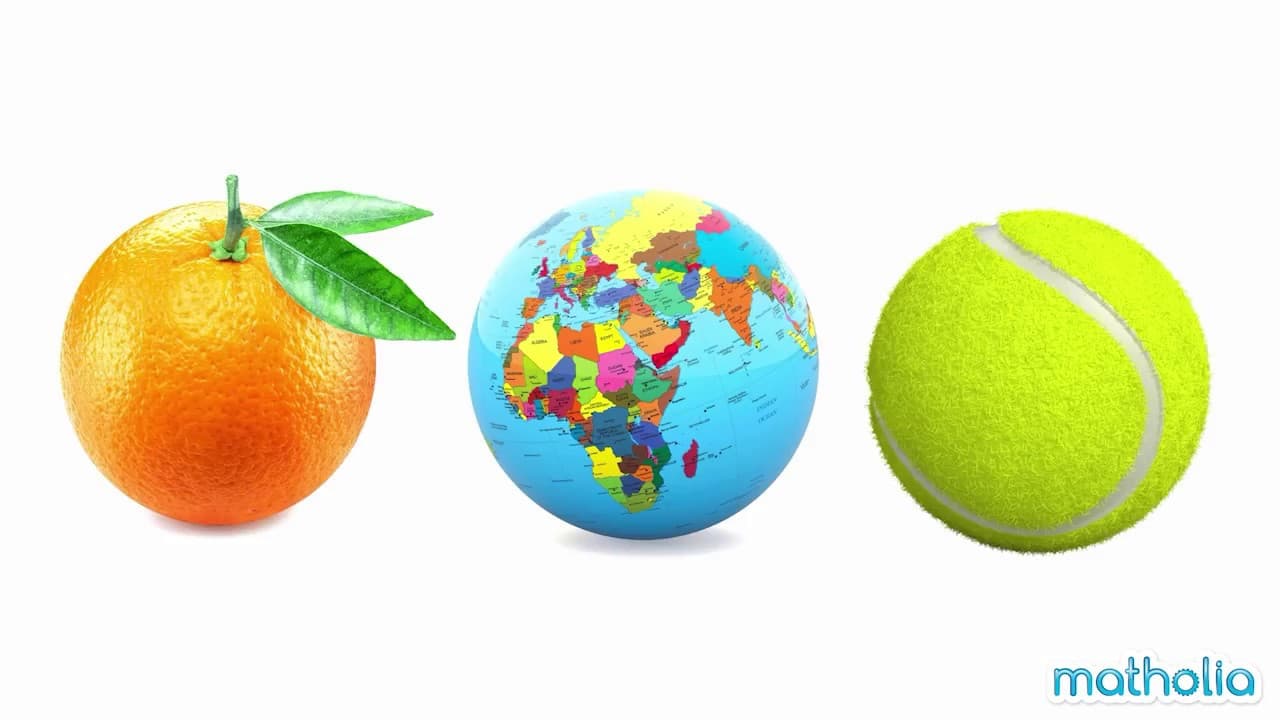
A concise and engaging animated introduction to the geometric concept of a circle, featuring Sandy the dingo from Khan Academy Kids. The video provides a clear, age-appropriate definition of a circle as a continuous line with no corners, making abstract geometry accessible for early learners. The content focuses on identifying 2D shapes and connecting mathematical concepts to the real world. By defining a circle by its attributes—specifically the lack of corners and the continuous round nature—it helps build the foundation for geometric reasoning and shape classification. This resource is highly valuable for Pre-K and Kindergarten classrooms as a quick hook or review. Its simple visual demonstration and connection to a familiar object (a tennis ball) allow teachers to easily pivot into activities involving shape hunting, sorting, or drawing. The short duration matches the attention span of the target age group perfectly.

Khan Academy KidsKhan Academy Kids

27s

Finding Shapes Within Pictures

Finding Shapes Within Pictures

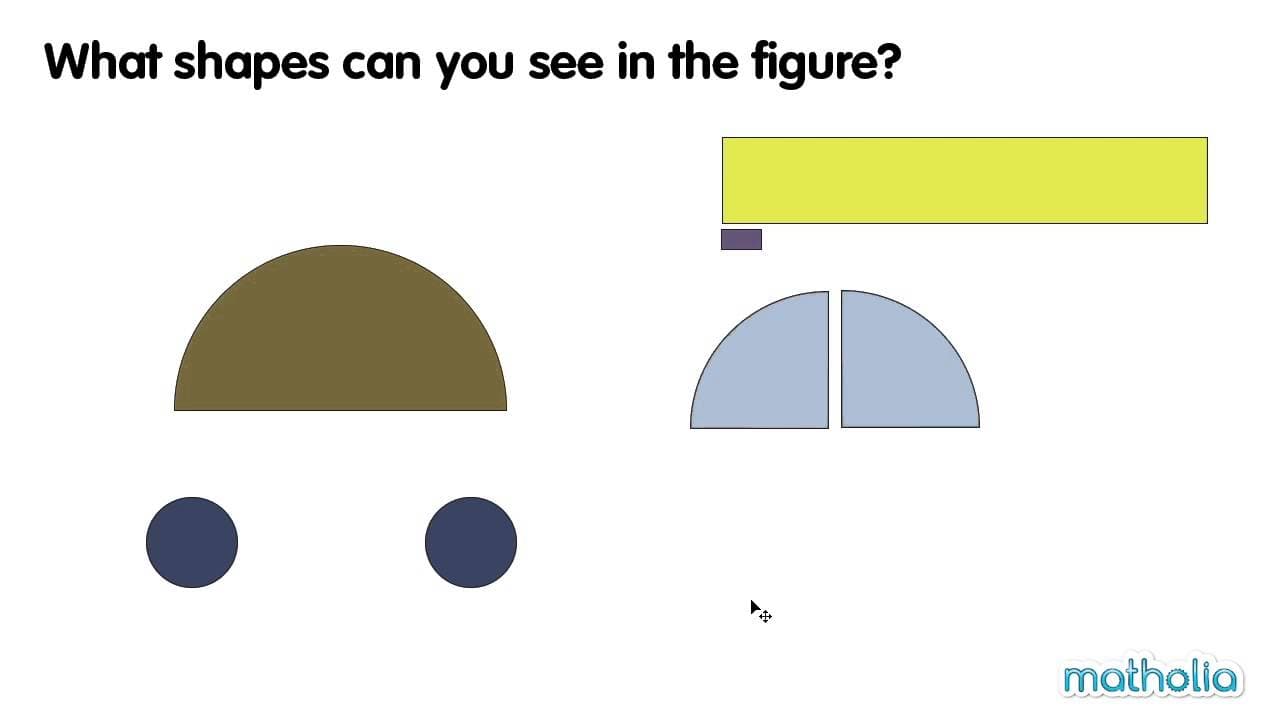
This educational video introduces young students to the concept of composite shapes—figures made up of smaller, distinct geometric shapes. Through clear, animated examples, it demonstrates how complex images like a car and a castle can be deconstructed into basic components such as rectangles, circles, semi-circles, and triangles. The video uses a slow, deliberate pace that allows students to visually track each shape as it is isolated from the main image and then returned to its place. The content focuses on key geometry topics including shape identification, spatial reasoning, and part-whole relationships. It explicitly names 2D shapes (rectangle, square, triangle, circle) and introduces more specific terms like 'semi-circle' and 'quarter circle,' helping to expand students' mathematical vocabulary beyond the basics. For the classroom, this video serves as an excellent hook for lessons on geometry or art. It encourages students to look at the world with a 'mathematical eye,' identifying geometric structures in everyday objects. Teachers can use this as a model for hands-on activities where students build their own figures using pattern blocks or paper cutouts, bridging the gap between abstract geometric concepts and tangible application.

MatholiaChannelMatholiaChannel

1min 29s

Materials

Word Spelling Practice Worksheet

Word Spelling Practice Worksheet

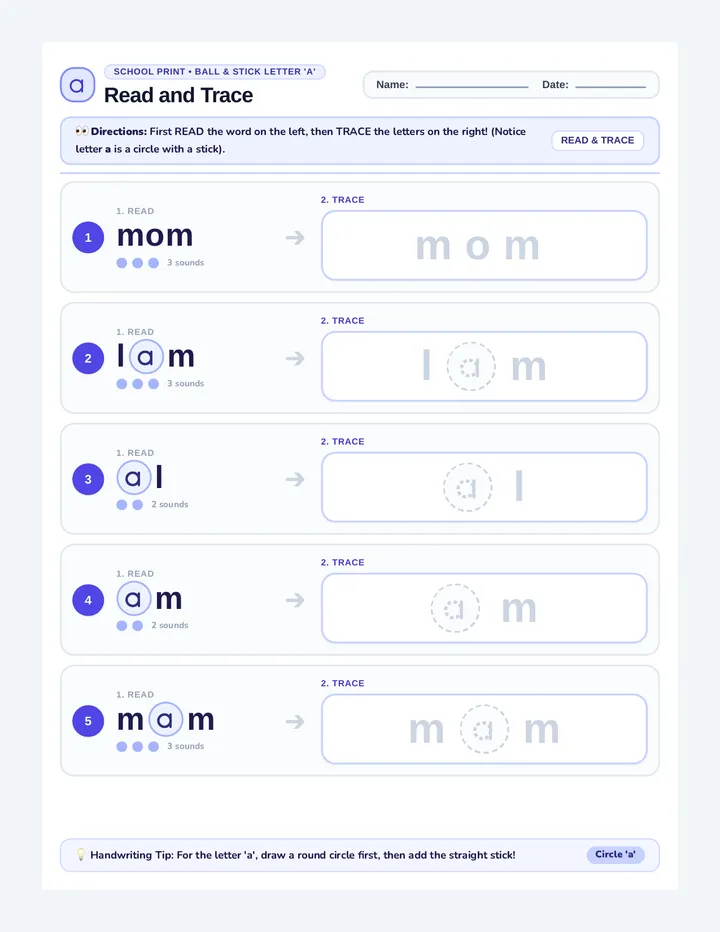
A large-print special education phonics worksheet for reading and tracing mom, lam, al, am, and mam with clean open tracing boxes (no triple lines), school circle-style letter a, and uniform sound dots with no yellow dots.

M

michelle.bernius

Figurative Patterns Slides Orientation Fix

Figurative Patterns Slides Orientation Fix

Fixed Slide 6 where the visualization of two paired triangular numbers forming a rectangle was missing. Replaced the previous layout with explicit flex rows to ensure the dots render correctly and clearly show how $T_4$ and its twin create a $4 \times 5$ rectangle. Label positioning and container sizing were also refined for better clarity. Adjusted Slide 4 to fill vertical space more effectively.

BC

Brenda Coombs

Grade 4 Math Priority Pacing Guide

Grade 4 Math Priority Pacing Guide

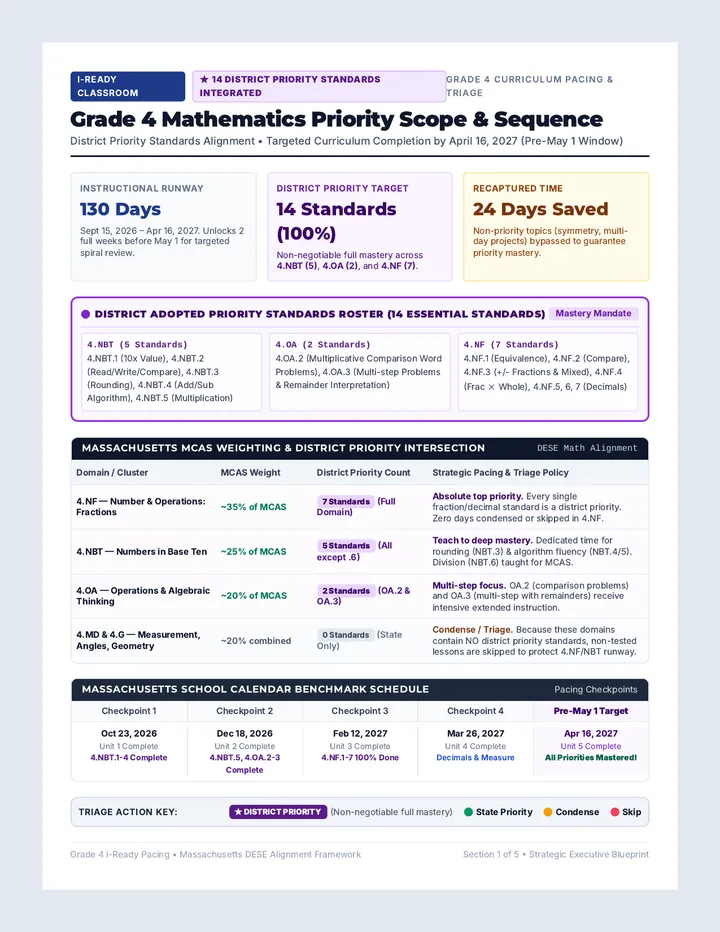
A comprehensive 5-page standards-aligned Grade 4 Mathematics curriculum pacing guide for i-Ready Classroom Mathematics, specifically incorporating the 14 designated District Priority Standards across 4.OA, 4.NBT, and 4.NF. Calibrated to the Massachusetts Curriculum Frameworks to guarantee 100% completion of all district priority standards before May 1, featuring explicit district priority badging, unit-by-unit pacing dates, strategic triage rationales for non-priority topics, and a Tier 2 prerequisite intervention bridge.

AS

Ashley Santiago

Weekly Math Spiral Packet

Weekly Math Spiral Packet

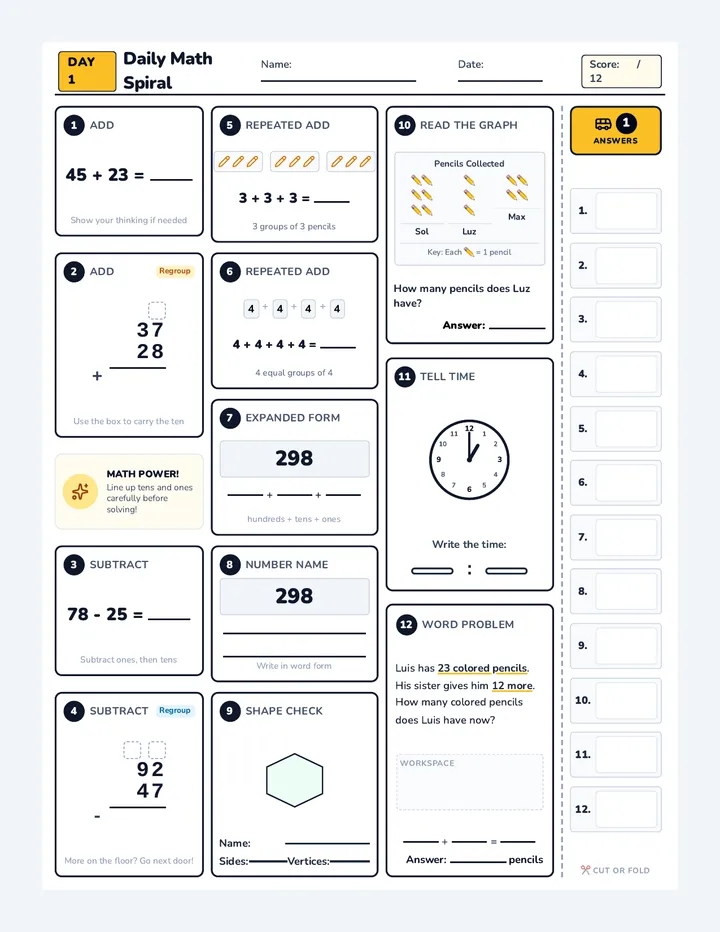
A 5-day printable weekly math spiral review packet (Monday to Friday) covering 2-digit addition and subtraction with regrouping, repeated addition, 3-digit expanded form, number names, 2D/3D geometry, graphs, analog time, and word problems, complete with a quick-grader answer strip.

DL

Damaris Lopez Valentin

Math Vocabulary Flashcards

Math Vocabulary Flashcards

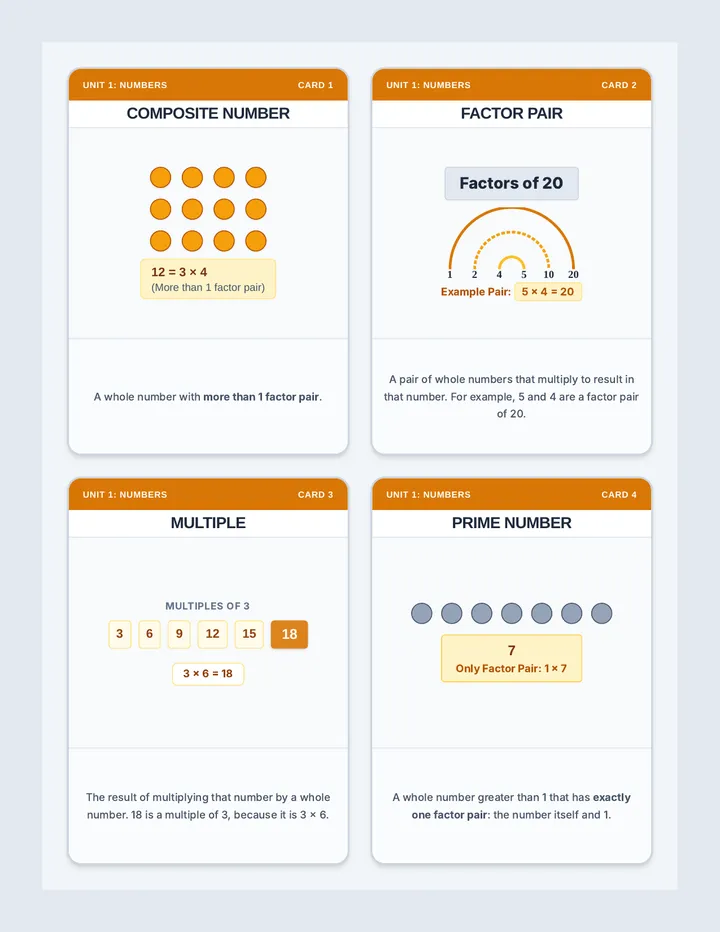
A complete, comprehensive classroom-ready set of 40 standard index-sized math vocabulary flashcards (4 per page) spanning Units 1 to 8. Includes unit fractions, mixed numbers, operations, geometry, and shape classifications with high-contrast diagrams and definitions.

N

nmack

Button Detective Exit Ticket

Button Detective Exit Ticket

A single-page exit ticket assessing student ability to classify and identify buttons by color, shape, and number of holes. Features visual button graphics and kid-friendly prompts for early elementary learners.

SB

Sondra Bell

Sequences

Packet Master TOC document

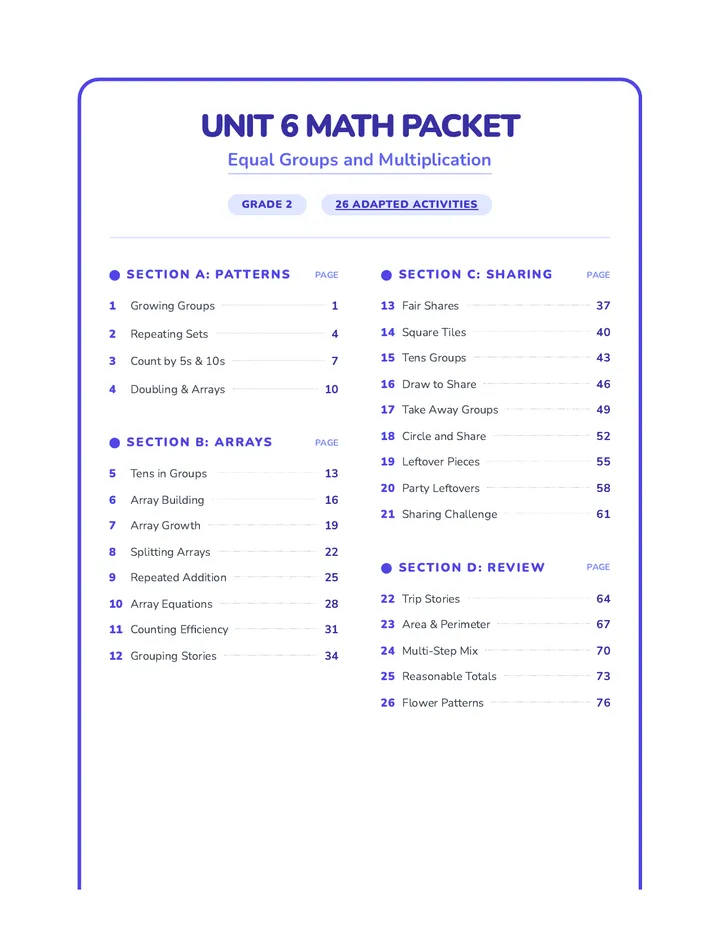
Unit 6 Equal Groups and Multiplication

A comprehensive Grade 2 math packet focused on skip counting, repeated addition, arrays, and equal groups.

N

nmack

39
Camp Multi-Math Worksheet

Math Review Adventures

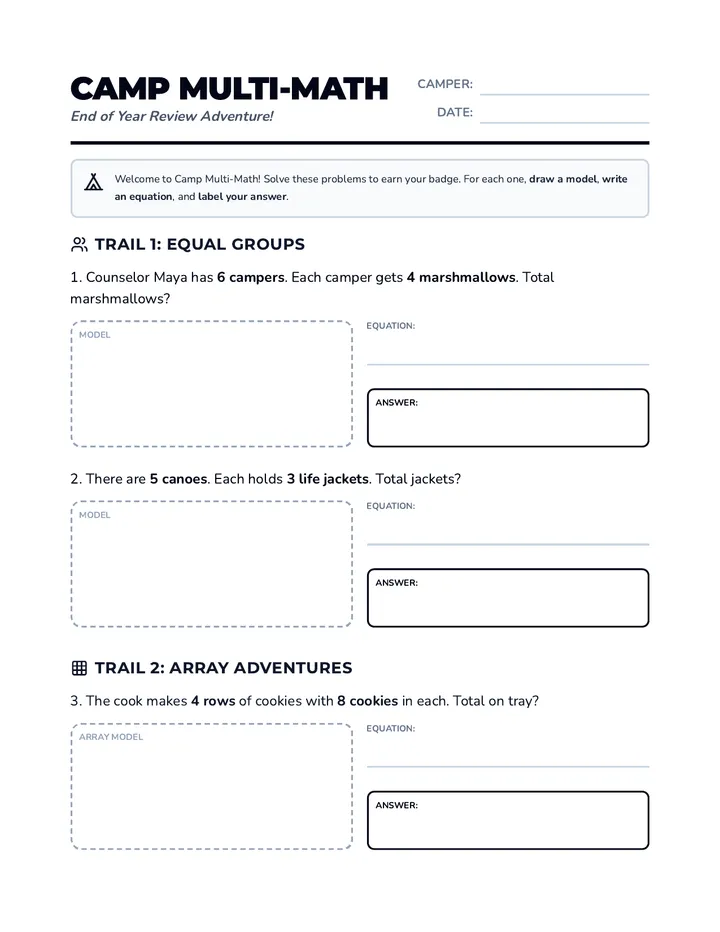
A collection of themed end-of-year math review adventures for different grade levels, focusing on spiraling key standards and problem-solving.

DB

Deborah Burton

21
Plunder Plan Teacher Guide

Pirate Math Plunder

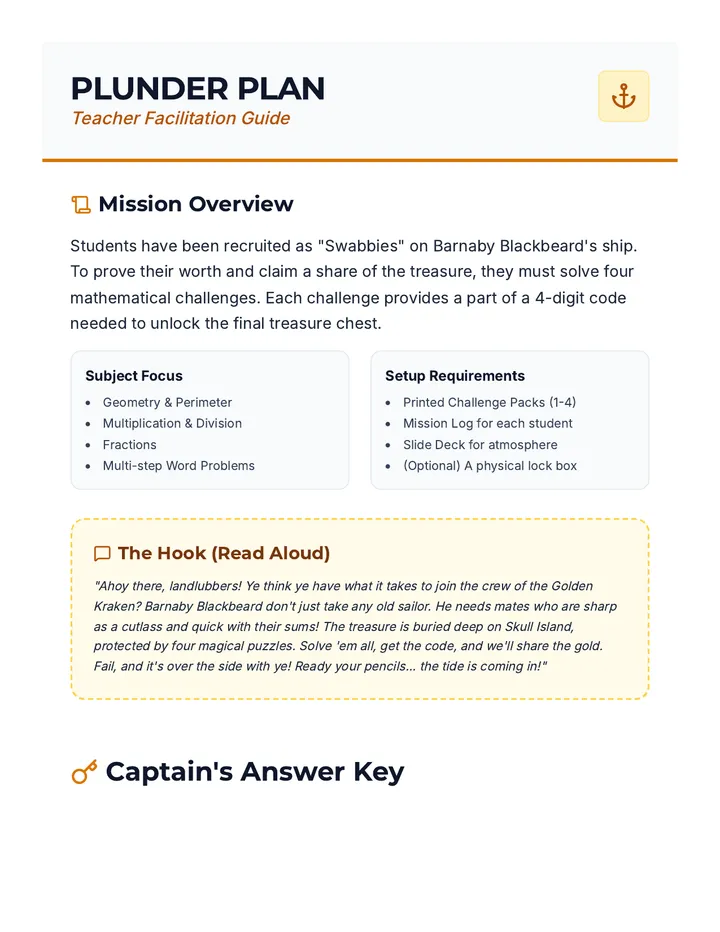
A pirate-themed 3rd grade math review escape room where students solve puzzles involving geometry, multiplication, division, fractions, and word problems to find the hidden treasure.

DG

Danielle Garland

12
Superpower Academy Slides

Math Mindset and Identity

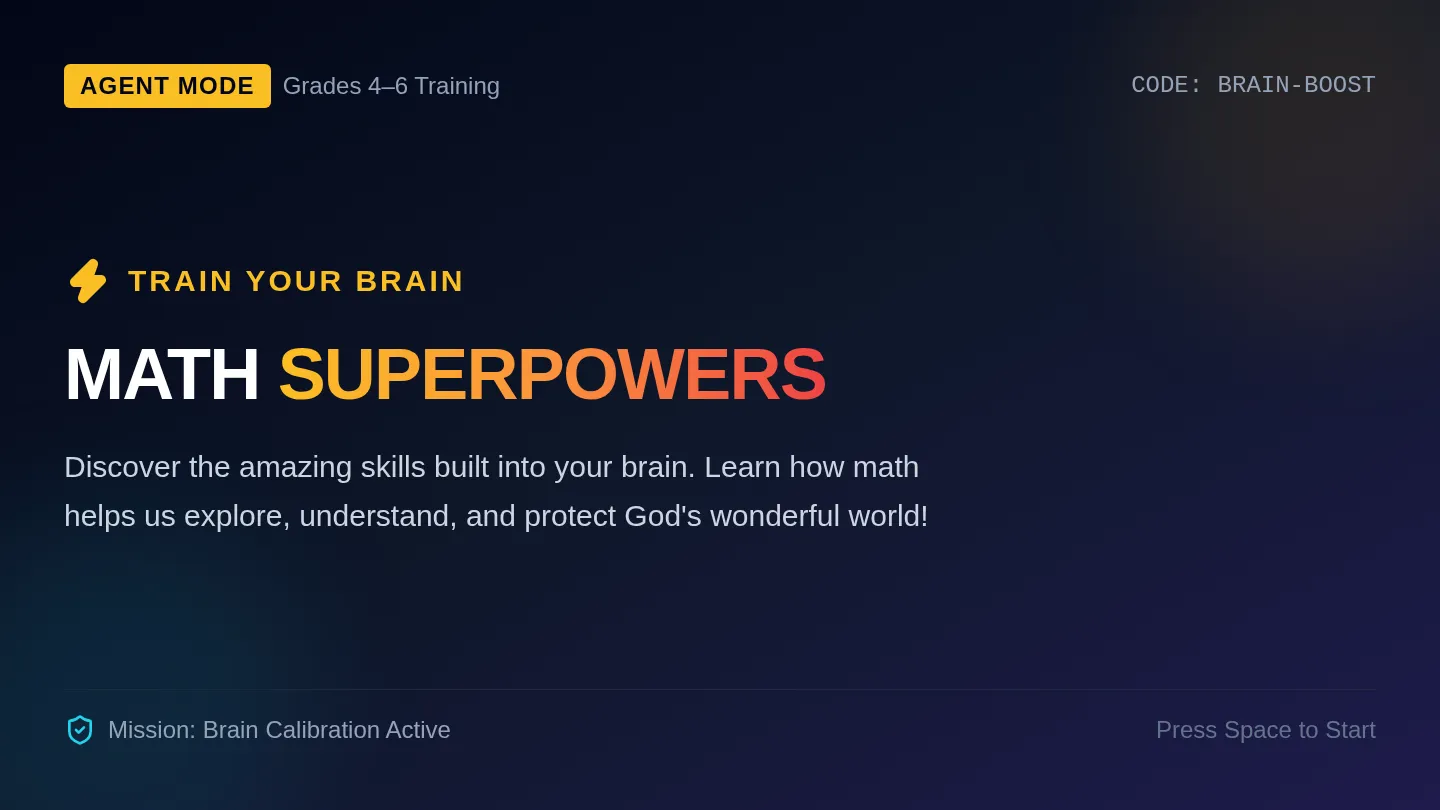
A transformative math unit focusing on math identity, mindset, and practical superpowers. Integrates a rich Biblical worldview to show how mathematics is woven into each student's past, present, and future purpose.

CH

Carlina Hui

14
Number Quest Workbook

Math Quest Tutoring

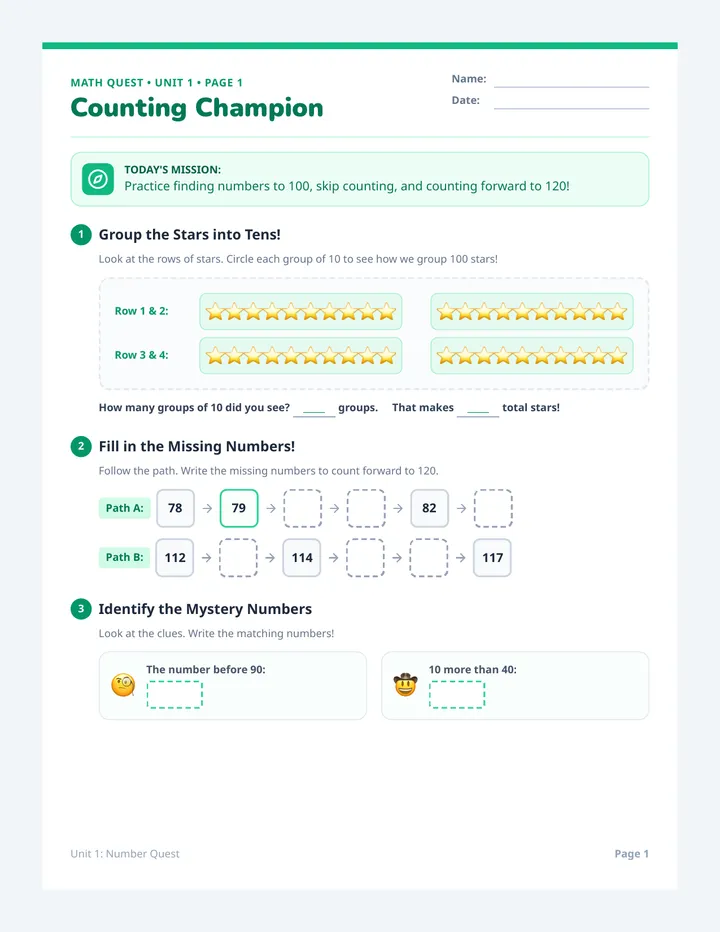
A comprehensive 1st and 2nd-grade math tutoring sequence featuring heavily scaffolded worksheets and visual progress monitoring kits. Covers number sense, algebraic operations, geometry, and measurement.

JC

Jennifer Campbell

16
Club Leader Master Guide

Math Mastery Club

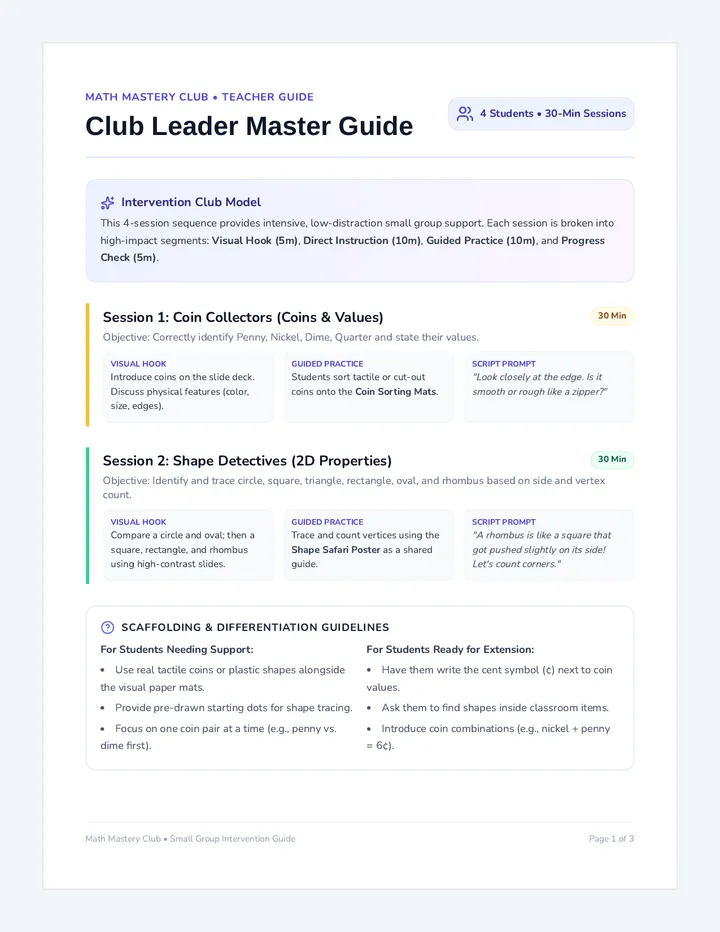
An expanded 14-session, cohesive small-group math intervention sequence for four 1st-grade students. Covers coin values (penny, nickel, dime, quarter) over 3 sessions; 2D shapes (circle, square, triangle, rectangle, oval, rhombus) over 3 sessions; and step-by-step number decomposition to make a ten for addition (3 sessions) and subtraction (3 sessions) to ensure deep student mastery.

K

kurtzm

37