Lenny.com
Explore
Create
ActivitiesNewMathEnglish Language ArtsScience & EngineeringSocial StudiesGlobal LanguagesHealth & Physical EducationSpecial EducationCounseling & Life SkillsArts & CreativityESL
Lenny.com
Lenny.com
Explore
Create
ActivitiesNewMathEnglish Language ArtsScience & EngineeringSocial StudiesGlobal LanguagesHealth & Physical EducationSpecial EducationCounseling & Life SkillsArts & CreativityESL
Lenny.com
MathNumbers & CountingCounting ObjectsNumber NamesComparing NumbersNumber OperationsCounting SequenceNumbers 0-10Place Value Understanding and SystemAdd and Subtract Within 20Addition and Subtraction ConceptsAddition and Subtraction EquationsAddition and Subtraction ProblemsFoundations for MultiplicationMultiplication and Division PropertiesMultiply and Divide Within 100Multiplication and Division ProblemsFactors and MultiplesProperties of OperationsPatterns and RelationshipsGenerate and Analyze PatternsMulti-Digit ArithmeticPlace Value OperationsMulti-Digit and Decimal OperationsNumerical ExpressionsFour Operations and PatternsFour Operations Problem SolvingMeasurement & DataMeasurable AttributesMeasuring LengthsMeasure and Estimate Lengths in Standard UnitsRelate Addition and Subtraction to LengthClassifying and Counting ObjectsTime and MoneyArea Concepts and MeasurementPerimeter and Area MeasuresAngle Concepts and MeasurementTime, Volume, and MassMeasurement Unit ConversionsGeometryIdentifying ShapesShapes and AttributesShape Attributes and ReasoningShapes and CompositionClassifying 2D FiguresGeometric Figures and RelationshipsLines, Angles, and ShapesAngle, Area, and VolumeGeometric MeasurementVolume of 3D ShapesCoordinate Plane ApplicationsTransformations in the PlaneCongruence and SimilarityUnderstand congruence in terms of rigid motionsSimilarity and TransformationsProve Theorems Involving SimilarityPythagorean TheoremTrigonometry for General TrianglesMake Geometric ConstructionsProve Geometric TheoremsTheorems About CirclesFind Arc Lengths And Areas of Sectors of CirclesVolume FormulasRelationships Between Two-Dimensional and Three-Dimensional ObjectsProve Simple Geometric Theorems AlgebraicallyTranslate Between Geometric Description and Equation for Conic SectionApply Geometric Concepts in Modeling SituationsFractions & DecimalsFractions as NumbersBuilding FractionsFraction Equivalence and OrderingAdding and Subtracting FractionsMultiplying and Dividing FractionsDividing FractionsDecimal FractionsMulti-Digit Computation and FactorsAdd, Subtract, Multiply, and Divide Rational NumbersRational Number SystemIrrational Numbers and ApproximationsRatiosRatios and ProportionsProportional RelationshipsUnit RateAlgebraAlgebraic ExpressionsGenerate Equivalent ExpressionsQuantitative RelationshipsProportional Relationships and Linear EquationsEquations and InequalitiesEquation Solving and ReasoningLinear Equations and SystemsGraph Equations and InequalitiesSystems of EquationsReal-World Algebraic ProblemsQuantitative Reasoning with UnitsExpression StructureEquivalent Expression FormsRadicals and Integer ExponentsRational ExponentsRational and Irrational NumbersPolynomial OperationsPolynomial IdentitiesPolynomial Zeros and FactorsRational ExpressionsComplex Number OperationsComplex Numbers in PolynomialsComplex Numbers on PlaneStatistics & ProbabilityRepresent and Interpret DataData DistributionsStatistical VariabilityProbability ModelsCompound Event ProbabilitiesStatistical SamplingInterpret Categorical and Quantitative DataBivariate Data PatternsInterpret Linear ModelsComparing Two PopulationsRandom Processes in StatisticsIndependence and Conditional ProbabilityExpected ValuesProbability-Based Decision MakingStatistical Inference and ConclusionsFunctionsFunction Concepts and NotationDefine and Compare FunctionsInterpret Functions in ContextAnalyze Function RepresentationsModel Relationships with FunctionsIdentify Linear vs Exponential GrowthDistinguish Between Function TypesCompare Growth RatesInterpret Function ExpressionsBuild Functions from RelationshipsConstruct and Model FunctionsTransform and Combine FunctionsModel Comparison and SelectionSolve Exponential EquationsTrigonometryTrigonometric Ratios Involving Right TrianglesTrigonometric Functions and Unit CircleModel with Trigonometric FunctionsTrigonometric IdentitiesVectors & MatricesIntroduction to Vectors and MatricesVector QuantitiesVector OperationsMatrix OperationsCalculusLimits and ContinuityDerivative Concepts and NotationDerivative Rules and TechniquesApplications of DerivativesOptimization ProblemsRelated RatesCurve Sketching and AnalysisIntegration Concepts and NotationAntiderivatives and Indefinite IntegralsDefinite Integrals and AreaFundamental Theorem of CalculusIntegration TechniquesApplications of IntegrationDifferential EquationsSequences and SeriesParametric and Polar FunctionsVector-Valued Functions

Angle, Area, and Volume

Geometric properties including angle measurement, area of polygons, and volume of three-dimensional solids. Applies formulas and theorems to solve spatial reasoning problems.

Lenny.com

Solutions

Lenny for EducatorsLenny for SchoolsLenny for Districts

Product

ExploreSign inCreateSupportAbout

Resources

Getting startedMTSS Acceleration Program

© 2026 Lenny Learning Inc.

TermsPrivacyAccessibility
LinkedInInstagramX
Lenny

Videos

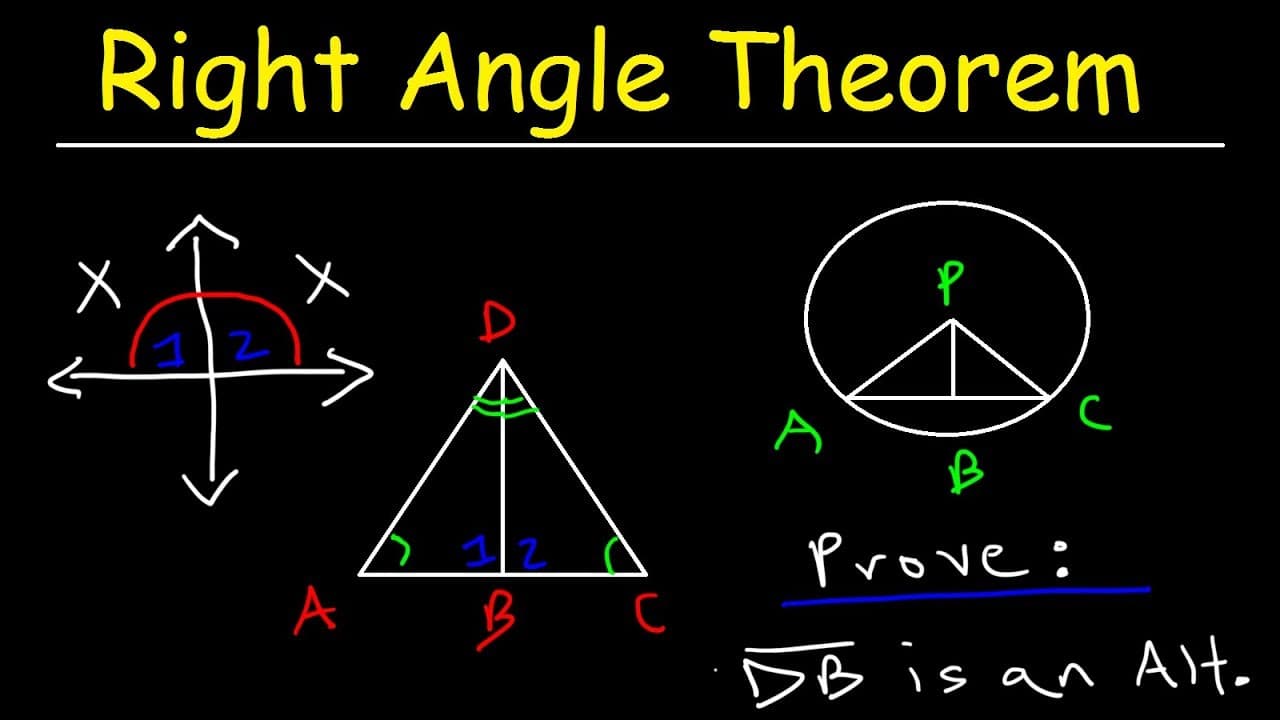
Mastering the Right Angle Theorem in Geometry

Mastering the Right Angle Theorem in Geometry

This comprehensive geometry tutorial breaks down the Right Angle Theorem, explaining that if two angles are both supplementary and congruent, they must be right angles. The video begins by establishing the logic behind the theorem using a simple algebraic proof ($x + x = 180$, therefore $x = 90$). It serves as an excellent resource for bridging the gap between algebraic reasoning and geometric properties. The core of the video is dedicated to practical application through three distinct examples: a two-column proof involving a circle and midpoints, a triangle proof demonstrating altitudes, and an algebraic problem involving systems of linear equations with intersecting lines. Each example is worked through step-by-step, modeling proper mathematical notation, logical sequencing (statements and reasons), and verification techniques. For educators, this video is a versatile tool that connects multiple math strands. It reinforces triangle congruence postulates (SSS, AAS), the use of CPCTC (Corresponding Parts of Congruent Triangles are Congruent), and the skill of solving systems of equations within a geometric context. It is ideal for scaffolding lessons on writing formal proofs or for reviewing how algebra supports geometric definitions.

The Organic Chemistry TutorThe Organic Chemistry Tutor

21mins 59s

Calculating Unknown Angles on a Straight Line

Calculating Unknown Angles on a Straight Line

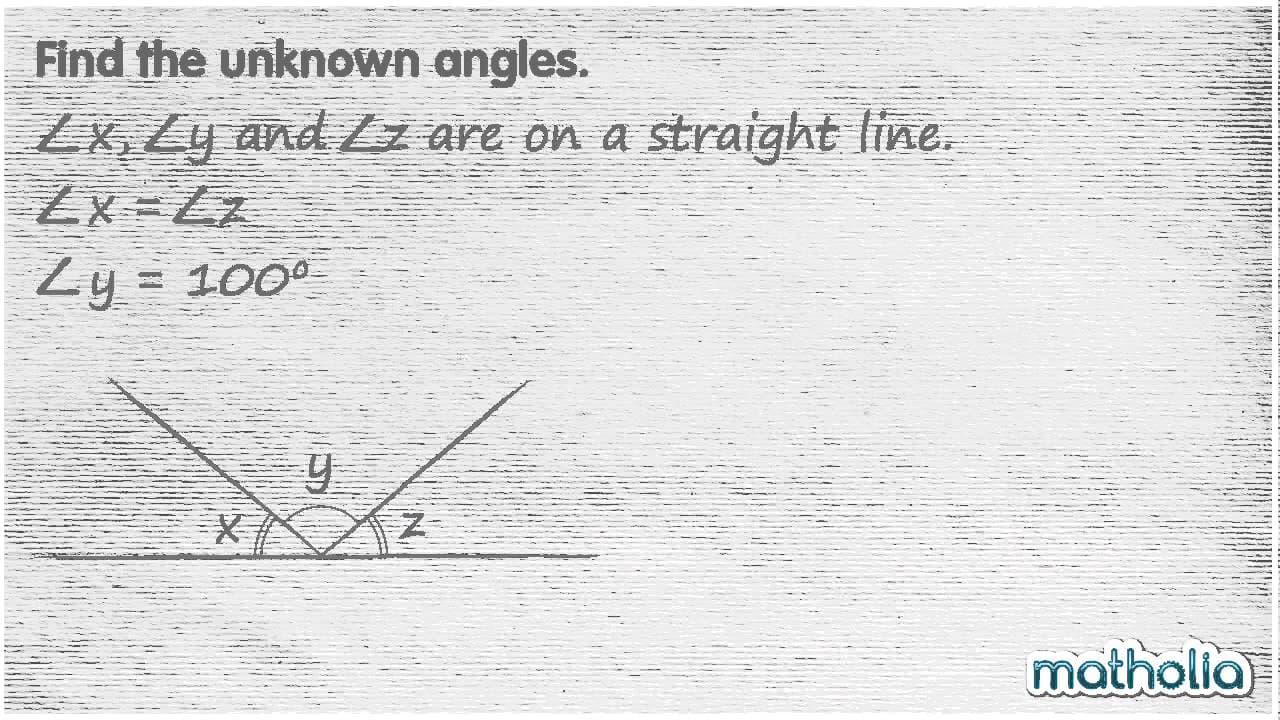
This educational video provides a clear, step-by-step tutorial on calculating unknown angles situated on a straight line. Using a clean, whiteboard-style animation, it visually demonstrates the fundamental geometric principle that angles on a straight line add up to 180 degrees. The video guides viewers through three distinct problem types: finding a single missing angle when a right angle is involved, solving for two equal unknown angles, and dividing a straight line into three equal angles. The content moves from concrete arithmetic to introductory algebraic thinking, helping students transition from simple subtraction to multi-step reasoning involving variables like x, y, and z. Each problem is broken down methodically: identifying known values, setting up the equation based on the 180-degree rule, and performing the necessary calculations to find the solution. The visual presentation reinforces the connection between the geometric figures and the mathematical equations used to solve them. Teachers can use this video to introduce or review the concept of supplementary angles and linear pairs without getting bogged down in complex terminology. It serves as an excellent model for setting up geometry problems, showing students how to organize their work and justify their steps. The clear pacing allows for pausing and student participation, making it a versatile tool for whole-class instruction, independent practice, or remediation for students struggling with basic geometric calculations.

MatholiaChannelMatholiaChannel

2mins 40s

Understanding Angles and How to Draw Them in Standard Position

Understanding Angles and How to Draw Them in Standard Position

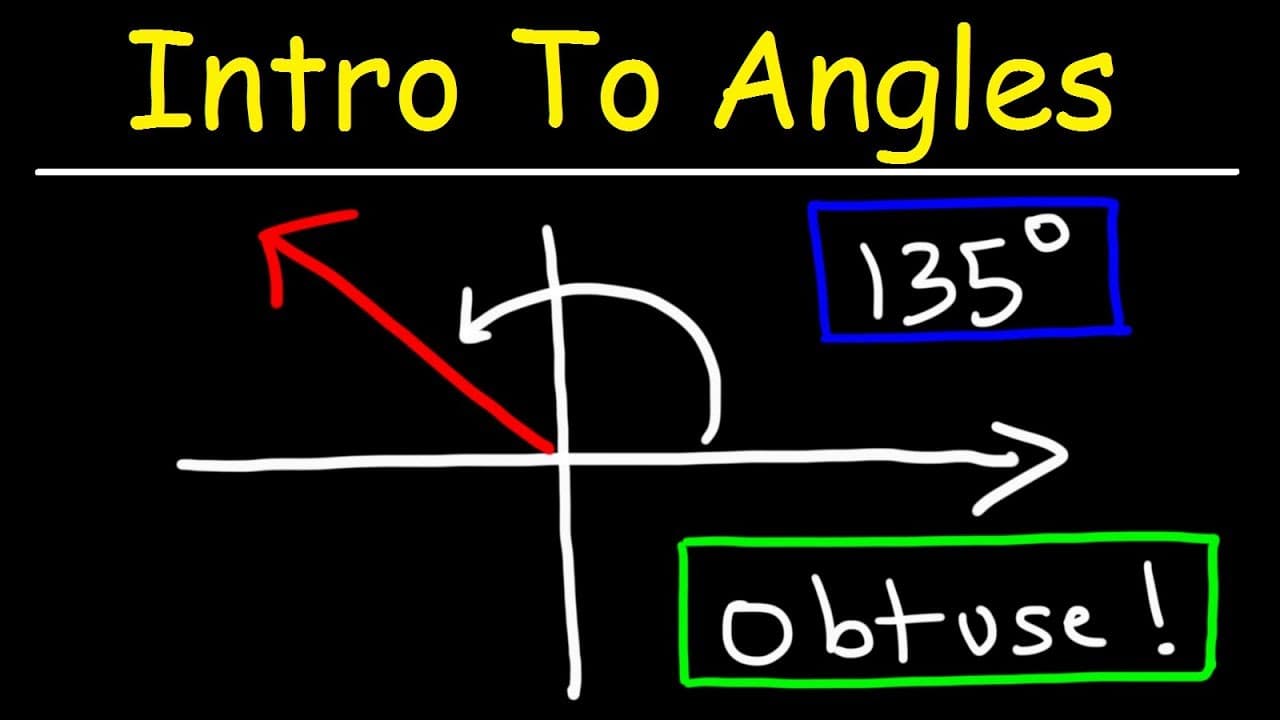
This educational video provides a comprehensive introduction to geometric angles, establishing the foundational concepts necessary for trigonometry. The instructor begins by clearly defining basic geometric elements—segments, rays, and lines—before explaining how an angle is formed by two rays sharing a common endpoint called the vertex. The video transitions into placing angles on a coordinate plane in "standard position," introducing the concepts of initial and terminal sides, and distinguishing between positive (counter-clockwise) and negative (clockwise) rotations. Key themes include geometric vocabulary, the properties of the Cartesian coordinate system (quadrants), and the classification of angles (acute, right, obtuse, straight). The instructor visually demonstrates how to determine angle measures based on their rotation and quadrant location. A significant portion of the video is dedicated to worked examples, showing step-by-step how to sketch both positive and negative angles given specific degree measures. For educators, this video serves as an excellent flipped classroom resource or review tool for Algebra II, Geometry, or Pre-Calculus students. It effectively bridges the gap between basic geometry and early trigonometry by visualizing angles as rotations rather than static shapes. Teachers can use the clear blackboard-style diagrams to help students visualize abstract concepts like negative degrees and coterminal angles.

The Organic Chemistry TutorThe Organic Chemistry Tutor

14mins 6s

Finding the Side Length of a Square From Its Area

Finding the Side Length of a Square From Its Area

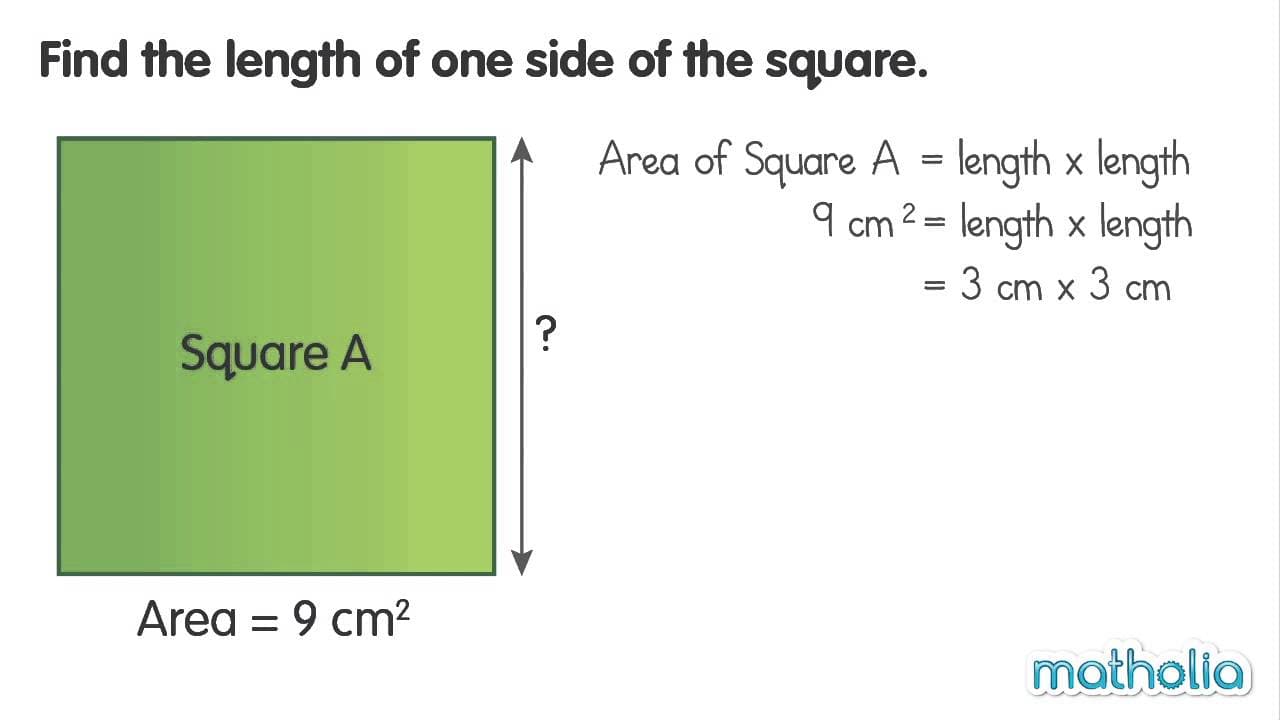
This video provides a clear, step-by-step tutorial on how to determine the side length of a square when the area is known. Through three distinct examples using different colors and units (cm² and m²), it guides viewers through the logic of inverse operations without explicitly introducing complex algebraic notation. The narrator explains that since a square's area is length multiplied by length, finding the side means identifying a number that multiplies by itself to equal the given area. The video explores key mathematical themes including geometry, measurement, and the relationship between multiplication and area. It reinforces the concept of "perfect squares" (9, 25, 64) and visually demonstrates how to use multiplication facts to solve for unknown dimensions. The repetitive structure serves to build confidence and fluency with the procedure, allowing students to practice the thinking process three separate times. For educators, this resource is an excellent tool for introducing the concept of square roots in a concrete, geometric context. It bridges the gap between basic multiplication and algebraic thinking. Teachers can use it to help students visualize why the inverse of squaring a number helps find geometric dimensions, making it suitable for lessons on area, perimeter, and pre-algebraic reasoning.

MatholiaChannelMatholiaChannel

3mins 5s

How to Calculate Triangle Height Given Three Sides

How to Calculate Triangle Height Given Three Sides

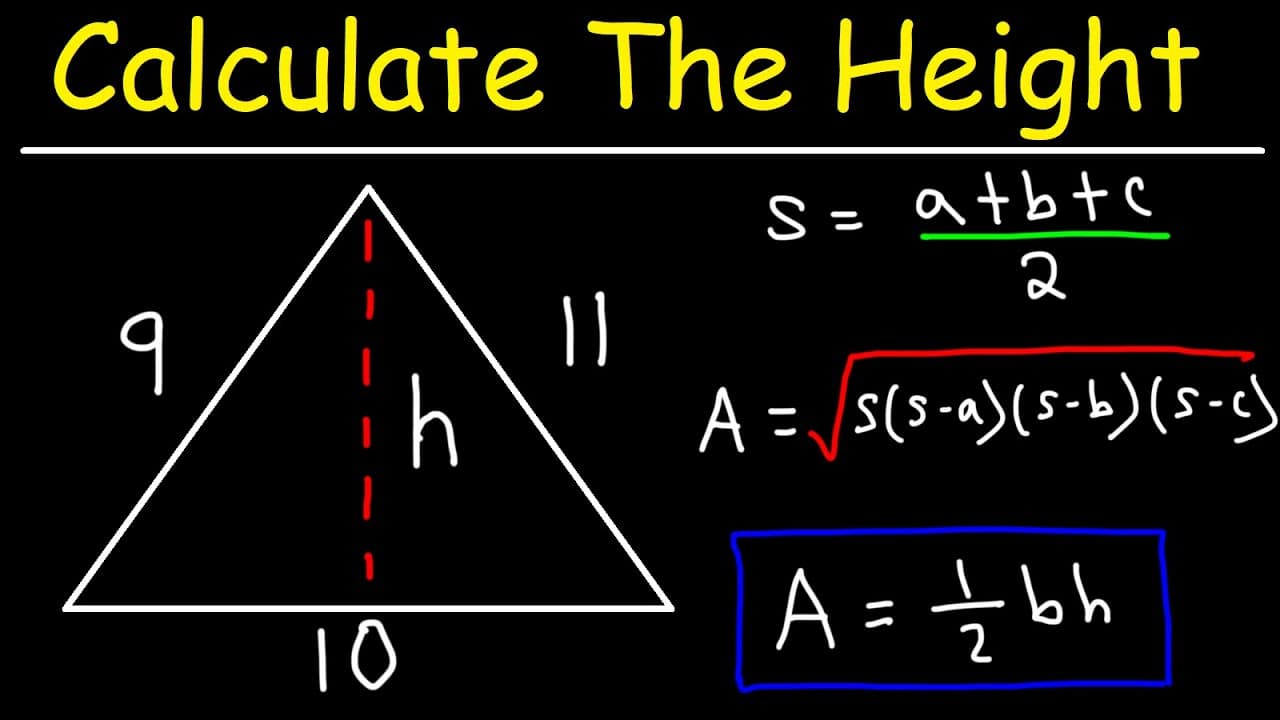
This educational mathematics tutorial demonstrates how to calculate the height of a triangle when only the lengths of its three sides are known. The video guides viewers through a two-step strategy: first using Heron's Formula to determine the total area of the scalene triangle, and then substituting that area into the standard triangle area formula to solve for the unknown height. The instructor uses a specific example with side lengths of 9, 10, and 11 to make the abstract concepts concrete. A significant portion of the video focuses on algebraic skills, specifically calculating the semi-perimeter and simplifying radicals without a calculator. The instructor breaks down complex square roots by factoring numbers to find perfect squares, demonstrating an efficient mental math technique. The video concludes by setting up an algebraic equation to isolate the height variable, providing both an exact radical answer and a decimal approximation. For educators, this video serves as an excellent bridge between geometry and algebra. It reinforces key concepts like substitution, solving for variables, and properties of radicals while teaching a specific geometric application. It is particularly useful for demonstrating that height can be found for non-right triangles without using trigonometry, making it a valuable resource for high school geometry and algebra curriculums.

The Organic Chemistry TutorThe Organic Chemistry Tutor

5mins 33s

Understanding Circles: Area, Circumference, Arcs, and Angles

Understanding Circles: Area, Circumference, Arcs, and Angles

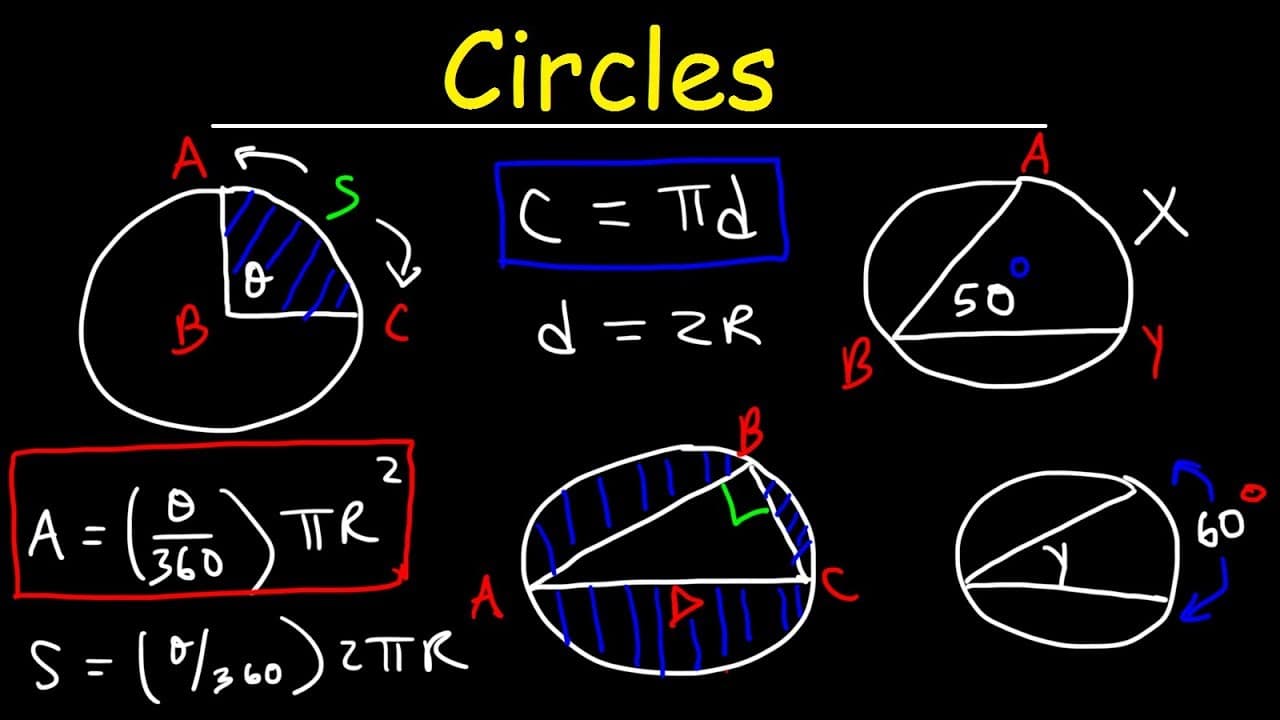
This comprehensive math tutorial provides an in-depth exploration of circle geometry, moving from basic definitions to complex problem-solving. The video begins by defining fundamental components such as the radius, diameter, circumference, and area, clearly establishing the relationship between these elements. It progresses to more advanced concepts including sectors, arc lengths, chords, and the theorems governing central and inscribed angles. The narration uses a blackboard style to visually demonstrate how formulas are derived and applied. Key themes include the distinction between central and inscribed angles, calculating the area of sectors and segments, and using the Pythagorean theorem within circle contexts. The video explicitly covers the Inscribed Angle Theorem—demonstrating that an inscribed angle is half the measure of its intercepted arc—and explores how to calculate arc lengths and sector areas using degrees. It concludes with multi-step word problems that require synthesizing multiple concepts, such as finding the area of a shaded region by subtracting a triangle's area from a circle's area. For educators, this video serves as an excellent instructional tool for high school geometry units. It can be used to introduce new vocabulary, demonstrate the application of formulas, or review for standardized tests. The step-by-step problem-solving sections allow teachers to pause and let students attempt calculations before seeing the solution, making it ideal for interactive classroom learning or independent study for students needing remediation on geometric concepts.
The Organic Chemistry TutorThe Organic Chemistry Tutor

18mins 7s

Materials

Composite Polynomials Worksheet

Composite Polynomials Worksheet

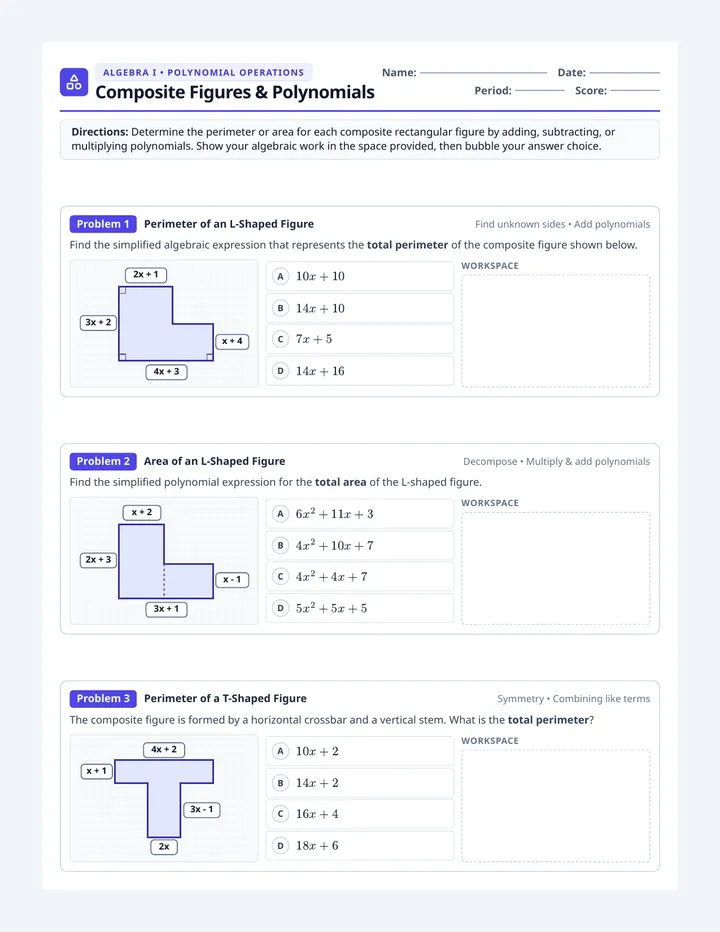
A two-page printable high school Algebra I worksheet containing 6 multiple-choice problems on finding the perimeter and area of composite rectangular figures using polynomial addition, subtraction, and multiplication, featuring crisp, bold SVG geometric diagrams with high-contrast dimension labels and student workspaces.

JW

Jessica Waters

Polygon Area Guided Notes

Polygon Area Guided Notes

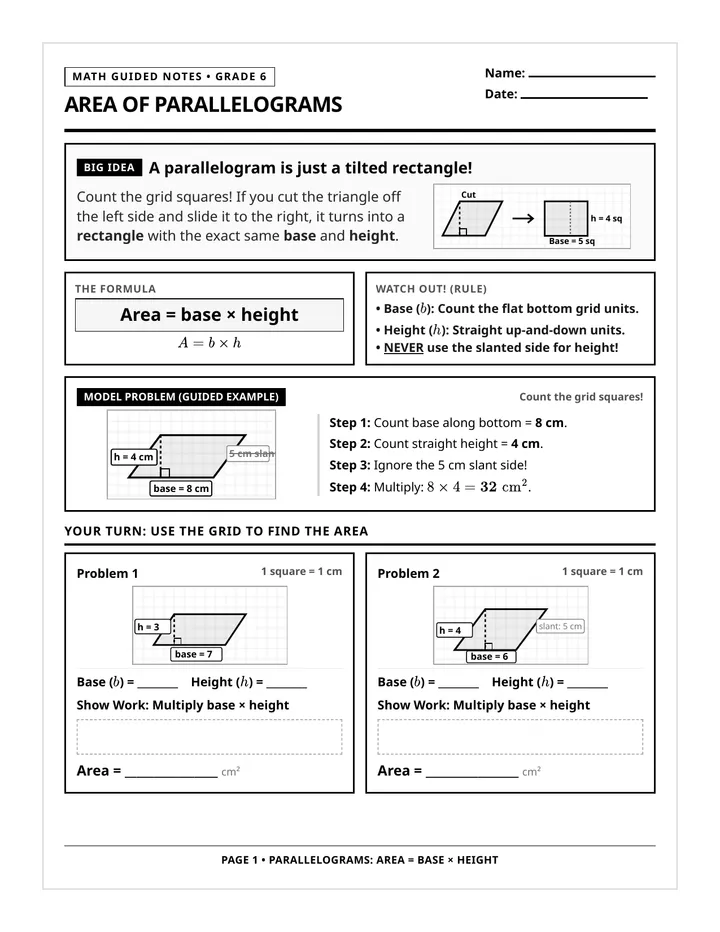
A 3-page scaffolded, large-font, black-and-white guided lesson sheet for 6th graders with foundational math proficiency. Features visible unit measurement grids behind all geometric shapes for counting base and height, zero overlap between text labels and shapes, and clear step-by-step models for parallelograms, triangles, and composite polygons.

MJ

Meg Jones

Prism Volume Worksheet

Prism Volume Worksheet

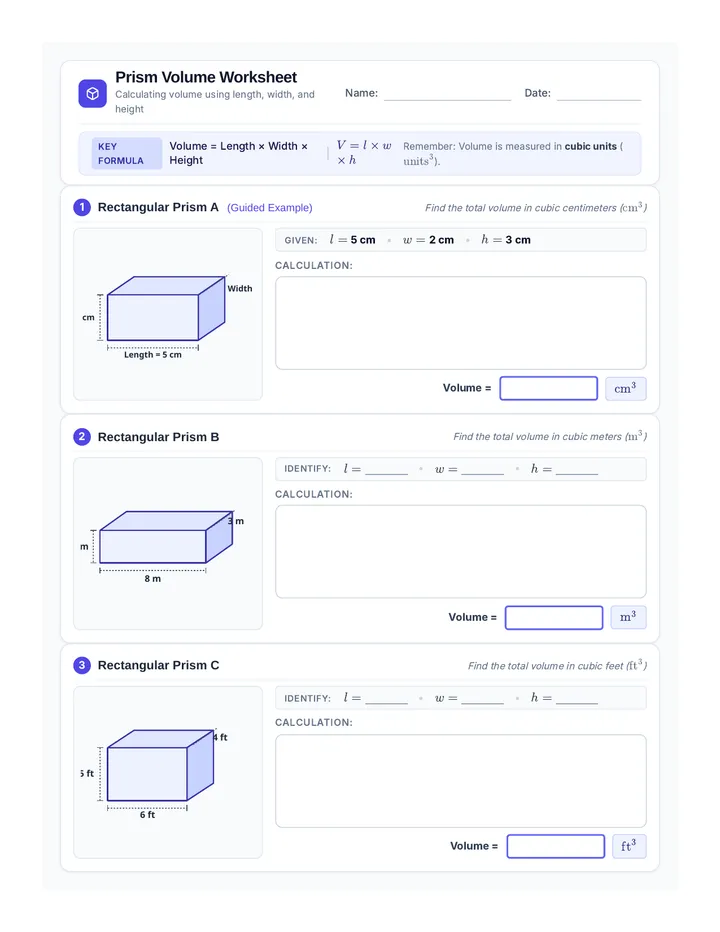
A two-page student practice worksheet featuring three rectangular prism volume problems on page one and five three-factor multiplication equations on page two with large white calculation boxes for handwriting work.

SM

Susannah Malloy

Deep Ocean Expedition Work Packet

Deep Ocean Expedition Work Packet

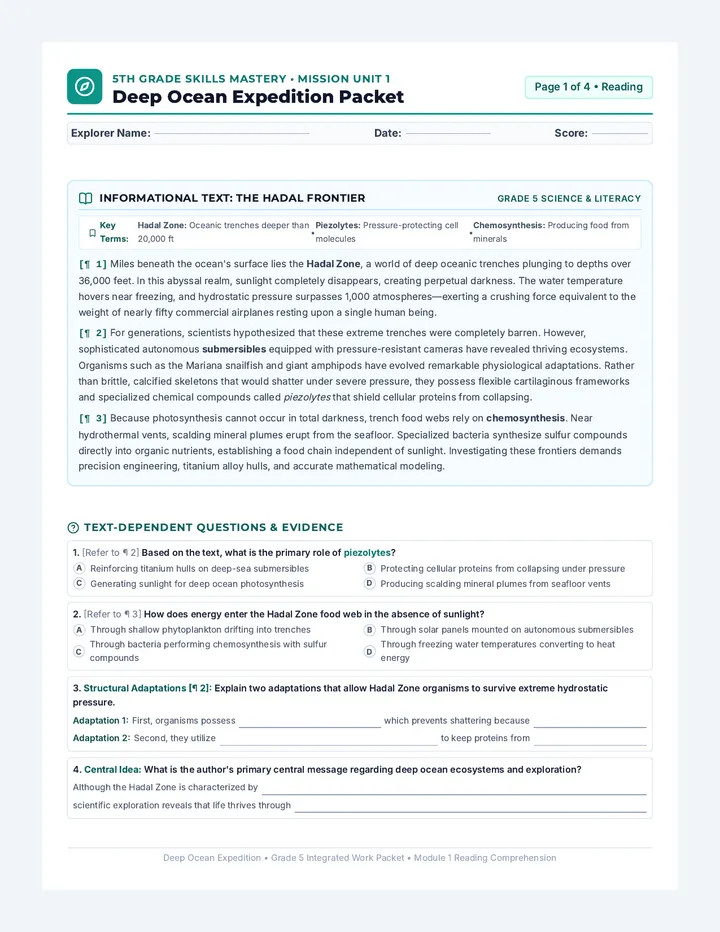
A rigorous 4-page 5th-grade Deep Ocean Expedition work packet with instructional scaffolds. Includes an informational text on Hadal Zone adaptations with vocabulary callouts and text-dependent questions, an engineering proposal writing task with graphic organizers and transition supports, 3-digit by 3-digit multiplication grid algorithms, and area and volume missing dimension challenges.

CZ

Claire Zietsman

Grade 4 Math Priority Pacing Guide

Grade 4 Math Priority Pacing Guide

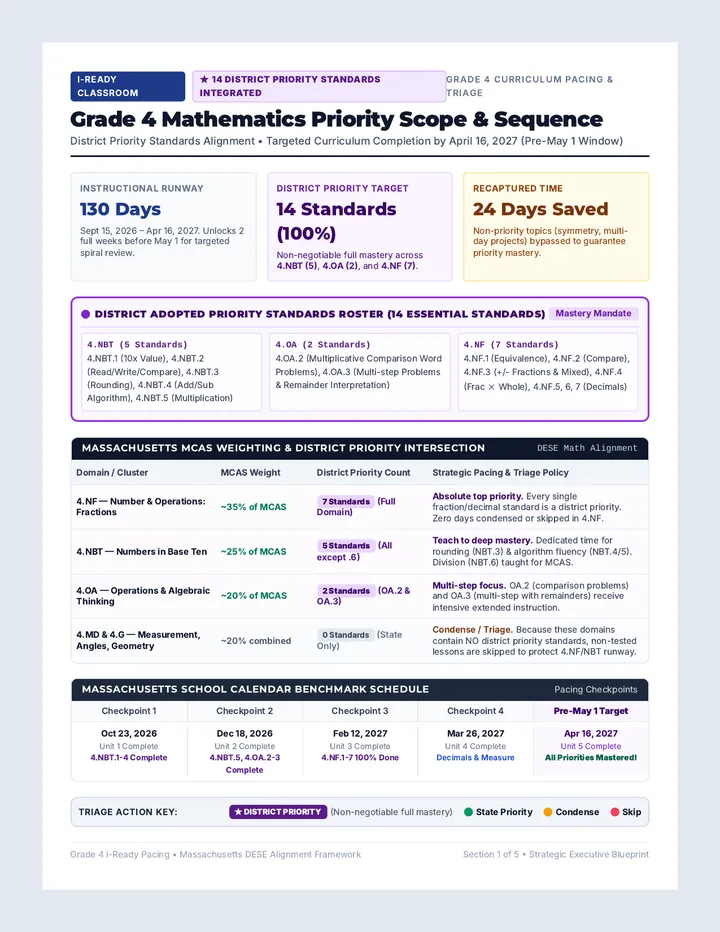
A comprehensive 5-page standards-aligned Grade 4 Mathematics curriculum pacing guide for i-Ready Classroom Mathematics, specifically incorporating the 14 designated District Priority Standards across 4.OA, 4.NBT, and 4.NF. Calibrated to the Massachusetts Curriculum Frameworks to guarantee 100% completion of all district priority standards before May 1, featuring explicit district priority badging, unit-by-unit pacing dates, strategic triage rationales for non-priority topics, and a Tier 2 prerequisite intervention bridge.

AS

Ashley Santiago

Compound Shapes Simplified Worksheet

Compound Shapes Simplified Worksheet

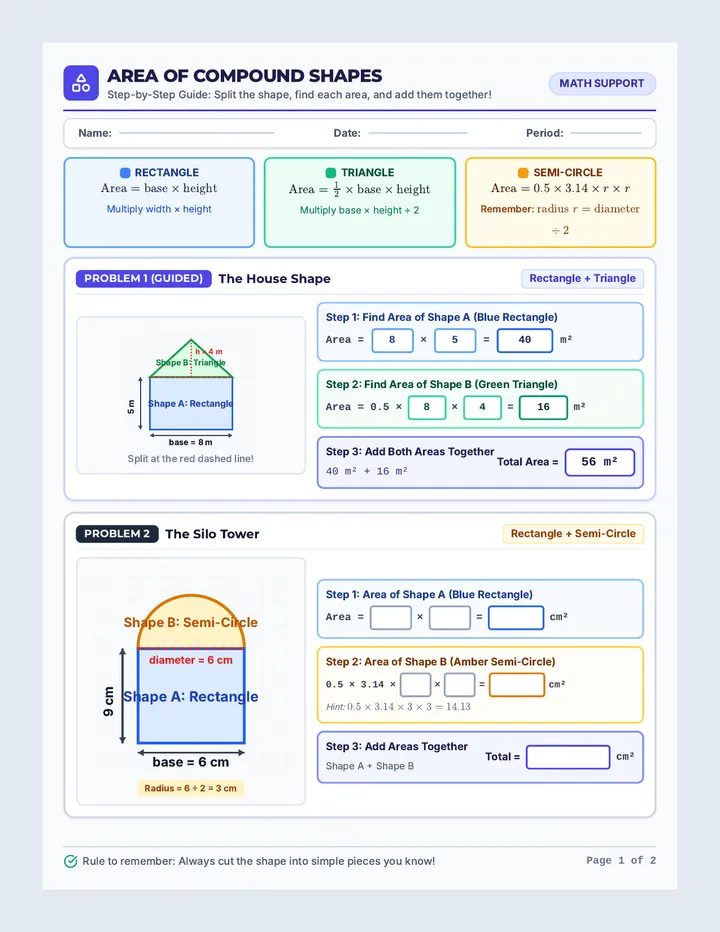
A simplified, highly scaffolded two-page compound area worksheet for 9th-grade special education students. Features chunked 3-step problem solving, color-coded sub-shapes, pre-drawn partition lines, diameter-to-radius helper cues, and structured fill-in-the-blank formula frames.

LB

Lisa Ball

Sequences

Equation Balancing Student Packet

Distance Detectives

A highly visual geometry unit focused on applying algebraic formulas to coordinate planes. Students use coordinate grids, step-by-step graphic organizers, and tactile representations to solve real-world distance and segment length problems.

D

deeohnny.jackson

64
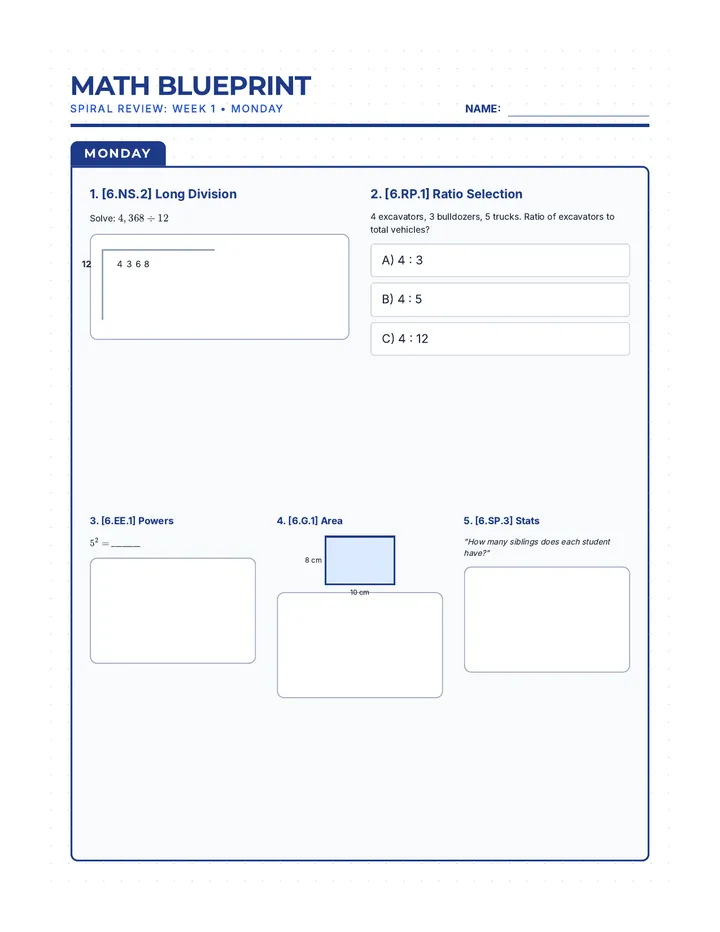
Math Blueprint Week 1 Booklet (Definitive)

Math Blueprint Spiral

A 7-week comprehensive math review sequence designed to prepare 6th-grade students for North Carolina state testing, covering Number Systems, Ratios, Expressions, Geometry, and Statistics.

MK

Michell Kisler

27
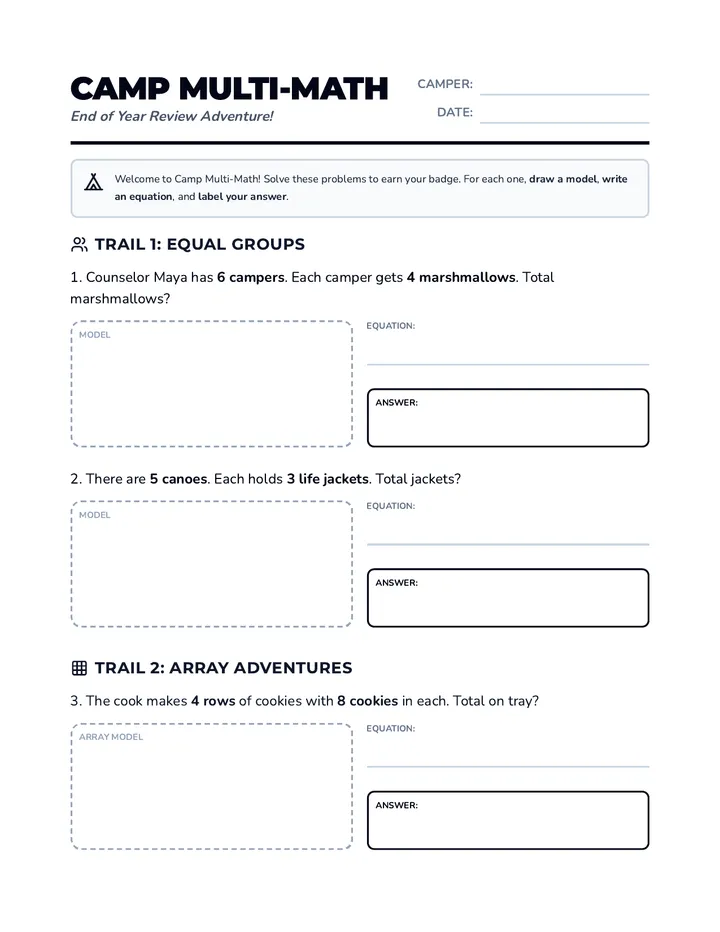
Camp Multi-Math Worksheet

Math Review Adventures

A collection of themed end-of-year math review adventures for different grade levels, focusing on spiraling key standards and problem-solving.

DB

Deborah Burton

21
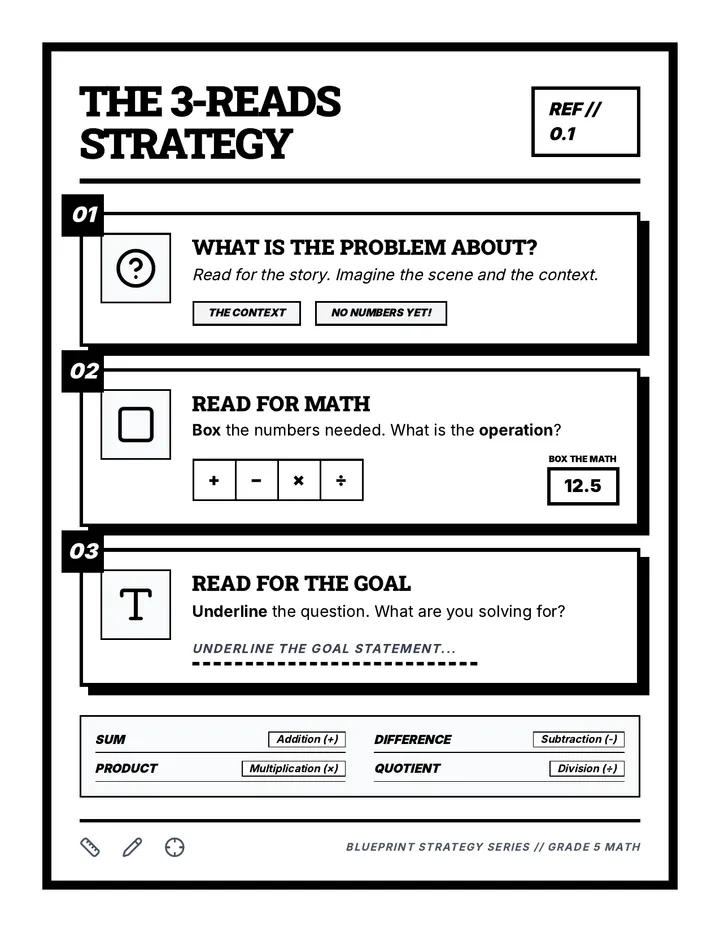
3 Reads Strategy Poster

Math Blueprints Grade 5

A comprehensive set of math supports for 5th-grade students in a co-taught environment. Each unit includes visual vocabulary, worked examples, cloze-style guided notes, and exit tickets featuring a 'Mistake of the Day' analysis.

HJ

Hope Joel

23
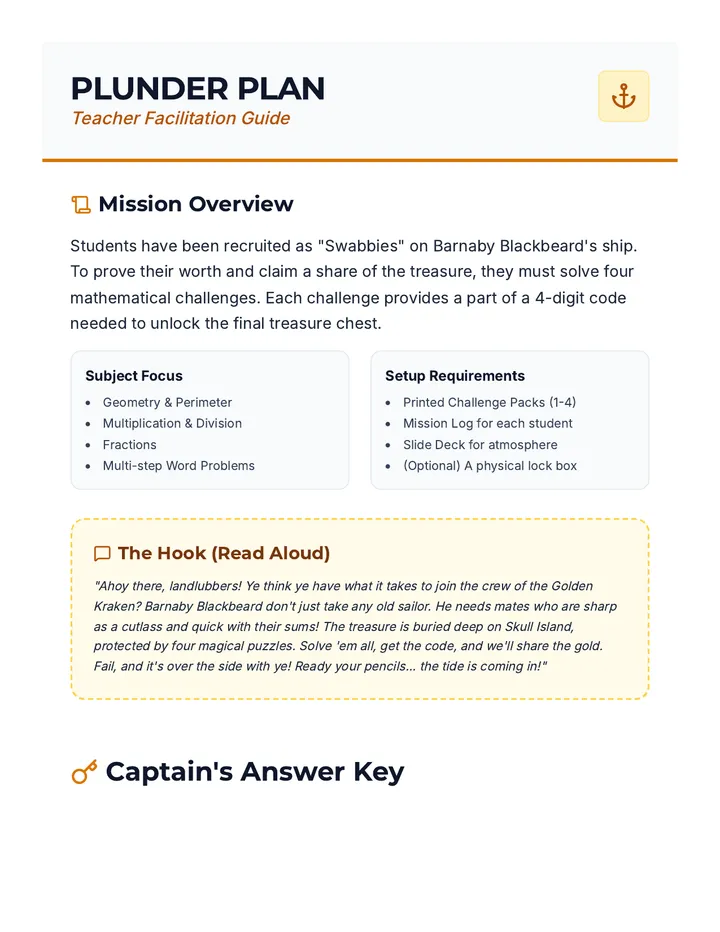
Plunder Plan Teacher Guide

Pirate Math Plunder

A pirate-themed 3rd grade math review escape room where students solve puzzles involving geometry, multiplication, division, fractions, and word problems to find the hidden treasure.

DG

Danielle Garland

12
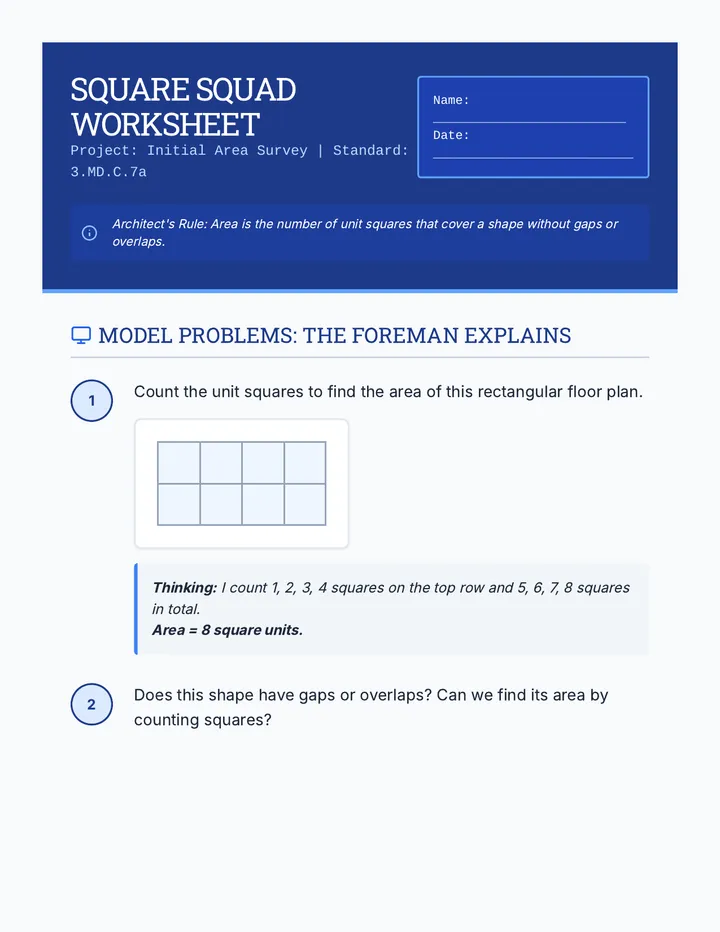
Square Squad Worksheet

Blueprint Builders

A 4-day unit on area measurement for 3rd grade students, covering tiling, the relationship between multiplication and addition, and decomposing rectilinear shapes. Designed with a 'Blueprint Builders' architectural theme.

TD

Taylor Doucet

10

Lessons

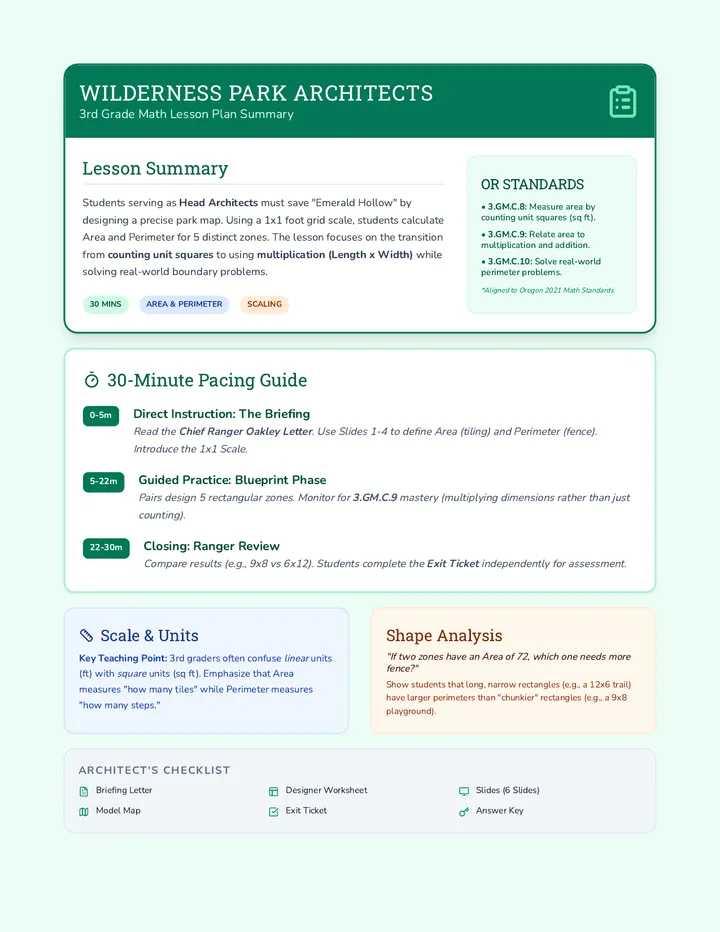
Wilderness Park Architects Teacher Guide

Wilderness Park Architects

A 30-minute interactive lesson where 3rd graders design a Wilderness Park, applying their knowledge of area and perimeter to create specific park zones on a 1x1 foot grid scale.

AJ

Alexander Jacinto

7
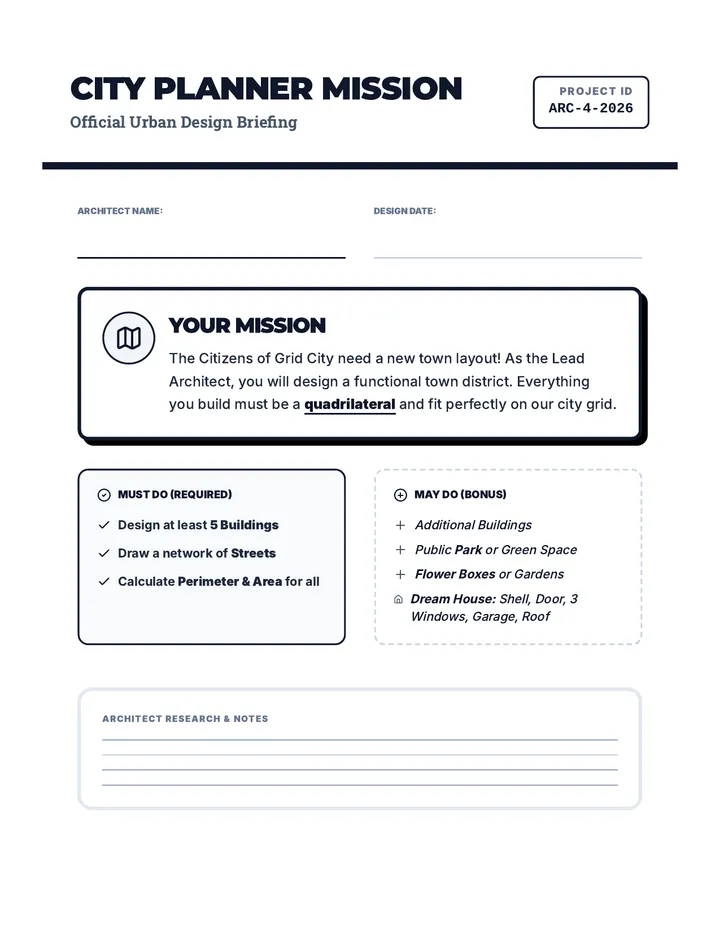
City Planner Mission Guide

Grid City Architects

Students act as urban architects to design a town using quadrilaterals on a grid, calculating perimeter and area for their structures.

TC

Tracey Craft

5
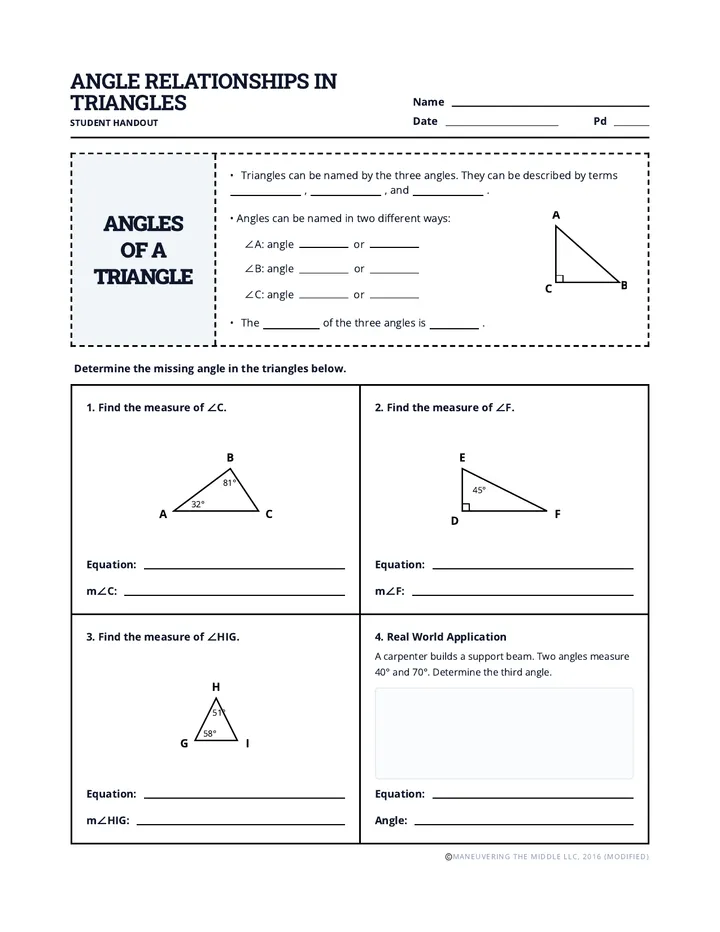
Triangle Sum Secrets Handout

Triangle Sum Secrets

A simplified lesson on the Triangle Sum Rule, focusing on 3-letter angle naming and solving for missing angles using one-step equations with whole numbers.

HF

Hannah Fernandes

6
Essential Standards Tracker Document

Arizona Mastery Trackers

A collection of standards mastery tracking cards for Grade 3 Arizona students, covering Math and ELA with a consistent multi-attempt tracking system.

KB

Krista Bodkin

3
Blueprint Builders Worksheet

Blueprint Builders Review

A 20-minute review lesson on combining coordinate plotting with volume calculations, featuring structured guided review and high-leverage DOK 3 exit ticket questions.

SM

stacy maslyn

2
Math Mastermind Project Guide

Math Mastermind Academy

A project-based lesson where 3rd grade students become the teachers, creating a math lesson and a corresponding game on key concepts like fractions, area, and operations.

KB

Krista Bodkin

7