Lenny.com
Explore
Create
ActivitiesNewMathEnglish Language ArtsScience & EngineeringSocial StudiesGlobal LanguagesHealth & Physical EducationSpecial EducationCounseling & Life SkillsArts & CreativityESL
Lenny.com
Lenny.com
Explore
Create
ActivitiesNewMathEnglish Language ArtsScience & EngineeringSocial StudiesGlobal LanguagesHealth & Physical EducationSpecial EducationCounseling & Life SkillsArts & CreativityESL
Lenny.com
Lenny.com

Solutions

Lenny for EducatorsLenny for SchoolsLenny for Districts

Product

ExploreSign inCreateSupportAbout

Resources

Getting startedMTSS Acceleration Program

© 2026 Lenny Learning Inc.

TermsPrivacyAccessibility
LinkedInInstagramX
Lenny

Irrational Numbers and Approximations

Identifies irrational numbers such as non-repeating decimals and square roots of non-perfect squares. Develops skills for estimating these values and positioning them accurately on a number line.

MathNumbers & CountingCounting ObjectsNumber NamesComparing NumbersNumber OperationsCounting SequenceNumbers 0-10Place Value Understanding and SystemAdd and Subtract Within 20Addition and Subtraction ConceptsAddition and Subtraction EquationsAddition and Subtraction ProblemsFoundations for MultiplicationMultiplication and Division PropertiesMultiply and Divide Within 100Multiplication and Division ProblemsFactors and MultiplesProperties of OperationsPatterns and RelationshipsGenerate and Analyze PatternsMulti-Digit ArithmeticPlace Value OperationsMulti-Digit and Decimal OperationsNumerical ExpressionsFour Operations and PatternsFour Operations Problem SolvingMeasurement & DataMeasurable AttributesMeasuring LengthsMeasure and Estimate Lengths in Standard UnitsRelate Addition and Subtraction to LengthClassifying and Counting ObjectsTime and MoneyArea Concepts and MeasurementPerimeter and Area MeasuresAngle Concepts and MeasurementTime, Volume, and MassMeasurement Unit ConversionsGeometryIdentifying ShapesShapes and AttributesShape Attributes and ReasoningShapes and CompositionClassifying 2D FiguresGeometric Figures and RelationshipsLines, Angles, and ShapesAngle, Area, and VolumeGeometric MeasurementVolume of 3D ShapesCoordinate Plane ApplicationsTransformations in the PlaneCongruence and SimilarityUnderstand congruence in terms of rigid motionsSimilarity and TransformationsProve Theorems Involving SimilarityPythagorean TheoremTrigonometry for General TrianglesMake Geometric ConstructionsProve Geometric TheoremsTheorems About CirclesFind Arc Lengths And Areas of Sectors of CirclesVolume FormulasRelationships Between Two-Dimensional and Three-Dimensional ObjectsProve Simple Geometric Theorems AlgebraicallyTranslate Between Geometric Description and Equation for Conic SectionApply Geometric Concepts in Modeling SituationsFractions & DecimalsFractions as NumbersBuilding FractionsFraction Equivalence and OrderingAdding and Subtracting FractionsMultiplying and Dividing FractionsDividing FractionsDecimal FractionsMulti-Digit Computation and FactorsAdd, Subtract, Multiply, and Divide Rational NumbersRational Number SystemIrrational Numbers and ApproximationsRatiosRatios and ProportionsProportional RelationshipsUnit RateAlgebraAlgebraic ExpressionsGenerate Equivalent ExpressionsQuantitative RelationshipsProportional Relationships and Linear EquationsEquations and InequalitiesEquation Solving and ReasoningLinear Equations and SystemsGraph Equations and InequalitiesSystems of EquationsReal-World Algebraic ProblemsQuantitative Reasoning with UnitsExpression StructureEquivalent Expression FormsRadicals and Integer ExponentsRational ExponentsRational and Irrational NumbersPolynomial OperationsPolynomial IdentitiesPolynomial Zeros and FactorsRational ExpressionsComplex Number OperationsComplex Numbers in PolynomialsComplex Numbers on PlaneStatistics & ProbabilityRepresent and Interpret DataData DistributionsStatistical VariabilityProbability ModelsCompound Event ProbabilitiesStatistical SamplingInterpret Categorical and Quantitative DataBivariate Data PatternsInterpret Linear ModelsComparing Two PopulationsRandom Processes in StatisticsIndependence and Conditional ProbabilityExpected ValuesProbability-Based Decision MakingStatistical Inference and ConclusionsFunctionsFunction Concepts and NotationDefine and Compare FunctionsInterpret Functions in ContextAnalyze Function RepresentationsModel Relationships with FunctionsIdentify Linear vs Exponential GrowthDistinguish Between Function TypesCompare Growth RatesInterpret Function ExpressionsBuild Functions from RelationshipsConstruct and Model FunctionsTransform and Combine FunctionsModel Comparison and SelectionSolve Exponential EquationsTrigonometryTrigonometric Ratios Involving Right TrianglesTrigonometric Functions and Unit CircleModel with Trigonometric FunctionsTrigonometric IdentitiesVectors & MatricesIntroduction to Vectors and MatricesVector QuantitiesVector OperationsMatrix OperationsCalculusLimits and ContinuityDerivative Concepts and NotationDerivative Rules and TechniquesApplications of DerivativesOptimization ProblemsRelated RatesCurve Sketching and AnalysisIntegration Concepts and NotationAntiderivatives and Indefinite IntegralsDefinite Integrals and AreaFundamental Theorem of CalculusIntegration TechniquesApplications of IntegrationDifferential EquationsSequences and SeriesParametric and Polar FunctionsVector-Valued Functions

Videos

How to Simplify Square and Cube Roots

How to Simplify Square and Cube Roots

This educational video provides a clear, step-by-step guide on how to simplify square roots, moving beyond basic perfect squares to more complex, non-perfect numbers. Hosted by a narrator named Justin, the lesson begins by reviewing the inverse relationship between squaring and square roots using familiar perfect squares like 49 and 36. It then introduces the core technique for simplifying non-perfect squares: prime factorization. The video demonstrates how to break numbers down into their prime factors, identify pairs, and "pull them out" of the radical to create a simplified expression. The content covers key algebraic themes including prime factorization, the properties of radicals, and the distinction between rational and irrational numbers. It provides detailed walkthroughs of three specific examples: the square root of 216, the square root of 810, and an extension problem involving the cube root of 250. Through these examples, the video establishes a consistent algorithm: factor the number inside the radical, group identical factors (pairs for square roots, triplets for cube roots), move one representative from each group outside the radical, and multiply the remaining terms. For educators, this video serves as an excellent instructional tool for Algebra I or Pre-Algebra classes. It demystifies a procedural skill that often confuses students by providing a visual and logical method (the pairing strategy) rather than just rote memorization. The clear visual layout, where factors are grouped and moved explicitly, helps students visualize the mathematical operations. It is particularly useful for introducing the concept of exact form versus decimal approximation and prepares students for future topics involving radical operations and variables.

Miacademy & MiaPrep Learning ChannelMiacademy & MiaPrep Learning Channel

5mins 17s

ACT Math Practice Test: Review of Algebra, Geometry, and Trig Concepts

ACT Math Practice Test: Review of Algebra, Geometry, and Trig Concepts

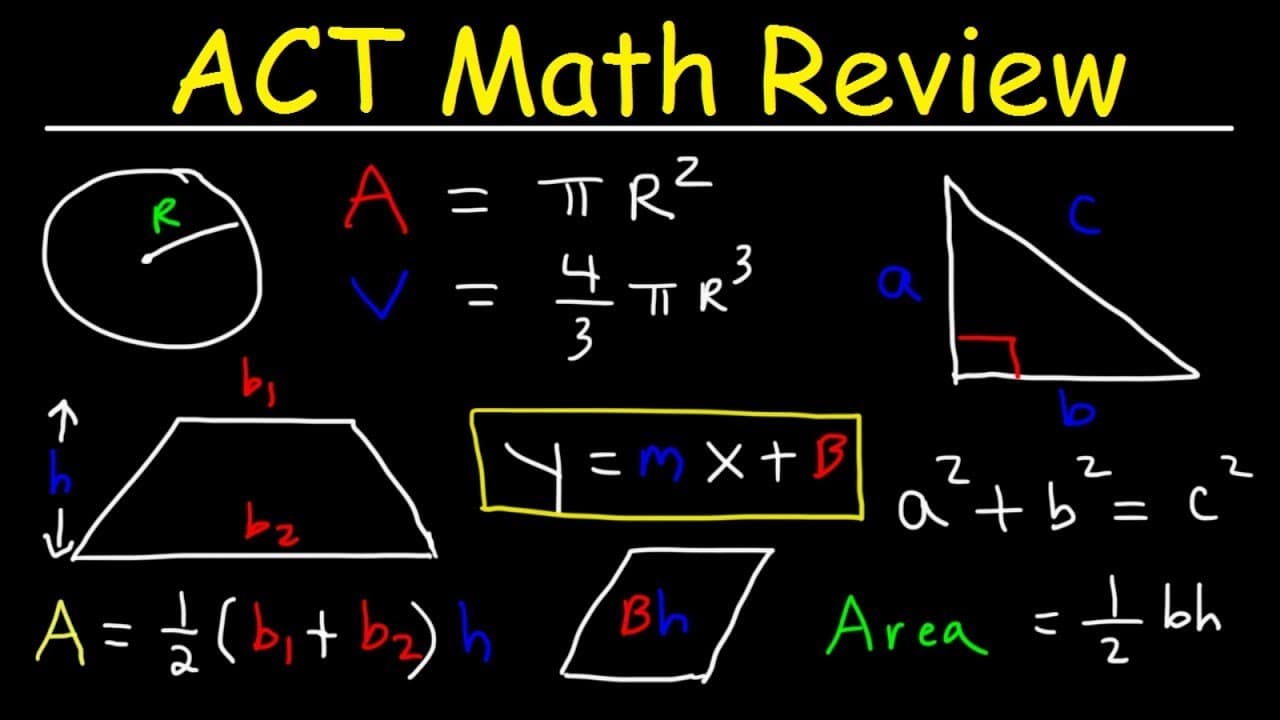
This comprehensive video tutorial serves as an intensive review for the ACT Math section, covering a wide array of topics crucial for high school students preparing for college entrance exams. The content is structured as a series of 31 practice problems that mimic the style and difficulty of actual ACT questions. It progresses through various mathematical domains including pre-algebra, elementary algebra, intermediate algebra, coordinate geometry, plane geometry, and trigonometry. The video adopts a pause-and-practice format, encouraging active participation where viewers attempt each problem before watching the detailed step-by-step solution. Key themes explored in this review include solving linear and quadratic equations, working with functions, understanding geometric properties of polygons and circles, applying trigonometric ratios (SOH CAH TOA) and identities, and analyzing statistical data. The video also places a strong emphasis on real-world application problems involving percentages, sales tax, discounts, and unit conversions. Particular attention is given to algebraic manipulation strategies, such as solving systems of equations and simplifying complex expressions, as well as test-taking tactics like identifying key information in word problems. For educators and students, this video is a valuable resource for standardized test preparation. It allows teachers to identify specific areas of weakness in student understanding by isolating problem types (e.g., if a student struggles with problem 10, they need more support with circle geometry). The step-by-step explanations model clear mathematical reasoning, demonstrating not just *how* to get the right answer, but *why* specific methods work. This makes it an excellent tool for flipped classrooms, homework support, or intensive boot-camp style review sessions prior to test dates.
The Organic Chemistry TutorThe Organic Chemistry Tutor

20mins 33s

Simplifying Radicals and Understanding Rational Exponents

Simplifying Radicals and Understanding Rational Exponents

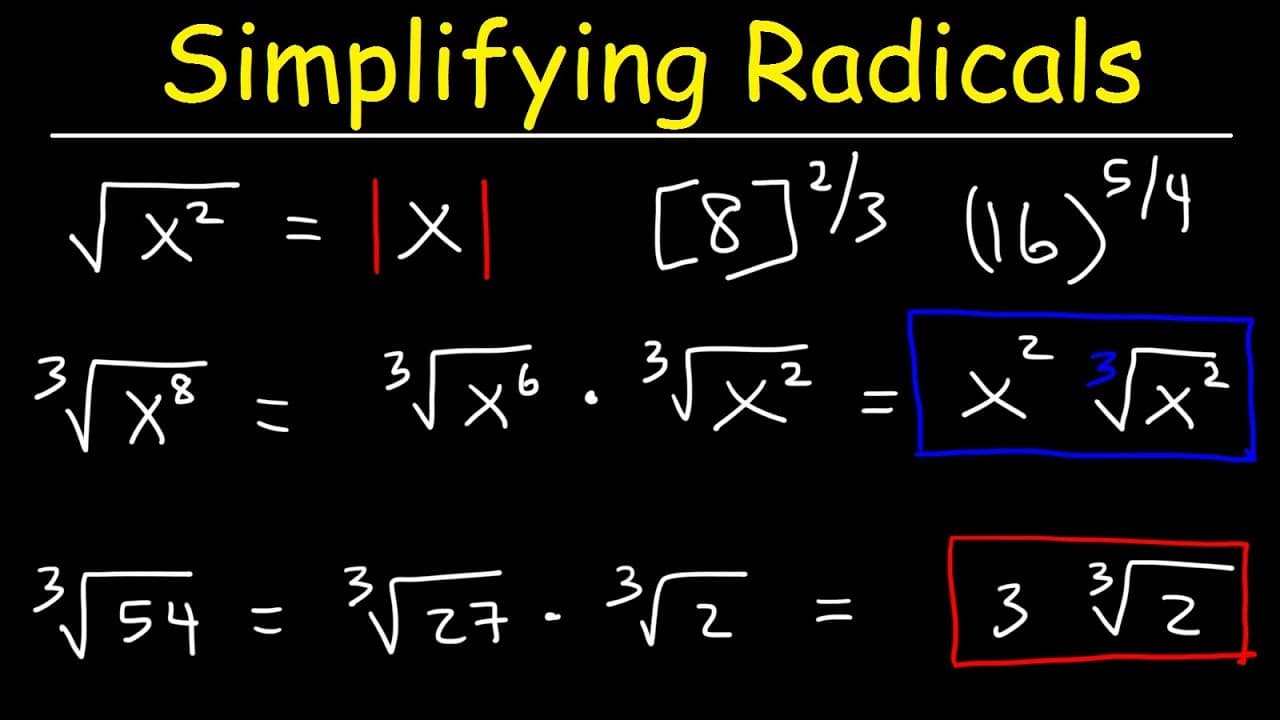
This comprehensive math tutorial guides students through the process of simplifying radicals, starting with basic square roots and progressing to higher-order roots and rational exponents. The video employs a step-by-step approach on a digital whiteboard, clearly demonstrating the algebraic rules governing indices, exponents, and absolute value requirements. It serves as a thorough review of properties of exponents and radicals typically found in Algebra courses. The content covers several key mathematical themes: the relationship between root indices and exponents, the specific condition requiring absolute value notation (even index resulting in an odd exponent), and methods for simplifying non-perfect squares and cubes. It also provides detailed lists of perfect squares and perfect cubes to aid in mental math and simplification. Later sections bridge the gap between radical notation and exponential notation, showing how to convert between the two and evaluate numbers raised to fractional powers. For educators, this video is a valuable resource for reinforcing concepts in Algebra I and Algebra II. It addresses common student pitfalls, such as forgetting the absolute value symbol or struggling with fractional exponents. The clear, isolated examples allow teachers to use specific segments for targeted practice, making it ideal for a flipped classroom model or as a supplementary resource for remediation and test preparation.

The Organic Chemistry TutorThe Organic Chemistry Tutor

17mins 58s

How to Rationalize the Denominator with Radicals and Conjugates

How to Rationalize the Denominator with Radicals and Conjugates

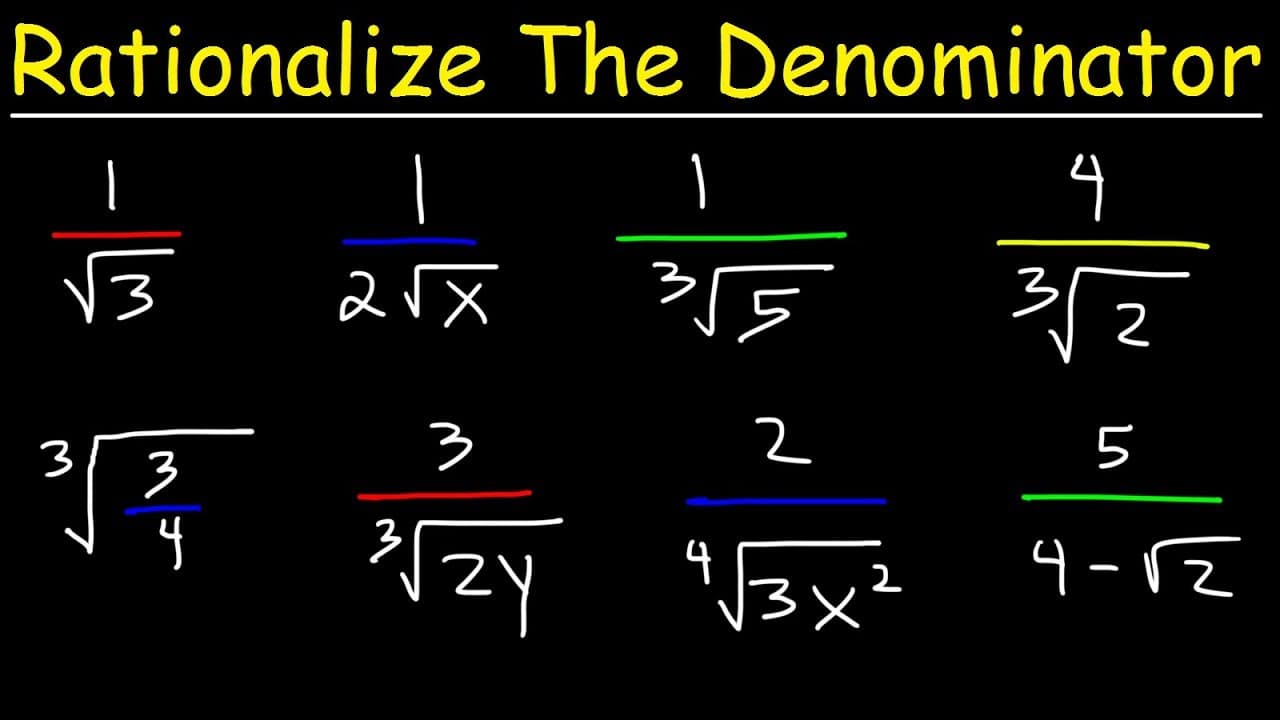
This comprehensive mathematics tutorial provides a step-by-step guide on how to rationalize denominators containing various types of radicals. The video begins with the fundamental concept of eliminating square roots from the denominator by multiplying by the root itself. It progressively advances to more complex scenarios, including fractions with variables, cube roots, and higher-order roots (4th and 7th roots). For these higher indexes, the narrator explains the critical rule of multiplying by a radical where the exponents sum up to the index number to create a perfect power that eliminates the root.

The Organic Chemistry TutorThe Organic Chemistry Tutor

10mins 4s

Algebra 1 Final Exam Review: From Arithmetic to Logarithms

Algebra 1 Final Exam Review: From Arithmetic to Logarithms

This comprehensive video serves as a rapid-fire review of core algebra concepts, ranging from basic arithmetic operations to advanced equation solving. It begins by establishing a foundation with number systems, including real, rational, and imaginary numbers, before moving into fundamental operations with integers, fractions, and decimals. The instructor demonstrates various techniques for arithmetic, such as the number line for integers and the 'keep-change-flip' method for dividing fractions, ensuring viewers have the prerequisite skills for algebra. The content progresses into key algebraic topics including exponents, radicals, and polynomial factoring. Viewers are guided through the laws of exponents, simplifying complex radical expressions, and converting between exponential and radical forms. A significant portion of the video is dedicated to solving different types of equations: linear equations involving fractions, quadratic equations using both factoring and the quadratic formula, and exponential and logarithmic equations. The instructor emphasizes checking for extraneous solutions, particularly with logarithmic and rational equations. This video is an invaluable resource for students preparing for an Algebra 1 final exam or an Algebra 2 placement test. Its modular structure allows teachers to use specific segments for targeted review or as a complete overview of the curriculum. The step-by-step problem-solving approach models mathematical thinking, making it ideal for classroom observation, homework support, or 'flipped classroom' assignments where students review the theory at home and solve problems in class.

The Organic Chemistry TutorThe Organic Chemistry Tutor

12mins 10s

Estimating Square Roots of Non-Perfect Numbers

Estimating Square Roots of Non-Perfect Numbers

This educational math video guides students through the process of finding and estimating square roots for non-perfect square numbers. Hosted by an instructor named Justin and narrated with clear visual aids, the video moves beyond basic perfect squares to explore how to estimate roots for whole numbers, decimals, and fractions using number line logic and proximity. It emphasizes that square roots exist for almost all numbers, not just perfect squares, and demonstrates how to use known perfect squares as benchmarks for estimation. Key themes include number sense, estimation strategies, and the properties of radicals. The video covers using a number line to visualize where a square root falls between two integers, determining which integer a root is closer to based on the original number's value, and a specific "secret trick" for finding square roots of fractions by splitting the root to the numerator and denominator. It also compares solving fraction roots by splitting versus converting to decimals. This video is highly valuable for middle school math classrooms, particularly for introducing irrational numbers and estimation. It helps students build intuition about the magnitude of radicals without immediately reaching for a calculator. The clear breakdown of the fraction property (Quotient Property of Radicals) provides a practical algebraic tool, while the estimation segments support strong mental math skills. The video ends with an inquiry-based challenge prompting students to discover which type of number does not have a real square root.

Miacademy & MiaPrep Learning ChannelMiacademy & MiaPrep Learning Channel

4mins 32s

Materials

Irrational Plotting Worksheet

Irrational Plotting Worksheet

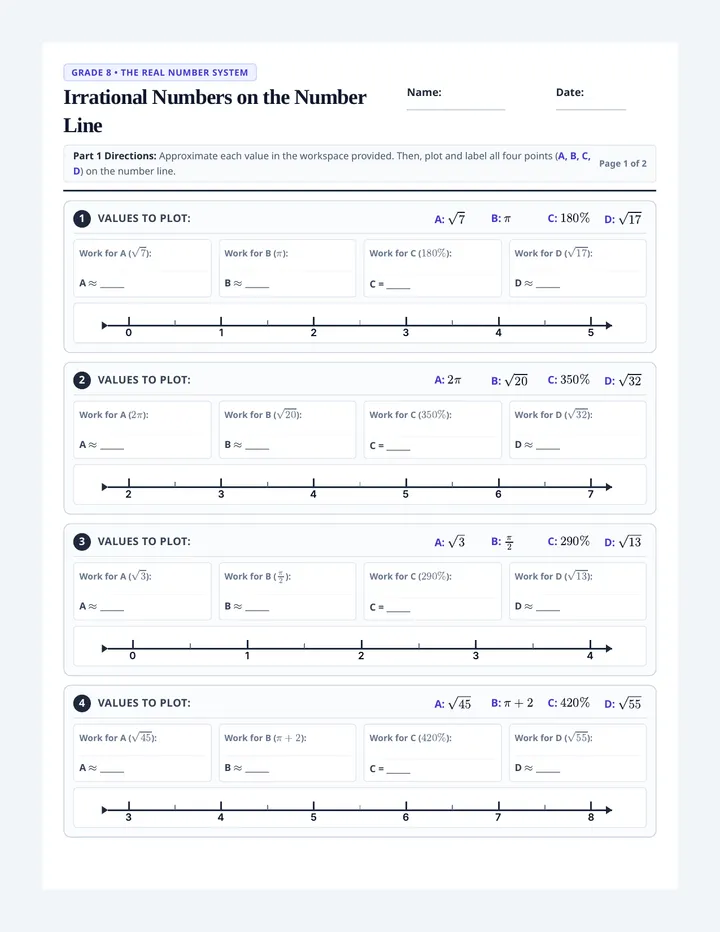
A two-page printable math worksheet featuring four plotting problems on page 1 and four True/False comparison and number line analysis questions on page 2, mixing square roots, pi expressions, and percents with ample student workspaces.

CD

Craig Davis

Square Roots Guided Notes

Square Roots Guided Notes

Finalized two-page guided notes handout for Estimating Square Roots: Page 1 features modeled problem 1, scaffolded problem 2, and blank number lines for problems 3-5 with ample handwriting space. Page 2 seamlessly renumbers all problems from 6 through 10, provides extra spacing under both multi-point number lines (8 and 9), and concludes with True/False error analysis (10) and lesson synthesis.

CD

Craig Davis

Sequences

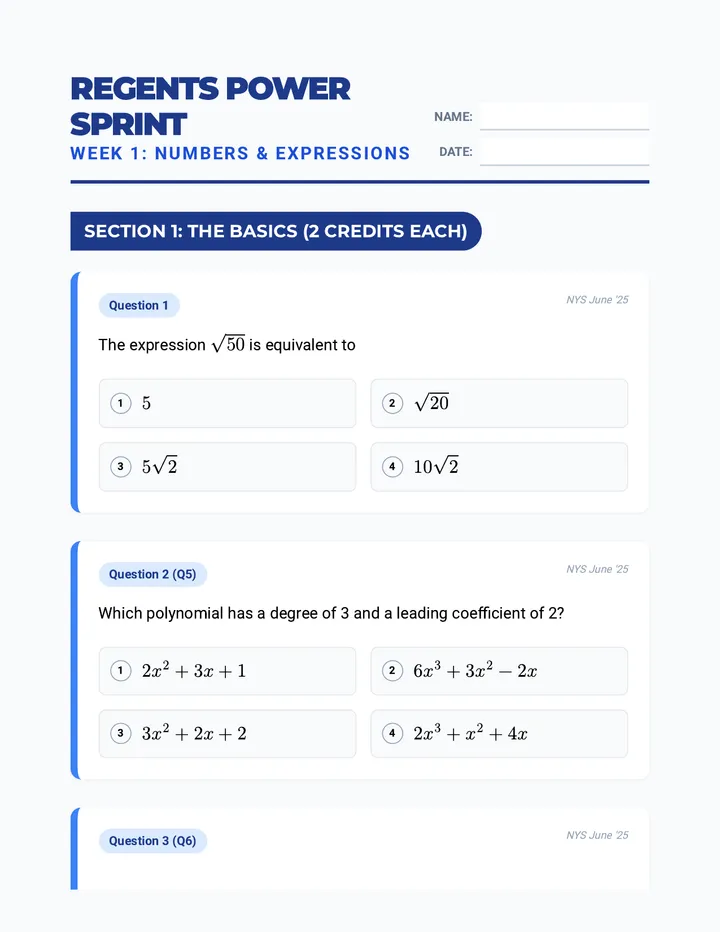
Week 1 Power Sprint Worksheet

Regents Road Map

A comprehensive 10-week preparation sequence designed to get students ready for the Algebra I Regents exam by May 15th, featuring bi-weekly 30-minute practice sessions and visual anchor charts.

L

laura.clar

31
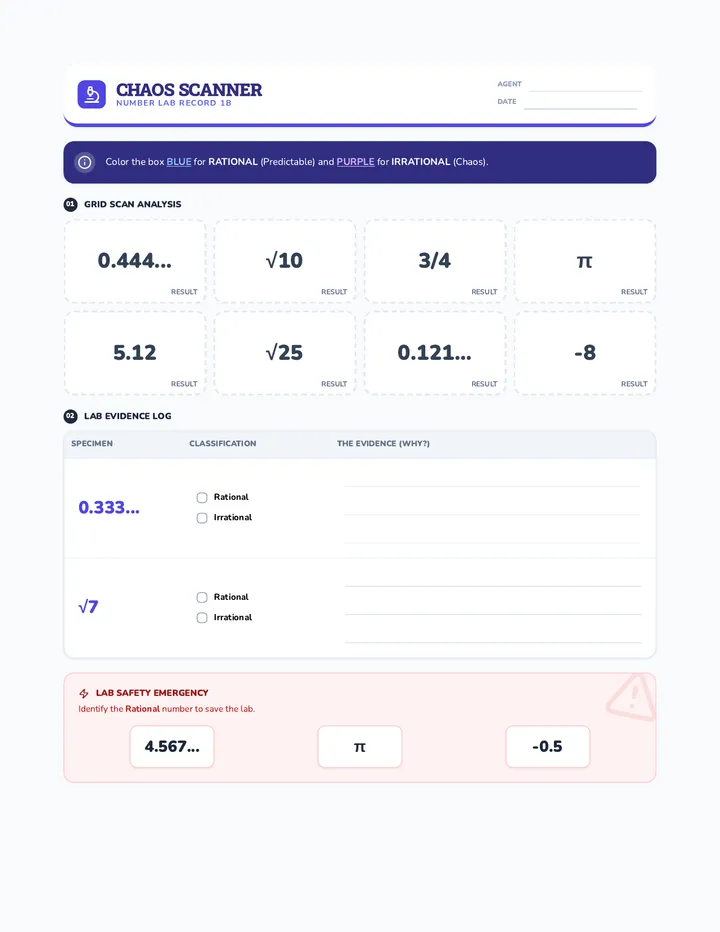
Chaos Scanner Worksheet

Number Lab Real Numbers

A 4-day introductory unit on the Real Number System designed for special education classrooms, focusing on identifying rational and irrational numbers, converting repeating decimals, and estimating square roots with high-scaffold supports.

BR

Brandon Ruffin

19
Morning Work Cover Page

Brain Blueprint Math Review

A comprehensive 5-day math review sequence designed for middle school students preparing for state testing. The sequence covers number systems, expressions, ratios, geometry, and statistics through a 'Brain Blueprint' theme.

AA

alicia accapezzato

7
Foundations Slides

Algebra Archive Review

A comprehensive 3-day review sequence for the Algebra I Regents examination, focusing on foundations, systems, and polynomial operations. Each 75-minute lesson provides a balance of guided instruction and independent practice with problems modeled after the NYS Interim Assessment.

AO

Archie Olson

9
Sign Language Slides

Math Mastery

A series of lessons designed to build fluency in mathematical notation and operations through visual and tactile learning.

BC

Brenda Coombs

9
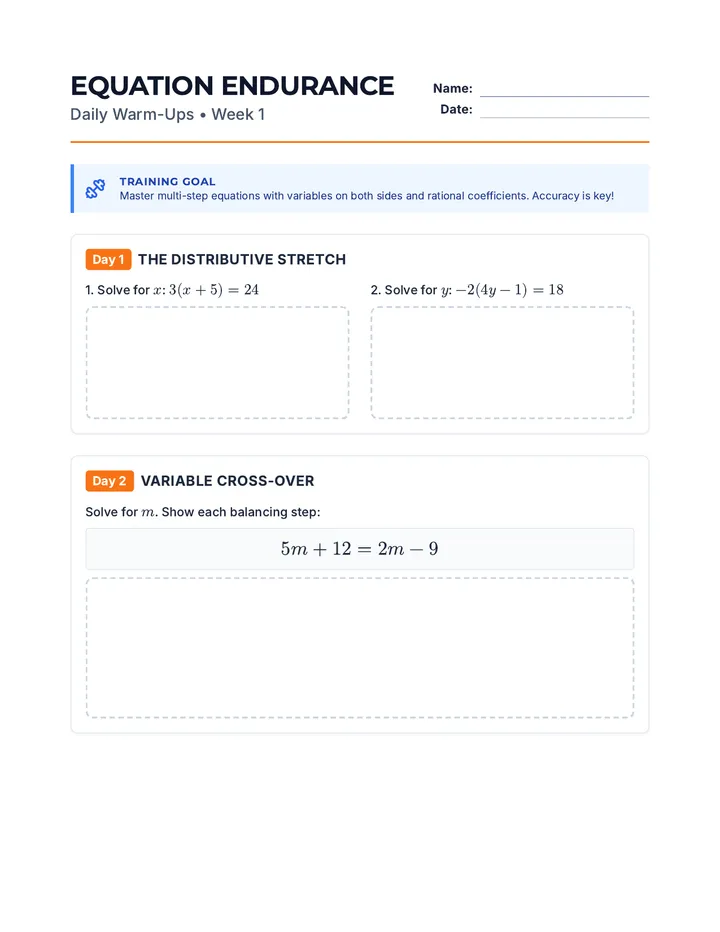
Equation Endurance Warm-Ups

Empire State Math Marathon

A comprehensive 7-week NYS Math Assessment preparation sequence for 8th grade, covering major clusters including algebra, functions, geometry, and statistics.

AG

Anna Gomez

30

Lessons

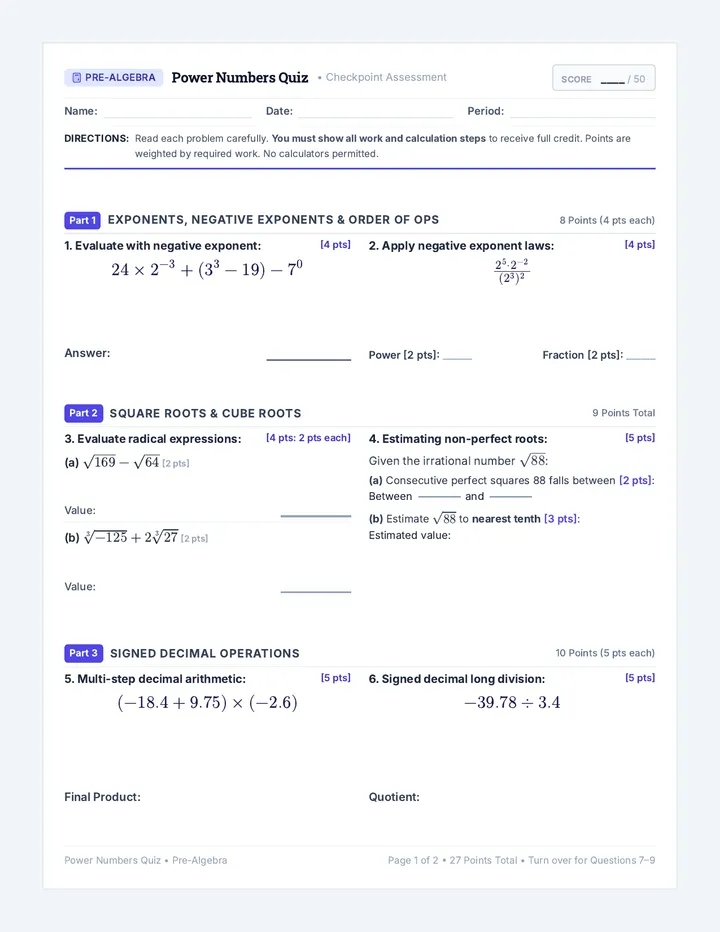
Power Numbers Quiz

Power Numbers Checkpoint

A pre-algebra checkpoint assessing exponents, square and cube roots, prime factorization, decimal arithmetic, and scientific notation with number ordering.

CS

Chynna Smith

4
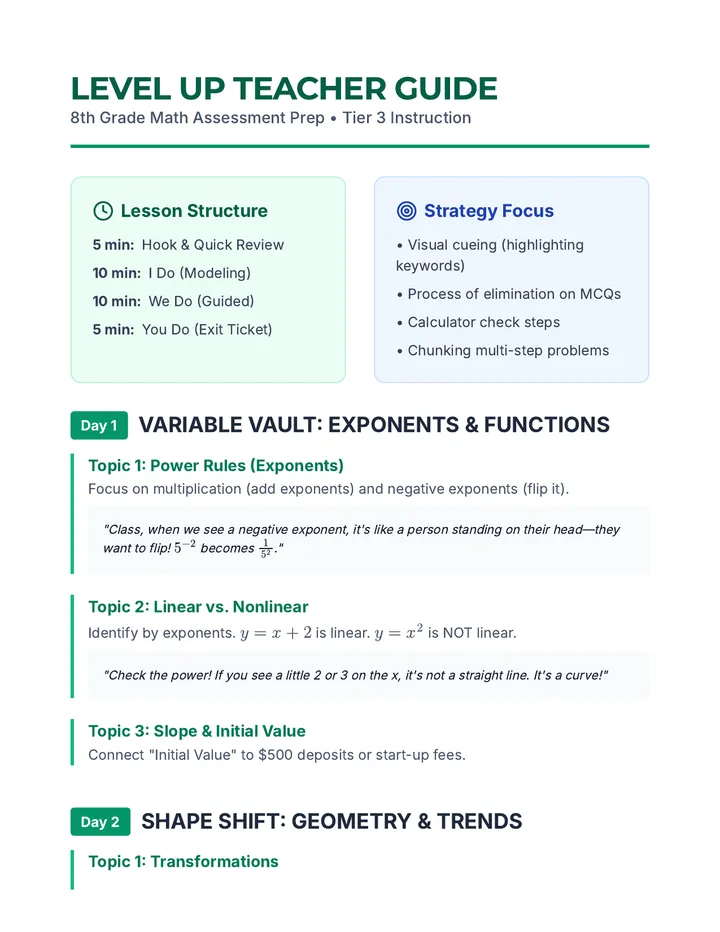
Level Up Teacher Guide

Level Up Math Review

A specialized two-day review sequence for 8th-grade Tier 3 students, focusing on high-frequency assessment topics: exponents, linear functions, transformations, and scatter plots. Each 30-minute lesson uses a 'Model, Guide, Practice' framework to build confidence and accuracy.

L

laura.clar

10
Radical Products Notes

Radical Multiplication Basics

A lesson on multiplying radical expressions focusing on square roots and cube roots with numerical radicands. Students will learn the product property of radicals and apply it to simplify expressions.

CK

Cheydon Krysl

3
Number Map Notes Handout

Number Neighborhoods

Students will learn to classify and place real numbers into their appropriate subsets: Natural, Whole, Integers, Rational, and Irrational numbers, using a Venn diagram model.

K

kstanfield

4
Number Realms Guided Notes

Real Number Realms

A comprehensive lesson on TEKS 8.2.A focusing on the classification and relationship between different sets of real numbers (Whole, Integers, Rational, and Irrational). Students will use visual representations to master the hierarchy of number systems.

K

kstanfield

3
Radical Remix Guided Notes

Radical Remix

A comprehensive lesson on adding and multiplying numerical radicals using a record-shop 'Remix' theme. Includes guided notes and a practice worksheet focusing on horizontal operations.

CK

Cheydon Krysl

3