Lenny.com
Explore
Create
ActivitiesNewMathEnglish Language ArtsScience & EngineeringSocial StudiesGlobal LanguagesHealth & Physical EducationSpecial EducationCounseling & Life SkillsArts & CreativityESL
Lenny.com
Lenny.com
Explore
Create
ActivitiesNewMathEnglish Language ArtsScience & EngineeringSocial StudiesGlobal LanguagesHealth & Physical EducationSpecial EducationCounseling & Life SkillsArts & CreativityESL
Lenny.com
Lenny.com

Solutions

Lenny for EducatorsLenny for SchoolsLenny for Districts

Product

ExploreSign inCreateSupportAbout

Resources

Getting startedMTSS Acceleration Program

© 2026 Lenny Learning Inc.

TermsPrivacyAccessibility
LinkedInInstagramX
Lenny

Limits and Continuity

Fundamental concepts of limits, including one-sided and infinite limits, to analyze function behavior. Establishes formal criteria for continuity at points and across intervals as the basis for differentiation.

MathNumbers & CountingCounting ObjectsNumber NamesComparing NumbersNumber OperationsCounting SequenceNumbers 0-10Place Value Understanding and SystemAdd and Subtract Within 20Addition and Subtraction ConceptsAddition and Subtraction EquationsAddition and Subtraction ProblemsFoundations for MultiplicationMultiplication and Division PropertiesMultiply and Divide Within 100Multiplication and Division ProblemsFactors and MultiplesProperties of OperationsPatterns and RelationshipsGenerate and Analyze PatternsMulti-Digit ArithmeticPlace Value OperationsMulti-Digit and Decimal OperationsNumerical ExpressionsFour Operations and PatternsFour Operations Problem SolvingMeasurement & DataMeasurable AttributesMeasuring LengthsMeasure and Estimate Lengths in Standard UnitsRelate Addition and Subtraction to LengthClassifying and Counting ObjectsTime and MoneyArea Concepts and MeasurementPerimeter and Area MeasuresAngle Concepts and MeasurementTime, Volume, and MassMeasurement Unit ConversionsGeometryIdentifying ShapesShapes and AttributesShape Attributes and ReasoningShapes and CompositionClassifying 2D FiguresGeometric Figures and RelationshipsLines, Angles, and ShapesAngle, Area, and VolumeGeometric MeasurementVolume of 3D ShapesCoordinate Plane ApplicationsTransformations in the PlaneCongruence and SimilarityUnderstand congruence in terms of rigid motionsSimilarity and TransformationsProve Theorems Involving SimilarityPythagorean TheoremTrigonometry for General TrianglesMake Geometric ConstructionsProve Geometric TheoremsTheorems About CirclesFind Arc Lengths And Areas of Sectors of CirclesVolume FormulasRelationships Between Two-Dimensional and Three-Dimensional ObjectsProve Simple Geometric Theorems AlgebraicallyTranslate Between Geometric Description and Equation for Conic SectionApply Geometric Concepts in Modeling SituationsFractions & DecimalsFractions as NumbersBuilding FractionsFraction Equivalence and OrderingAdding and Subtracting FractionsMultiplying and Dividing FractionsDividing FractionsDecimal FractionsMulti-Digit Computation and FactorsAdd, Subtract, Multiply, and Divide Rational NumbersRational Number SystemIrrational Numbers and ApproximationsRatiosRatios and ProportionsProportional RelationshipsUnit RateAlgebraAlgebraic ExpressionsGenerate Equivalent ExpressionsQuantitative RelationshipsProportional Relationships and Linear EquationsEquations and InequalitiesEquation Solving and ReasoningLinear Equations and SystemsGraph Equations and InequalitiesSystems of EquationsReal-World Algebraic ProblemsQuantitative Reasoning with UnitsExpression StructureEquivalent Expression FormsRadicals and Integer ExponentsRational ExponentsRational and Irrational NumbersPolynomial OperationsPolynomial IdentitiesPolynomial Zeros and FactorsRational ExpressionsComplex Number OperationsComplex Numbers in PolynomialsComplex Numbers on PlaneStatistics & ProbabilityRepresent and Interpret DataData DistributionsStatistical VariabilityProbability ModelsCompound Event ProbabilitiesStatistical SamplingInterpret Categorical and Quantitative DataBivariate Data PatternsInterpret Linear ModelsComparing Two PopulationsRandom Processes in StatisticsIndependence and Conditional ProbabilityExpected ValuesProbability-Based Decision MakingStatistical Inference and ConclusionsFunctionsFunction Concepts and NotationDefine and Compare FunctionsInterpret Functions in ContextAnalyze Function RepresentationsModel Relationships with FunctionsIdentify Linear vs Exponential GrowthDistinguish Between Function TypesCompare Growth RatesInterpret Function ExpressionsBuild Functions from RelationshipsConstruct and Model FunctionsTransform and Combine FunctionsModel Comparison and SelectionSolve Exponential EquationsTrigonometryTrigonometric Ratios Involving Right TrianglesTrigonometric Functions and Unit CircleModel with Trigonometric FunctionsTrigonometric IdentitiesVectors & MatricesIntroduction to Vectors and MatricesVector QuantitiesVector OperationsMatrix OperationsCalculusLimits and ContinuityDerivative Concepts and NotationDerivative Rules and TechniquesApplications of DerivativesOptimization ProblemsRelated RatesCurve Sketching and AnalysisIntegration Concepts and NotationAntiderivatives and Indefinite IntegralsDefinite Integrals and AreaFundamental Theorem of CalculusIntegration TechniquesApplications of IntegrationDifferential EquationsSequences and SeriesParametric and Polar FunctionsVector-Valued Functions

Videos

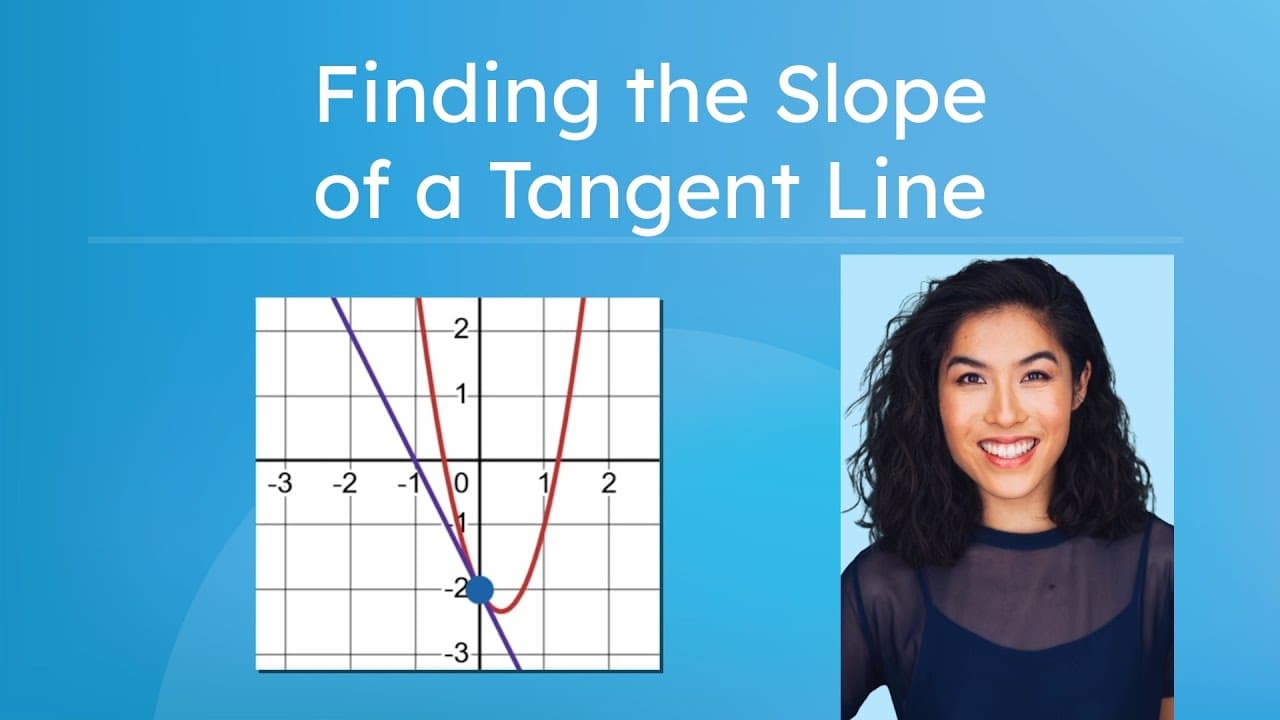
Finding the Slope of a Tangent Line Using Limits

Finding the Slope of a Tangent Line Using Limits

This educational video introduces the fundamental calculus concept of finding the slope of a tangent line using limits. It bridges the gap between algebra and calculus by demonstrating how the slope formula, which typically requires two points, can be adapted to find the slope at a single point on a curve. The video uses visual animations of secant lines approaching a tangent line to make this abstract concept concrete and understandable.

Miacademy & MiaPrep Learning ChannelMiacademy & MiaPrep Learning Channel

9mins 42s

What Is the Number e and How Do We Calculate It?

What Is the Number e and How Do We Calculate It?

This educational video provides a comprehensive overview of the mathematical constant e, also known as Euler's number. It begins by defining e as an irrational number approximately equal to 2.718, commonly found in exponential functions and logarithms. The narrator then explores the origins of e through three distinct mathematical approaches: the formula for compound interest as the compounding frequency approaches infinity, the limit of (1 + n)^(1/n) as n approaches zero, and the infinite series of the reciprocals of factorials. Key themes include the relationship between discrete and continuous growth, the concept of limits and infinity in mathematics, and the unique properties of exponential functions in calculus. The video bridges the gap between algebraic financial formulas and advanced calculus concepts, demonstrating how a simple question about interest rates leads to the discovery of a fundamental constant of the universe. For educators, this video serves as an excellent bridge between Algebra II, Pre-Calculus, and Calculus. It visualizes abstract definitions, provides concrete numerical evidence for limits, and introduces the profound calculus properties of e^x—specifically that its slope and the area under its curve are equal to its value. This makes it a versatile tool for introducing the constant to beginners or deepening the understanding of advanced students studying derivatives and integrals.
The Organic Chemistry TutorThe Organic Chemistry Tutor

12mins 11s

Evaluating Limits of Function Products and Quotients Graphically

Evaluating Limits of Function Products and Quotients Graphically

This video provides a clear, step-by-step tutorial on evaluating limits for combined functions using graphical data. The narrator guides viewers through two distinct examples: the limit of a product of functions and the limit of a quotient of functions. By applying fundamental limit properties, the video demonstrates how to break down complex expressions into simpler components that can be evaluated visually from provided graphs. The content explores key calculus themes including the product and quotient laws for limits, the distinction between a function's value and its limit, one-sided limits (left-hand vs. right-hand), and continuity. It specifically addresses the scenario where a limit does not exist due to division by zero, helping students recognize this critical mathematical condition. For educators, this video serves as an excellent bridge between algebraic limit laws and graphical interpretation. It is particularly useful for helping students develop visual intuition for calculus concepts. Teachers can use this resource to reinforce how to read function behavior near specific points and to spark discussions about why limits might exist even when a function is undefined at a point, or conversely, why they might fail to exist.

Khan AcademyKhan Academy

4mins 9s

Introduction to Calculus Limits with Puzzles and Graphs

Introduction to Calculus Limits with Puzzles and Graphs

This video provides an accessible and intuitive introduction to the calculus concept of limits, designed specifically for Pre-Calculus or introductory Calculus students. It begins by using a relatable jigsaw puzzle analogy to explain how we can determine the shape of a missing piece by examining the surrounding pieces. This metaphor is then seamlessly translated into mathematical terms, demonstrating how to determine the value of a function at an undefined point by analyzing the function's behavior at nearby values.

Miacademy & MiaPrep Learning ChannelMiacademy & MiaPrep Learning Channel

12mins 12s

Understanding Limits, Continuity, and Discontinuities

Understanding Limits, Continuity, and Discontinuities

This video provides a comprehensive overview of limits and continuity in precalculus, moving beyond one-sided limits to the full definition of an overall limit. It explains that for an overall limit to exist, the left-hand and right-hand limits must be equal. The lesson uses visual graphs to introduce the concept of continuity informally as tracing a curve without lifting a pencil, and then categorizes different types of discontinuities: removable (holes), jump, infinite (asymptotes), and oscillating.

Miacademy & MiaPrep Learning ChannelMiacademy & MiaPrep Learning Channel

14mins 28s

Mastering Limits at Infinity and Horizontal Asymptotes

Mastering Limits at Infinity and Horizontal Asymptotes

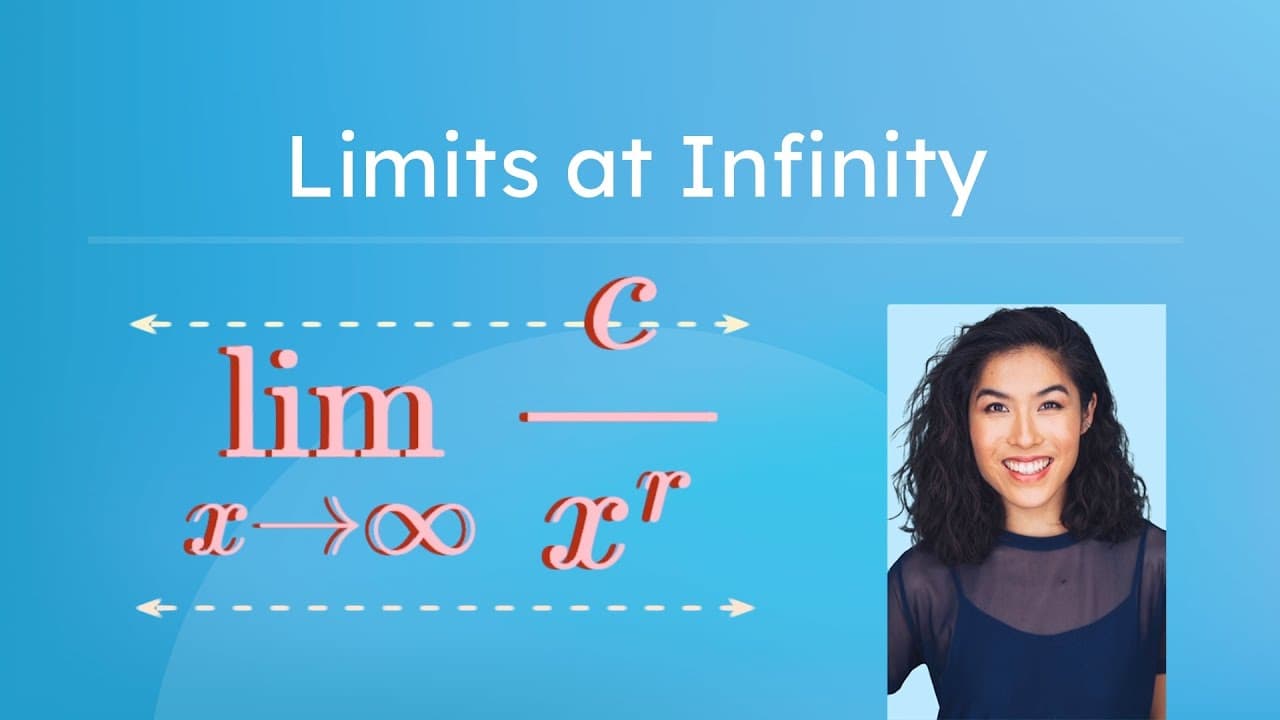
This educational video provides a comprehensive guide to understanding limits at infinity, a fundamental concept in Precalculus and Calculus. It bridges the gap between graphical intuition and algebraic rigor by connecting limits at infinity directly to the concept of horizontal asymptotes. The video progresses from visual inspection of rational function graphs to formal definitions using limit notation, and finally to analytic methods for evaluating limits without graphing calculators. The content explores key themes such as end behavior, rational functions, and the algebraic manipulation required to solving limits. It specifically addresses how the degrees of the numerator and denominator influence the limit, covering three main cases: when the denominator's degree is higher (limit is 0), when degrees are equal (limit is the ratio of leading coefficients), and when the numerator's degree is higher (limit is infinite or DNE). It also touches upon special cases involving oscillating trigonometric functions and exponential functions. For educators, this video is an excellent resource for introducing or reinforcing the concept of end behavior in a rigorous way. It moves beyond simple memorization of rules by explaining the "why" behind them through the technique of dividing by the highest power of x. The clear step-by-step examples make it suitable for flipped classrooms, review sessions, or as a primary instructional tool for introducing the analytic evaluation of limits.

Miacademy & MiaPrep Learning ChannelMiacademy & MiaPrep Learning Channel

17mins 40s

Materials

Asymptote & Limit Lab Worksheet

Asymptote & Limit Lab Worksheet

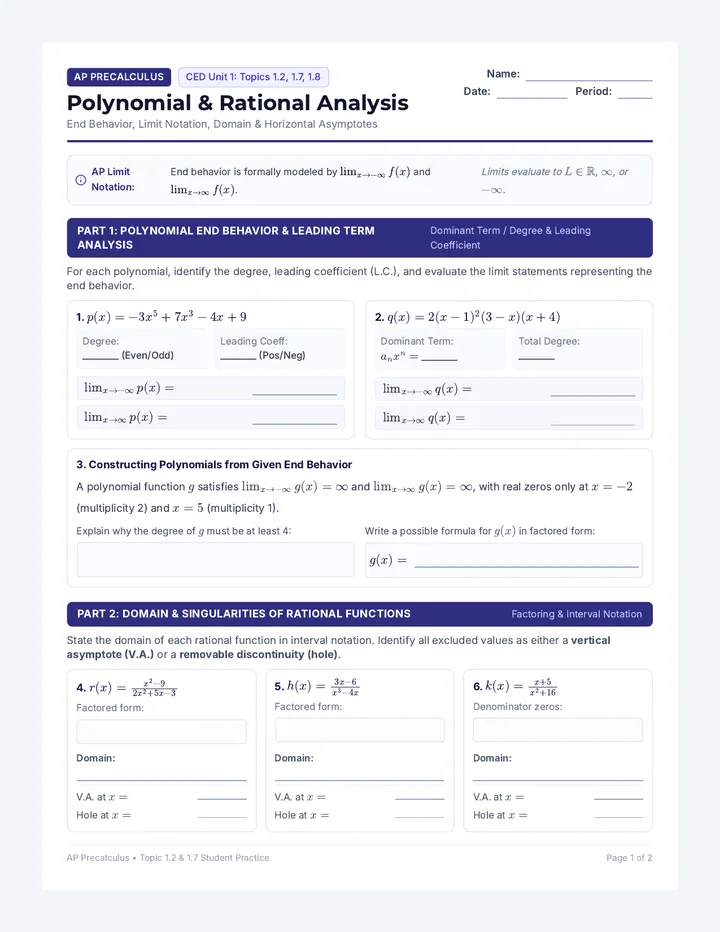
A comprehensive 2-page AP Precalculus worksheet covering polynomial end behavior using limit notation, rational function domains, and end behavior including horizontal asymptotes with AP-style analysis questions.

R

Robinson

Limit Mastery Station Slides

Limit Mastery Station Slides

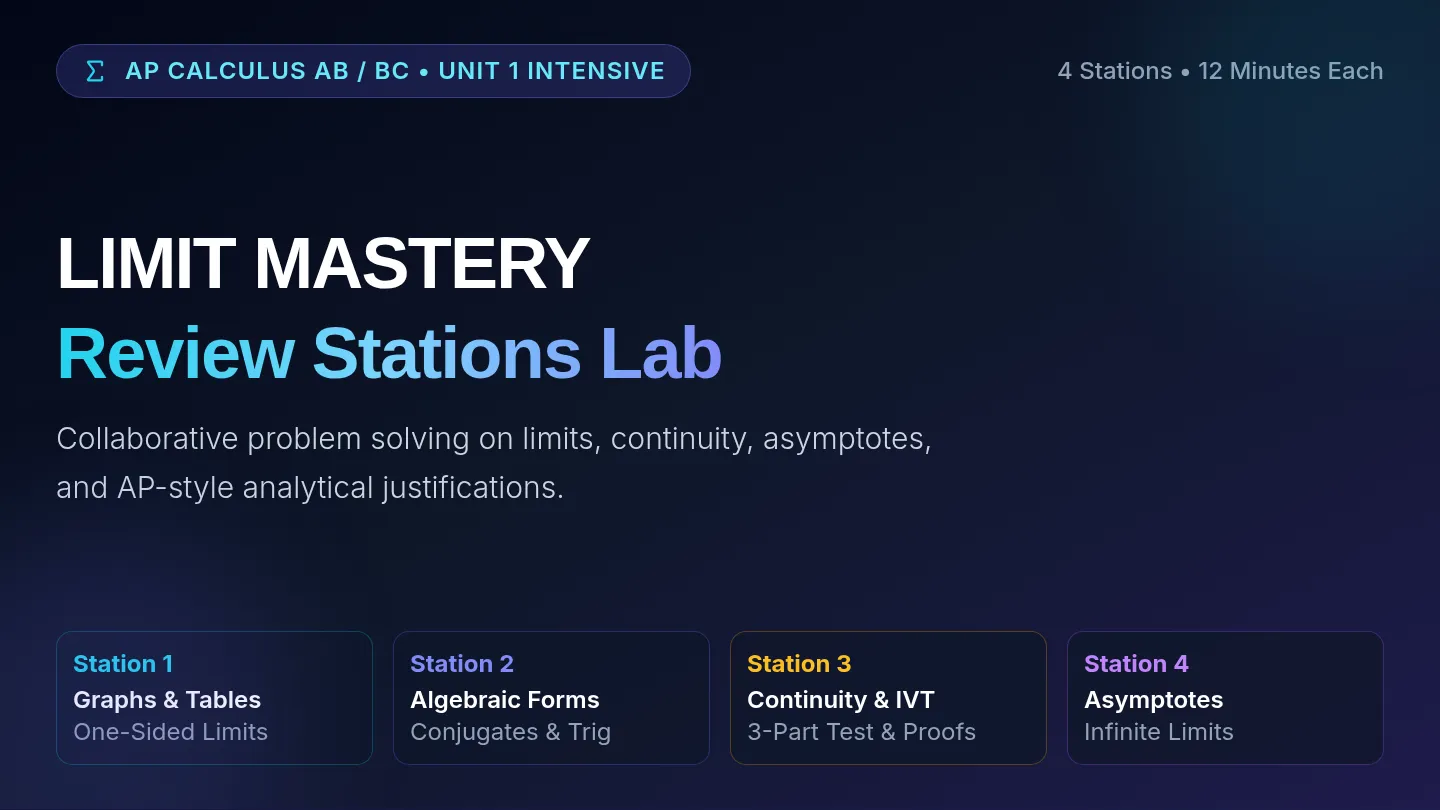
Interactive AP Calculus review presentation guiding students through four timed stations on limits and continuity. Includes station challenges, AP exam tips, and transition cues.

KM

Kristen Miracle

Infinite Limits Sketch Worksheet

Infinite Limits Sketch Worksheet

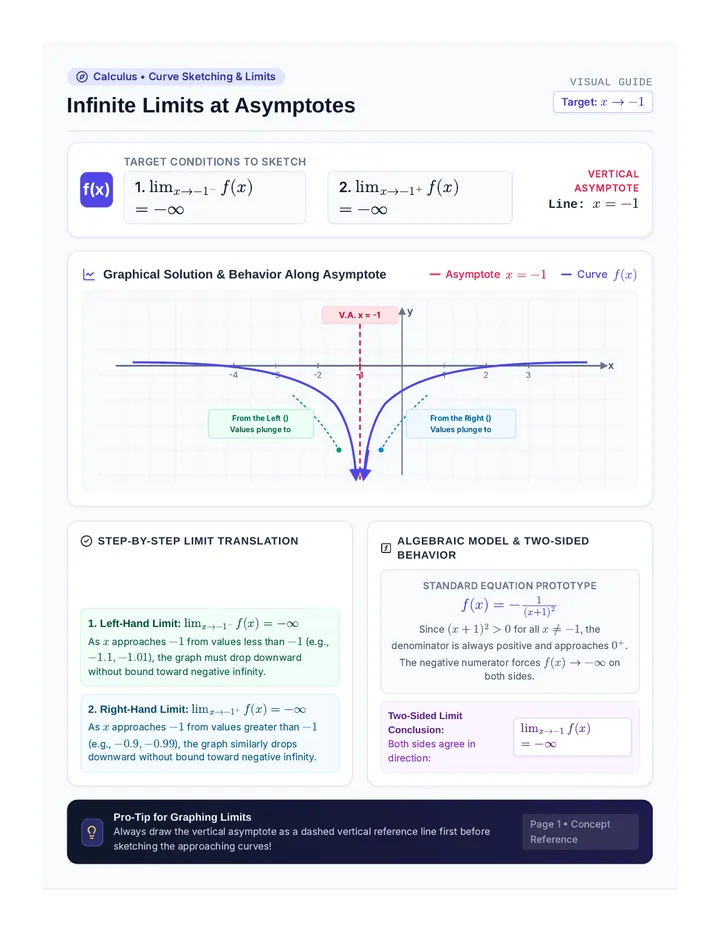
A comprehensive two-page calculus reference guide and student sketching lab for infinite limits, featuring an accurate mathematical coordinate graph of f(x) with one-sided limits approaching negative infinity at x = -1, analytical breakdowns, algebraic models, and guided practice problems.

R

Robinson

Limit Storyboard Worksheet

Limit Storyboard Worksheet

A group activity worksheet where students create 'Limit Stories' by translating real-world constraints into one-sided limit notation and graphs.

Sequences

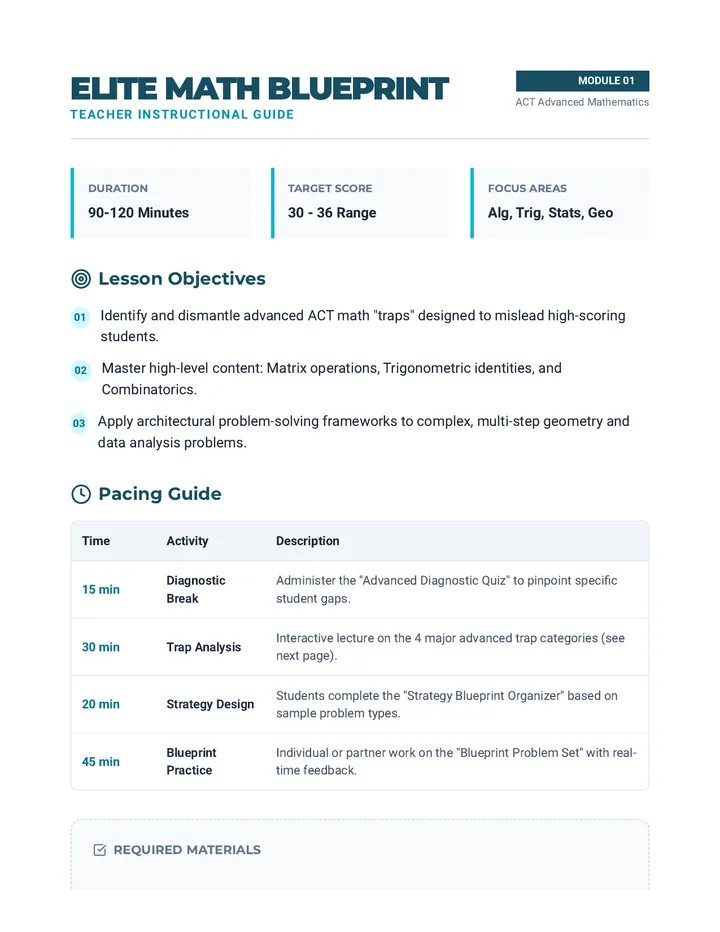
Elite Math Teacher Guide

Advanced ACT Mastery

A comprehensive prep sequence for the most challenging questions on the ACT Math and Science sections. It focuses on high-level conceptual blueprints for math topics like complex numbers and matrices, alongside speed-reading and data-interpretation strategies for the Science section.

AL

ava larumbe

29
Ratio Test Teacher Guide

Series Blueprinting

This advanced sequence introduces powerful tools for analyzing series with factorials and powers, leading to the concept of power series. Students master the Ratio and Root tests, explore absolute versus conditional convergence, and conclude by connecting series to functions through Taylor polynomials.

21
Case File Teacher Guide

Calculus Foundations

A series of higher-level mathematics lessons exploring calculus foundations through engaging, thematic activities and visual demonstrations.

5
Limit Threshold Slides

Rigorous Proofs in Analysis

An undergraduate-level introduction to Real Analysis focusing on the formal epsilon-N definition of limits, proof construction, Cauchy sequences, and the Bolzano-Weierstrass Theorem. Students transition from computational calculus to rigorous mathematical proof.

10
Fixed Point Slides

Iterative Insights

This sequence explores numerical analysis through the lens of sequences, focusing on iterative methods to approximate solutions to complex equations. Students investigate fixed-point iteration, Newton's method, convergence rates, and the transition into chaotic behavior.

10
Limit Horizons Slides

Infinite Destinations

This sequence guides undergraduate students from an intuitive understanding of sequence limits to rigorous analysis using algebraic laws, the Squeeze Theorem, L'Hôpital's Rule, and the Monotone Convergence Theorem. Students will explore how infinite processes behave as they approach infinity, bridging the gap between discrete sequences and continuous calculus.

11

Lessons

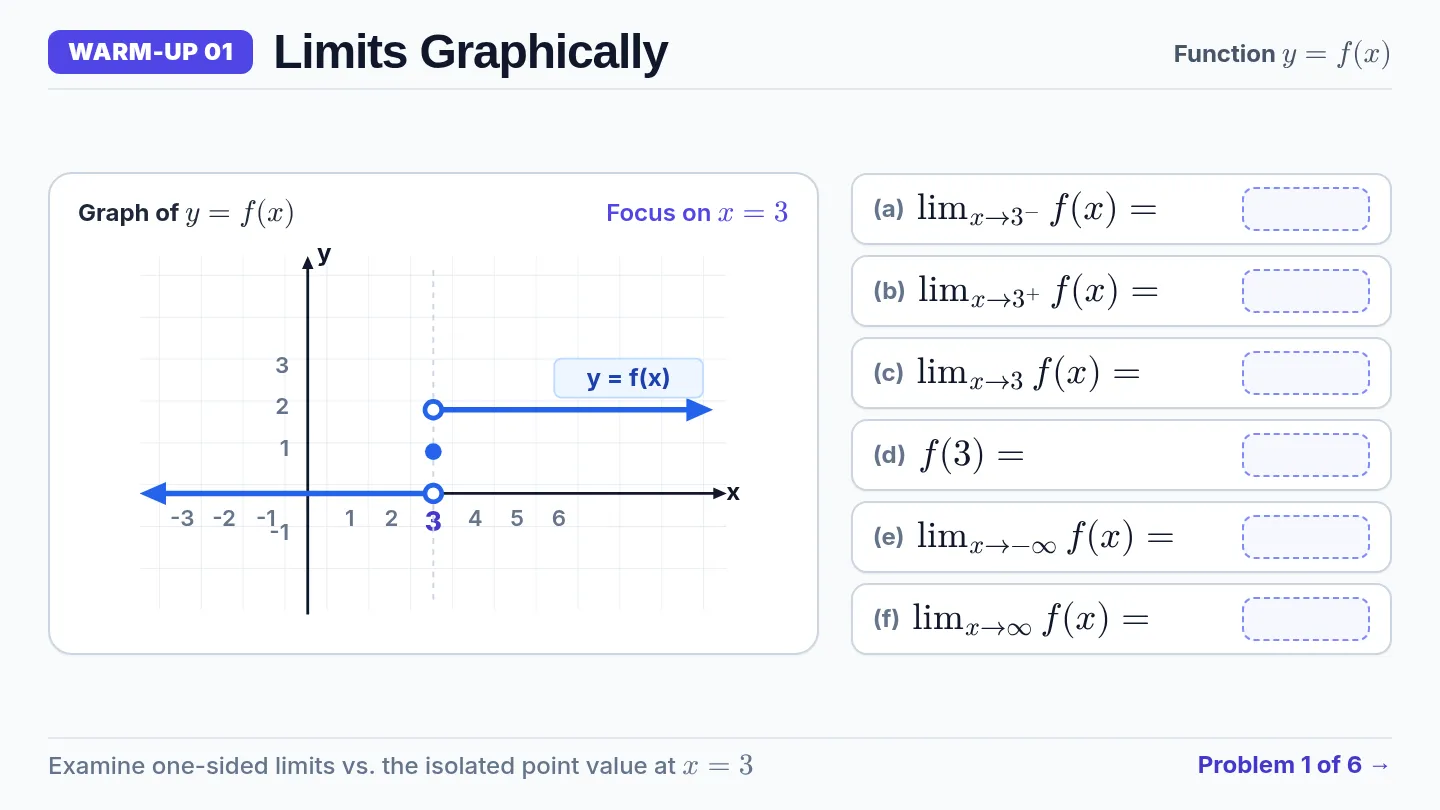
Limits Graphically Slides

Limits Graphically

A calculus lesson exploring limits from graphical representations, covering one-sided limits, removable and jump discontinuities, vertical asymptotes, and limit existence.

J

jfrisk

2
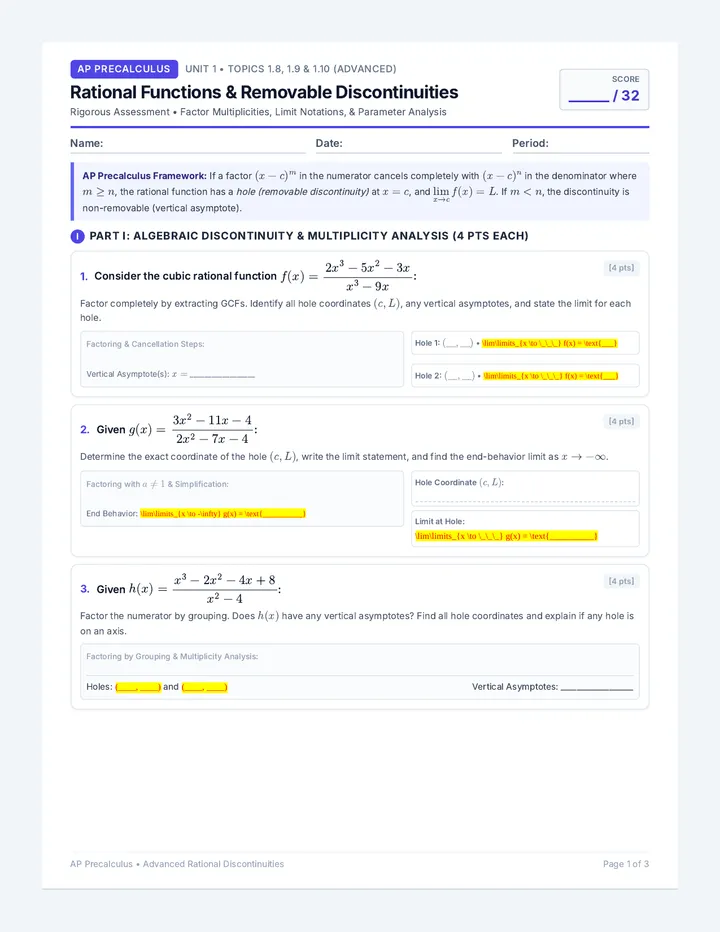
Hole Hunter Mini Assessment

Holes and Limits Assessment

A focused AP Precalculus mini-assessment and worked solutions key targeting rational functions, removable discontinuities (holes), graphical limit notations, and numerical table investigations.

R

Robinson

2
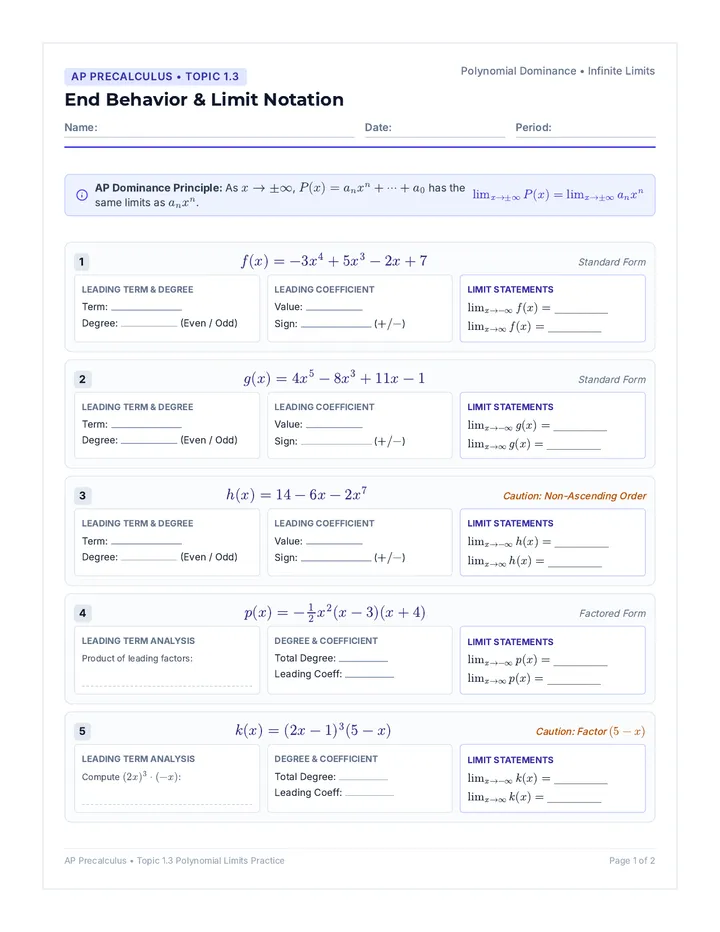
End Behavior Limits Worksheet

Limit Horizons

An AP Precalculus lesson on analyzing and expressing the end behavior of polynomial functions using formal limit notation. Students determine the leading term, analyze degree parity and leading coefficient signs, and evaluate limits as x approaches positive and negative infinity across standard and factored forms.

R

Robinson

2
Polynomial Power Review Packet

Polynomial Power Review

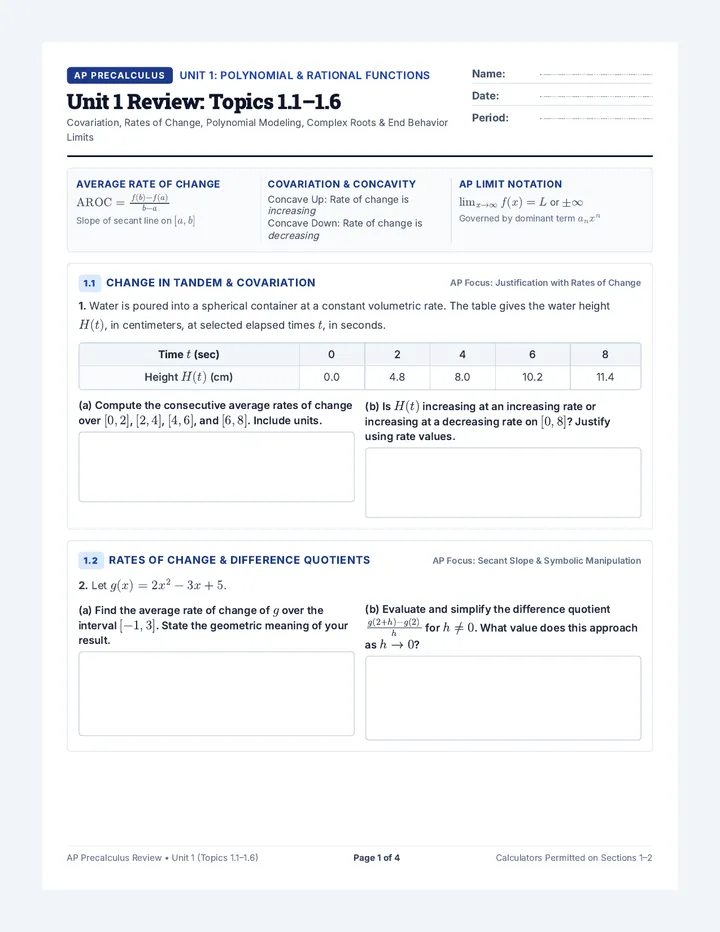
A comprehensive AP Precalculus Unit 1 review covering Topics 1.1 through 1.6, featuring student practice problems with AP-style reasoning and a full teacher scoring guide.

2
Pathfinder Lab Worksheet

Pathfinder Continuity

A Precalculus lesson focusing on the informal definition of continuity through the 'pencil test' and identifying the four main types of discontinuities: removable, jump, infinite, and oscillating. Students engage in a hands-on card sort to classify functions based on their graphical behavior.

3
Limit Logic Teacher Guide

Limit Logic vs Function Facts

A comprehensive calculus lesson focused on the critical distinction between the value of a function at a point and the limit as it approaches that point, featuring video analysis and a 'True/False/Fix' activity.

3