Lenny.com
Explore
Create
ActivitiesNewMathEnglish Language ArtsScience & EngineeringSocial StudiesGlobal LanguagesHealth & Physical EducationSpecial EducationCounseling & Life SkillsArts & CreativityESL
Lenny.com
Lenny.com
Explore
Create
ActivitiesNewMathEnglish Language ArtsScience & EngineeringSocial StudiesGlobal LanguagesHealth & Physical EducationSpecial EducationCounseling & Life SkillsArts & CreativityESL
Lenny.com
Lenny.com

Solutions

Lenny for EducatorsLenny for SchoolsLenny for Districts

Product

ExploreSign inCreateSupportAbout

Resources

Getting startedMTSS Acceleration Program

© 2026 Lenny Learning Inc.

TermsPrivacyAccessibility
LinkedInInstagramX
Lenny

Systems of Equations

Simultaneous solution methods including substitution, elimination, and graphing for linear systems. Examines intersection points, parallel lines, and infinite solution sets in algebraic and real-world contexts.

MathNumbers & CountingCounting ObjectsNumber NamesComparing NumbersNumber OperationsCounting SequenceNumbers 0-10Place Value Understanding and SystemAdd and Subtract Within 20Addition and Subtraction ConceptsAddition and Subtraction EquationsAddition and Subtraction ProblemsFoundations for MultiplicationMultiplication and Division PropertiesMultiply and Divide Within 100Multiplication and Division ProblemsFactors and MultiplesProperties of OperationsPatterns and RelationshipsGenerate and Analyze PatternsMulti-Digit ArithmeticPlace Value OperationsMulti-Digit and Decimal OperationsNumerical ExpressionsFour Operations and PatternsFour Operations Problem SolvingMeasurement & DataMeasurable AttributesMeasuring LengthsMeasure and Estimate Lengths in Standard UnitsRelate Addition and Subtraction to LengthClassifying and Counting ObjectsTime and MoneyArea Concepts and MeasurementPerimeter and Area MeasuresAngle Concepts and MeasurementTime, Volume, and MassMeasurement Unit ConversionsGeometryIdentifying ShapesShapes and AttributesShape Attributes and ReasoningShapes and CompositionClassifying 2D FiguresGeometric Figures and RelationshipsLines, Angles, and ShapesAngle, Area, and VolumeGeometric MeasurementVolume of 3D ShapesCoordinate Plane ApplicationsTransformations in the PlaneCongruence and SimilarityUnderstand congruence in terms of rigid motionsSimilarity and TransformationsProve Theorems Involving SimilarityPythagorean TheoremTrigonometry for General TrianglesMake Geometric ConstructionsProve Geometric TheoremsTheorems About CirclesFind Arc Lengths And Areas of Sectors of CirclesVolume FormulasRelationships Between Two-Dimensional and Three-Dimensional ObjectsProve Simple Geometric Theorems AlgebraicallyTranslate Between Geometric Description and Equation for Conic SectionApply Geometric Concepts in Modeling SituationsFractions & DecimalsFractions as NumbersBuilding FractionsFraction Equivalence and OrderingAdding and Subtracting FractionsMultiplying and Dividing FractionsDividing FractionsDecimal FractionsMulti-Digit Computation and FactorsAdd, Subtract, Multiply, and Divide Rational NumbersRational Number SystemIrrational Numbers and ApproximationsRatiosRatios and ProportionsProportional RelationshipsUnit RateAlgebraAlgebraic ExpressionsGenerate Equivalent ExpressionsQuantitative RelationshipsProportional Relationships and Linear EquationsEquations and InequalitiesEquation Solving and ReasoningLinear Equations and SystemsGraph Equations and InequalitiesSystems of EquationsReal-World Algebraic ProblemsQuantitative Reasoning with UnitsExpression StructureEquivalent Expression FormsRadicals and Integer ExponentsRational ExponentsRational and Irrational NumbersPolynomial OperationsPolynomial IdentitiesPolynomial Zeros and FactorsRational ExpressionsComplex Number OperationsComplex Numbers in PolynomialsComplex Numbers on PlaneStatistics & ProbabilityRepresent and Interpret DataData DistributionsStatistical VariabilityProbability ModelsCompound Event ProbabilitiesStatistical SamplingInterpret Categorical and Quantitative DataBivariate Data PatternsInterpret Linear ModelsComparing Two PopulationsRandom Processes in StatisticsIndependence and Conditional ProbabilityExpected ValuesProbability-Based Decision MakingStatistical Inference and ConclusionsFunctionsFunction Concepts and NotationDefine and Compare FunctionsInterpret Functions in ContextAnalyze Function RepresentationsModel Relationships with FunctionsIdentify Linear vs Exponential GrowthDistinguish Between Function TypesCompare Growth RatesInterpret Function ExpressionsBuild Functions from RelationshipsConstruct and Model FunctionsTransform and Combine FunctionsModel Comparison and SelectionSolve Exponential EquationsTrigonometryTrigonometric Ratios Involving Right TrianglesTrigonometric Functions and Unit CircleModel with Trigonometric FunctionsTrigonometric IdentitiesVectors & MatricesIntroduction to Vectors and MatricesVector QuantitiesVector OperationsMatrix OperationsCalculusLimits and ContinuityDerivative Concepts and NotationDerivative Rules and TechniquesApplications of DerivativesOptimization ProblemsRelated RatesCurve Sketching and AnalysisIntegration Concepts and NotationAntiderivatives and Indefinite IntegralsDefinite Integrals and AreaFundamental Theorem of CalculusIntegration TechniquesApplications of IntegrationDifferential EquationsSequences and SeriesParametric and Polar FunctionsVector-Valued Functions

Videos

How to Identify No Solution and Infinite Solutions Algebraically

How to Identify No Solution and Infinite Solutions Algebraically

This educational mathematics video explains how to algebraically identify systems of linear equations that have either no solution or infinitely many solutions, without needing to graph them. Building on previous knowledge of graphing, substitution, and elimination methods, the narrator demonstrates how these special cases appear during algebraic solving—specifically looking for false statements (indicating no solution) or always-true statements (indicating infinite solutions). The video walks through step-by-step examples using both the substitution and elimination methods. It shows specific algebraic manipulations where variables cancel out, leaving students to interpret the remaining constants. The narrator connects these algebraic results back to the geometric concepts of parallel lines (no solution) and identical overlapping lines (infinite solutions), reinforcing the conceptual understanding behind the math. Finally, the video provides "shortcuts" for recognizing these systems by inspection. Students learn to look for identical variable terms with different constants (no solution) or equations that are multiples of one another (infinite solutions). This resource is valuable for Algebra 1 and 8th-grade math classrooms as it bridges the gap between visual graphing concepts and abstract algebraic reasoning.

Miacademy & MiaPrep Learning ChannelMiacademy & MiaPrep Learning Channel

6mins 28s

Algebra 1 Final Exam Review: Part 1

Algebra 1 Final Exam Review: Part 1

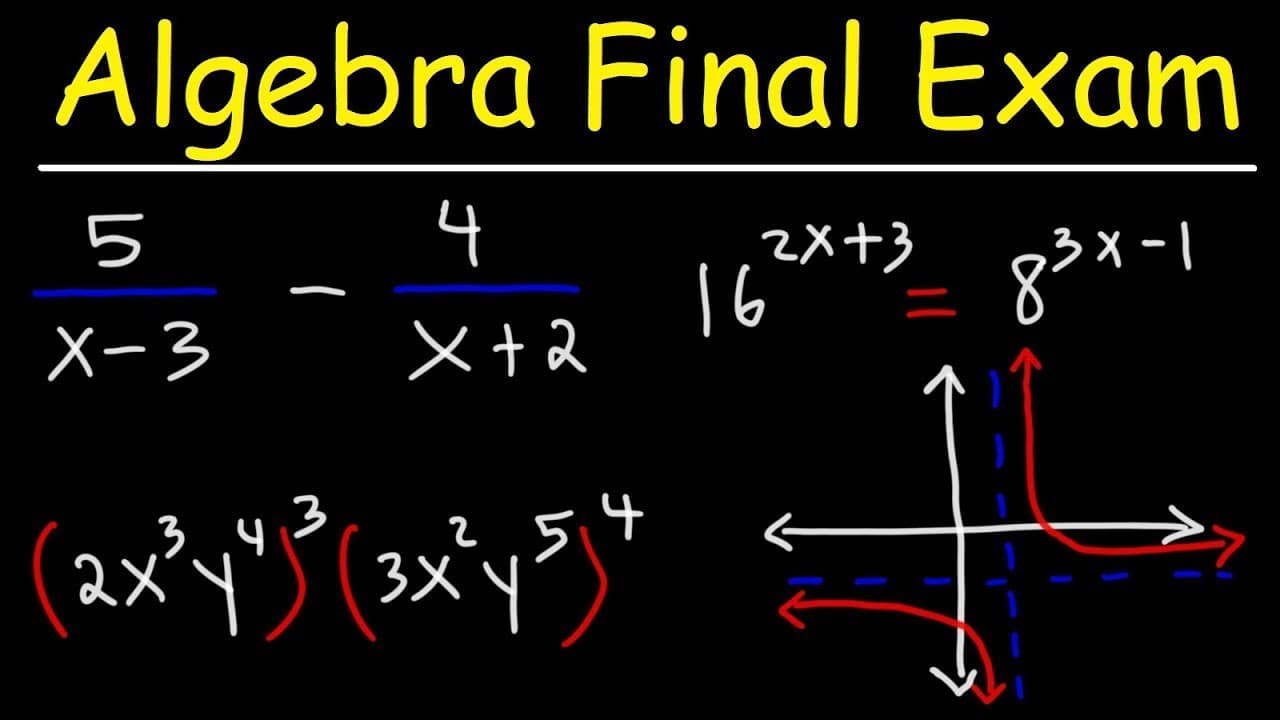
This comprehensive video serves as a targeted review for students preparing for an Algebra 1 final exam. It systematically walks through 15 distinct problem types commonly found on end-of-course assessments, covering a wide range of algebraic concepts. The video format functions as a digital tutor, presenting a problem, allowing the viewer to pause and attempt it, and then providing a detailed, step-by-step walkthrough of the solution. The instructor uses clear visual annotations on a blackboard style background to demonstrate the mechanics of each operation. Key algebraic themes explored include operations with polynomials (multiplying binomials, subtracting polynomials), linear functions (finding slope, graphing lines, matching equations to graphs), and factoring techniques (difference of squares, trinomials, difference of cubes). The video also covers solving various types of equations, including linear, quadratic, rational, and systems of equations. Additionally, it addresses exponent rules, the order of operations, and applying algebraic concepts to geometric word problems involving area and perimeter. For educators, this video is a valuable resource for review sessions, flipped classroom assignments, or differentiated instruction. It allows students to self-pace their review, focusing on areas where they need the most support. The clear explanations of multiple methods (e.g., solving quadratics by factoring vs. the quadratic formula) help reinforce conceptual understanding rather than just rote memorization. Teachers can use specific segments to reteach difficult concepts or assign the entire video as a comprehensive study guide before major assessments.

The Organic Chemistry TutorThe Organic Chemistry Tutor

55mins 8s

Understanding Rectangles: Properties and Problem Solving

Understanding Rectangles: Properties and Problem Solving

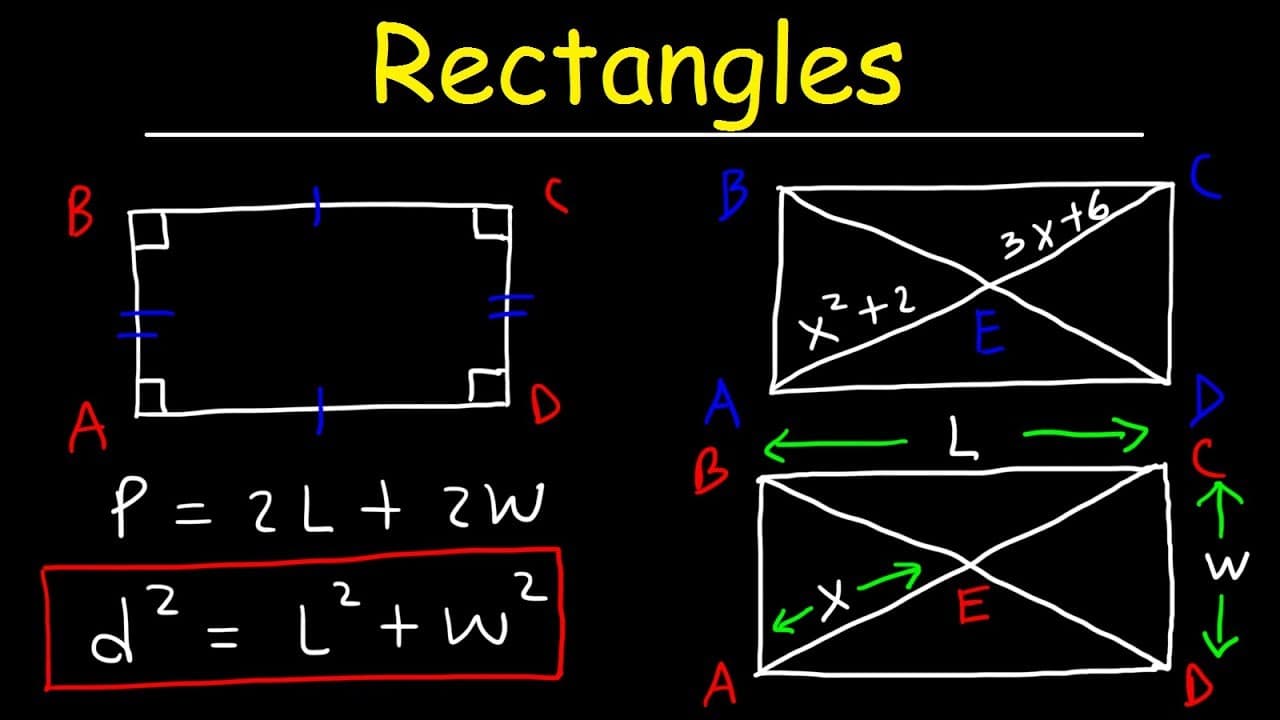
This educational video provides a comprehensive overview of rectangles, blending geometric theory with algebraic application. It begins by defining a rectangle as a specific type of quadrilateral and parallelogram, detailing essential properties such as parallel opposite sides, congruent opposite sides, and four right angles. The narrator explains the unique properties of diagonals in a rectangle, including congruency and bisection, before moving on to fundamental formulas for area, perimeter, and calculating diagonal length using the Pythagorean theorem. The video progresses from basic concepts to advanced problem-solving, demonstrating how to apply algebraic skills within a geometric context. Two complex example problems are worked through in real-time. The first involves setting up and solving a quadratic equation derived from diagonal properties to find segment lengths. The second presents a scenario where students must calculate a segment length given only the area and perimeter, requiring the creation and solution of a system of equations involving substitution and factoring. For educators, this video serves as an excellent bridge between geometry and algebra. It goes beyond simple shape identification, challenging students to use deductive reasoning and rigorous calculation. It is particularly useful for demonstrating how multiple mathematical concepts—such as systems of equations, factoring quadratics, and geometric theorems—converge in a single problem, making it a valuable resource for high school geometry or algebra curriculums.

The Organic Chemistry TutorThe Organic Chemistry Tutor

12mins 26s

Conic Sections Practice Problems: Circles, Ellipses, Parabolas, and Hyperbolas

Conic Sections Practice Problems: Circles, Ellipses, Parabolas, and Hyperbolas

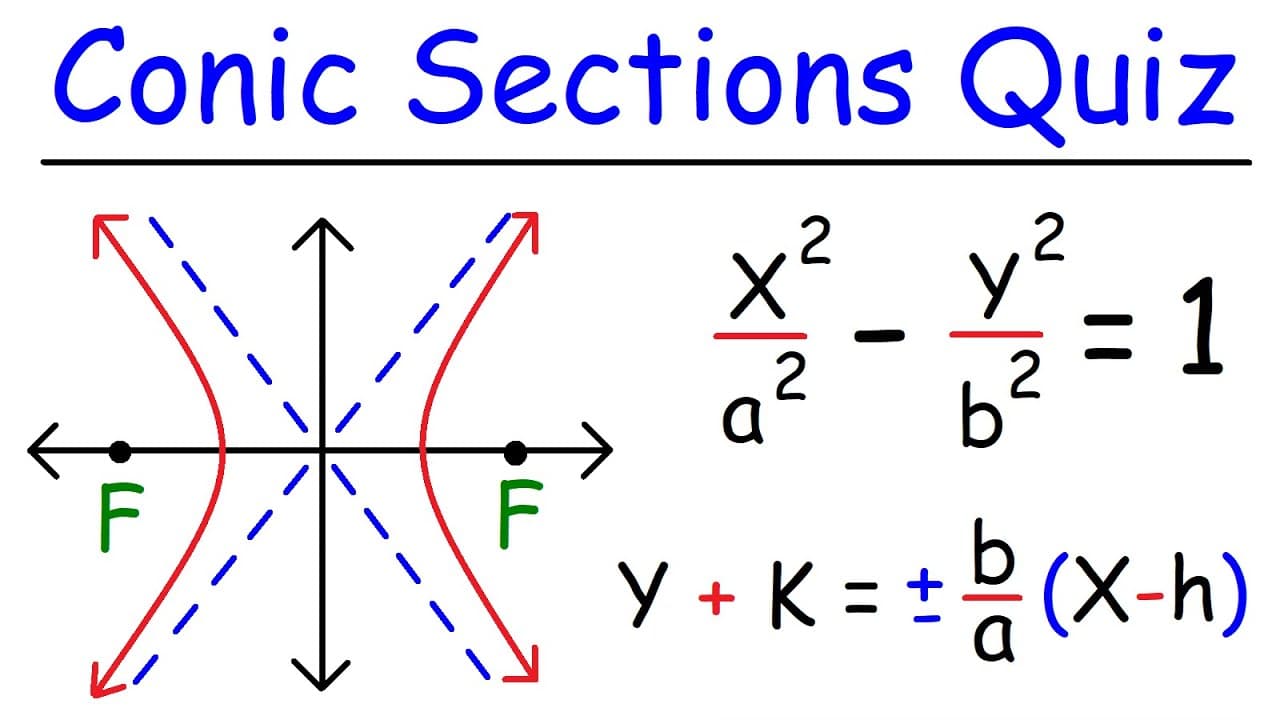
A comprehensive math tutorial solving 10 diverse practice problems related to conic sections. The video systematically covers circles, ellipses, hyperbolas, and parabolas, teaching viewers how to identify shapes from equations, graph them, and calculate key features. The narrator demonstrates essential techniques such as completing the square to convert general equations into standard form and using formulas to find vertices, foci, directrices, and asymptotes. Key themes include the algebraic definitions of conic sections, the geometric relationship between centers, foci, and vertices, and the process of sketching graphs from equations. The video contrasts the four types of conics, highlighting the specific differences in their standard equations, such as sign changes and coefficient differences. It also delves into analytic geometry concepts like the distance formula and midpoint formula within the context of conics. This video is highly valuable for Algebra II and Pre-Calculus classrooms as a review tool or a guided practice session. Teachers can use specific segments to model problem-solving strategies for individual conic sections or assign the entire video as a study guide for unit tests. The step-by-step explanations provide clear models for students to check their work and understand the logic behind geometric definitions.

The Organic Chemistry TutorThe Organic Chemistry Tutor

29mins 31s

Graphing Systems of Equations: Special Cases and Solutions

Graphing Systems of Equations: Special Cases and Solutions

A comprehensive Algebra 1 tutorial exploring the special cases that arise when solving systems of equations by graphing. While standard systems typically yield a single intersection point, this video focuses specifically on scenarios resulting in "No Solution" (parallel lines) and "Infinite Solutions" (coincident lines). The narrator, Justin, uses clear visual graphing examples to demonstrate why these outcomes occur and how to identify them by analyzing slopes and y-intercepts. The video progresses from simple two-variable linear systems to more complex challenges involving three lines, helping students understand that a solution must satisfy *every* equation in the system. It creates a strong visual connection between the algebraic properties of lines (like identical slopes) and their geometric behavior on a coordinate plane. This resource is highly valuable for math educators introducing or reinforcing systems of equations. It directly addresses common student misconceptions, such as the belief that "infinite solutions" means any point on the plane is a valid answer. The included "challenge" segments provide excellent opportunities for formative assessment and class discussion regarding systems with more than two equations.

Miacademy & MiaPrep Learning ChannelMiacademy & MiaPrep Learning Channel

6mins 3s

How to Find Solutions for Systems of Inequalities

How to Find Solutions for Systems of Inequalities

This educational video provides a clear and practical guide to identifying solutions for systems of inequalities using both graphical and algebraic methods. The narrator, Justin, transitions from solving singular inequalities to systems with two variables, demonstrating how to identify solution regions on a coordinate plane. The video visually distinguishes between individual inequality solutions and the specific overlapping region that satisfies the entire system, using color-coded graphs to make the concept accessible. Key themes include the critical distinction between dashed and solid boundary lines, the testing of specific coordinate points to verify validity, and the algebraic process of substitution. The video meticulously explains 'edge cases'—such as points lying directly on a boundary line—and clarifies why points on dashed lines are excluded while those on solid lines are included. It also covers the special case of 'no solution' systems involving parallel lines shaded in opposite directions. For educators, this video serves as an excellent instructional tool for Algebra I or II units on systems. It effectively addresses common student misconceptions regarding boundary lines and offers a step-by-step procedure for checking solutions algebraically when a graph is unavailable. The dual approach helps students connect abstract algebraic verification with concrete visual representations, deepening their conceptual understanding of what a 'solution' truly represents in the context of inequalities.

Miacademy & MiaPrep Learning ChannelMiacademy & MiaPrep Learning Channel

5mins 11s

Materials

Linear Solutions Poster

Linear Solutions Poster

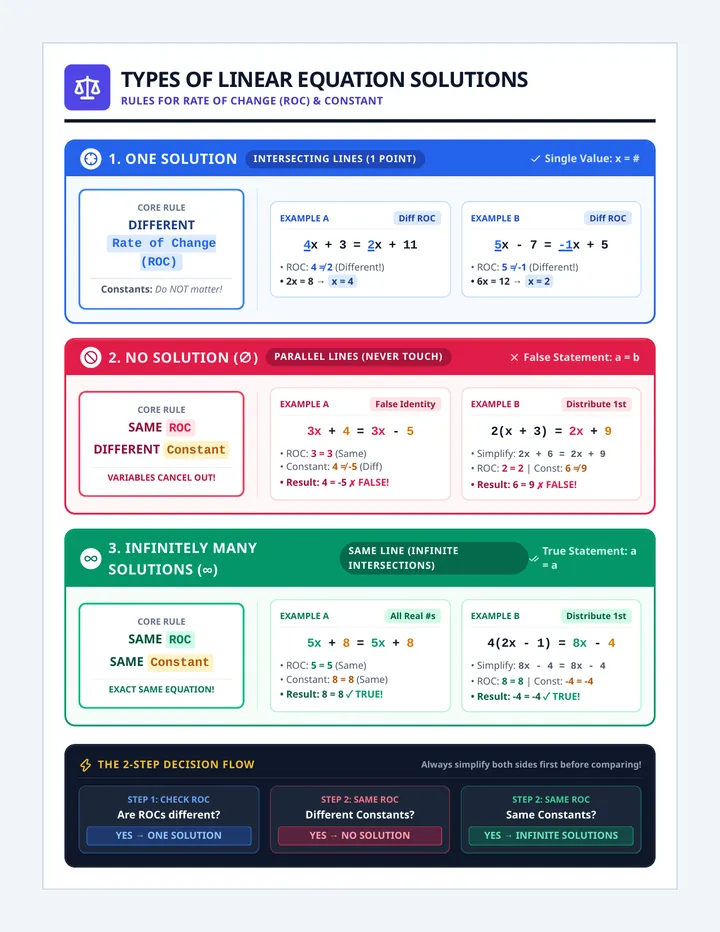
A high-contrast classroom reference poster for 8th-grade math that clearly defines the rules for determining whether a linear equation has one solution, no solution, or infinitely many solutions based on Rate of Change (ROC) and constant terms, complete with visual cues and two worked examples for each case.

CE

Clifford Ernst

System Showdown Station Cards

System Showdown Station Cards

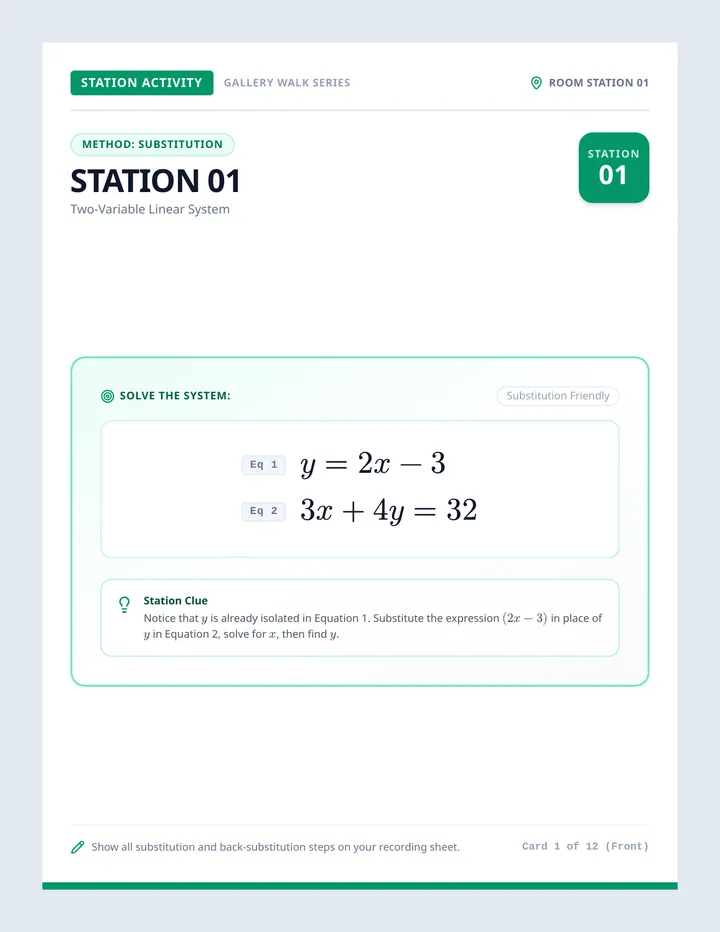
Twelve printable station posters for solving 2-variable linear systems of equations, featuring 4 substitution problems and 8 elimination problems with varied complexity and special cases. Each problem page is immediately paired with a comprehensive step-by-step solution backside designed for double-sided printing and gallery-walk station rotations.

RB

Ronald Berg

Grid Masters Exam Worksheet house v2

Grid Masters Exam Worksheet house v2

A 4-page math examination on linear equations and systems of equations, featuring 50 multiple-choice questions in a compact, two-column layout with a modern "Grid Masters" theme. Every question includes 4 answer choices (A-D) and shares identical styling.

AC

Anjoe Calamba

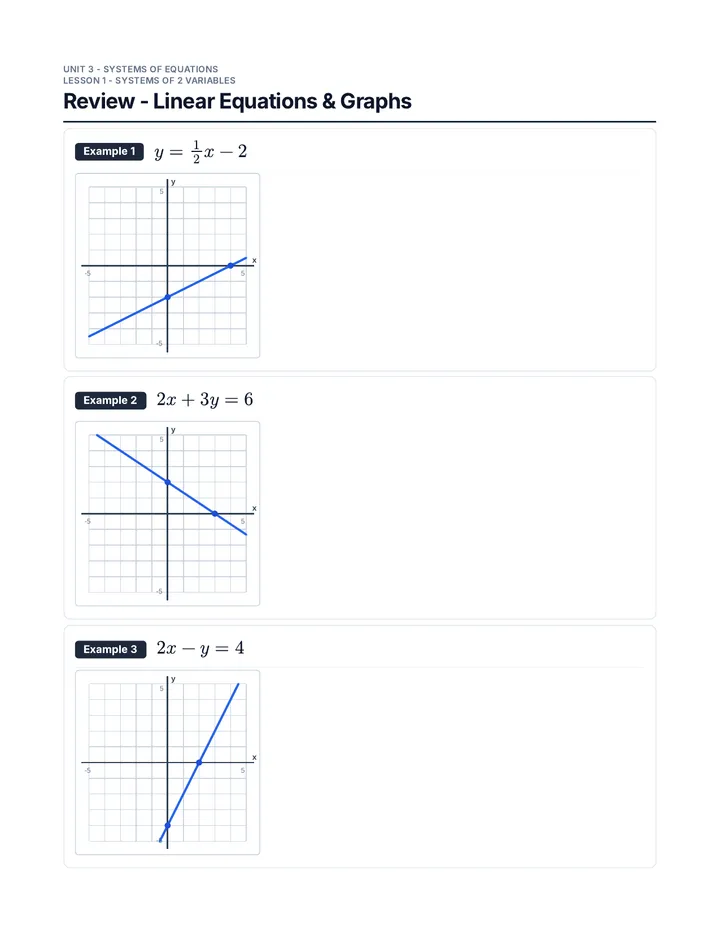
Grid Lock Graphing Worksheet

Grid Lock Graphing Worksheet

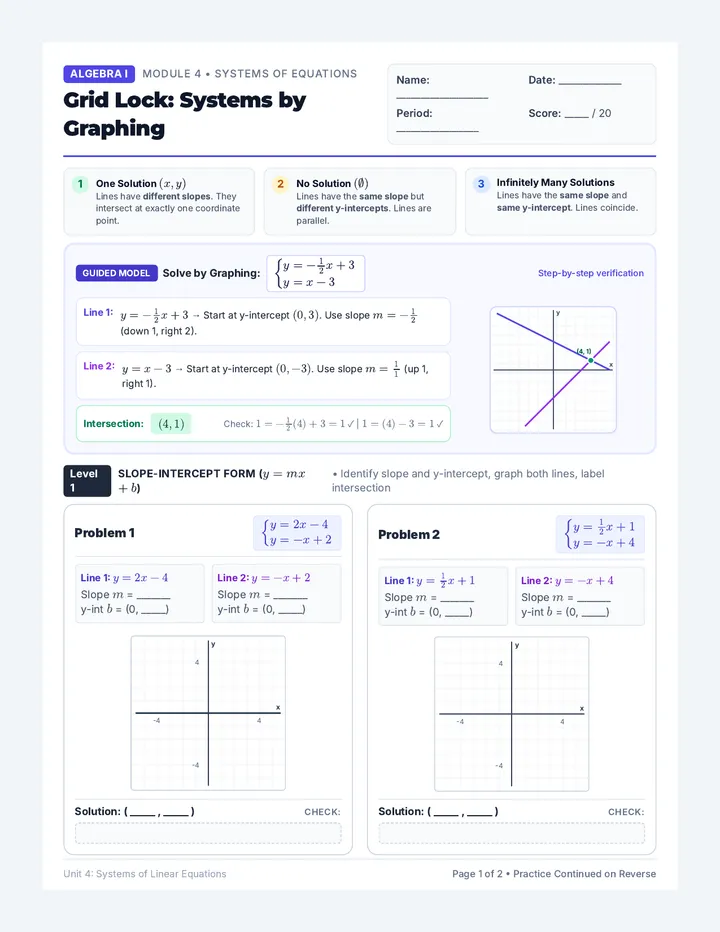
A 2-page scaffolded practice worksheet for solving linear systems by graphing. Features guided step-by-step models, crisp coordinate grids, standard form conversions, special solution cases, and a real-world application problem.

R

Robinson

Algebra Essentials Reference Sheet

Algebra Essentials Reference Sheet

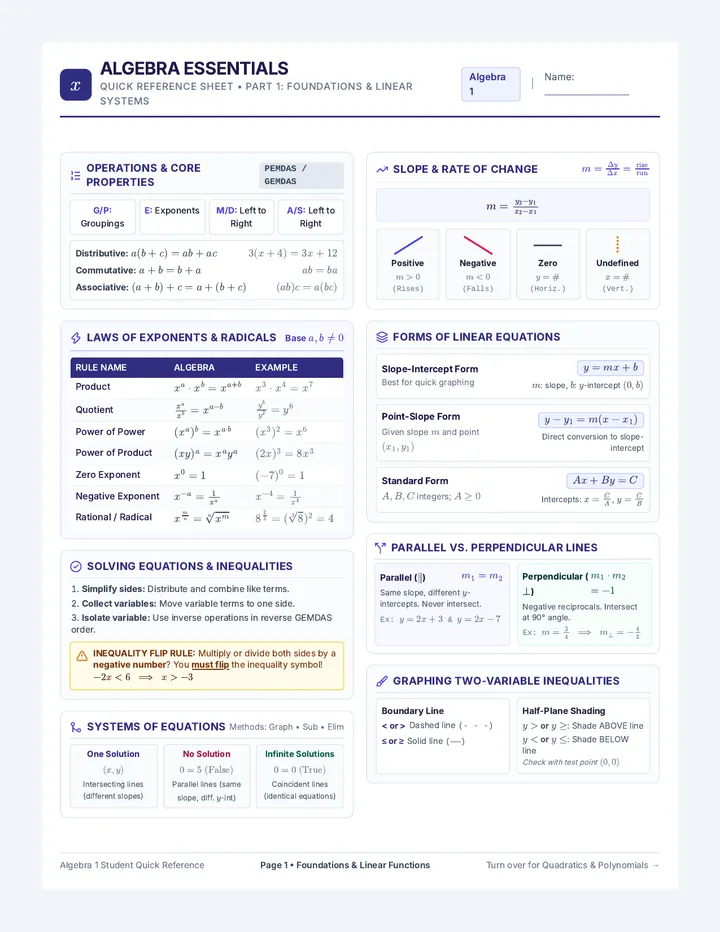
A comprehensive two-page visual reference sheet summarizing foundational Algebra 1 concepts, formulas, and graphing models. It covers linear relationships, systems of equations, exponent laws, polynomial factoring, quadratic functions, and critical algebraic traps.

KL

Karen Lloyd

Triple Threat Systems Worksheet

Triple Threat Systems Worksheet

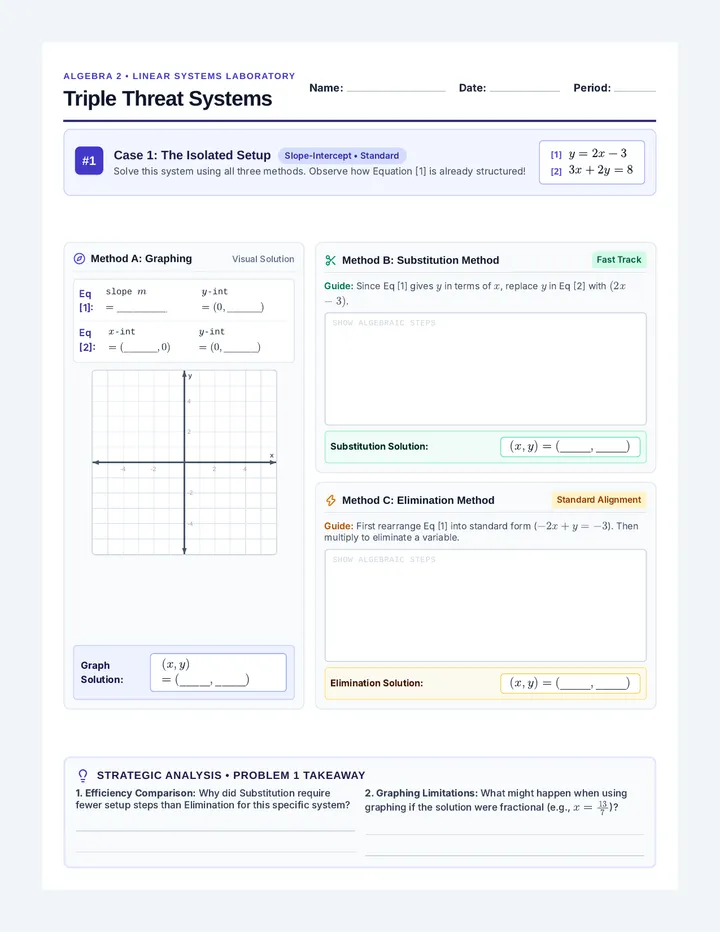
An Algebra 2 worksheet featuring two 2x2 systems of linear equations, each solved using graphing, substitution, and elimination. Problem 1 highlights substitution when a variable is already isolated, while Problem 2 features standard-form equations requiring scaling by a multiplier to eliminate variables cleanly without fractions.

RB

Ronald Berg

Sequences

Foundation Missions Part 1 Final

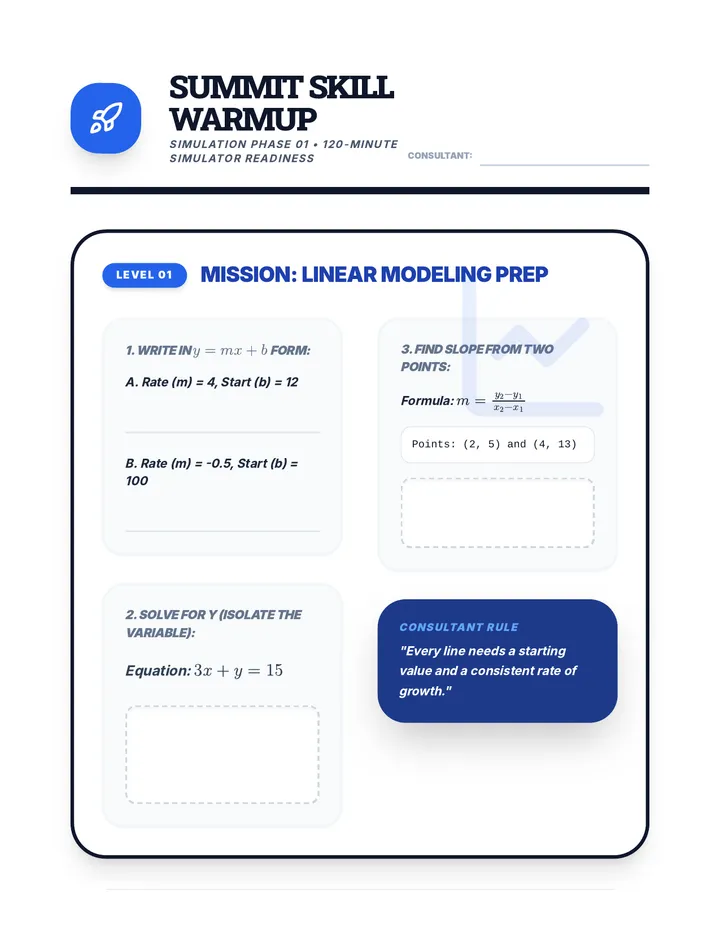
Math in Motion: The 2-Hour Summit

A high-intensity, 120-minute math simulation. Students act as lead consultants, completing a high-speed skill warmup before selecting a professional sector (Music, Urban Planning, Rocket Science, or Sports Analytics) to solve a series of complex work orders.

EL

Elsa LaLone

102
Project Mission Slides Final

Math in Motion: The 2-Hour Summit

A high-intensity, 120-minute math simulation. Students act as lead consultants, completing a high-speed skill warmup before selecting a professional sector (Music, Urban Planning, Rocket Science, or Sports Analytics) to solve a series of complex work orders.

EL

Elsa LaLone

102
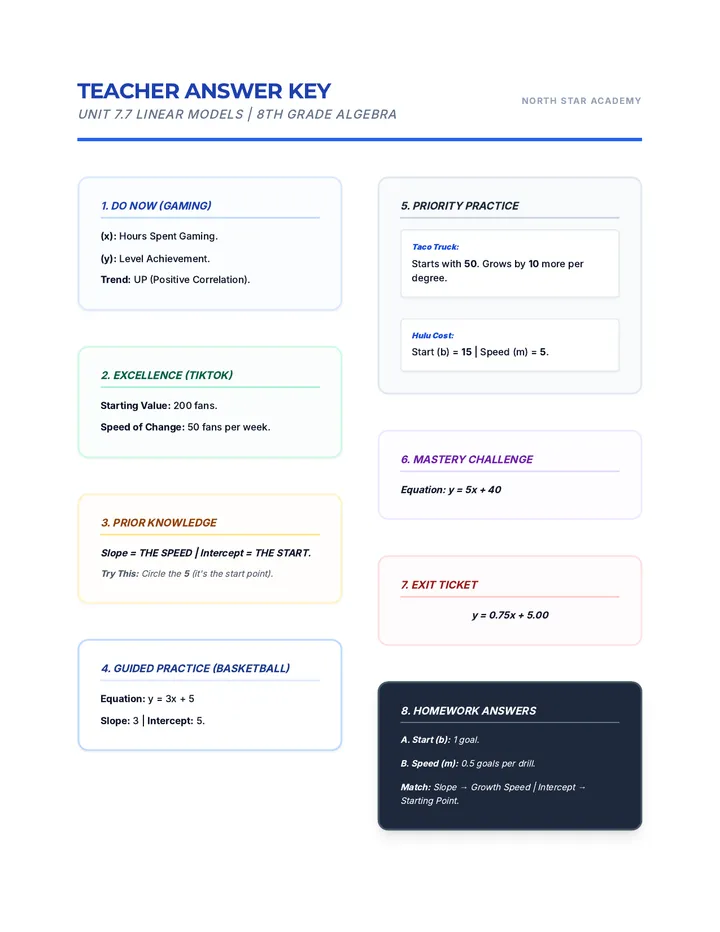
Trend Trackers Answer Key

Algebra Essentials Sequence

A series of 8th and 9th grade Algebra lessons focused on linear relationships and systems of equations, with a focus on SPED/IEP support.

D

deeohnny.jackson

55
Inequality Blueprint Student Packet

Algebra Blueprint Series

A 5-lesson Algebra series focused on linear inequalities and systems of equations, designed for 9th-grade special education students with scaffolded instruction, visual aids, and scripted teacher guidance.

D

deeohnny.jackson

18
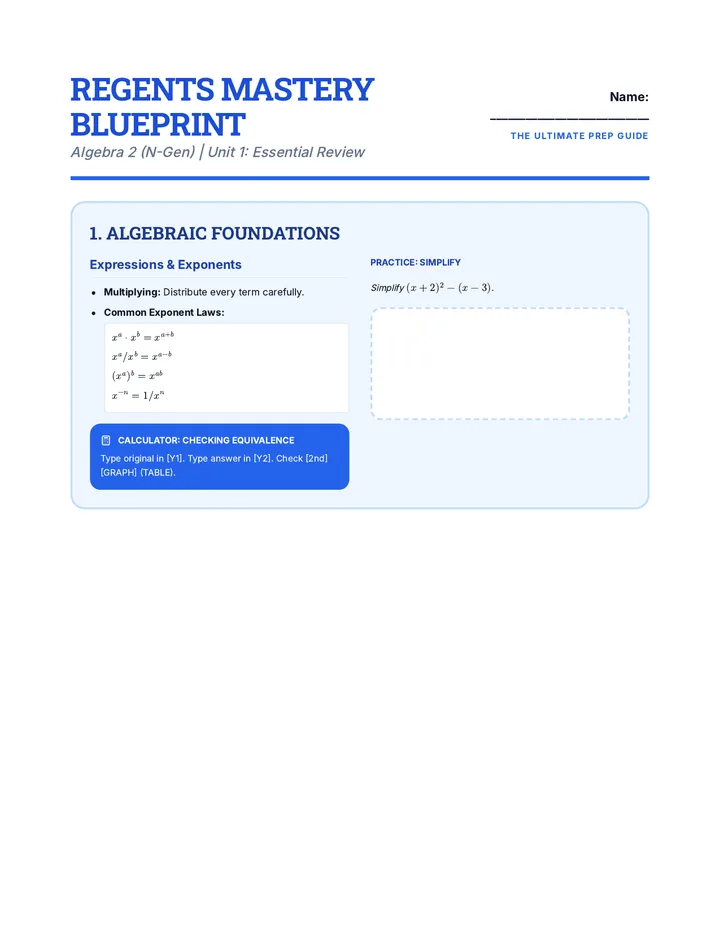
Regents Mastery Blueprint Study Guide

Regents Mastery Suite

A comprehensive review suite for the New York State Mathematics Regents exams, including Algebra 1, Geometry, and Algebra 2, featuring mastery blueprints, calculator strategies, and exam-taking tips.

KB

Kayla Borozny

15
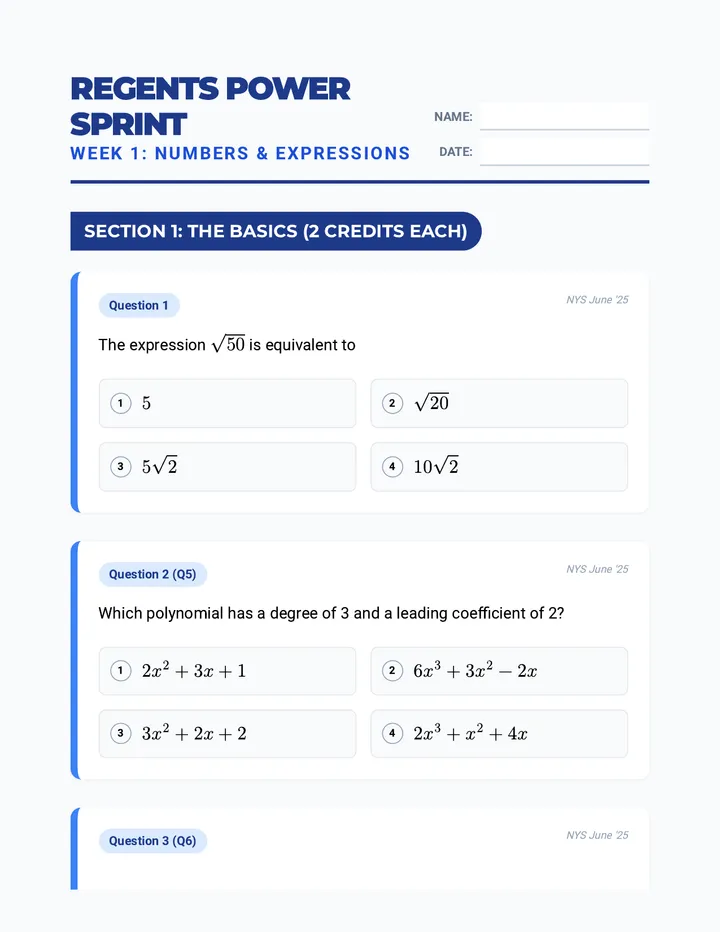
Week 1 Power Sprint Worksheet

Regents Road Map

A comprehensive 10-week preparation sequence designed to get students ready for the Algebra I Regents exam by May 15th, featuring bi-weekly 30-minute practice sessions and visual anchor charts.

L

laura.clar

31

Lessons

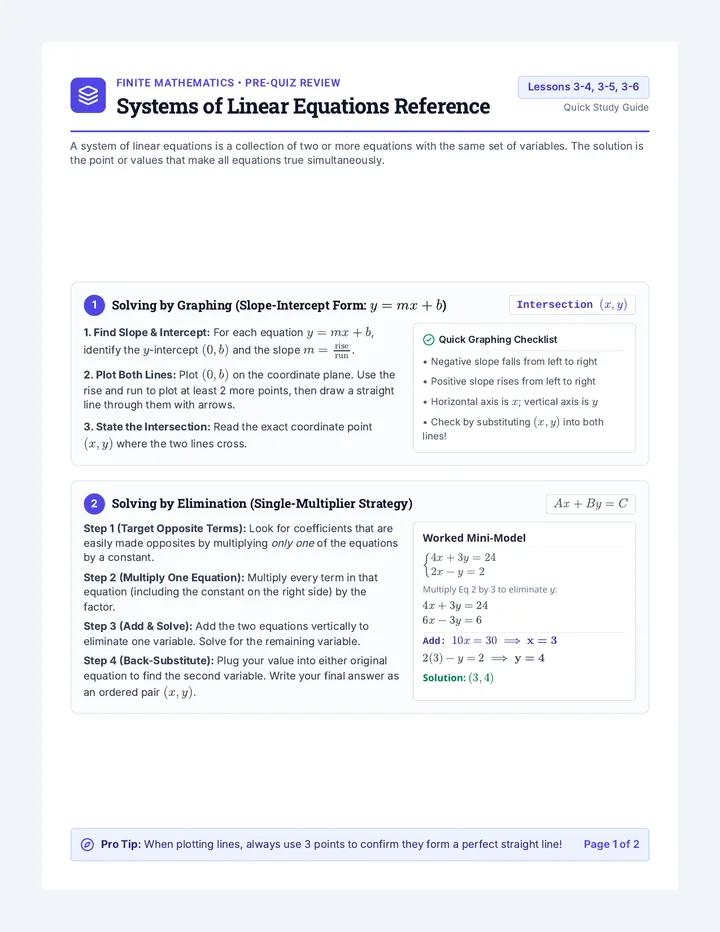
Systems Decoded Review Handout

Systems Decoded

A comprehensive finite mathematics unit covering systems of linear equations via graphing, substitution, elimination, and augmented matrices with Desmos rref calculation, including applied real-world modeling.

RB

Ronald Berg

7
Urban Architect Guide

Boundary Blueprint

A high school geometry lesson where students learn to construct Voronoi diagrams using perpendicular bisectors to solve real-world spatial optimization problems in urban planning.

BW

Brian Whalen

5
Desmos Power Moves Slides

Desmos SAT Launchpad

A high-impact 45-minute workshop introducing Algebra 2 students to essential Desmos Graphing Calculator strategies for the digital PSAT and SAT. Students discover key calculator moves through a brief interactive demo followed by an authentic partner sprint.

RB

Ronald Berg

3
Linear Equations and Inequalities Sheet

Linear Systems and Inequalities

A comprehensive high school algebra lesson covering linear equations, single linear inequalities with shaded regions, and multi-inequality systems of linear inequalities.

PT

Patrick Timmons

2
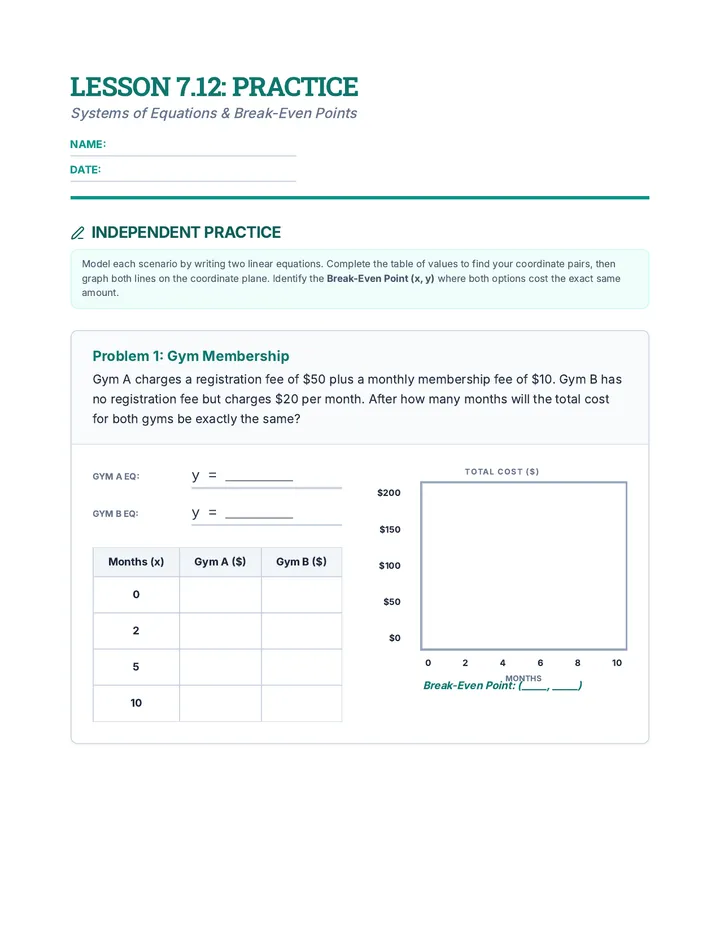
Lesson 7.12 Practice Worksheet

Lesson 7.12

A comprehensive series of activities where students learn to identify, model, and solve systems of linear equations to find the 'better deal' in real-world scenarios.

D

david.marques

4
Algebra 1 Formula Sheet

Algebra 1 Assessment

A comprehensive final assessment for Algebra 1 covering linear equations, systems, exponents, polynomials, and quadratic functions. Includes free response and graphing sections to evaluate deep understanding.

JF

Jim Fusaro

3