Algebra Essentials Reference Sheet
\(x\)
Algebra Essentials
Quick Reference Sheet • Part 1: Foundations & Linear Systems
Algebra 1 | Name:
Operations & Core Properties
PEMDAS / GEMDAS
G/P: Groupings
E: Exponents
M/D: Left to Right
A/S: Left to Right
Distributive: \(a(b + c) = ab + ac\) \(3(x+4) = 3x+12\)
Commutative: \(a + b = b + a\) \(ab = ba\)
Associative: \((a + b) + c = a + (b + c)\) \((ab)c = a(bc)\)
Laws of Exponents & Radicals
Base \(a, b \neq 0\)
| Rule Name | Algebra | Example |
|---|
| Product | \(x^a \cdot x^b = x^{a+b}\) | \(x^3 \cdot x^4 = x^7\) |
| Quotient | \(\frac{x^a}{x^b} = x^{a-b}\) | \(\frac{y^8}{y^2} = y^6\) |
| Power of Power | \((x^a)^b = x^{a \cdot b}\) | \((x^3)^2 = x^6\) |
| Power of Product | \((xy)^a = x^a y^a\) | \((2x)^3 = 8x^3\) |
| Zero Exponent | \(x^0 = 1\) | \((-7)^0 = 1\) |
| Negative Exponent | \(x^{-a} = \frac{1}{x^a}\) | \(x^{-4} = \frac{1}{x^4}\) |
| Rational / Radical | \(x^{\frac{m}{n}} = \sqrt[n]{x^m}\) | \(8^{\frac{2}{3}} = (\sqrt[3]{8})^2 = 4\) |
Solving Equations & Inequalities
- Simplify sides: Distribute and combine like terms.
- Collect variables: Move variable terms to one side.
- Isolate variable: Use inverse operations in reverse GEMDAS order.
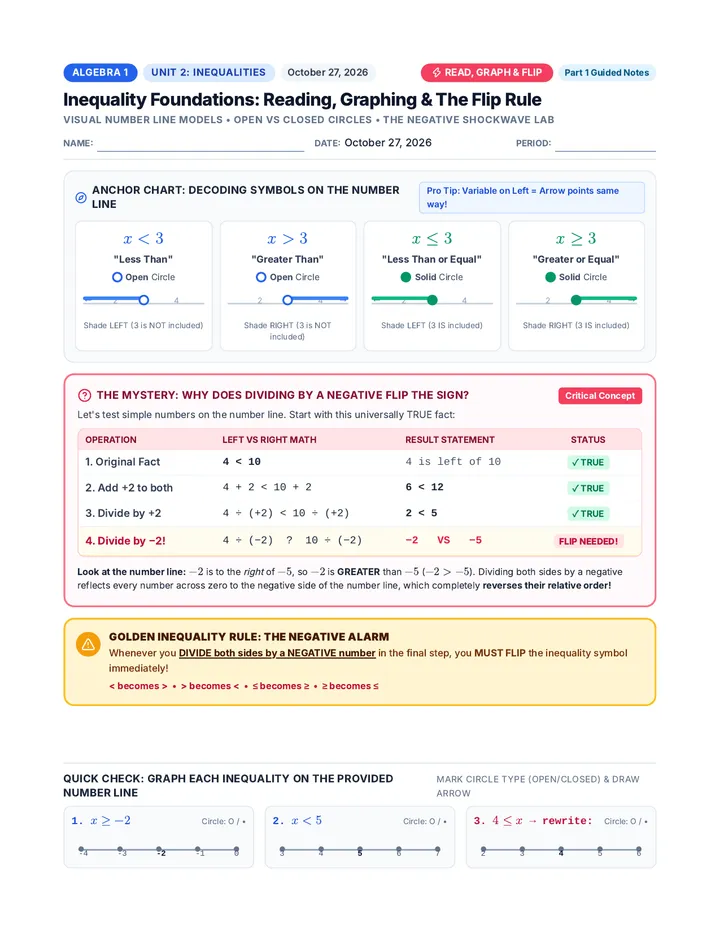
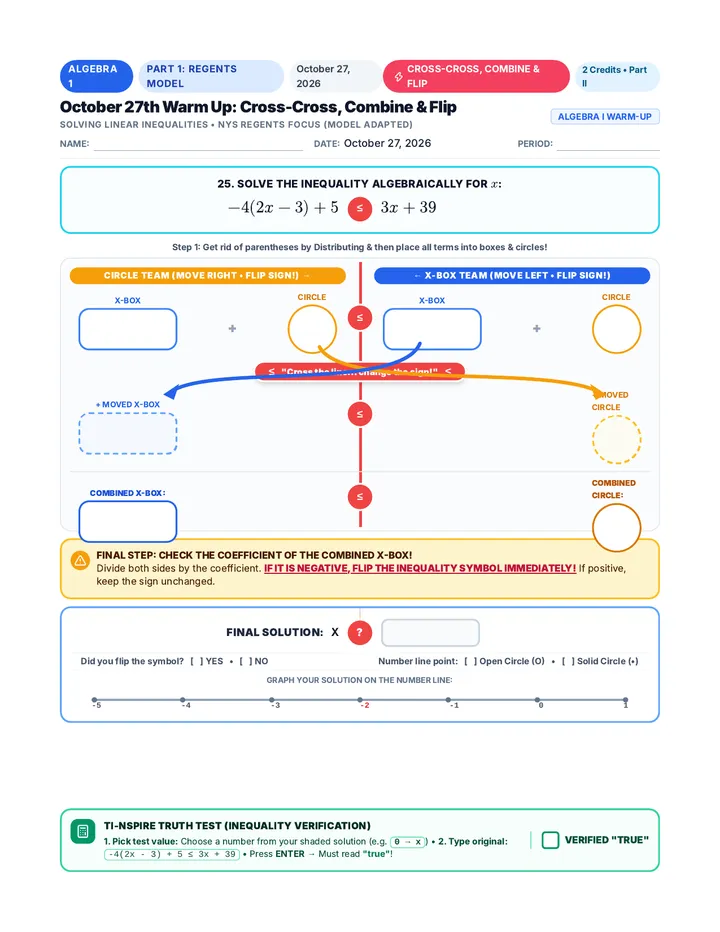
INEQUALITY FLIP RULE: Multiply or divide both sides by a negative number? You must flip the inequality symbol!
\(-2x < 6 \;\implies\; x > -3\)
Systems of Equations
Methods: Graph • Sub • Elim
One Solution
\((x, y)\)
Intersecting lines (different slopes)
No Solution
\(0 = 5 \;\text{(False)}\)
Parallel lines (same slope, diff. \(y\)-int)
Infinite Solutions
\(0 = 0 \;\text{(True)}\)
Coincident lines (identical equations)
Slope & Rate of Change
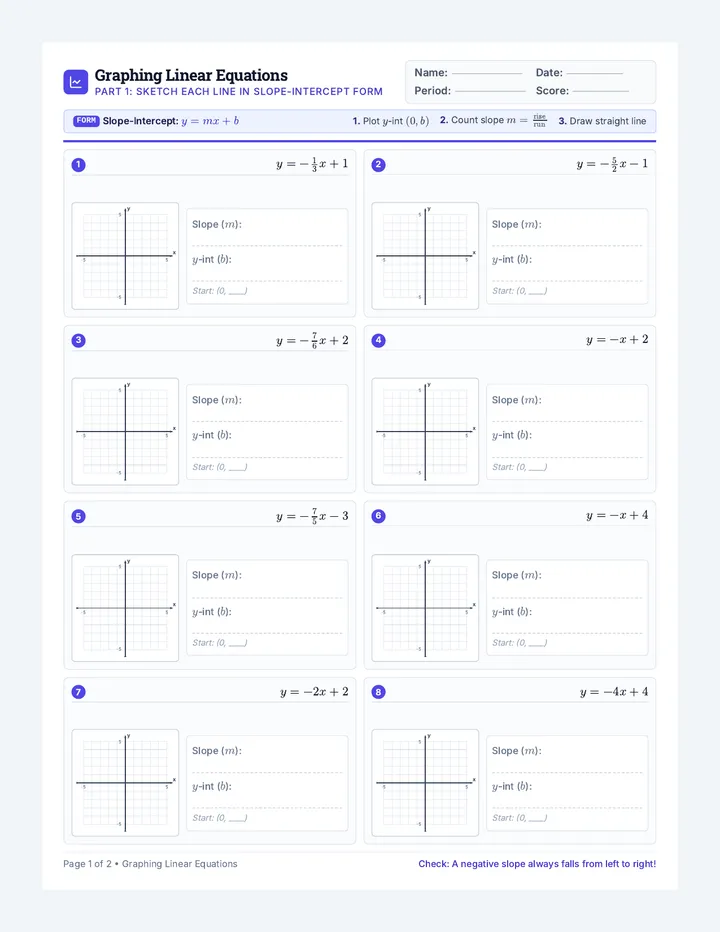
\(m = \frac{\Delta y}{\Delta x} = \frac{\text{rise}}{\text{run}}\)
\(m = \frac{y_2 - y_1}{x_2 - x_1}\)
Positive \(m > 0\) (Rises)
Negative \(m < 0\) (Falls)
Zero \(y = \#\) (Horiz.)
Undefined \(x = \#\) (Vert.)
Forms of Linear Equations
Slope-Intercept Form Best for quick graphing
\(y = mx + b\) \(m\): slope, \(b\): \(y\)-intercept \((0, b)\)
Point-Slope Form Given slope \(m\) and point \((x_1, y_1)\)
\(y - y_1 = m(x - x_1)\) Direct conversion to slope-intercept
Standard Form \(A, B, C\) integers; \(A \ge 0\)
\(Ax + By = C\) Intercepts: \(x = \frac{C}{A}\), \(y = \frac{C}{B}\)
Parallel vs. Perpendicular Lines
Parallel (\(\parallel\)) \(m_1 = m_2\)
Same slope, different \(y\)-intercepts. Never intersect.
Ex: \(y=2x+3\) & \(y=2x-7\)
Perpendicular (\(\perp\)) \(m_1 \cdot m_2 = -1\)
Negative reciprocals. Intersect at 90° angle.
Ex: \(m = \frac{3}{4} \;\implies\; m_\perp = -\frac{4}{3}\)
Graphing Two-Variable Inequalities
Boundary Line
< or > Dashed line (- - -)
≤ or ≥ Solid line (——)
Half-Plane Shading
\(y >\) or \(y \ge\): Shade ABOVE line
\(y <\) or \(y \le\): Shade BELOW line
Check with test point \((0,0)\)
Algebra 1 Student Quick Reference Page 1 • Foundations & Linear Functions Turn over for Quadratics & Polynomials →
\(x^2\)
Algebra Essentials
Quick Reference Sheet • Part 2: Functions, Quadratics & Factoring
Algebra 1 | Page 2 of 2
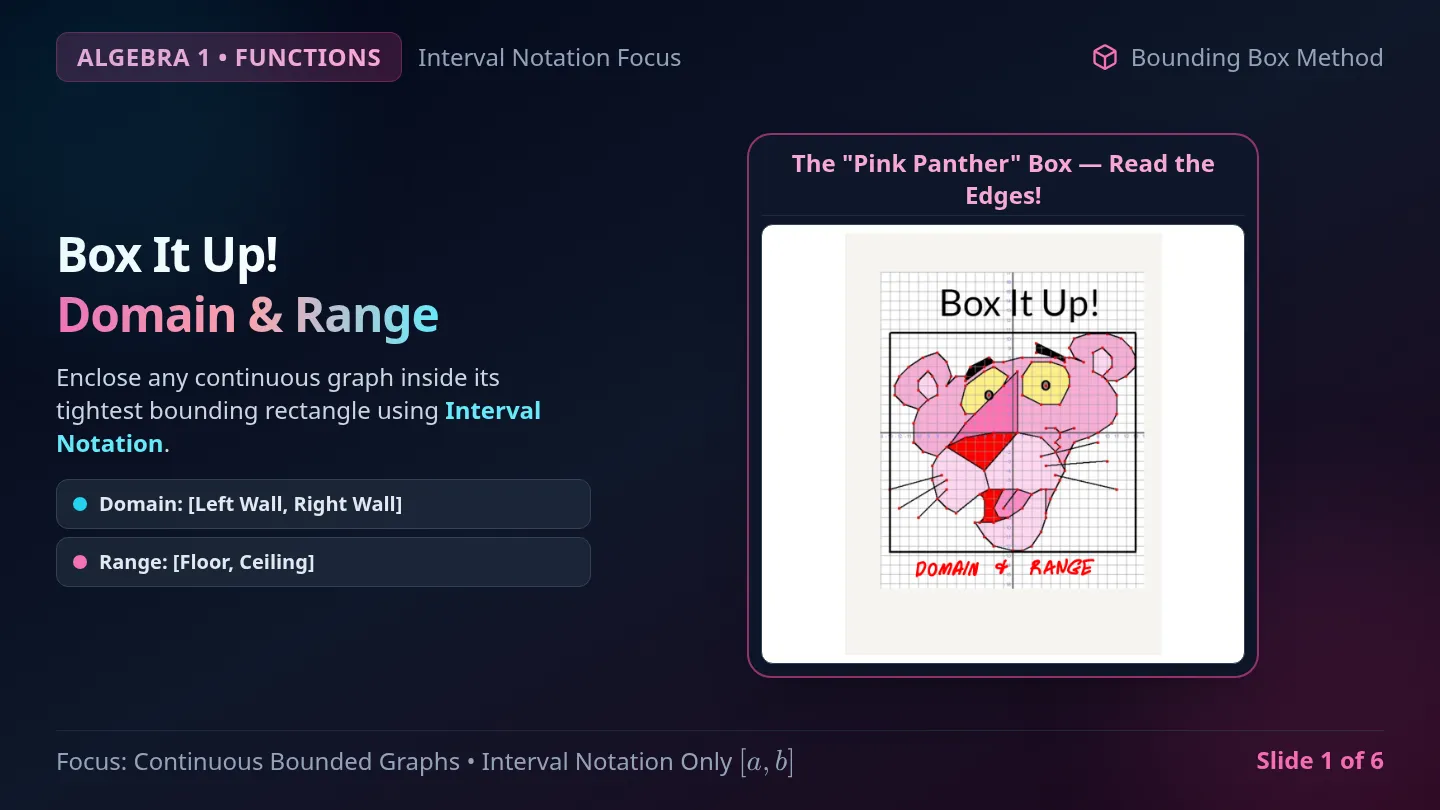
Relations & Functions
Function Definition:
Every input \(x\) (Domain) has exactly one output \(y\) (Range). \(x\)-values never repeat!
Vertical Line Test
A curve is a function if no vertical line crosses it more than once.
Function Notation
\(f(3)\) means substitute \(x=3\) into \(f(x)\). Output is \(y\).
Factoring Toolkit (Step-by-Step)
Priority: GCF First
1. Greatest Common Factor (GCF) Always check first!
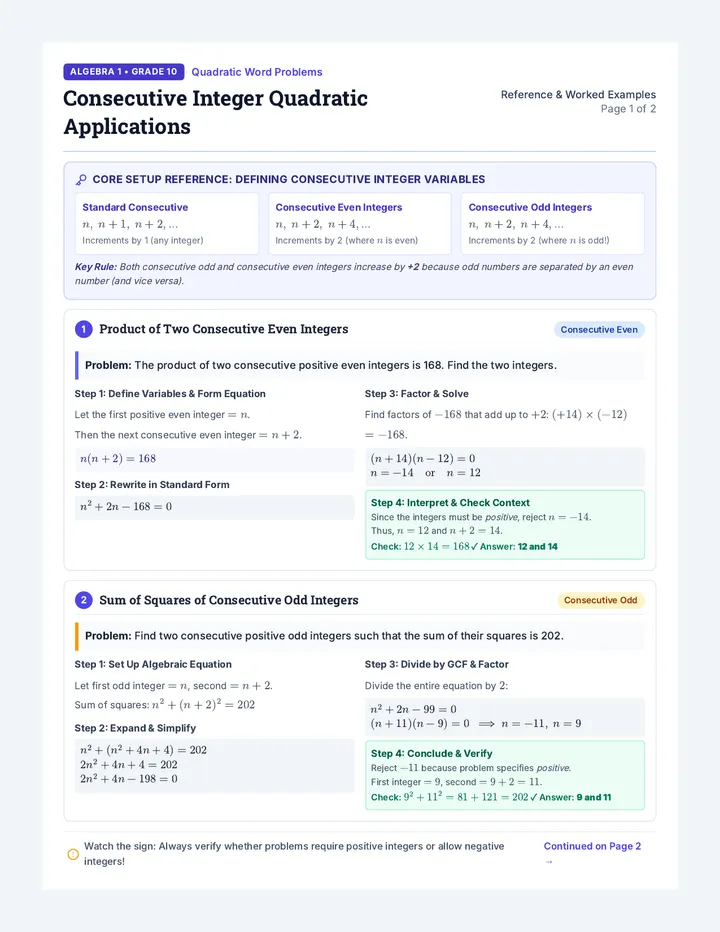
\(4x^3 + 8x^2 = 4x^2(x + 2)\)
2. Difference of Two Squares \(a^2 - b^2 = (a-b)(a+b)\)
\(x^2 - 49 = (x - 7)(x + 7)\)
3. Trinomials (\(a = 1\)): \(x^2 + bx + c\)
Find two numbers that multiply to \(c\) and add to \(b\).
\(x^2 + 5x + 6 = (x + 2)(x + 3)\)
4. Trinomials (\(a \neq 1\)): "AC Method"
Multiply \(a \cdot c\). Find factors adding to \(b\). Split middle term & factor by grouping.
\(2x^2 + 7x + 3 = (2x + 1)(x + 3)\)
Exponential Functions
\(y = a \cdot b^x\)
\(a\): Initial value (\(y\)-intercept at \((0,a)\)) \(b\): Growth / decay factor
Growth (\(b > 1\))
\(b = 1 + r\)
Ex: \(y = 100(1.05)^x\)
Decay (\(0 < b < 1\))
\(b = 1 - r\)
Ex: \(y = 80(0.85)^x\)
Common Algebra Traps!
× \((a+b)^2 \neq a^2 + b^2\)
✓ \(a^2 + 2ab + b^2\)
× \(\sqrt{a^2 + b^2} \neq a + b\)
Roots do not split sums!
× \(-3^2 \neq (-3)^2\)
\(-3^2 = -9\), \((-3)^2 = 9\)
× \(\frac{2x + 4}{2} \neq x + 4\)
✓ Divide both: \(x + 2\)
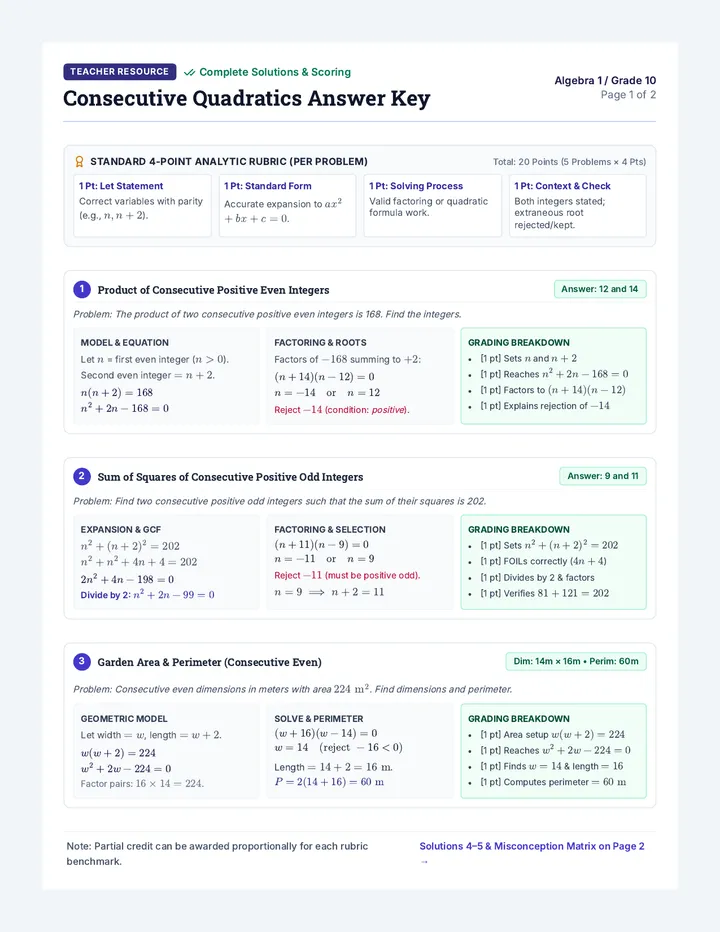
Anatomy of a Parabola
\(y = ax^2 + bx + c\)
Vertex (h, k) Axis: x = h Zeros / Roots
Vertex: Turnaround point \((h, k)\). Minimum if \(a > 0\), Maximum if \(a < 0\).
Axis of Symmetry: Vertical line \(x = -\frac{b}{2a}\) bisecting parabola.
Zeros / Roots / \(x\)-int: Values where \(f(x) = 0\).
\(y\)-intercept: Point \((0, c)\) on standard form.
Three Quadratic Forms
Standard Form Gives \(y\)-intercept and width/direction
\(y = ax^2 + bx + c\) \(y\)-int: \((0, c)\) • Axis: \(x = -\frac{b}{2a}\)
Vertex Form Best for graphing shifts & extrema
\(y = a(x - h)^2 + k\) Vertex: \((h, k)\) • Watch the sign inside!
Factored / Intercept Form Directly shows the roots/zeros
\(y = a(x - p)(x - q)\) \(x\)-intercepts at \((p, 0)\) and \((q, 0)\)
The Quadratic Formula
Works on ANY quadratic!
\(x = \frac{-b \pm \sqrt{b^2 - 4ac}}{2a}\)
4 Ways to Solve \(ax^2 + bx + c = 0\):
- Factoring: Fast when factors are integers (Zero Product Property).
- Square Roots: Best when equation has no \(bx\) term (\(ax^2 + c = 0\)).
- Completing the Square: Ideal when \(a = 1\) and \(b\) is even.
- Quadratic Formula: Always works, even with irrationals & decimals.
The Discriminant
\(\Delta = b^2 - 4ac\)
\(b^2 - 4ac > 0\)
2 Real Solutions
Crosses \(x\)-axis twice
\(b^2 - 4ac = 0\)
1 Real Solution
Touches \(x\)-axis (vertex)
\(b^2 - 4ac < 0\)
0 Real Solutions
Never crosses \(x\)-axis
Algebra 1 Student Quick Reference Page 2 • Functions, Quadratics & Factoring Keep in binder for exams & daily homework