Lenny.com
Explore
Create
ActivitiesNewMathEnglish Language ArtsScience & EngineeringSocial StudiesGlobal LanguagesHealth & Physical EducationSpecial EducationCounseling & Life SkillsArts & CreativityESL
Lenny.com
Lenny.com
Explore
Create
ActivitiesNewMathEnglish Language ArtsScience & EngineeringSocial StudiesGlobal LanguagesHealth & Physical EducationSpecial EducationCounseling & Life SkillsArts & CreativityESL
Lenny.com
Lenny.com

Solutions

Lenny for EducatorsLenny for SchoolsLenny for Districts

Product

ExploreSign inCreateSupportAbout

Resources

Getting startedMTSS Acceleration Program

© 2026 Lenny Learning Inc.

TermsPrivacyAccessibility
LinkedInInstagramX
Lenny

Radicals and Integer Exponents

Product, quotient, and power rules for integer exponents alongside methods for simplifying square and cube roots. Connects radical notation to exponential form while practicing operations with irrational numbers.

MathNumbers & CountingCounting ObjectsNumber NamesComparing NumbersNumber OperationsCounting SequenceNumbers 0-10Place Value Understanding and SystemAdd and Subtract Within 20Addition and Subtraction ConceptsAddition and Subtraction EquationsAddition and Subtraction ProblemsFoundations for MultiplicationMultiplication and Division PropertiesMultiply and Divide Within 100Multiplication and Division ProblemsFactors and MultiplesProperties of OperationsPatterns and RelationshipsGenerate and Analyze PatternsMulti-Digit ArithmeticPlace Value OperationsMulti-Digit and Decimal OperationsNumerical ExpressionsFour Operations and PatternsFour Operations Problem SolvingMeasurement & DataMeasurable AttributesMeasuring LengthsMeasure and Estimate Lengths in Standard UnitsRelate Addition and Subtraction to LengthClassifying and Counting ObjectsTime and MoneyArea Concepts and MeasurementPerimeter and Area MeasuresAngle Concepts and MeasurementTime, Volume, and MassMeasurement Unit ConversionsGeometryIdentifying ShapesShapes and AttributesShape Attributes and ReasoningShapes and CompositionClassifying 2D FiguresGeometric Figures and RelationshipsLines, Angles, and ShapesAngle, Area, and VolumeGeometric MeasurementVolume of 3D ShapesCoordinate Plane ApplicationsTransformations in the PlaneCongruence and SimilarityUnderstand congruence in terms of rigid motionsSimilarity and TransformationsProve Theorems Involving SimilarityPythagorean TheoremTrigonometry for General TrianglesMake Geometric ConstructionsProve Geometric TheoremsTheorems About CirclesFind Arc Lengths And Areas of Sectors of CirclesVolume FormulasRelationships Between Two-Dimensional and Three-Dimensional ObjectsProve Simple Geometric Theorems AlgebraicallyTranslate Between Geometric Description and Equation for Conic SectionApply Geometric Concepts in Modeling SituationsFractions & DecimalsFractions as NumbersBuilding FractionsFraction Equivalence and OrderingAdding and Subtracting FractionsMultiplying and Dividing FractionsDividing FractionsDecimal FractionsMulti-Digit Computation and FactorsAdd, Subtract, Multiply, and Divide Rational NumbersRational Number SystemIrrational Numbers and ApproximationsRatiosRatios and ProportionsProportional RelationshipsUnit RateAlgebraAlgebraic ExpressionsGenerate Equivalent ExpressionsQuantitative RelationshipsProportional Relationships and Linear EquationsEquations and InequalitiesEquation Solving and ReasoningLinear Equations and SystemsGraph Equations and InequalitiesSystems of EquationsReal-World Algebraic ProblemsQuantitative Reasoning with UnitsExpression StructureEquivalent Expression FormsRadicals and Integer ExponentsRational ExponentsRational and Irrational NumbersPolynomial OperationsPolynomial IdentitiesPolynomial Zeros and FactorsRational ExpressionsComplex Number OperationsComplex Numbers in PolynomialsComplex Numbers on PlaneStatistics & ProbabilityRepresent and Interpret DataData DistributionsStatistical VariabilityProbability ModelsCompound Event ProbabilitiesStatistical SamplingInterpret Categorical and Quantitative DataBivariate Data PatternsInterpret Linear ModelsComparing Two PopulationsRandom Processes in StatisticsIndependence and Conditional ProbabilityExpected ValuesProbability-Based Decision MakingStatistical Inference and ConclusionsFunctionsFunction Concepts and NotationDefine and Compare FunctionsInterpret Functions in ContextAnalyze Function RepresentationsModel Relationships with FunctionsIdentify Linear vs Exponential GrowthDistinguish Between Function TypesCompare Growth RatesInterpret Function ExpressionsBuild Functions from RelationshipsConstruct and Model FunctionsTransform and Combine FunctionsModel Comparison and SelectionSolve Exponential EquationsTrigonometryTrigonometric Ratios Involving Right TrianglesTrigonometric Functions and Unit CircleModel with Trigonometric FunctionsTrigonometric IdentitiesVectors & MatricesIntroduction to Vectors and MatricesVector QuantitiesVector OperationsMatrix OperationsCalculusLimits and ContinuityDerivative Concepts and NotationDerivative Rules and TechniquesApplications of DerivativesOptimization ProblemsRelated RatesCurve Sketching and AnalysisIntegration Concepts and NotationAntiderivatives and Indefinite IntegralsDefinite Integrals and AreaFundamental Theorem of CalculusIntegration TechniquesApplications of IntegrationDifferential EquationsSequences and SeriesParametric and Polar FunctionsVector-Valued Functions

Videos

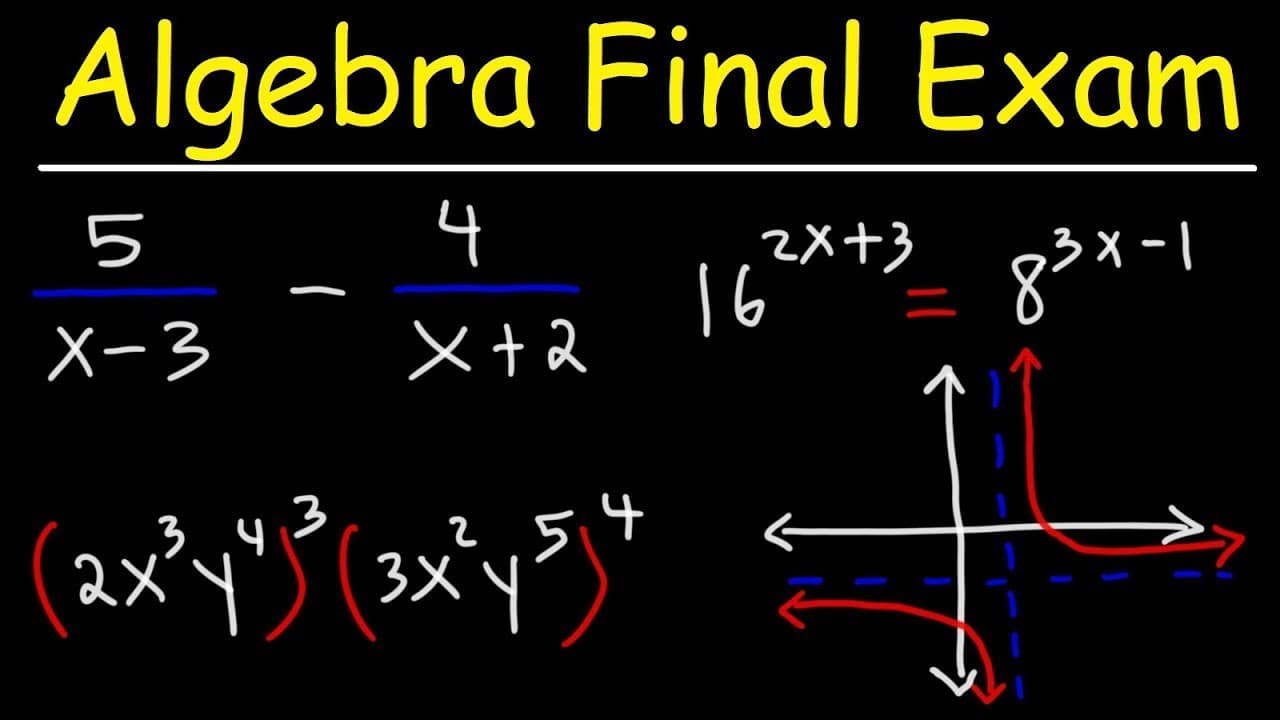
Algebra 1 Final Exam Review: Part 1

Algebra 1 Final Exam Review: Part 1

This comprehensive video serves as a targeted review for students preparing for an Algebra 1 final exam. It systematically walks through 15 distinct problem types commonly found on end-of-course assessments, covering a wide range of algebraic concepts. The video format functions as a digital tutor, presenting a problem, allowing the viewer to pause and attempt it, and then providing a detailed, step-by-step walkthrough of the solution. The instructor uses clear visual annotations on a blackboard style background to demonstrate the mechanics of each operation. Key algebraic themes explored include operations with polynomials (multiplying binomials, subtracting polynomials), linear functions (finding slope, graphing lines, matching equations to graphs), and factoring techniques (difference of squares, trinomials, difference of cubes). The video also covers solving various types of equations, including linear, quadratic, rational, and systems of equations. Additionally, it addresses exponent rules, the order of operations, and applying algebraic concepts to geometric word problems involving area and perimeter. For educators, this video is a valuable resource for review sessions, flipped classroom assignments, or differentiated instruction. It allows students to self-pace their review, focusing on areas where they need the most support. The clear explanations of multiple methods (e.g., solving quadratics by factoring vs. the quadratic formula) help reinforce conceptual understanding rather than just rote memorization. Teachers can use specific segments to reteach difficult concepts or assign the entire video as a comprehensive study guide before major assessments.
The Organic Chemistry TutorThe Organic Chemistry Tutor

55mins 8s

Finding Missing Sides of Right Triangles Using the Pythagorean Theorem

Finding Missing Sides of Right Triangles Using the Pythagorean Theorem

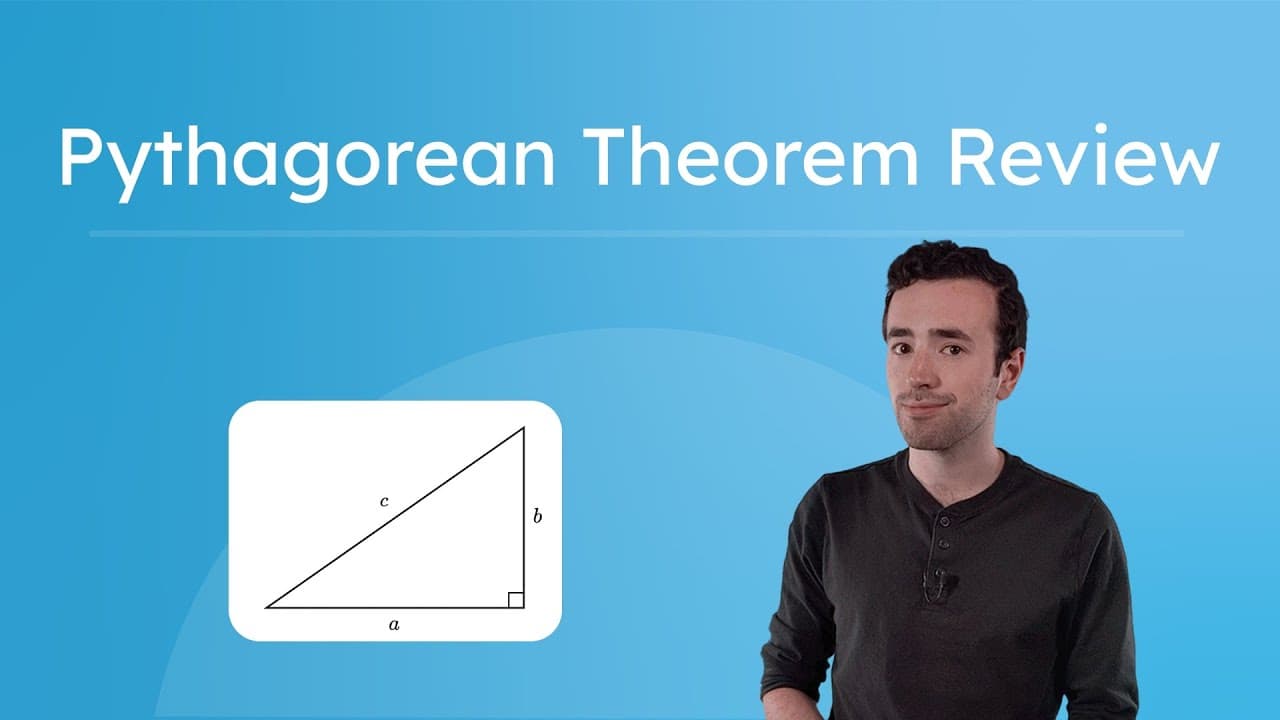
This instructional video provides a comprehensive review of the Pythagorean Theorem, a fundamental concept in geometry used to find the missing side of a right triangle. Narrated by Justin, the lesson begins by defining the specific parts of a right triangle—identifying the legs and the hypotenuse—and explaining the importance of correctly labeling them before applying the formula $a^2 + b^2 = c^2$. The video walks viewers through two distinct examples to demonstrate the theorem's application in different scenarios. The first example solves for an unknown hypotenuse using a standard 5-12-13 triangle. The second example presents a more complex problem where the hypotenuse is known, requiring students to solve for a missing leg; this example also demonstrates how to simplify radicals (square roots) for an exact answer rather than using decimal approximations. Designed for middle and high school math students, this video serves as an excellent resource for introducing the concept or reviewing it before moving on to the Distance Formula. It effectively models mathematical thinking, algebraic manipulation, and the procedure for simplifying square roots, making it a versatile tool for classroom instruction, homework support, or test preparation.

Miacademy & MiaPrep Learning ChannelMiacademy & MiaPrep Learning Channel

6mins 23s

10 Essential Algebra Problems Explained

10 Essential Algebra Problems Explained

This comprehensive tutorial video walks students through ten of the most fundamental and frequently encountered problem types in a standard high school or college Algebra course. The instructor methodically demonstrates how to solve specific examples ranging from calculating slope and solving linear equations to more complex tasks like factoring trinomials, graphing parabolas, and solving systems of equations. Each problem is presented clearly on a blackboard-style interface, with the instructor breaking down the logic and steps required to reach the solution. The video explores key algebraic themes including linear functions, inequalities, quadratic equations, exponents, and systems of equations. It serves as an excellent review of the core curriculum found in Algebra I and Algebra II. The instructor emphasizes not just the 'how' but often the 'why,' discussing concepts like the axis of symmetry, properties of exponents, and different methods for solving quadratics (such as factoring versus the quadratic formula). For educators, this video is a versatile tool that can be used for end-of-unit reviews, standardized test preparation (like the SAT or ACT), or flipped classroom assignments. Teachers can assign specific segments to reinforce struggling concepts or use the entire video as a comprehensive course review. The clear, step-by-step visual working makes it ideal for students who benefit from seeing mathematical processes modeled explicitly.

The Organic Chemistry TutorThe Organic Chemistry Tutor

26mins 15s

Calculating and Deriving the Area of an Equilateral Triangle

Calculating and Deriving the Area of an Equilateral Triangle

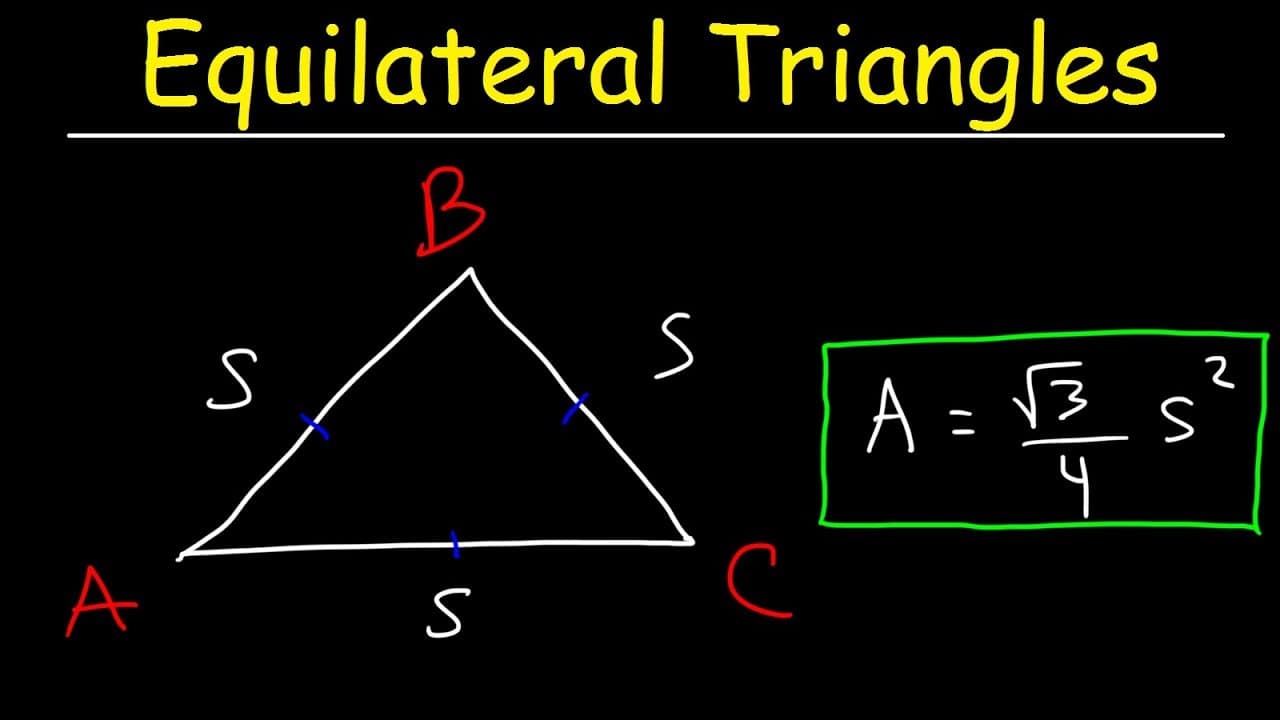
This educational math tutorial provides a comprehensive guide on how to find the area of an equilateral triangle. The video is divided into two distinct parts: first, it introduces the specific area formula for equilateral triangles and demonstrates a practical calculation using a side length of 10. Second, it guides viewers through the formal algebraic derivation of that formula, transitioning from rote memorization to deep conceptual understanding.

The Organic Chemistry TutorThe Organic Chemistry Tutor

5mins 26s

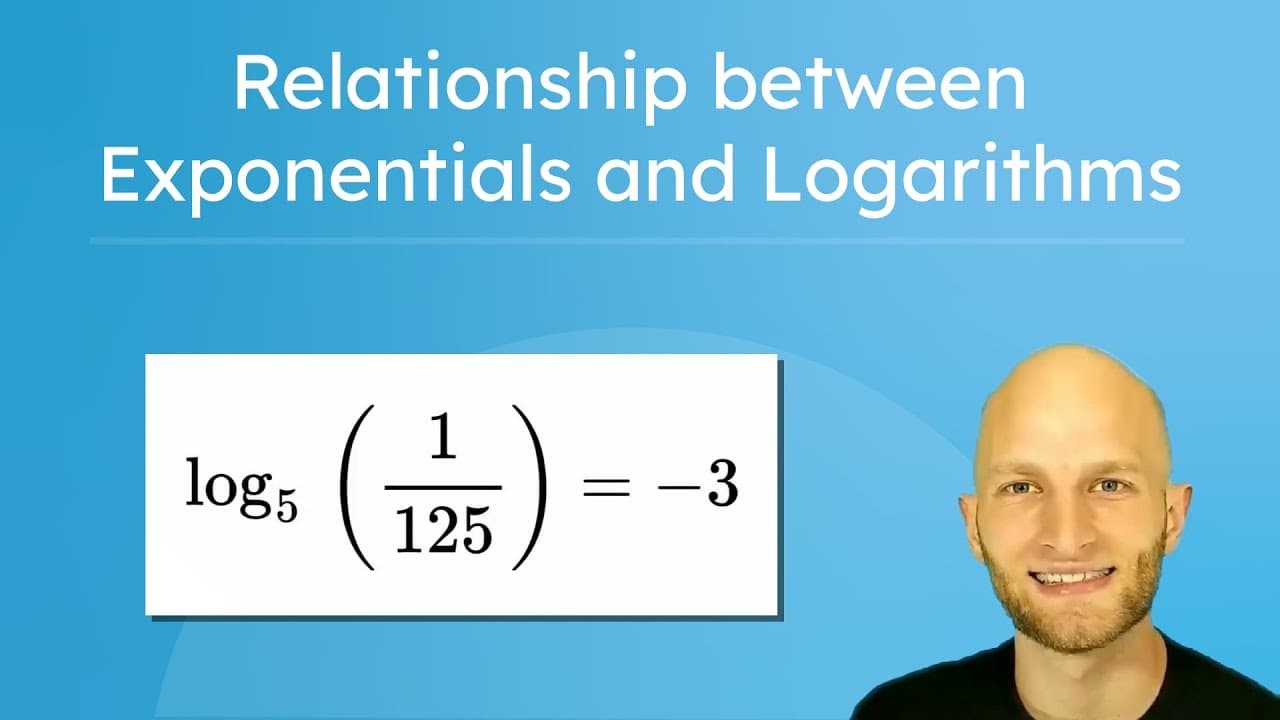
How to Evaluate Logarithms Without a Calculator

How to Evaluate Logarithms Without a Calculator

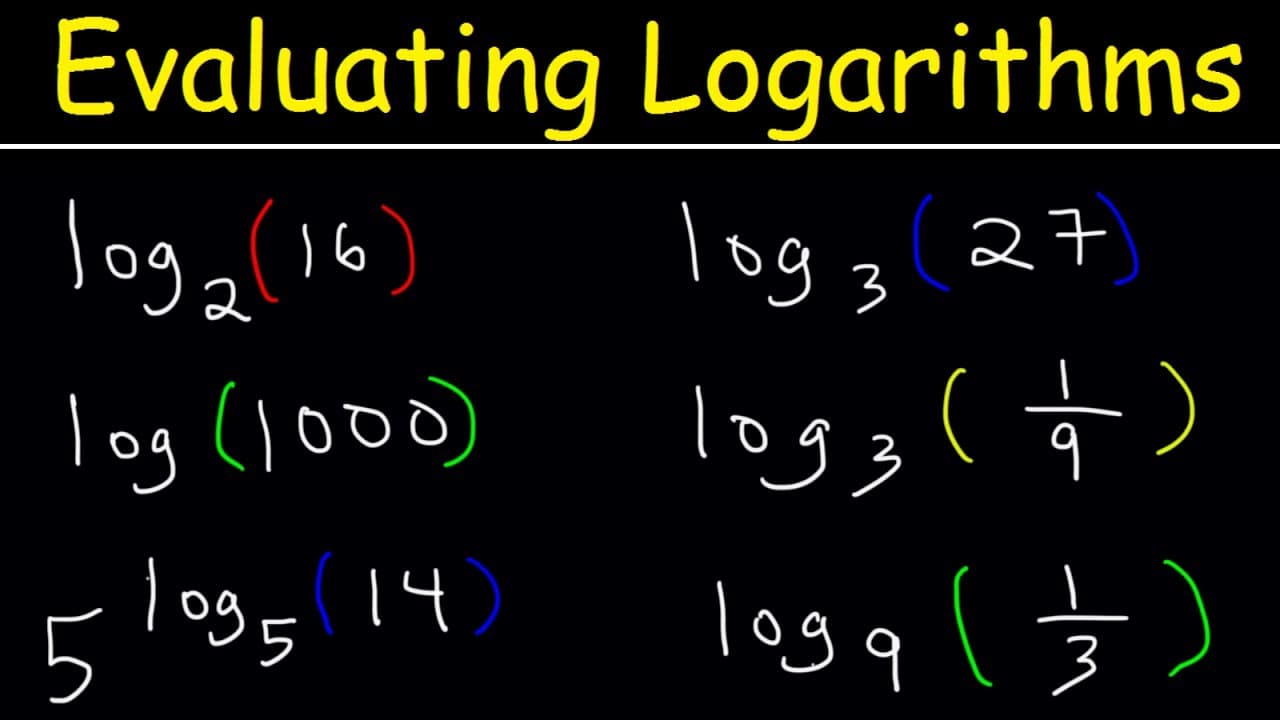
This educational video provides a comprehensive tutorial on evaluating logarithms without the use of a calculator. It begins by establishing the fundamental relationship between logarithmic and exponential forms, teaching viewers to ask the question "Base raised to what power equals the argument?" The narrator progresses from simple integer examples to more complex scenarios involving common logarithms (base 10), negative exponents with decimals and fractions, and fractional exponents representing roots. The video systematically explores several key logarithmic properties, including the logarithm of 1, the logarithm of the base itself, and the inverse property where a base is raised to a logarithm of the same base. It places significant emphasis on mental math techniques, such as counting zeros to evaluate powers of 10 and understanding how reciprocal fractions relate to negative exponents. For educators, this resource serves as an excellent instructional tool for introducing or reinforcing the concept of logarithms in Algebra 2 or Pre-Calculus. The clear, step-by-step handwritten derivations on a blackboard style background make it easy for students to follow along. The video concludes with a mixed practice set, allowing teachers to pause and assess student mastery of various log evaluation techniques in a single session.

The Organic Chemistry TutorThe Organic Chemistry Tutor

10mins 20s

Converting Between Logarithmic and Exponential Forms

Converting Between Logarithmic and Exponential Forms

This instructional video provides a clear, step-by-step guide on how to convert mathematical expressions between logarithmic and exponential forms. Opening with a brief explanation of why these conversions are useful in science and engineering, the instructor uses a digital whiteboard to demonstrate the structural relationship between the two forms. The video breaks down the specific variables involved—base ($b$), exponent ($x$), and argument ($y$)—and shows how they map onto one another when switching formats. The content covers four distinct examples: two converting from logarithmic to exponential equations, and two converting from exponential to logarithmic equations. The instructor emphasizes a pattern-matching strategy, encouraging viewers to explicitly identify which numbers correspond to the variables $b$, $x$, and $y$ in the standard formulas. This methodical approach helps demystify the often-confusing notation associated with logarithms. Ideally suited for Algebra II and Pre-Calculus classrooms, this video serves as excellent direct instruction or review material. It simplifies abstract notation into a concrete process of rearranging terms. Teachers can use this resource to introduce the definition of a logarithm, reinforce the concept of inverse functions, or support students who struggle with the syntax of logarithmic equations.

Miacademy & MiaPrep Learning ChannelMiacademy & MiaPrep Learning Channel

7mins 17s

Materials

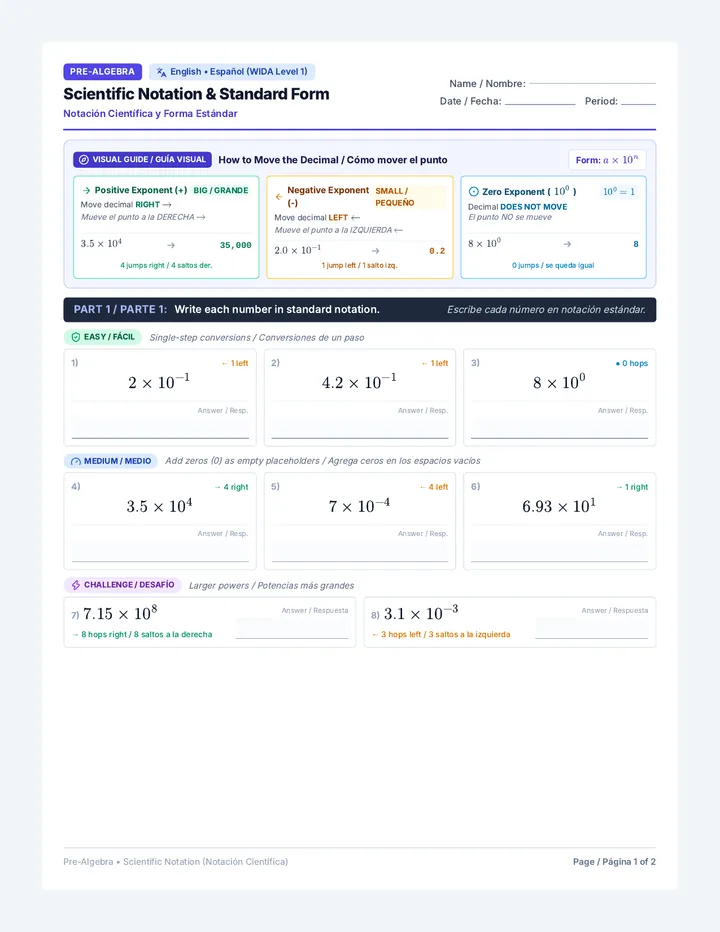
Scientific Notation Bilingual Worksheet

Scientific Notation Bilingual Worksheet

A focused 2-page Grade 8 Pre-Algebra worksheet reduced to 15 problems (cut by 50% from the original 30). Tailored for WIDA Level 1 Spanish-speaking math students with side-by-side English and Spanish text, visual decimal jump guides, ample handwriting room, and a math cognate vocabulary bank.

JD

Jenna Dzioba

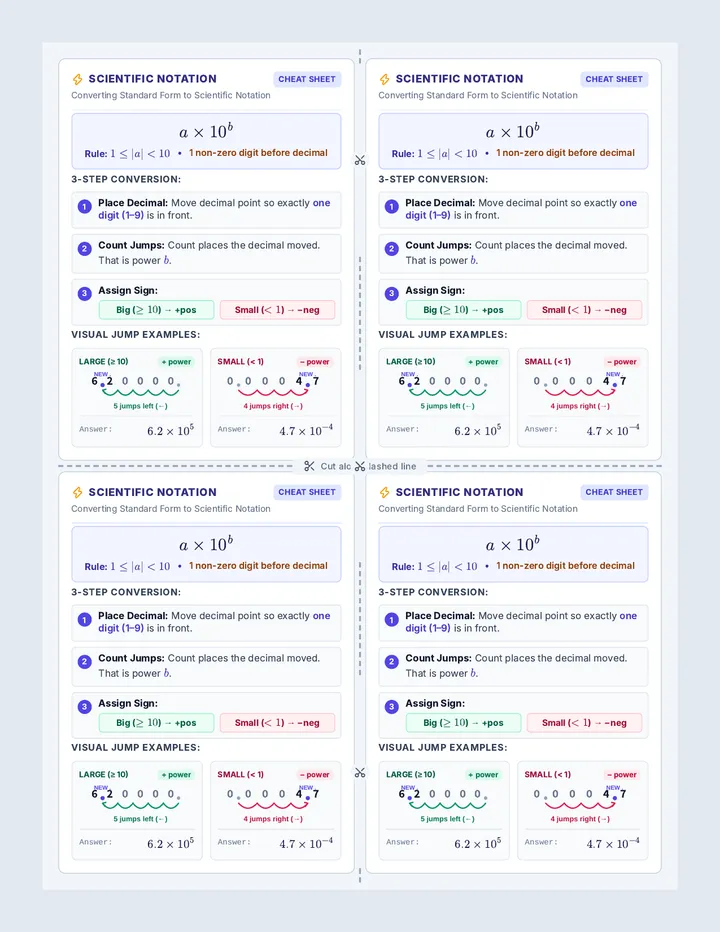
Scientific Notation Cheat Sheet

Scientific Notation Cheat Sheet

A print-ready 4-copy cut-apart cheat sheet providing concise step-by-step guidance, formula rules, and visual decimal jump diagrams for converting standard numbers into scientific notation. Designed with dashed cut lines and scissor guidelines to easily produce four compact reference cards from a single page.

JL

Joseph LePage

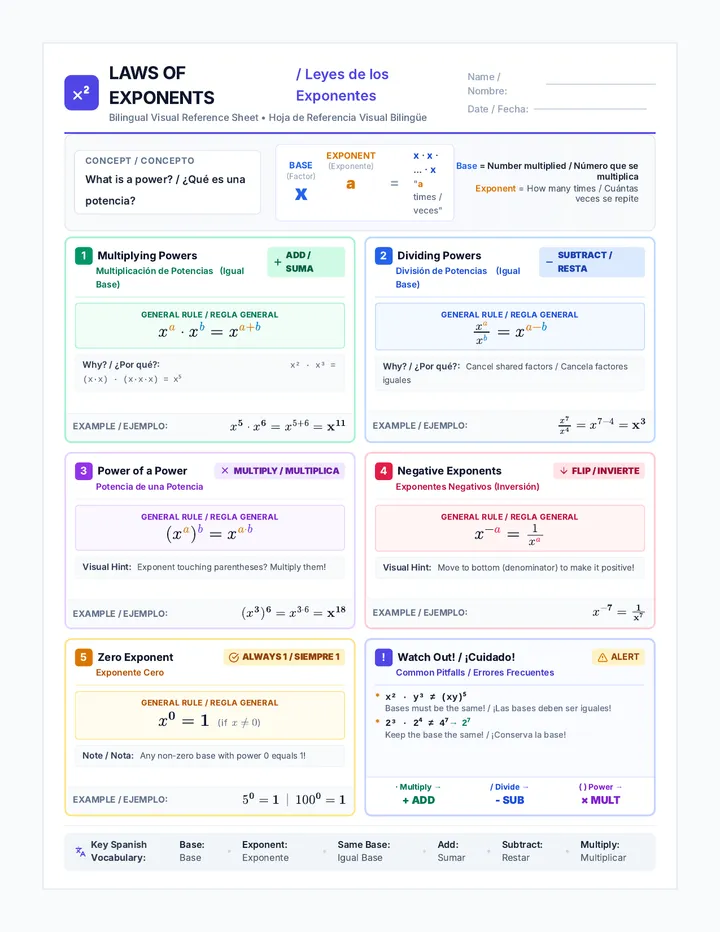
Exponent Laws Reference Sheet

Exponent Laws Reference Sheet

A comprehensive, visually rich bilingual reference sheet (English and Spanish) covering the five fundamental laws of exponents with labeled anatomy, color-coded rules, step-by-step examples, and common pitfalls for Level 1 Spanish speakers.

JD

Jenna Dzioba

Radical Sprint Worksheet

Radical Sprint Worksheet

A 60-question math worksheet covering square root simplification for values up to 1350, featuring a balanced mix of perfect squares and simplest radical form problems across two 30-question pages.

J

jeffreychadwick.inspiretx

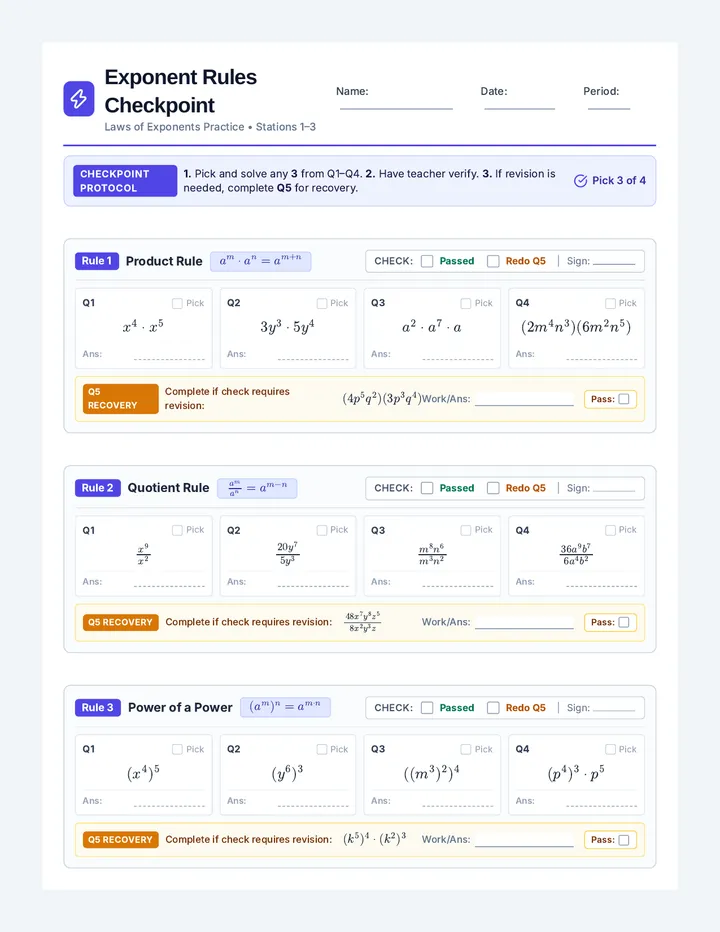
Exponent Rules Checkpoint Worksheet

Exponent Rules Checkpoint Worksheet

Updated 2-page practice worksheet covering the 6 rules of exponents: Product, Quotient, Power of a Power, Power of a Product (with strictly positive coefficients), Zero Exponent, and Negative Exponent. Features student choice with 5 questions per rule, teacher check-off stamps, and recovery questions.

CD

Craig Davis

Math Matrix Worksheet

Math Matrix Worksheet

A comprehensive 30-question mixed review worksheet covering absolute value, integer operations, rules of exponents, order of operations, and square roots, featuring a built-in quick-reference formula toolkit and structured student workspace.

J

jeffreychadwick.inspiretx

Sequences

Equation Balancing Student Packet

Distance Detectives

A highly visual geometry unit focused on applying algebraic formulas to coordinate planes. Students use coordinate grids, step-by-step graphic organizers, and tactile representations to solve real-world distance and segment length problems.

D

deeohnny.jackson

64
Project Mission Slides Final

Math in Motion: The 2-Hour Summit

A high-intensity, 120-minute math simulation. Students act as lead consultants, completing a high-speed skill warmup before selecting a professional sector (Music, Urban Planning, Rocket Science, or Sports Analytics) to solve a series of complex work orders.

EL

Elsa LaLone

102
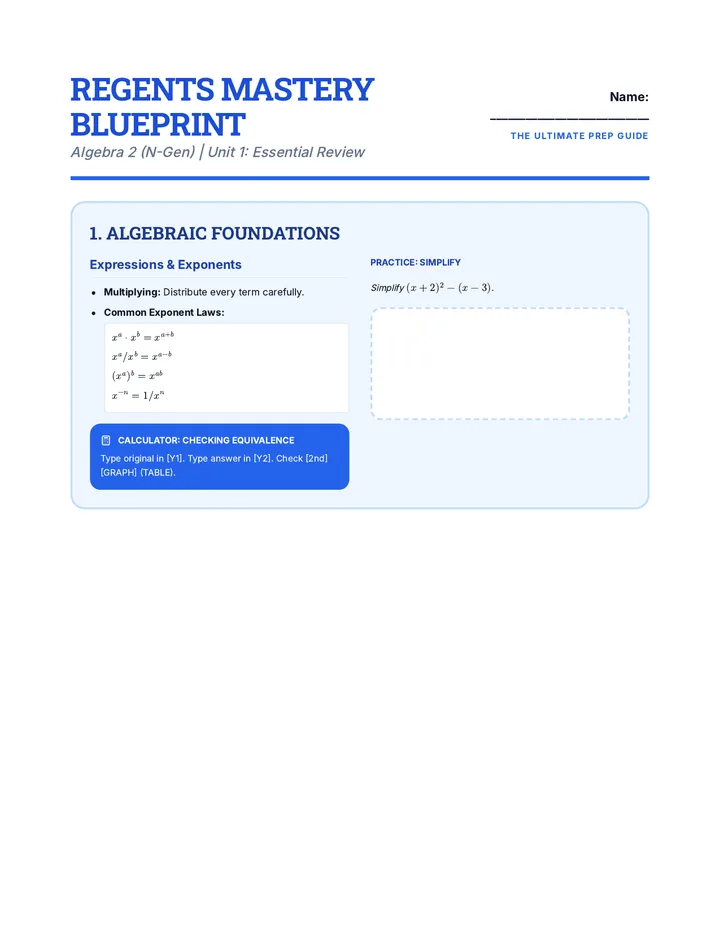
Regents Mastery Blueprint Study Guide

Regents Mastery Suite

A comprehensive review suite for the New York State Mathematics Regents exams, including Algebra 1, Geometry, and Algebra 2, featuring mastery blueprints, calculator strategies, and exam-taking tips.

KB

Kayla Borozny

15
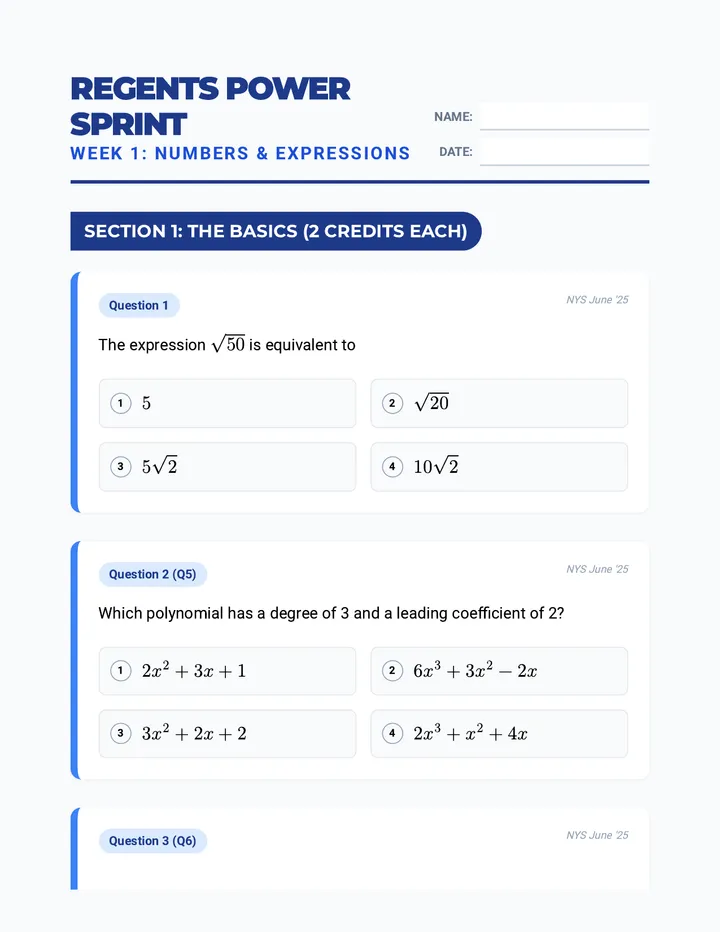
Week 1 Power Sprint Worksheet

Regents Road Map

A comprehensive 10-week preparation sequence designed to get students ready for the Algebra I Regents exam by May 15th, featuring bi-weekly 30-minute practice sessions and visual anchor charts.

L

laura.clar

31
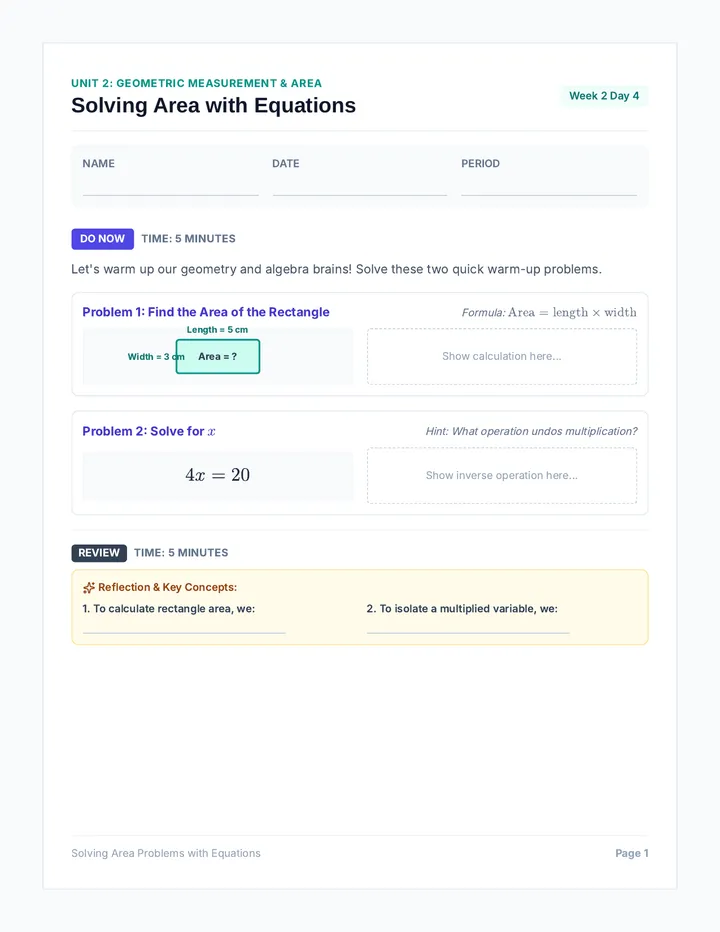
Compound Inequalities Bonus Worksheet

Equations and Inequalities

A comprehensive unit covering linear and compound inequalities, absolute value equations and inequalities, and real-world modeling applications.

FM

Fernando Mancini

16
Trapezoid Survey A Answer Key

Quadrilateral Coordinate Land

A high-level coordinate geometry sequence where students apply coordinate algebra formulas to identify and verify the properties of quadrilaterals and other polygons on the coordinate plane.

M

mastronardil

14

Lessons

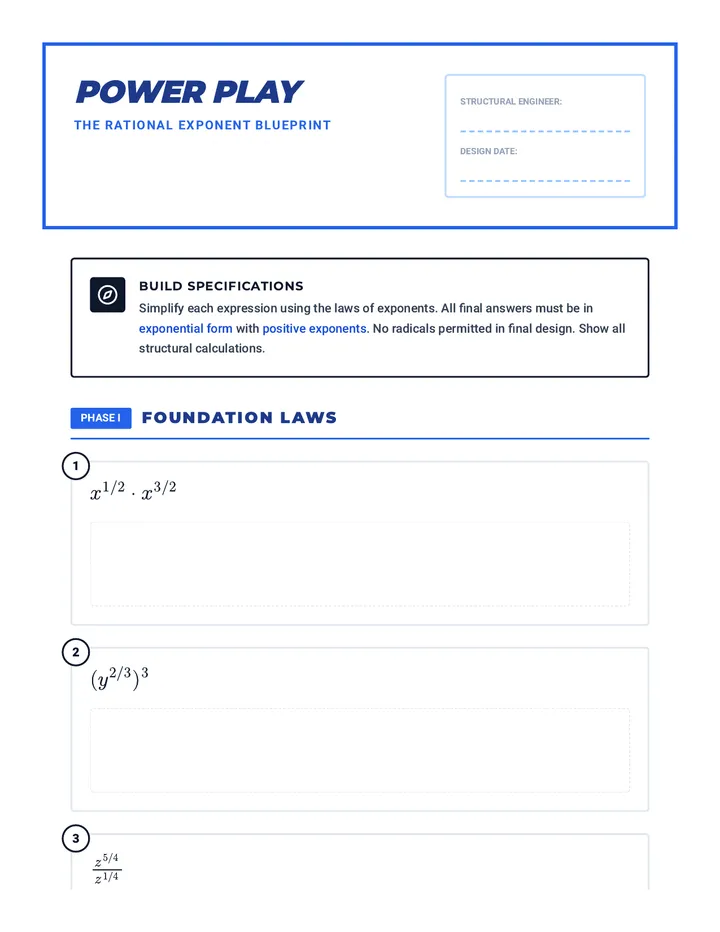
Power Play Worksheet

Power Play Masterclass

A lesson focused on mastering the laws of exponents with rational exponents, progressing from single-step applications to complex multi-step simplifications without using radical notation.

M

mastronardil

5
Algebra II Final Exam Test

Algebra II Spring Final Exam

A comprehensive Algebra II final exam covering quadratics, function operations, inverses, exponent rules, and polynomial division.

BF

Ben Freitag

2
Math Screener Student Booklet

8th Grade Math Diagnostic Screener

A comprehensive 8th-grade math screener diagnostic tool designed to identify students for Tier 2 and Tier 3 interventions. Includes a 4-page student booklet, a matching step-by-step answer key, and an instructional rubric, placement guide, and class data tracker spanning 6th, 7th, and 8th-grade standards.

B

Bennington

3
Slam Dunk Slides

Slam Dunk Exponents

A basketball-themed lesson for 8th grade students covering the product, quotient, and power rules of exponents with both numbers and variables. The lesson includes instructional slides, guided notes, and differentiated practice.

JS

Jennifer Stevens

19
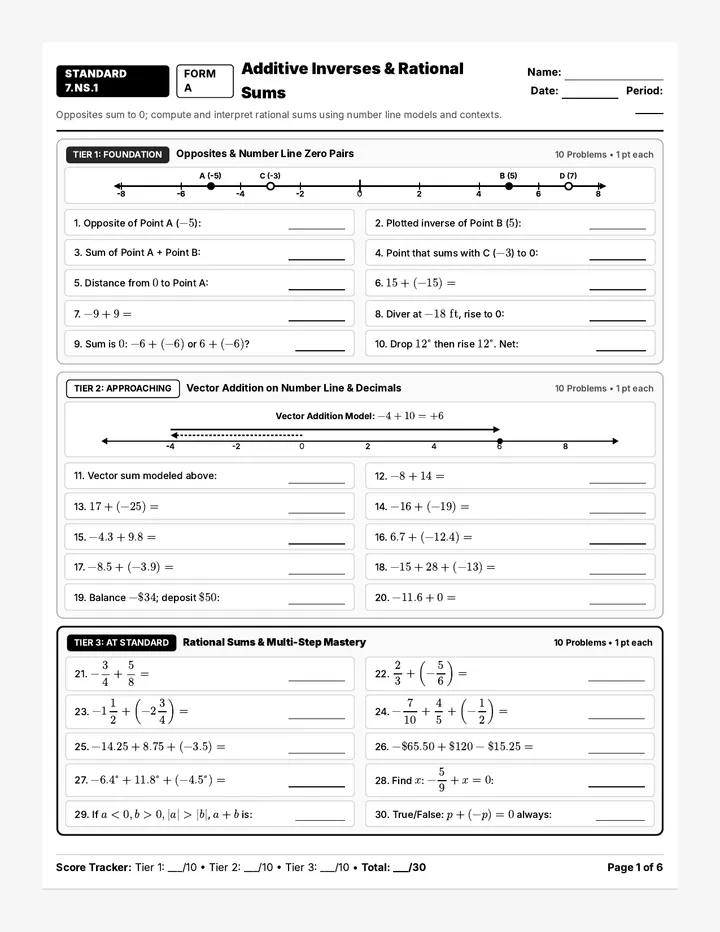
Number Sense Form A Workbook

Number Sense Progression

Grade 7 number sense progression series covering standards 7.NS.1 through 7.NS.6. Features four parallel assessment workbooks (Forms A, B, C, and the 4-tier Form D with Above Standard challenge), a master answer key, teacher facilitation guide, and tier quick notes.

CS

Chynna Smith

7
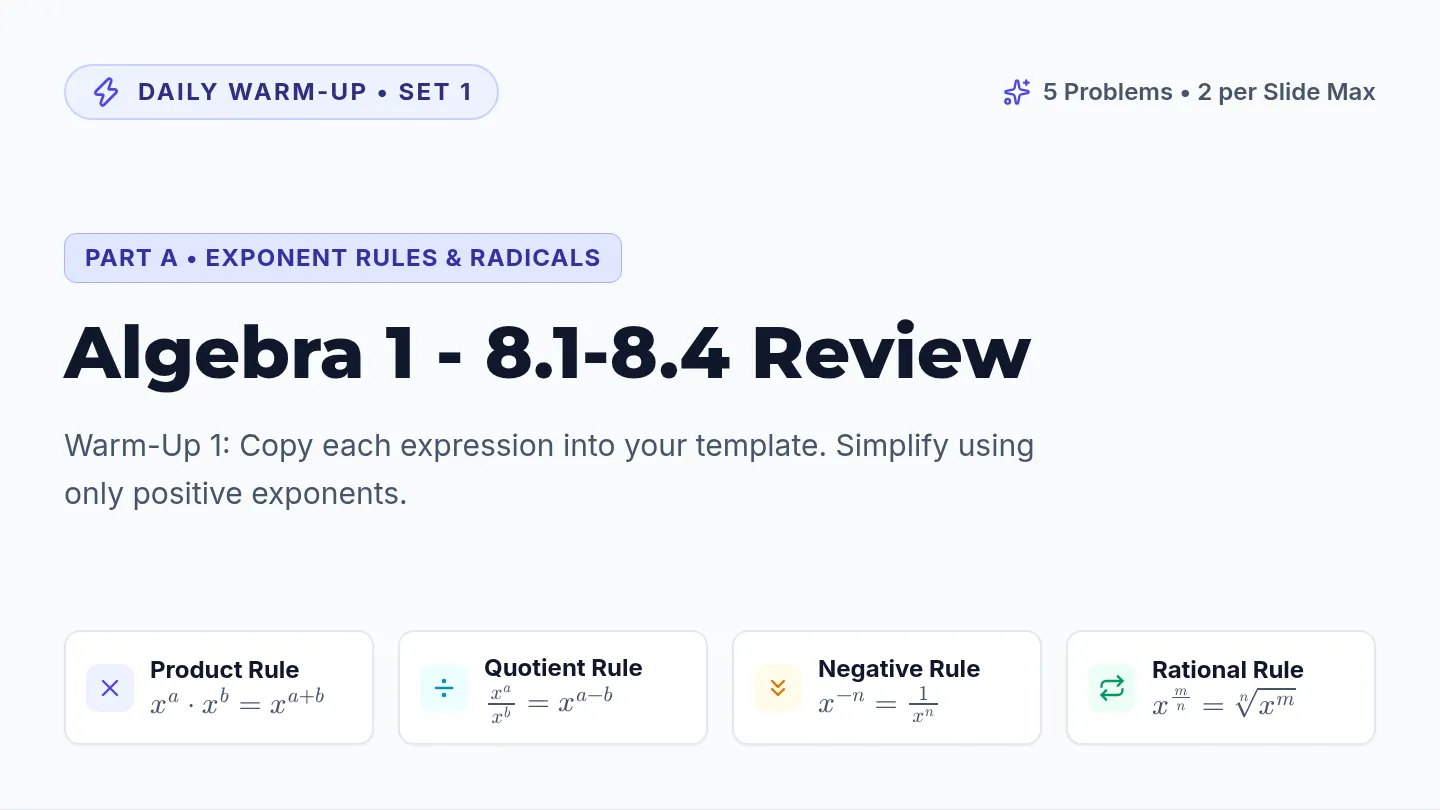
Warm Up One Slides

Exponent Power Review

A targeted warm-up and practice module reviewing Algebra 1 exponent rules, negative exponents, rational powers, and radical expressions. Includes visual presentation slides and a matching student work template.

J

jfrisk

3