Break Apart Exit Ticket Exit Ticket
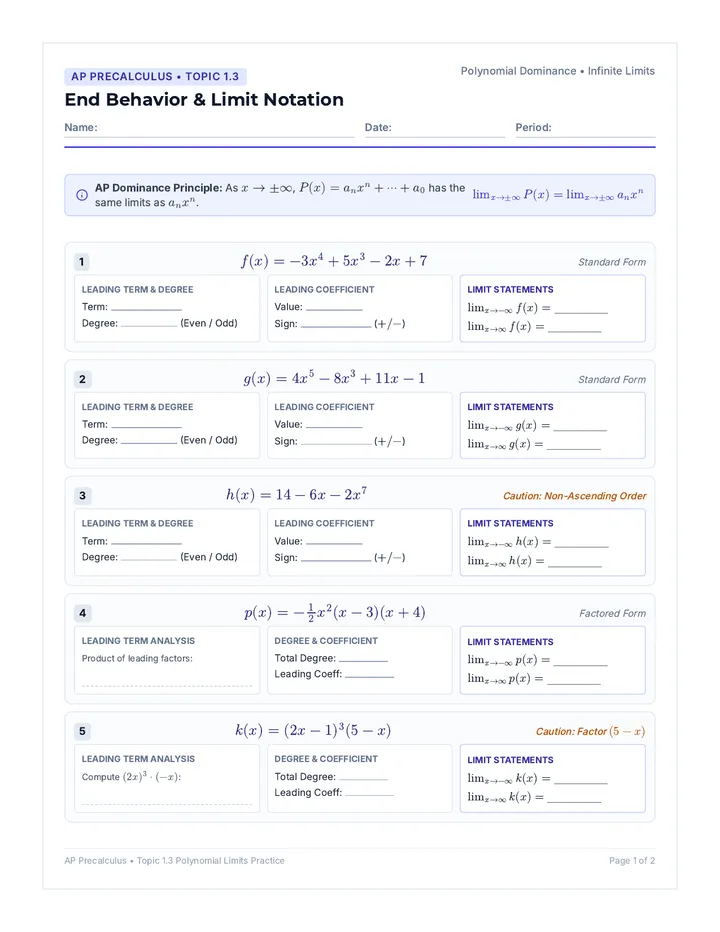
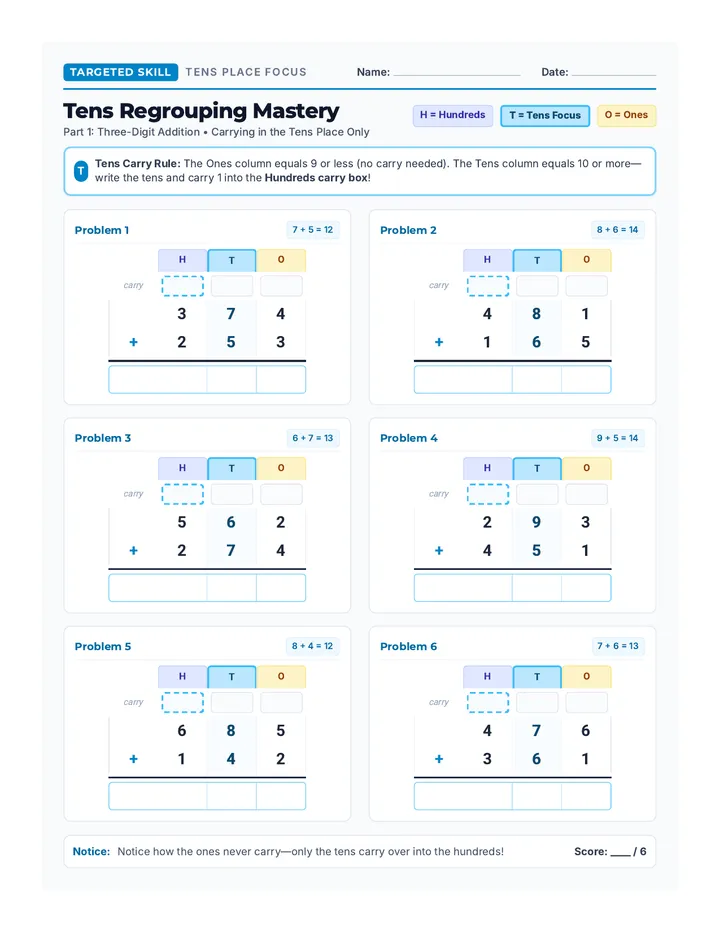
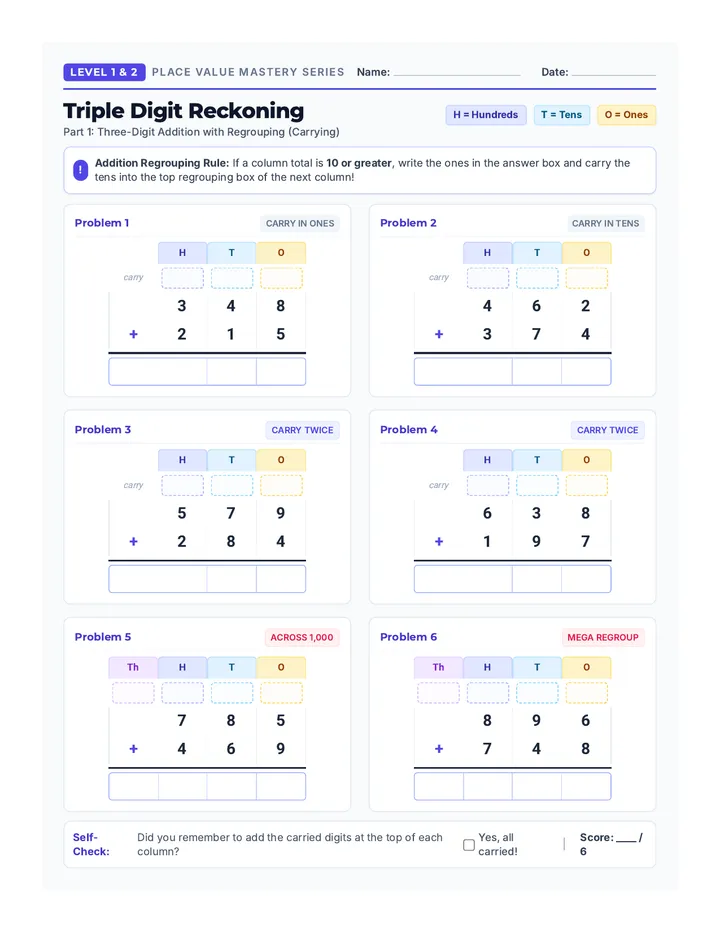
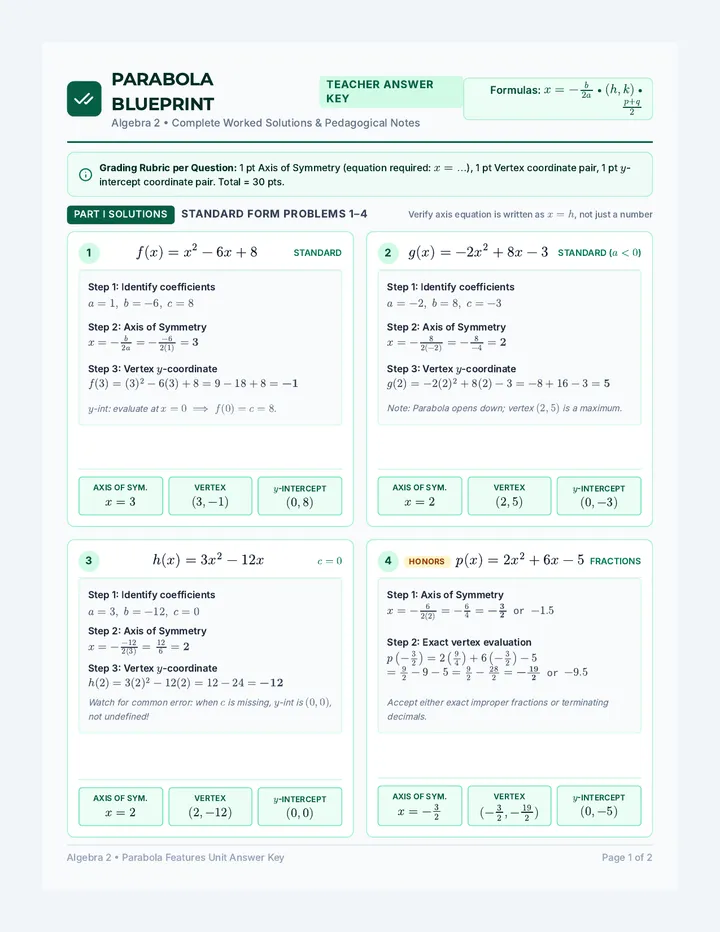
Lesson 7: Break Apart Area
(3.MD.C.7.c)
Independent Check • Work Silently on Your Own
Name:
Date:
A rectangular garden is 8 feet wide and 14 feet long . Use the break apart strategy (distributive property) to find the total area.
1. Break apart 14 into two numbers:
14 = +
2. Calculate partial areas & total:
Part A: \(8 \times \) \( = \) sq ft
Part B: \(8 \times \) \( = \) sq ft
Total Area: + = sq ft
Area Model Diagram:
____ ft ____ ft
Part A Area: ____ sq ft
Part B Area: ____ sq ft
Height: 8 ft
Label the sides and areas on the diagram
3. Explain Thinking: Why does breaking 14 apart still give us the exact same total area?
Teacher Check:
4 Mastered 3 Approaching 2 Emerging 1 Needs Help
Notes: ______________
Cut Here • 2 Exit Tickets Per Sheet
Exit Ticket
Lesson 7: Break Apart Area
(3.MD.C.7.c)
Independent Check • Work Silently on Your Own
Name:
Date:
A rectangular garden is 8 feet wide and 14 feet long . Use the break apart strategy (distributive property) to find the total area.
1. Break apart 14 into two numbers:
14 = +
2. Calculate partial areas & total:
Part A: \(8 \times \) \( = \) sq ft
Part B: \(8 \times \) \( = \) sq ft
Total Area: + = sq ft
Area Model Diagram:
____ ft ____ ft
Part A Area: ____ sq ft
Part B Area: ____ sq ft
Height: 8 ft
Label the sides and areas on the diagram
3. Explain Thinking: Why does breaking 14 apart still give us the exact same total area?
Teacher Check:
4 Mastered 3 Approaching 2 Emerging 1 Needs Help
Notes: ______________
Break Apart Scoring Guide Teacher Guide Unit 3 • Lesson 7
Standards: 3.MD.C.7.c, 3.OA.B.5
Break Apart Area: Exit Ticket Scoring & Diagnostic Guide
Quickly evaluate student exit tickets to assess individual conceptual mastery and plan next-day intervention groups.
Exemplar Student Response & Key
Problem: 8 ft wide by 14 ft long
1. Decomposition: 14 = 10 + 4 (or 7 + 7, 5 + 9)
2. Calculations:
• Part A: \(8 \times 10 = 80\) sq ft
• Part B: \(8 \times 4 = 32\) sq ft
• Total Area: \(80 + 32 = \mathbf{112\text{ sq ft}}\)
3. Conceptual Explanation:
"The rectangle is still the exact same size. We didn't add or take away any space; we just split it into two friendly pieces and added their areas together."
Key Look-For: Student articulates that the overall space/area is preserved when decomposed.
4-Level Mastery Rubric (Sort in under 3 minutes)
Level 4: Exceeds 100%
Accurately decomposes 14, draws/labels model, computes both partial areas correctly (112 sq ft), and writes an articulate explanation of area conservation.
Action: Peer leader / Extend to 3-digit dimensions.
Level 3: Mastered 80-90%
Correctly decomposes 14 and calculates 112 sq ft with units. Explanation is clear though may be informal (e.g., "we split it and put them back together").
Action: Ready for Lesson 8 (Missing Sides).
Level 2: Developing 60-70%
Understands decomposition concept but makes minor basic-fact multiplication errors (e.g., \(8 \times 4 = 28\)) or forgot units. Explanation is partial.
Action: 5-min fact check warm-up in Lesson 8.
Level 1: Needs Support <60%
Adds instead of multiplies (e.g., \(8 + 10 = 18\)), fails to distribute the 8 to both parts, or cannot decompose. Unable to explain.
Action: Small group with grid paper / square tiles.
Diagnostic Decoder: What Errors Reveal
Observed Error Underlying Misconception Targeted Next-Day Intervention Writes \(8 + 10 = 18\) and \(8 + 4 = 12\) Confusing area (multiplication of rows & columns) with perimeter/addition. Have student shade 8 rows of 10 on centimeter grid paper. Emphasize "groups of". Does \(8 \times 10 = 80\) but leaves out \(8 \times 4\) Forgot that the height applies to BOTH parts of the broken rectangle. Use two colored highlighters to color both Part A and Part B's shared side (8). Cannot articulate why it works Relying on procedure without visual conservation understanding. Physically fold or cut a paper rectangle into two pieces to show area does not change.
Next-Day Sorting Groups (Fill in Student Names): Goal: Plan grouping before tomorrow's missing sides lesson
Reteach (Level 1):
Fact Support (Level 2):
Mastered / Ready (Levels 3-4):
Missing Sides Exit Ticket Exit Ticket
Lesson 8: Finding Missing Sides
(3.MD.C.7.b, 3.OA.B.6)
Independent Mastery Check • Silent Individual Work
Name:
Date:
A rectangular reading rug has an area of 42 square feet . One of the sides is 6 feet . What is the length of the other side ?
1. Label the Sides on Diagram:
? ft (missing side)
Area = 42 sq ft 6 ft \(\times\) ? = 42
Known side: 6 ft opposite: 6 ft
Label the sides and area on the diagram
2. Show Both Methods:
Think Multiplication: \(6 \times \) \( = 42\)
Use Division: \(42 \div 6 = \)
Missing Side = feet Check: \(\times\) = 42 ✓
3. Explain Connection: Why does dividing \(42 \div 6\) give the same answer as \(6 \times ? = 42\)?
Teacher Check:
4 Mastered 3 Approaching 2 Emerging 1 Needs Help
Notes: ______________
Cut Here • 2 Exit Tickets Per Sheet
Exit Ticket
Lesson 8: Finding Missing Sides
(3.MD.C.7.b, 3.OA.B.6)
Independent Mastery Check • Silent Individual Work
Name:
Date:
A rectangular reading rug has an area of 42 square feet . One of the sides is 6 feet . What is the length of the other side ?
1. Label the Sides on Diagram:
? ft (missing side)
Area = 42 sq ft 6 ft \(\times\) ? = 42
Known side: 6 ft opposite: 6 ft
Label the sides and area on the diagram
2. Show Both Methods:
Think Multiplication: \(6 \times \) \( = 42\)
Use Division: \(42 \div 6 = \)
Missing Side = feet Check: \(\times\) = 42 ✓
3. Explain Connection: Why does dividing \(42 \div 6\) give the same answer as \(6 \times ? = 42\)?
Teacher Check:
4 Mastered 3 Approaching 2 Emerging 1 Needs Help
Notes: ______________
Missing Sides Scoring Guide Teacher Guide Unit 3 • Lesson 8
Standards: 3.MD.C.7.b, 3.OA.B.6
Finding Missing Sides: Exit Ticket Scoring & Diagnostic Guide
Diagnose independent student mastery of unknown side lengths and inverse multiplication/division relationships.
Exemplar Student Response & Key
Problem: Area = 42 sq ft, Width = 6 ft
Equations & Calculations:
• Think Multiplication: \(6 \times \mathbf{7} = 42\)
• Use Division: \(42 \div 6 = \mathbf{7}\)
• Final Answer: Length = 7 feet (requires units)
• Verification Check: \(6 \times 7 = 42\) ✓
Conceptual Connection:
"Multiplication and division are opposite (inverse) operations. Asking '6 times what equals 42?' is asking the exact same question as 'what is 42 split into groups of 6?'"
Key Look-For: Student recognizes the inverse relationship between factors and quotients.
4-Level Mastery Rubric (Sort in under 3 minutes)
Level 4: Exceeds 100%
Accurately labels diagram, writes both equations, states 7 feet with units, checks multiplication, and explains inverse relationship clearly.
Action: Extend to Lesson 9 perimeter integration.
Level 3: Mastered 80-90%
Correctly finds 7 feet and writes both equations and check. Explanation demonstrates understanding that division undoes multiplication.
Action: Ready for Lesson 9 (Multi-step problems).
Level 2: Developing 60-70%
Calculates 7 correctly using one method but cannot link to division, forgot units ("7" instead of "7 ft"), or skipped the check.
Action: Warm-up on fact families (6, 7, 42).
Level 1: Needs Support <60%
Subtracts known side from area (\(42 - 6 = 36\)) or multiplies (\(42 \times 6\)). Lacks understanding of area formula inverse.
Action: Small group hands-on with color tiles.
Diagnostic Decoder: What Errors Reveal
Observed Error Underlying Misconception Targeted Next-Day Intervention Subtracts: \(42 - 6 = 36\) Thinks of area as an additive total rather than an array of equal rows. Build 42 tiles into rows of 6. Count how many rows are created. Multiplies: \(42 \times 6 = 252\) Automatically multiplies any two numbers seen in an area word problem. Teach "Inside vs Outside": 42 is inside the box; sides are outside the box.
Mastering Sides Exit Ticket Exit Ticket
Lesson 9: Missing Sides Mastery
(3.MD.C.7.b, 3.OA.B.6)
Independent Mastery Check • Silent Individual Work
Name:
Date:
Farmer Maya builds a rectangular goat pen with an area of 72 square feet . One of the sides is 8 feet .
1. Draw & Label the Sides:
? ft (missing side)
Area = 72 sq ft Show equation in box
Known side: 8 ft 8 ft
Label the sides and units on the diagram
2. Equation & Solution:
Write equation: 8 \(\times\) = 72
Or use division: 72 \(\div\) 8 =
Missing Side = ft Check: \(\times\) = 72 ✓
3. Geometric Reasoning: Is this pen a square ? Explain why or why not using your side lengths:
Teacher Check:
4 Mastered 3 Approaching 2 Emerging 1 Needs Help
Notes: ______________
Cut Here • 2 Exit Tickets Per Sheet
Exit Ticket
Lesson 9: Missing Sides Mastery
(3.MD.C.7.b, 3.OA.B.6)
Independent Mastery Check • Silent Individual Work
Name:
Date:
Farmer Maya builds a rectangular goat pen with an area of 72 square feet . One of the sides is 8 feet .
1. Draw & Label the Sides:
? ft (missing side)
Area = 72 sq ft Show equation in box
Known side: 8 ft 8 ft
Label the sides and units on the diagram
2. Equation & Solution:
Write equation: 8 \(\times\) = 72
Or use division: 72 \(\div\) 8 =
Missing Side = ft Check: \(\times\) = 72 ✓
3. Geometric Reasoning: Is this pen a square ? Explain why or why not using your side lengths:
Teacher Check:
4 Mastered 3 Approaching 2 Emerging 1 Needs Help
Notes: ______________
Mastering Sides Scoring Guide Teacher Guide Unit 3 • Lesson 9
Standards: 3.MD.C.7.b, 3.OA.B.6
Mastering Missing Sides: Exit Ticket Scoring Guide
Diagnose independent student mastery of unknown side lengths, multiplication checks, and geometric square verification.
Exemplar Student Response & Key
Problem: Area = 72 sq ft, Side = 8 ft
Equations & Calculations:
• Multiplication: \(8 \times \mathbf{9} = 72\)
• Division: \(72 \div 8 = \mathbf{9}\)
• Missing Side: 9 feet (must include units)
• Verification Check: \(8 \times 9 = 72\) ✓
Geometric Reasoning (Square Analysis):
"No, it is not a square. One side is 8 feet and the other side is 9 feet. A square must have all four sides the exact same length, but 8 and 9 are not equal."
Key Look-For: Student clearly references both dimensions (8 and 9) and the definition of a square.
4-Level Mastery Rubric (Sort in under 3 minutes)
Level 4: Exceeds 100%
Accurately draws/labels diagram, solves for 9 ft, writes check (\(8 \times 9 = 72\)), and articulates why the shape is not a square using precise side lengths.
Action: Ready for Unit 3 Summative Assessment.
Level 3: Mastered 80-90%
Calculates 9 ft with correct units, shows equation and check. States "No, not a square because sides are 8 and 9" with adequate clarity.
Action: Ready for Unit 3 Assessment.
Level 2: Developing 60-70%
Calculates 9 ft but says "Yes it's a square because 8 and 9 are close," or forgot to label the diagram or check their calculation.
Action: Review polygon attributes & equal sides.
Level 1: Needs Support <60%
Cannot identify missing dimension or makes multiplication error (e.g., \(8 \times 8 = 64\)). No conceptual grasp of side length vs area.
Action: Intensive small group with 1-inch square tiles.
Diagnostic Decoder: What Errors Reveal
Observed Error Underlying Misconception Targeted Next-Day Intervention Calculates 8 ft instead of 9 ft Mistakes \(8 \times 8 = 64\) for 72; square number confusion. Review 8s fact strip: 64 is 8 groups, add 1 more 8 to reach 72 (9 groups). Says "Yes it is a square because it has 4 sides" Focuses on number of sides (quadrilateral) rather than side equality. Have student measure real objects: compare an index card to a square sticky note.