Lenny.com
Explore
Create
ActivitiesNewMathEnglish Language ArtsScience & EngineeringSocial StudiesGlobal LanguagesHealth & Physical EducationSpecial EducationCounseling & Life SkillsArts & CreativityESL
Lenny.com
Lenny.com
Explore
Create
ActivitiesNewMathEnglish Language ArtsScience & EngineeringSocial StudiesGlobal LanguagesHealth & Physical EducationSpecial EducationCounseling & Life SkillsArts & CreativityESL
Lenny.com
Lenny.com

Solutions

Lenny for EducatorsLenny for SchoolsLenny for Districts

Product

ExploreSign inCreateSupportAbout

Resources

Getting startedMTSS Acceleration Program

© 2026 Lenny Learning Inc.

TermsPrivacyAccessibility
LinkedInInstagramX
Lenny
MathNumbers & CountingCounting ObjectsNumber NamesComparing NumbersNumber OperationsCounting SequenceNumbers 0-10Place Value Understanding and SystemAdd and Subtract Within 20Addition and Subtraction ConceptsAddition and Subtraction EquationsAddition and Subtraction ProblemsFoundations for MultiplicationMultiplication and Division PropertiesMultiply and Divide Within 100Multiplication and Division ProblemsFactors and MultiplesProperties of OperationsPatterns and RelationshipsGenerate and Analyze PatternsMulti-Digit ArithmeticPlace Value OperationsMulti-Digit and Decimal OperationsNumerical ExpressionsFour Operations and PatternsFour Operations Problem SolvingMeasurement & DataMeasurable AttributesMeasuring LengthsMeasure and Estimate Lengths in Standard UnitsRelate Addition and Subtraction to LengthClassifying and Counting ObjectsTime and MoneyArea Concepts and MeasurementPerimeter and Area MeasuresAngle Concepts and MeasurementTime, Volume, and MassMeasurement Unit ConversionsGeometryIdentifying ShapesShapes and AttributesShape Attributes and ReasoningShapes and CompositionClassifying 2D FiguresGeometric Figures and RelationshipsLines, Angles, and ShapesAngle, Area, and VolumeGeometric MeasurementVolume of 3D ShapesCoordinate Plane ApplicationsTransformations in the PlaneCongruence and SimilarityUnderstand congruence in terms of rigid motionsSimilarity and TransformationsProve Theorems Involving SimilarityPythagorean TheoremTrigonometry for General TrianglesMake Geometric ConstructionsProve Geometric TheoremsTheorems About CirclesFind Arc Lengths And Areas of Sectors of CirclesVolume FormulasRelationships Between Two-Dimensional and Three-Dimensional ObjectsProve Simple Geometric Theorems AlgebraicallyTranslate Between Geometric Description and Equation for Conic SectionApply Geometric Concepts in Modeling SituationsFractions & DecimalsFractions as NumbersBuilding FractionsFraction Equivalence and OrderingAdding and Subtracting FractionsMultiplying and Dividing FractionsDividing FractionsDecimal FractionsMulti-Digit Computation and FactorsAdd, Subtract, Multiply, and Divide Rational NumbersRational Number SystemIrrational Numbers and ApproximationsRatiosRatios and ProportionsProportional RelationshipsUnit RateAlgebraAlgebraic ExpressionsGenerate Equivalent ExpressionsQuantitative RelationshipsProportional Relationships and Linear EquationsEquations and InequalitiesEquation Solving and ReasoningLinear Equations and SystemsGraph Equations and InequalitiesSystems of EquationsReal-World Algebraic ProblemsQuantitative Reasoning with UnitsExpression StructureEquivalent Expression FormsRadicals and Integer ExponentsRational ExponentsRational and Irrational NumbersPolynomial OperationsPolynomial IdentitiesPolynomial Zeros and FactorsRational ExpressionsComplex Number OperationsComplex Numbers in PolynomialsComplex Numbers on PlaneStatistics & ProbabilityRepresent and Interpret DataData DistributionsStatistical VariabilityProbability ModelsCompound Event ProbabilitiesStatistical SamplingInterpret Categorical and Quantitative DataBivariate Data PatternsInterpret Linear ModelsComparing Two PopulationsRandom Processes in StatisticsIndependence and Conditional ProbabilityExpected ValuesProbability-Based Decision MakingStatistical Inference and ConclusionsFunctionsFunction Concepts and NotationDefine and Compare FunctionsInterpret Functions in ContextAnalyze Function RepresentationsModel Relationships with FunctionsIdentify Linear vs Exponential GrowthDistinguish Between Function TypesCompare Growth RatesInterpret Function ExpressionsBuild Functions from RelationshipsConstruct and Model FunctionsTransform and Combine FunctionsModel Comparison and SelectionSolve Exponential EquationsTrigonometryTrigonometric Ratios Involving Right TrianglesTrigonometric Functions and Unit CircleModel with Trigonometric FunctionsTrigonometric IdentitiesVectors & MatricesIntroduction to Vectors and MatricesVector QuantitiesVector OperationsMatrix OperationsCalculusLimits and ContinuityDerivative Concepts and NotationDerivative Rules and TechniquesApplications of DerivativesOptimization ProblemsRelated RatesCurve Sketching and AnalysisIntegration Concepts and NotationAntiderivatives and Indefinite IntegralsDefinite Integrals and AreaFundamental Theorem of CalculusIntegration TechniquesApplications of IntegrationDifferential EquationsSequences and SeriesParametric and Polar FunctionsVector-Valued Functions

Summit Expedition Math

A rigorous 4-part math review sequence designed for rising 5th graders, moving progressively from foundational review to advanced 5th-grade preparation. Each packet is an 'Expedition Journal' featuring ten essential domains of fourth-grade math with mixed daily practice and comprehensive answer keys.

JCJennifer Campbell
Base Camp Journey

The foundational stage of the Summit Expedition, reviewing basic fraction equivalence, simple multi-digit multiplication, 3-digit division without remainders, and prime identification up to 20.

Glacier Pass Trek

The second stage of the expedition, advancing to mixed numbers, multi-step division, comparisons with common denominators, and prime identification up to 50.

The Ridge Ascent

The third stage of the expedition, introducing mixed number subtraction with borrowing, division with larger remainders, fraction-to-decimal conversion of non-standard denominators, and prime identification up to 100.

The Summit Reach

The final stage of the journey, featuring advanced 5th-grade prep questions, challenging division with zeros, multi-step word problems, and prime/composite analysis up to 120.

Summit Expedition Math

A rigorous 4-part math review sequence designed for rising 5th graders, moving progressively from foundational review to advanced 5th-grade preparation. Each packet is an 'Expedition Journal' featuring ten essential domains of fourth-grade math with mixed daily practice and comprehensive answer keys.

JCJennifer Campbell

Composite. Factors of 9 are 1, 3, and 9. Since it has more than two factors (specifically, 3 × 3 = 9), it is composite.

10 Zone 10: Expedition Word Problems

Problem A: Clara is preparing hiking snack bags. Each bag needs 1/4 cup of almonds. If she makes 8 bags, how many cups of almonds does she need in total?

Work: 8 × 1/4 = 8/4 = 2

Answer: 2 cups

Problem B: The Base Camp team has 256 water bottles to distribute equally among 4 supply tents. How many water bottles does each tent receive?

Work: 256 ÷ 4 = 64

Answer: 64 bottles

Summit Expedition Math • Base Camp Journey Page 2 of 2

Workspace:

Answer: ______________________ km

Summit Expedition Math • Glacier Pass Trek Page 2 of 2

A. Circle the numbers below that are COMPOSITE:

23 29 39 45

(39 = 3×13, and 45 = 5×9; they are composite)

B. Consider the number 29. Is it prime or composite? Explain your reasoning:

Prime. The only whole factors of 29 are 1 and 29. It cannot be divided evenly by any other number.

10 Zone 10: Expedition Word Problems

Problem A: A trail crew is clearing 1,248 meters of mountain pathway. If they can clear exactly 4 meters of pathway each hour, how many hours will it take them to clear the entire trail?

Work: 1,248 ÷ 4 = 312

Answer: 312 hours

Problem B: A team pack contains 5 separate climbing ropes, each measuring 3/8 of a kilometer. What is the total length of ropes in kilometers? Write your answer as a fraction.

Work: 5 × 3/8 = 15/8 km (or 1 7/8 km)

Answer: 15/8 km

Summit Expedition Math • Glacier Pass Trek Page 2 of 2

Workspace:

Answer: ______________________ rolls

Summit Expedition Math • The Ridge Ascent Page 2 of 2

   08

   -7↓

    19 → -14 = 5

Answer: 112 R 5

9 Zone 9: Prime or Composite?

A. Circle the numbers below that are PRIME:

53 57 87 97

(53 and 97 are prime. 57 and 87 are divisible by 3!)

B. Consider the number 57. Is it prime or composite? Explain your reasoning:

Composite. Although it looks prime, 57 can be factored into 3 × 19. Note: 5 + 7 = 12 (divisible by 3).

10 Zone 10: Expedition Word Problems

Problem A: Marcus packed 4 1/8 kilograms of camp fuel. During the first two days of the trek, his stove burned 1 5/8 kilograms of fuel. How many kilograms of fuel does he have left?

Work: 4 1/8 - 1 5/8 = 3 9/8 - 1 5/8 = 2 4/8 = 2 1/2

Answer: 2 1/2 kg (or 2 4/8 kg)

Problem B: A field botanist is setting up 5 plant observation quadrats. Each quadrat requires 3/4 of a roll of protective fencing tape. How many total rolls of fencing tape does she need? Write as a mixed number.

Work: 5 × 3/4 = 15/4 = 3 3/4 rolls

Answer: 3 3/4 rolls

Summit Expedition Math • The Ridge Ascent Page 2 of 2

Problem B: A climber drinks 3/5 of a liter of electrolyte water per hour. If they climb for 9 hours, how many liters of electrolyte water do they consume? Write your answer as a mixed number.

Workspace:

Answer: ______________________ Liters

Summit Expedition Math • The Summit Reach Page 2 of 2

Answer: 226 R 1

9 Zone 9: Prime or Composite? (Ultimate Diagnostic)

A. Circle the numbers below that are COMPOSITE:

101 111 117 119

(101 is prime. 111=3×37, 117=3×39, and 119=7×17!)

B. Consider 119. Is it prime or composite? Explain your reasoning:

Composite. It is composite because it has factors other than 1 and itself, specifically 7 × 17 = 119.

10 Zone 10: Expedition Word Problems

Problem A: The summit station needs to stock emergency blankets. They bought 8 cartons, each containing 64 blankets. If they want to distribute these equally among 6 base camps, how many blankets will each camp receive, and how many will be left over?

Work: 8 × 64 = 512 total blankets. 512 ÷ 6 = 85 R 2.

Each receive: 85, Leftover: 2

Problem B: A climber drinks 3/5 of a liter of electrolyte water per hour. If they climb for 9 hours, how many liters of electrolyte water do they consume? Write your answer as a mixed number.

Work: 9 × 3/5 = 27/5 liters = 5 2/5 liters

Answer: 5 2/5 Liters

Summit Expedition Math • The Summit Reach Page 2 of 2
You might also like

Single Digit Sub Guide

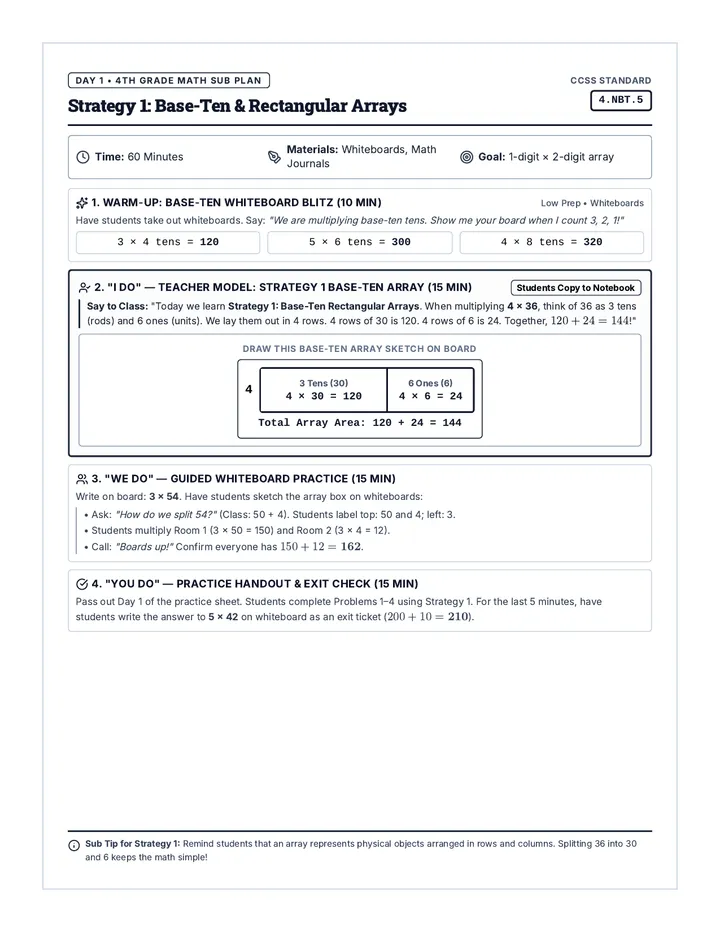
Multiplication Mastery Week

A comprehensive 5-day math curriculum sequence for 4th Grade standard 4.NBT.5, featuring scripted sub plans with gradual release, low-prep whiteboard and manipulative routines, student notebook guides, and a spiraled weekly homework packet.

RM

Rodnesha Minor

7
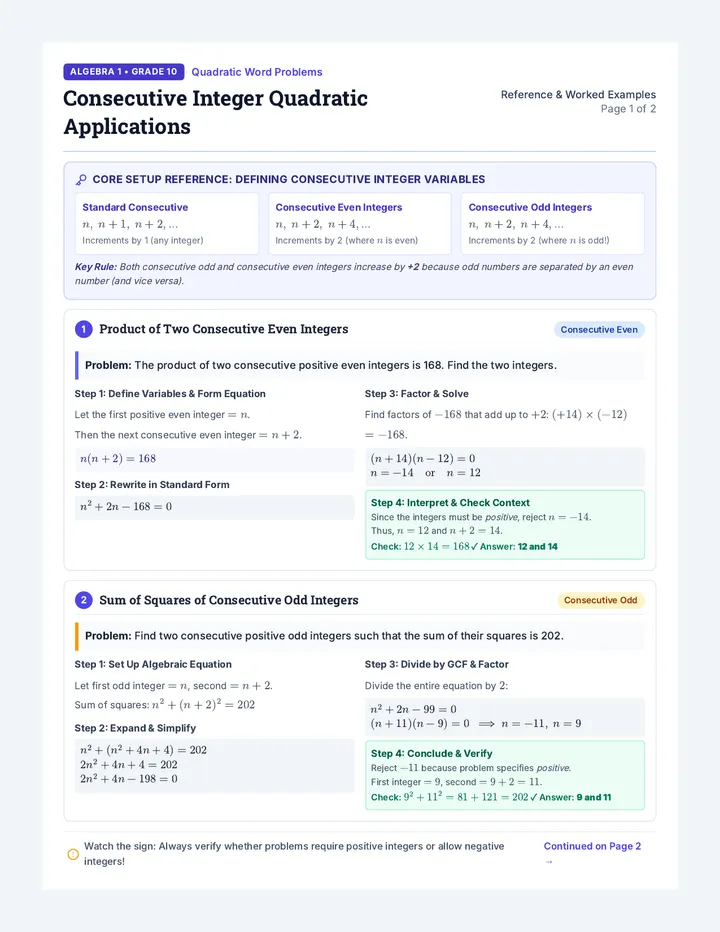
Consecutive Quadratics Practice Guide

Consecutive Integer Quadratics

A focused 10th-grade algebra lesson on modeling real-world and algebraic relationships using quadratic equations with consecutive odd and even integers. Features structured reference materials and an in-depth teacher solutions key.

AR

Angie Rice

4
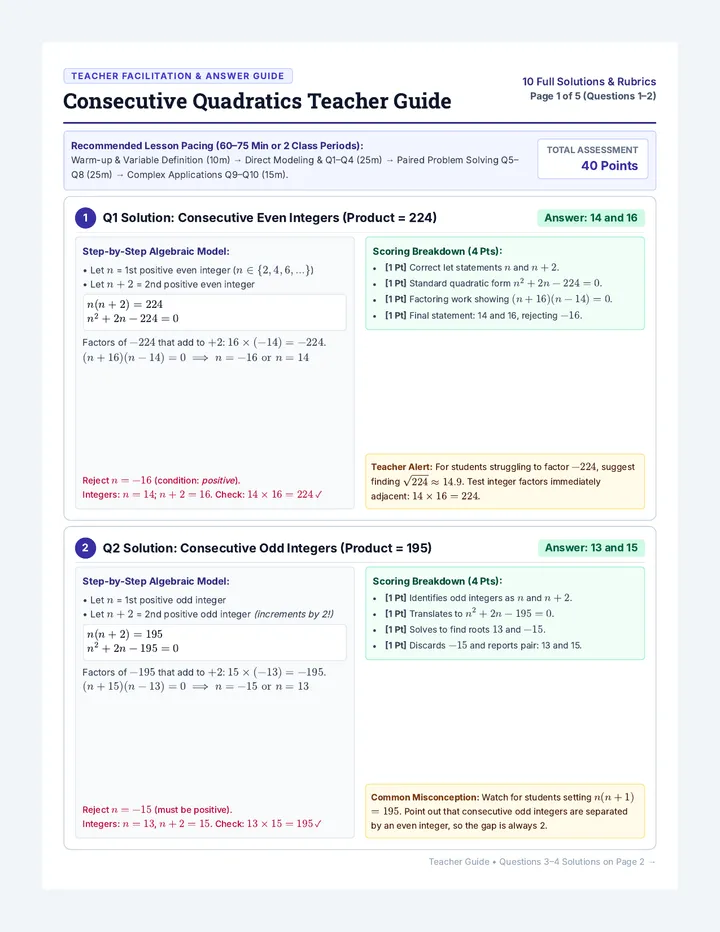
Consecutive Quadratics Teacher Guide

Consecutive Quadratics Teacher Guide

A five-page comprehensive teacher guide and solutions manual matching the ten-problem student worksheet. Provides detailed step-by-step algebraic solutions, 4-point grading rubrics for all 10 problems, pedagogical notes, error diagnostics, and differentiation strategies.

AR

Angie Rice

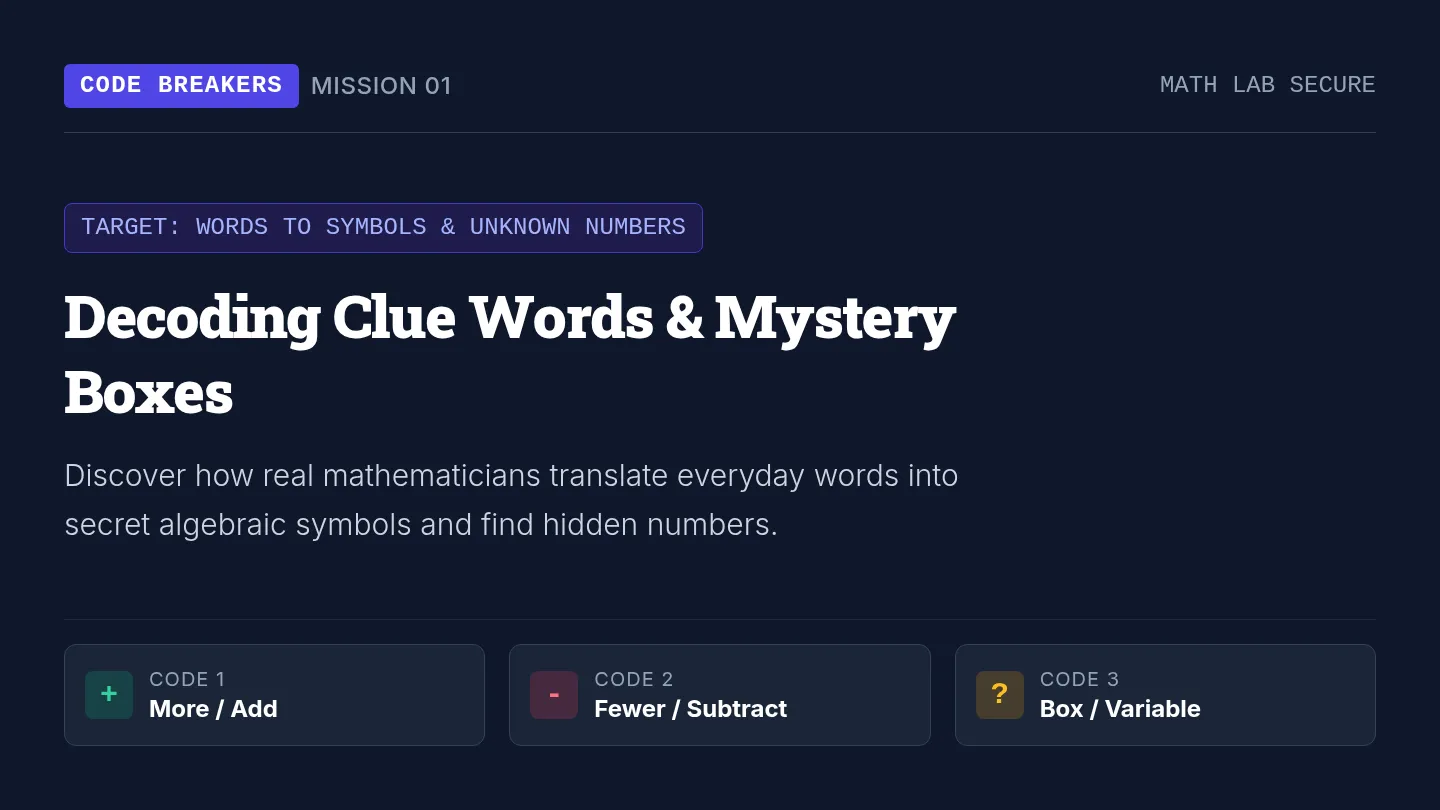
Clue Words Presentation

Code Breakers Squad

A scaffolded pre-algebra sequence designed for sixth graders building confidence from second-grade arithmetic foundations. Students use code-breaking visual models, mystery boxes, number swaps, and equal-group arrays to master algebraic concepts without cognitive overload. Each lesson bridges concrete representations to symbolic expressions with age-respectful styling and supportive pacing.

MJ

Meg Jones

9
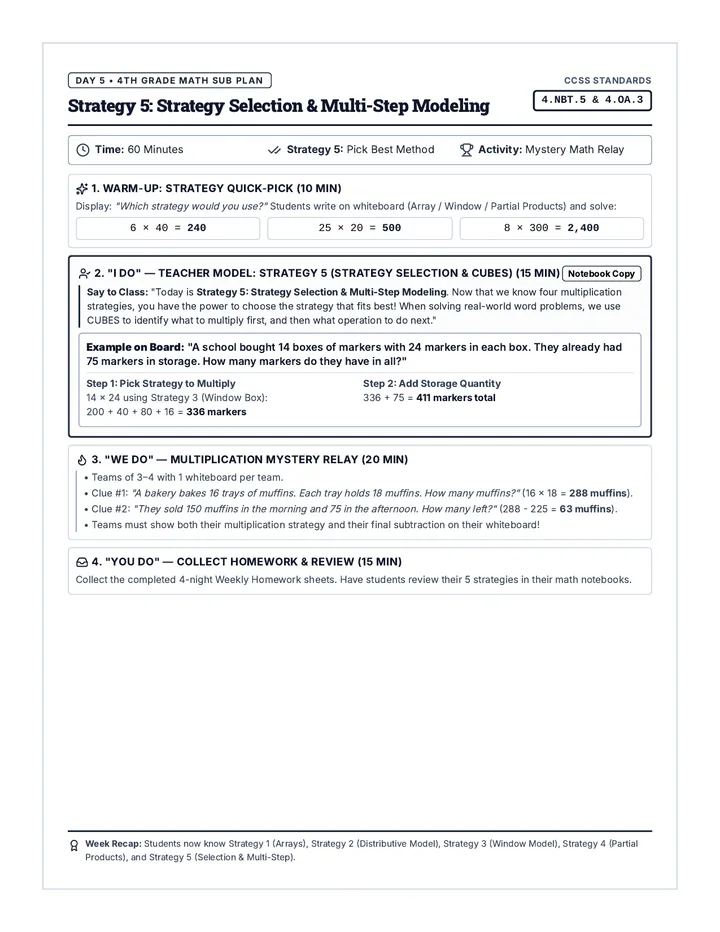
Problem Solving Sub Guide

Spiral And Problem Solving

Day 5 synthesizes multiplication strategies with multi-step word problems, error analysis, and includes the complete 4-night spiraled weekly homework packet and full answer keys.

RM

Rodnesha Minor

3
Consecutive Quadratics Worksheet

Consecutive Quadratics Worksheet

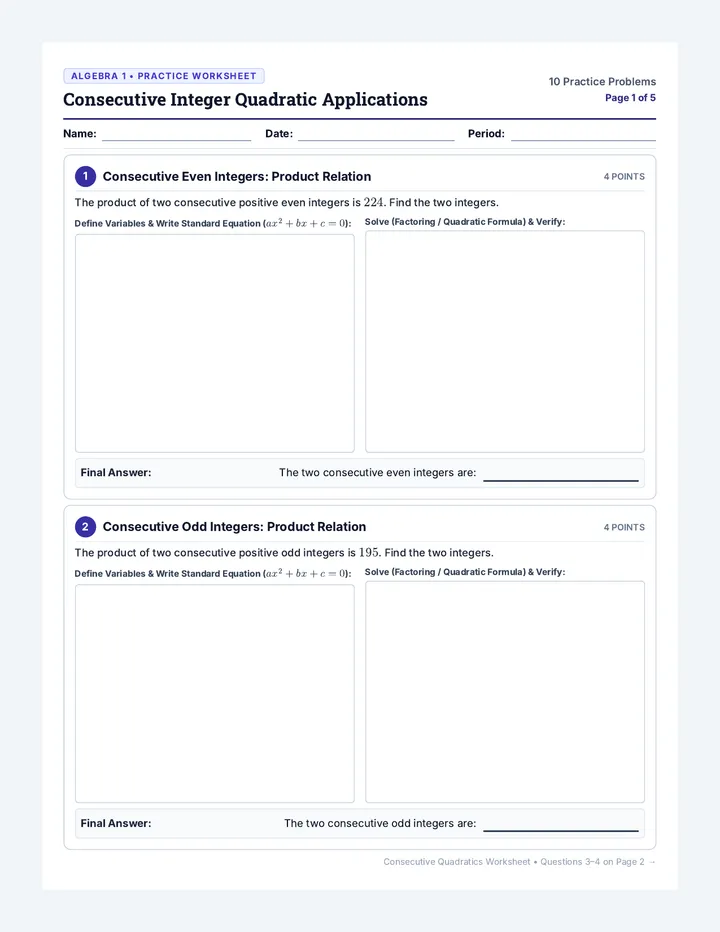
A five-page student worksheet containing ten comprehensive quadratic application word problems involving consecutive odd and even integers. Features expanded, extra-large partitioned blank work areas for defining variables, setting up standard-form equations, factoring, and contextual checks.

AR

Angie Rice

Pumpkin Patch Unit Plan

Seasonal Math Quests

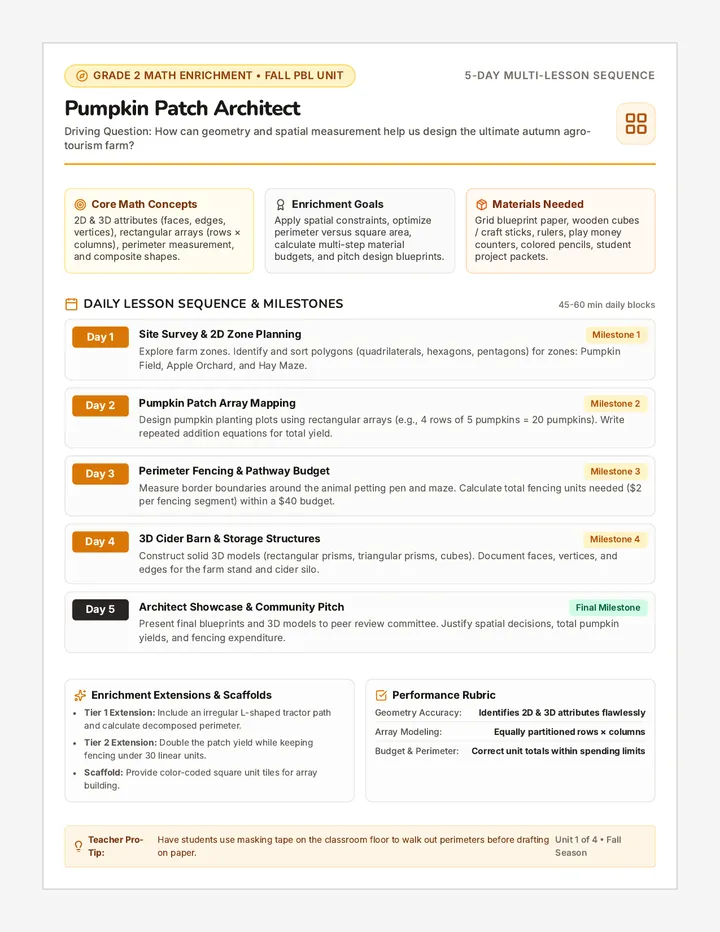
A collection of four seasonal project-based learning units for Grade 2 math enrichment featuring autumn harvest and winter wonderland design missions. Students apply advanced geometry, multi-digit money math, precision measurement, and elapsed time to solve authentic real-world challenges.

K

kkipperman

8
Double Digit Sub Guide

Double Digit Models

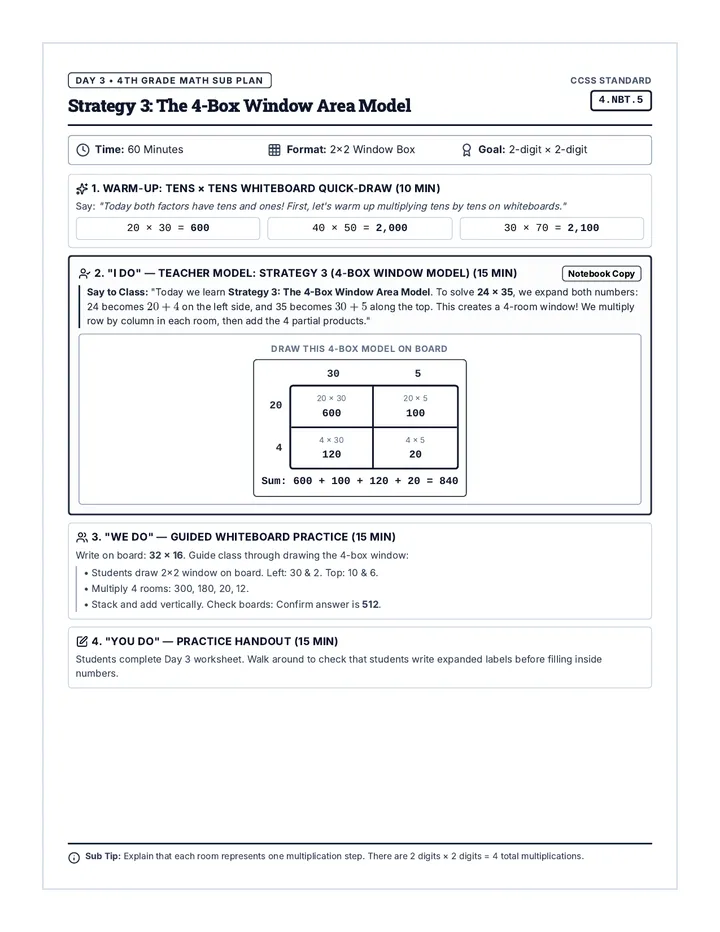
Days 3 and 4 tackle multiplying two two-digit numbers using 4-part rectangular area models and partial products, featuring turnkey scripts, whiteboard showdown routines, and student notebook organizers.

RM

Rodnesha Minor

2
Consecutive Quadratics Answer Key

Consecutive Quadratics Answer Key

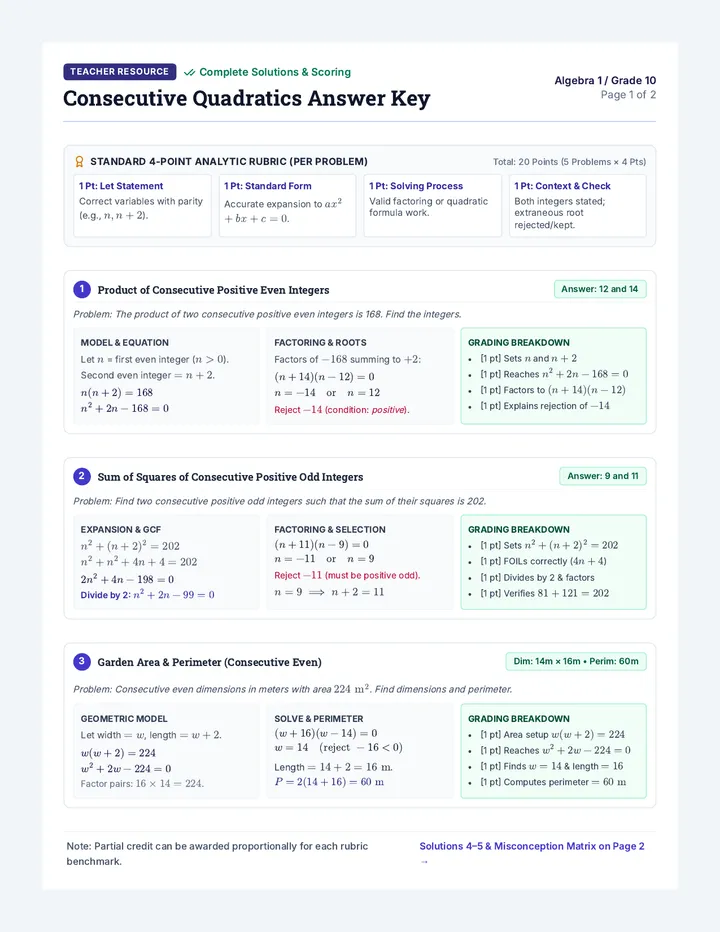
A comprehensive two-page teacher answer key and scoring guide for the five consecutive integer quadratic applications. Includes detailed algebraic solutions, standard forms, factorizations, extraneous root justifications, a 4-point scoring rubric per problem, and a teacher misconception diagnostic chart.

AR

Angie Rice

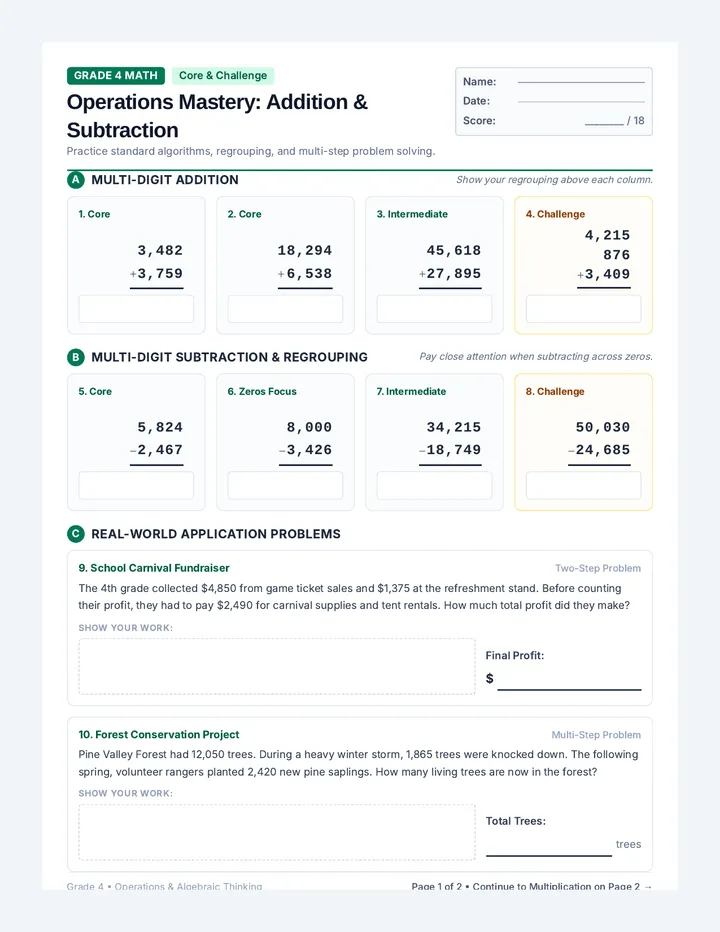
Fourth Grade Math Worksheet

Math Powerhouse

A targeted multi-grade mathematics sequence focusing on mastering whole-number operations including addition, subtraction, and multi-digit multiplication. It equips fourth and fifth-grade learners with procedural fluency, conceptual problem-solving, and rigorous challenge tasks.

T

temetropolis

4
Single Digit Sub Guide

Single Digit Area

Days 1 and 2 focus on multiplying up to four-digit whole numbers by a one-digit whole number using place value strategies, base-ten models, and rectangular area models with scripted gradual release for the substitute teacher.

RM

Rodnesha Minor

2
Consecutive Quadratics Practice Guide

Consecutive Quadratics Practice Guide

A comprehensive two-page reference and worked-example guide for 10th-grade algebra covering quadratic applications with consecutive odd and even integers. It presents five detailed, step-by-step examples spanning product relations, sum of squares, geometric area modeling, multi-solution cases, and Pythagorean theorem setups.

AR

Angie Rice