Balance or Bust SlidesSession 1 • 6.EE.7 Equation Lab Balance or Bust Solving one-step equations with algebra tiles while keeping both sides equal. Learning Target I will solve 1-step equations. Goal: 5 / 6 Mastery Spiral Warm-Up 3–5 Minutes 1. Mental Math What number plus \(5\) equals \(12\)? 2. Equal Groups \(24 \div 4 = \_\_\_\_\) 3. Fraction Builder How many \(\frac{1}{4}\)'s make \(1\) whole? 4. Mixed Number Check \(5 - 2\frac{1}{2} = \_\_\_\_\) Complete all 4 problems on your Session 1 sheet before we check together. Launch: The Mystery Box \(? + 4\) Left Pan: 1 Mystery Box + 4 kg \(=\) \(10\text{ kg}\) Right Pan: 10 kg Total If we remove \(4\text{ kg}\) from the left pan, what must happen to keep the scale balanced? I Do: Modeling with Algebra Tiles Watch & Think Greg had a mystery number of dollars before earning \(\$5\) for mowing the lawn. Now he has \(\$9\). Equation: \(x + 5 = 9\) Step 1: Build Both Sides \(+x\) 5 ones \(=\) 9 ones Step 2: Remove Equal Values Take away 5 ones from the left AND 5 ones from the right. Step 3: Read Solution \(x = 4\) Greg started with \(\$4\). We Do: Balance or Bust? Thumbs Up = Balance | Down = Bust A. \(x + 4 = 6\) Move: Remove 4 ones from the left, and 4 ones from the right. B. \(3x = 12\) Move: Remove 2 \(+x\) tiles from the left, nothing from the right. C. \(4x = 8\) Move: Split 8 ones into 4 equal groups, keep 1 \(+x\) and its group. Rule: Whatever you do to one side of the equal sign, you must do to the other! You Do: Tile Lab & Quick Check A Independent Work 1. Solve 5 Equations \(x + 5 = 8\) \(2x = 10\) \(x + 6 = 10\) \(4x = 12\) \(3x = 15\) 2. Closure & Quick Check A Rate your confidence (Up / Sideways / Down), complete Quick Check Form A (4 minutes), and chart your score on your Growth Chart! Target: 5 out of 6 Correct
Balance or Bust PacketSession 1 • 6.EE.7 Equation Lab Balance or Bust Name: ________________________ Date: ____________ Learning Target: I will solve 1-step equations. Goal: 5/6 WARM-UP Spiral Check (3–5 min) 1. What number plus \(5\) equals \(12\)? 2. Divide: \(24 \div 4 = \) 3. How many \(\frac{1}{4}\)'s make \(1\) whole? 4. Subtract: \(5 - 2\frac{1}{2} = \) I DO Modeling Equality with Algebra Tiles Greg had a mystery number of dollars before earning \(\$5\) for mowing the lawn. Now he has \(\$9\). Equation: \(x + 5 = 9\). How much did Greg have before mowing? Sketch or record the tile steps here: WE DO Balance or Bust? (Circle your verdict, then solve with tiles) Equation Proposed Move Verdict Solution 1. \(x + 4 = 6\) Remove 4 ones from both sides. Balance / Bust \(x = \) 2. \(3x = 12\) Remove 2 \(+x\) tiles from left only. Balance / Bust \(x = \) 3. \(4x = 8\) Split 8 into 4 equal groups; keep 1 group. Balance / Bust \(x = \) 4. \(x + 3 = 11\) Remove 3 ones from both sides. Balance / Bust \(x = \) Session 1: Independent Tile Lab You Do Build each equation on your Equation Mat using algebra tiles. Maintain balance to find \(x\), and record your solution. 1. \(x + 5 = 8\) \(x = \) 2. \(2x = 10\) \(x = \) 3. \(x + 6 = 10\) \(x = \) 4. \(4x = 12\) \(x = \) 5. \(3x = 15\) \(x = \) Session 1: Self-Reflection What did I learn today about keeping an equation balanced? How confident do I feel solving 1-step equations on my own? Thumbs Up | Sideways | Down Delta Math Quick Check Quick Check – Form A Name: ________________________ Date: ____________ Learning Target: I will solve 1-step equations. Work time: 4 minutes \(x + 6 = 12\) \(x + 3\frac{1}{2} = 9\) \(4x = 20\) \(\frac{1}{4}x = 6\) \(x + 2\frac{3}{4} = 7\) \(\frac{2}{3}x = 8\) Self-Check Score: _____ / 6 Mastery Goal: 5 out of 6
Balance or Bust Teacher GuideTeacher Toolkit • Session 1 Balance or Bust – Lesson Script 6.EE.7 Tier 3 Pacing Routine (~28–32 min) Spiral Warm-Up: 3–5 min (4 questions) Hook (Mystery Box): 2 min Explicit Instruction (I Do): 5–7 min Guided Practice (Balance or Bust): 8–10 min Independent Practice: 5–7 min Closure & Quick Check A: 6 min Materials & Prep • Session 1 Student Packets & Quick Check A • Reusable Equation Mat (1 per student) • Algebra Tiles: 20 \(+1\) tiles, 10 \(+x\) tiles per student • Student Growth Chart (set Session 1 goal) Launch & Explicit Instruction Script (I Do) Hook (2 min): Show Slide 3. "Imagine a balanced scale. On the left pan is a mystery box plus 4 kg. On the right is 10 kg. If I take 4 kg off the left pan, what happens?" (It tips!) "To keep it balanced, I must remove 4 kg from the right pan too. Today we use that exact rule with algebra tiles." I Do Think-Aloud (\(x + 5 = 9\)): What is the problem about? Greg's money before and after mowing a lawn. What do I need to find? How much money Greg had before mowing (\(x\)). Model on Mat: Place 1 \(+x\) tile and 5 \(+1\) tiles on the left; 9 \(+1\) tiles on the right. Point to the double line: "This equals sign means both sides have the exact same value." Maintain Equality: "I want \(x\) alone. Since 5 ones are added to \(x\), I remove 5 ones from the left—and to stay balanced, I must remove 5 ones from the right." Solution: "1 \(+x\) tile remains on the left and 4 \(+1\) tiles remain on the right, so \(x = 4\). Greg had \(\$4\)." We Do: Balance or Bust Facilitation For each item, students build the equation first. Read the Proposed Move aloud and have students show Thumbs Up (Balance) or Thumbs Down (Bust) before touching tiles. • For #2 (\(3x = 12\)): Ask, "Why is removing 2 \(+x\) tiles from only one side a BUST?" Guide students to align 12 ones into 3 equal rows next to the 3 \(+x\) tiles, then cover 2 rows to reveal \(1x = 4\). • Translate to meaning: Before solving, always ask: "What does \(3x = 12\) mean in words?" ("3 times what number is 12?") Note on Quick Check A: Items 2, 4, 5, and 6 include fractions/mixed numbers not yet taught explicitly. Reassure students to try their best and focus growth tracking on whole-number items (1 & 3) for Session 1. Misconceptions, Feedback & Answer Keys Session 1 Common Misconception Corrective Feedback Prompt Student adds \(5 + 9 = 14\) for \(x + 5 = 9\). "Look at your mat. Does \(14 + 5\) equal \(9\)? We want to isolate \(x\), so remove the 5 ones from both sides." Student subtracts \(3\) instead of dividing for \(3x = 12\). "Are those 3 ones, or 3 \(+x\) tiles? Since you have 3 groups of \(x\), split the 12 ones into 3 equal groups." Student removes tiles from only one side. "Balance or Bust? If you take from the left pan without taking from the right pan, the scale tips!" Warm-Up Key \(7\) \(6\) \(4\) fourths \(2\frac{1}{2}\) We Do: Balance or Bust Key Balance; \(x = 2\) Bust (must split into 3 equal groups); \(x = 4\) Balance; \(x = 2\) Balance; \(x = 8\) You Do: Independent Key \(x = 3\) \(x = 5\) \(x = 4\) \(x = 3\) \(x = 5\) Quick Check Form A Key \(x = 6\) \(x = 5\frac{1}{2}\) \(x = 5\) \(x = 24\) \(x = 4\frac{1}{4}\) \(x = 12\) Data Decision: Record Form A scores on Growth Charts. Students scoring 5–6/6 on three consecutive forms may exit Tier 3.
Equation Lab Kit PrintableReusable Tool • Laminate or Sheet Protector Double-Sided Equation Mat Sides A & B Side A: Tile & Drawing Balance Mat Left Expression \(=\) Right Expression Side B: Symbolic Inverse Operations Mat Write Equation → Apply Inverse Operation to Both Sides → Check Solution Keep It Balanced! \(=\) Manipulative Toolkit • Cut Along Solid Lines Algebra Tiles & Fraction Strips 1 Set per Student Variable Tiles (\(+x\)) \(+x\) \(+x\) \(+x\) \(+x\) \(+x\) \(+x\) \(+x\) \(+x\) \(+x\) \(+x\) Unit Tiles (\(+1\)) \(+1\) \(+1\) \(+1\) \(+1\) \(+1\) \(+1\) \(+1\) \(+1\) \(+1\) \(+1\) \(+1\) \(+1\) \(+1\) \(+1\) \(+1\) \(+1\) \(+1\) \(+1\) \(+1\) \(+1\) Partitioned \(x\)-Strips (Sessions 5 & 6) \(\frac{1}{2}x\) \(\frac{1}{2}x\) \(\frac{1}{3}x\) \(\frac{1}{3}x\) \(\frac{1}{3}x\) \(\frac{1}{4}x\) \(\frac{1}{4}x\) \(\frac{1}{4}x\) \(\frac{1}{4}x\) \(\frac{1}{5}x\) \(\frac{1}{5}x\) \(\frac{1}{5}x\) \(\frac{1}{5}x\) \(\frac{1}{5}x\) Store cut tiles in a resealable bag for reuse across Sessions 1–6. 6.EE.7 Progress Tracker Growth Chart Name: ________________________ Date: ____________ Learning Target: I will solve 1-step equations. Mastery Goal: 5 out of 6 correct Plot your Quick Check score (0–6) after each session. Dashed line = 5/6 Goal! Intervention Session Date Goal Score Session 1: Balance or Bust Session 2: Mystery Value Challenge Session 3: Build It, Sketch It, Solve It Session 4: Math Detective Session 5: The Missing Whole Session 6: Recover the Missing Pieces Session 7: The Undo Button Session 8: Crack the Code
Mystery Value SlidesSession 2 • 6.EE.7 Equation Lab Mystery Value Challenge Uncovering unknown values in addition and multiplication equations with algebra tiles. Learning Target I will solve 1-step equations. Quick Check B Today Spiral Warm-Up 3–5 Minutes 1. Addition Check \(x + 7 = 15\). What is \(x\)? 2. Multiplication Check \(5x = 30\). What is \(x\)? 3. Fraction Sense How many \(\frac{1}{3}\)'s make \(2\) wholes? 4. Mixed Number Regrouping \(4 - 2\frac{1}{3} = \_\_\_\_\) Hint for #4: Rewrite \(4\) as \(3\frac{3}{3}\) before subtracting! Launch: Which Mystery Box Contains More? Box A \(x + 4 = 11\) 1 box plus 4 coins equals 11 coins. Box B \(3x = 18\) 3 identical boxes equal 18 coins. Predict first, then prove which box holds more coins! I Do: Addition vs. Multiplication Equations Compare Actions Addition: \(x + 4 = 7\) Meaning: "What number plus 4 equals 7?" Tile Action: Remove 4 ones from BOTH sides. Result: \(x = 3\) Multiplication: \(4x = 12\) Meaning: "4 times what number equals 12?" Tile Action: Split 12 ones into 4 equal groups. Result: \(x = 3\) Look closely at the operation attached to \(x\) before you move a single tile! We Do: Mystery Value Challenge Draw • Build • Reveal Card 1 \(2x = 8\) Card 2 \(x + 5 = 11\) Card 3 \(3x = 12\) Card 4 \(5x = 10\) With your partner: 1) Read the phrase aloud, 2) Build with tiles, 3) Reveal the mystery value! You Do: Match-Up & Quick Check B Independent Work Equation Match-Up Match each equation on Page 2 to its tile action and solution. Double-check by plugging \(x\) back in! Quick Check Form B 4 minutes independent work. Self-check and plot your Form B score on your Growth Chart! Goal: Beat or Match Your Form A Score!
Mystery Value PacketSession 2 • 6.EE.7 Equation Lab Mystery Value Challenge Name: ________________________ Date: ____________ Learning Target: I will solve 1-step equations. Goal: 5/6 WARM-UP Spiral Check (3–5 min) 1. Solve: \(x + 7 = 15\) 2. Solve: \(5x = 30\) 3. How many \(\frac{1}{3}\)'s make \(2\) wholes? 4. Subtract: \(4 - 2\frac{1}{3} = \) I DO Addition vs. Multiplication Tile Moves \(x + 4 = 7\) Phrase & Solution: \(4x = 12\) Phrase & Solution: WE DO Mystery Value Challenge Cards (Build with tiles, then record) Card 1: \(2x = 8\) \(x = \) Card 2: \(x + 5 = 11\) \(x = \) Card 3: \(3x = 12\) \(x = \) Card 4: \(5x = 10\) \(x = \) Session 2: Equation Match-Up You Do Use algebra tiles to solve each equation. Then write the matching Letter from the Solution Bank. A: \(x = 5\) B: \(x = 7\) C: \(x = 3\) D: \(x = 6\) E: \(x = 4\) 1. \(x + 3 = 8\) Match: ____ \(x = \) 2. \(x + 6 = 9\) Match: ____ \(x = \) 3. \(2x = 14\) Match: ____ \(x = \) 4. \(x + 6 = 11\) Match: ____ \(x = \) 5. \(4x = 16\) Match: ____ \(x = \) Session 2: Self-Reflection How do you decide whether to remove tiles or split tiles into equal groups? Confidence Check: Thumbs Up | Sideways | Down Delta Math Quick Check Quick Check – Form B Name: ________________________ Date: ____________ Learning Target: I will solve 1-step equations. Work time: 4 minutes \(x + 4 = 16\) \(x + 2\frac{1}{3} = 4\) \(3x = 15\) \(\frac{1}{4}x = 2\) \(x + 3\frac{2}{5} = 8\) \(\frac{3}{4}x = 9\) Self-Check Score: _____ / 6 Mastery Goal: 5 out of 6
Mystery Value Teacher GuideTeacher Toolkit • Session 2 Mystery Value Challenge – Script 6.EE.7 Tier 3 Pacing Routine (~28–32 min) Spiral Warm-Up: 3–5 min Hook (Which Box Has More?): 2 min Explicit Instruction (I Do): 5–7 min Guided Practice (Mystery Cards): 8–10 min Independent Match-Up: 5–7 min Closure & Quick Check B: 6 min Materials & Prep • Session 2 Student Packets & Quick Check B • Equation Mats & Algebra Tiles • Student Growth Charts (plot Form B) Launch & Explicit Instruction Script (I Do) Hook (2 min): Display Slide 3. "Box A: \(x + 4 = 11\). Box B: \(3x = 18\). Without touching tiles yet, which mystery box holds more? Why?" Have students justify mentally (\(7\) vs \(6\)). I Do Comparison (\(x + 4 = 7\) vs. \(4x = 12\)): Build \(x + 4 = 7\) on the left mat: "Here, \(4\) ones are added to \(x\). To isolate \(x\), I take away \(4\) ones from both sides. \(x = 3\)." Build \(4x = 12\) on the right mat: "Here, I don't have \(+4\) ones—I have \(4\) groups of \(x\)! I can't subtract \(4\) ones. Instead, I split \(12\) ones into \(4\) equal rows, one for each \(+x\) tile. Covering \(3\) rows shows \(x = 3\)." We Do: Mystery Value Challenge Facilitation Have pairs take turns leading each card. Before touching tiles, the leader must translate the equation into a question (e.g., "2 times what number is 8?") and state whether they will remove ones or make equal groups. Spiral Warm-Up Note: Problem 4 (\(4 - 2\frac{1}{3}\)) builds the exact regrouping skill needed for Quick Check Form B #2. Model \(4 = 3\frac{3}{3}\) briefly when reviewing the warm-up! Misconceptions, Feedback & Answer Keys Session 2 Common Misconception Corrective Feedback Prompt Confuses \(4x = 12\) with \(x + 4 = 12\). "Read the left side: is it \(x\) plus \(4\) ones, or \(4\) copies of \(x\)? Build \(4\) \(+x\) tiles on your mat." For \(2x = 8\), gives \(x = 16\) (multiplies instead of divides). "If \(x = 16\), then two boxes of \(16\) would be \(32\), not \(8\)! Split \(8\) ones into \(2\) equal groups." Warm-Up Key \(x = 8\) \(x = 6\) \(6\) thirds \(1\frac{2}{3}\) We Do: Mystery Cards Key \(x = 4\) \(x = 6\) \(x = 4\) \(x = 2\) You Do: Match-Up Key A (\(x = 5\)) C (\(x = 3\)) B (\(x = 7\)) A (\(x = 5\)) E (\(x = 4\)) Quick Check Form B Key \(x = 12\) \(x = 1\frac{2}{3}\) \(x = 5\) \(x = 8\) \(x = 4\frac{3}{5}\) \(x = 12\) Data Decision: Compare Form B to Form A. Celebrate growth on whole-number equations (1 & 3) and note fraction readiness from Warm-Up #4.
Build Sketch Solve SlidesSession 3 • 6.EE.7 Equation Lab Build It, Sketch It, Solve It Transitioning from physical algebra tiles to fast, accurate mathematical drawings. Learning Target I will solve 1-step equations. Quick Check C Today Spiral Warm-Up 3–5 Minutes 1. Solve \(x + 9 = 16\) 2. Solve \(6x = 24\) 3. Fraction Groups If \(\frac{1}{5}\) of a bar is \(3\), what is the whole bar? 4. Mixed Number Subtraction \(7 - 4\frac{2}{3} = \_\_\_\_\) Use mental math or a quick sketch for #3 and #4! Launch: Can You Solve It Without Tiles? \(3x = 18\) You don't have \(18\) unit tiles on your desk today. How could you use a quick math drawing to prove what \(x\) equals? Turn & Talk: What symbol can replace a \(+x\) tile? What symbol can replace a \(+1\) tile? I Do: Sketching Algebra Tiles Representational Greg's mom doubled his weekend gaming time to \(8\) hours. Equation: \(2x = 8\) Drawing Code • Rectangle \(+x\) = Variable tile • Double line \(\|\) = Equal sign • Plus sign \(+\) = One unit tile Sketch for \(2x = 8\) \(+x\) \(\|\) \(+\ +\ +\ +\) \(+x\) \(\|\) \(+\ +\ +\ +\) Loop 1 group: \(x = 4\) hours We Do: Finish the Sketch Build It → Sketch It → Solve It 1. \(x + 3 = 12\) Draw \(+x\) and \(3\) plus signs on the left, \(12\) plus signs on the right. Cross out \(3\) from both sides! 2. \(12 = 4x\) Draw \(12\) plus signs on the left in \(4\) equal rows, and \(4\) \(+x\) boxes on the right. Loop \(1\) row! Notice #2 has \(x\) on the right side—keep the equal sign in the middle and read both sides carefully! You Do: Sketch & Solve + Quick Check C Independent Work Sketch & Solve 5 Equations Use boxes for \(+x\), double bars for \(=\), and \(+\) marks for ones. Cross out equal amounts or loop equal groups! Quick Check Form C 4 minutes independent work. Self-check and plot Form C on your Growth Chart! Mastery Goal: 5 out of 6
Build Sketch Solve PacketSession 3 • 6.EE.7 Equation Lab Build It, Sketch It, Solve It Name: ________________________ Date: ____________ Learning Target: I will solve 1-step equations. Goal: 5/6 WARM-UP Spiral Check (3–5 min) 1. Solve: \(x + 9 = 16\) 2. Solve: \(6x = 24\) 3. If \(\frac{1}{5}\) of a bar is \(3\), what is the whole? 4. Subtract: \(7 - 4\frac{2}{3} = \) I DO Sketching Equations (\(2x = 8\)) Greg's mom doubled his normal gaming time to \(8\) hours. Equation: \(2x = 8\). Sketch boxes for \(+x\), double bars for \(=\), and \(+\) marks for ones. WE DO Complete the Math Drawing & Solve 1. \(x + 3 = 12\) \(+x\) \(+\ +\ +\) \(\|\) (draw 12 \(+\)) \(x = \) 2. \(3x = 18\) (draw 3 \(+x\)) \(\|\) (align 18 \(+\)) \(x = \) 3. \(12 = 4x\) \(x = \) 4. \(13 = 5 + x\) \(x = \) Session 3: Sketch & Solve Independently You Do Draw a mathematical model for each equation (use boxes for \(+x\), \(\|\) for \(=\), and \(+\) for ones). Cross out equal amounts or loop equal groups to solve. 1. \(x + 5 = 8\) \(x = \) 2. \(2x = 10\) \(x = \) 3. \(10 = x + 6\) \(x = \) 4. \(12 = 4x\) \(x = \) 5. \(3x = 15\) \(x = \) Session 3: Self-Reflection How does sketching help you solve equations even without physical tiles? Confidence Check: Thumbs Up | Sideways | Down Delta Math Quick Check Quick Check – Form C Name: ________________________ Date: ____________ Learning Target: I will solve 1-step equations. Work time: 4 minutes \(x + 5 = 6\) \(x + 2\frac{1}{4} = 9\) \(6x = 30\) \(\frac{1}{6}x = 3\) \(x + 4\frac{2}{3} = 7\) \(\frac{2}{5}x = 8\) Self-Check Score: _____ / 6 Mastery Goal: 5 out of 6
Build Sketch Solve Teacher GuideTeacher Toolkit • Session 3 Build It, Sketch It, Solve It – Script 6.EE.7 Tier 3 Pacing Routine (~28–32 min) Spiral Warm-Up: 3–5 min Hook (No Tiles?): 2 min Explicit Instruction (I Do): 5–7 min Guided Practice (We Do): 8–10 min Independent Sketching: 5–7 min Closure & Quick Check C: 6 min Materials & Prep • Session 3 Student Packets & Quick Check C • Algebra Tiles available only as backup • Student Growth Charts (plot Form C) Launch & Explicit Instruction Script (I Do) Hook (2 min): "Today we level up from plastic/paper tiles to fast math drawings. If you're on a test or quiz, you won't carry tiles—you'll sketch them in 10 seconds." I Do Think-Aloud (\(2x = 8\)): What do I know? Greg's doubled gaming time is \(8\) hours (\(2x = 8\)). Draw the model: Draw 2 stacked \(+x\) rectangles on the left, two vertical lines (\(\|\)) for \(=\), and deal \(8\) plus signs (\(+\)) alternating between the top and bottom row so they form \(2\) equal rows of \(4\). Loop 1 group: Circle the bottom \(+x\) rectangle and its \(4\) plus signs. "Each \(x\) equals \(4\), so Greg normally gets \(4\) hours." We Do Facilitation Problems #1 and #2 give students a scaffolded start; #3 (\(12 = 4x\)) and #4 (\(13 = 5 + x\)) preview \(x\) on the right side. Have students translate each equation into a question first, then draw and cross out or loop. Representational Check: Ensure students draw \(+\) signs in neat rows of 5 or equal groups rather than a messy pile—organization prevents counting errors! Misconceptions, Feedback & Answer Keys Session 3 Common Misconception Corrective Feedback Prompt Crosses out \(+x\) instead of \(+\) signs. "We want to find what ONE \(+x\) equals, so keep \(+x\) on the mat and cross out the same number of \(+\) signs on both sides." Confused when \(x\) is on the right (\(12 = 4x\)). "The equals sign is a mirror. Whether \(4x\) is on the left or right, split the \(12\) plus signs into \(4\) equal rows." Warm-Up Key \(x = 7\) \(x = 4\) \(15\) \(2\frac{1}{3}\) We Do Key \(x = 9\) \(x = 6\) \(x = 3\) \(x = 8\) You Do Key \(x = 3\) \(x = 5\) \(x = 4\) \(x = 3\) \(x = 5\) Quick Check Form C Key \(x = 1\) \(x = 6\frac{3}{4}\) \(x = 5\) \(x = 18\) \(x = 2\frac{1}{3}\) \(x = 20\) Data Decision: Record Form C on Growth Charts. Check if students are ready to work with reversed orientations in Session 4.
Math Detective SlidesSession 4 • 6.EE.7 Equation Lab Math Detective Solving equations with the unknown on either side of the equal sign—and spotting sneaky model errors. Learning Target I will solve 1-step equations. Quick Check D Today Spiral Warm-Up 3–5 Minutes 1. Solve \(x + 8 = 15\) 2. Solve \(4x = 28\) 3. Fraction Builder If \(\frac{1}{3}\) of a bar is \(8\), what is the whole? 4. Mixed Number Subtraction \(6 - 4\frac{1}{3} = \_\_\_\_\) Check #4 carefully: regroup \(6\) as \(5\frac{3}{3}\)! Launch: Catch the Teacher's Mistake! Equation: \(12 = 3x\) "Since \(12\) is on the left and \(3\) is on the right, I'll subtract \(3\) from \(12\) to get \(x = 9\)." What two mistakes did the teacher make? How do we fix it? I Do: Variable on Either Side Equal Means Same Value \(12 = 3x\) Phrase: "12 is equal to 3 times what number?" Sketch: \(12\) plus signs in \(3\) equal rows on the left \(\|\) \(3\) \(+x\) boxes on the right. \(4 = x\) (or \(x = 4\)) \(14 = 6 + x\) Phrase: "14 is equal to 6 plus what number?" Sketch: \(14\) plus signs on the left \(\|\) \(6\) plus signs and \(1\) \(+x\) box on the right. Cross out \(6\) from both sides: \(8 = x\) We Do: Math Detective Cases Investigate & Repair Case A: \(15 = x + 7\) Suspect's Work: "I added \(7\) to \(15\) and got \(x = 22\)." Case B: \(21 = 3x\) Suspect's Work: "I drew \(21\) plus signs on the left and \(7\) \(+x\) boxes on the right." On your packet: 1) Spot the error, 2) Sketch the true model, 3) Solve for \(x\). You Do: Case Files & Quick Check D Independent Work Detective Practice Complete the error analysis and 4 independent equations on Page 2. Watch out for reversed orientations! Quick Check Form D 4 minutes independent work. Self-check and plot Form D on your Growth Chart! Mastery Goal: 5 out of 6
Math Detective PacketSession 4 • 6.EE.7 Equation Lab Math Detective Name: ________________________ Date: ____________ Learning Target: I will solve 1-step equations. Goal: 5/6 WARM-UP Spiral Check (3–5 min) 1. Solve: \(x + 8 = 15\) 2. Solve: \(4x = 28\) 3. If \(\frac{1}{3}\) of a bar is \(8\), what is the whole? 4. Subtract: \(6 - 4\frac{1}{3} = \) I DO Equations with \(x\) on the Right Side \(12 = 3x\) \(x = \) \(14 = 6 + x\) \(x = \) WE DO Math Detective: Spot the Error & Repair the Model Case A: \(15 = x + 7\) — Suspect wrote: "I added \(7\) to \(15\) and got \(x = 22\)." Error: _______________________________ True Solution: \(x = \) ____ Case B: \(21 = 3x\) — Suspect drew \(21\) plus signs on the left and \(7\) \(+x\) boxes on the right. Error: _______________________________ True Solution: \(x = \) ____ Session 4: Independent Detective Work You Do 1. Case C (Repair It!): A student solved \(18 = 6 + x\) and got \(x = 24\). Explain the mistake and draw the correct model. Correct Solution: \(x = \) Sketch a model and solve each equation (watch where \(x\) is located!): 2. \(x + 4 = 11\) \(x = \) 3. \(20 = 4x\) \(x = \) 4. \(17 = x + 5\) \(x = \) 5. \(5x = 10\) \(x = \) Session 4: Self-Reflection Does switching the sides of an equation (like \(3x = 12\) vs. \(12 = 3x\)) change the value of \(x\)? Why? Confidence Check: Thumbs Up | Sideways | Down Delta Math Quick Check Quick Check – Form D Name: ________________________ Date: ____________ Learning Target: I will solve 1-step equations. Work time: 4 minutes \(x + 9 = 11\) \(x + 4\frac{1}{3} = 6\) \(2x = 14\) \(\frac{1}{3}x = 8\) \(x + 1\frac{3}{5} = 9\) \(\frac{2}{3}x = 10\) Self-Check Score: _____ / 6 Mastery Goal: 5 out of 6
Math Detective Teacher GuideTeacher Toolkit • Session 4 Math Detective – Script 6.EE.7 Tier 3 Pacing Routine (~28–32 min) Spiral Warm-Up: 3–5 min Hook (Catch the Teacher): 2 min Explicit Instruction (I Do): 5–7 min Guided Practice (Math Detective): 8–10 min Independent Detective Work: 5–7 min Closure & Quick Check D: 6 min Materials & Prep • Session 4 Student Packets & Quick Check D • Student Growth Charts (plot Form D) Launch & Explicit Instruction Script (I Do) Hook (2 min): Show Slide 3. Pretend to be confident about \(12 = 3x \rightarrow x = 9\). Wait for students to object! Highlight: (1) \(3x\) is multiplication, not addition; (2) \(x\) can sit on the right side of \(=\). I Do Modeling (\(12 = 3x\) and \(14 = 6 + x\)): Read \(12 = 3x\) as "12 is equal to 3 times what number?" Draw \(12\) plus signs in \(3\) rows on the left, \(3\) \(+x\) boxes on the right, and loop \(1\) row to show \(4 = x\). Read \(14 = 6 + x\) as "14 is equal to 6 plus what number?" Draw \(14\) plus signs on the left, \(6\) plus signs \(+ 1\) \(+x\) box on the right, and cross out \(6\) from both sides to show \(8 = x\). We Do: Math Detective Facilitation Have partners act as "Detectives" for Cases A and B. Require them to name the specific error (e.g., "Added instead of removing 7 from both sides" or "Drew 7 \(+x\) boxes instead of 3") before sketching the repair. Halfway Checkpoint: After Session 4, review Growth Charts. Students are halfway through the 8-session cycle and ready to transition to fractional coefficients in Session 5! Misconceptions, Feedback & Answer Keys Session 4 Common Misconception Corrective Feedback Prompt Thinks \(x\) must always be on the left. "An equal sign works like a balance scale—if the left equals the right, the right also equals the left. \(8 = x\) means \(x = 8\)." Adds the constant instead of subtracting (\(18 = 6 + x \rightarrow 24\)). "Plug \(24\) back in: does \(6 + 24\) equal \(18\)? No! Remove \(6\) from both sides." Warm-Up Key \(x = 7\) \(x = 7\) \(24\) \(1\frac{2}{3}\) We Do: Detective Key Case A: Added \(7\) instead of removing \(7\); \(x = 8\) Case B: Drew \(7\) \(+x\) boxes instead of \(3\); \(x = 7\) You Do Key Added \(6\) instead of subtracting \(6\); \(x = 12\) \(x = 7\) \(x = 5\) \(x = 12\) \(x = 2\) Quick Check Form D Key \(x = 2\) \(x = 1\frac{2}{3}\) \(x = 7\) \(x = 24\) \(x = 7\frac{2}{5}\) \(x = 15\) Data Decision: Record Form D on Growth Charts. Note students' comfort with Warm-Up #3 (\(\frac{1}{3}\) of a bar is \(8\)) as a bridge to Session 5!
Missing Whole SlidesSession 5 • 6.EE.7 Equation Lab The Missing Whole Using partitioned \(+x\) strips to reconstruct unknown wholes from unit and non-unit fractions. Learning Target I will solve 1-step equations. Quick Check E Today Spiral Warm-Up 3–5 Minutes 1. Reversed Orientation \(18 = 6 + x\) 2. Reversed Orientation \(24 = 3x\) 3. Two Parts to One Part If \(\frac{2}{5}\) of a bar is \(8\), what is \(\frac{1}{5}\)? 4. Mixed Number Subtraction \(7 - 2\frac{3}{4} = \_\_\_\_\) Question #3 is your secret weapon for today's lesson! Launch: The Quarter Allowance You only finished part of your chores, so you received \(\frac{1}{4}\) of your normal allowance, which was \(\$5\). How much money did you originally earn for a full allowance? Equation: \(\frac{1}{4}x = 5\) — "1 fourth of what number is equal to 5?" I Do: Partitioning the \(+x\) Bar Unit & Non-Unit Unit: \(\frac{1}{4}x = 5\) 5 5 5 5 All 4 fourths equal \(5\), so \(x = 5 \cdot 4 = 20\). Non-Unit: \(\frac{2}{5}x = 8\) 4 4 4 4 4 2 fifths \(= 8 \rightarrow\) 1 fifth \(= 4 \rightarrow x = 4 \cdot 5 = 20\). We Do: Reconstruct the Missing Whole Find 1 Part First! 1. \(\frac{1}{3}x = 7\) Split \(+x\) into 3 parts. Each part is \(7\). 2. \(\frac{1}{4}x = 2\) Split \(+x\) into 4 parts. Each part is \(2\). 3. \(8 = \frac{2}{5}x\) 2 shaded parts equal \(8\), so 1 part equals ____. 4. \(\frac{3}{4}x = 15\) 3 shaded parts equal \(15\), so 1 part equals ____. You Do: Fraction Models & Quick Check E Independent Work Complete the Models Fill in the value of each fractional piece on Page 2, then multiply to find the whole \(x\). Quick Check Form E 4 minutes independent work. Now you can tackle #4 and #6 using your fraction-bar strategy! Mastery Goal: 5 out of 6
Missing Whole PacketSession 5 • 6.EE.7 Equation Lab The Missing Whole Name: ________________________ Date: ____________ Learning Target: I will solve 1-step equations. Goal: 5/6 WARM-UP Spiral Check (3–5 min) 1. Solve: \(18 = 6 + x\) 2. Solve: \(24 = 3x\) 3. If \(\frac{2}{5}\) of a bar is \(8\), what is \(\frac{1}{5}\)? 4. Subtract: \(7 - 2\frac{3}{4} = \) I DO Greg's Allowance (\(\frac{1}{4}x = 5\)) Greg earned \(\frac{1}{4}\) of his allowance, which was \(\$5\). Partition the \(+x\) bar into \(4\) equal fourths and fill in each piece: Whole \(x = \) _______ WE DO Complete the Partitioned \(+x\) Bar & Solve 1. \(\frac{1}{3}x = 7\) \(x = \) 2. \(\frac{1}{4}x = 2\) \(x = \) 3. \(8 = \frac{2}{5}x\) \(x = \) 4. \(\frac{3}{4}x = 15\) \(x = \) Session 5: Independent Fraction Models You Do Draw and partition an \(+x\) bar for each equation. Find the value of ONE fractional piece first, then find the whole \(x\). 1. \(\frac{1}{4}x = 7\) \(x = \) 2. \(\frac{2}{3}x = 6\) \(x = \) 3. \(\frac{1}{3}x = 6\) \(x = \) 4. \(12 = \frac{3}{5}x\) \(x = \) Session 5: Self-Reflection When solving \(\frac{3}{4}x = 15\), why do we divide \(15\) by \(3\) before multiplying by \(4\)? Confidence Check: Thumbs Up | Sideways | Down Delta Math Quick Check Quick Check – Form E Name: ________________________ Date: ____________ Learning Target: I will solve 1-step equations. Work time: 4 minutes \(x + 6 = 12\) \(x + 3\frac{1}{2} = 9\) \(4x = 20\) \(\frac{1}{4}x = 6\) \(x + 2\frac{3}{4} = 7\) \(\frac{2}{3}x = 8\) Self-Check Score: _____ / 6 Mastery Goal: 5 out of 6
Missing Whole Teacher GuideTeacher Toolkit • Session 5 The Missing Whole – Script 6.EE.7 Tier 3 Pacing Routine (~28–32 min) Spiral Warm-Up: 3–5 min Hook (Quarter Allowance): 2 min Explicit Instruction (I Do): 5–7 min Guided Practice (Missing Whole): 8–10 min Independent Fraction Models: 5–7 min Closure & Quick Check E: 6 min Materials & Prep • Session 5 Student Packets & Quick Check E • Partitioned \(x\)-strips from Equation Lab Kit • Student Growth Charts (plot Form E) Launch & Explicit Instruction Script (I Do) Hook (2 min): "If \(\frac{1}{4}\) of your allowance is \(\$5\), do you have more or less than \(\$5\) for the full allowance?" (More! \(4\) quarters make \(\$20\).) I Do Think-Aloud (\(\frac{1}{4}x = 5\)): Partition \(+x\): "The denominator \(4\) tells me to split the \(+x\) bar into \(4\) equal fourths. Shade \(1\) fourth." Fill in values: "Since \(\frac{1}{4}x = 5\), that shaded fourth equals \(5\). Because all fourths are equal, every piece is \(5\). Four 5's make \(x = 20\)." Bridge to Non-Unit (\(\frac{2}{5}x = 8\)): "Here, \(2\) shaded fifths equal \(8\). Split \(8\) equally between the \(2\) shaded fifths—each fifth is \(4\). Five 4's make \(x = 20\)." We Do Facilitation Have students translate each equation aloud first (e.g., "3 fourths of what number is 15?"). Always ask: "How many shaded pieces do we have? What is the value of ONE piece?" Quick Check E Note: Students now have explicit strategies for items 1, 3, 4, and 6 on Form E! Misconceptions, Feedback & Answer Keys Session 5 Common Misconception Corrective Feedback Prompt For \(\frac{3}{4}x = 15\), puts \(15\) in each of the \(4\) boxes (\(x = 60\)). "Look at the numerator \(3\): all \(3\) shaded boxes TOGETHER equal \(15\). Split \(15\) across those \(3\) shaded boxes first." For \(\frac{1}{4}x = 2\), divides \(2 \div 4\) instead of multiplying. "If \(1\) fourth of the bar is \(2\), is the whole bar bigger or smaller than \(2\)? Fill in all \(4\) fourths." Warm-Up Key \(x = 12\) \(x = 8\) \(4\) \(4\frac{1}{4}\) We Do Key \(x = 21\) \(x = 8\) \(x = 20\) (each fifth \(= 4\)) \(x = 20\) (each fourth \(= 5\)) You Do Key \(x = 28\) \(x = 9\) (each third \(= 3\)) \(x = 18\) \(x = 20\) (each fifth \(= 4\)) Quick Check Form E Key \(x = 6\) \(x = 5\frac{1}{2}\) \(x = 5\) \(x = 24\) \(x = 4\frac{1}{4}\) \(x = 12\) Data Decision: Record Form E on Growth Charts. Note any students who still struggle with non-unit fractions for Session 6.
Missing Pieces SlidesSession 6 • 6.EE.7 Equation Lab Recover the Missing Pieces Solving fractional-coefficient equations—even when each piece isn't a whole number! Learning Target I will solve 1-step equations. Quick Check F Today Spiral Warm-Up 3–5 Minutes 1. Solve \(\frac{1}{4}x = 6\) 2. Solve \(\frac{2}{3}x = 8\) 3. Splitting Odd Numbers \(7 \div 2 = \_\_\_\_\) 4. Mixed Number Subtraction \(8 - 3\frac{2}{5} = \_\_\_\_\) Hint for #3: Write your answer as a mixed number (\(3\frac{1}{2}\))! Launch: Which Piece Completes the Model? Equation: \(7 = \frac{2}{5}x\) ? ? ? ? ? The 2 shaded pieces together equal \(7\). Why doesn't a whole number fit? I Do: Non-Whole-Number Solutions \(7 = \frac{2}{5}x\) 1. Find 1 Fifth \(2\) fifths \(= 7\), so \(1\) fifth \(= 7 \div 2 = \mathbf{3\frac{1}{2}}\). 2. Fill All 5 Fifths Each of the \(5\) pieces is \(3\frac{1}{2}\). 3. Total Whole \(x = 5 \cdot 3\frac{1}{2} = 17\frac{1}{2}\) \(5 \cdot 3 = 15\), plus \(5 \cdot \frac{1}{2} = 2\frac{1}{2} \rightarrow 17\frac{1}{2}\)! We Do: Recover the Missing Pieces Progressive Puzzles 1. \(\frac{1}{3}x = 8\) Unit fraction: 3 thirds of \(8\). 2. \(\frac{3}{4}x = 18\) 3 fourths \(= 18 \rightarrow\) 1 fourth \(= \_\_\_\_\). 3. \(\frac{2}{3}x = 7\) 2 thirds \(= 7 \rightarrow\) 1 third \(= \_\_\_\_\). 4. \(6 = \frac{3}{5}x\) 3 fifths \(= 6 \rightarrow\) 1 fifth \(= \_\_\_\_\). You Do: Create & Solve + Quick Check F Independent Work Complete & Create Solve the 3 puzzles on Page 2, then create your own fractional-coefficient equation for a partner! Quick Check Form F 4 minutes independent work. Self-check and plot Form F on your Growth Chart! Next Session: The Undo Button!
Missing Pieces PacketSession 6 • 6.EE.7 Equation Lab Recover the Missing Pieces Name: ________________________ Date: ____________ Learning Target: I will solve 1-step equations. Goal: 5/6 WARM-UP Spiral Check (3–5 min) 1. Solve: \(\frac{1}{4}x = 6\) 2. Solve: \(\frac{2}{3}x = 8\) 3. Divide (mixed number): \(7 \div 2 = \) 4. Subtract: \(8 - 3\frac{2}{5} = \) I DO When Pieces Aren't Whole Numbers (\(7 = \frac{2}{5}x\)) 1 fifth \(= \) ______ • Whole \(x = \) ______ WE DO Recover the Missing Pieces & Solve 1. \(\frac{1}{3}x = 8\) \(x = \) 2. \(\frac{3}{4}x = 18\) \(x = \) 3. \(\frac{2}{3}x = 7\) \(x = \) 4. \(6 = \frac{3}{5}x\) \(x = \) Session 6: Independent Fraction Puzzles You Do 1. \(\frac{1}{4}x = 9\) \(x = \) 2. \(12 = 3x\) \(x = \) 3. \(\frac{3}{4}x = 12\) \(x = \) 4. Create Your Own Fractional Equation & Solve! \(x = \) Session 6: Self-Reflection What do you do when the shaded pieces don't divide evenly into whole numbers (like \(7 = \frac{2}{5}x\))? Confidence Check: Thumbs Up | Sideways | Down Delta Math Quick Check Quick Check – Form F Name: ________________________ Date: ____________ Learning Target: I will solve 1-step equations. Work time: 4 minutes \(x + 4 = 16\) \(x + 2\frac{1}{3} = 4\) \(3x = 15\) \(\frac{1}{4}x = 2\) \(x + 3\frac{2}{5} = 8\) \(\frac{3}{4}x = 9\) Self-Check Score: _____ / 6 Mastery Goal: 5 out of 6
Missing Pieces Teacher GuideTeacher Toolkit • Session 6 Recover the Missing Pieces – Script 6.EE.7 Tier 3 Pacing Routine (~28–32 min) Spiral Warm-Up: 3–5 min Hook (Missing Piece): 2 min Explicit Instruction (I Do): 5–7 min Guided Practice (We Do): 8–10 min Independent Puzzles: 5–7 min Closure & Quick Check F: 6 min Materials & Prep • Session 6 Student Packets & Quick Check F • Student Growth Charts (plot Form F) Launch & Explicit Instruction Script (I Do) Hook (2 min): "In Session 5, every piece was a neat whole number. What happens when \(2\) fifths equal \(7\)? Can we split \(7\) cookies between \(2\) people?" (Yes, \(3\frac{1}{2}\) each!) I Do Think-Aloud (\(7 = \frac{2}{5}x\)): Draw a \(5\)-part bar and shade \(2\) fifths. "Those \(2\) fifths equal \(7\). Half of \(7\) is \(3\frac{1}{2}\), so each fifth equals \(3\frac{1}{2}\)." Write \(3\frac{1}{2}\) in all \(5\) sections. "To find \(x\), add or multiply \(5\) groups of \(3\frac{1}{2}\): \(5 \cdot 3 = 15\), plus \(5 \cdot \frac{1}{2} = 2\frac{1}{2}\), so \(x = 17\frac{1}{2}\)." We Do & Differentiation After Session 6, check Delta Math's differentiation rule: students who have already met the 5/6 goal may work independently on Session 7/8 challenges while you pull a targeted small group for mixed-number addition equations. Misconceptions, Feedback & Answer Keys Session 6 Common Misconception Corrective Feedback Prompt Says "\(7 = \frac{2}{5}x\) has no solution" because \(7 \div 2\) has a remainder. "In middle school, remainders become fractions! \(7 \div 2 = 3\frac{1}{2}\). Write \(3\frac{1}{2}\) inside each of the 5 boxes." Forgets to multiply the fractional part (\(5 \cdot 3\frac{1}{2} \rightarrow 15\frac{1}{2}\)). "You multiplied \(5 \cdot 3 = 15\), now don't forget \(5\) halves! Five halves equal \(2\frac{1}{2}\), so \(15 + 2\frac{1}{2} = 17\frac{1}{2}\)." Warm-Up Key \(x = 24\) \(x = 12\) \(3\frac{1}{2}\) \(4\frac{3}{5}\) We Do Key \(x = 24\) \(x = 24\) (each fourth \(= 6\)) \(x = 10\frac{1}{2}\) (each third \(= 3\frac{1}{2}\)) \(x = 10\) (each fifth \(= 2\)) You Do Key \(x = 36\) \(x = 4\) \(x = 16\) Answers vary; check model & solution. Quick Check Form F Key \(x = 12\) \(x = 1\frac{2}{3}\) \(x = 5\) \(x = 8\) \(x = 4\frac{3}{5}\) \(x = 12\) Data Decision: Record Form F on Growth Charts. Prepare for Session 7's transition to symbolic inverse operations & explicit mixed-number addition!
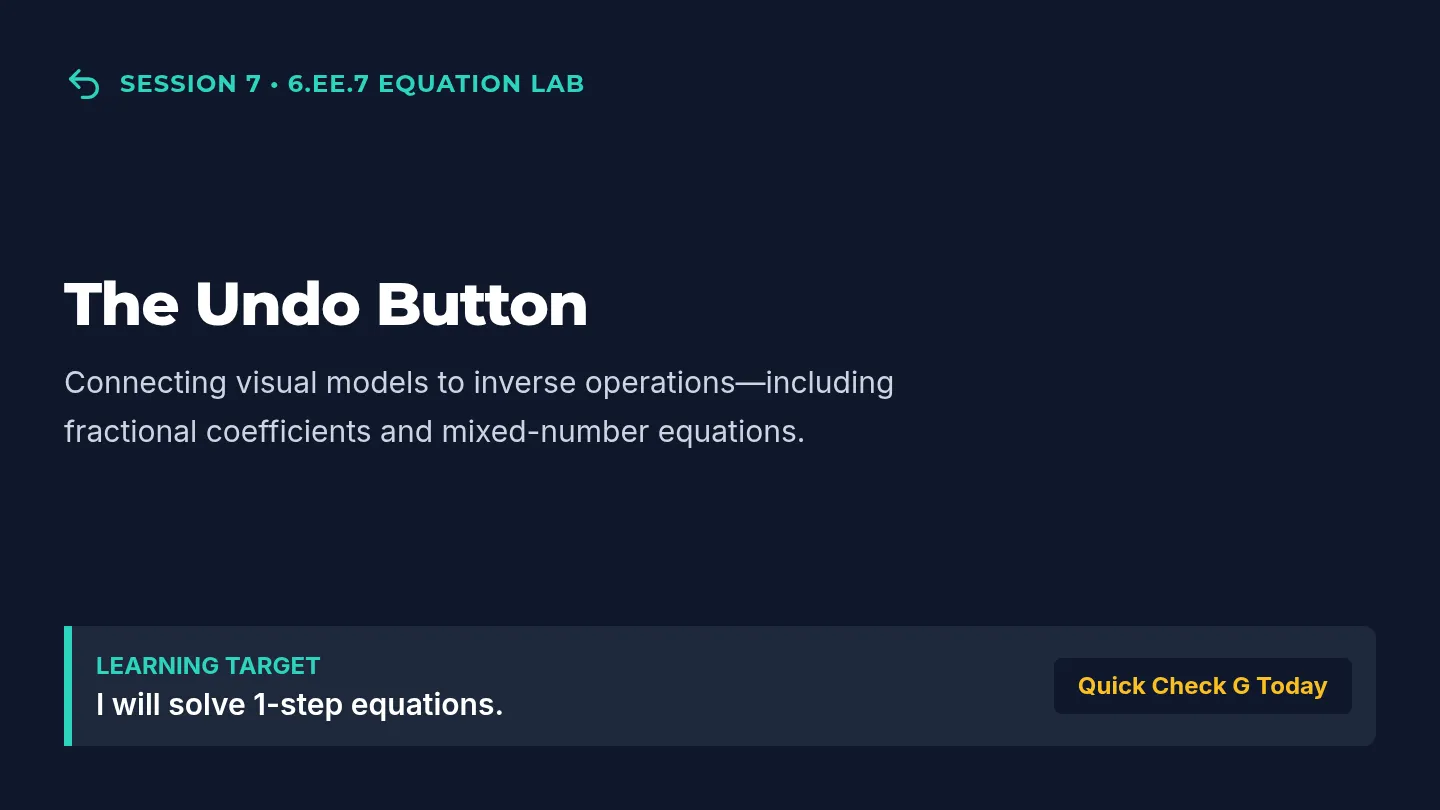
Undo Button SlidesSession 7 • 6.EE.7 Equation Lab The Undo Button Connecting visual models to inverse operations—including fractional coefficients and mixed-number equations. Learning Target I will solve 1-step equations. Quick Check G Today Spiral Warm-Up 3–5 Minutes 1. Solve \(\frac{2}{5}x = 8\) 2. Reciprocal Check \(15 \div \frac{3}{4} = 15 \cdot \_\_\_\_\) 3. Regrouping Whole \(9 = 8\frac{\_\_\_\_}{4}\) 4. Mixed Number Subtraction \(9 - 3\frac{1}{4} = \_\_\_\_\) Problems #2–#4 power up today's symbolic Undo Button! Launch: What Operation Undoes This? \(+ 7\) Undo with: \(?\) \(\cdot 2\) Undo with: \(?\) \(\cdot \frac{3}{4}\) Undo with: \(?\) Inverse operations are operations that undo each other—just like Ctrl+Z! I Do: Model → Inverse Operations \(\frac{3}{4}x = 15\) Greg's Drawing 5 5 5 5 \(x = 15 \cdot \frac{4}{3} = 20\) Inverse Operations \(\frac{3}{4}x = 15\) Divide both sides by \(\frac{3}{4}\) (multiply by reciprocal \(\frac{4}{3}\)): \(1 \cdot x = \frac{15}{1} \cdot \frac{4}{3} = 20\) I Do: Mixed-Number Equations \(x + 3\frac{1}{4} = 9\) 1. Undo Addition Subtract \(3\frac{1}{4}\) from both sides. 2. Ungroup 1 Whole Rewrite \(9\) as \(8\frac{4}{4}\). 3. Subtract \(8\frac{4}{4} - 3\frac{1}{4} = 5\frac{3}{4}\) Check: \(5\frac{3}{4} + 3\frac{1}{4} = 8\frac{4}{4} = 9\)! Equation Sort & Quick Check G Practice & Assess We Do: Equation Sort First sort each equation by the inverse operation needed (Subtract vs. Divide / Multiply by Reciprocal), then solve symbolically! Quick Check Form G You now have a strategy for ALL 6 problems! Show your inverse operations and plot Form G. Mastery Goal: 5 out of 6
Undo Button PacketSession 7 • 6.EE.7 Equation Lab The Undo Button Name: ________________________ Date: ____________ Learning Target: I will solve 1-step equations. Goal: 5/6 WARM-UP Spiral Check (3–5 min) 1. Solve: \(\frac{2}{5}x = 8\) 2. Rewrite: \(15 \div \frac{3}{4} = 15 \cdot \) 3. Regroup: \(9 = 8\frac{\phantom{4}}{4}\) 4. Subtract: \(9 - 3\frac{1}{4} = \) I DO Connecting Models to Inverse Operations (\(\frac{3}{4}x = 15\)) Visual Model \(x = 15 \cdot \frac{4}{3} = \) Inverse Operations (Symbolic) \(\frac{3}{4}x = 15\) I DO Mixed-Number Addition Equations (\(x + 3\frac{1}{4} = 9\)) Step 1: Subtract \(3\frac{1}{4}\) from both sides. • Step 2: Ungroup \(9\) as \(8\frac{4}{4}\). • Step 3: Subtract fractions, then wholes. \(x = \) Session 7: Equation Sort & Symbolic Practice We Do & You Do We Do: Name the Inverse Operation, Then Solve 1. \(2x = 10\) (Undo: ________) \(x = \) 2. \(\frac{2}{5}x = 20\) (Undo: ________) \(x = \) 3. \(x + 3\frac{1}{4} = 9\) (Undo: ________) \(x = \) 4. \(9 = \frac{3}{4}x\) (Undo: ________) \(x = \) You Do: Solve Using Inverse Operations & Check Your Answer 5. \(\frac{1}{2}x = 12\) \(x = \) 6. \(x + 3\frac{1}{3} = 10\) \(x = \) 7. \(10 = x + 3\frac{2}{5}\) \(x = \) 8. \(15 = \frac{3}{4}x\) \(x = \) Session 7: Self-Reflection Why does dividing by \(\frac{3}{4}\) give the same result as multiplying by \(\frac{4}{3}\)? Confidence Check: Thumbs Up | Sideways | Down Delta Math Quick Check Quick Check – Form G Name: ________________________ Date: ____________ Learning Target: I will solve 1-step equations. Work time: 4 minutes \(x + 5 = 6\) \(x + 2\frac{1}{4} = 9\) \(6x = 30\) \(\frac{1}{6}x = 3\) \(x + 4\frac{2}{3} = 7\) \(\frac{2}{5}x = 8\) Self-Check Score: _____ / 6 Mastery Goal: 5 out of 6
Undo Button Teacher GuideTeacher Toolkit • Session 7 The Undo Button – Script 6.EE.7 Tier 3 Pacing Routine (~28–32 min) Spiral Warm-Up: 3–5 min Hook (The Undo Button): 2 min Explicit Instruction (I Do): 6–8 min Guided Practice (Equation Sort): 8–10 min Independent Practice: 5–7 min Closure & Quick Check G: 6 min Materials & Prep • Session 7 Student Packets & Quick Check G • Reusable Equation Mat (Side B: Symbolic) • Student Growth Charts (plot Form G) Launch & Explicit Instruction Script (I Do) Hook (2 min): "Every operation has an Undo Button. Addition is undone by subtraction; multiplication is undone by division." I Do Part 1 (\(\frac{3}{4}x = 15\)): Compare Greg's bar drawing (\(x = 15 \cdot \frac{4}{3} = 20\)) with Mom's inverse operations (\(\div \frac{3}{4}\) on both sides, then multiply by the reciprocal \(\frac{4}{3}\)). Point out: "Both methods produce \(15 \cdot \frac{4}{3}\)! Dividing by a fraction IS multiplying by its reciprocal." I Do Part 2 (Explicit Mixed-Number Addition: \(x + 3\frac{1}{4} = 9\)): "To undo \(+ 3\frac{1}{4}\), subtract \(3\frac{1}{4}\) from both sides." "I can't subtract \(\frac{1}{4}\) from nothing, so I ungroup \(1\) whole from \(9\) as \(\frac{4}{4}\): \(9 = 8\frac{4}{4}\)." "Now subtract: \(\frac{4}{4} - \frac{1}{4} = \frac{3}{4}\), and \(8 - 3 = 5\), so \(x = 5\frac{3}{4}\)." We Do: Equation Sort Facilitation Have students identify the Undo operation for all 4 equations BEFORE solving any of them. This builds strategic selection rather than guessing! Misconceptions, Feedback & Answer Keys Session 7 Common Misconception Corrective Feedback Prompt For \(x + 3\frac{1}{4} = 9\), subtracts wholes only and writes \(6\frac{1}{4}\). "Check by adding back: \(6\frac{1}{4} + 3\frac{1}{4} = 9\frac{2}{4}\), too big! Ungroup \(9\) as \(8\frac{4}{4}\) so you can subtract the \(\frac{1}{4}\)." Forgets to flip \(\frac{2}{5}\) to \(\frac{5}{2}\) when dividing by a fraction. "Dividing by \(\frac{2}{5}\) means multiplying by its reciprocal, \(\frac{5}{2}\). Simplify \(20 \div 2 = 10\) first, then \(10 \cdot 5 = 50\)." Warm-Up Key \(x = 20\) \(\frac{4}{3}\) \(8\frac{4}{4}\) \(5\frac{3}{4}\) We Do Key \(\div 2\); \(x = 5\) \(\div \frac{2}{5}\) (or \(\cdot \frac{5}{2}\)); \(x = 50\) \(- 3\frac{1}{4}\); \(x = 5\frac{3}{4}\) \(\div \frac{3}{4}\) (or \(\cdot \frac{4}{3}\)); \(x = 12\) You Do Key \(x = 24\) \(x = 6\frac{2}{3}\) \(x = 6\frac{3}{5}\) \(x = 20\) Quick Check Form G Key \(x = 1\) \(x = 6\frac{3}{4}\) \(x = 5\) \(x = 18\) \(x = 2\frac{1}{3}\) \(x = 20\) Data Decision: Record Form G on Growth Charts. Use Form G errors to customize your Session 8 misconception review!
Crack the Code SlidesSession 8 • 6.EE.7 Equation Lab Crack the Code Synthesizing all one-step equation strategies to unlock the final 4-digit vault code. Learning Target I will solve 1-step equations. Final Quick Check H Spiral Warm-Up 3–5 Minutes 1. Whole Number \(2x = 18\) 2. Reversed \(13 = x + 4\) 3. Fractional Coefficient \(\frac{2}{5}x = 10\) 4. Mixed Number \(x + 2\frac{1}{4} = 6\) All 4 equation types from our 8 sessions in one warm-up! Launch: Unlock the Final Vault [ ? ] – [ ? ] – [ ? ] – [ ? ] Every equation you solve today reveals one digit of the vault combination—but one wrong inverse operation jams the lock! I Do: Which One Doesn't Belong? Strategy Check A. \(x + 5 = 12\) B. \(3x = 21\) C. \(\frac{3}{4}x = 18\) D. \(14 = x + 7\) Solve all 4 first! Which equation has a different solution, or uses a different inverse operation? We Do: Mixed Challenge Decreasing Support 1. \(4x = 24\) Inverse operation: ________ 2. \(\frac{1}{2}x = 15\) Inverse operation: ________ 3. \(x + 3\frac{1}{3} = 9\) Regroup \(9\) as \(8\frac{3}{3}\)! 4. \(24 = \frac{3}{4}x\) Multiply by reciprocal \(\frac{4}{3}\). You Do: Crack the Code & Quick Check H Final Mission Crack the Code Solve the 4 vault equations on Page 2 to reveal the 4-digit combination! Quick Check Form H Show everything you've learned across all 8 sessions. Plot your final score on your Growth Chart! Mastery Goal: 5 out of 6
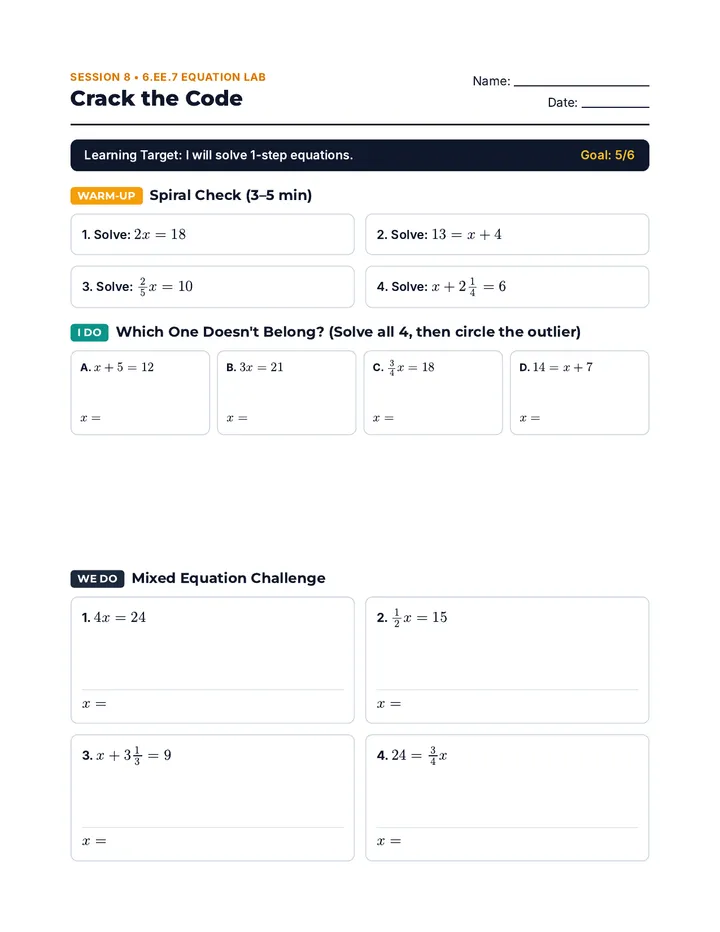
Crack the Code PacketSession 8 • 6.EE.7 Equation Lab Crack the Code Name: ________________________ Date: ____________ Learning Target: I will solve 1-step equations. Goal: 5/6 WARM-UP Spiral Check (3–5 min) 1. Solve: \(2x = 18\) 2. Solve: \(13 = x + 4\) 3. Solve: \(\frac{2}{5}x = 10\) 4. Solve: \(x + 2\frac{1}{4} = 6\) I DO Which One Doesn't Belong? (Solve all 4, then circle the outlier) A. \(x + 5 = 12\) \(x = \) B. \(3x = 21\) \(x = \) C. \(\frac{3}{4}x = 18\) \(x = \) D. \(14 = x + 7\) \(x = \) WE DO Mixed Equation Challenge 1. \(4x = 24\) \(x = \) 2. \(\frac{1}{2}x = 15\) \(x = \) 3. \(x + 3\frac{1}{3} = 9\) \(x = \) 4. \(24 = \frac{3}{4}x\) \(x = \) Session 8: Crack the Code Vault Challenge You Do Solve each equation independently. Then use the Code Key below to unlock the 4-digit vault combination! Digit 1: \(x + 4\frac{1}{2} = 11\) \(x = \) Digit 2: \(\frac{2}{3}x = 12\) \(x = \) Digit 3: \(32 = 4x\) \(x = \) Digit 4: \(\frac{1}{5}x = 3\) \(x = \) Vault Code Key (Match your \(x\) value to its secret digit): \(x = 8 \rightarrow \mathbf{4}\) \(x = 15 \rightarrow \mathbf{9}\) \(x = 6\frac{1}{2} \rightarrow \mathbf{7}\) \(x = 18 \rightarrow \mathbf{2}\) FINAL VAULT CODE: [ ____ ] – [ ____ ] – [ ____ ] – [ ____ ] Session 8: Final Self-Reflection Which 1-step equation strategy (tiles, drawings, or inverse operations) is your favorite and why? Final Confidence Check: Thumbs Up | Sideways | Down Delta Math Quick Check Quick Check – Form H Name: ________________________ Date: ____________ Learning Target: I will solve 1-step equations. Work time: 4 minutes \(x + 9 = 11\) \(x + 4\frac{1}{3} = 6\) \(2x = 14\) \(\frac{1}{3}x = 8\) \(x + 1\frac{3}{5} = 9\) \(\frac{2}{3}x = 10\) Self-Check Score: _____ / 6 Mastery Goal: 5 out of 6
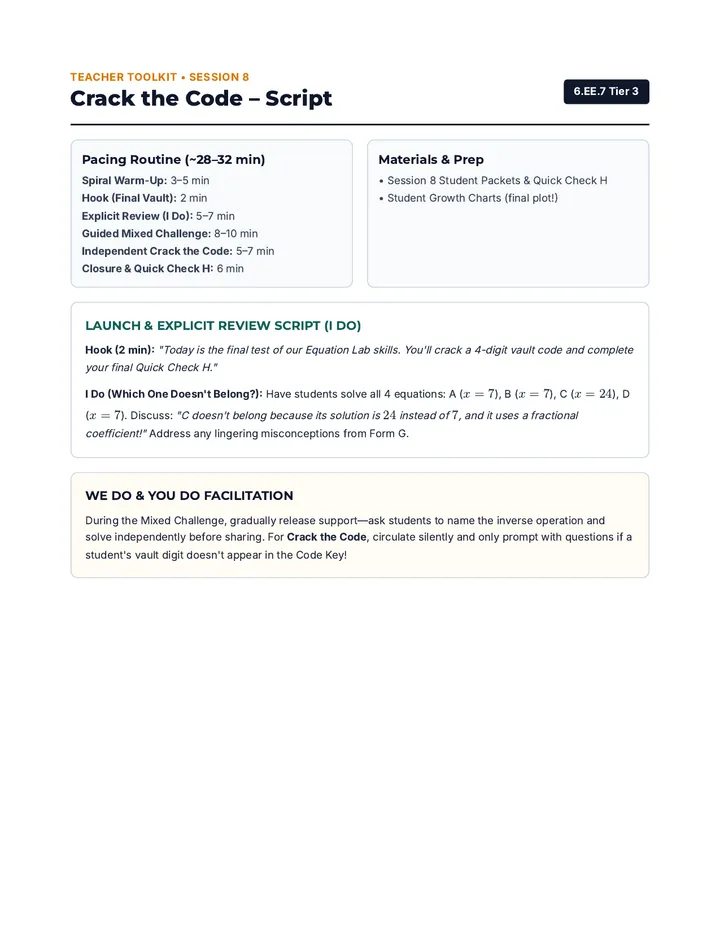
Crack the Code Teacher GuideTeacher Toolkit • Session 8 Crack the Code – Script 6.EE.7 Tier 3 Pacing Routine (~28–32 min) Spiral Warm-Up: 3–5 min Hook (Final Vault): 2 min Explicit Review (I Do): 5–7 min Guided Mixed Challenge: 8–10 min Independent Crack the Code: 5–7 min Closure & Quick Check H: 6 min Materials & Prep • Session 8 Student Packets & Quick Check H • Student Growth Charts (final plot!) Launch & Explicit Review Script (I Do) Hook (2 min): "Today is the final test of our Equation Lab skills. You'll crack a 4-digit vault code and complete your final Quick Check H." I Do (Which One Doesn't Belong?): Have students solve all 4 equations: A (\(x = 7\)), B (\(x = 7\)), C (\(x = 24\)), D (\(x = 7\)). Discuss: "C doesn't belong because its solution is \(24\) instead of \(7\), and it uses a fractional coefficient!" Address any lingering misconceptions from Form G. We Do & You Do Facilitation During the Mixed Challenge, gradually release support—ask students to name the inverse operation and solve independently before sharing. For Crack the Code, circulate silently and only prompt with questions if a student's vault digit doesn't appear in the Code Key! Intervention Decisions & Answer Keys Session 8 End-of-Cycle Tier 3 Decision: Review Growth Charts across Forms A–H. Students who met the 5/6 mastery goal on 3+ forms are ready for 7.EE.4a (two-step equations). For students below 5/6 on Form H, problem-solve with your intervention team to target either (a) mixed-number regrouping or (b) fractional coefficients. Warm-Up Key \(x = 9\) \(x = 9\) \(x = 25\) \(x = 3\frac{3}{4}\) We Do Key \(x = 6\) \(x = 30\) \(x = 5\frac{2}{3}\) \(x = 32\) You Do: Crack the Code Key \(x = 6\frac{1}{2} \rightarrow\) Digit 7 \(x = 18 \rightarrow\) Digit 2 \(x = 8 \rightarrow\) Digit 4 \(x = 15 \rightarrow\) Digit 9 Final Vault Code: 7 – 2 – 4 – 9 Quick Check Form H Key \(x = 2\) \(x = 1\frac{2}{3}\) \(x = 7\) \(x = 24\) \(x = 7\frac{2}{5}\) \(x = 15\) Celebration: Celebrate students' growth from Form A to Form H on their Growth Charts!