Ten Team Teacher Guide Ten Is A Team
Lesson 1: The Foundation of Ten
Day 1
Objective
Students will identify a full ten-frame as a "Team of Ten" and recognize that 10 ones equal 1 group of ten.
Materials
Physical Ten-Frames
Large Counters (Red/Yellow)
"Ten Team" Slides
"Frame Filler" Worksheet
SDC Scaffolds
High visual contrast, tactile manipulatives, repetitive verbal cues: "Is the team full?"
Direct Instruction (10-15 mins)
1
The Hook: Introduce the "Number Neighborhood." Today we are building the "Ten Team House." The house has exactly 10 rooms (a ten-frame).
2
Modeling: Place counters one by one into a large ten-frame. Count aloud with students. When the frame is full, shout "TEAM TEN!"
3
Concept Check: Show a frame with 9. Ask, "Is the team full?" (No). Add one. "Now is it a Team of Ten?" (Yes!).
Guided Practice (15 mins)
Students use physical ten-frames to match what is shown on the Ten Team Slides .
Teacher circulates to check for 1-to-1 correspondence while counting.
Encourage students to use the phrase: "Full house, that's ten!"
Independent Work (10 mins)
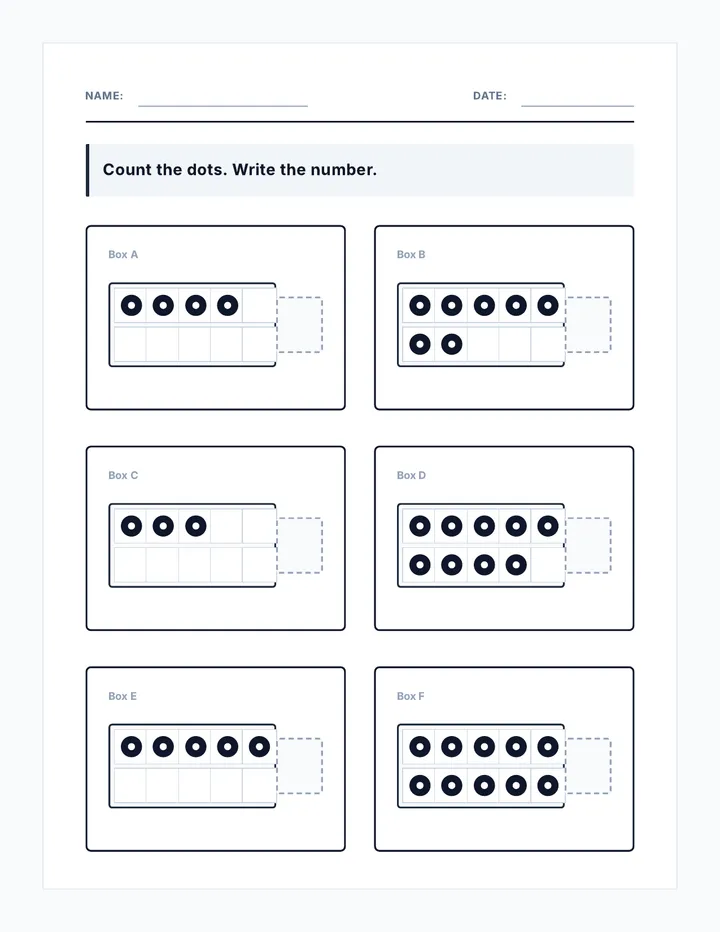
Students complete the Frame Filler Worksheet . They will identify which houses are full (10) and which ones are still waiting for more "neighbors."
"Tomorrow, we'll see what happens when the Ten Team moves into their very own skyscraper!"
Frame Filler Worksheet Frame Filler
Number Neighborhood: Lesson 1
Name:
Date:
Find the Team!
Is the house full? Count the dots. If there are 10 , circle the house!
House 1
House 2
House 3
House 4
Bonus: Draw a Team of Ten! Ten Team Slides Ten Is A Team!
Number Neighborhood: Day 1
The Neighborhood House
How many rooms are in the house?
Move in, Neighbors!
Wait! Is the team full?
TEAM TEN!
Every room is full! We have 10!
Tower Power Slides 🏠
🏠
🌳
🌳
Tower Power
Making a Ten Rod
Let's Count!
1
2
3
4
5
6
7
8
9
10
How many blocks do we have? We have 10!
Stack Them Up!
...
A TEN ROD!
Is it a Ten?
Too short...
❌
Just right!
✅
Tower Power Rule
10
Ten small blocks...
Make ONE big Ten Rod!
Tall Tower Teacher Guide Tall Ten Tower
Lesson 2: From Units to Rods
Day 2
Objective
Students will understand that 10 ones can be "stuck together" to create 1 tall rod (ten).
Materials
Base-ten ones and tens
Glue sticks (for visual metaphor)
"Tower Builder" Slides
"Tower Match" Worksheet
SDC Scaffolds
Physical linking cubes or Velcro to "snap" tens together. Use color coding (yellow for ones, blue for tens).
The Big Reveal (10 mins)
1
Review: Revisit the Ten-Frame. "Yesterday, we filled the house." Today, the neighbors are moving to a Skyscraper !
2
The "Stuck" Trick: Hold 10 loose cubes. Pretend to put "Magic Glue" on them and snap them into a rod. "Now they are a Team Tower!"
Build It (20 mins)
Group Activity: Hand out 10 yellow ones to each student.
Challenge: Can you swap your 10 ones for 1 blue rod?
Verbal Check: "Is this tower still 10?" (Yes!)
Quick Check
Hold up a rod. Ask: "How many ones live in this tower?" (Ten!)
Tower Detective Slides Tower Detective
Is it a Ten Rod?
Time to use your detective eyes!
Your Mission
Find the Ten Rods!
COUNT TO 10
IT'S A TEN!
Is this a Ten Rod?
Maybe?
YES!
10987654321
It has 10 blocks! It's a Ten Rod!
What about this one?
Is it tall enough?
NOPE!
4321
Only 4 blocks. Too small for a ten!
Great Job!
You are a Tower Detective Expert!
Tower Match Worksheet Tower Match
Number Neighborhood: Lesson 2
Name:
Date:
Draw a line to match the 10 Ones to the 10 Tower .
Empty Lot
10 ONES = 1 TALL TOWER
Tower Factory Slides Tower Factory
Making Ten Rods
Step 1: Get Blocks
How many blocks do we need? TEN!
Step 2: Squish Together
PERFECT!
Step 3: Quality Check
Too Many!
Just Ten!
Factory Rule
10 ONES
1 TEN ROD
Teen Team Teacher Guide Teen Team Ups
Lesson 3: 10 and Some More
Day 3
Objective
Students will compose teen numbers (11-19) using one ten-rod and 1-9 ones blocks.
Key Terms
Ten, Ones, Teen, "Extra Neighbors"
Differentiation
Use a "Teen House" visual aid where the 10 rod sits in the garage and ones sit in the windows.
The Neighborhood Map (10 mins)
1
Story: Sometimes we have a full tower of 10, but more people want to move in! They have to wait on the "ones sidewalk."
2
Modeling: Show 1 rod and 2 ones. "We have 10 and 2 more. That's 12!" Do this for 11, 13, and 15.
Teen Builders (20 mins)
Students work in pairs with base-ten blocks.
Teacher calls out a teen number (e.g., "Build 14!").
Students must pick 1 rod and then count out the "extra" ones.
Prompt: "How many tens? (One) How many ones? (Four)"
Closing Question
"Do all teen numbers have a Ten Tower?" (Yes!)
Teen Houses Worksheet Teen Houses
Number Neighborhood: Lesson 3
Name:
Count the blocks. Write the teen number!
Number
Number
Number
Adding Up Teacher Guide Adding Up Street
Teacher Guide • Day 4
Number Neighborhood Unit
Objective
Students will represent addition of a single-digit number to 10 using base-ten blocks (one ten-rod and unit cubes) to form teen numbers (11-19).
Materials
Ten-rods and Unit cubes
"Adding Up Street" Worksheet
"Moving In" Slides
Individual ten-frames
SDC Scaffolds
Use the "Ten is the leader" metaphor—the ten-rod always comes first.
Color-code the addition sign in green (for "Go/Add").
Physical movement: Have students physically place cubes next to the rod.
Instructional Flow
1
The Welcome Wagon (Warm-up)
Review the "Ten Rod" from yesterday. Hold up a ten-rod and ask, "How many are in here?" (10). Show a single cube. "One neighbor wants to move in next door!"
2
New Neighbors Move In (Guided)
Model addition equations on the board using the Neighborhood visual: 10 + 3. Script: "We have our tall ten tower. Plus 3 more neighbors. Put them together... we have thirteen!" Emphasize that the "1" in thirteen comes from our one big ten-rod.
3
Building the Street (Collaborative)
Give students a ten-rod and a small pile of cubes. Call out a number (e.g., 15). Students must identify that they need the "Ten Team" (the rod) plus "5 Neighbors."
4
Independent Move-In (Worksheet)
Students complete the "Adding Up Street" worksheet. They will count the ten-rod, count the ones, and write the total teen number.
Discussion Prompts
"When we add 10 and 2, does the ten-rod change?"
"Which number tells us how many extra neighbors there are?"
Taking Away Teacher Guide Taking Away Houses
Lesson 5: Subtracting from Teens
Day 5
Objective
Students will subtract ones from teen numbers to find the remaining 'Ten Tower' (e.g., 14 - 4 = 10).
Focus
Recognizing that removing the "ones" leaves exactly one "ten."
Mastery Check
Can the student identify that removing all 'extra' neighbors leaves the original 'Ten Team'?
Moving Day (10 mins)
1
The Story: Some neighbors are moving away! They were living in the ones houses, but now they are gone.
2
Modeling: Show 15 (1 rod, 5 ones). Say: "We have 15. Now 5 move away." Physically remove the 5 ones. "What is left?" (The Ten Tower!)
Subtraction Smash (20 mins)
Students build a teen number with playdough "ones" and a wooden block "ten."
Teacher says: "Subtract the ones!"
Students "smash" or remove the playdough ones.
Verbal Check: "14 take away 4 is... 10!"
Unit Wrap-Up
Review the week: "We found ten, we built towers, we made teen numbers, and we added and subtracted!"
Moving Out Subtraction Worksheet Moving Out
Number Neighborhood: Lesson 5
Name:
Cross out the Ones that are moving away. How many stay?
13 - 3 =
17 - 7 =
WHAT'S LEFT? JUST THE TEN!