Equations And Functions Worksheet Day 1 Review • Algebra 1 Semester Exam
Equations & Functions
Name:
Date: Period:
Blueprint Targets: #12 (A1.5A) • #13 (A1.12E) • #9 (A1.12B) • #8 & #17 (A1.2A) • #2 & #14 (A1.6A)
1. Solve the linear equation for \(x\). Show all steps. Blueprint #12 • A1.5A
\[4(2x - 3) + 5 = 3(x + 6) - 10\]
2. Solve the linear equation for \(x\). Show all steps. Blueprint #12 • A1.5A
\[-2(3x + 4) + 10 = 5x - 3(x - 6)\]
3. Solve each literal equation for the specified variable. Blueprint #13 • A1.12E
a) Solve \(P = 2l + 2w\) for \(w\).
b) Solve \(3x - 4y = 12\) for \(y\).
4. Given \(f(x) = -2x^2 + 5x - 3\), evaluate each expression. Blueprint #9 • A1.12B
a) Find \(f(-2)\).
b) Find \(f(4)\).
Day 1 Review — Equations & Functions Domain & Range Practice
5. Discrete Real-World Range Blueprint #8 • A1.2A
A school robotics club sells custom keychains for $7 each. They have 12 keychains in stock to sell at the winter fair. Let \(R(n)\) represent the total revenue in dollars from selling \(n\) keychains. Which set represents the reasonable range for this situation?
A) All real numbers from \(0\) to \(84\)
B) \(\{0, 7, 14, 21, \dots, 84\}\)
C) \(\{0, 1, 2, 3, \dots, 12\}\)
D) All integers greater than or equal to \(0\)
6. Continuous Real-World Domain Blueprint #17 • A1.2A
A 450-gallon water tank is being drained at a steady rate of 15 gallons per minute until it is completely empty. Let \(t\) represent the time in minutes since draining began. Write an inequality that represents the reasonable domain for this situation, and briefly explain your reasoning.
7. Quadratic Domain #14 • A1.6A
What is the domain of the quadratic function shown below?
x y 2 4 -2 2 4 -2
A) \(x \le 5\)
B) \(-1 \le x \le 5\)
C) \(x \ge 2\)
D) All real numbers
8. Quadratic Range #2 • A1.6A
Determine the range of the quadratic function shown below. Represent your answer as an inequality.
x y 2 -2 2 -2 -4
Range Inequality:
Equations And Functions Answer Key Teacher Answer Key • Day 1 Review
Equations & Functions — Solutions
Blueprint #2, 8, 9, 12, 13, 14, 17
1. Linear Equation (Blueprint #12 • A1.5A) Answer: \(x = 3\)
\(4(2x - 3) + 5 = 3(x + 6) - 10 \implies 8x - 12 + 5 = 3x + 18 - 10 \implies 8x - 7 = 3x + 8 \implies 5x = 15 \implies x = 3\)
2. Linear Equation (Blueprint #12 • A1.5A) Answer: \(x = -2\)
\(-2(3x + 4) + 10 = 5x - 3(x - 6) \implies -6x - 8 + 10 = 5x - 3x + 18 \implies -6x + 2 = 2x + 18 \implies -8x = 16 \implies x = -2\)
3. Literal Equations (Blueprint #13 • A1.12E) a) \(w = \frac{P - 2l}{2}\) | b) \(y = \frac{3}{4}x - 3\)
a) \(P - 2l = 2w \implies w = \frac{P - 2l}{2}\) (or \(\frac{P}{2} - l\))
b) \(-4y = -3x + 12 \implies y = \frac{3}{4}x - 3\)
4. Evaluating Functions (Blueprint #9 • A1.12B) a) \(f(-2) = -21\) | b) \(f(4) = -15\)
a) \(f(-2) = -2(-2)^2 + 5(-2) - 3 = -8 - 10 - 3 = -21\)
b) \(f(4) = -2(4)^2 + 5(4) - 3 = -32 + 20 - 3 = -15\)
5. Discrete Real-World Range (Blueprint #8 • A1.2A) Answer: B) \(\{0, 7, 14, 21, \dots, 84\}\)
Only whole numbers of keychains (\(0\) to \(12\)) can be sold. Revenue increases by $7 per keychain up to \(7 \times 12 = \$84\). Choice C is the domain, not the range.
6. Continuous Real-World Domain (Blueprint #17 • A1.2A) Answer: \(0 \le t \le 30\)
Time starts at \(t = 0\) minutes. At 15 gal/min, a 450-gallon tank empties in \(450 \div 15 = 30\) minutes. Because time is continuous, the domain is \(0 \le t \le 30\).
7. Quadratic Domain (#14 • A1.6A)
Answer: D) All real numbers
Every quadratic function extends infinitely left and right, so its domain is all real numbers (\(-\infty < x < \infty\)).
8. Quadratic Range (#2 • A1.6A)
Answer: \(y \ge -4\) (or \(f(x) \ge -4\))
The parabola opens upward with a minimum vertex at \((-1, -4)\), so all \(y\)-values are greater than or equal to \(-4\).
Linear Graphs And Rules Worksheet Day 2 Review • Algebra 1 Semester Exam
Linear Graphs & Rules
Name:
Date: Period:
Blueprint Targets: #6 & #20 (A1.3B) • #3 & #18 (A1.2C) • #10 & #16 (A1.3C) • #7 (A1.2H) • #4 (A1.3D)
1. Rate of Change from Standard Form Blueprint #6 • A1.3B
Calculate the rate of change of \(y\) with respect to \(x\) for the linear equation \(5x - 3y = 18\).
2. Real-World Rate of Change Blueprint #20 • A1.3B
300 200 100 0 1 2 3 4 5 Distance (mi) vs. Time (hr)
The graph shows the distance remaining on a road trip over time. Calculate the rate of change of the distance with respect to time, and explain what it means in this situation.
3. Equation from a Table #3 • A1.2C
Write a linear equation in slope-intercept form (\(y = mx + b\)) for the table below.
\(x\)
\(y\)
\(-2\)
\(7\)
\(0\)
\(4\)
\(2\)
\(1\)
\(4\)
\(-2\)
4. Equation from a Graph #18 • A1.2C
Write a linear equation in two variables that represents the line shown below.
2 -2 2 -2
Day 2 Review — Linear Graphs & Rules Zeros, Graphing & Inequalities
5. Zero of a Linear Function #10 • A1.3C
What is the zero of the linear function shown on the graph?
2 4 2 -2
A) \(-2\)
B) \(2\)
C) \(4\)
D) \(-\frac{1}{2}\)
6. Graph from \(m\) and \(b\) #16 • A1.3C
Graph the linear function with a slope of \(-\frac{2}{3}\) and a \(y\)-intercept of \(4\).
2 4 -2 2 4 -2
7. Write a Linear Inequality from a Verbal Description Blueprint #7 • A1.2H
A bakery sells cupcakes for $3 each and brownies for $2 each. To cover daily costs, the bakery needs to make at least $180 in sales. Let \(x\) represent the number of cupcakes sold and \(y\) represent the number of brownies sold. Write a linear inequality in two variables to represent this situation.
8. Graph the Solution Set of a Linear Inequality Blueprint #4 • A1.3D
Graph the solution set of:
\[y < \frac{1}{2}x - 1\]
Be sure to use the correct boundary line (solid or dashed) and shade the solution region.
2 4 -2 2 4 -2
Linear Graphs And Rules Answer Key Teacher Answer Key • Day 2 Review
Linear Graphs & Rules — Solutions
Blueprint #3, 4, 6, 7, 10, 16, 18, 20
1. Rate of Change from Standard Form (#6 • A1.3B) Answer: \(m = \frac{5}{3}\)
Solve for \(y\): \(-3y = -5x + 18 \implies y = \frac{5}{3}x - 6\). The rate of change (slope) is \(\frac{5}{3}\).
2. Real-World Rate of Change (#20 • A1.3B) Answer: \(-60\text{ miles per hour}\)
Using \((0, 270)\) and \((2, 150)\): \(m = \frac{150 - 270}{2 - 0} = \frac{-120}{2} = -60\). The distance remaining decreases by 60 miles each hour.
3. Equation from a Table (#3 • A1.2C) Answer: \(y = -\frac{3}{2}x + 4\)
Slope: \(m = \frac{1 - 4}{2 - 0} = -\frac{3}{2}\). The \(y\)-intercept from \((0, 4)\) is \(b = 4\). Equation: \(y = -\frac{3}{2}x + 4\).
4. Equation from a Graph (#18 • A1.2C) Answer: \(y = \frac{4}{3}x - 2\)
The line passes through \((0, -2)\) and \((3, 2)\). Slope: \(m = \frac{2 - (-2)}{3 - 0} = \frac{4}{3}\), and \(b = -2\).
5. Zero of a Linear Function (#10 • A1.3C) Answer: C) \(4\)
The zero is the \(x\)-intercept where \(y = 0\), which is at \((4, 0)\), so the zero is \(4\).
6. Graph from \(m\) and \(b\) (#16 • A1.3C)
Line: \(y = -\frac{2}{3}x + 4\)
Plot \((0, 4)\), then move down 2 and right 3 to \((3, 2)\) and \((6, 0)\), or up 2 and left 3 to \((-3, 6)\). Connect with a solid line.
8. Graph Linear Inequality (#4 • A1.3D)
Dashed line, shaded below
Plot \(y\)-intercept \((0, -1)\) and slope \(\frac{1}{2}\) (e.g., \((2, 0), (4, 1)\)). Draw a dashed line (strict \(<\)) and shade below the line.
7. Write Linear Inequality (#7 • A1.2H) Answer: \(3x + 2y \ge 180\)
"At least $180" means greater than or equal to \(180\) (\(\ge 180\)).
Systems Showdown Worksheet Day 3 Review • Algebra 1 Semester Exam
Systems Showdown
Name:
Date: Period:
Blueprint Targets: #1 & #15 (A1.2I) • #5 & #11 (A1.5C) • #19 (A1.3F)
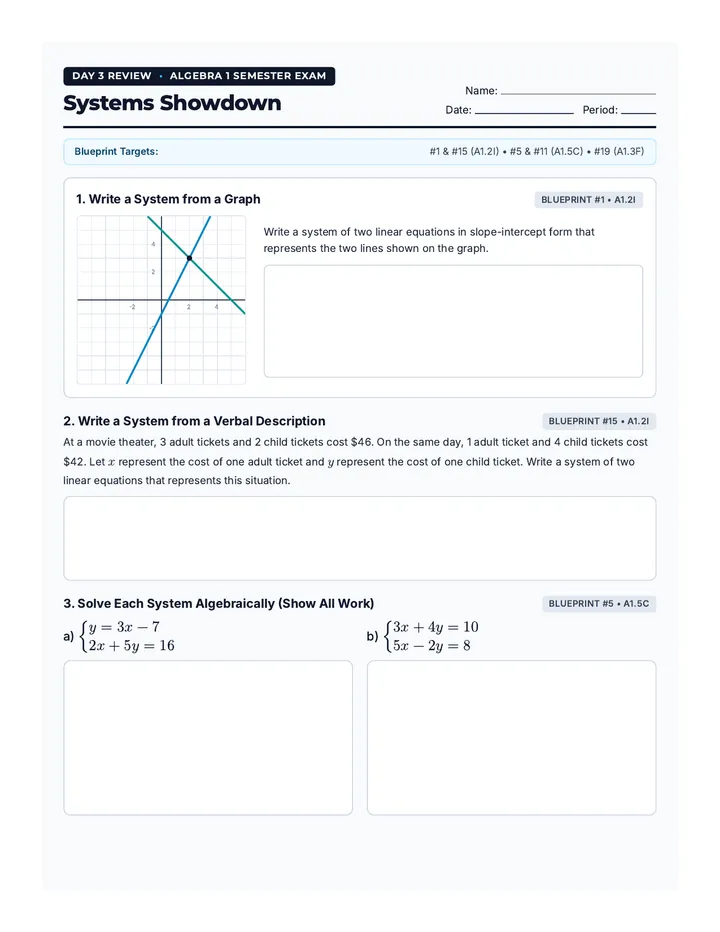
1. Write a System from a Graph Blueprint #1 • A1.2I
2 4 -2 2 4 -2
Write a system of two linear equations in slope-intercept form that represents the two lines shown on the graph.
2. Write a System from a Verbal Description Blueprint #15 • A1.2I
At a movie theater, 3 adult tickets and 2 child tickets cost $46. On the same day, 1 adult ticket and 4 child tickets cost $42. Let \(x\) represent the cost of one adult ticket and \(y\) represent the cost of one child ticket. Write a system of two linear equations that represents this situation.
3. Solve Each System Algebraically (Show All Work) Blueprint #5 • A1.5C
a) \(\begin{cases} y = 3x - 7 \\ 2x + 5y = 16 \end{cases}\)
b) \(\begin{cases} 3x + 4y = 10 \\ 5x - 2y = 8 \end{cases}\)
Day 3 Review — Systems Showdown Number of Solutions & Graphing
4. Determine the Number of Solutions (One, None, or Infinitely Many) Blueprint #11 • A1.5C
a) \(\begin{cases} 4x - 2y = 6 \\ y = 2x - 3 \end{cases}\)
b) \(\begin{cases} 3x + y = 5 \\ 6x + 2y = -4 \end{cases}\)
5. Solve the System by Graphing Blueprint #19 • A1.3F
Graph both equations and state the solution:
\[\begin{cases} y = x + 1 \\ y = -\frac{1}{2}x + 4 \end{cases}\]
Solution:
2 4 -2 2 4 -2
6. Graph & Determine If a Solution Exists Blueprint #19 • A1.3F
Graph both equations and determine the solution, if one exists:
\[\begin{cases} y = -2x + 3 \\ 4x + 2y = -2 \end{cases}\]
Solution:
2 4 -2 2 4 -2
Systems Showdown Answer Key Teacher Answer Key • Day 3 Review
Systems Showdown — Solutions
Blueprint #1, 5, 11, 15, 19
1. Write a System from a Graph (#1 • A1.2I) Answer: \(y = 2x - 1\) and \(y = -x + 5\)
Blue line: \(y\)-intercept \((0, -1)\), slope \(2\) \(\implies y = 2x - 1\). Teal line: \(y\)-intercept \((0, 5)\), slope \(-1\) \(\implies y = -x + 5\). They intersect at \((2, 3)\).
2. Write a System from a Verbal Description (#15 • A1.2I) Answer: \(3x + 2y = 46\) and \(x + 4y = 42\)
3 adult + 2 child = $46 gives \(3x + 2y = 46\). 1 adult + 4 child = $42 gives \(x + 4y = 42\).
3. Solve Algebraically (#5 • A1.5C) a) \((3, 2)\) | b) \((2, 1)\)
a) Substitute \(y = 3x - 7\): \(2x + 5(3x - 7) = 16 \implies 17x = 51 \implies x = 3\), then \(y = 3(3) - 7 = 2\).
b) Multiply 2nd eq by 2: \(10x - 4y = 16\). Add to 1st eq: \(13x = 26 \implies x = 2\), then \(3(2) + 4y = 10 \implies y = 1\).
4. Number of Solutions (#11 • A1.5C) a) Infinitely many | b) No solution
a) Substitute \(y = 2x - 3\): \(4x - 2(2x - 3) = 6 \implies 6 = 6\) (true statement \(\implies\) infinitely many solutions).
b) Multiply 1st eq by \(-2\): \(-6x - 2y = -10\). Add to 2nd eq: \(0 = -14\) (false statement \(\implies\) no solution).
5. Solve by Graphing (#19 • A1.3F) Answer: \((2, 3)\)
Graph \(y = x + 1\) (through \((0, 1), (2, 3)\)) and \(y = -\frac{1}{2}x + 4\) (through \((0, 4), (2, 3)\)). The lines intersect at \((2, 3)\).
6. Graph & Determine Solution (#19 • A1.3F) Answer: No solution
Rewrite \(4x + 2y = -2\) as \(y = -2x - 1\). Both lines have slope \(-2\) with different \(y\)-intercepts (\(3\) and \(-1\)), so they are parallel and never intersect.