IA2 B1 Polar Bears Interim Assessment Morgan State Math
Camden Prep Mt Ephraim Middle School
MIDDLE SCHOOL INTERIM ASSESSMENT
TEST BOOKLET
Subject: Math Assessment: IA 2 BOOK 1 Booklet: Fractions & Word Problems (Visual) Class: Morgan State
Student Name:
Team:
Date:
1
Name: ______________________________ Date: ________________
Section 1: Addition Word Problems
Directions: Read each word problem carefully. Underline or circle the important information, write an equation, and show all of your work in the space provided.
1. Maya collected 348 canned goods for the school food drive on Monday and 275 canned goods on Tuesday. How many canned goods did Maya collect in all?
Equation:
2. Camden Prep's library had 1,245 books. Over the summer, the school bought 360 new fiction books and received 185 donated science books. How many books does the library have now?
Equation:
3. Three classes raised money for a field trip. Room 101 raised $146 , Room 102 raised $29 more than Room 101, and Room 103 raised $215 . How much money did all three classes raise altogether?
Equation:
Page 2
Section 2: Subtraction Word Problems
Directions: Solve each problem. Show all of your work in the box, then write your final answer in a complete sentence on the lines below.
4. A stadium has 850 seats. If 576 tickets have been sold for Friday's game, how many seats are still empty?
Answer Sentence:
5. Elena had $500 saved for a new bicycle. She spent $185 on a helmet and safety gear, and then spent $240 on the bicycle. How much money does Elena have left?
Answer Sentence:
6. A bakery made 620 muffins on Saturday morning. They sold 245 blueberry muffins and 198 banana muffins by noon. How many muffins were left at noon?
Answer Sentence:
Page 3
Section 3: Division Word Problems
Directions: Solve each division problem. Write a division equation, draw an equal-groups picture or array, and show your calculations.
7. Ms. Davis has 48 markers to share equally among 6 table groups. How many markers will each table group receive?
Equation:
Drawing / Equal Groups
Calculations & Answer
8. A coach is packing 54 tennis balls into cans. Each can holds 9 tennis balls. How many cans does the coach need?
Equation:
Drawing / Equal Groups
Calculations & Answer
9. There are 96 students going on a science museum trip. They are divided equally into 4 buses. How many students will ride on each bus?
Equation:
Drawing / Equal Groups
Calculations & Answer
Page 4
Section 4: Comparing Fractions
Directions: Compare each pair of fractions. Write > (greater than), < (less than), or = (equal to) in the circle. Shade the fraction bars to help you, and show your reasoning below each problem.
10. Shade the fraction bars to compare.
\(\frac{3}{8}\) \(\frac{5}{8}\)
\(\frac{3}{8}\)
\(\frac{5}{8}\)
Explain your reasoning:
11. Shade the fraction bars to compare.
\(\frac{2}{3}\) \(\frac{2}{5}\)
\(\frac{2}{3}\)
\(\frac{2}{5}\)
Explain your reasoning:
12. Shade the fraction bars to compare.
\(\frac{1}{2}\) \(\frac{3}{6}\)
\(\frac{1}{2}\)
\(\frac{3}{6}\)
Explain your reasoning:
Page 5
Section 4: Comparing Fractions (Continued)
13. Write the fraction for each shaded model, then compare.
Show how you know:
14. Compare the fractions independently. Show your work or draw a model.
\(\frac{2}{3}\) \(\frac{3}{4}\)
15. Compare the fractions independently. Show your work or draw a model.
\(\frac{5}{6}\) \(\frac{7}{12}\)
Page 6
IA 2 Book 1 Fractions Visual Answer Key Teacher Answer Key
IA 2 Book 1 – Fractions & Word Problems (With Visuals)
ANSWER KEY
Section 1: Addition Word Problems
1. Maya's Canned Goods
Equation: \(348 + 275 = 623\)
Answer: 623 canned goods
2. Camden Prep Library Books
Equation: \(1,245 + 360 + 185 = 1,790\)
Work: \(1,245 + 360 = 1,605\); \(1,605 + 185 = 1,790\)
Answer: 1,790 books
3. Field Trip Fundraiser
Step 1 (Room 102): \(146 + 29 = 175\)
Step 2 (Total): \(146 + 175 + 215 = 536\)
Answer: $536
Section 2: Subtraction Word Problems
4. Stadium Seats
Work: \(850 - 576 = 274\)
Sample Sentence: There are 274 seats still empty.
5. Elena's Savings
Work: \(185 + 240 = 425\); \(500 - 425 = 75\) (or \(500 - 185 = 315\); \(315 - 240 = 75\))
Sample Sentence: Elena has $75 left.
6. Bakery Muffins
Work: \(245 + 198 = 443\); \(620 - 443 = 177\)
Sample Sentence: There were 177 muffins left at noon.
Page 1
Section 3: Division Word Problems
7. Ms. Davis's Markers
Equation: \(48 \div 6 = 8\) (Drawing: 6 equal groups of 8)
Answer: 8 markers per table group
8. Tennis Ball Cans
Equation: \(54 \div 9 = 6\) (Drawing: 6 groups of 9)
Answer: 6 cans
9. Science Museum Buses
Equation: \(96 \div 4 = 24\) (Drawing: 4 groups of 24)
Answer: 24 students per bus
Section 4: Comparing Fractions
10. \(\frac{3}{8} \mathbf{<} \frac{5}{8}\) — Both bars are split into 8 equal parts; 3 shaded parts is less than 5 shaded parts.
11. \(\frac{2}{3} \mathbf{>} \frac{2}{5}\) — Both fractions have 2 parts, but thirds are larger pieces than fifths.
12. \(\frac{1}{2} \mathbf{=} \frac{3}{6}\) — Both fraction bars have the exact same shaded length (half of the whole bar).
13. \(\frac{3}{4} \mathbf{>} \frac{5}{8}\) — \(\frac{3}{4} = \frac{6}{8}\), and \(\frac{6}{8} > \frac{5}{8}\).
14. \(\frac{2}{3} \mathbf{<} \frac{3}{4}\) — Common denominator 12: \(\frac{8}{12} < \frac{9}{12}\).
15. \(\frac{5}{6} \mathbf{>} \frac{7}{12}\) — Common denominator 12: \(\frac{10}{12} > \frac{7}{12}\).
Page 2
IA 2 Book 1 Fractions Nonvisual Assessment Interim Assessment Morgan State Math
Camden Prep Mt Ephraim Middle School
MIDDLE SCHOOL INTERIM ASSESSMENT
TEST BOOKLET
Subject: Math Assessment: IA 2 BOOK 1 Booklet: Fractions & Word Problems Class: Morgan State
Student Name:
Team:
Date:
1
Name: ______________________________ Date: ________________
Section 1: Addition Word Problems
Directions: Read each problem carefully. Write an equation and show all of your calculations in the workspace provided.
1. Jordan read 426 pages of his book last week and 189 pages this week. How many pages did Jordan read in all?
Equation:
2. A community garden had 1,150 seeds. Volunteers bought 425 more flower seeds and received 275 donated vegetable seeds. How many seeds does the garden have in total?
Equation:
3. Three classes collected box tops. Class A collected 164 box tops, Class B collected 38 more than Class A, and Class C collected 220 box tops. How many box tops did all three classes collect altogether?
Equation:
Page 2
Section 2: Subtraction Word Problems
Directions: Solve each problem. Show all of your work in the box, then write your final answer in a complete sentence on the line below.
4. A theater has 920 seats. If 645 tickets have been sold for the Saturday show, how many seats are still available?
Answer Sentence:
5. Marcus had $600 in his savings account. He spent $215 on a tablet and $135 on headphones. How much money does Marcus have left?
Answer Sentence:
6. A farmer harvested 740 apples. He sold 315 apples at the morning market and 268 apples at the afternoon stand. How many apples did the farmer have left?
Answer Sentence:
Page 3
Section 3: Division Word Problems
Directions: Solve each division problem using numbers and equations. Show all of your calculations in the workspace provided.
7. Mr. Rivera has 56 pencils to share equally among 8 students. How many pencils will each student receive?
Equation:
8. A baker is packing 63 cupcakes into boxes. Each box holds 9 cupcakes. How many boxes does the baker need?
Equation:
9. There are 84 campers going on a nature hike. They are divided equally into 4 groups. How many campers are in each group?
Equation:
Page 4
Section 4: Comparing Fractions
Directions: Compare each pair of fractions using > , < , or = in the circle. Show your mathematical reasoning (such as equivalent fractions or common denominators) in the box below each problem.
\(\frac{4}{9}\) \(\frac{7}{9}\)
\(\frac{3}{4}\) \(\frac{3}{7}\)
\(\frac{2}{3}\) \(\frac{4}{6}\)
\(\frac{3}{5}\) \(\frac{7}{10}\)
\(\frac{3}{4}\) \(\frac{4}{5}\)
\(\frac{5}{8}\) \(\frac{1}{2}\)
Page 5
IA 2 Book 1 Fractions Nonvisual Answer Key Teacher Answer Key
IA 2 Book 1 – Fractions & Word Problems (No Visuals)
ANSWER KEY
Section 1: Addition Word Problems
1. Jordan's Reading
Equation: \(426 + 189 = 615\)
Answer: 615 pages
2. Community Garden Seeds
Equation: \(1,150 + 425 + 275 = 1,850\)
Work: \(1,150 + 425 = 1,575\); \(1,575 + 275 = 1,850\)
Answer: 1,850 seeds
3. Box Tops Collection
Step 1 (Class B): \(164 + 38 = 202\)
Step 2 (Total): \(164 + 202 + 220 = 586\)
Answer: 586 box tops
Section 2: Subtraction Word Problems
4. Theater Seats
Work: \(920 - 645 = 275\)
Sample Sentence: There are 275 seats still available.
5. Marcus's Savings
Work: \(215 + 135 = 350\); \(600 - 350 = 250\)
Sample Sentence: Marcus has $250 left.
6. Farmer's Apples
Work: \(315 + 268 = 583\); \(740 - 583 = 157\)
Sample Sentence: The farmer had 157 apples left.
Page 1
Section 3: Division Word Problems
7. Mr. Rivera's Pencils
Equation: \(56 \div 8 = 7\)
Answer: 7 pencils per student
8. Baker's Cupcakes
Equation: \(63 \div 9 = 7\)
Answer: 7 boxes
9. Nature Hike Campers
Equation: \(84 \div 4 = 21\)
Answer: 21 campers per group
Section 4: Comparing Fractions
10. \(\frac{4}{9} \mathbf{<} \frac{7}{9}\) — Same denominator (9); 4 ninths is less than 7 ninths.
11. \(\frac{3}{4} \mathbf{>} \frac{3}{7}\) — Same numerator (3); fourths are larger than sevenths.
12. \(\frac{2}{3} \mathbf{=} \frac{4}{6}\) — Equivalent fractions: \(\frac{2 \times 2}{3 \times 2} = \frac{4}{6}\).
13. \(\frac{3}{5} \mathbf{<} \frac{7}{10}\) — Common denominator 10: \(\frac{6}{10} < \frac{7}{10}\).
14. \(\frac{3}{4} \mathbf{<} \frac{4}{5}\) — Common denominator 20: \(\frac{15}{20} < \frac{16}{20}\).
15. \(\frac{5}{8} \mathbf{>} \frac{1}{2}\) — Common denominator 8: \(\frac{5}{8} > \frac{4}{8}\).
Page 2
IA 2 Book 1 Foundational Numbers Assessment Interim Assessment Morgan State Math
Camden Prep Mt Ephraim
INTERIM ASSESSMENT
TEST BOOKLET
Subject: Math Assessment: IA 2 BOOK 1 Booklet: Foundational Number Skills Class: Morgan State
Student Name:
Team:
Date:
1
Name: ______________________________ Date: ________________
Section 1: Number Recognition (11–20)
Directions: Look at each number. Circle the matching number in each row.
1. Circle the number 14:
11 14 17 20
2. Circle the number 17:
12 15 17 19
3. Circle the number 19:
13 16 18 19
Directions: Count the objects in each group. Draw a line to match each group to its number.
4. ⭐⭐⭐⭐⭐⭐
15
5. 🍎🍎🍎🍎🍎🍎🍎🍎
18
6. 🔵🔵🔵🔵🔵🔵🔵🔵🔵
12
Page 2
Section 2: Number Sequencing (1–20)
7. Fill in the missing numbers from 1 to 20.
1
3
4
6
8
9
11
13
15
16
18
20
8. Write the number that comes before and after .
14
18
9. Put these mixed-up numbers in order from smallest to largest .
16 12 19 14
Page 3
Section 3: Simple Word Problems
Directions: Read each story. Draw a picture to show your thinking and write your answer on the line.
10. Sam has 3 red apples and 2 green apples. How many apples in all?
🍎🍎🍎 🍏🍏
Answer
11. Mia has 6 crayons. She gives 2 crayons away. How many are left?
🖍️🖍️🖍️🖍️🖍️🖍️
Answer
12. There are 4 toy cars. Leo adds 3 more cars. How many toy cars now?
🚗🚗🚗🚗 🚗🚗🚗
Answer
13. 5 ducks are in a pond. 1 duck walks away. How many ducks are left?
🦆🦆🦆🦆🦆
Answer
Page 4
IA 2 Book 1 Foundational Numbers Answer Key Teacher Answer Key
IA 2 Book 1 – Foundational Number Skills
ANSWER KEY
Section 1: Number Recognition (11–20)
1. Circle 14 (second option)
2. Circle 17 (third option)
3. Circle 19 (fourth option)
4. 12 stars → match to 12
5. 15 apples → match to 15
6. 18 blue circles → match to 18
Section 2: Number Sequencing (1–20)
7. Missing numbers in order: 2, 5, 7, 10, 12, 14, 17, 19
8. Before and After:
9. Smallest to largest: 12, 14, 16, 19
Section 3: Simple Word Problems
10. \(3 + 2 = \mathbf{5}\) apples
11. \(6 - 2 = \mathbf{4}\) crayons
12. \(4 + 3 = \mathbf{7}\) toy cars
13. \(5 - 1 = \mathbf{4}\) ducks
Page 1
IA 2 Book 2 Fraction Ops Visual Assessment Interim Assessment Morgan State Math
Camden Prep Mt Ephraim Middle School
MIDDLE SCHOOL INTERIM ASSESSMENT
TEST BOOKLET
Subject: Math Assessment: IA 2 BOOK 2 Booklet: Fraction Add & Subtract (Visual) Class: Morgan State
Student Name:
Team:
Date:
1
Name: ______________________________ Date: ________________
Section 1: Adding Fractions
Directions: Find each sum. Use the fraction bars and equivalent fraction models to help you, and show how you find common denominators when needed.
1. \(\frac{2}{6} + \frac{3}{6} = \) __________
2. \(\frac{1}{2} + \frac{1}{4} = \) __________ (Use the equivalent fraction bars to find a common denominator.)
\(\frac{1}{2}\)
\(\frac{2}{4}\)
\(\frac{1}{4}\)
3. \(\frac{2}{3} + \frac{1}{6} = \) __________
\(\frac{2}{3}\)
\(\frac{?}{6}\)
\(\frac{1}{6}\)
4. Solve independently. Show how you find a common denominator: \(\frac{1}{3} + \frac{2}{5} = \) __________
Page 2
Section 2: Subtracting Fractions
Directions: Find each difference. Cross out parts on the visual models or rewrite fractions with common denominators. Show all steps!
5. \(\frac{7}{8} - \frac{3}{8} = \) __________
6. \(\frac{3}{4} - \frac{1}{2} = \) __________
\(\frac{3}{4}\)
\(\frac{1}{2}\)
7. \(\frac{5}{6} - \frac{1}{3} = \) __________
\(\frac{5}{6}\)
\(\frac{1}{3}\)
8. Solve independently. Show all steps: \(\frac{4}{5} - \frac{1}{2} = \) __________
Page 3
Section 3: Fraction Word Problems
Directions: Solve each word problem. Draw a model or fraction bar, write an equation, and show all calculations.
9. Maya ate \(\frac{1}{4}\) of a pizza and her brother ate \(\frac{2}{4}\) of the same pizza. How much of the pizza did they eat in all?
10. A baker used \(\frac{1}{2}\) cup of brown sugar and \(\frac{1}{3}\) cup of white sugar for a muffin recipe. How much sugar did the baker use altogether?
11. Liam had \(\frac{7}{8}\) yard of ribbon. He used \(\frac{1}{4}\) yard to wrap a gift. How much ribbon does Liam have left?
Page 4
IA 2 Book 2 Fraction Ops Visual Answer Key Teacher Answer Key
IA 2 Book 2 – Fraction Add & Subtract (With Visuals)
ANSWER KEY
Section 1: Adding Fractions
1. \(\frac{2}{6} + \frac{3}{6} = \mathbf{\frac{5}{6}}\)
2. \(\frac{1}{2} + \frac{1}{4} = \frac{2}{4} + \frac{1}{4} = \mathbf{\frac{3}{4}}\)
3. \(\frac{2}{3} + \frac{1}{6} = \frac{4}{6} + \frac{1}{6} = \mathbf{\frac{5}{6}}\)
4. \(\frac{1}{3} + \frac{2}{5} = \frac{5}{15} + \frac{6}{15} = \mathbf{\frac{11}{15}}\)
Section 2: Subtracting Fractions
5. \(\frac{7}{8} - \frac{3}{8} = \mathbf{\frac{4}{8}}\) (or \(\mathbf{\frac{1}{2}}\))
6. \(\frac{3}{4} - \frac{1}{2} = \frac{3}{4} - \frac{2}{4} = \mathbf{\frac{1}{4}}\)
7. \(\frac{5}{6} - \frac{1}{3} = \frac{5}{6} - \frac{2}{6} = \mathbf{\frac{3}{6}}\) (or \(\mathbf{\frac{1}{2}}\))
8. \(\frac{4}{5} - \frac{1}{2} = \frac{8}{10} - \frac{5}{10} = \mathbf{\frac{3}{10}}\)
Section 3: Fraction Word Problems
9. \(\frac{1}{4} + \frac{2}{4} = \mathbf{\frac{3}{4}}\) of the pizza
10. \(\frac{1}{2} + \frac{1}{3} = \frac{3}{6} + \frac{2}{6} = \mathbf{\frac{5}{6}}\) cup of sugar
11. \(\frac{7}{8} - \frac{1}{4} = \frac{7}{8} - \frac{2}{8} = \mathbf{\frac{5}{8}}\) yard of ribbon
Page 1
IA 2 Book 2 Fraction Ops Nonvisual Assessment Interim Assessment Morgan State Math
Camden Prep Mt Ephraim Middle School
MIDDLE SCHOOL INTERIM ASSESSMENT
TEST BOOKLET
Subject: Math Assessment: IA 2 BOOK 2 Booklet: Fraction Add & Subtract Class: Morgan State
Student Name:
Team:
Date:
1
Name: ______________________________ Date: ________________
Section 1: Adding Fractions
Directions: Add each pair of fractions. When denominators are different, show how you find equivalent fractions with a common denominator. Write your final answer in simplest form.
1. \(\frac{3}{8} + \frac{2}{8} = \) _______________
2. \(\frac{1}{2} + \frac{1}{6} = \) _______________
3. \(\frac{3}{4} + \frac{1}{8} = \) _______________
4. \(\frac{2}{5} + \frac{1}{3} = \) _______________
Page 2
Section 2: Subtracting Fractions
Directions: Subtract each pair of fractions. Show every step, including finding common denominators and equivalent fractions when needed.
5. \(\frac{5}{6} - \frac{2}{6} = \) _______________
6. \(\frac{5}{8} - \frac{1}{4} = \) _______________
7. \(\frac{2}{3} - \frac{1}{6} = \) _______________
8. \(\frac{3}{4} - \frac{2}{5} = \) _______________
Page 3
Section 3: Fraction Word Problems
Directions: Solve each word problem using equations and your mathematical reasoning. Show every step of your work.
9. Noah drank \(\frac{2}{5}\) liter of water in the morning and \(\frac{1}{5}\) liter at lunch. How much water did Noah drink in all?
10. A chef mixed \(\frac{1}{4}\) cup of olive oil and \(\frac{2}{3}\) cup of vinegar for a salad dressing. How much liquid did the chef mix altogether?
11. Sofia had \(\frac{5}{6}\) pound of clay. She used \(\frac{1}{2}\) pound to make a bowl. How much clay does Sofia have left?
Page 4
IA 2 Book 2 Fraction Ops Nonvisual Answer Key Teacher Answer Key
IA 2 Book 2 – Fraction Add & Subtract (No Visuals)
ANSWER KEY
Section 1: Adding Fractions
1. \(\frac{3}{8} + \frac{2}{8} = \mathbf{\frac{5}{8}}\)
2. \(\frac{1}{2} + \frac{1}{6} = \frac{3}{6} + \frac{1}{6} = \frac{4}{6} = \mathbf{\frac{2}{3}}\)
3. \(\frac{3}{4} + \frac{1}{8} = \frac{6}{8} + \frac{1}{8} = \mathbf{\frac{7}{8}}\)
4. \(\frac{2}{5} + \frac{1}{3} = \frac{6}{15} + \frac{5}{15} = \mathbf{\frac{11}{15}}\)
Section 2: Subtracting Fractions
5. \(\frac{5}{6} - \frac{2}{6} = \frac{3}{6} = \mathbf{\frac{1}{2}}\)
6. \(\frac{5}{8} - \frac{1}{4} = \frac{5}{8} - \frac{2}{8} = \mathbf{\frac{3}{8}}\)
7. \(\frac{2}{3} - \frac{1}{6} = \frac{4}{6} - \frac{1}{6} = \frac{3}{6} = \mathbf{\frac{1}{2}}\)
8. \(\frac{3}{4} - \frac{2}{5} = \frac{15}{20} - \frac{8}{20} = \mathbf{\frac{7}{20}}\)
Section 3: Fraction Word Problems
9. \(\frac{2}{5} + \frac{1}{5} = \mathbf{\frac{3}{5}}\) liter of water
10. \(\frac{1}{4} + \frac{2}{3} = \frac{3}{12} + \frac{8}{12} = \mathbf{\frac{11}{12}}\) cup of liquid
11. \(\frac{5}{6} - \frac{1}{2} = \frac{5}{6} - \frac{3}{6} = \frac{2}{6} = \mathbf{\frac{1}{3}}\) pound of clay
Page 1
IA 2 Book 2 Foundational Ops Assessment Interim Assessment Morgan State Math
Camden Prep Mt Ephraim
INTERIM ASSESSMENT
TEST BOOKLET
Subject: Math Assessment: IA 2 BOOK 2 Booklet: Foundational Add & Subtract Class: Morgan State
Student Name:
Team:
Date:
1
Name: ______________________________ Date: ________________
Section 1: Addition (Numbers 11–20)
Directions: Solve each addition problem. Draw pictures or tally marks in the box to help you.
1. 11 + 4 = ⭐⭐⭐⭐⭐⭐⭐⭐⭐⭐⭐ + ⭐⭐⭐⭐
Draw pictures or tally marks:
2. 13 + 5 =
Draw pictures or tally marks:
3. 12 + = 17
Draw pictures or tally marks:
4. + 6 = 16
Draw pictures or tally marks:
Page 2
Section 2: Subtraction (Numbers 11–20)
Directions: Solve each subtraction problem. Cross out pictures or draw tally marks in the box to show your work.
5. 14 − 3 = 🍎🍎🍎🍎🍎🍎🍎
Show your work:
6. 18 − 6 =
Draw pictures or tally marks:
7. 15 − = 10
Draw pictures or tally marks:
8. 19 − 8 =
Draw pictures or tally marks:
Page 3
Section 3: Word Problems
Directions: Read each story. Draw a picture or tally marks, write a number sentence, and write your answer.
9. Ben has 11 toy blocks. His sister gives him 6 more toy blocks. How many toy blocks does Ben have in all?
Draw a picture or tally marks:
Number Sentence: _____________________________ Answer: _________ blocks
10. There are 16 crayons in a box. Ava takes out 5 crayons. How many crayons are left in the box?
Draw a picture or tally marks:
Number Sentence: _____________________________ Answer: _________ crayons
11. 12 students are sitting on the rug. 7 more students join them. How many students are on the rug now?
Draw a picture or tally marks:
Number Sentence: _____________________________ Answer: _________ students
Page 4
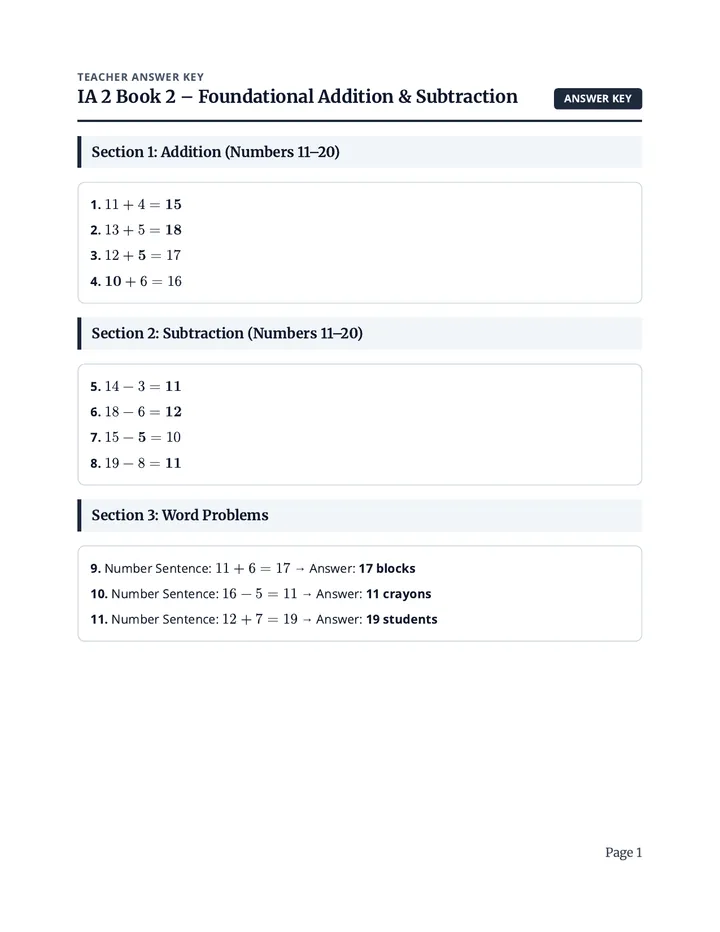
IA 2 Book 2 Foundational Ops Answer Key Teacher Answer Key
IA 2 Book 2 – Foundational Addition & Subtraction
ANSWER KEY
Section 1: Addition (Numbers 11–20)
1. \(11 + 4 = \mathbf{15}\)
2. \(13 + 5 = \mathbf{18}\)
3. \(12 + \mathbf{5} = 17\)
4. \(\mathbf{10} + 6 = 16\)
Section 2: Subtraction (Numbers 11–20)
5. \(14 - 3 = \mathbf{11}\)
6. \(18 - 6 = \mathbf{12}\)
7. \(15 - \mathbf{5} = 10\)
8. \(19 - 8 = \mathbf{11}\)
Section 3: Word Problems
9. Number Sentence: \(11 + 6 = 17\) → Answer: 17 blocks
10. Number Sentence: \(16 - 5 = 11\) → Answer: 11 crayons
11. Number Sentence: \(12 + 7 = 19\) → Answer: 19 students
Page 1