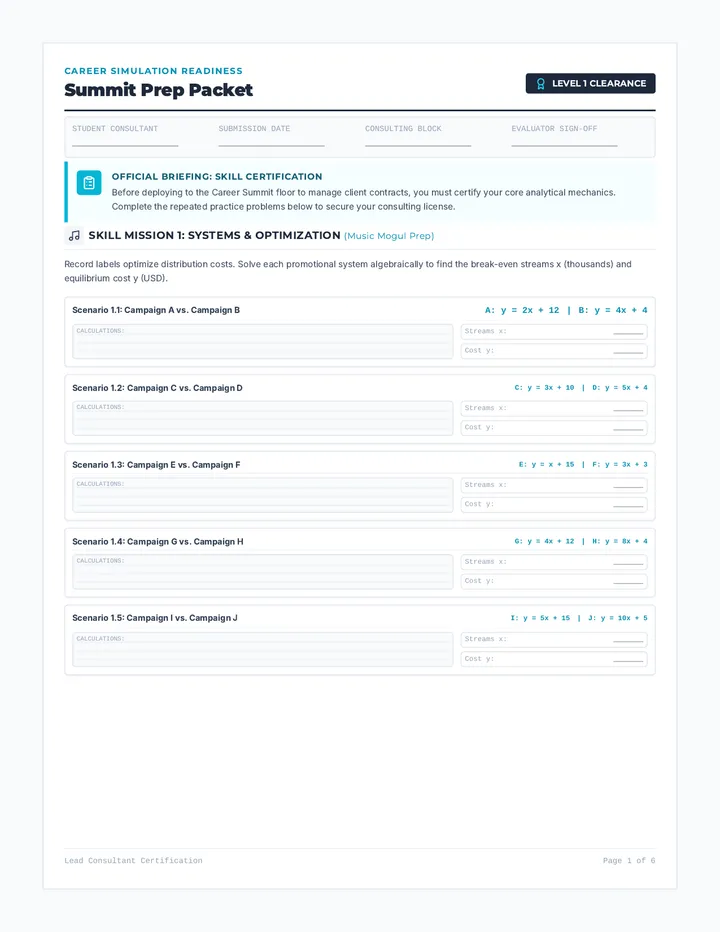
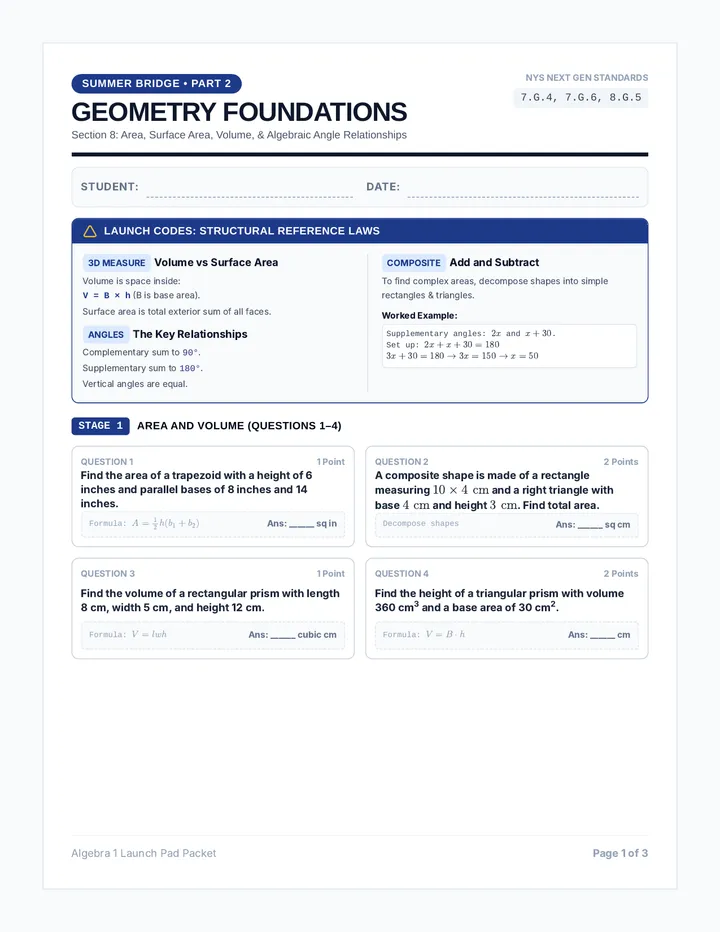
A visual presentation for a Tier 2 intervention on volume of composite solids, featuring step-by-step decomposition, a grain silo case study, and measurement mission instructions.
A set of 10 printable task cards featuring diverse binomial distribution scenarios. Perfect for station activities, group work, or extra practice bank. Includes integrated answer key. Now updated to include Expected Value (E[X]) calculations for every case.
A comprehensive answer key for the task-card edition of the Binomial Breakdown Worksheet, reformatted into individual 1/3-page cards to facilitate separate distribution or physical cutting. Each card provides detailed logic, modern BINOM.DIST syntax, and correctly rendered manual formulas. Updated for density and usability.
A 21-question practice worksheet for 12th-grade statistics, reformatted as a modular task-card bank. Designed with three horizontal cut-lines per page for easy physical division. Covers BINS criteria, spreadsheet formulas (BINOM.DIST), hand-calculation theory, and now includes questions on Expected Value (n*p). Card IDs and questions are aligned 1:1.
A visual presentation accompanying the Binomial Breakdown lesson. Covers BINS criteria, expected value (mean), spreadsheet formula syntax (BINOM.DIST), and the hand-calculation formula connection. Updated with a new slide for expected value (n*p) and improved summary visuals.
A set of 10 printable task cards featuring diverse binomial distribution scenarios. Perfect for station activities, group work, or extra practice bank. Includes integrated answer key.
A visual presentation accompanying the Binomial Breakdown lesson. Covers BINS criteria, spreadsheet formula syntax (BINOM.DIST), and the hand-calculation formula connection. Updated with reliable manual math rendering, corrected tracking, and improved layout stability. Includes a dedicated fill-in-the-blank practice slide.
A 17-question practice worksheet for 12th-grade statistics, reformatted as a modular task-card bank. Designed with three horizontal cut-lines per page for easy physical division. Covers BINS criteria, spreadsheet formulas (BINOM.DIST), and hand-calculation theory with fill-in-the-blank formula components. Updated with improved structured identification grids, reliable math rendering syntax, and integrated cuttable answer key. Card IDs and questions are now aligned 1:1.
Teacher-facing answer key for the summative assessment. Refined to align with the single-column parabola analysis and updated problem layouts.
Teacher-facing answer key for the review worksheet. Updated to match the refined single-column parabola analysis items.
A formal summative assessment with 6 items, evaluating student proficiency in solving quadratic equations through graphing analysis, algebraic factoring, and guided quadratic formula steps. Graphing items feature single-column layouts and explicitly displayed equations. Fixes layout bugs in the formula section.
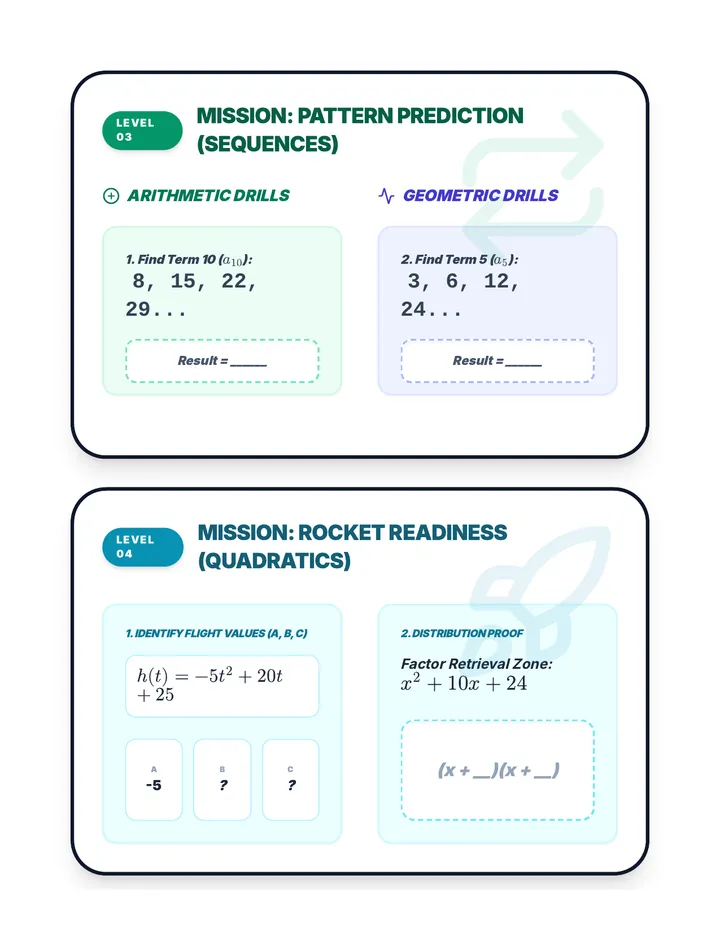
A 12-question comprehensive review worksheet covering quadratic equations via graphing, factoring, and the quadratic formula, styled with a professional 'blueprint' aesthetic. This version features single-column graph layouts, explicitly displayed equations, and refined formula templates.
A teacher answer key for the Study Session worksheet, featuring a completed scatter plot with a positive association and a circled outlier at (12, 45).
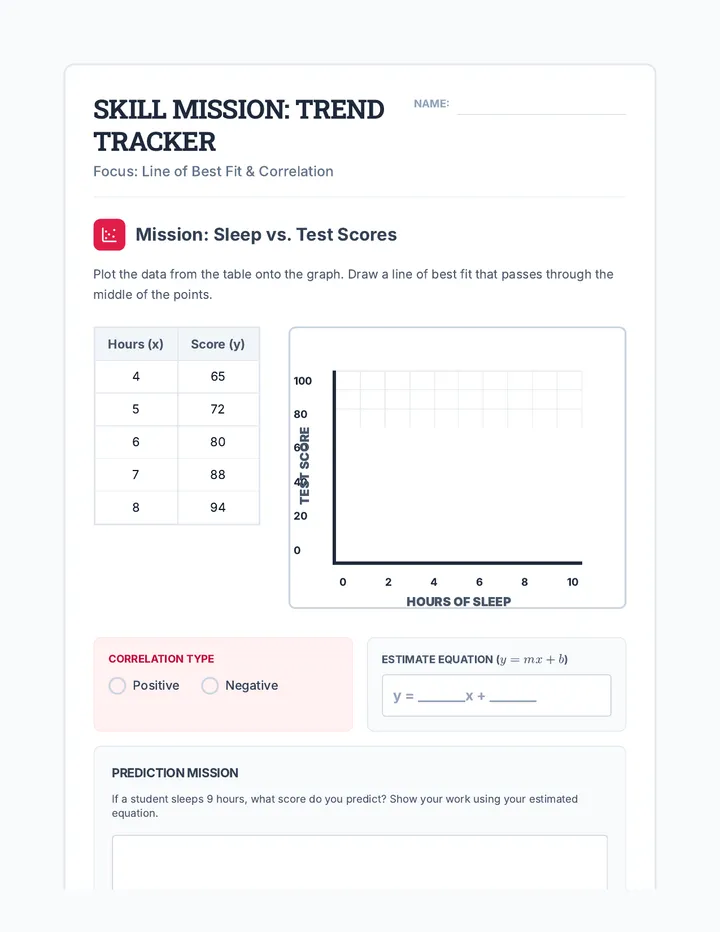
A practice worksheet where students plot bivariate data relating weekly study hours to test scores. It features a positive association and a significant outlier representing high effort but low results.
A teacher answer key for the Screen Scramble worksheet, featuring a completed scatter plot with a negative association and a circled outlier at (7, 120).
A practice worksheet where students plot bivariate data relating daily screen time to physical activity minutes. It features a negative association and a distinct outlier representing high usage and high activity.
A teacher answer key for the Mood Map worksheet, featuring a completed scatter plot with labeled outliers, correct association identification, and sample explanations.
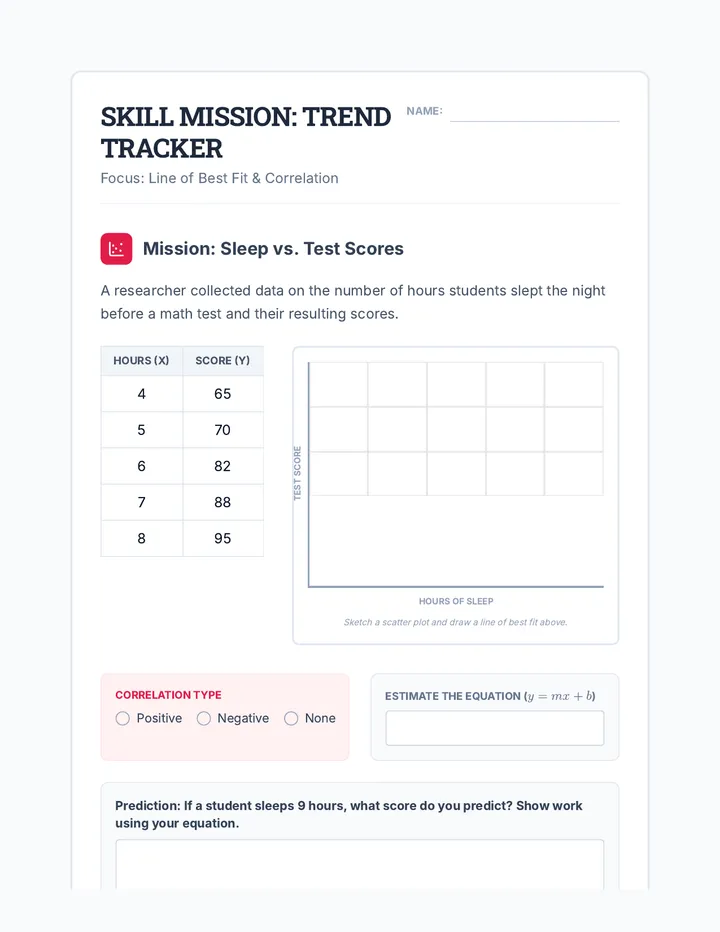
A practice worksheet where students plot bivariate data relating hours of sleep to mood scores. It includes a coordinate grid, a data table with a clear outlier, and analysis questions to identify trends and explain anomalies.
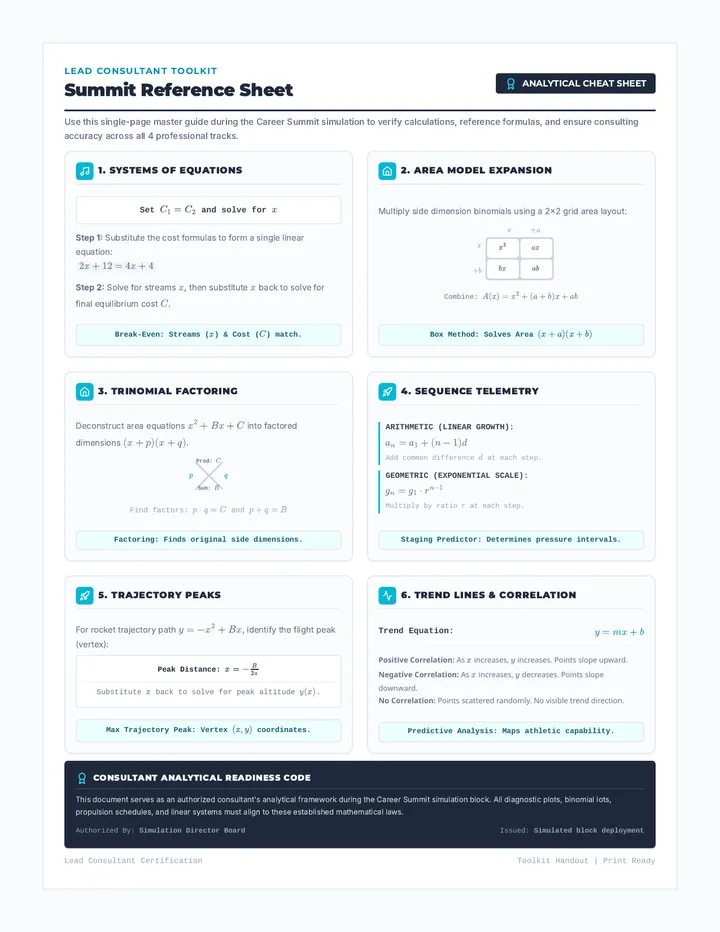
A high-density one-page reference sheet for rational functions. Includes essential steps for finding holes, asymptotes, and intercepts, plus a fully worked complex example.
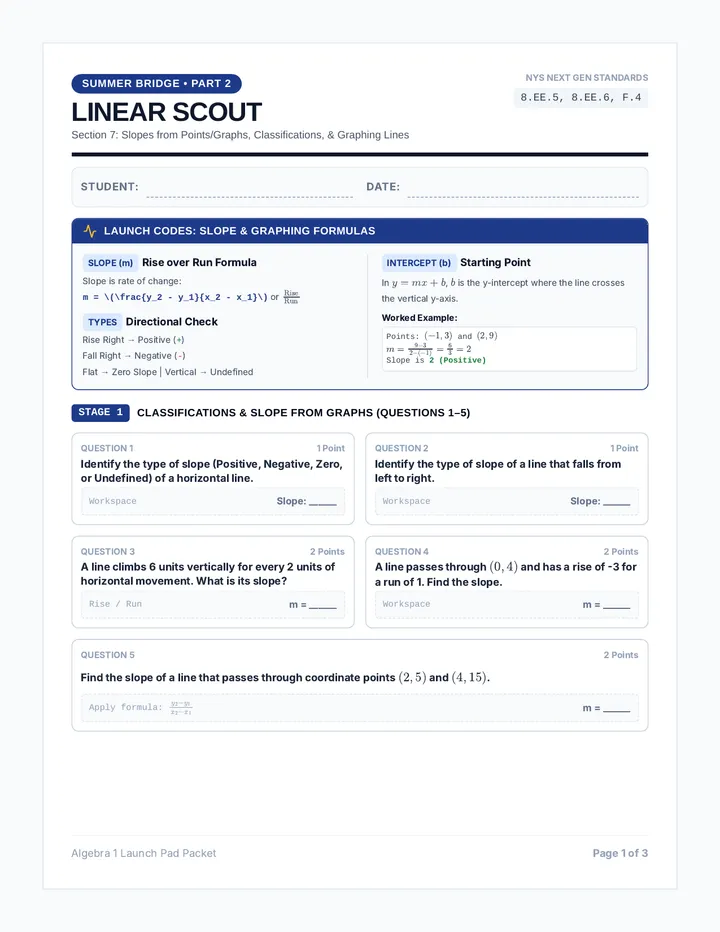
A teacher answer key for the Slope Hunter Expedition Worksheet, providing full step-by-step solutions and interpretations for coordinate calculation, special cases, and real-world modeling.
A student worksheet activity for calculating slope from coordinates, identifying special cases (zero/undefined), and interpreting real-world rates of change with a field-report theme.
Advanced slides for teaching slope as a rate of change, introducing the coordinate-based slope formula, zero and undefined anomalies, and real-world unit analysis. Includes a challenging drone case study.
Answer key for Version B of the Equation Lab Quiz, showing equations and solutions for all 24 problems.
Revised Version B of the Equation Lab Quiz, addressing layout issues, page breaks, and providing more robust student work areas for word problems.
A ticket-themed exit ticket for students to reflect on their learning about fairness, probability, and the Law of Large Numbers following the project.
A data recording sheet for students to use during the Chance Fair, featuring tally sections for wins and losses, calculation areas for experimental probability, and a comparison spectrum.
A project blueprint for students to design their carnival game, define rules, and calculate the theoretical probability of winning before testing begins.
An engaging slide deck introducing theoretical versus experimental probability, the Law of Large Numbers, and the Chance Fair project instructions.
A comprehensive teacher facilitation guide for the Chance Fair project, including learning objectives, materials list, and a step-by-step instructional sequence.
Condensed teacher answer key and instructional guide. Fits all worksheet solutions, notes keys, and pedagogical tips onto a single page for easy reference. Uses full terminology as requested.
Highly scaffolded practice worksheet for angle relationships. Features enlarged work boxes for equations and substitution steps, improved SVG clarity, and high-contrast visual hints for student accessibility.
Comprehensive practice slides for angle relationships. Features 3-step scaffolds (Identify, Equation, Solve) for complementary, supplementary, and vertical angle problems, ensuring "one step per slide" instruction as requested.
Scaffolded guided notes for teaching angle relationships. Includes a word bank with "intersecting", visual cues (L-shape, Line, X), and step-by-step practice problems with enlarged handwriting areas. All definitions fit on the first page.
Answer key for the high-school statistics test, featuring detailed algebraic steps, frequency table summations, and conceptual justifications. Standardized layout for better teacher reference.
A comprehensive high-school level statistics assessment covering central tendency, algebraic solving, frequency tables, and outlier analysis with a professional academic aesthetic. Revised for improved layout and student writing space. Unicode mean symbol used for stability.
Answer key for the Academy Final Evaluation, featuring step-by-step solutions, correct extraction orders, and grading tips for the final assessment. Standardized layout for better teacher reference.
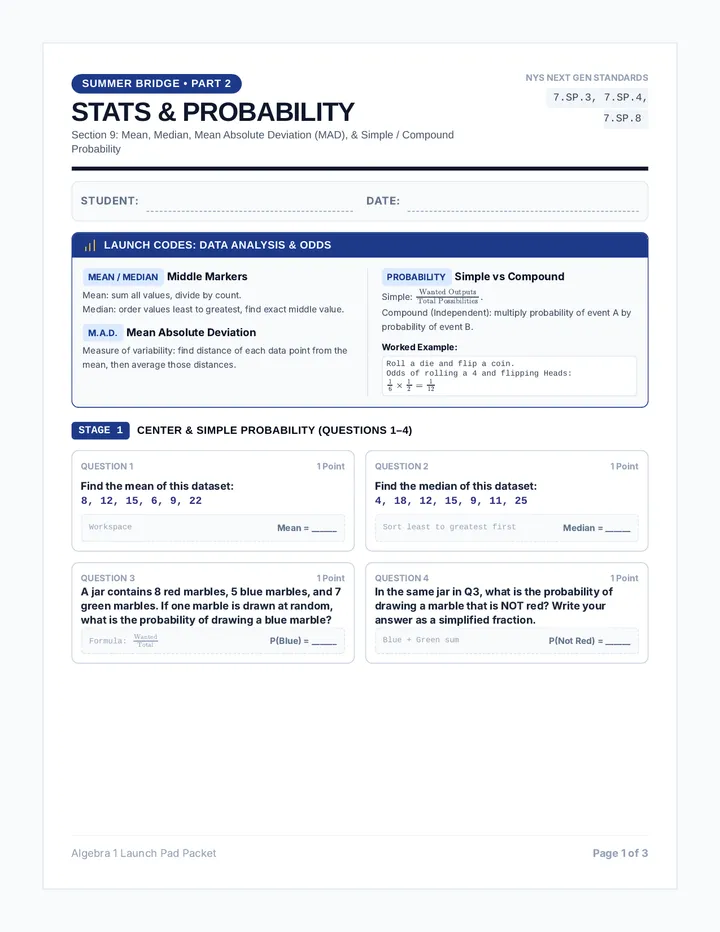
A comprehensive assessment covering Level 1, Level 2, and Level 3 data analysis, designed to evaluate mastery of mean, median, mode, and range in both numerical and narrative contexts. Improved layout for student handwriting.
Updated slide deck for SIFE students that moves beyond the 5/3 example to show halves (3/2), the concept of 'top = bottom' equaling one whole, and multiple number line examples. It maintains high-contrast visuals and minimal text.
A visual anchor chart for SIFE students demonstrating that when the numerator and denominator are the same, the fraction equals one whole. It uses high-contrast models for halves, thirds, and fourths to show the pattern across different denominators.
A visual sorting activity where SIFE students categorize visual fraction models into 'Part' (less than 1), '1 Whole' (exactly 1), and 'More' (greater than 1). The cards use variety in shapes (circles, strips, squares) and denominators (halves, thirds, fourths) to build conceptual understanding beyond a single example.
Answer key for the Mystery Logs worksheet, featuring step-by-step extraction logic, calculations, and analytical verdicts for the narrative problems. Standardized layout for better teacher reference.
A series of narrative-based word problems themed as mystery investigations, requiring students to extract data sets from text and calculate central tendency and range. Standardized layout and improved work areas for better usability.