QUESTION 10 2 Points
Find \(12.5\%\) of \(160\).
Write percent as decimal or fraction first: Ans: ______
Algebra 1 Launch Pad Packet Page 2 of 4
Real World Operations
STAGE 3
QUESTION 11 2 Points
Evaluate: \(\frac{2}{3} \times (1.5 - \frac{3}{4})\)
Workspace
Ans: ________________
QUESTION 12 2 Points
Evaluate: \(-0.8 \div \frac{4}{5} - \frac{1}{2}\)
Workspace
Ans: ________________
QUESTION 13 2 Points
A jacket is originally priced at \$84.00. It is on sale for \(25\%\) off. If the NYS sales tax rate is \(8\%\), what is the final price of the jacket including tax?
Workspace
Final Price: \$________________
QUESTION 14 2 Points
A recipe for pancake batter requires \(2\frac{1}{2}\) cups of flour. If Sarah wants to make only \(\frac{3}{4}\) of the recipe size, how many cups of flour should she use?
Workspace
Flour: ________________ cups
QUESTION 15 2 Points
Max's bank balance was \$45.50. He deposited \(3\) checks of \$18.75 each, and then withdrew \$60.00. What is his new bank balance?
Workspace
Balance: \$________________
Algebra 1 Launch Pad Packet Page 3 of 4
Boss Level
BOSS FIGHT
CHALLENGE 16 3 Points
Perform the multi-step operation and write the final result as a fraction in simplest form:
\(\left( \frac{5}{6} - 1.25 \right) \div \left( -2\frac{1}{3} \right) + \frac{3}{8}\)
Use a common form (fractions are recommended): Simplest Fraction Ans: ______________
CHALLENGE 17 3 Points
The high temperatures for a 5-day school week in Rochester, NY were: -4.5°C, 2.3°C, -1.8°C, 0.6°C, and -3.1°C. What was the mean daily high temperature, to the nearest hundredth?
Sum the values and divide by 5: Mean: ______________ °C
CHALLENGE 18 3 Points
An investment account of \$1,200 grew by \(15\%\) in year 1. In year 2, the new balance decreased by \(10\%\). Is the final balance higher or lower than the original \$1,200, and by what exact dollar amount?
Calculate year 1, then use that result for year 2: Result: Higher/Lower by $______________
Section 2 Complete!
Page 4 of 4
STAGE 3
QUESTION 11 2 Points
Translate the verbal phrase into an algebraic expression:
"Four less than three times a number, x"
Watch for "less than" order flip!
Expression: ________________
QUESTION 12 2 Points
Translate the verbal phrase into an algebraic expression:
"The product of negative five and the sum of a number, y, and eight"
Parentheses are required for sums.
Expression: ________________
QUESTION 13 2 Points
Write an algebraic expression representing the perimeter of a rectangle with a width of x and a length of \(2x - 3\). Simplify the expression completely.
Formula: \(P = 2L + 2W\)
Simplified: ________________
QUESTION 14 2 Points
Write an expression to represent the total cost of buying s shirts for \$15 each and p pairs of pants for \$32 each, plus a shipping fee of \$6.50.
Workspace
Expression: ________________
QUESTION 15 2 Points
Simplify the following expression completely:
\(4(x + 2) - 3(2x - 1) + 2x\)
Watch out for signs!
Simplest Form: ________________
Algebra 1 Launch Pad Packet Page 3 of 4
Boss Level
BOSS FIGHT
CHALLENGE 16 3 Points
Simplify the following expression completely by distributing and combining like terms:
\(-\frac{1}{2}(12x - 8) - \frac{2}{3}(9x - 15) + \frac{1}{4}(16x + 24)\)
Distribute fraction elements carefully: Simplified Expression: ______________
CHALLENGE 17 3 Points
Write an algebraic expression that represents the area of a trapezoid with height h = 4x, and bases b_1 = 3x - 2 and b_2 = x + 6. Simplify the final expression completely.
Formula: \(A = \frac{1}{2}h(b_1 + b_2)\) Area Expression: ______________
CHALLENGE 18 3 Points
If \(x = -2\) and \(y = -3\), evaluate the complex expression:
\(\frac{-3x^3 + 2y^2}{4xy + 14}\)
Substitute, solve numerator and denominator separately: Value: ______________
Section 3 Complete!
Page 4 of 4
Solve: \(5x + 9 = 2x - 12\)
Workspace
x = ________________
QUESTION 12 2 Points
Solve: \(-3(2y - 4) = 18\)
Workspace
y = ________________
QUESTION 13 2 Points
Solve: \(4(w - 2) = 2(w + 5)\)
Workspace
w = ________________
QUESTION 14 2 Points
Solve: \(15 - 2p = 5p + 39\)
Workspace
p = ________________
QUESTION 15 2 Points
Solve: \(3(x - 5) - x = -23\)
Workspace
x = ________________
Algebra 1 Launch Pad Packet Page 3 of 4
Literal & Advanced Solving
STAGE 4
QUESTION 16 2 Points
Solve: \(\frac{2}{3}(6x - 9) = 3(x + 4) - 20\)
Workspace x = ______________
QUESTION 17 2 Points
Solve: \(12.5 - 2.5y = -3.5y - 7.5\)
Workspace y = ______________
QUESTION 18 2 Points
Solve: \(\frac{3}{4}(12a - 8) = -2(2a - 5) - 3\)
Workspace a = ______________
QUESTION 19 (Literal Equation) 2 Points
Solve the literal equation for the variable w:
\(P = 2l + 2w\)
Isolate the variable w w = ______________
QUESTION 20 (Real World Application) 2 Points
The total cost of printing summer shirts is represented by the formula \(C = 5.50n + 45\), where \(n\) is the number of shirts. If a school spends \$320, how many shirts did they print?
Set C = 320 and solve for n n = ______________ shirts
Section 4 Complete!
Page 4 of 4
Calculate \(k = \frac{y}{x}\): k = ______
QUESTION 7 2 Points
Write an equation for the proportional relationship in Q6.
Format equation as \(y = kx\): Equation: ______
QUESTION 8 2 Points
State the constant of proportionality for the equation:
\(3y = 15x\)
Isolate y to find k: k = ______
QUESTION 9 2 Points
An elevator climbs 45 floors in 15 seconds. If it climbs at a constant rate, write an equation representing the height in floors (\(y\)) after \(x\) seconds.
Find unit rate \(k\), then construct \(y=kx\): Equation: ______________
QUESTION 10 2 Points
A straight line passes through \((0,0)\) and the point \((4, 28)\). What is the equation of this line?
Calculate the unit rate using \((x, y) \rightarrow \frac{y}{x}\): Equation: ______
Algebra 1 Launch Pad Packet Page 2 of 3
Graphs & Applications
STAGE 3
QUESTION 11 2 Points
The point (1, 3.5) lies on a graph representing a proportional relationship. Describe what this point represents in the context of unit rate.
Explain clearly: Ans: _______________________________
QUESTION 12 2 Points
A map has a scale of 2 inches = 75 miles. If two towns are 6.4 inches apart on the map, what is the actual distance between them in miles?
Set up a proportion: ______ miles
QUESTION 13 2 Points
Store A sells a 5-pound bag of flour for \$4.25. Store B sells an 8-pound bag of the same flour for \$6.40. Which store has the better buy, and what is its unit price?
Calculate unit cost for both stores: Better Buy: _________ at \$______/lb
QUESTION 14 2 Points
A pool fills at a constant rate of 12 gallons per minute. How many hours will it take to fill a 1,800-gallon pool?
Find total minutes, then convert to hours: ______ hours
QUESTION 15 3 Points
If \(y\) is directly proportional to \(x\), and \(y = 15\) when \(x = 6\), find the value of \(y\) when \(x = 10\).
Find constant k first: y = ______
Section 5 Complete!
Page 3 of 3
Q4: -\(\frac{10}{3}\) or -3\(\frac{1}{3}\)
Multiply by Reciprocal: \(-\frac{5}{2} \times \frac{4}{3} = -\frac{20}{6} = -\frac{10}{3}\)
Q5: -18.16
Same signs, add with negative: \(-4.26 + (-13.90) = -18.16\)
Q6: 0.054
Negative times negative is positive: \(0.045 \times 1.2 = 0.054\)
Q7: -5.2
Divide decimals: \(15.6 \div (-3) = -5.2\)
Q8: 0.4375, 43.75%
Divide 7 by 16 = 0.4375, then multiply by 100.
Q9: 42%, \(\frac{4}{9}\), \(0.45\), \(\frac{9}{20}\)
Decimals: \(0.42 < 0.444... < 0.450 < 0.452\)
Q10: 20
Convert: \(12.5\% = \frac{1}{8}\). Then \(\frac{1}{8} \times 160 = 20\)
Q11: \(\frac{1}{2}\) or 0.5
Parentheses first: \(\frac{2}{3} \times (1.5 - 0.75) = \frac{2}{3} \times \frac{3}{4} = \frac{1}{2}\)
Q12: -1.5 or -\(\frac{3}{2}\)
Divide first: \(-0.8 \div 0.8 = -1\). Then \(-1 - 0.5 = -1.5\)
Q13: \$68.04
Sale Price: \(84 \times 0.75 = 63\). Taxed Price: \(63 \times 1.08 = \$68.04\)
Q14: 1\(\frac{7}{8}\) cups
Multiply fractions: \(\frac{5}{2} \times \frac{3}{4} = \frac{15}{8} = 1\frac{7}{8}\) cups
Q15: \$41.75
Balance: \(45.50 + 3(18.75) - 60 = 45.50 + 56.25 - 60 = 41.75\)
CHALLENGE 16: \(\frac{13}{24}\)
\(\left(\frac{5}{6} - \frac{5}{4}\right) \div \left(-\frac{7}{3}\right) + \frac{3}{8} = -\frac{5}{12} \times \left(-\frac{3}{7}\right) + \frac{3}{8} = \frac{5}{28} + \frac{3}{8} = \frac{13}{24}\)
CHALLENGE 17: -1.32°C
Sum: \(-6.60\). Divide by 5: \(-6.60 \div 5 = -1.32°C\)
CHALLENGE 18: Higher by \$42
Year 1: \(1200 \times 1.15 = 1380\). Year 2: \(1380 \times 0.90 = \$1242\). \(1242 - 1200 = +42\)
Algebra 1 Launch Pad Keys Page 2 of 4
Section 3 & 4 Answers
SECTION 3
Q1: -19
Q2: -18
Q3: \(15w - 20\)
Q4: \(-12a - 21b\)
Q5: \(15x + 7\)
Q6: \(-3a - 4b\)
Q7: \(-2k + 10\)
Q8: \(6p + 7\)
Q9: \(6(3x - 4)\)
Q10: \(9x - 8\)
Q11: \(3x - 4\)
Q12: \(-5(y + 8)\)
Q13: \(6x - 6\)
Q14: \(15s + 32p + 6.50\)
Q15: \(11\)
CHALLENGE 16: \(-8x + 20\)
Steps: \(-6x + 4 - 6x + 10 + 4x + 6 = -8x + 20\)
CHALLENGE 17: \(8x^2 + 8x\)
Steps: \(A = \frac{1}{2}(4x)((3x-2) + (x+6)) = 2x(4x + 4) = 8x^2 + 8x\)
CHALLENGE 18: \(\frac{21}{19}\) or 1\(\frac{2}{19}\)
Steps: Substitute \(x = -2, y = -3\). Numerator: \(-3(-2)^3 + 2(-3)^2 = 24 + 18 = 42\). Denominator: \(4(-2)(-3) + 14 = 24 + 14 = 38\). \(\frac{42}{38} = \frac{21}{19}\).
SECTION 4
Q1: x = -15
Add 14 to both sides: \(-29 + 14 = -15\)
Q2: y = -12
Divide both sides by -8: \(96 \div -8 = -12\)
Q3: w = 60
Multiply by -5: \(-12 \times -5 = 60\)
Q4: m = -7
Subtract 15: \(3m = -21 \rightarrow m = -7\)
Q5: a = -7
Add 11: \(-4a = 28 \rightarrow a = -7\)
Q6: x = -20
Add 7: \(\frac{x}{4} = -5 \rightarrow x = -20\)
y = -18
Subtract 8: \(\frac{2}{3}y = -12 \rightarrow y = -12 \times \frac{3}{2} = -18\)
Q8: k = -22
Multiply by 3: \(k - 5 = -27 \rightarrow k = -22\)
Q9: a = 4
Add 3.4: \(1.2a = 4.8 \rightarrow a = 4\)
Q10: w = 7
Subtract 8: \(-3w = -21 \rightarrow w = 7\)
Algebra 1 Launch Pad Keys Page 3 of 4
Section 4 & 5 Answers
SECTION 4
Q11: x = -7
Subtract 2x, subtract 9: \(3x = -21 \rightarrow x = -7\)
Q12: y = -1
Distribute: \(-6y + 12 = 18 \rightarrow -6y = 6 \rightarrow y = -1\)
Q13: w = 9
Expand: \(4w - 8 = 2w + 10 \rightarrow 2w = 18 \rightarrow w = 9\)
Q14: p = -24/7 or -3.43
Add 2p, subtract 39: \(-24 = 7p \rightarrow p = -24/7\)
Q15: x = -4
Expand: \(3x - 15 - x = -23 \rightarrow 2x = -8 \rightarrow x = -4\)
Q16: x = 2
Expand: \(4x - 6 = 3x + 12 - 20 \rightarrow 4x - 6 = 3x - 8 \rightarrow x = 2\)
Q17: y = -20
Add 3.5y, subtract 12.5: \(y = -20\)
Q18: a = 1
Expand: \(9a - 6 = -4a + 10 - 3 \rightarrow 13a = 13 \rightarrow a = 1\)
Q19: w = (P - 2l) / 2
Isolate term: \(P - 2l = 2w \rightarrow w = \frac{P - 2l}{2}\)
Q20: n = 50 shirts
Solve: \(320 = 5.5n + 45 \rightarrow 275 = 5.5n \rightarrow n = 50\)
SECTION 5
Q1: \$2.40 / lb
Q2: 1.5 mph
Q3: 48 wpm
Q4: x = 25
Q5: No (\(\frac{250}{6} \neq 45\))
Q6: k = 4.5
Q7: \(y = 4.5x\)
Q8: k = 5
Q9: \(y = 3x\)
Q10: \(y = 7x\)
Q11: Unit rate is 3.5 units of y per 1 unit of x
Q12: 240 actual miles
\(\frac{2}{75} = \frac{6.4}{d} \rightarrow 2d = 480 \rightarrow d = 240\)
Q13: Store B is better (\$0.80/lb vs \$0.85/lb)
Q14: 2.5 hours
\(1800 \div 12 = 150 \text{ mins} = 2.5 \text{ hours}\)
Q15: y = 25
\(k = \frac{15}{6} = 2.5\). Then \(y = 2.5 \times 10 = 25\).
Algebra 1 Launch Pad Keys Page 4 of 4
Identifying Functions
STAGE 2
QUESTION 6 1 Point
Does the following set of ordered pairs represent a function? Explain why or why not.
\(\{(-2, 5), (3, -1), (0, 4), (-2, 8)\}\)
Explanation: Ans: ______
QUESTION 7 1 Point
Does this mapping diagram represent a function? Explain.
X -1 →
2 →
5 →
Y 4
-3
7
Explanation: Ans: ______
QUESTION 8 1 Point
Which of the following tables represents a function? (Every inputs maps to 1 output)
Table A
Table B
Workspace: Choice (A or B): ______
QUESTION 9 1 Point
If the relation \(\{(1, a), (2, 5), (3, -2)\}\) is a function, which of the following values is NOT a possible value for \(a\)?
(A) 5 (B) -2 (C) 0 (D) None of these (all are possible)
Workspace: Choice: ______
QUESTION 10 2 Points
Describe the Vertical Line Test and how it is used to determine if a graph is a function.
Explain in your own words:
Algebra 1 Launch Pad Packet Page 2 of 3
Writing Rules & Equations
STAGE 3
QUESTION 11 2 Points
Write a function rule (equation) that represents the pattern in this input-output table:
Observe constant rate of change
Equation: y = ________________
QUESTION 12 2 Points
Write a function rule (equation) for the following sequence: 5, 9, 13, 17, 21, ... (Let \(x = 1\) represent the first term).
Workspace
Equation: y = ________________
QUESTION 13 2 Points
A taxi ride costs a flat fee of \$3.50 plus \$2.00 per mile driven. Write a function rule where \(C\) is the total cost in dollars, and \(m\) is the number of miles driven.
Workspace
Rule: C = ________________
QUESTION 14 2 Points
Using the taxi ride rule in Q13, what is the total cost of riding in a taxi for 12.5 miles?
Substitute m = 12.5 into rule
Total Cost: \$________________
QUESTION 15 2 Points
A bacteriological culture starts with 100 bacteria and doubles every hour. Write a function rule that represents the total bacteria count (\(B\)) after \(h\) hours.
Observe pattern: 100, 200, 400...
Rule: B = ________________
Section 6 Complete!
Page 3 of 3
QUESTION 10 2 Points
Find the slope of the linear function represented by this table:
Select any two coordinates to calculate rate: m = ______
Algebra 1 Launch Pad Packet Page 2 of 3
Equations & Intercepts
STAGE 3
QUESTION 11 2 Points
Find the y-intercept (\(b\)) of the line that passes through \((0, -3)\) and \((4, 5)\).
Intercept is point where \(x = 0\) b = ________________
QUESTION 12 2 Points
Write the equation of the line in slope-intercept form (\(y = mx + b\)) that has a slope of \(-3\) and passes through coordinate \((0, 7)\).
Identify m and b Equation: ________________
QUESTION 13 2 Points
State the slope (\(m\)) and the y-intercept (\(b\)) of the line represented by the equation:
\(2y - 4x = 12\)
Isolate y to match slope-intercept form first m = ______ b = ______
QUESTION 14 2 Points
Write the equation of the line represented by the coordinates: \((1, 5)\) and \((3, 11)\).
Find m first, then substitute to find b Equation: ________________
QUESTION 15 3 Points
Are the lines represented by \(y = 2x + 5\) and \(2y - 4x = 8\) parallel, perpendicular, or neither? Explain with mathematical justification.
Compare the slopes of both lines: Answer: _______________________
Section 7 Complete!
Page 3 of 3
Formula: \(V = \pi r^2 h\): V = ______ \(\pi\) cu in
QUESTION 8 2 Points
A container shaped like a rectangular prism is filled with water. Its dimensions are \(12 \text{ in} \times 8 \text{ in} \times 10 \text{ in}\). If it is \(\frac{3}{4}\) full, what volume of water is inside?
Find full volume first, then multiply by \(\frac{3}{4}\): V = ______ cu in
Algebra 1 Launch Pad Packet Page 2 of 3
Algebraic Angles
STAGE 3
QUESTION 9 2 Points
Two angles are complementary. One angle measures \(3x + 10\) degrees, and the other measures \(x + 20\) degrees. Write and solve an equation to find the value of \(x\).
Set sum of both expressions equal to 90: x = ________________
QUESTION 10 2 Points
Two angles are supplementary. One angle measures \(5x - 20\) degrees, and the other measures \(2x + 15\) degrees. Find the measure of the smaller angle in degrees.
Set sum equal to 180, solve for x, then substitute back: Smaller Angle = ________________ degrees
QUESTION 11 2 Points
Two intersecting lines form vertical angles measured as \(2x + 45\) and \(4x - 15\) degrees. Find the value of \(x\).
Set expressions equal to each other: x = ________________
QUESTION 12 2 Points
The three interior angles of a triangle are represented by \(2x\), \(3x\), and \(x + 10\) degrees. Find the value of the largest angle in the triangle.
Triangle interior sum is 180 degrees: Largest Angle = ________________ degrees
Section 8 Complete!
Page 3 of 3
Calculate P(Odd) × P(Tails): Probability = ______
QUESTION 8 2 Points
A spinner is divided into 4 equal sectors numbered 1 to 4. If you spin it twice, what is the probability of spinning a number greater than 2 on both spins?
Find P(>2) for Spin 1, and multiply by Spin 2: Probability = ______
Algebra 1 Launch Pad Packet Page 2 of 3
Advanced Probability
STAGE 3
QUESTION 9 2 Points
In a box plot representation, what does the rightmost vertical boundary of the central "box" (the upper quartile or Q3) represent? What percent of the data points lie at or below this value?
Conceptual box plot breakdown: Percent = ________________ %
QUESTION 10 2 Points
A deck has cards numbered 1 to 10. You select one card, keep it out (without replacement), and then select a second card. What is the probability that both cards are prime numbers (2, 3, 5, 7)?
Find P(Prime) for Card 1, and multiply by updated P(Prime) for Card 2: P(Both Prime) = ________________
QUESTION 11 2 Points
Class A has a mean test score of 82 with a MAD of 3. Class B has a mean test score of 82 with a MAD of 8. In which class are the individual scores more consistent? Explain.
Relate MAD to the spread of values: Class: _______________________
QUESTION 12 2 Points
What is the sample space size (total number of possible unique outcomes) if you roll a standard six-sided die, flip a coin, and draw one card from a deck of 52 cards?
Apply the Fundamental Counting Principle (multiply options): Total Outcomes = ________________
Section 9 Complete!
Page 3 of 3
Algebra 1 Launch Pad Packet Page 2 of 3
Exponential & Growth
STAGE 3
QUESTION 8 2 Points
A population of butterflies starts with 50 butterflies and triples every year. This is represented by the exponential rule:
\(P = 50(3)^t\) where \(t\) is time in years. Find the butterfly population after 4 years.
Substitute t = 4: Butterflies = ________________
QUESTION 9 2 Points
Classify each equation as Linear, Quadratic (nonlinear), or Exponential (nonlinear):
Equation 1
\(y = 3x^2 - 5\)
________________
Equation 2
\(y = \frac{2}{3}x + 8\)
________________
Equation 3
\(y = 4(2)^x\)
________________
QUESTION 10 2 Points
Which type of relationship represents a constant additive rate of change, and which type represents a constant multiplicative rate of change? Select the correct terms (Linear vs. Exponential).
Match term to growth behavior: Additive: ___________________ Multiplicative: ___________________
Algebra 1 Preview Complete!
Page 3 of 3
Sum area of rectangle (\(lw\)) and triangle (\(\frac{1}{2}bh\)).
Workspace: Code 8: ____________ sq cm
Algebra 1 Launch Pad Packet Page 2 of 3
Launch Overrides
GATE 9: STELLAR CODES 10 Points
Decrypt the shared system coordinate solution to unlock sector 9. The coordinate's \(y\) value is the code:
\(2x + y = 12\)
\(y = 4x\)
Substitute y = 4x into the first equation, solve for x, then find y.
Code 9 (y value): ______
GATE 10: ALGEBRA MASTER 10 Points
Find the value of \(x\) that satisfies this algebraic inequality. The positive integer boundary is code 10:
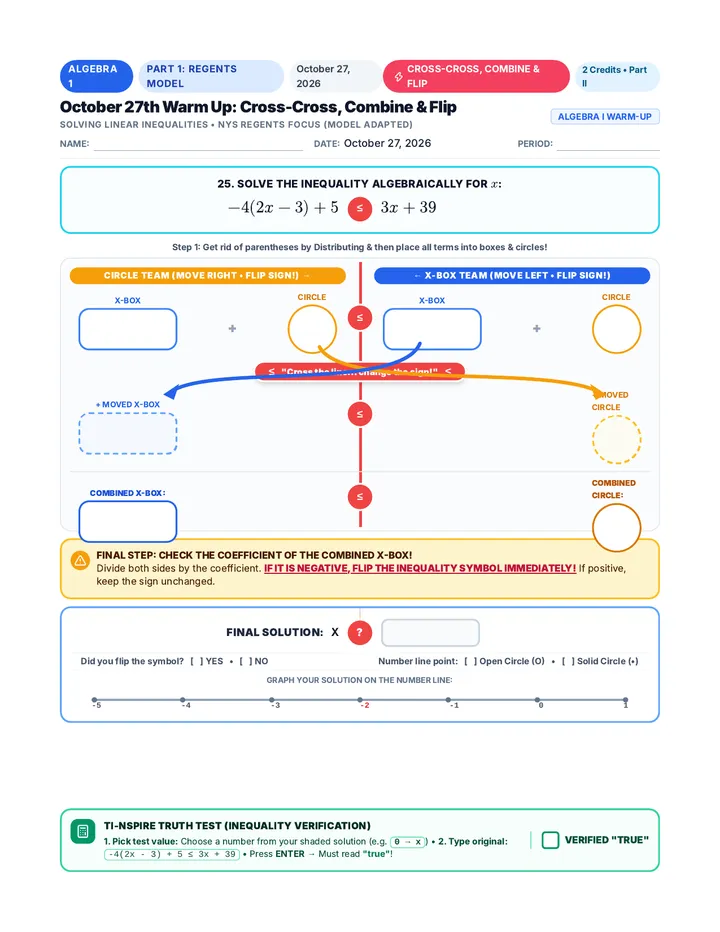
\(-2(3x - 4) \ge -16\)
Distribute carefully, isolate x. Don't forget to flip inequality when dividing by negative!
Code 10: x ≤ ______
Gate 1: _______
Gate 2: _______
Gate 3: _______
Gate 4: _______
Gate 5: _______
Gate 6: _______
Gate 7: _______
Gate 8: _______
Gate 9: _______
Gate 10: _______
Calculate your score: Each bypass code is worth 10 points. Sum the bypassed points to identify your state of readiness.
90–100 Points Algebra 1 Ready
80–89 Points Almost Ready
70–79 Points Keep Practicing
Below 70 Points Review Key Skills
Mission Operations Complete!
Page 3 of 3
\(V_{\text{full}} = 12 \times 8 \times 10 = 960\). \(960 \times \frac{3}{4} = 720\)
Q9: x = 15
\(3x+10+x+20 = 90 \rightarrow 4x+30 = 90 \rightarrow x = 15\)
Q10: 65 degrees
\(7x-5=180 \rightarrow x=25\). Angles: \(105°\) and \(65°\).
Q11: x = 30
\(2x+45 = 4x-15 \rightarrow 60 = 2x \rightarrow x = 30\)
Q12: 85 degrees
\(6x+10=180 \rightarrow x=28.3\). Wait, \(2(28.3)=56.6, 3(28.3)=85\).
SECTION 9
Q1: 12 (Sum = 72. Divide by 6 = 12)
Q2: 12 (Sorted: 4, 9, 11, 12, 15, 18, 25)
Q3: \(\frac{1}{4}\) (5/20 = 1/4)
Q4: \(\frac{3}{5}\) (12/20 = 3/5)
Q5: 2.4 (Distances: 4, 2, 4, 0, 2. Average = 12/5 = 2.4)
Q6: Smaller MAD indicates data is more grouped & consistent.
Q7: \(\frac{1}{4}\) (\(\frac{3}{6} \times \frac{1}{2} = \frac{1}{4}\))
Q8: \(\frac{1}{4}\) (\(\frac{2}{4} \times \frac{2}{4} = \frac{1}{4}\))
Q9: Represents upper quartile (Q3). 75% of values are below.
Q10: \(\frac{2}{15}\) (\(\frac{4}{10} \times \frac{3}{9} = \frac{12}{90} = \frac{2}{15}\))
Q11: Class A (Smaller MAD value means closer to mean).
Q12: 624 (\(6 \times 2 \times 52 = 624\))
Algebra 1 Launch Pad Keys Page 2 of 4
Section 10 Answers
SECTION 10
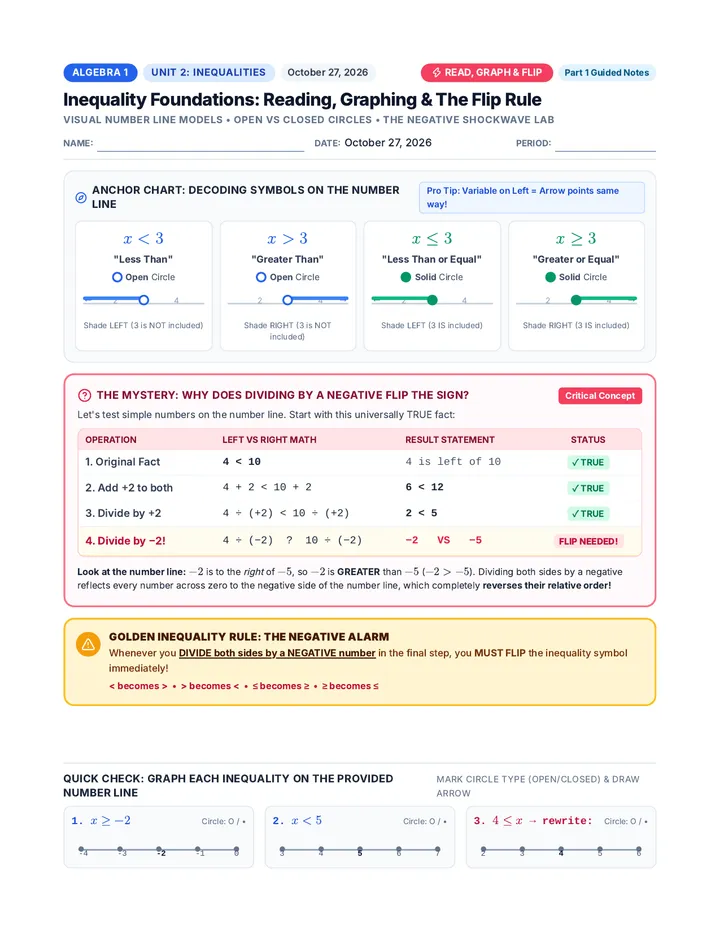
Q1: x ≤ 6
Subtract 7: \(2x \le 12 \rightarrow x \le 6\)
Q2: x > -5
Add 5: \(-3x < 15 \rightarrow\) Divide by -3 and flip the inequality sign: \(x > -5\)
Q3: x ≤ -9
Expand: \(5x - 10 \ge 3x + 8 \rightarrow 2x \ge 18 \rightarrow x \ge 9\). (Wait, in workbook: \(5(x - 2) \ge 3x + 8\). Yes, \(2x \ge 18 \rightarrow x \ge 9\))
Q4: No
Substitute \(x = -5\): \(-4(-5) + 2 = 20 + 2 = 22\). Is \(22 \le 18\)? No, false statement.
Q5: (3, 8)
Substitute: \(2x + (3x - 1) = 14 \rightarrow 5x - 1 = 14 \rightarrow 5x = 15 \rightarrow x = 3\). Then \(y = 3(3) - 1 = 8\).
Q6: (7, 3)
Add equations: \(2x = 14 \rightarrow x = 7\). Then \(7 + y = 10 \rightarrow y = 3\).
Q7: Yes
Eq 1: \(5 = 2(2) + 1\) (True). Eq 2: \(3(2) + 5 = 11\) (True). Since it works in both, it is a valid solution.
Q8: 4,050 butterflies
Solve: \(P = 50(3)^4 = 50(81) = 4,050\)
Q9 & Q10: See rules
Q9: Eq 1 is Quadratic (Nonlinear), Eq 2 is Linear, Eq 3 is Exponential (Nonlinear). Q10: Additive is Linear; Multiplicative is Exponential.
Algebra 1 Launch Pad Keys Page 3 of 4
Mission Overrides
BYPASS CODES
GATE 1 CODE: -47
\(-12 + (-20) - 15 = -47\)
GATE 2 CODE: 4
Substitute \(x = 6\): \(y = -3(6) + 22 = -18 + 22 = 4\)
GATE 3 CODE: 9
Unit rate is 4 units of thrust per liter. \(36 \div 4 = 9 \text{ liters}\).
GATE 4 CODE: -22
Simplified expression: \(2x - 16\). Substituting \(x = -3 \rightarrow 2(-3) - 16 = -22\)
GATE 5 CODE: 3
Rise over Run: \(\frac{10 - (-8)}{1 - (-5)} = \frac{18}{6} = 3\)
GATE 6 CODE: 16
\(6w - 12 = 4w + 20 \rightarrow 2w = 32 \rightarrow w = 16\)
GATE 7 CODE: 20
\(45 + 85 + 2x + 10 = 180 \rightarrow 2x + 140 = 180 \rightarrow 2x = 40 \rightarrow x = 20\)
GATE 8 CODE: 52
Rectangle area: \(40\). Triangle area: \(\frac{1}{2}(4)(6) = 12\). Total: \(52\)
GATE 9 CODE: 8
\(2x + (4x) = 12 \rightarrow 6x = 12 \rightarrow x = 2\). Then \(y = 4(2) = 8\).
GATE 10 CODE: 4
Divide by -2 and flip: \(3x - 4 \le 8 \rightarrow 3x \le 12 \rightarrow x \le 4\).
Algebra 1 Launch Pad Keys Page 4 of 4