Ten Friends Lesson Plan
Grade 1 Mathematics Operations & Algebraic Thinking
Ten Friends: Making 10 to Add
Visualizing complementary pairs to ten using double-sided counters and ten-frames.
Duration: 60 Minutes
Setting: Whole + Stations
CCSS: 1.OA.C.6
Learning Objectives & "I Can" Statements
- • Compose 10: Students can find the number that makes 10 when added to any given number from 1 to 9.
- • Visual Modeling: Students can accurately represent number pairs using a ten-frame and write corresponding addition sentences (e.g., 7 + 3 = 10).
- • "I Can": "I can quickly find the partner that joins my number to fill a whole ten-frame."
Key Vocabulary
Ten-Frame: A 2×5 grid used to anchor numbers to 5 and 10.
Ten-Friend: Two addends that combine together to equal 10.
Addend & Sum: The parts being combined, and the total whole.
Number Bond: A visual model showing part-part-whole.
Materials & Manipulatives: Demonstration magnetic ten-frame & counters, student desk ten-frames (1 per student), 10 red/yellow two-color counters per student, dry-erase sleeves.
PHASE 1
Warm-Up & Hook: The Missing Friend Mystery (10 Mins)
Whole Group Rug
Quick-Look Flash: Flash a giant ten-frame showing 6 red dots for 3 seconds, then cover it. Ask: "How many dots did you see? How many empty spaces did you notice?"
Teacher Script: "Mathematicians, our ten-frame is like a bus with exactly 10 seats! Today, 6 friends got on the bus. How many empty seats are waiting for a buddy so the bus can roll? Turn and whisper to your elbow partner... Yes! 4! Because 6 and 4 are Ten Friends!"
Student Routine: Flash fingers (e.g., student flashes 6 fingers, partner shows 4 fingers to complete 10).
Check for Understanding: Ensure students count blank squares without having to recount the filled squares from 1.
PHASE 2
Direct Instruction: Visualizing Ten-Pairs ("I Do") (15 Mins)
Explicit Modeling
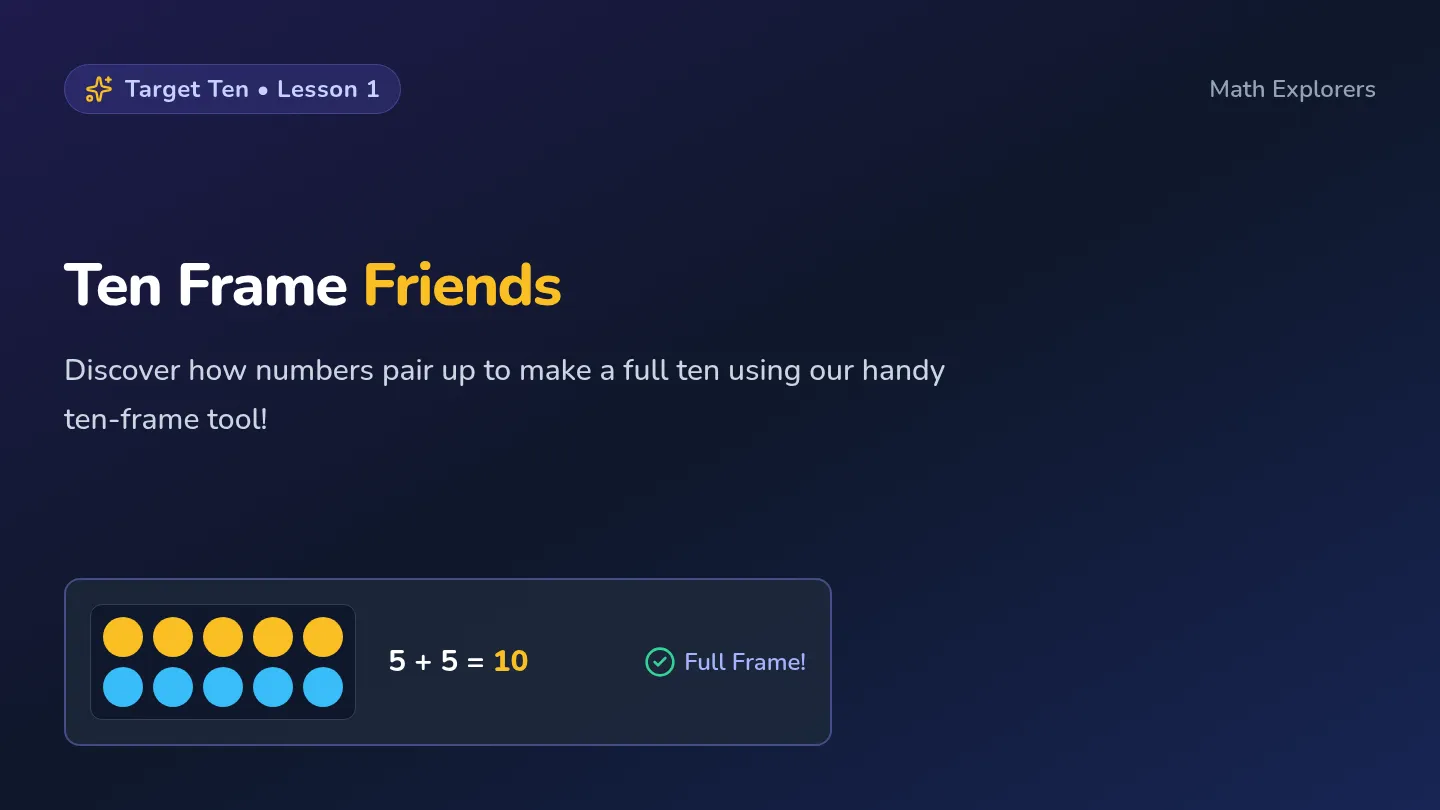
Step 1: Anchor to 5. Place 5 red counters filling the top row. "Notice the entire top row is full! That's 5. If we fill the bottom row with 5 yellow counters, we make a complete 10. So 5 + 5 = 10."
Step 2: Systematic Pair Decomposition. Demonstrate shifting from left to right:
9 + 1 = 10
9 red, 1 yellow
8 + 2 = 10
8 red, 2 yellow
7 + 3 = 10
7 red, 3 yellow
6 + 4 = 10
6 red, 4 yellow
5 + 5 = 10
5 red, 5 yellow
Key Insight (Commutative Property): Show that turning the board upside-down or swapping colors gives the turnaround fact: "If 7 and 3 make 10, then 3 and 7 also make 10! The friends just swapped sides!"
Grade 1 Math • Operations & Algebraic Thinking Page 1 of 2
Ten Friends: Guided Practice, Stations & Assessment
Instructional Delivery Plan
PHASE 3
Guided Practice: Partner Ten-Frame Flash ("We Do") (15 Mins)
Desk Partners
Interactive Partner Protocol: Partner A places any number of red counters on their desk ten-frame (e.g., 8). Partner B immediately fills the rest with yellow counters and announces: "8 needs 2 to make 10!" Both partners record the equation on their personal whiteboard: 8 + 2 = 10.
Teacher Guiding Questions:
- "Did you need to count the yellow counters one by one, or did you see the group of 2?"
- "How does knowing 5 + 5 = 10 help you solve 6 + ___ = 10?"
Formative Teacher Walkabout:
Carry a clipboard checklist. Note students who count empty boxes by 1s versus students who use perceptual subitizing (recognizing groups instantly).
PHASE 4
Independent Stations & Centers ("You Do") (15 Mins)
3 Rotational Centers
A Shake & Spill 10
Put 10 two-color counters in a cup, shake, and spill. Sort by color onto a ten-frame and write the number bond and addition sentence on the recording sheet.
Manipulatives: Cups & Counters
B Ten-Friend Memory
Card matching game: Students flip two cards facing down (cards show numbers 0-10 or ten-frame visuals). If the sum is exactly 10 (e.g., 3 and 7), keep the pair!
Manipulatives: 10-Pair Cards
C Rainbow 10 Builder
Students slide beads on a 10-bead Rekenrek or color a rainbow chart connecting 0 to 10, 1 to 9, 2 to 8, etc., creating their visual reference anchor strip.
Manipulatives: Rekenreks / Crayons
Targeted Differentiation Strategies
Support / Tier 2: Use physical egg cartons with 10 slots and large colored plastic balls. Restrict to anchoring from 5 first (e.g., 5 + 5, then 6 + 4).
Extension / Advanced: Introduce missing addend word problems: "Maya has 7 markers in her box. The box holds 10. How many are missing?" Challenge with three addends: \( 4 + 2 + \_\_ = 10 \).
English Language Learners: Use sentence frames: "I have [number]. I need [number] more to make 10." Provide tactile visual gesture cards.
Common Misconceptions
• Double Counting 10: Students include 10 itself as a pair partner (thinking 10 + 1 = 10 instead of 10 + 0 = 10).
• Recounting from One: Students recount all filled counters from 1 rather than subitizing or continuing from the known part.
PHASE 5
Debrief & Exit Ticket Assessment (5 Mins)
Exit Check
Individual Exit Ticket ("Show-Me Slip"):
Distribute half-slips showing a printed ten-frame with 4 filled stars and the prompt:
1. Draw circles to fill the empty spaces.
2. Complete the number sentence: 4 + ___ = 10
Quick Mastery Rubric:
Mastery (3): Draws 6 circles instantly; writes 4 + 6 = 10 correctly without hesitation.
Approaching (2): Correct answer (6) but counts each empty space one by one on fingers.
Needs Support (1): Writes incorrect addend or miscounts spaces; pull for Tier 2 small group.
Grade 1 Math • Operations & Algebraic Thinking Page 2 of 2