Tape Splitter Slides
Grade 3 Math • Multiplication Strategies Tape Diagram Series
Tape Splitter
Breaking Big Multiplication Facts into Friendly Facts Using Tape Diagrams
4
4
4
4
4
= Friendly Facts!
Distributive Property in Action Slide 1 of 10
1
The Big Math Secret
Why Split Numbers?
Tricky Multiplication Fact
7 × 6 = ?
Seven groups of six can feel big and hard to remember right away.
The Distributive Fix!
(5 × 6) + (2 × 6)
Break 7 into friendly numbers: 5 and 2! Fives and twos are easy to count.
Distributive Property: You can break apart a multiplication fact into smaller facts, solve each part, and add the answers together!
2
Meet the Tape Diagram
Visual Math Tool
A tape diagram is a bar divided into equal parts that helps us "see" multiplication.
Example: 4 groups of 5 (4 × 5) 4 equal boxes
5 1 group
5 2 groups
5 3 groups
5 4 groups
Total Length = 20
Each box has the same number. Count the boxes to find the number of groups!
3
Our Challenge Fact: 7 × 4
Step 1: Draw the Whole Tape
Problem: 7 × 4 = ?
This means: 7 groups of 4
Number of boxes 7 boxes of 4
Full Tape (One Big Bar of 7 Parts):
4
4
4
4
4
4
4
7 is tricky! What if we split this long tape into two friendlier pieces?
Next slide: We are going to cut this tape in a very smart spot!
4
Snap! Split 7 into 5 and 2
Step 2: Split the Tape
We break 7 into friendly numbers: 5 + 2
7 = 5 + 2
4
4
4
4
4
SPLIT
4
4
5 groups of 4
5 × 4
2 groups of 4
2 × 4
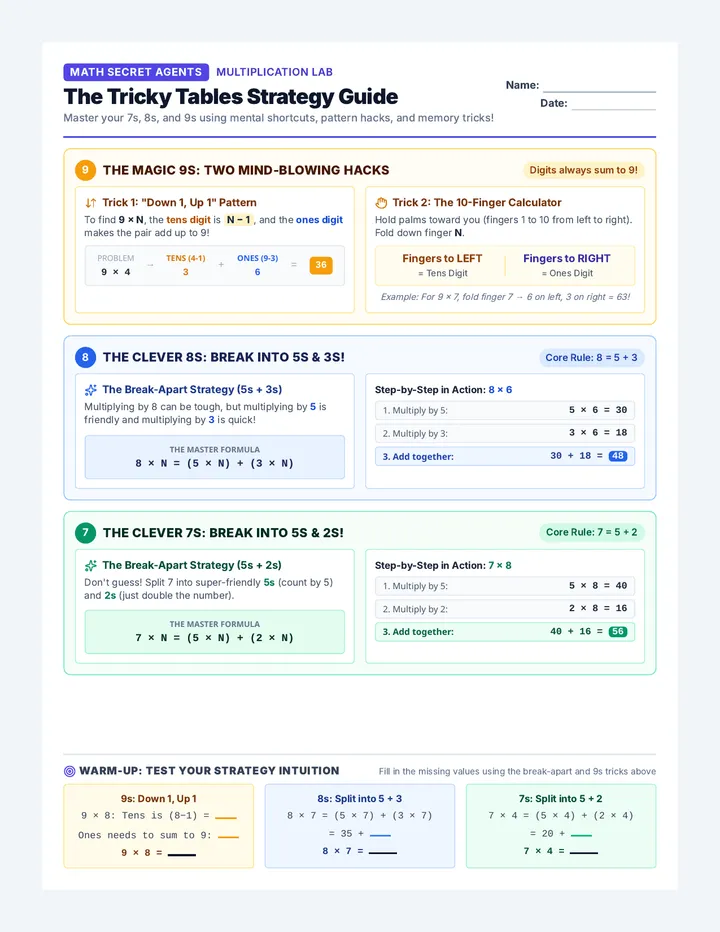
Why 5? Because counting by 5s is fast: 5, 10, 15, 20!
5
Multiply Each Part & Add
Step 3: Combine
First Friendly Part A
5 × 4 = 20
5 groups of 4 equals 20.
Second Friendly Part B
2 × 4 = 8
2 groups of 4 equals 8.
Now add the two parts:
20 + 8 = 28
So that means: 7 × 4 = 28
We solved 7 × 4 without guessing or counting on fingers!
6
The 3-Step Tape Strategy
Summary Rule
1
Spot Tough Factor
Find the factor that feels hard (like 6, 7, 8, or 9). Draw a tape diagram with that many boxes.
Example: 7 boxes of 4
2
Snap into Friendly
Split the boxes into friendly numbers you love, like 5s, 2s, or equal doubles!
7 splits into 5 and 2
3
Multiply & Add
Multiply both friendly parts separately. Then add the two answers together for the total!
20 + 8 = 28
Remember: Any factor can be broken apart as long as the parts add up to the original!
7
Another Way: Splitting with Doubles
Challenge: 8 × 6
Can we split 8 in half into 4 + 4? Yes! Doubles Strategy
6
6
6
6
HALF
6
6
6
6
4 groups of 6
4 × 6 = 24
4 groups of 6
4 × 6 = 24
Double 24: 24 + 24 = 48 8 × 6 = 48
Even numbers like 4, 6, and 8 love to be split into equal halves!
8
Your Turn: Break Apart 9 × 3
Let's Try It!
How can we split 9 into friendly numbers?
Hint: 9 = 5 + 4
3
3
3
3
3
3
3
3
3
Part 1 5 × 3 = 15
Part 2 4 × 3 = 12
Add Together 15 + 12 = 27
Check: Does 9 × 3 = 27? Yes, 27!
You Have the Tape Splitter Superpower!
Mathematician's Toolkit
Key Takeaways
- Tape diagrams show the number of groups and the size of each group clearly.
- Distributive property means splitting one factor into smaller friendly pieces.
- Always multiply both parts before adding them back together!
Favorite friendly splits: 5s, 2s, and Doubles!
Never Get Stuck Again!
When a fact looks tough, grab your pencil, sketch a tape diagram, snap it into friendly parts, and conquer the problem!
Ready for practice?
You are now a Distributive Master!
Grade 3 Distributive Property with Tape Diagrams Great job, Mathematicians!