A 7-slide presentation for the 'Strategy Showdown' lesson, including a brain warm-up, embedded YouTube video for doubling/halving, a main math talk activity, and a strategy comparison/voting slide.
A student-facing record sheet for the math review game. Provides organized, light-colored workspaces for each Common Core domain, a score tally area, and extra scratch space for multi-step calculations.
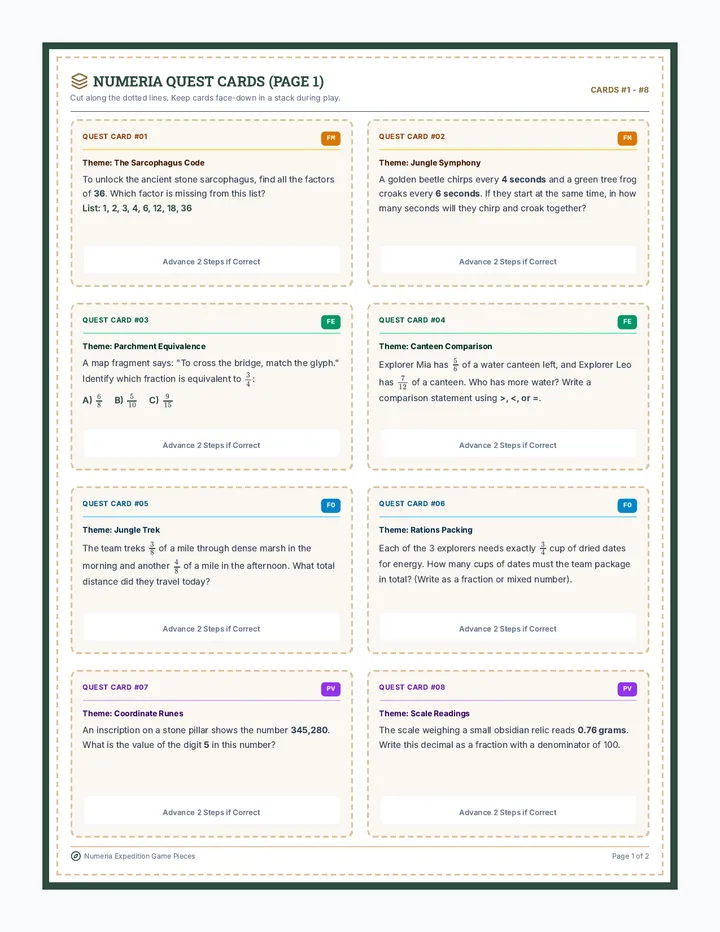
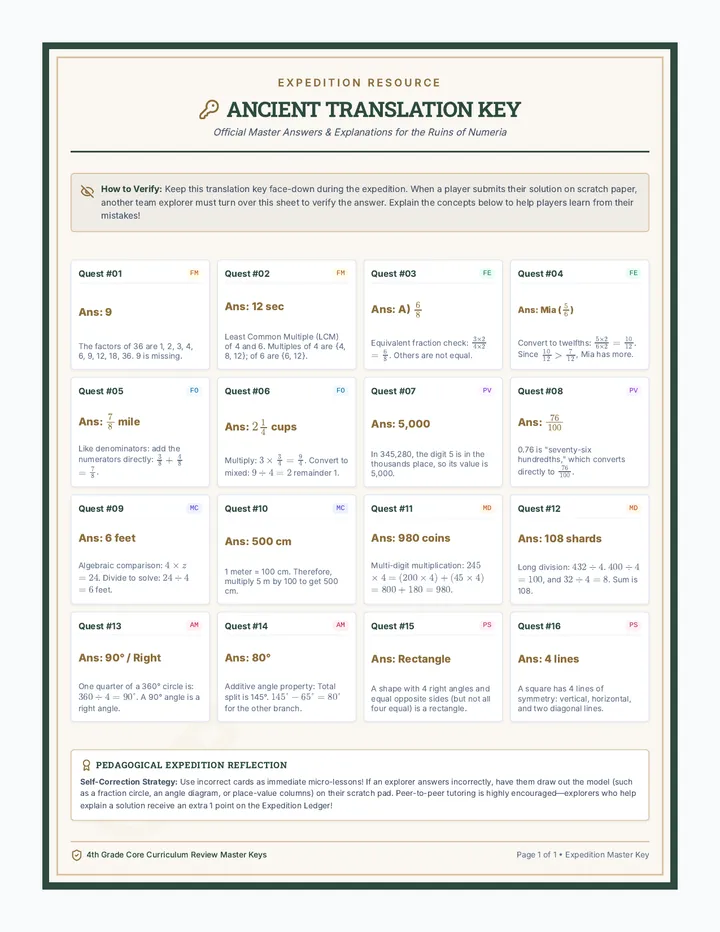
A comprehensive facilitation guide for the 4th-grade math review game. Includes a full answer key, rules of play, and a Slide Map to help teachers navigate the presentation deck manually.
A comprehensive teacher guide for the "Data Detectives" lesson. Includes lesson objectives, a detailed pacing guide, instructional strategies for slides and activities, common misconceptions, and differentiation tips for supporting and challenging students. Revised to fix layout, spacing, and page break issues.
An arcade-themed 4th-grade math review slide deck in a Jeopardy-style format. Features 25 questions across 5 Common Core domains with hidden answer slides for high-energy classroom review. Includes slide number indicators for easier manual navigation.
A hands-on sorting activity for measures of center. Students calculate the mean for 12 data cards (Case Files) and sort them into folders based on their values. Includes workspace for calculations and a thematic detective-inspired sorting mat. Revised to fix page breaks and student work area layout.
A thematic vocabulary reference sheet for measures of center. Includes clear definitions and "Investigation Tips" for mean, median, mode, and range, along with a dossier of supplementary statistical terms like outliers, distribution, and skewed data. Revised to fix page breaks and include more terms.
An introductory slide deck for the Decimal Dash lesson, featuring visual representations of tenths and hundredths, game rules, and real-world money connections.
A decimal shading game where students use paperclip spinners to determine tenths and hundredths, then represent the total on a 10x10 grid.
A competitive 10-sided dice game where students build decimals to the hundredths place and compare them using mathematical symbols.
A comprehensive teacher guide for the Decimal Dash game set, including setup instructions, standard alignments, common misconceptions, and differentiation strategies.
Complete 2-page answer key for Version B of the One-Step Equation Challenge, featuring 24 solutions with inverse operations shown and emerald green styling to match the student worksheet.
Version B of the One-Step Equation Challenge worksheet, featuring 24 new addition and subtraction problems involving whole numbers, decimals, and fractions, including two word problems. It maintains the same structure and difficulty as Version A but with emerald green accents for differentiation.
Answer key for Version B of the Equation Lab Quiz, showing equations and solutions for all 24 problems.
Revised Version B of the Equation Lab Quiz, addressing layout issues, page breaks, and providing more robust student work areas for word problems.
Revised Answer Key for Test B with streamlined grid layout (1-10 in col 1, 11-20 in col 2), improved text contrast, and refined grading summary. Provides quick reference for all 20 questions.
Revised 20-question Test B with improved spacing for student work, consistent question distribution (7-7-6), and fixed formatting to prevent diagram overlap. Includes visual modeling and word problems.
A detailed answer key for the "Final Verdict" assessment and "Case Closed" escape room. Provides step-by-step solution paths for mean, median, and missing value problems. Revised to fix page breaks, degree symbol rendering, and layout consistency.
A two-part assessment on measures of center. Part I focuses on summarizing data using mean and median calculations with time and group size contexts. Part II challenges students to find missing data values given the mean. Revised to fix page breaks, footer placement, and work area sizing.
A four-station "Data Detective" escape room activity. Students solve puzzles involving mean (time data), median (negative temperature data), mode (group sizes), and a missing value challenge to unlock "vault codes." Includes workspace for calculations and distinct thematic sections for each puzzle. Revised to fix page breaks, contrast, and box sizing.
A guided notes document and practice worksheet for measures of center. Features fill-in-the-blank definitions for mean, median, and mode, a step-by-step strategy guide for finding missing data values, and three categorized "Case File" practice problems. Revised to fix page breaks and student work area alignment.
A slide deck introducing measures of center (mean, median, mode) using a detective theme. Includes definitions, step-by-step examples with time, temperature, and group size data, and interactive practice problems. Revised to fix slide overflow and rendering issues.
A ticket-themed exit ticket for students to reflect on their learning about fairness, probability, and the Law of Large Numbers following the project.
A data recording sheet for students to use during the Chance Fair, featuring tally sections for wins and losses, calculation areas for experimental probability, and a comparison spectrum.
A project blueprint for students to design their carnival game, define rules, and calculate the theoretical probability of winning before testing begins.
An engaging slide deck introducing theoretical versus experimental probability, the Law of Large Numbers, and the Chance Fair project instructions.
A comprehensive teacher facilitation guide for the Chance Fair project, including learning objectives, materials list, and a step-by-step instructional sequence.
An answer key for the Mixed Conversion Worksheet, providing the step-by-step calculation (denominator * whole + numerator) and the final improper fraction for all 10 problems.
A structured worksheet for converting mixed numbers into improper fractions. It includes a visual "Circle Strategy" example at the top and provides dedicated space for showing work and writing the final improper fraction for 10 problems. Improved layout with CSS fractions to ensure PDF rendering consistency. Reduced to 2 pages with a professional 2-column layout. Labeling added to all student work areas.