A short assessment to check student understanding of equivalent fractions. It asks students to identify matching visual models, draw a visual representation of 1/2 = 2/4, and define equivalent fractions in their own words.
Detailed answer key for the Blueprint Building Worksheet, showing carried and borrowed numbers and final results in red for easy grading.
A comprehensive teacher guide for implementing the Place Value Blueprint lesson. Includes instructional strategies, pacing guides, key vocabulary, and color-coding tips.
A structured practice worksheet featuring 3-digit addition and subtraction problems. Each problem is presented in a blueprint format with color-coded columns and designated spaces for carrying and borrowing.
A compact, printable reference sheet for students featuring color-coded examples and step-by-step instructions for 3-digit addition and subtraction with regrouping.
A visually engaging slide deck using a 'Blueprint' theme to teach double and triple-digit addition and subtraction with regrouping. Features color-coded columns (Hundreds/Tens/Ones) and step-by-step worked examples.
A complete teacher answer key for the 3rd Grade N.C. EOG aligned morning work packet, including NCSCOS standard references and step-by-step math solutions.
A 6-page weekly morning work packet featuring a themed cover page, aligned to 3rd Grade N.C. EOG standards, with rigorous multiple-choice ELA questions and multi-step math problems. Standard references are included beside each ELA question.
An answer key for the McOrder Calculator Worksheet, providing the total costs for each customer order and teaching tips for calculator instruction.
A functional math worksheet themed after a mobile ordering app. Students use a calculator to add the prices of two specific menu items for various customers, referencing the provided McDonald's Price Guide.
A project guide for students to build their own paper fractal garden, featuring construction steps, space to define their mathematical rule, success criteria, and reflection questions.
A practice worksheet where students learn to draw fractals like the Sierpinski triangle and fractal trees, focusing on the concept of repeating rules and iteration.
Instructional slides for the Fractal Garden Design lesson, defining fractals, demonstrating self-similarity in nature, and explaining the mathematical process of iteration.
A comprehensive facilitator guide for the Fractal Garden Design lesson, including core concepts like iteration and self-similarity, a step-by-step learning loop, and tips for managing common student misconceptions.
An engaging introductory letter from 'Chief Ranger Oakley' to the student architects, setting the narrative scene for the Wilderness Park design mission and establishing the problem to be solved. Fixed for single-page printing.
A visual exemplar for the Wilderness Park Architects project, showing a completed grid design with five zones and a mathematical comparison using larger numbers. Text contrast improved.
A teacher-facing answer key for the Wilderness Park Architects Exit Ticket, providing correct answers for the larger numerical examples.
A dual-printed exit ticket for students to demonstrate understanding of area versus perimeter, featuring larger numerical examples (8x6 dimension calculation).
A professional architectural proposal and blueprint worksheet for students, featuring a large design grid, specification table for area and perimeter, and a post-project reflection with larger numerical examples.
An updated 6-slide presentation for 'Wilderness Park Architects' featuring architectural themes, a dedicated slide on scale, improved text contrast, and fixed grid rendering. now with larger numerical examples.
A comprehensive lesson plan for 'Wilderness Park Architects' containing a detailed summary, updated 2021 Oregon standards alignment (GM codes), and 30-minute pacing guide.
A two-page student worksheet for the Park Planners project, featuring a large design grid and a math recording table for area and perimeter calculations.
A facilitation guide for teachers leading the Park Planners project, including standards alignment, lesson pacing, and questioning prompts.
A slide deck for 3rd graders on designing a nature park, teaching area, perimeter, and scale (1 square = 1 foot) with visual grid drawings and Oregon state standards.
A map legend template for students to define the symbols and colors used in their Nature Park design. Includes pre-labeled rows for required features and blank rows for custom additions. Optimized to fit on a single page. Units updated to feet.
Two-per-page exit ticket for the Wilderness Park Design lesson, requiring students to calculate area and perimeter for a given shape and reflect on their learning. Units updated to feet.
A comprehensive teacher lesson plan for the Wilderness Park Design session, detailing standards alignment, learning targets, a 30-minute procedure, and differentiation strategies. Optimized to fit on a single page. Units updated to feet.
Visual anchor chart poster for the classroom or student notebooks, clearly defining area and perimeter with visual models and formulas. Now optimized for a single-page layout. Units updated to feet.
Vocabulary flashcards for the Nature Park Design lesson, covering Area, Perimeter, Unit Square, and Comparison with visual models. Now optimized for easy printing and cutting. Units updated to feet.
Differentiated template sheet with pre-drawn rectangles and squares on a 1-foot scale grid to help students create their park zones. Units updated to feet.
Guided recording sheet for students to design their nature park, calculate area and perimeter for three zones, and compare the results. Units updated to feet.
Instructional slide deck for the Wilderness Park Design lesson, featuring visual anchor charts for area and perimeter, mission steps, and a comparison task for park zones. All units converted to feet.
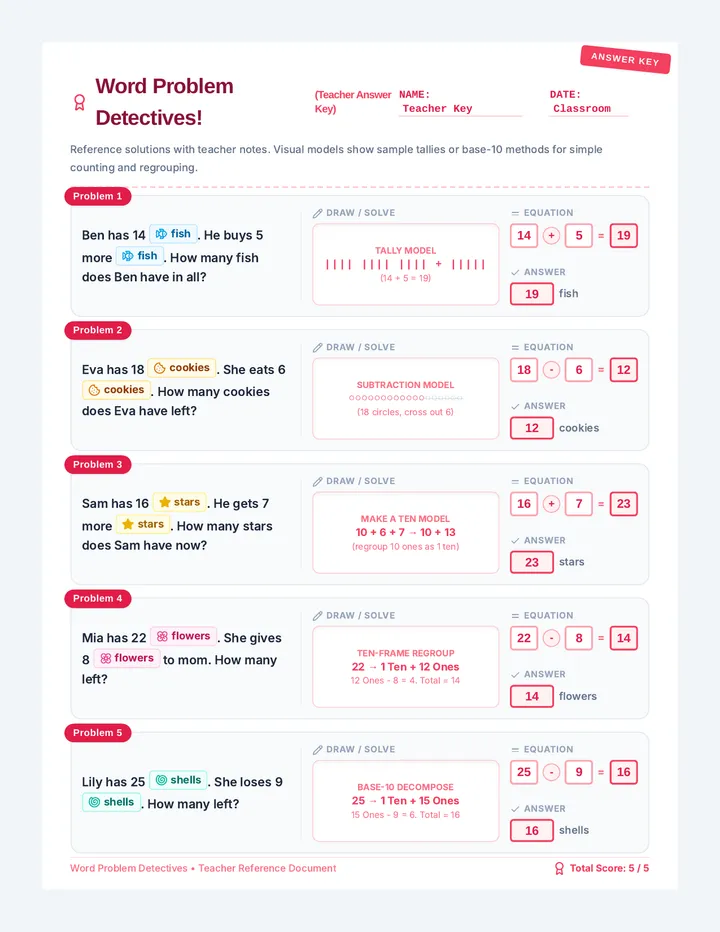
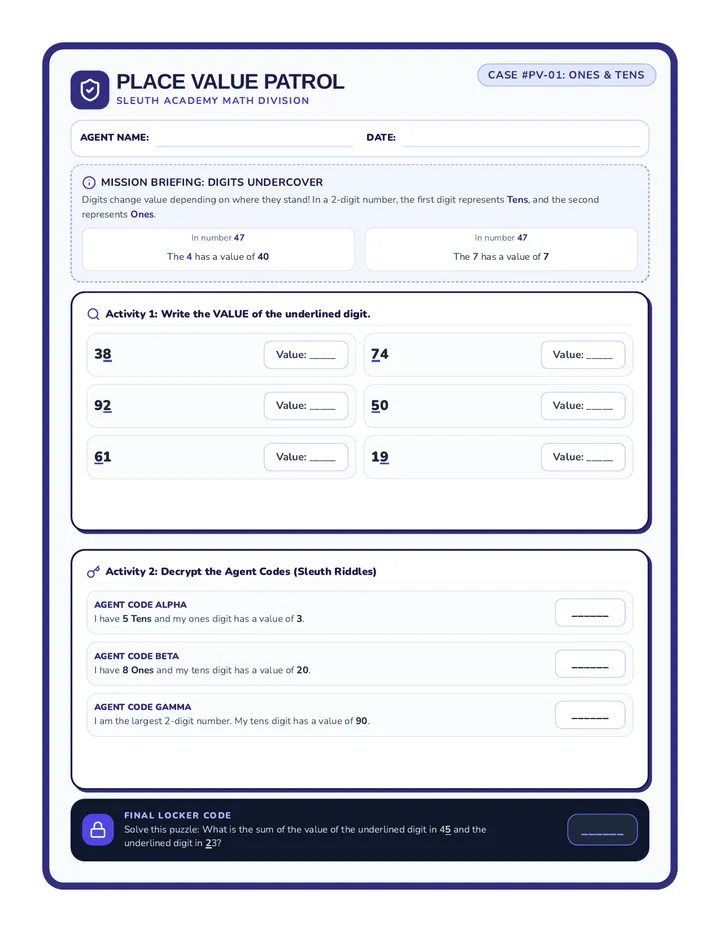
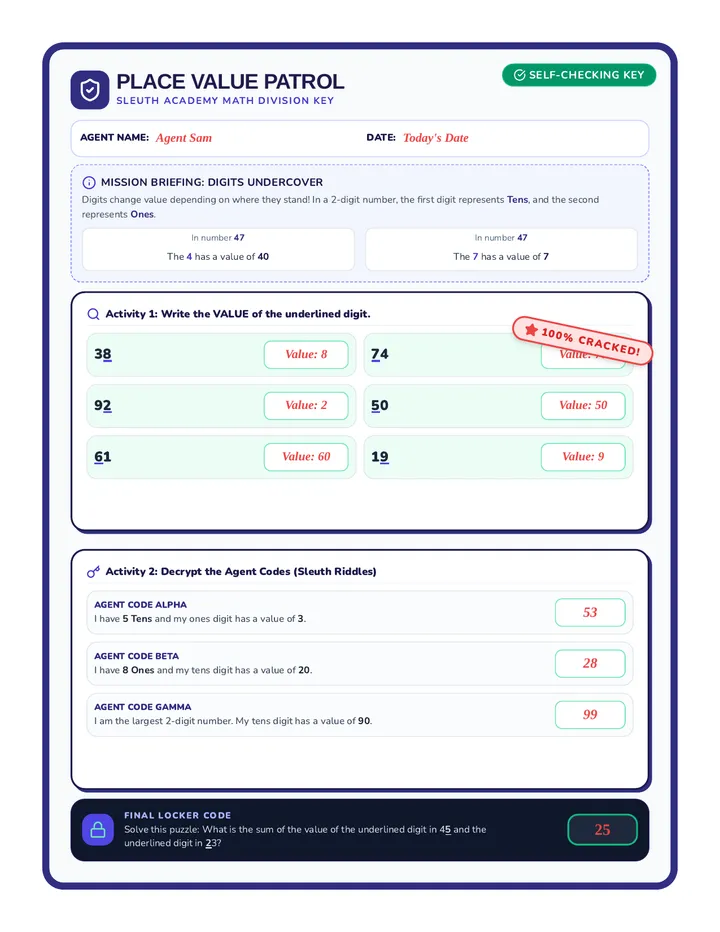
A 2-digit number circle-the-blocks worksheet where students identify and select the correct base-ten blocks to represent a given 2-digit value.
A 2-digit number counting worksheet where students identify the value represented by tens and ones blocks.
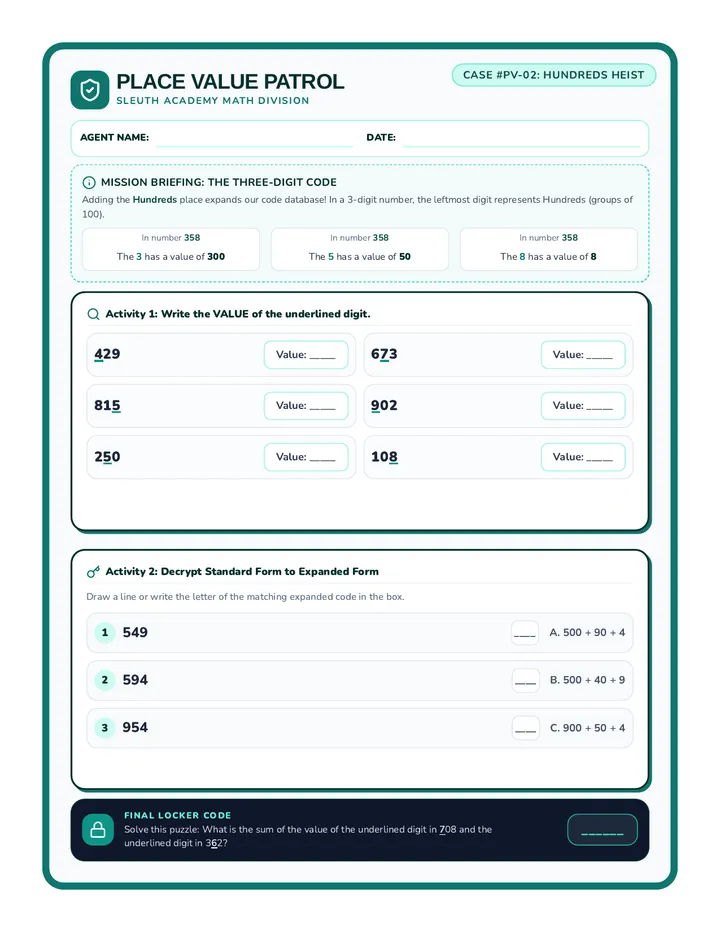
A 3-digit number circle-the-blocks worksheet where students identify and select the correct base-ten blocks to represent a given 3-digit value.
A 3-digit number counting worksheet where students identify the value represented by hundreds, tens, and ones blocks.
A comprehensive lesson plan for the Nature Number Talks lesson, outlining the 30-minute instructional sequence, Oregon math standards, learning targets, and differentiation strategies. Designed with a clean, nature-themed aesthetic for teacher use.
A teacher-facing facilitation guide and rubric for the Nature Number Talks lesson. Includes strategy observation lists, discussion prompts, and a 3-level assessment rubric focused on thinking and collaboration.
Reflective exit tickets for students to self-assess their strategy use and flexible thinking. Includes enlarged name fields and uniform icons for unbiased self-reflection. Designed with two tickets per page.
Nature-themed multiplication task cards with tiered difficulty. Includes "Sprout" cards with simplified number sets for differentiation and "Oak" cards for standard 3rd-grade curriculum. Cards include dashed cutting guides for easy prep.
A strategy recording sheet designed for students to document their own and their peers' math strategies during a nature-themed multiplication lesson. Includes space for drawings, comparisons, and a visual strategy toolkit. Optimized for one-page printing.
The answer key for the Jungle Jive Color-by-Number worksheet, featuring solved multiplication problems and the completed color pattern. Revised for one-page layout and better text contrast.
A jungle-themed color-by-number worksheet focusing on multiplication facts for 5 and 10. Students solve problems to determine colors and reveal a pattern. Revised for printability and one-page layout.
A teacher's answer key for the 5-day Division Dash daily drills, featuring concise solutions and a motivational scoring legend. Optimized for clarity and organized by page.
A fast-paced daily division drill for Day 5, featuring 50 mixed division facts from 0-12 in a clear, arcade-themed layout. Optimized for single-page printing.