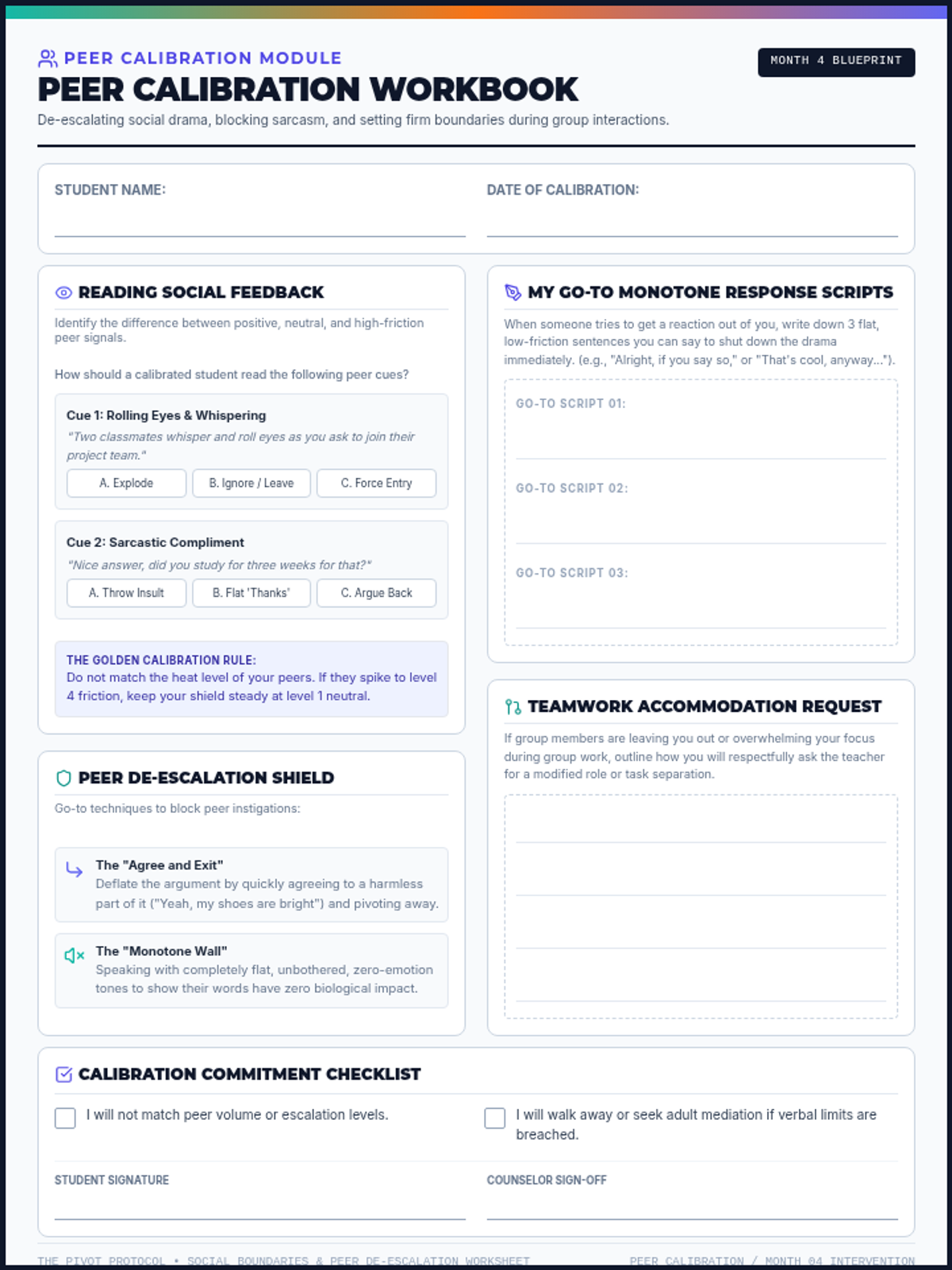
Updated 9th grade student-facing handbook for 'The Reset Protocol'. Features high-performance framing, professional advocacy scripts, and executive functioning-based self-monitoring exercises with a sophisticated, minimalist aesthetic.
A detective-themed reflection sheet for students to assess their confidence and application of the RT vs. TQ test-prep strategy.
A set of 10 printable question cards for the sorting activity, featuring dashed lines for cutting and subtle visual icons for scaffolding.
A detective-themed sorting mat for students to categorize test questions as 'Right There' or 'Thinking' during the Question Detectives lesson.
A comprehensive teacher guide for the Question Detectives lesson, including pacing, a hook script, instructional tips, and discussion prompts tailored for a 6th grade SPED environment.
A visually engaging slide deck designed for 6th grade SPED students, using a detective theme and real-world analogies to teach the difference between 'Right There' and 'Thinking' questions. Includes a specific visual equation for 'Thinking' questions combining text evidence and personal knowledge.
A high-density one-page reference chart for teachers summarizing WIDA Key Language Uses and language features across proficiency levels 1-5.
A high-impact instructional presentation for teachers, explaining the WIDA Key Language Uses and providing specific Grade 1 examples and scaffolding strategies for each curriculum unit.
A comprehensive, two-page landscape-oriented table that enhances the Grade 1 scope and sequence by integrating WIDA Key Language Uses (Inform, Narrate, Argue, Explain) and proficiency-leveled language features, while separating oral and writing projects into distinct columns as requested.
An annotated version of the Unit 1 Part 1 scope and sequence, visually mapping WIDA Narrate functions and highlighting specific instructional extension points for proficiency levels 2-4.
A teacher-facing instructional guide providing specific language extensions for EL proficiency levels 2-4, organized by the WIDA Narrate functions.
A crosswalk table mapping the WIDA Narrate standards to the specific components of Unit 1 Part 1, highlighting where functions and features appear in the existing curriculum.
A unit-by-unit planning guide that integrates all original curriculum details (vocabulary, phonics, grammar) with specific WIDA ELD Standards and Language Expectations.
A comprehensive multi-page master curriculum roadmap for Grade 1, integrating all original curriculum details (vocabulary, phonics, grammar, projects) with WIDA Key Language Use alignments.
A 1st Grade teacher resource mapping WIDA ELD standards (Science and Social Studies) across proficiency levels, with grammar skills integrated into language uses while maintaining a separate, isolated focus for phonics skills.
A simplified, high-contrast daily monitoring log for tracking sensory routine effectiveness, featuring alternating shaded rows and clear check-boxes for outcomes.
Updated Scope and Sequence table specifically aligned to WIDA Grade 1 Standards for Science and Social Studies, integrating existing grammar skills into the four Key Language Uses while maintaining a separate, distinct focus for Phonics skills.
A master answer key covering all activities in the Python Data Lab, including card sorting solutions, puzzle combinations, and worksheet answers. Organized into Section 1 (Data Types) and Section 2 (Variables). Updated to include mega-set sorter card solutions and new dictionary pairings.
Teacher answer key for the Variable Matcher Activity. Clearly shows correct matches for variable names, data types, and Python values, including the logic challenge solution.
A comprehensive guide for teachers on facilitating the Python Data Lab games. Organized into clear sections for Data Types and Variables, including accessibility tips and verbal scaffolding.
A logic matching worksheet where students connect variable names to their correct data types and values. Features large text, high contrast, and a clear layout for accessibility.
An expanded set of 12 extra-large printable puzzle blocks for building Python variables. Features thick borders, high-contrast colors, and large monospace fonts to support students with motor or visual impairments. Now with more dictionary variety.
A mega-collection of high-contrast printable cards featuring various Python values and data type labels. Expanded with 3 additional pages of real-world examples (Tech, School, and Robot data) for a total of 8 sets of practice cards (plus 5 dictionary-focused sets).
A teacher-facing resource providing instructional scripts, facilitation strategies, and diagnostic tips for using phonics materials with adult learners. Now split into two pages for clarity and better pacing.
An independent phonics practice log for adults, featuring daily tasks like word families, digraph identification, and functional sight word speed drills. Now formatted across two pages for better daily focus.
A reading passage and matching activity focusing on CVCe (silent e) words like 'late', 'time', and 'save' within a daily life context. Now split onto two pages.
A worksheet focusing on consonant digraphs (sh, ch, th) using professional vocabulary and workplace contexts. Now split into two pages for easier reading and writing.
Task cards featuring functional sight words and CVC phonics families with adult-themed example sentences. Expanded to two pages for additional practice.
A decodable short story for adults about a character named Sam starting a new job, now split onto two pages for better readability and a thorough reading check.
An adult-themed CVC decoding worksheet using workplace scenarios, now split across two pages for better readability and focus.
An answer key for the Field Notes Worksheet, with suggested definitions and examples for the teacher to use during instruction. It includes clearly marked sections corresponding to the student worksheet.