Quadratic Unit Internalization Plan
ISD
Curriculum and Instruction • Secondary Mathematics
Secondary Math Unit Internalization
Algebra I • Unit 8
Quadratic Functions & Equations
Purpose
Unit internalization is the process by which teachers collaboratively study the unit to deeply understand what students are expected to learn, how students will be assessed, and the arc of learning over the course of a unit.
Target Focus: Connecting representations of quadratics (tables, graphs, equations, contexts) and transitioning from linear behaviors to non-linear constant second differences.
Materials
Teachers and teams will need the following to internalize each unit:
- Course YAG & Unit Framework Documents (TEKS A.6A, A.7A, A.8A)
- District Unit Assessments & Released STAAR Quadratic Items
- Cosenza & Associates, Big Ideas Math, and Desmos Classroom
- Instructional Planning Calendar (IPC) 4-Week Template
Step 1 Understand the Big Picture
Review Unit Framework: Orient to big ideas, prerequisite skills from linear/exponential functions, and real-world projectile/area modeling.
Output: Big Picture Alignment
Step 2 Know the Destination
Analyze Assessment: Complete with student lens. Unpack question structures, vocabulary trap doors, and non-routine representation shifts.
Output: Misconception Bank
Step 3 Engage in the Learning
Select Core Experience: Deconstruct high-cognitive-demand projectile task. Design concrete scaffolds, visual anchors, and daily exit tickets.
Output: Exemplar Task & CFA
Step 4 Plan for Learning
Construct IPC: Account for testing interruptions, pace TEKS conceptually, schedule CFAs, and protect deliberate re-teach windows.
Output: Complete 15-Day IPC
Essential Priority Standard for Deep Study
TEKS A.7A & A.8A Readiness
What is this unit's core conceptual bridge?
Moving from constant rates of change (linear \(y = mx + b\)) to symmetric parabolic change with a constant second difference. Students must realize the vertex represents a maximum or minimum physical quantity and that x-intercepts correspond to roots, solutions, and zeros of \(ax^2 + bx + c = 0\).
High-Impact Success Criteria
1. Correctly identify axis of symmetry \(x = -b/(2a)\), vertex, zeros, and y-intercept in context.
2. Choose an efficient algebraic method (factoring, square root property, quadratic formula) based on equation form.
3. Interpret the physical domain and range in projectile and geometric constraints.
Irving ISD Math Professional Learning Community Protocol Page 1 of 5 • Unit Framework Protocol
Step 1
Understand the Big Picture
Guiding Questions & Considerations
Team Notes & Unit Synthesis
In your own words, what will students understand and continue to consider throughout the unit?
- • Essential Understanding: Quadratic functions model non-linear phenomena where change accelerates or decelerates symmetrically around a maximum or minimum value.
- • Guiding Question 1: How do changes in the parameters \(a\), \(b\), and \(c\) alter the shape, orientation, and position of a parabola?
- • Guiding Question 2: What determines whether a quadratic equation has real, repeated, or no real solutions, and what does this mean in a real-world scenario?
What essential standards will students encounter during this unit?
Determine 1 standard that is essential for students to be successful in the unit. Create a know/show chart for 1 essential standard.
Target Standard:
TEKS A.7A (Readiness): Graph quadratic functions on the coordinate plane and use the graph to identify key attributes, if possible, including \(x\)-intercept, \(y\)-intercept, zeros, maximum value, minimum values, vertex, and the equation of the axis of symmetry.
Know (Concepts & Vocabulary)
- • Definition of standard form: \(f(x) = ax^2 + bx + c\)
- • Parabola opens up if \(a > 0\) (min), down if \(a < 0\) (max)
- • Axis of symmetry line: \(x = -\frac{b}{2a}\)
- • Vertex is an ordered pair \((h, k)\)
- • Synonyms: \(x\)-intercepts = zeros = roots = solutions
- • \(y\)-intercept is at \((0, c)\)
- • Quadratic functions have domain of all real numbers unless constrained by contextual reality
Show (Skills & Actions)
- • Calculate axis of symmetry algebraically and draw it as a dashed vertical line \(x = h\)
- • Substitute \(x\) back into function to calculate vertex \((h, k)\)
- • Create an organized table with vertex centered to plot 5 accurate points
- • State the maximum or minimum value as a single \(y\)-value
- • Write domain and range using inequalities (e.g., \(y \le 16\) or \(\{y \mid y \le 16\}\))
- • Label all key features directly on graphs
What are connections to previous learning?
- • Linear Functions (Units 2-4): Students already know how to identify \(x\)- and \(y\)-intercepts, evaluate functions using function notation \(f(x)\), and graph relations. Quadratics contrast by having non-constant rates of change.
- • Polynomial Operations (Unit 7): Multiplying binomials (FOIL / box method) and factoring trinomials \(x^2 + bx + c\) are directly leveraged here to find zeros using the Zero Product Property.
- • Coordinate Geometry (Grade 8): Plotting ordered pairs and recognizing lines of symmetry.
What real world connections can be made that will enhance student learning during this unit of study?
- • Vertical Motion & Ballistics: Basketball free-throw trajectories, soccer kicks, model rocket launches, and water fountains (\(h(t) = -16t^2 + v_0t + h_0\)). Vertex = peak height; positive \(x\)-intercept = time hitting ground.
- • Business Revenue Optimization: Maximizing ticket sales or product profits where Price \(\times\) Quantity produces quadratic revenue curves.
- • Architectural & Structural Design: Parabolic suspension cables on bridges (Golden Gate) and satellite dish cross-sections.
Secondary Math Unit Internalization • Step 1: Big Picture Page 2 of 5
Step 2
Know the Destination
Guiding Questions & Considerations
Assessment Analysis & Student Lens Notations
Complete assessment with a student lens.
Notate what students must know and do to succeed.
- • Verbal Translation: Convert projectile situations into quadratic models independently.
- • Non-Zero Equations: Rearrange terms to standard form \(ax^2 + bx + c = 0\) before applying solving strategies.
- • Scale Reading: Interpret coordinate grids where axes scale by 2s or 5s without coordinate errors.
How will students’ understanding and mastery be assessed?
Question types, item formats, and test design.
- • Item Format Mix: 60% Multiple Choice (plausible distractors), 20% Multi-Select, 20% Free Response / Grid-in.
- • Interactive Items: Digital graphing items requiring vertex and a secondary point plotted.
- • Vocabulary Variety: Seamless interchange between zeros, roots, and \(x\)-intercepts.
What misconceptions may occur?
How will you address these misconceptions?
1. AOS as a Single Number: Writing "\(AOS = 3\)" instead of the line equation "\(x = 3\)".
Remedy: Mandate stem: "The axis of symmetry is the vertical line \(x = \underline{\hspace{0.6cm}}\)."
2. Confusing Max/Min with Vertex: Stating maximum of \((3, 25)\) is \(3\).
Remedy: Anchor rule: "\(x\) tells WHEN it happens; \(y\) tells WHAT maximum is reached."
3. Formula Sign Drops: For \(-b \pm \sqrt{b^2 - 4ac}\), if \(b = -6\), writing \(-6\) instead of \(+6\).
Remedy: Enforce the "Empty Parentheses Routine": \(-(\phantom{b}) \pm \sqrt{(\phantom{b})^2 - 4(\phantom{a})(\phantom{c})}\).
How will you use formative assessments throughout the unit?
- • Day 3 Checkpoint: Card sort matching equations to graphs using \(a\) and \(c\).
- • Day 6 CFA #1 (Graphing & Features): 5-item check on vertex, zeros, AOS, and realistic domain/range.
- • Day 11 CFA #2 (Solving Methods): Error analysis diagnosing flaws in factoring and formula steps.
Revisit essential standards know/show chart.
Clarify standard complexities.
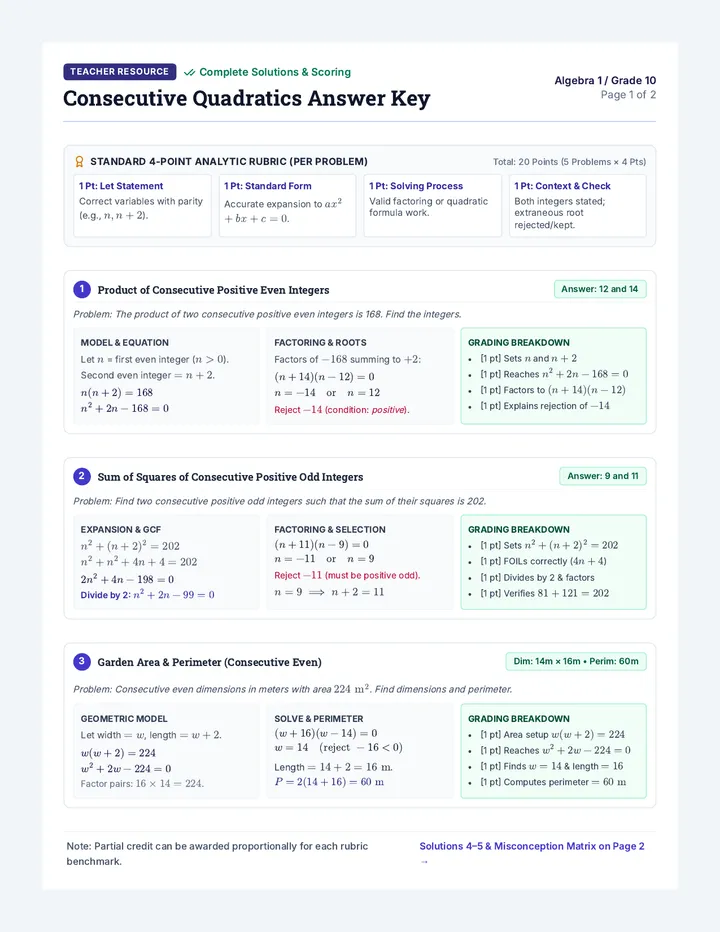
• Added Complexity for TEKS A.8A (Solving Quadratics):
Students must select the most efficient strategy: Square Root Property when \(b = 0\) (e.g. \(4x^2 - 36 = 0\)), Factoring when integer roots exist, and Quadratic Formula when radical expressions or messy decimals arise.
Secondary Math Unit Internalization • Step 2: Know the Destination Page 3 of 5
Step 3
Engage in the Learning
Guiding Questions & Considerations
Instructional Planning & Task Analysis
Select a learning experience that addresses an essential standard.
Independently, review the learning experience.
Selected Core Experience: "The Bottle Rocket Launch Investigation" (STEMscopes / Desmos Math modeling task).
Students are given the flight equation \(h(t) = -16t^2 + 64t + 80\), representing the height in feet of a pressurized water rocket \(t\) seconds after launch. Students work in pairs to predict, graph, and contextualize each structural feature.
Discuss the learning experience and what students should be able to do.
- • Calculate & Interpret Vertex: Find \(t = -\frac{64}{2(-16)} = 2\) sec, substitute to find \(h(2) = 144\) ft. Articulate that "the rocket reaches a maximum height of 144 feet after 2 seconds."
- • Determine Landing Time (Zero): Factor or solve \(-16(t - 5)(t + 1) = 0\) to get \(t = 5\) and \(t = -1\). Explain why \(t = -1\) is extraneous in this physical model.
- • State Realistic Domain & Range: Domain: \([0, 5]\) seconds; Range: \([0, 144]\) feet (rejecting infinite real numbers).
What instructional strategies and scaffolds are needed in order for students to be successful with the learning?
Scaffold 1
3-Reads Protocol for Word Problems: Read 1 for the context (no numbers), Read 2 for mathematical quantities, Read 3 for the focal question and required units.
Scaffold 2
Color-Coded Parabola Graphic Organizer: Green = Initial Launch / \(y\)-intercept \((0, c)\); Red = Peak Height / Vertex \((h, k)\); Blue = Splashdown / Positive \(x\)-intercept \((r, 0)\); Yellow = Line of Symmetry.
Scaffold 3
Sentence Frames for Emergent Bilinguals: "The value \(c = 80\) means the rocket launched from a height of \(\underline{\hspace{0.8cm}}\) feet. The maximum height is \(\underline{\hspace{0.8cm}}\) feet, reached at \(\underline{\hspace{0.8cm}}\) seconds."
Customize or create an exit ticket or a formative assessment aligned to the essential standards.
Exit Ticket: Parabola Feature Mastery (TEKS A.7A) Name: ____________________ Date: _______
A toy drone's flight is modeled by \(f(x) = -(x - 3)^2 + 16\), where \(x\) is time in seconds and \(f(x)\) is altitude in meters.
1. What is the maximum height reached?
Maximum height: ________________ meters
Reached at time \(x =\) ________ seconds
2. At what second does it return to ground?
Zero equation: \(0 = -(x - 3)^2 + 16\)
Time hitting ground: ________ seconds
Success Criteria: Vertex at \((3, 16)\); ground hit at \(x = 7\) sec. Aligned to STAAR 2024 Readiness Item
Secondary Math Unit Internalization • Step 3: Engage in the Learning Page 4 of 5
Step 4
Plan for Learning
Guiding Questions & Considerations
Instructional Planning Calendar (IPC) Roadmap
Brainstorm and add any upcoming campus events that will interrupt learning to your IPC.
- Oct 24 PSAT / Fall Testing Day: Morning block lost; afternoon 30-min shortened periods. Plan asynchronous Desmos polygraph review.
- Oct 31 Homecoming Pep Rally: 45-minute shortened schedule for periods 6-8.
- Nov 03 District Professional Learning / Student Holiday: No classes.
Calendar the potential dates for administering the major assessments (i.e. pre-assessment, unit assessment, CFAs, etc.) and provide time for intervention/extension based on the assessment data.
Diagnostic & Formative Milestones
- • Oct 15 (Day 1): Unit 8 Readiness Pre-Check (Factoring & Linear contrasts)
- • Oct 22 (Day 6): CFA #1 (TEKS A.7A Graphing & Key Features)
- • Oct 29 (Day 11): CFA #2 (TEKS A.8A Solving Quadratics)
Summative & Reteach Buffers
- • Nov 05 (Day 14): Unit 8 Summative Assessment (District Exam)
- • Oct 23 (Day 7): Data Re-teach / Small Group Station Day for CFA #1
- • Nov 06 (Day 15): Post-Exam Target Intervention & Extension Lab
Strategically pace lessons, including learning objectives using the course YAG and prioritized standards.
Shorten or lengthen the number of days you plan for each concept.
| Phase | Days | Standard & Core Learning Objective | Pacing Notes |
|---|
| Explore | Days 1-2 | A.6B, A.7A: Introduce quadratic parent function \(y = x^2\), investigate table second differences, and explore parameter \(a\) stretches/reflections. | Desmos Marbleslides |
| Features | Days 3-6 | A.7A (Readiness): Graph parabolas, calculate axis of symmetry \(x = -\frac{b}{2a}\), locate vertex, state domain/range, and identify zeros. | +1 Day Added (Heavy Rigor) |
| Reteach | Day 7 | Targeted Stations: CFA #1 Data Dive. Tier 2 small group intervention on domain/range; Tier 1 extension on vertex form \(a(x-h)^2+k\). | CFA #1 Action Plan |
| Solving | Days 8-11 | A.8A (Readiness): Solve quadratic equations by factoring (Zero Product Property), taking square roots, and applying the quadratic formula. | +1 Day Added (Formula Fluency) |
| Context | Days 12-13 | A.7B, A.8A: Apply quadratic models to vertical projectile motion, area optimization, and profit models with real-world constraints. | Bottle Rocket Task |
| Assess | Days 14-15 | Review & Unit Exam: Culminating district assessment followed by post-test error analysis and learning reflections. | Summative + Next Steps |
Pacing Decision Justification: Added +2 instructional days total by condensing linear regression review; essential readiness standards TEKS A.7A and A.8A account for 70% of STAAR Category 4.
* The IPC is a living document and should be revisited and adjusted throughout the unit based on CFA student evidence. Page 5 of 5