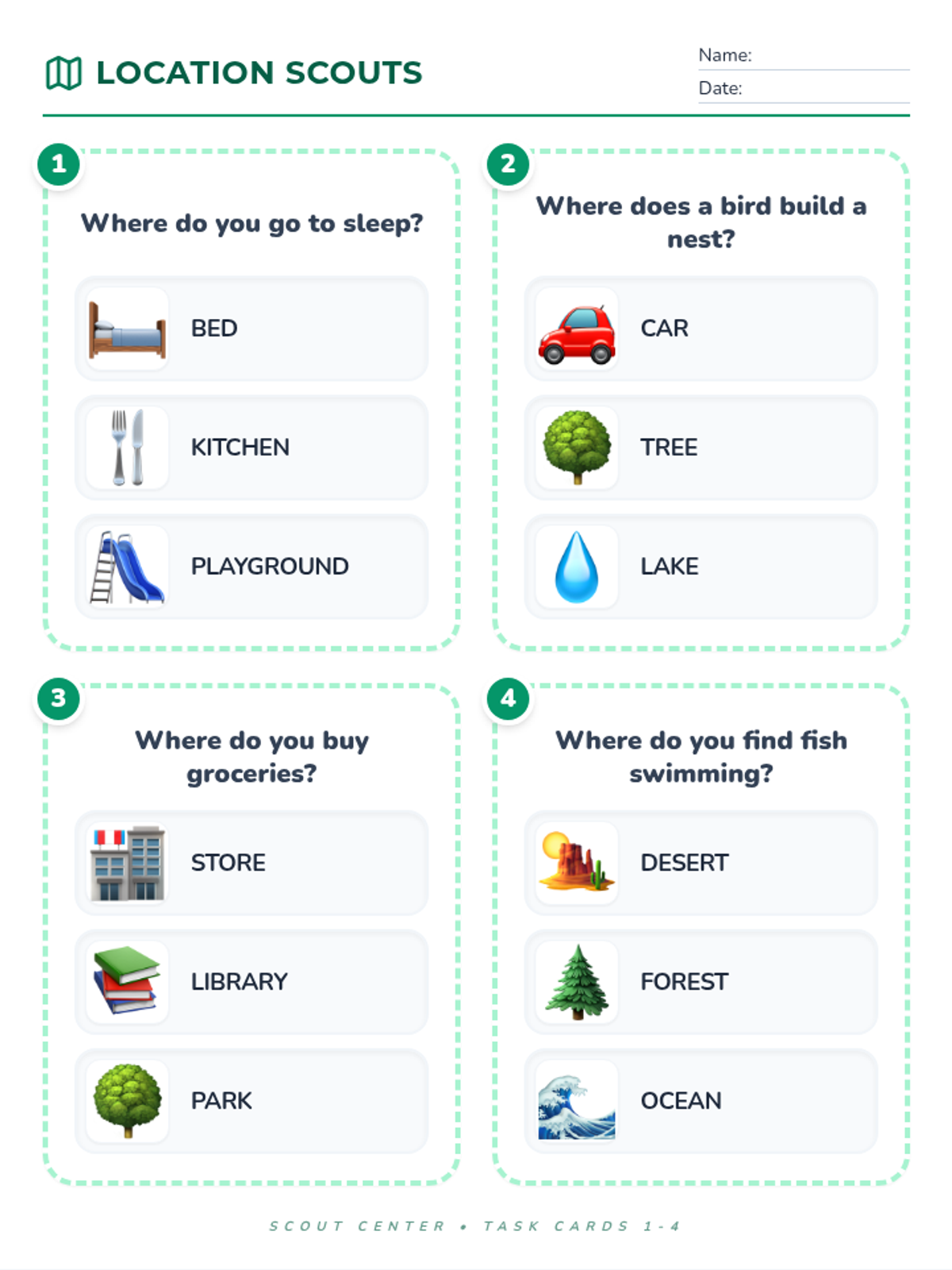
A teacher's answer key and implementation guide for the 'Location Scouts' task cards, including correct answers and creative classroom activity suggestions.
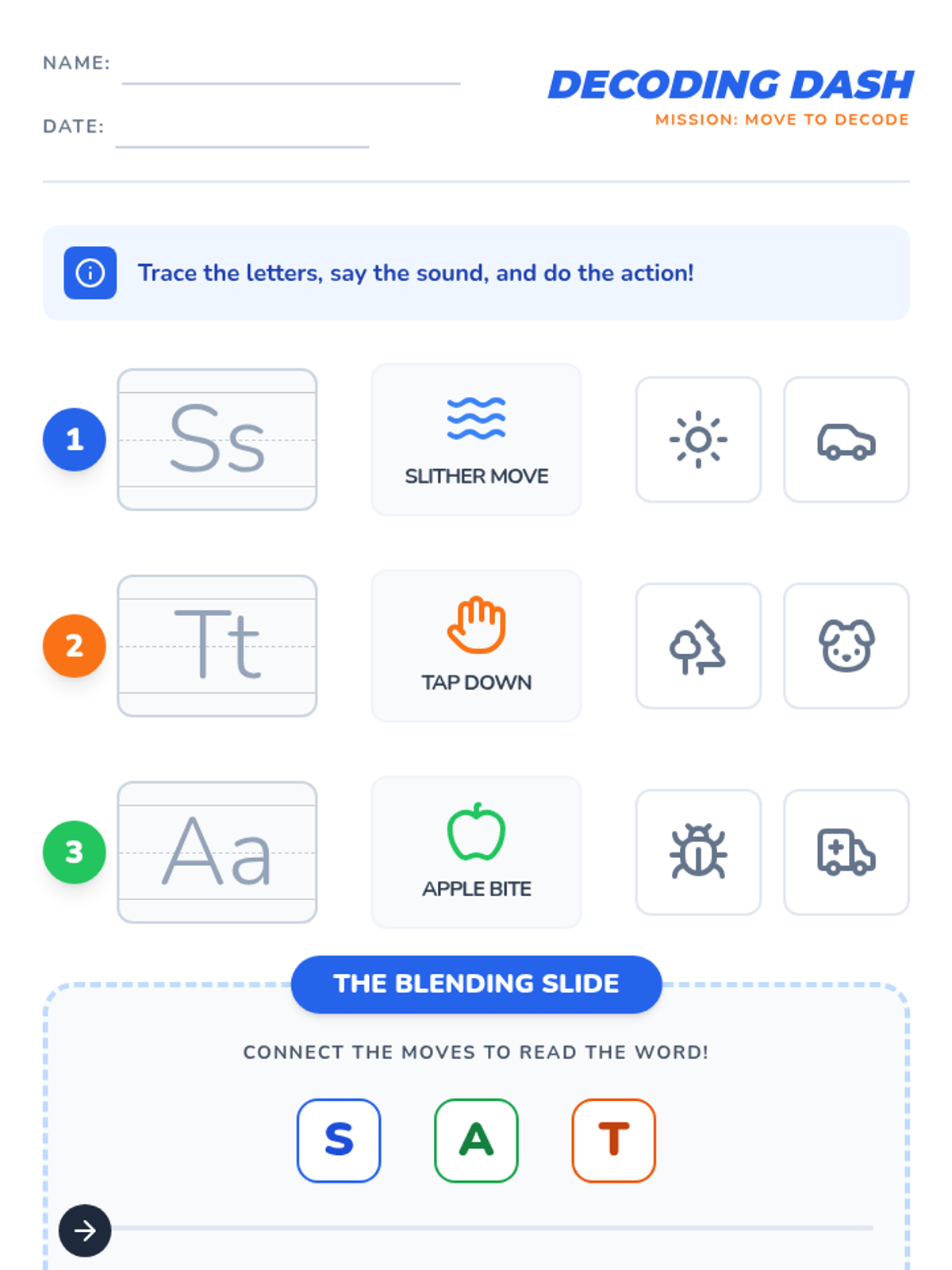
A hands-on worksheet where students practice tracing letters, identifying starting sounds, and performing kinetic gestures for phonemes.
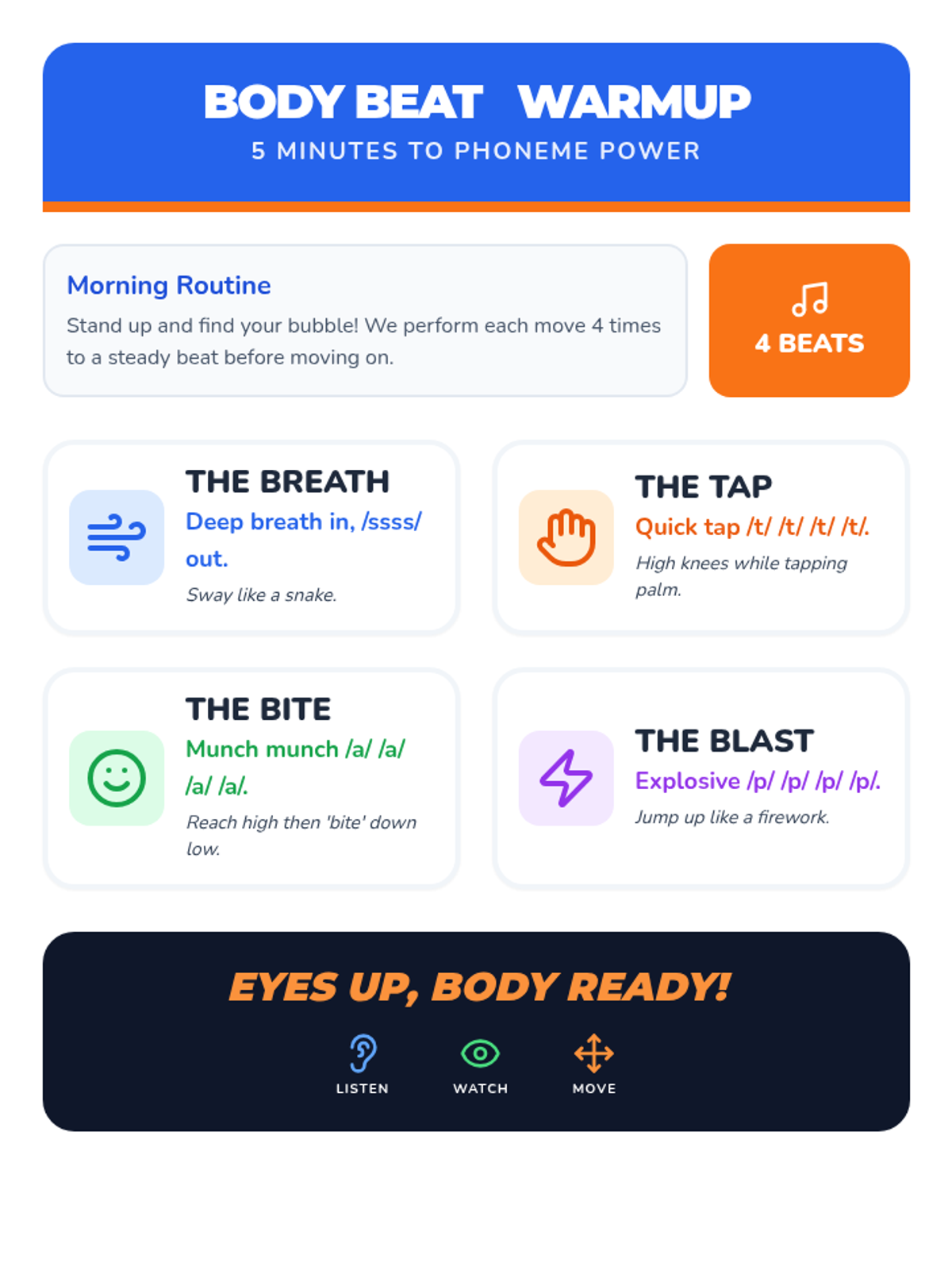
A quick-start visual reference guide for students to perform the daily kinetic phonics routine and build muscle memory.
An energetic presentation featuring high-contrast visuals and specific gesture instructions for key phonemes and CVC blending.
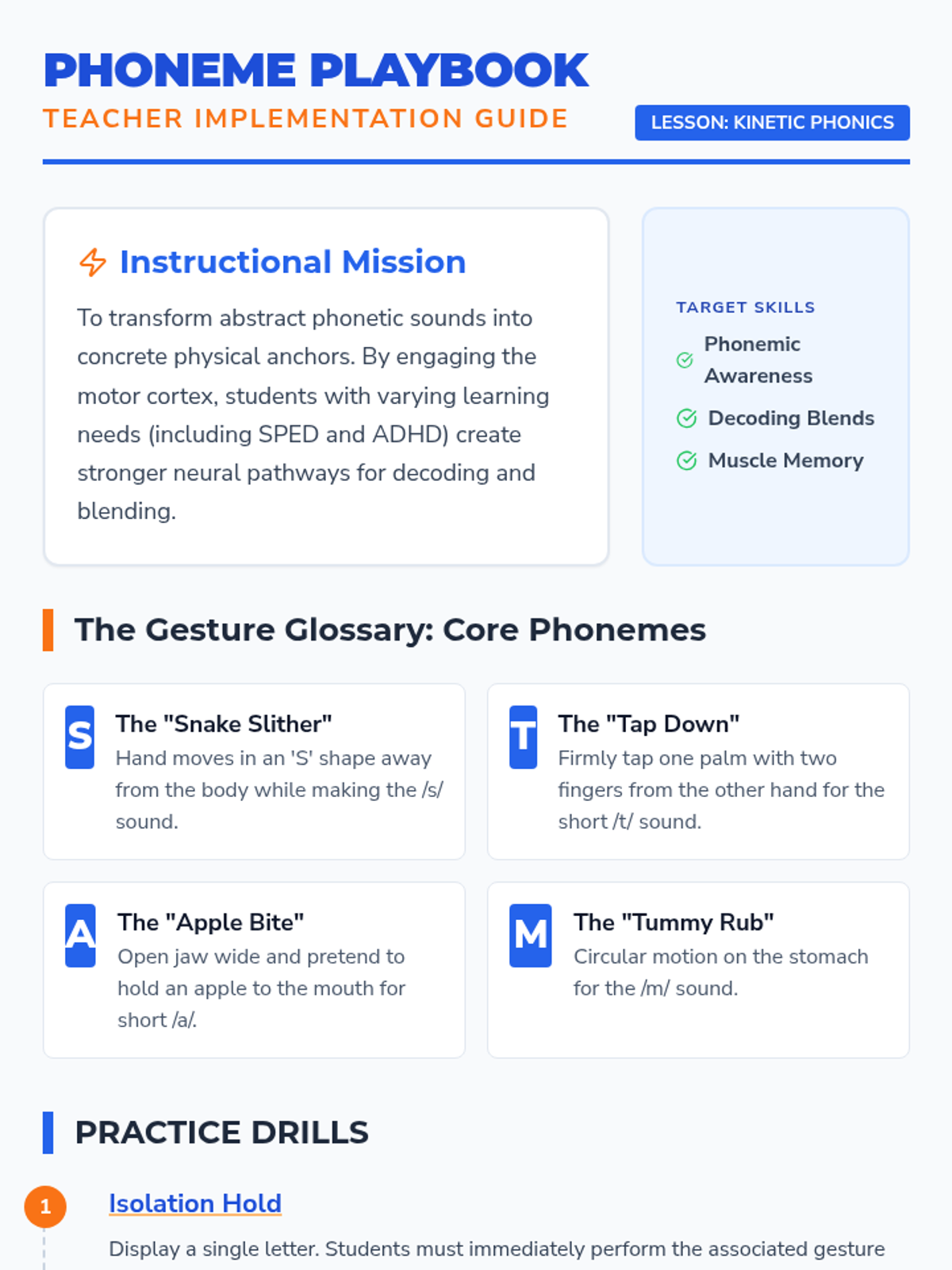
A comprehensive guide for teachers outlining the kinetic gestures, instructional goals, and differentiation strategies for movement-based phonics instruction.
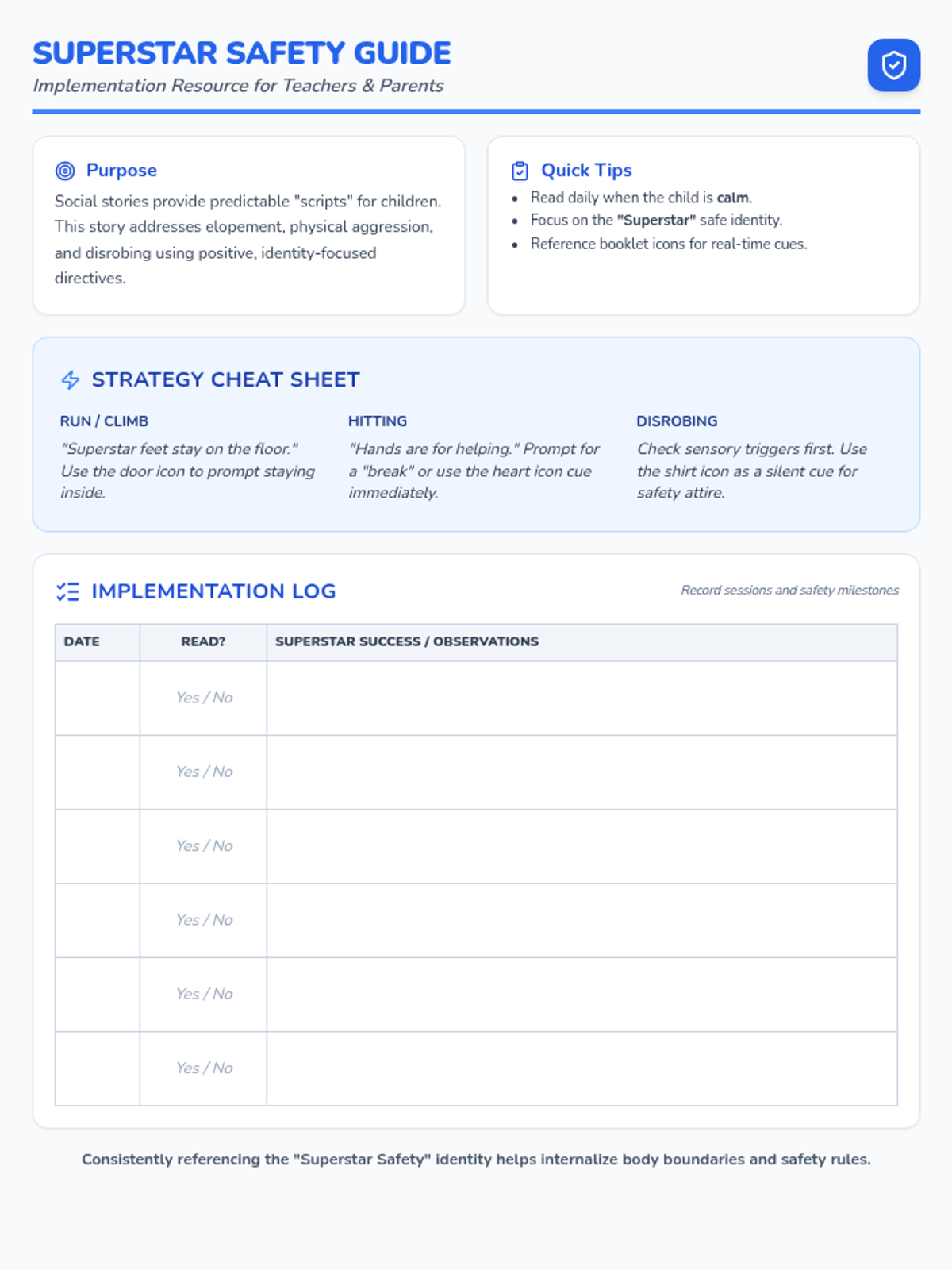
An instructional guide for teachers and parents on how to effectively implement the Superstar Safety social story with young children, including troubleshooting tips for specific behaviors.
A 7-page social story booklet for 5-year-olds that teaches essential school safety rules, including staying in the classroom, keeping hands gentle, and maintaining appropriate attire.
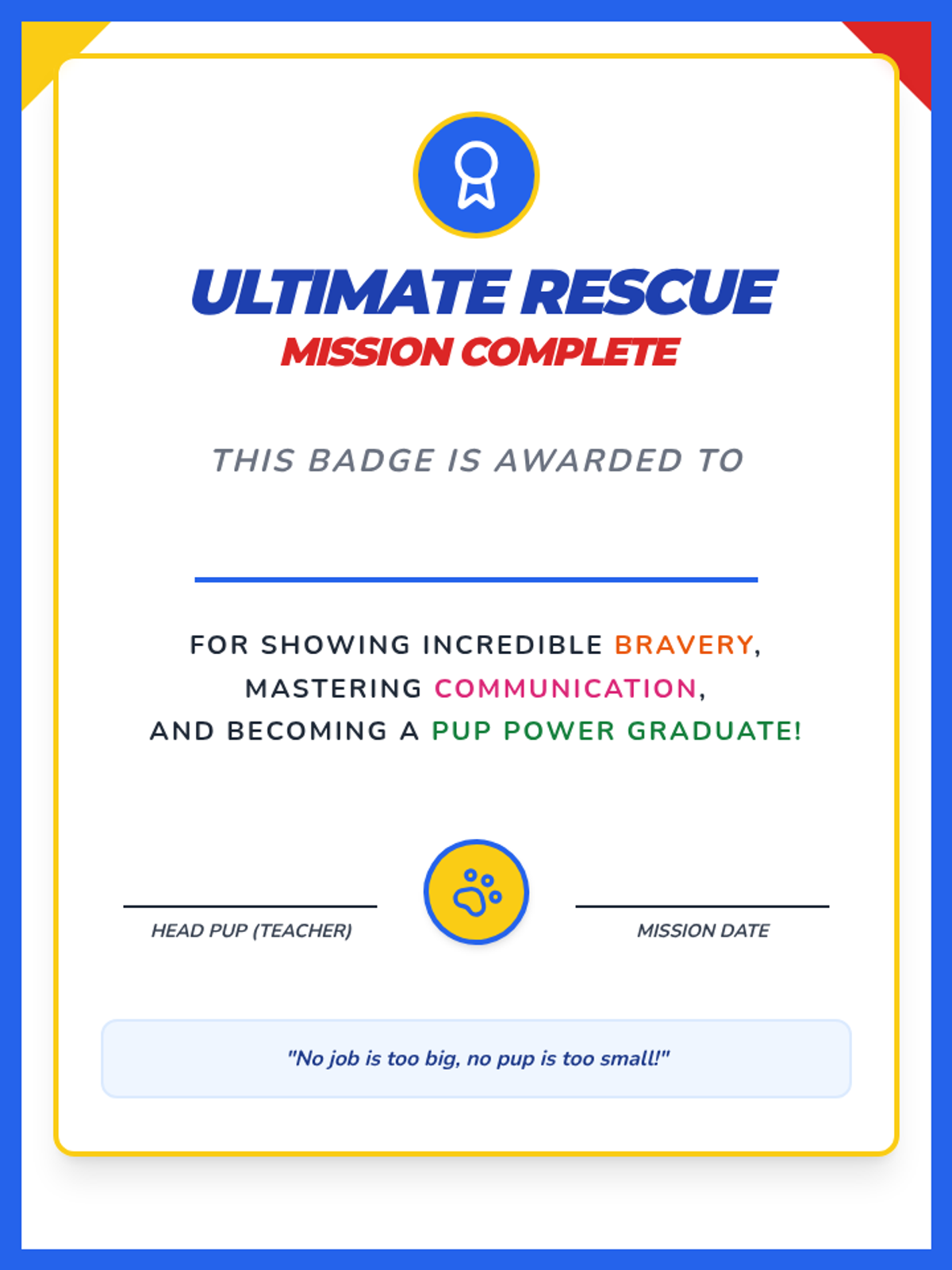
Graduation certificate. Sizing and layout polished to ensure a clean 1-page fit and improved handwriting space for the teacher.
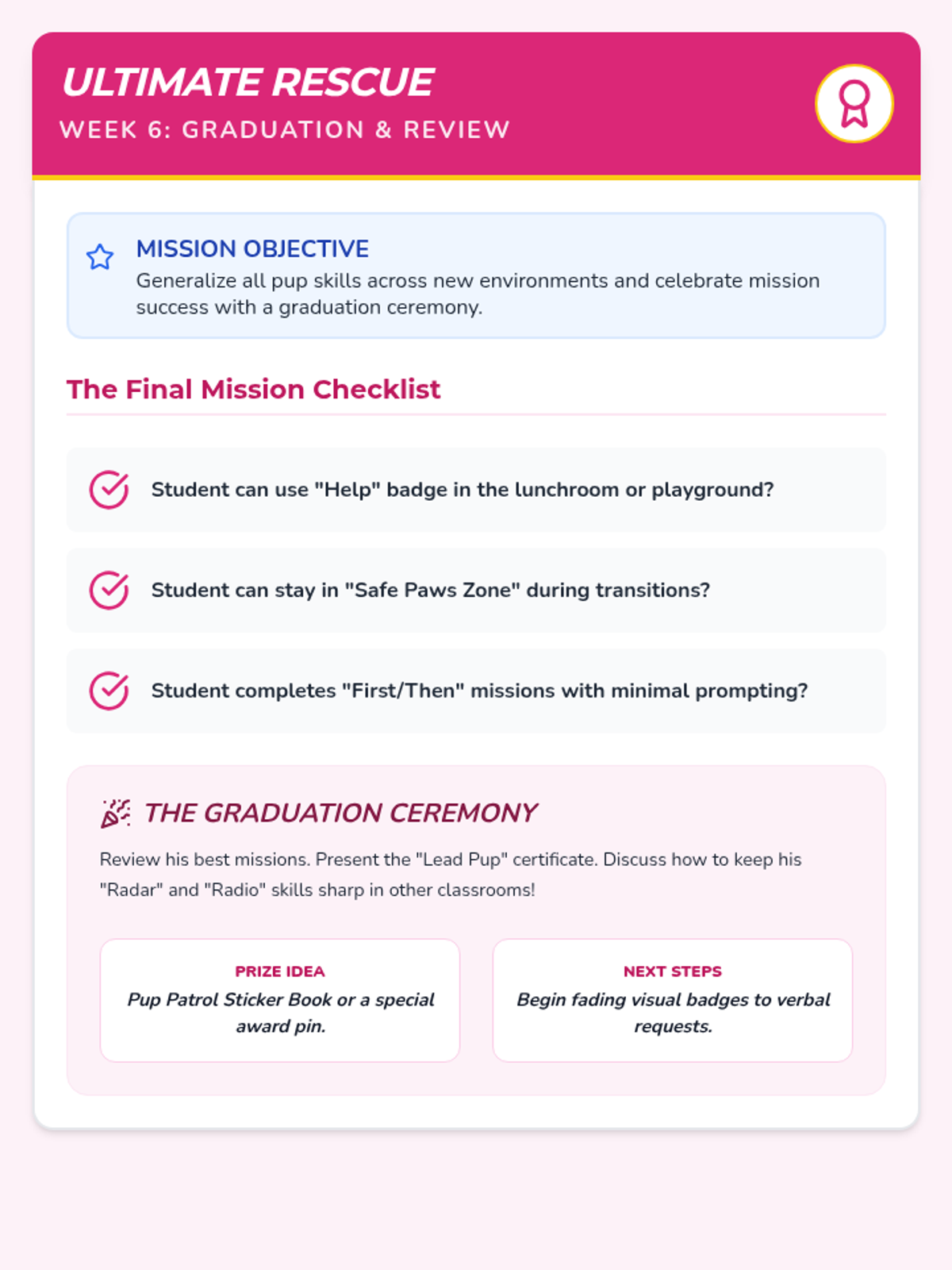
Teacher guide for Week 6. Spacing and text sizes optimized to ensure readability and a professional look on a single page.
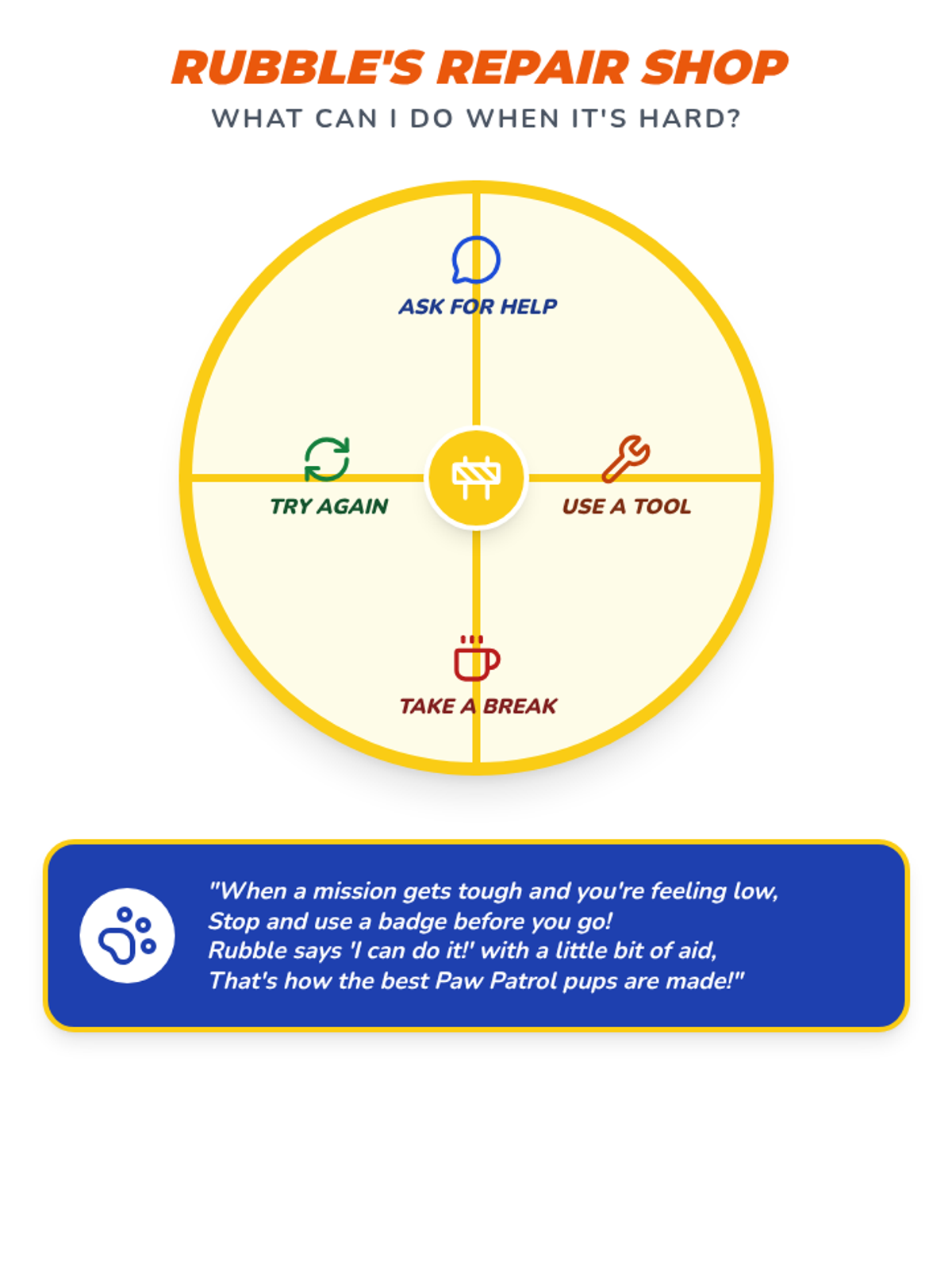
Rubble Repair Choice Board. Dividers fixed, contrast improved, and rhyme box spacing optimized to prevent page breaks.
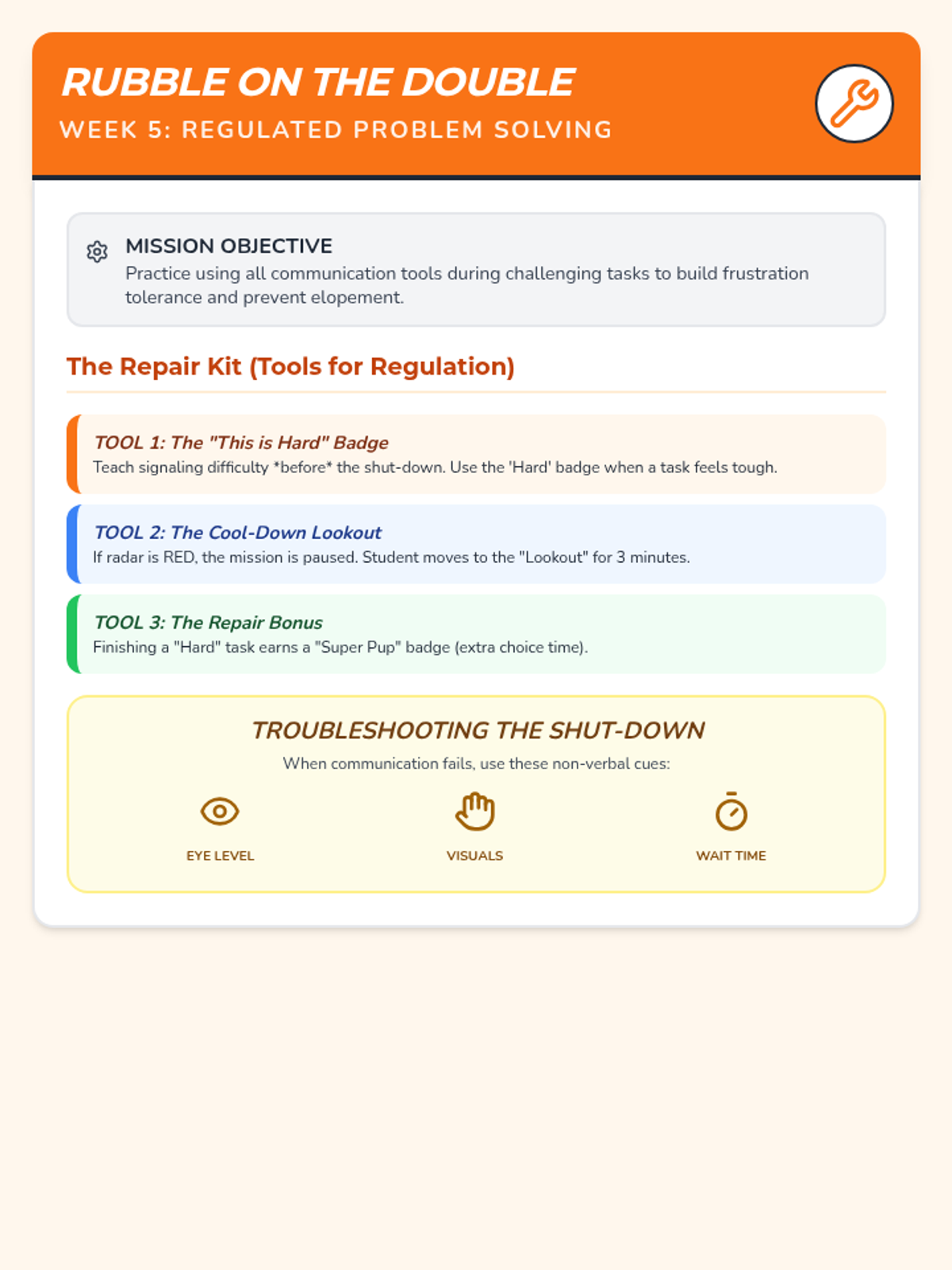
Teacher guide for Week 5. Layout tightened to fit on 1 page and higher contrast for text.
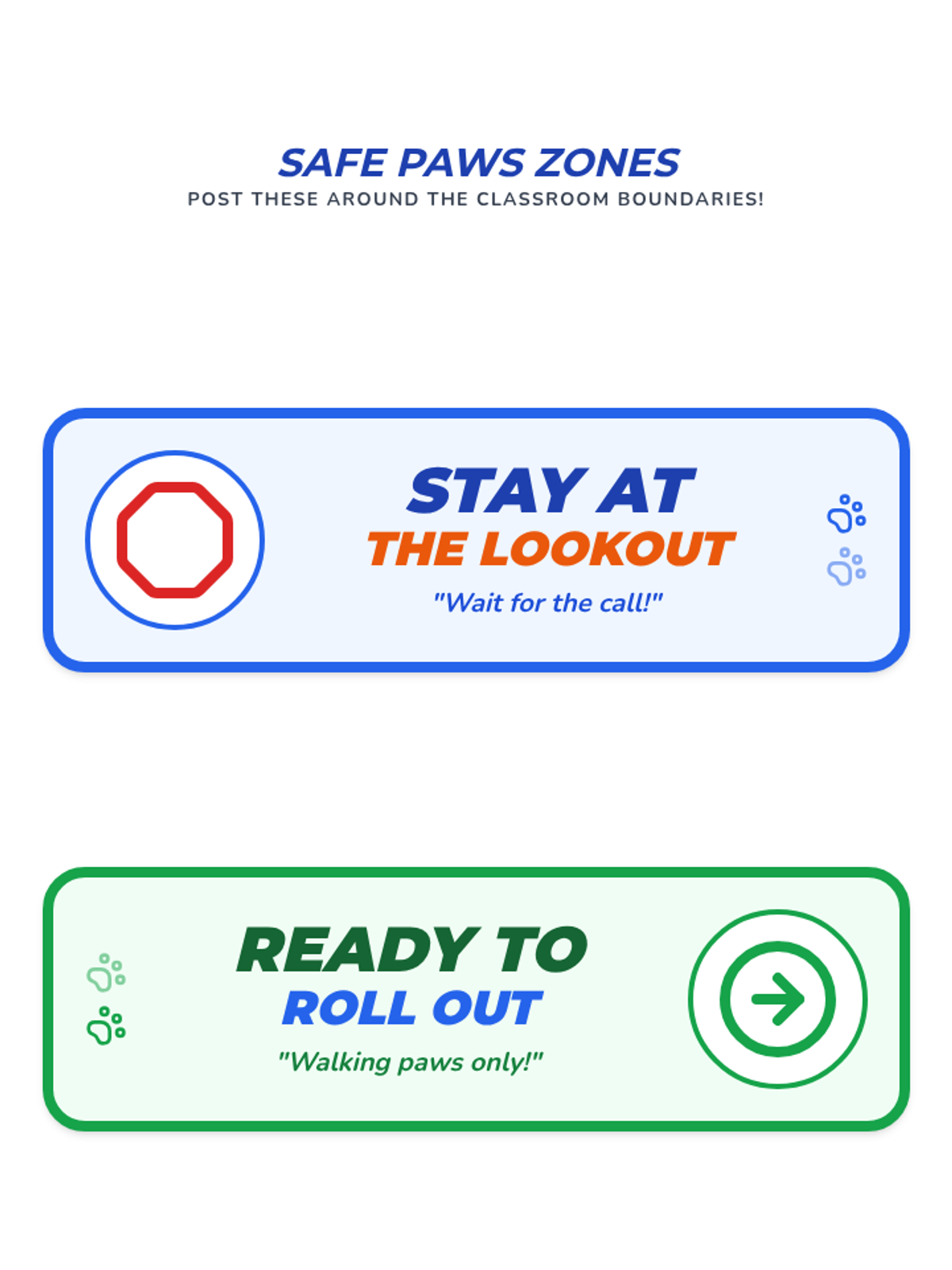
Boundary Safe Paws visual aids. Fixed page break issue by putting the Check-Out card on its own page and improved contrast.
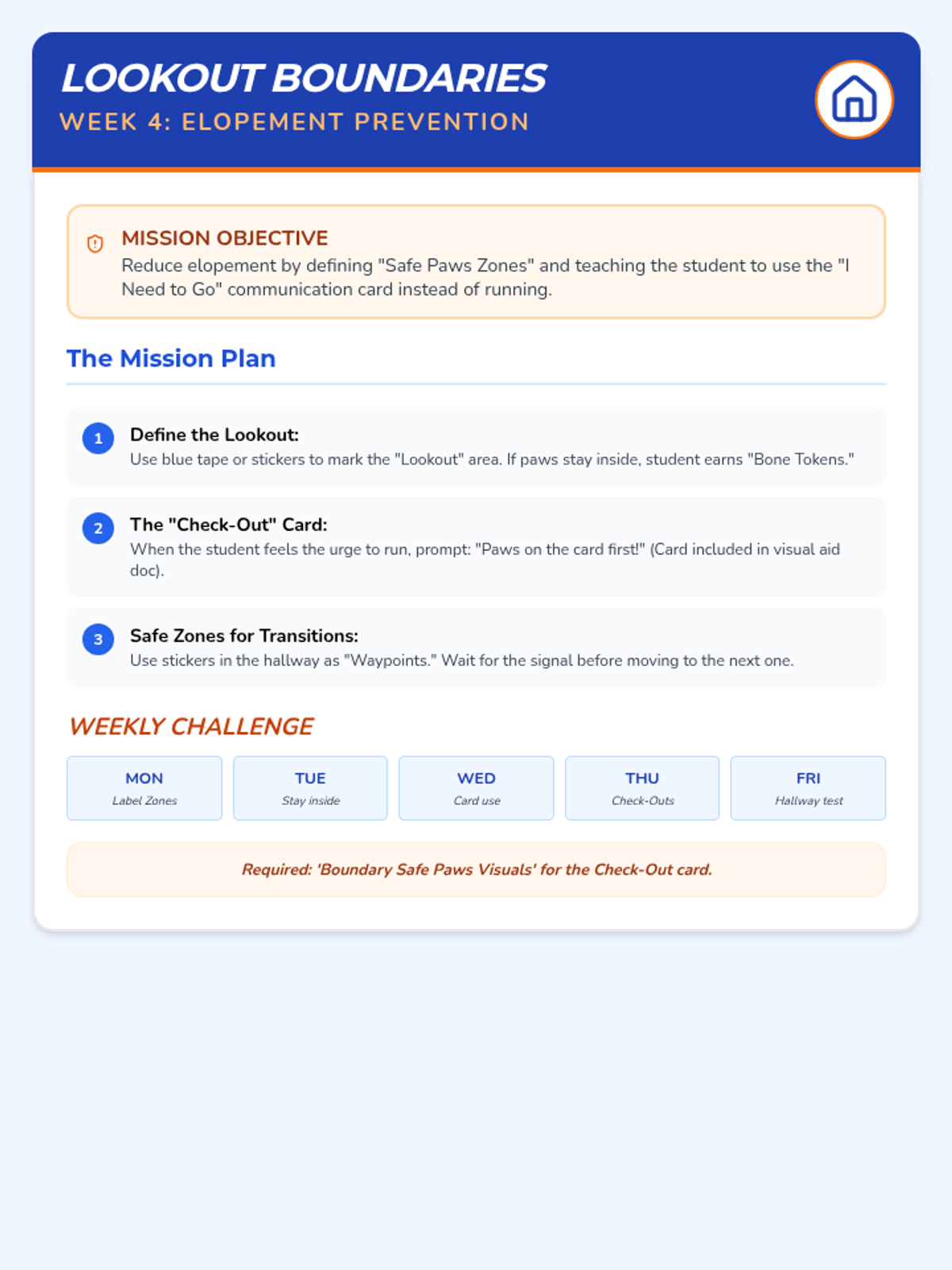
Teacher guide for Week 4. Spacing adjusted to ensure the weekly challenge fits on a single page with the header.
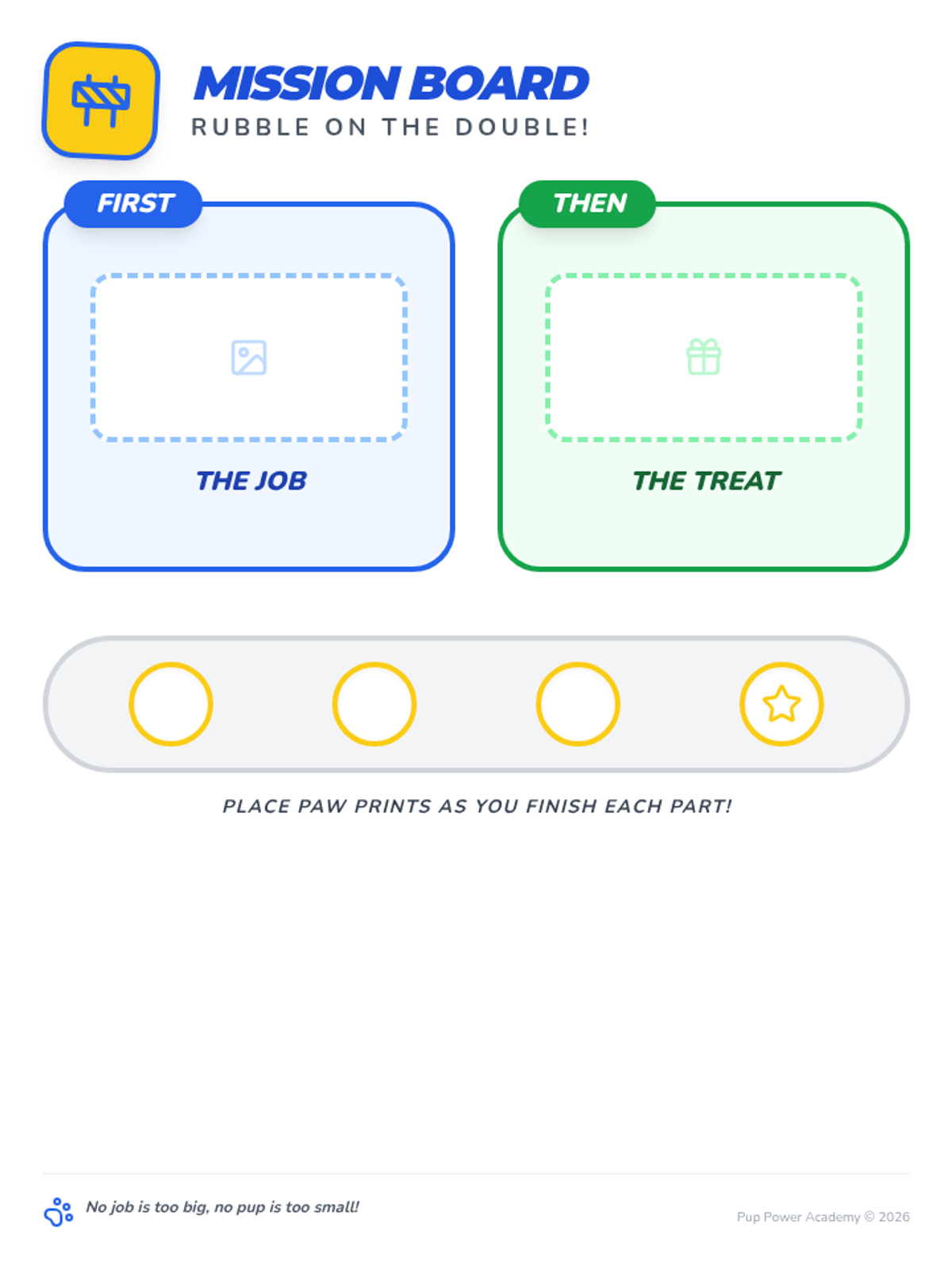
Mission Board visual with placeholders removed. Added a second page with cut-out paw print tokens as requested.
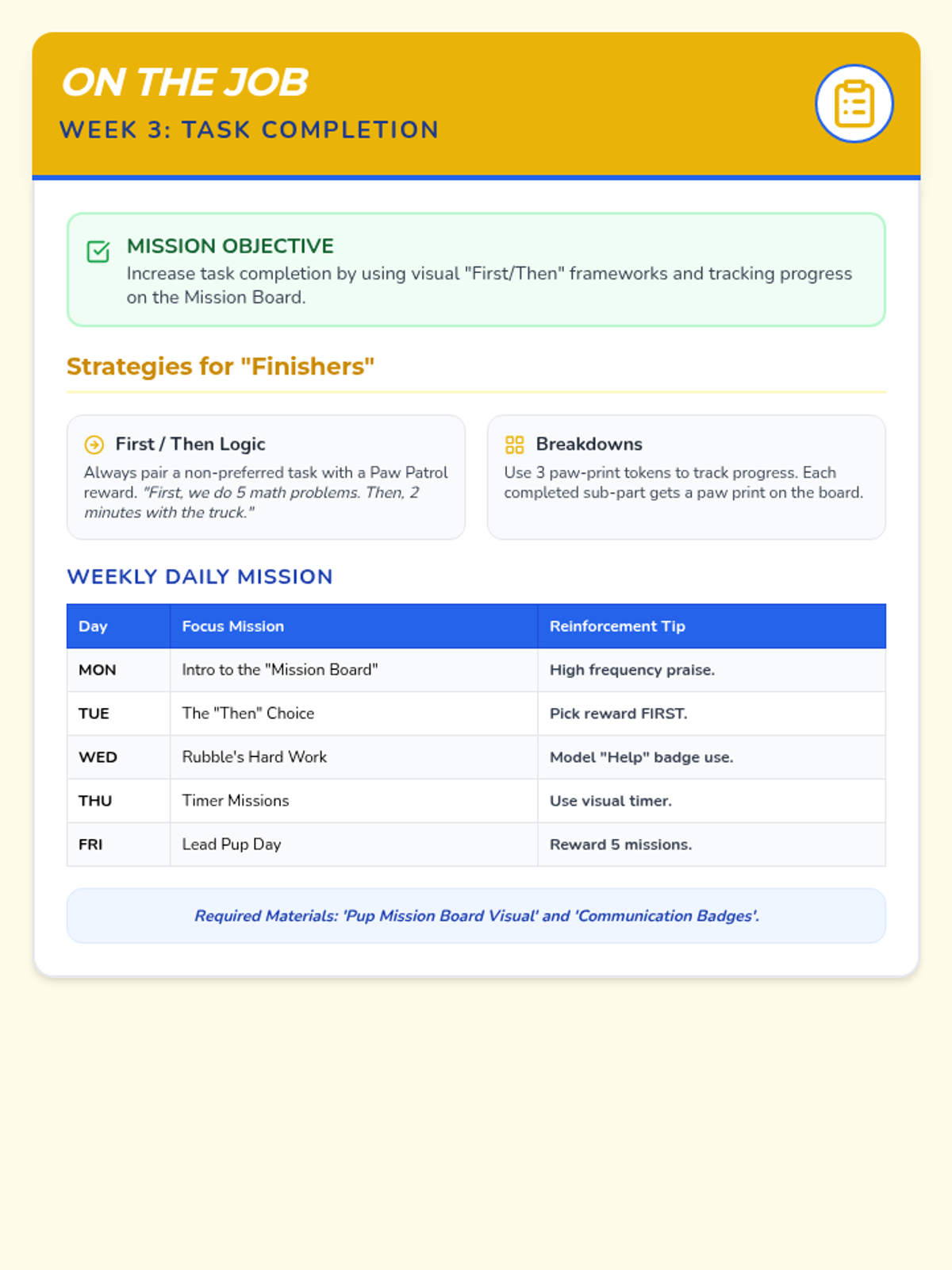
Teacher guide for Week 3. Table and layout optimized for 1-page fit with higher contrast text.
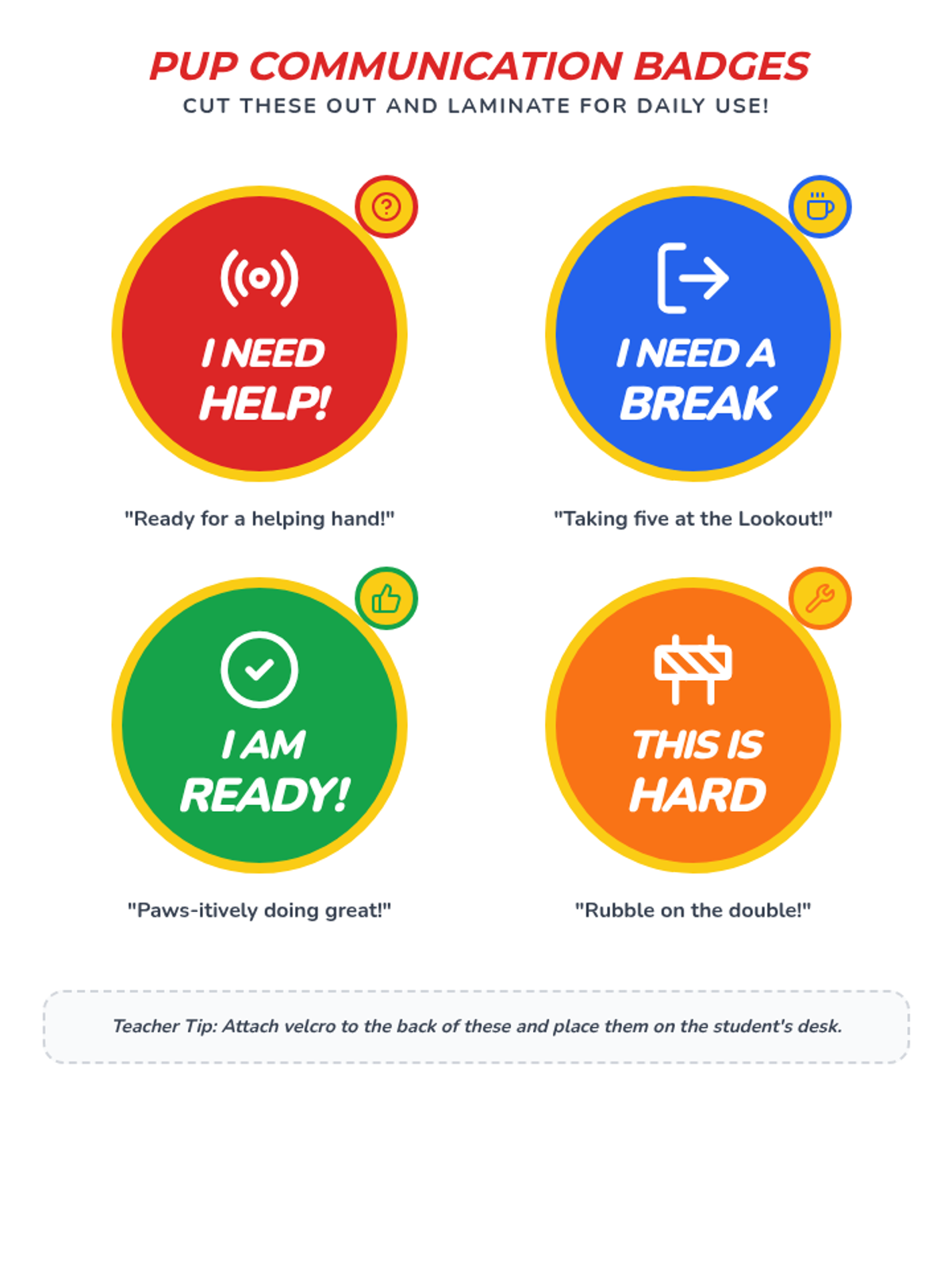
Printable non-verbal communication badges. Contrast improved and page breaks fixed.
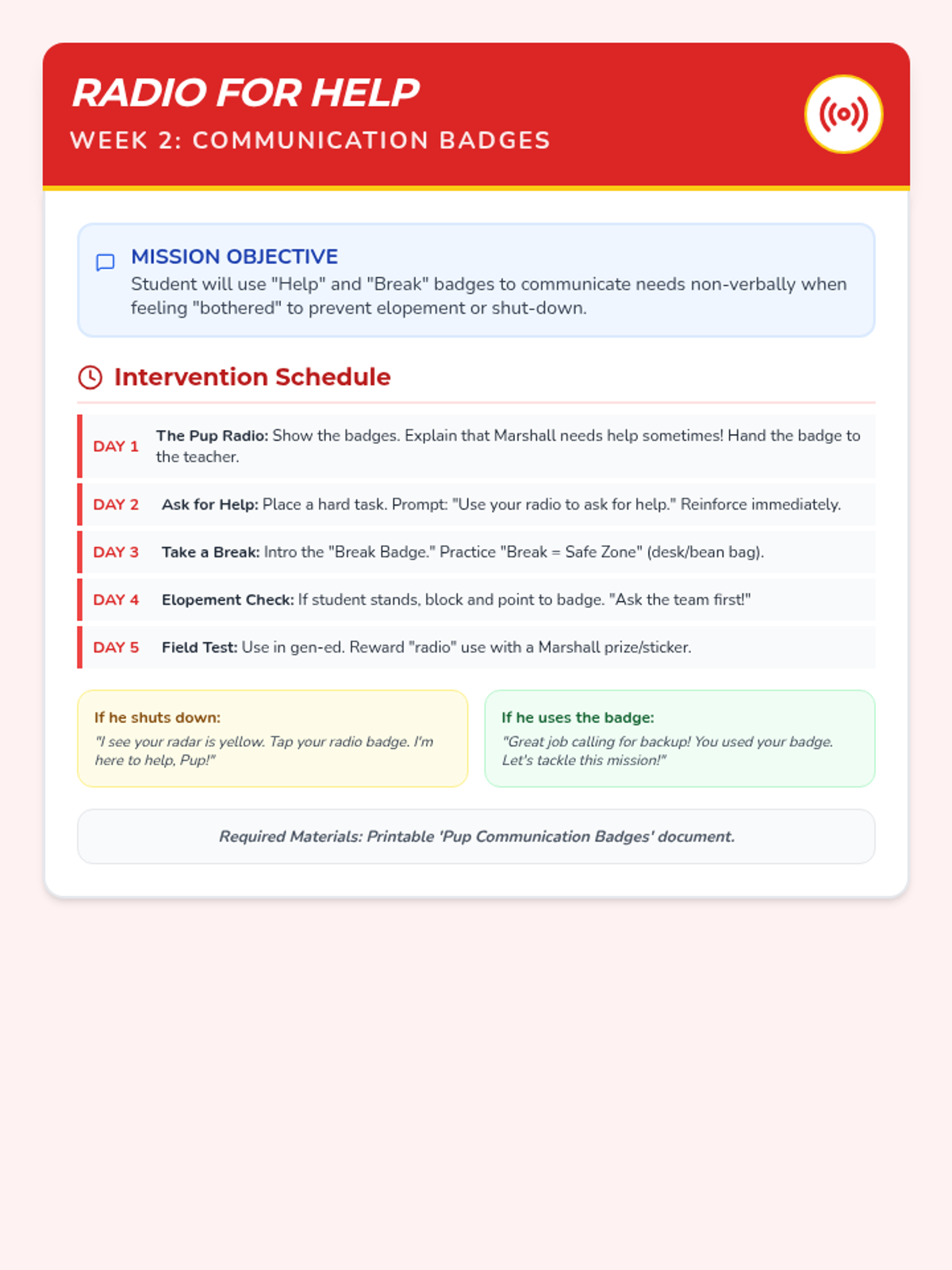
Teacher guide for Week 2, introducing 'Radio for Help' communication badges. Spacing fixed for 1-page printing.
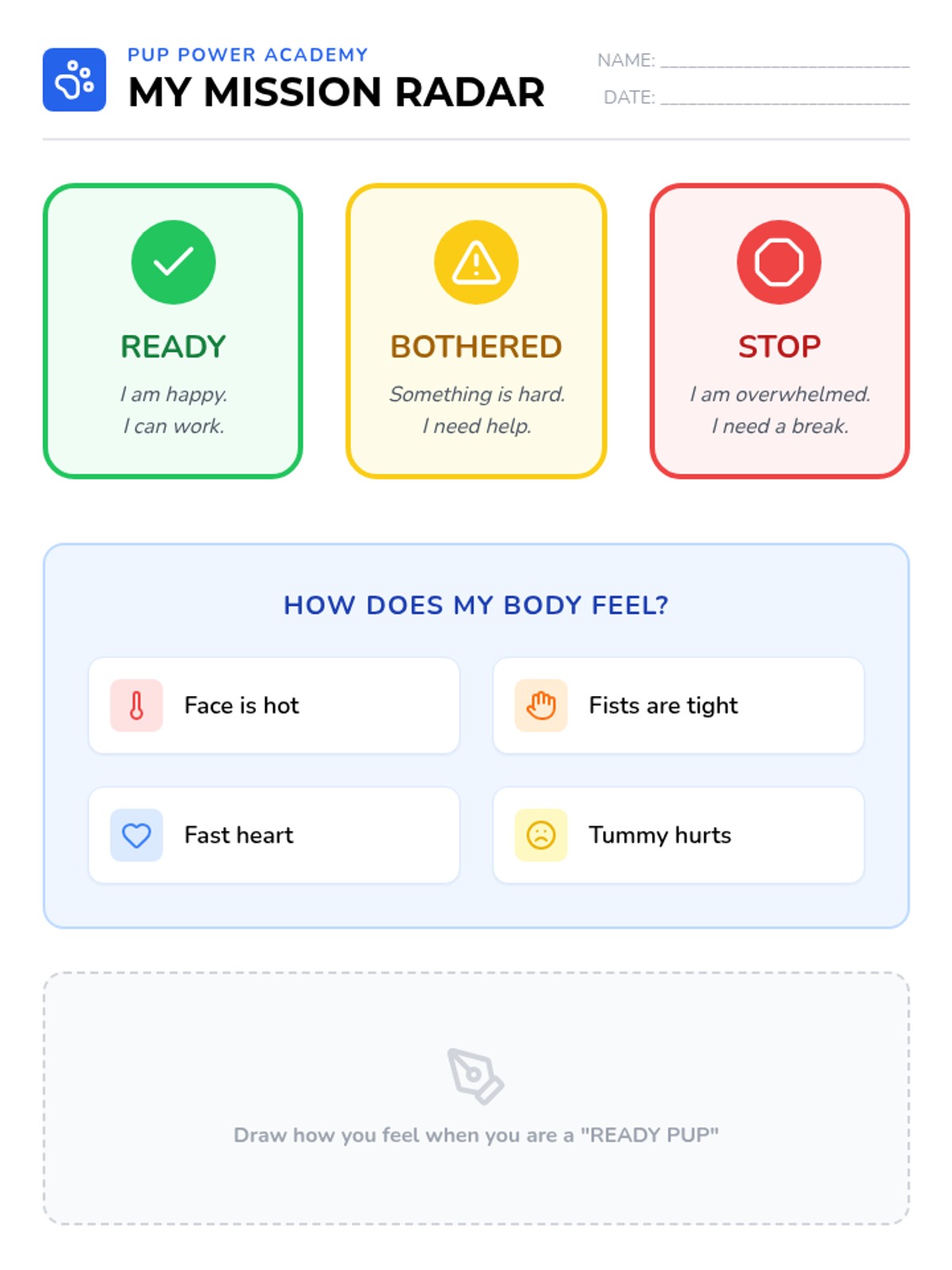
Student visual aid for Week 1, featuring a color-coded 'Mission Radar' to help identify feelings and physical symptoms of stress.
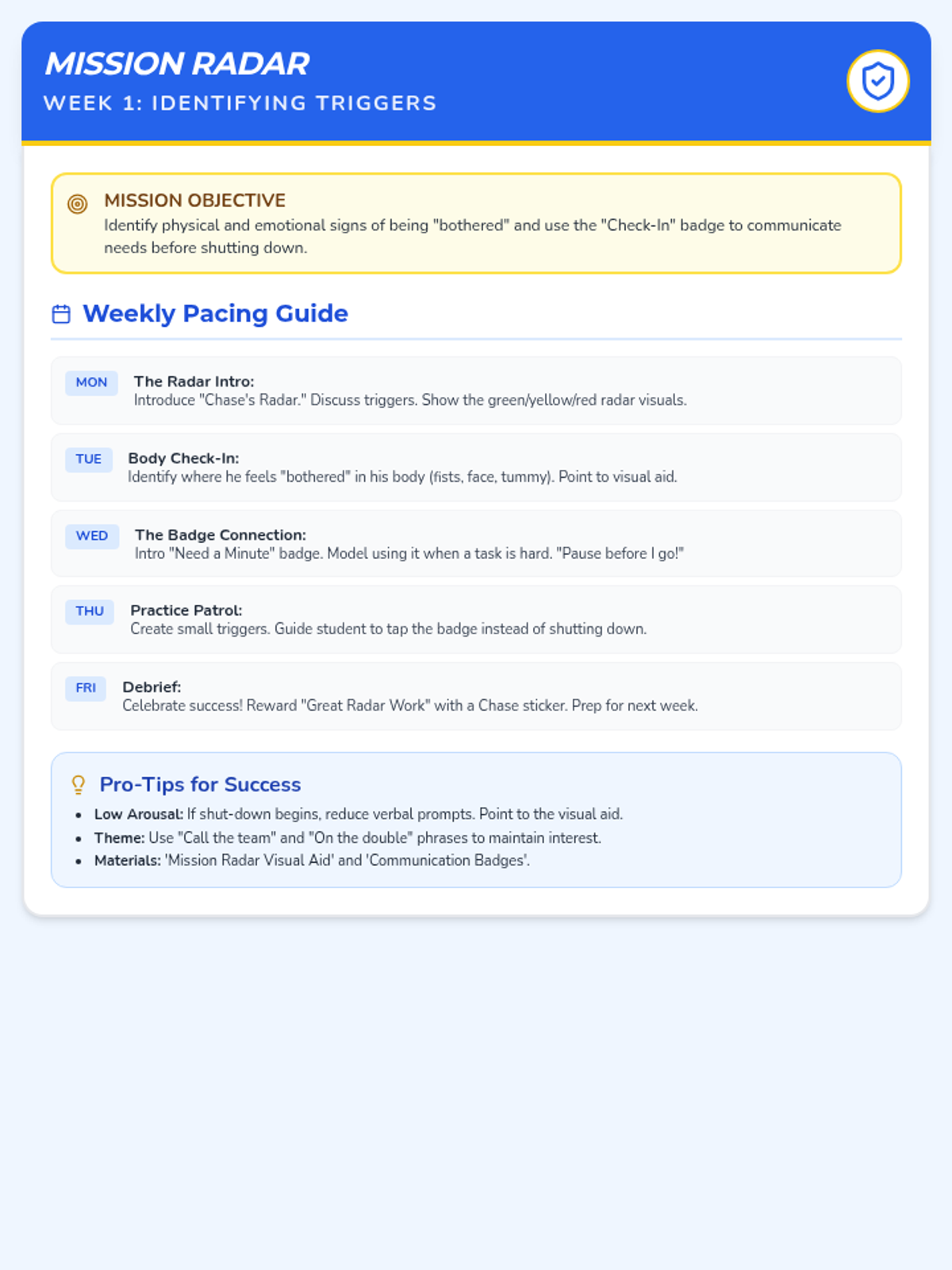
Teacher-facing lesson plan for Week 1, focusing on identifying emotional triggers using the 'Mission Radar' concept. Spacing updated for 1-page fit.
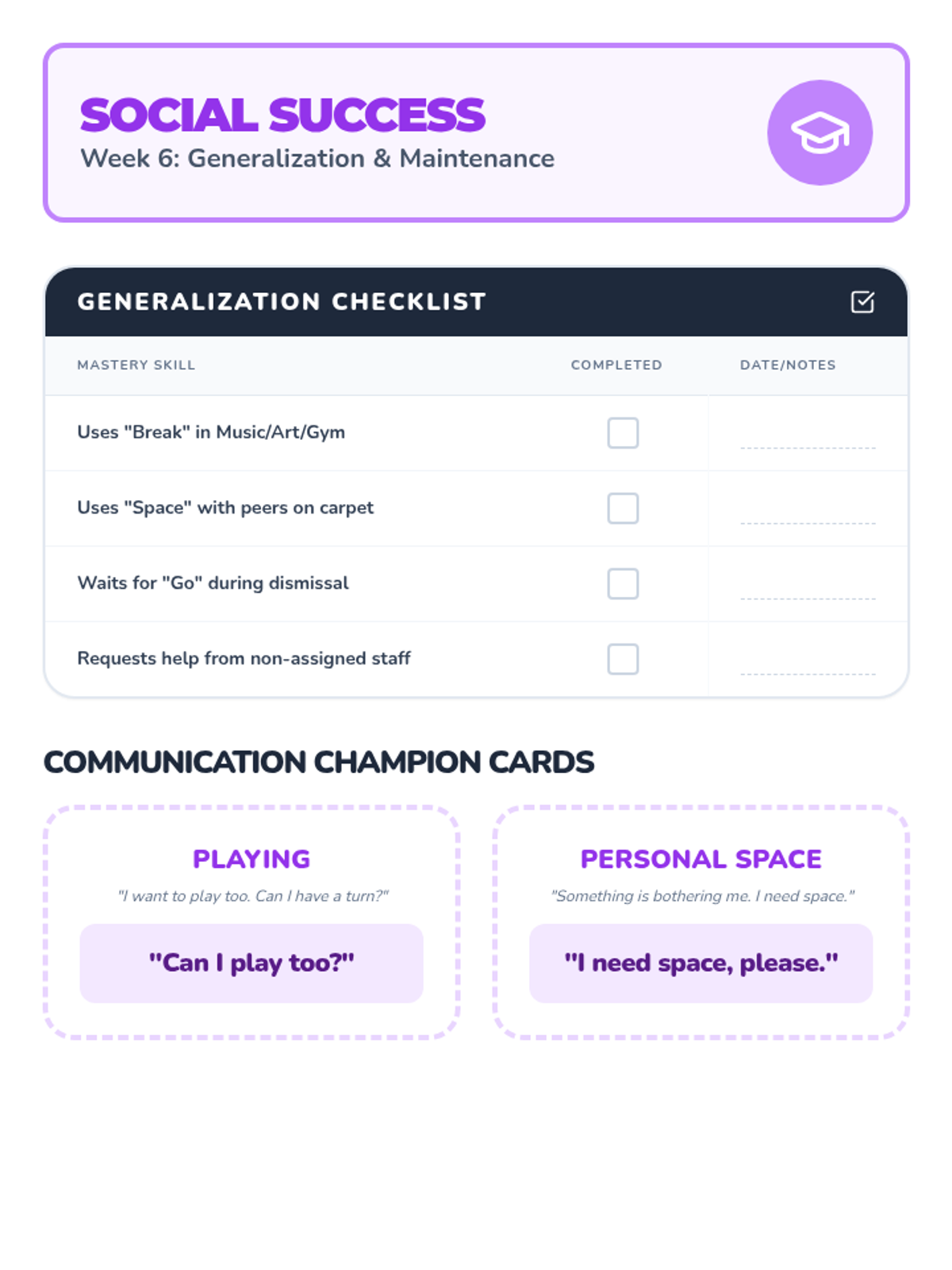
A generalization checklist, peer prompt cards, and an achievement certificate for Week 6, updated with a better tracking table, reinforced layout to prevent card splitting, and a larger, centered achievement certificate.
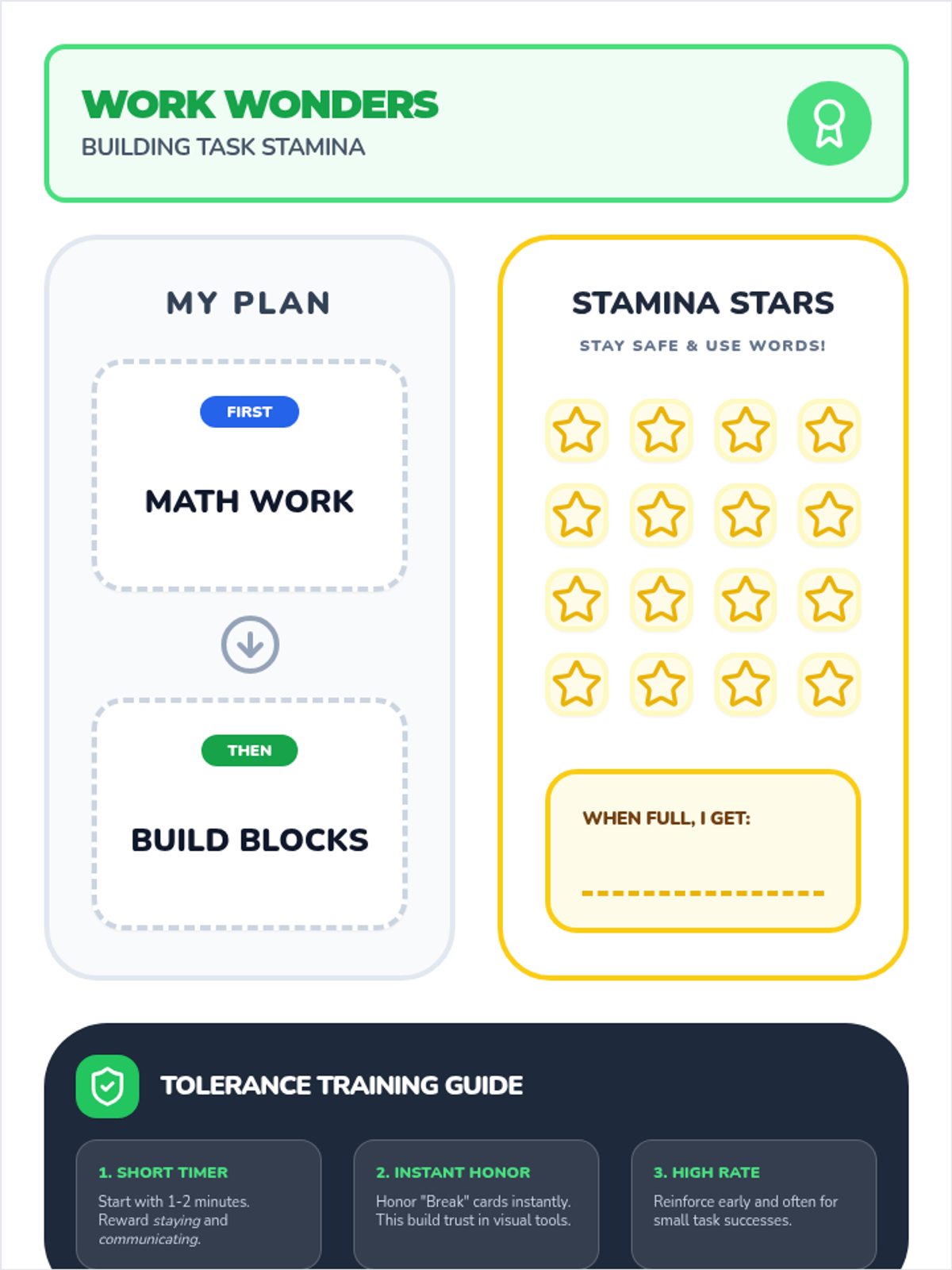
A 'First/Then' board and stamina tracking chart for Week 5, updated with higher contrast placeholder text, a refined layout that keeps teacher strategies on the same page, and a cleaner stamina star grid. Content sizing adjusted for 1st-grade readability.
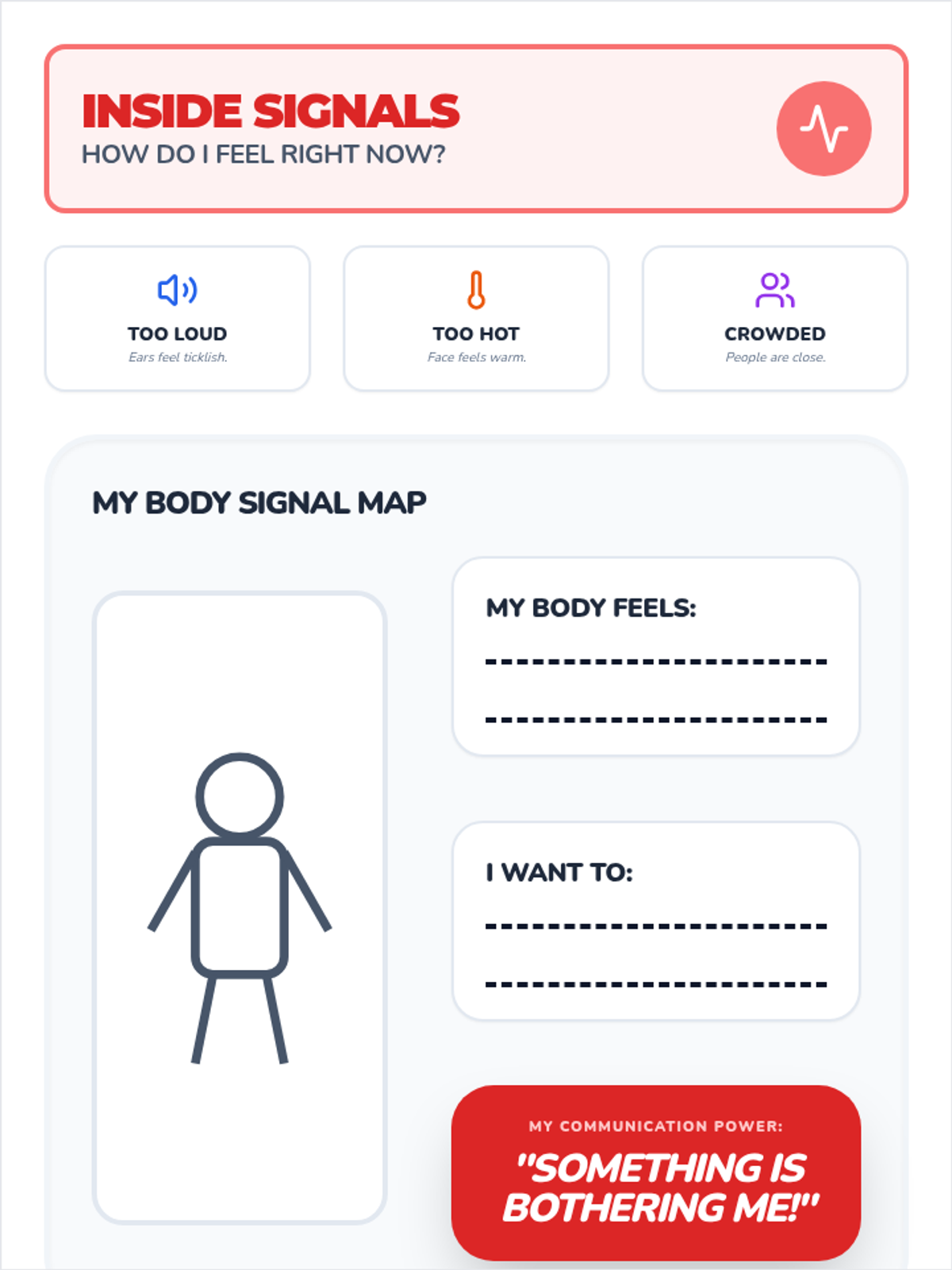
A 'Body Check' chart and student activity for Week 4, updated with improved body outline visibility, larger handwriting lines for primary students, and a layout that fits entirely on one page.
Visual instruction slides for Week 3, updated with improved text contrast, literal icons for clearer communication, and larger font sizes for 1st-grade readability. Content bleeding issues and typography collage resolved.
A choice board and preference sheet for Week 2, updated with larger text, high-contrast options, and a refined layout to ensure all content fits on a single printed page. Content is now split across two logical pages to prevent overflow.
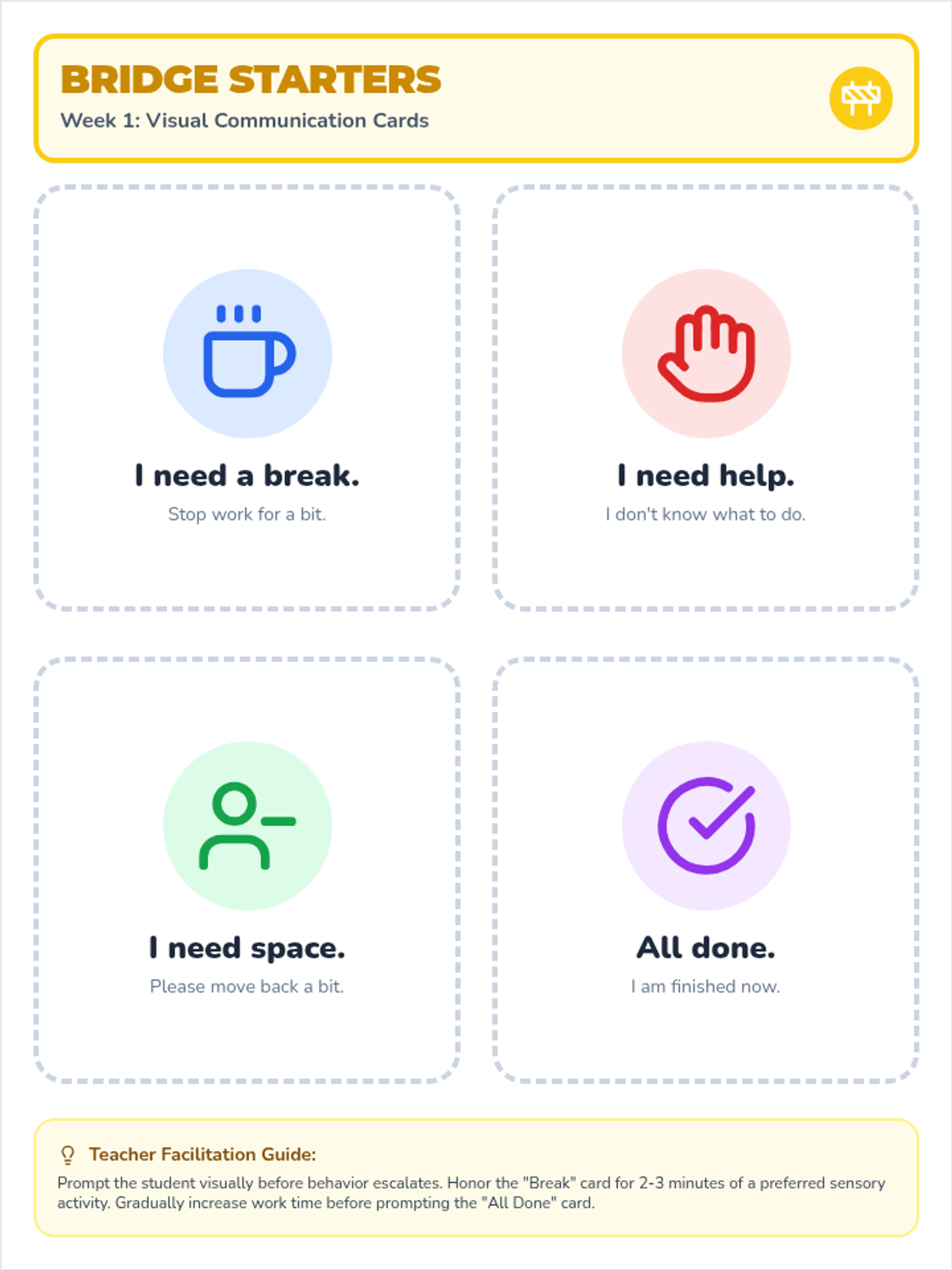
A set of visual functional communication cards and a teacher facilitation guide for Week 1, focusing on teaching 'Break' and 'Help' requests to replace task avoidance. Improved icon clarity and page layout for print.
A set of 12 adventure-themed task cards for 'Where' questions. Visuals are optimized at 5xl with fixed-size container boxes to ensure they fit perfectly within the task cards while remaining large and accessible for students. Question text is consistently aligned. Image for Farm updated to a red house structure to represent a barn. Label and emoji consistency improved. Image for Igloo, Fridge, and Grass updated for better accuracy.
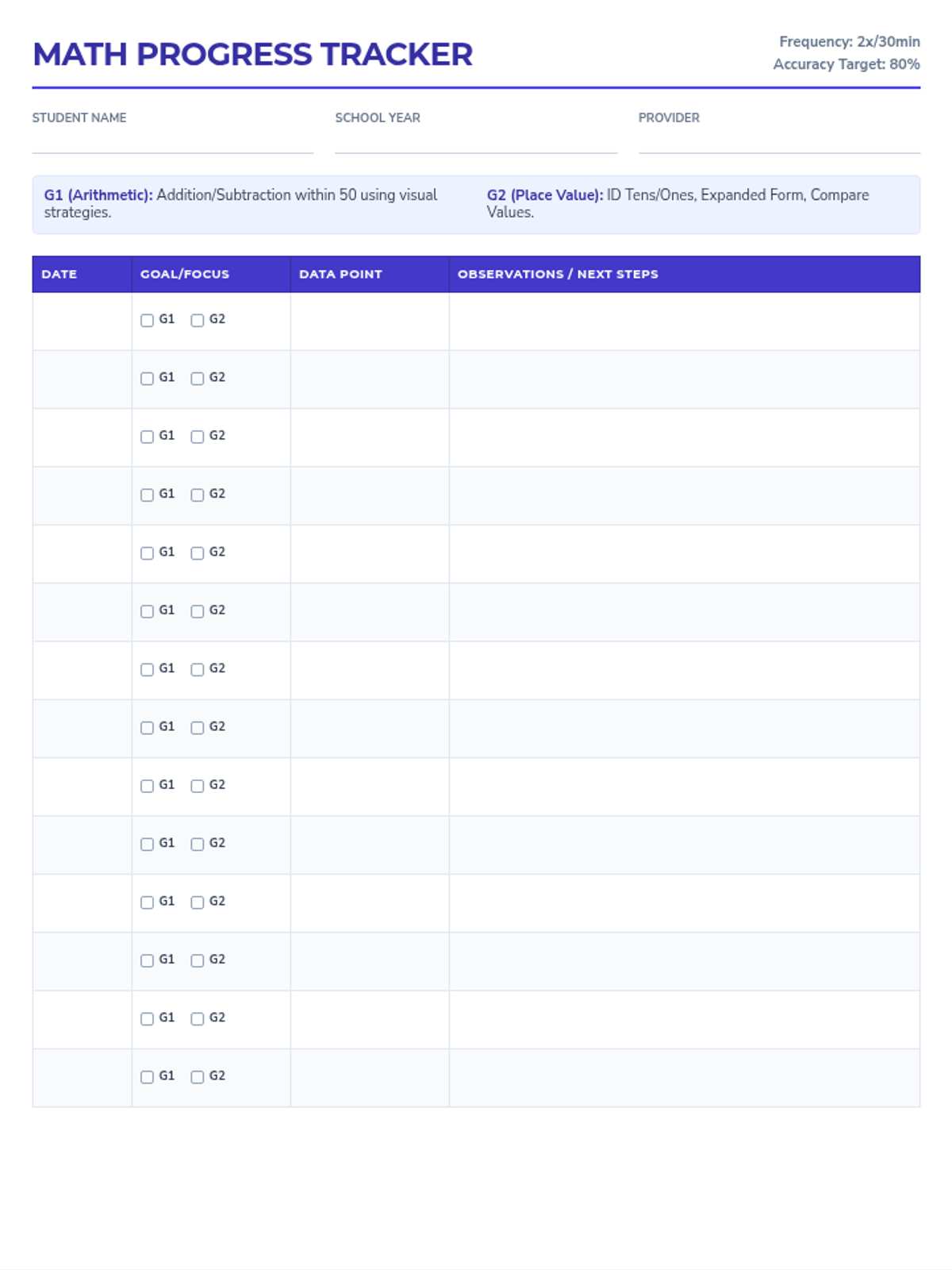
A dual-purpose tracking document containing a daily service log for arithmetic and place value instruction alongside a quarterly progress monitoring table and visual graphing area.
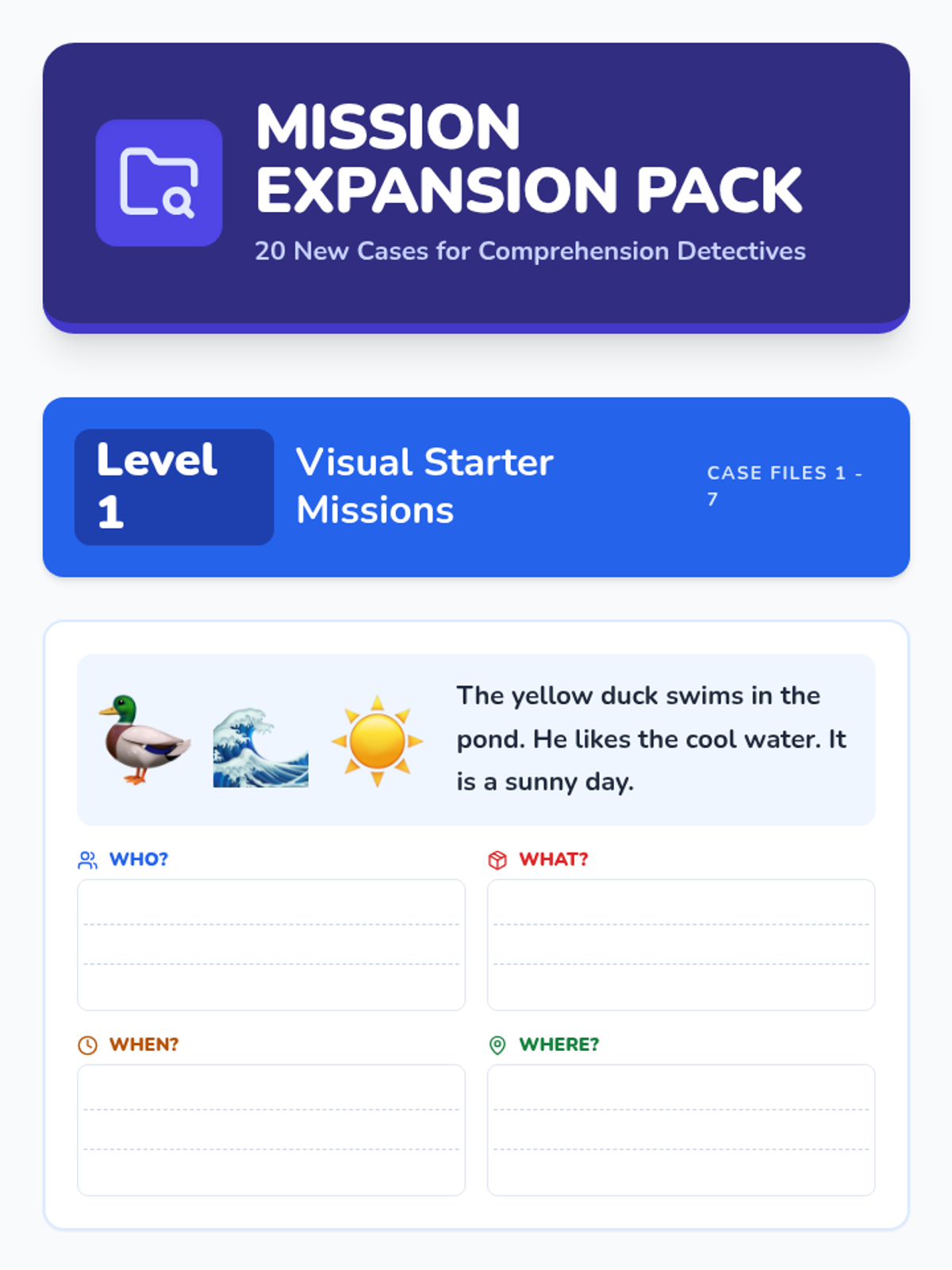
An extensive collection of 20 new tiered reading comprehension passages. Organized into three levels of increasing complexity, each mission features a unique scenario with structured answer areas for identifying Who, What, When, and Where.
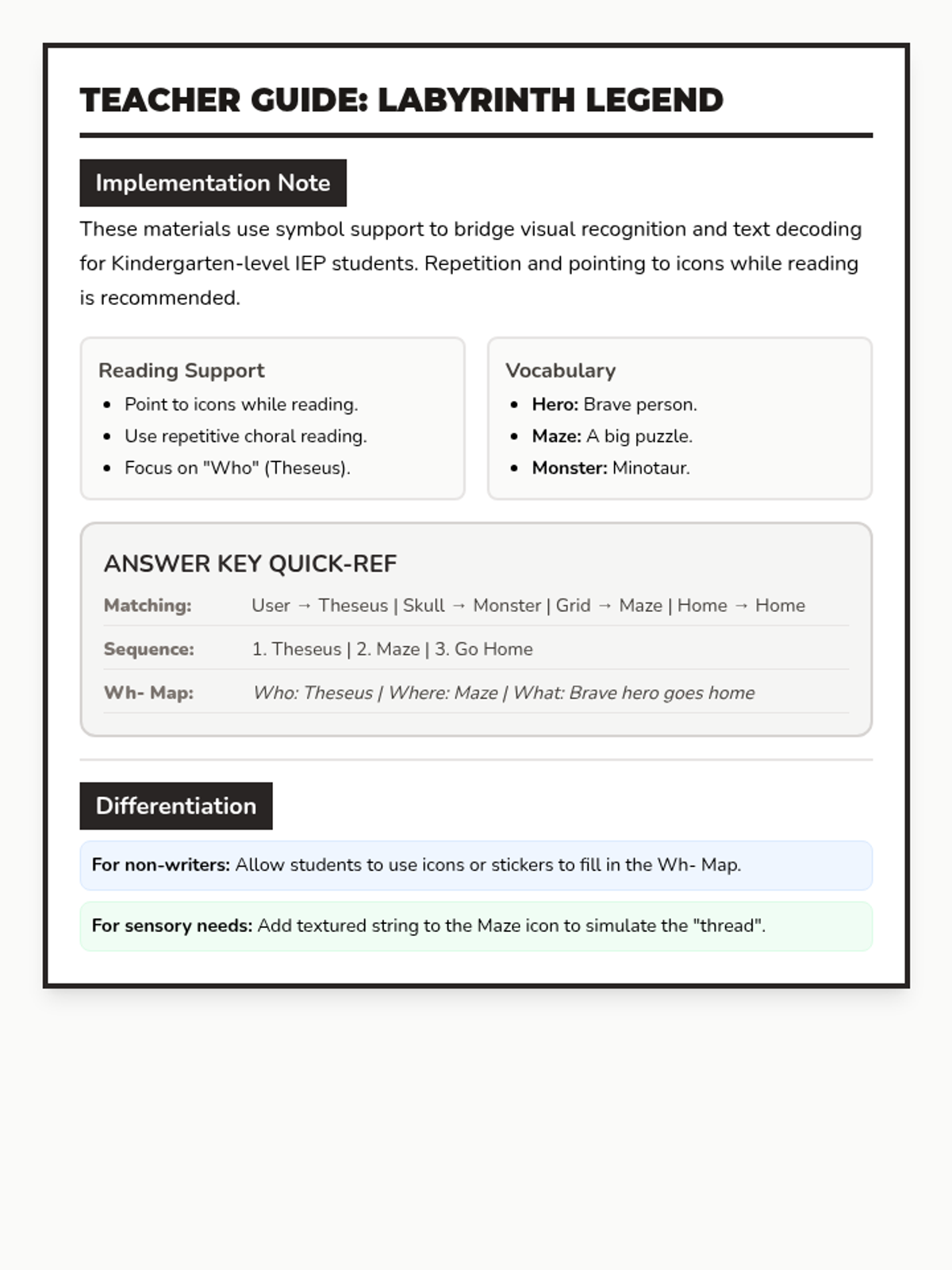
A teacher-facing resource providing implementation strategies, vocabulary definitions, answer keys, and differentiation tips for the Labyrinth Legend lesson.
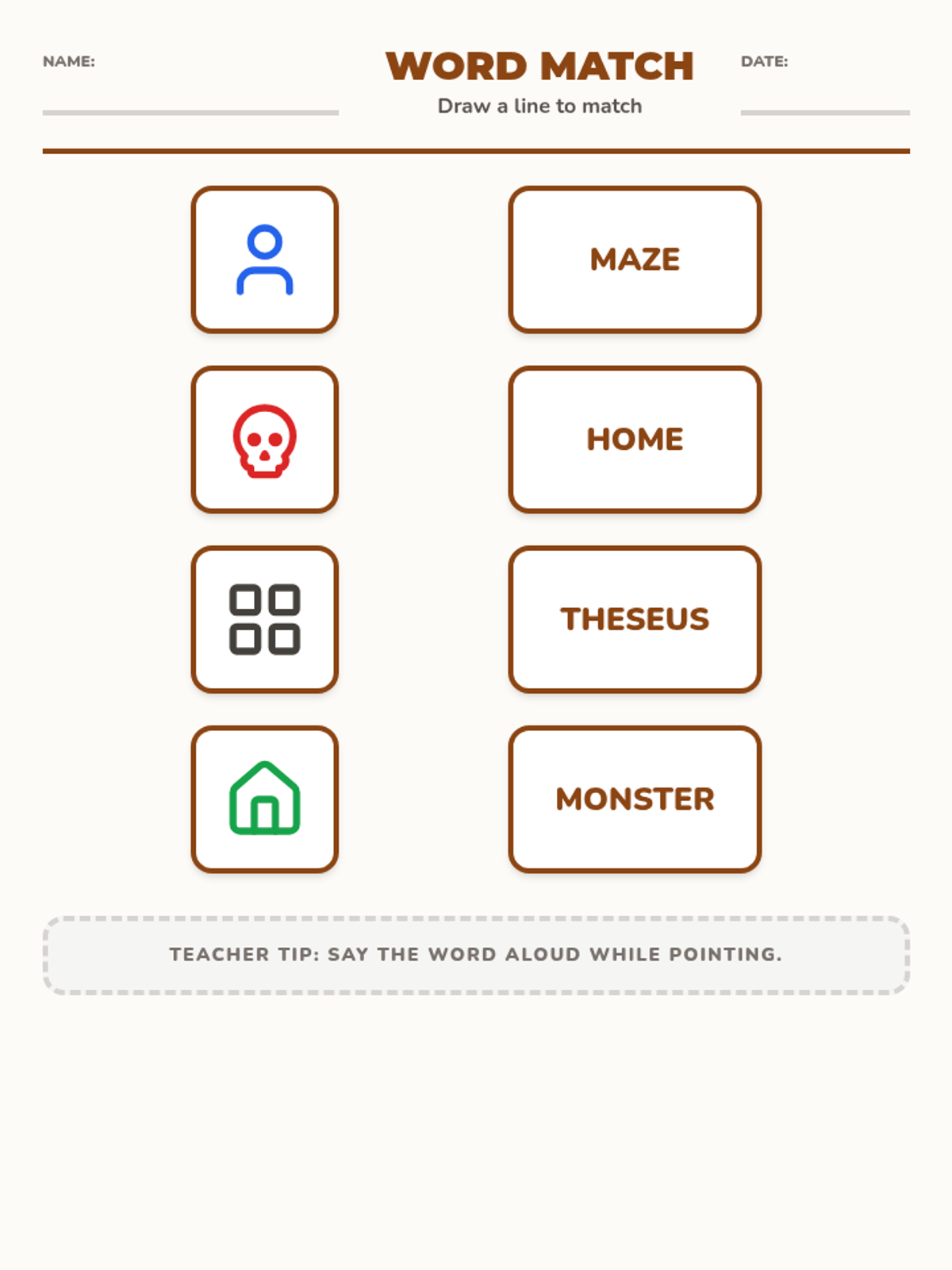
A picture-to-text matching worksheet where students connect story icons with their corresponding capitalized vocabulary words.
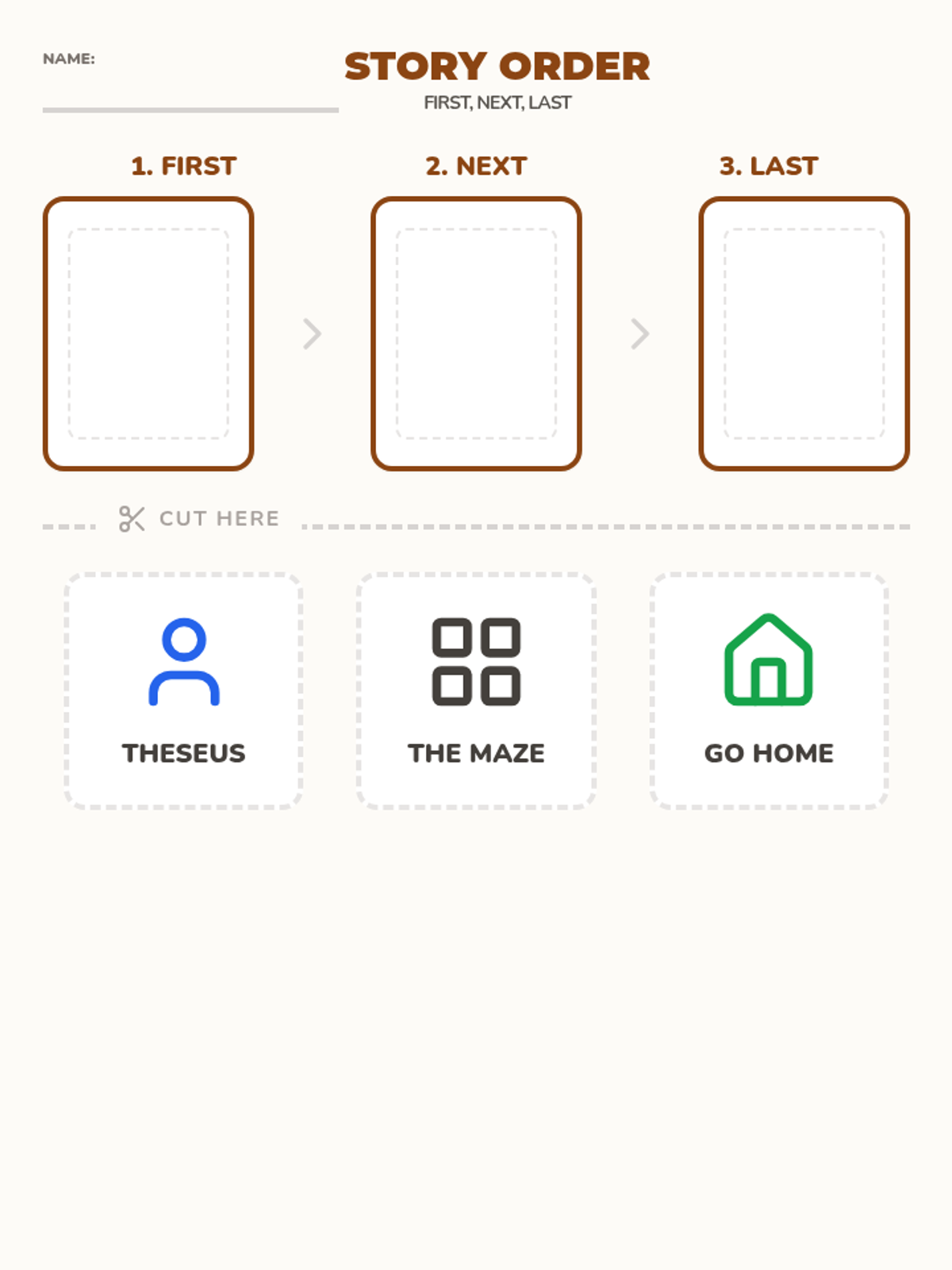
A cut-and-paste sequencing activity where students order three key events from the story (Hero, Maze, Home).
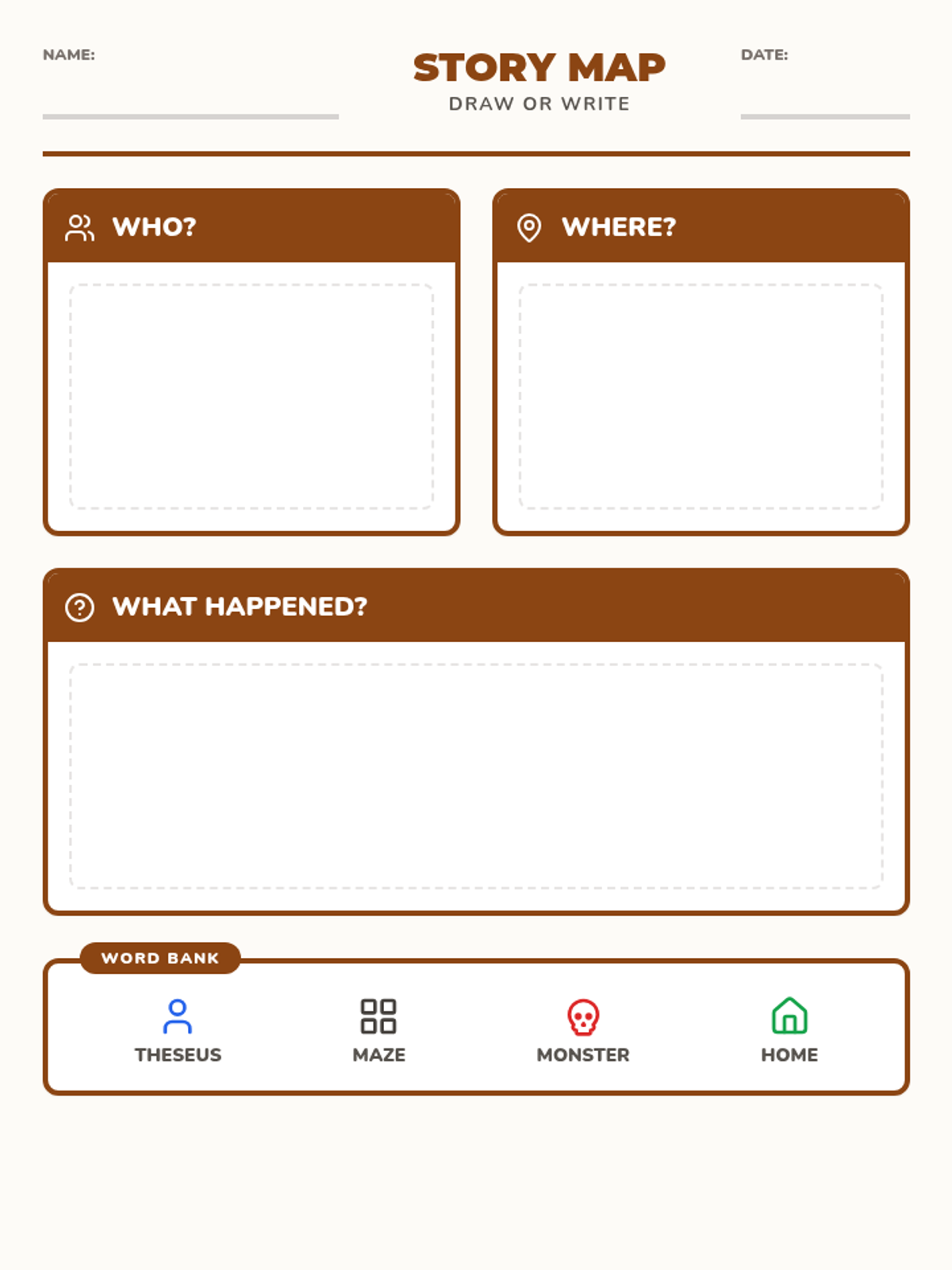
A Wh- question graphic organizer (Who, Where, What) for Kindergarten students to identify key story elements through drawing or simple writing.
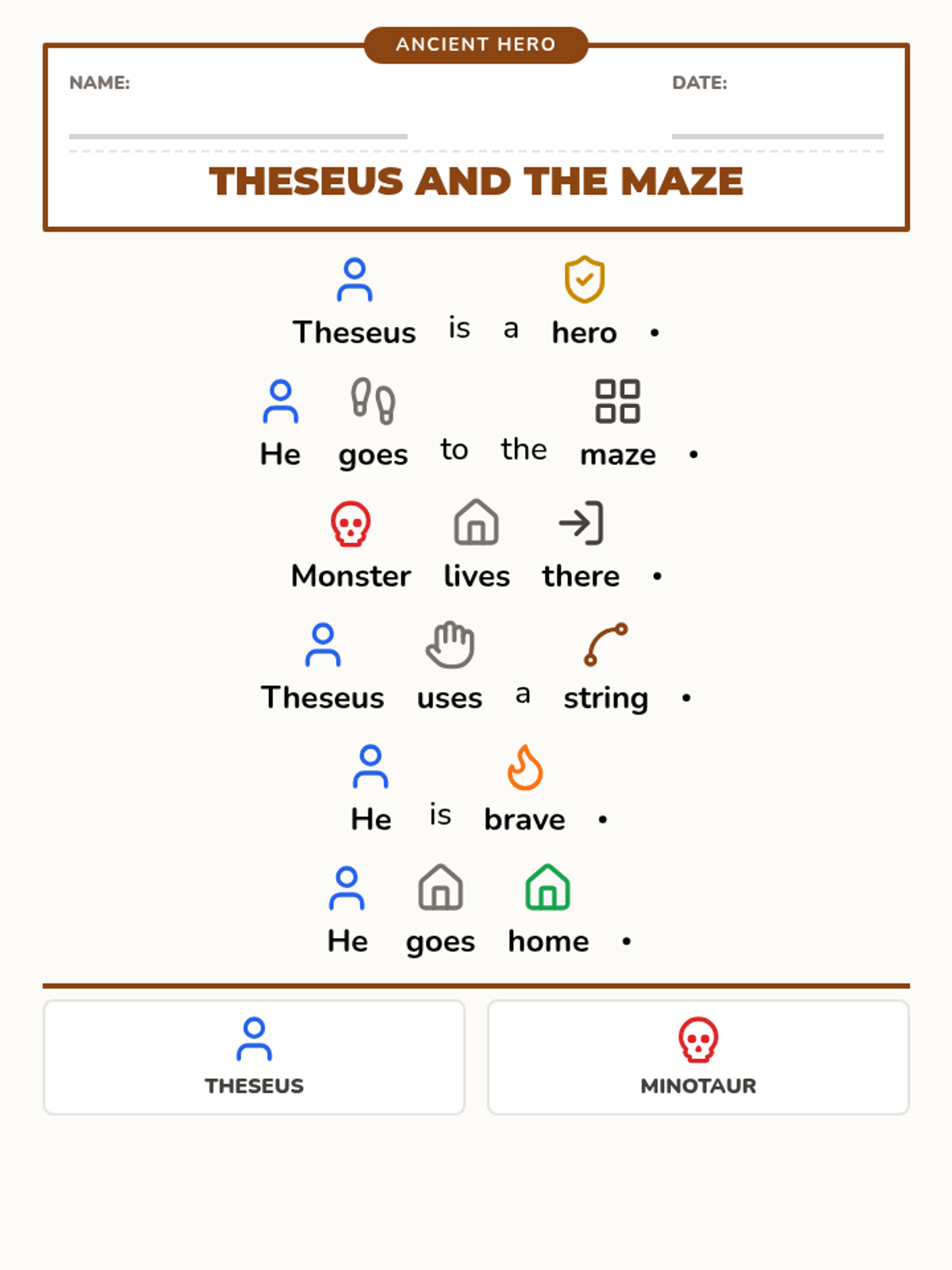
A Kindergarten-level reading passage about Theseus and the Minotaur featuring symbol support (icons above key words) and simplified vocabulary.
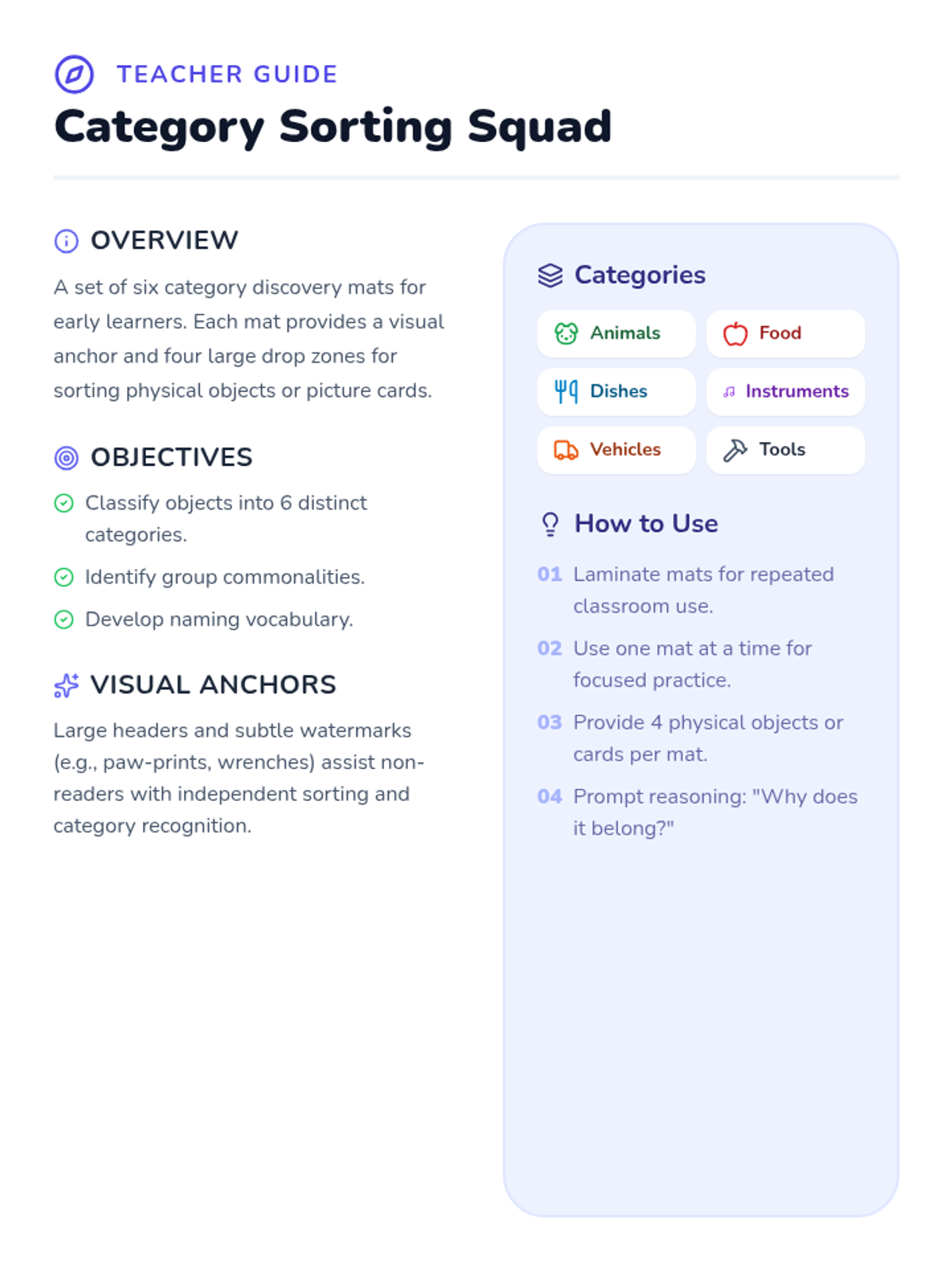
Teacher guide for the Category Sorting Squad activity, updated for the numbered square mat format.
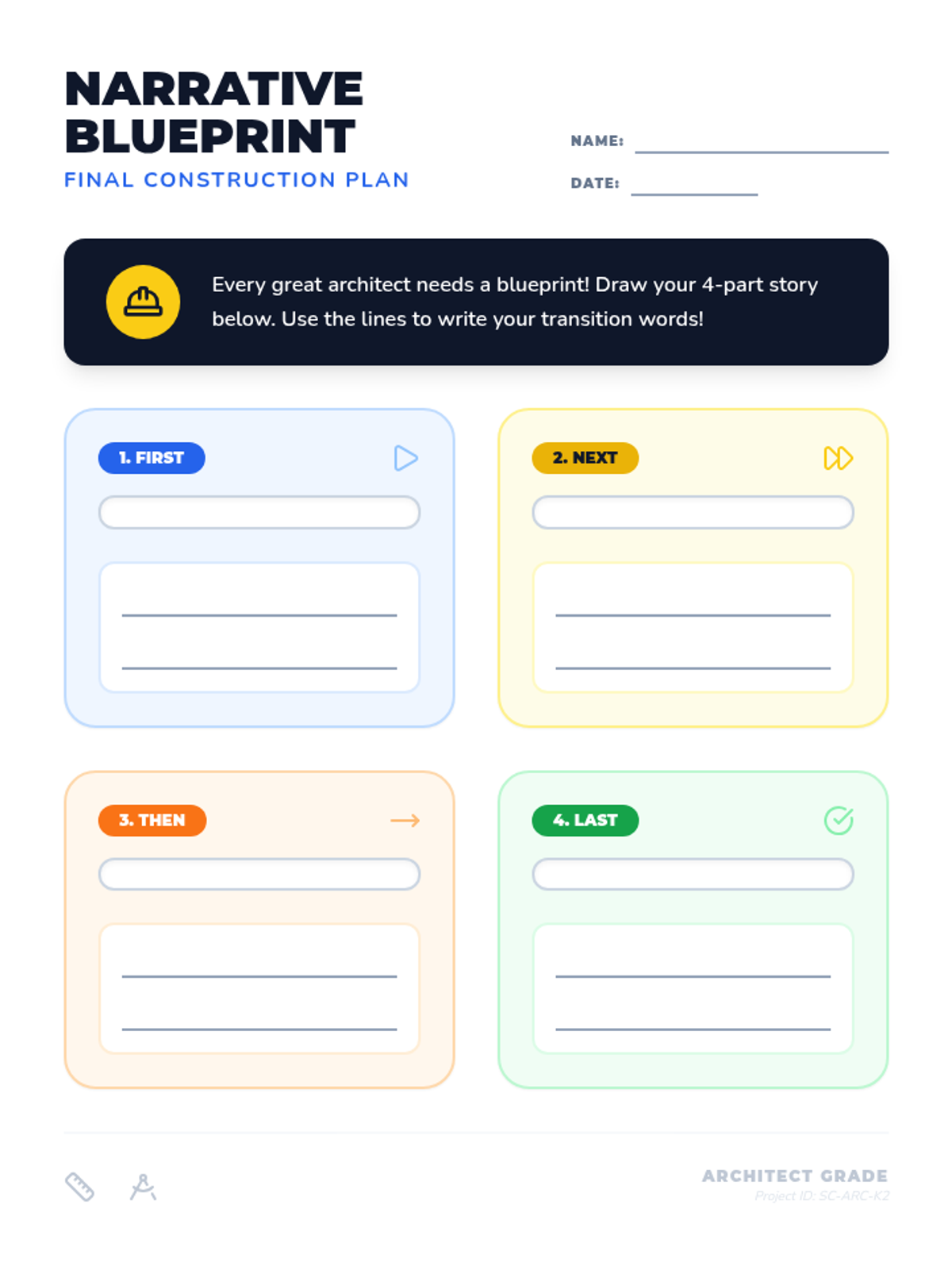
A narrative organization worksheet designed for assessment or independent practice. Features a 4-part 'blueprint' grid on a single page with large drawing areas and high-contrast writing lines.
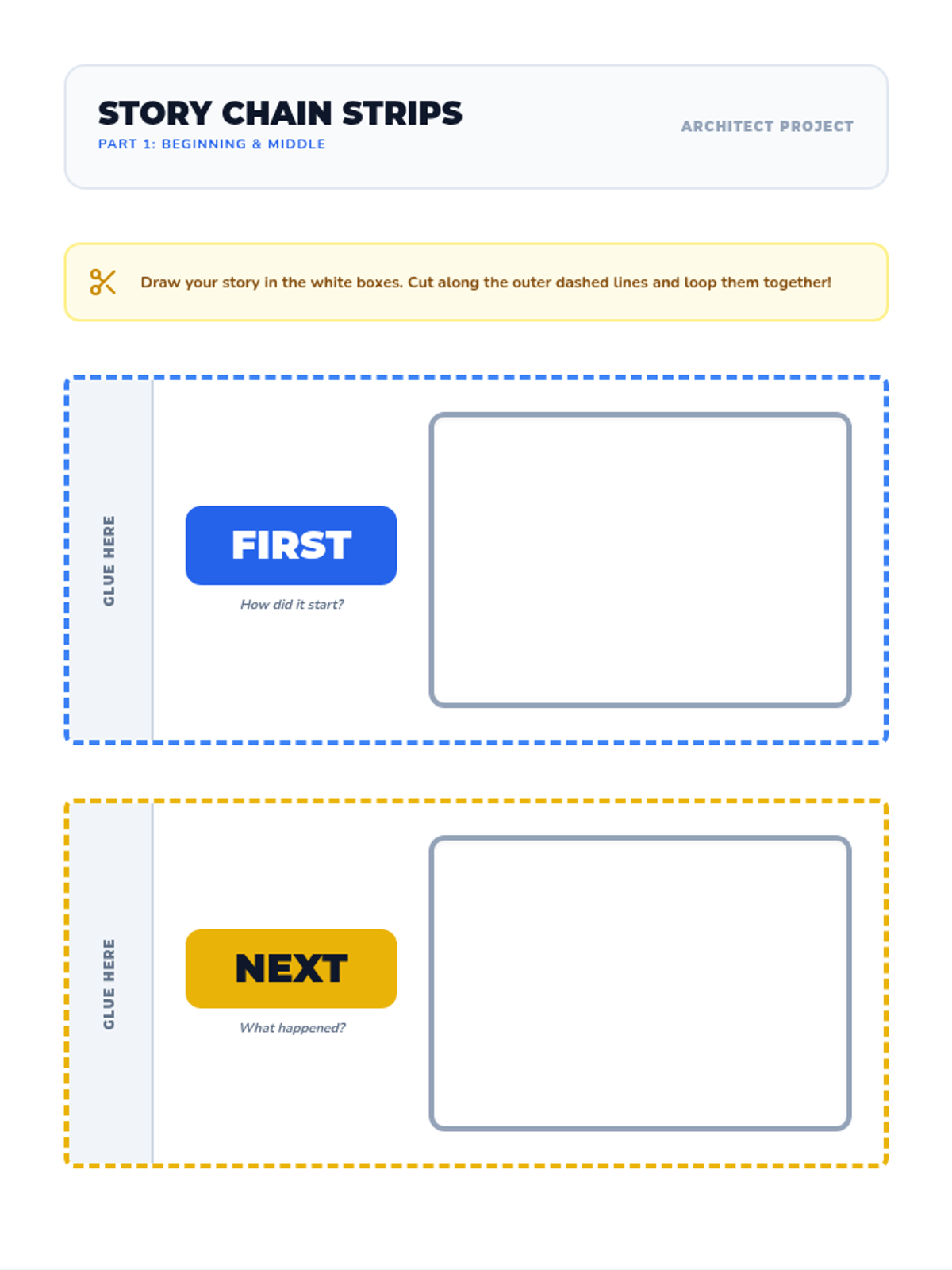
A printable activity sheet featuring tactile story links (First, Next, Then, Last). Split across two pages to provide large, white drawing areas and long strips for easy looping and stapling. Includes high-contrast labels and clear glue tabs.
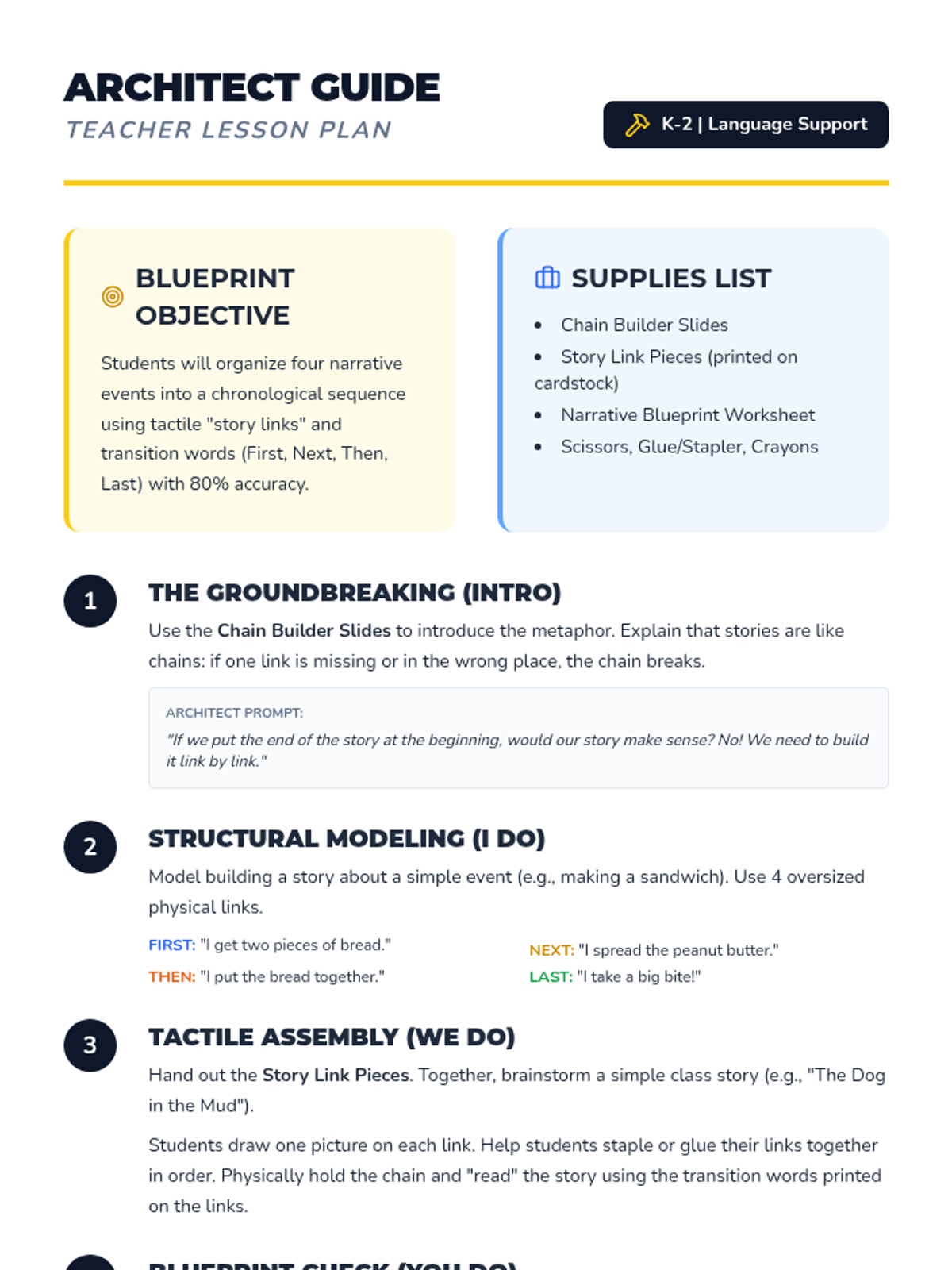
A comprehensive teacher guide for implementing the Story Chain Architects lesson. Includes clear instructional steps, modeling scripts, and differentiation strategies for language-delayed students.
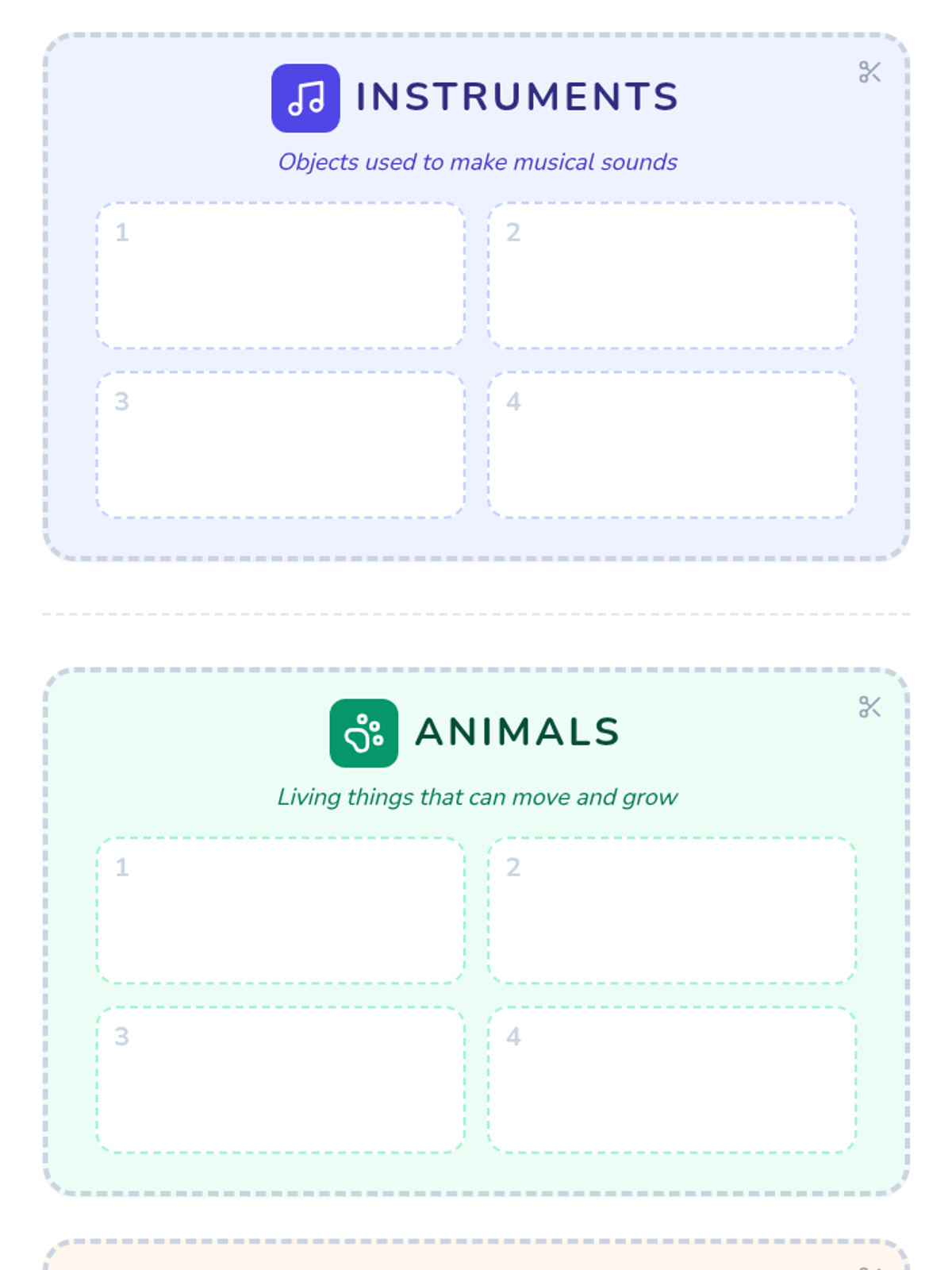
A collection of six half-page sorting mats for instruments, animals, foods, vehicles, tools, and dishes, reverting to the bold, centered-number layout while including the brief descriptions.
A bold, visual presentation for K-2 students that introduces the concept of building a story 'link by link' using the Architect metaphor. Features large text and clear transition words (First, Next, Then, Last).
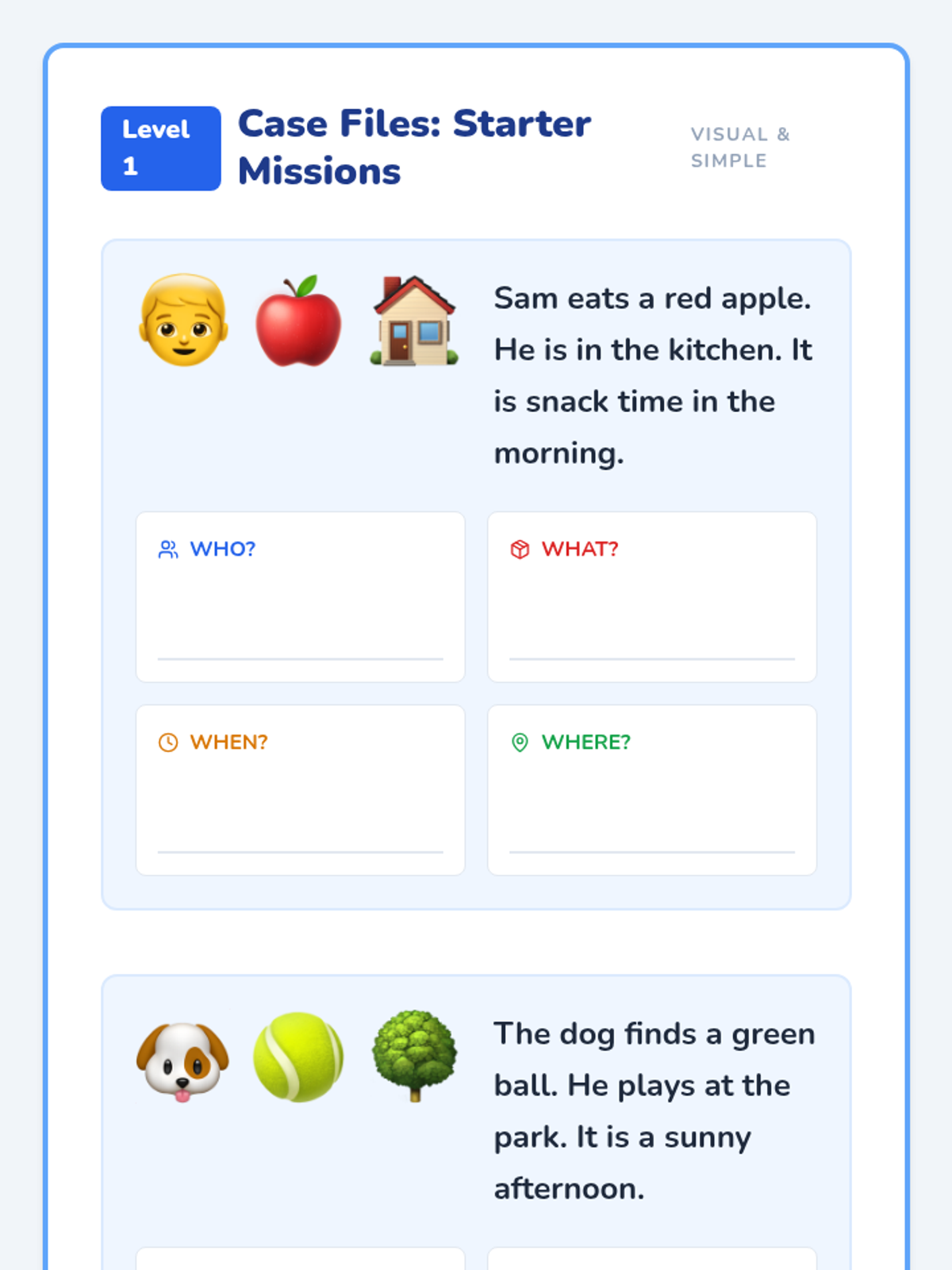
A tiered set of reading comprehension passages ranging from highly visual Level 1 starter missions to Grade 1-2 Level 3 missions. Each passage includes structured answer areas for identifying Who, What, When, and Where.
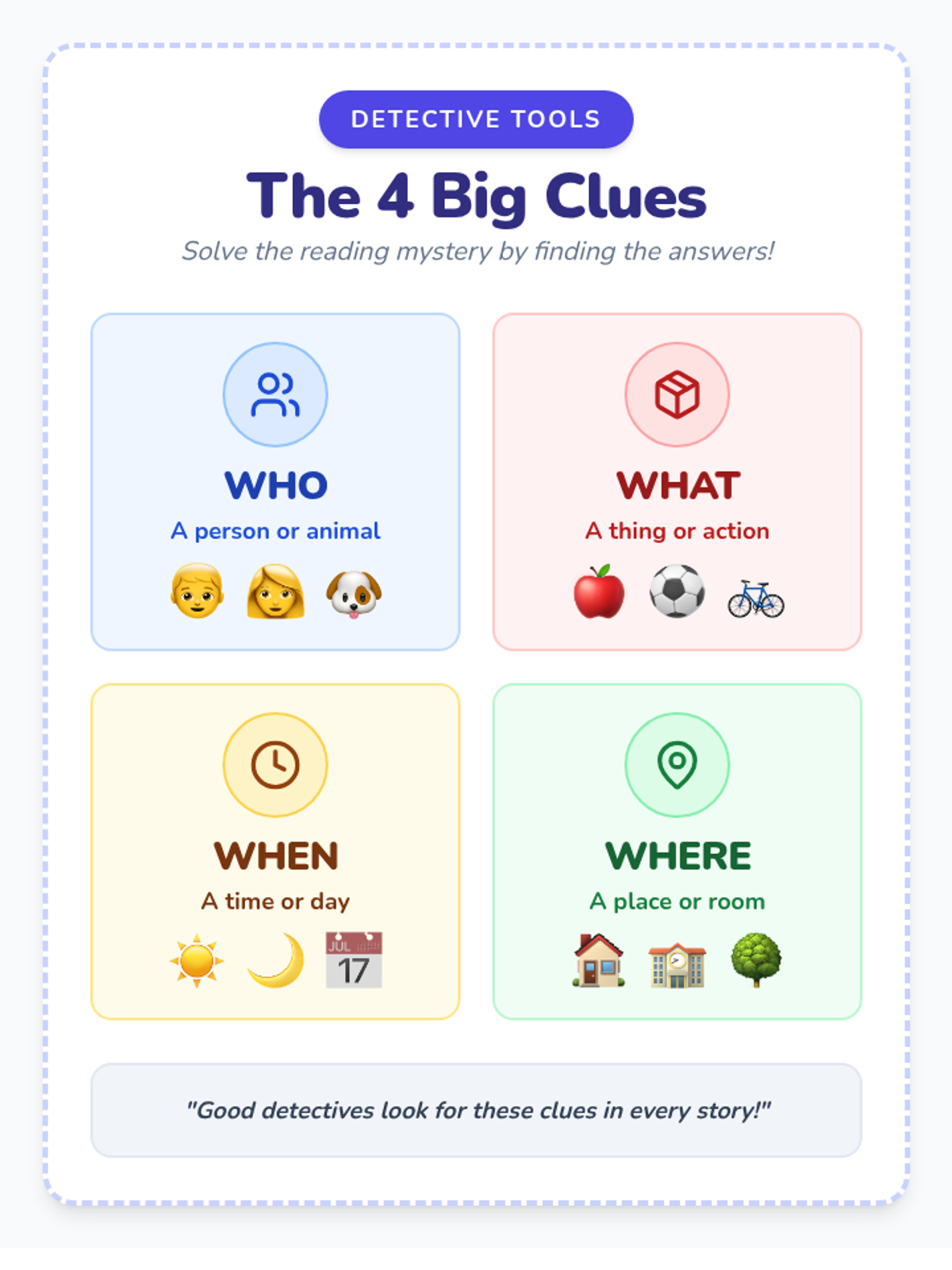
A highly visual anchor chart designed for autistic students to help them understand the 'Who, What, When, and Where' questions through icons and simple category examples.
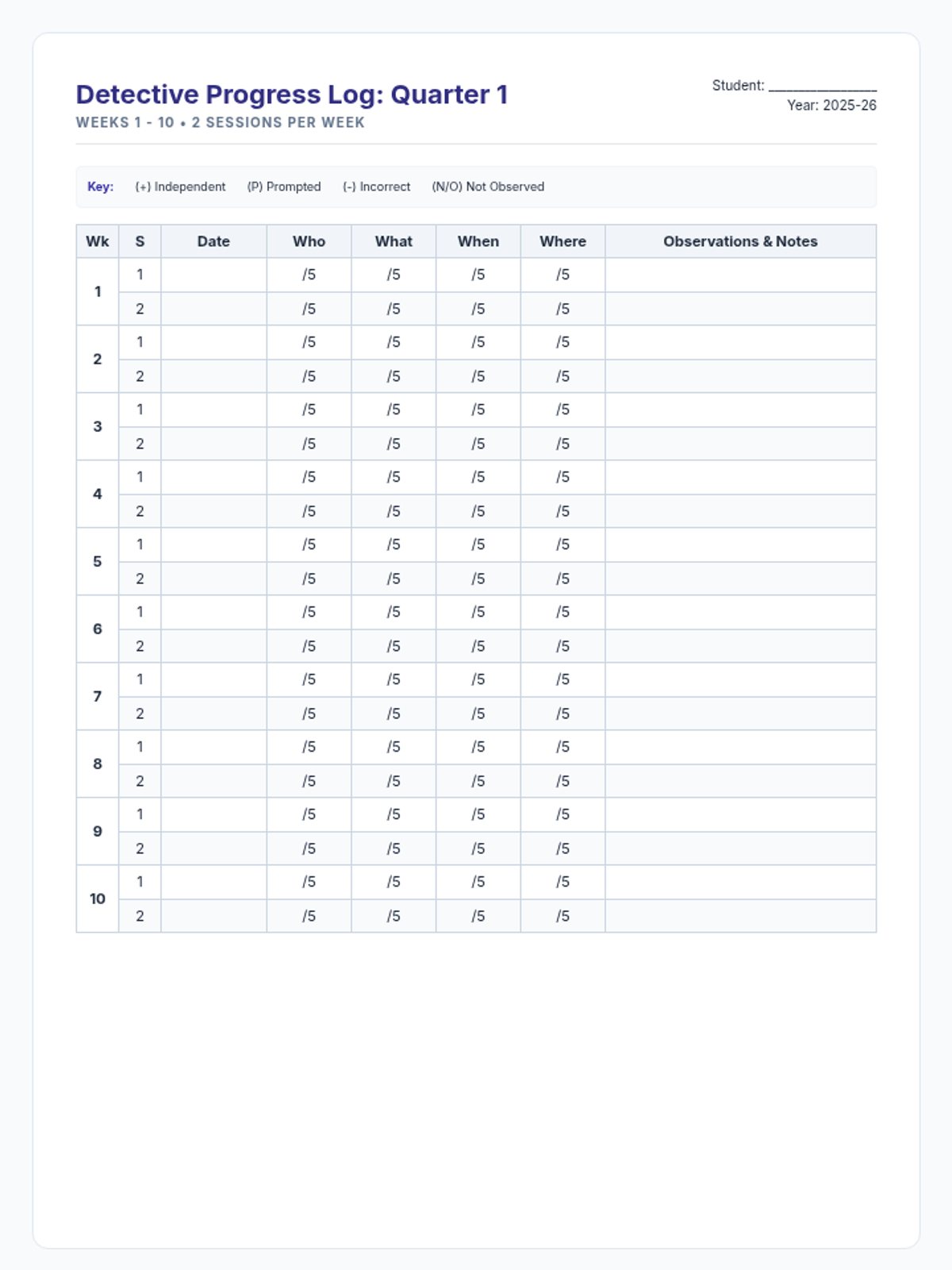
A detailed 40-week progress monitoring and service log designed for tracking reading comprehension data. It includes structured space for 2 weekly sessions across 4 quarters, focusing on accuracy for Who, What, When, and Where questions.
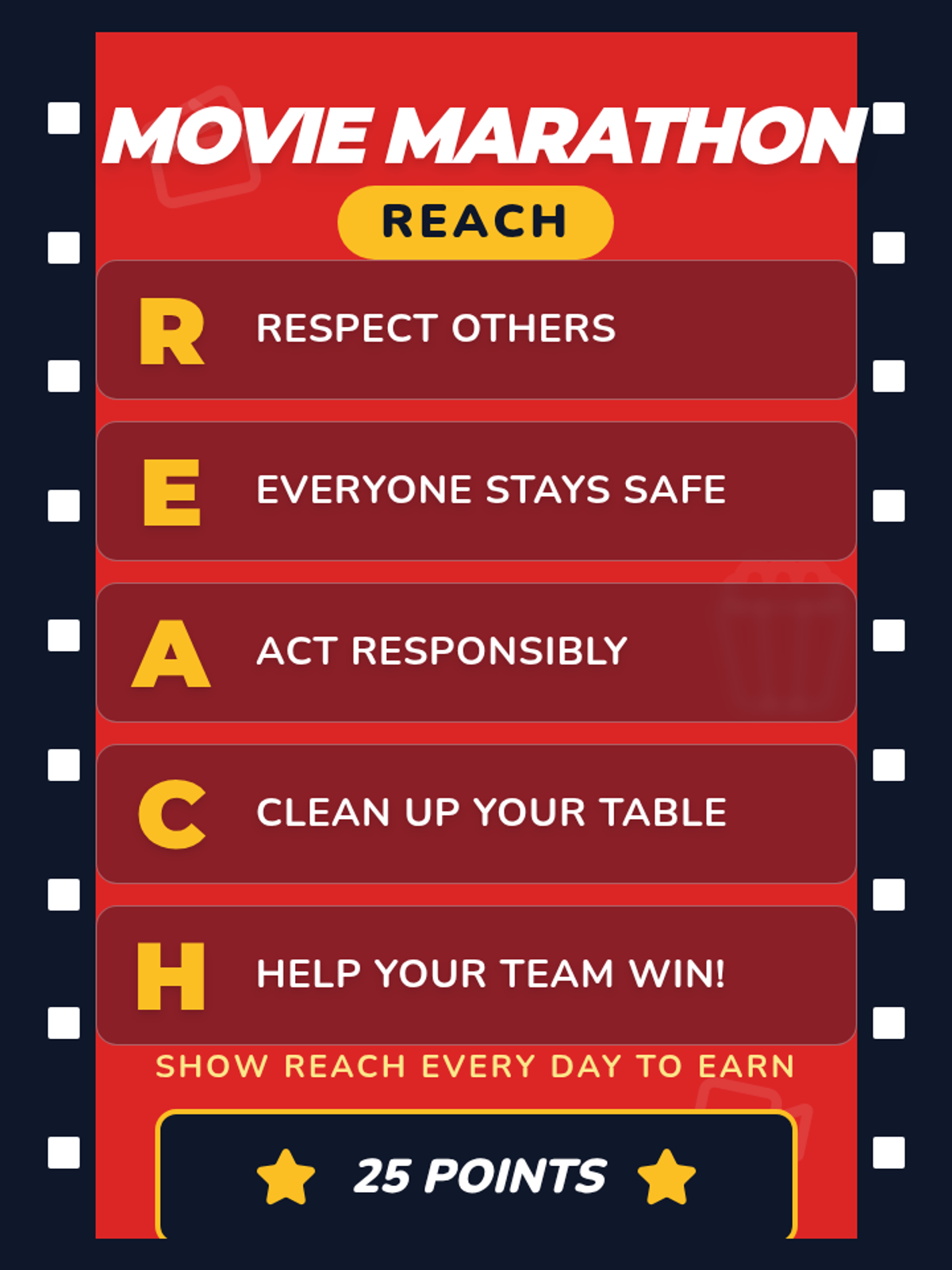
A bold motivational poster using the REACH acronym (Respect, Everyone safe, Act responsibly, Clean up, Help team) to encourage students to earn their movie reward.