A clear visual anchor chart contrasting geometric equality and congruence. Perfect for student reference or as a classroom poster, it uses specific notation examples to clarify common misconceptions.
A visual example and mockup of a completed 'Evidence Board' poster for Case 202, demonstrating how students should present their visual plot, statistics, verdict, and outlier analysis. Revised for single-page layout.
An answer key for the Distribution Debrief Exit Ticket, providing correct answers and brief pedagogical explanations.
A brief end-of-lesson assessment checking student understanding of how outliers affect mean vs median and when to use specific statistical measures. Two tickets per page for efficient printing. Revised for layout and uniform answer choices.
A guide for the collaborative poster activity featuring specific case studies for students to analyze and 'peer review' cards for a gallery walk. Revised with larger peer review cards and better layout.
An answer key for the Case Notes handout, providing calculations for mean and median and clear explanations of why certain measures are preferred in symmetric vs skewed data. Revised for layout and clarity.
A student practice worksheet with two real-world scenarios comparing symmetric data to data with an outlier, requiring students to calculate measures and justify their selection. Layout optimized for 8.5x11 printing. Revised for single-page fit.
Visual presentation for the lesson including outlier identification, impact on mean vs median, and selection criteria for symmetric vs skewed data.
A detailed 90-minute teacher guide for a 6th grade math lesson on statistical measures and outliers, featuring a 'Data Detective' theme with a clear timeline, learning objectives, and teaching tips. Revised for better page breaks.
A set of 10 printable task cards featuring diverse binomial distribution scenarios. Perfect for station activities, group work, or extra practice bank. Includes integrated answer key. Now updated to include Expected Value (E[X]) calculations for every case.
A comprehensive answer key for the task-card edition of the Binomial Breakdown Worksheet, reformatted into individual 1/3-page cards to facilitate separate distribution or physical cutting. Each card provides detailed logic, modern BINOM.DIST syntax, and correctly rendered manual formulas. Updated for density and usability.
A 21-question practice worksheet for 12th-grade statistics, reformatted as a modular task-card bank. Designed with three horizontal cut-lines per page for easy physical division. Covers BINS criteria, spreadsheet formulas (BINOM.DIST), hand-calculation theory, and now includes questions on Expected Value (n*p). Card IDs and questions are aligned 1:1.
A visual presentation accompanying the Binomial Breakdown lesson. Covers BINS criteria, expected value (mean), spreadsheet formula syntax (BINOM.DIST), and the hand-calculation formula connection. Updated with a new slide for expected value (n*p) and improved summary visuals.
A set of 10 printable task cards featuring diverse binomial distribution scenarios. Perfect for station activities, group work, or extra practice bank. Includes integrated answer key.
A visual presentation accompanying the Binomial Breakdown lesson. Covers BINS criteria, spreadsheet formula syntax (BINOM.DIST), and the hand-calculation formula connection. Updated with reliable manual math rendering, corrected tracking, and improved layout stability. Includes a dedicated fill-in-the-blank practice slide.
A 17-question practice worksheet for 12th-grade statistics, reformatted as a modular task-card bank. Designed with three horizontal cut-lines per page for easy physical division. Covers BINS criteria, spreadsheet formulas (BINOM.DIST), and hand-calculation theory with fill-in-the-blank formula components. Updated with improved structured identification grids, reliable math rendering syntax, and integrated cuttable answer key. Card IDs and questions are now aligned 1:1.
Teacher-facing answer key for the summative assessment. Refined to align with the single-column parabola analysis and updated problem layouts.
Teacher-facing answer key for the review worksheet. Updated to match the refined single-column parabola analysis items.
A formal summative assessment with 6 items, evaluating student proficiency in solving quadratic equations through graphing analysis, algebraic factoring, and guided quadratic formula steps. Graphing items feature single-column layouts and explicitly displayed equations. Fixes layout bugs in the formula section.
A 12-question comprehensive review worksheet covering quadratic equations via graphing, factoring, and the quadratic formula, styled with a professional 'blueprint' aesthetic. This version features single-column graph layouts, explicitly displayed equations, and refined formula templates.
Set of unique, pre-filled randomized Bingo cards for the Stat Squad activity. Each card features 24 numbers from the evidence pool and a free space. Optimized for 8.5 x 11 printing. Card set IDs #001 to #030.
Bingo activity presentation for calling variability problems in class. Features large, readable data sets and distinct case numbers to match the teacher's calling guide. Includes step-by-step solution slides.
Teacher Calling Sheet for Stat Squad Bingo. Features a complete answer key for Case #01 through #27, facilitation tips, and an Evidence Pool reference.
Teacher's answer key for the "Variability Vitals" worksheet, providing step-by-step solutions for MAD and IQR calculations. Optimized to fit on a single page.
A high-quality 6th-grade math worksheet titled "Variability Vitals" focused on calculating MAD and IQR with structured work areas for students. Optimized to fit on a single 8.5 x 11 page. Improved header sizes and work area spacing.
Updated slide deck for Variability Vitals, now including detailed step-by-step examples for Mean Absolute Deviation and Interquartile Range to facilitate teacher explanation.
A detailed 90-minute lesson plan for 6th grade math covering Mean Absolute Deviation and Interquartile Range with a "Stat Squad" theme. Updated with requested title and single-page layout.
A teacher answer key for the Study Session worksheet, featuring a completed scatter plot with a positive association and a circled outlier at (12, 45).
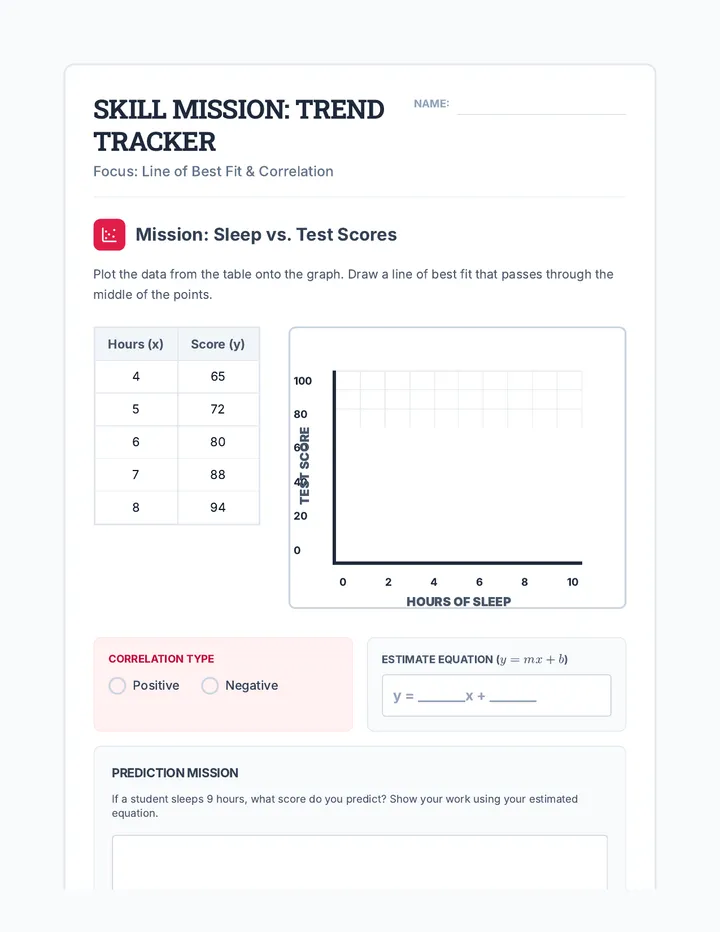
A practice worksheet where students plot bivariate data relating weekly study hours to test scores. It features a positive association and a significant outlier representing high effort but low results.
A teacher answer key for the Screen Scramble worksheet, featuring a completed scatter plot with a negative association and a circled outlier at (7, 120).
A practice worksheet where students plot bivariate data relating daily screen time to physical activity minutes. It features a negative association and a distinct outlier representing high usage and high activity.
A teacher answer key for the Mood Map worksheet, featuring a completed scatter plot with labeled outliers, correct association identification, and sample explanations.
A practice worksheet where students plot bivariate data relating hours of sleep to mood scores. It includes a coordinate grid, a data table with a clear outlier, and analysis questions to identify trends and explain anomalies.
A complete answer key for the Circle Logic Packet, providing step-by-step solutions for calculation practice and word problems. Includes rounding guidance and bonus challenge resolution. Revised for improved page flow and legibility. Standardized to two decimal places.
A high-energy, amusement park-themed packet for calculating the area of a circle. Students explore the Midway and Thrill Rides while solving radius and diameter problems using visual aids and calculators. Revised for the Carnival Circles theme.
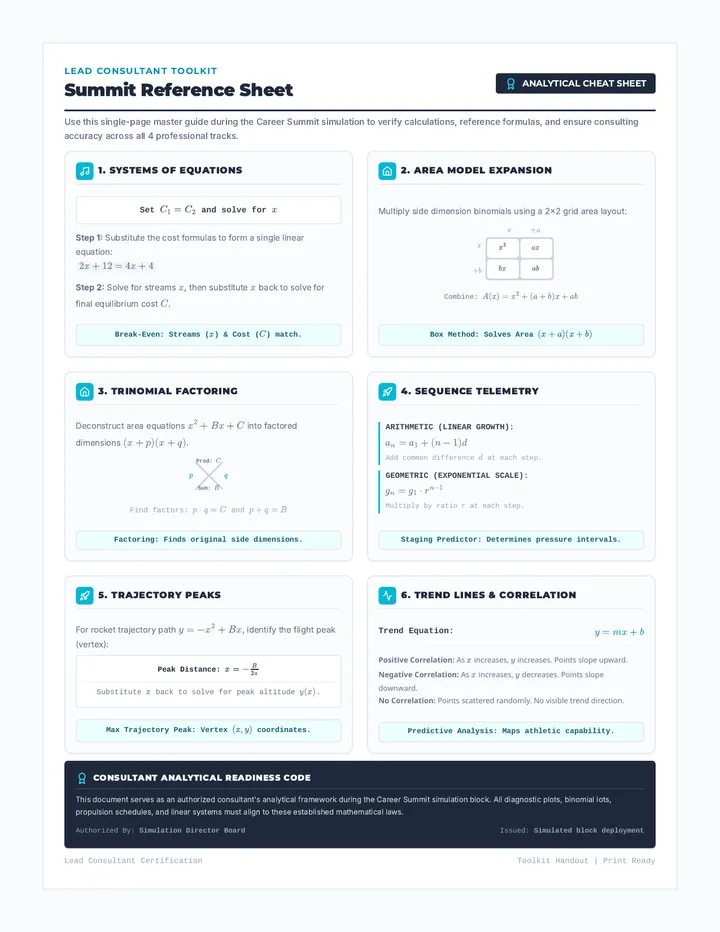
A high-density one-page reference sheet for rational functions. Includes essential steps for finding holes, asymptotes, and intercepts, plus a fully worked complex example.
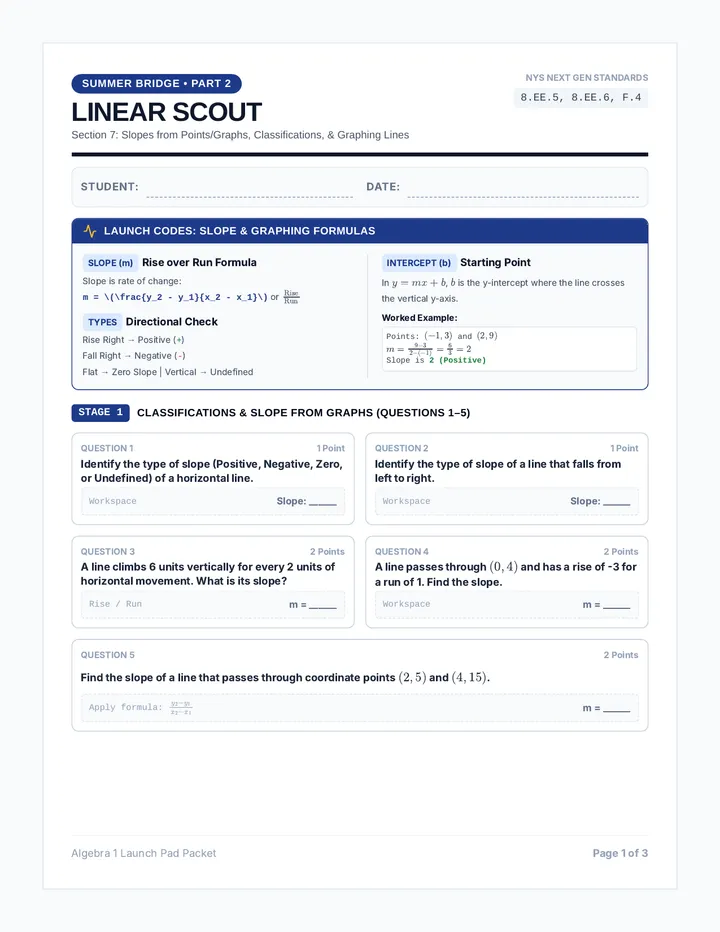
A teacher answer key for the Slope Hunter Expedition Worksheet, providing full step-by-step solutions and interpretations for coordinate calculation, special cases, and real-world modeling.
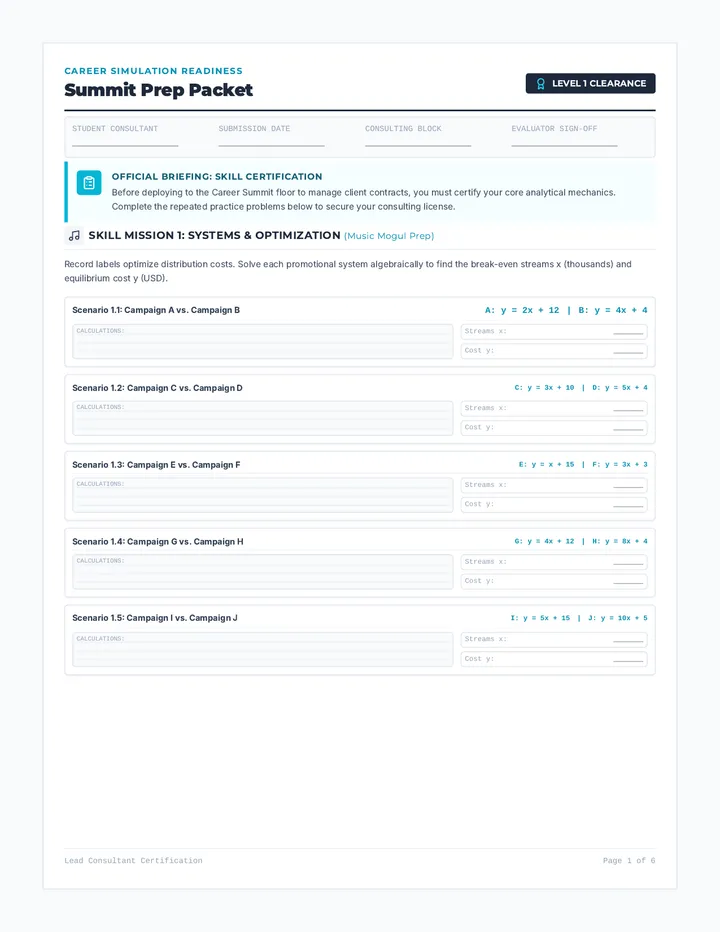
A student worksheet activity for calculating slope from coordinates, identifying special cases (zero/undefined), and interpreting real-world rates of change with a field-report theme.
Advanced slides for teaching slope as a rate of change, introducing the coordinate-based slope formula, zero and undefined anomalies, and real-world unit analysis. Includes a challenging drone case study.
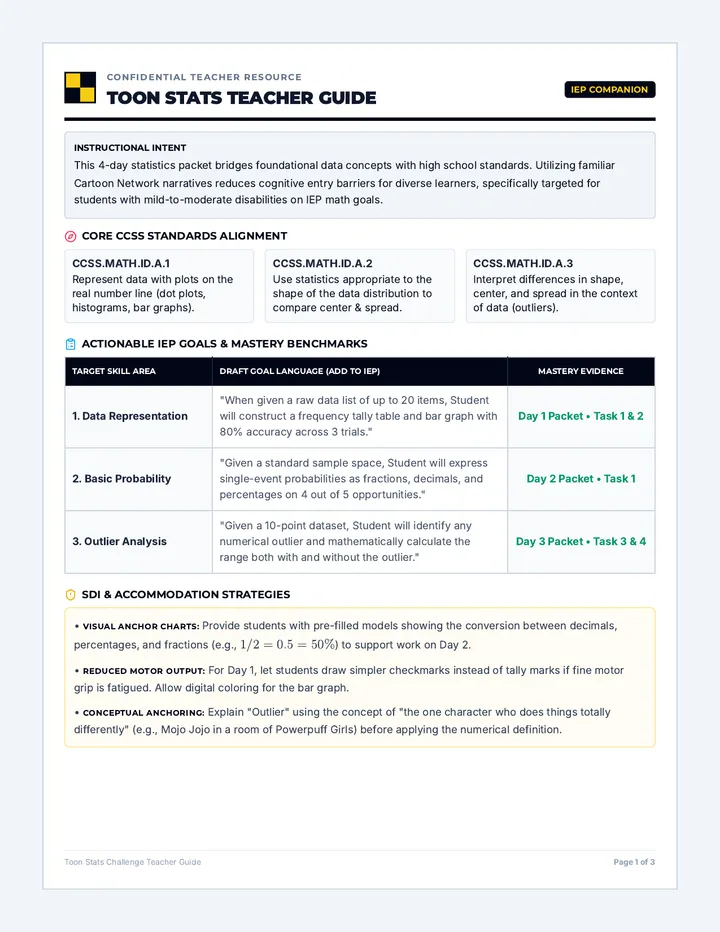
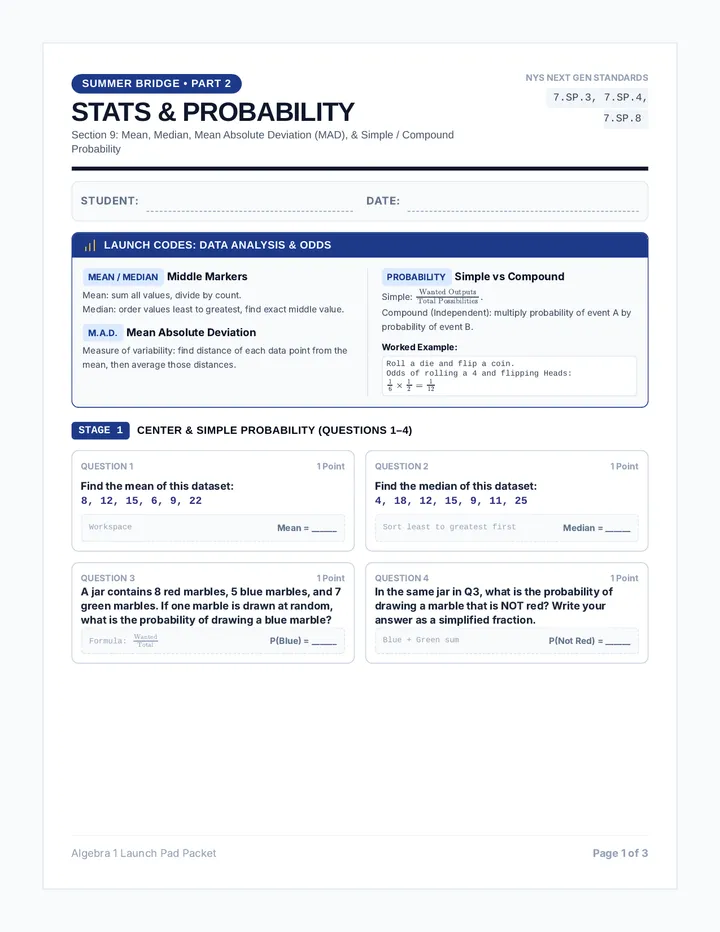
A comprehensive teacher guide for the "Data Detectives" lesson. Includes lesson objectives, a detailed pacing guide, instructional strategies for slides and activities, common misconceptions, and differentiation tips for supporting and challenging students. Revised to fix layout, spacing, and page break issues.
A hands-on sorting activity for measures of center. Students calculate the mean for 12 data cards (Case Files) and sort them into folders based on their values. Includes workspace for calculations and a thematic detective-inspired sorting mat. Revised to fix page breaks and student work area layout.
A thematic vocabulary reference sheet for measures of center. Includes clear definitions and "Investigation Tips" for mean, median, mode, and range, along with a dossier of supplementary statistical terms like outliers, distribution, and skewed data. Revised to fix page breaks and include more terms.
Complete 2-page answer key for Version B of the One-Step Equation Challenge, featuring 24 solutions with inverse operations shown and emerald green styling to match the student worksheet.
Version B of the One-Step Equation Challenge worksheet, featuring 24 new addition and subtraction problems involving whole numbers, decimals, and fractions, including two word problems. It maintains the same structure and difficulty as Version A but with emerald green accents for differentiation.