Fact Fluency Family Night Slides
FAMILY MATH NIGHT
Grades K–2
Math Fact Fluency
Helping our kids become confident, flexible problem solvers—far beyond memorizing flashcards.
Based on Math Fact Fluency (Ch. 1) by Jennifer Bay-Williams & Gina Kling
The 5 Fundamentals
Welcome, Families!
More Than Memorization
The Old Way
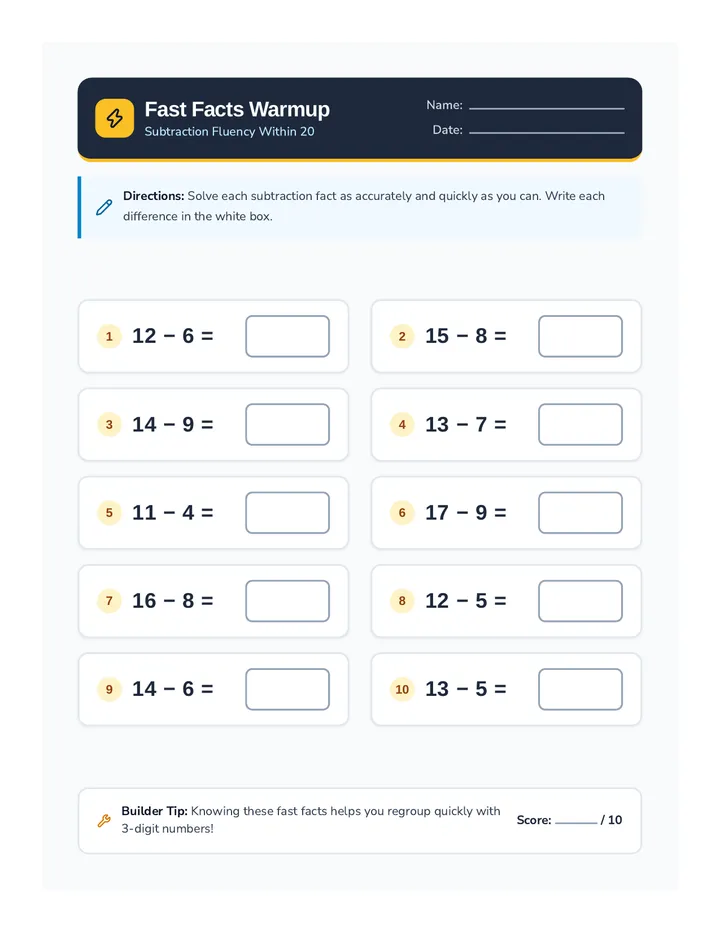
Relying only on drills, flashcards, and timed tests pushes kids to memorize without understanding how numbers work together.
What Research Shows
Teaching strategies and number relationships builds lasting fluency—so automatic recall comes naturally over time.
Tonight, we will explore the 5 Fundamentals of Fluency and how you can support your child at home.
Fundamental 1
Mastery Must Focus on Fluency
Procedural fluency is solving math problems accurately, efficiently, and flexibly by choosing strategies that make sense.
1. Accuracy
Getting the correct answer.
2. Efficiency
Solving the problem in a reasonable amount of time.
3. Appropriate Strategy
Choosing and applying a strategy that fits the given problem.
4. Flexibility
Thinking about a problem in multiple ways and adapting when needed.
Fundamental 1
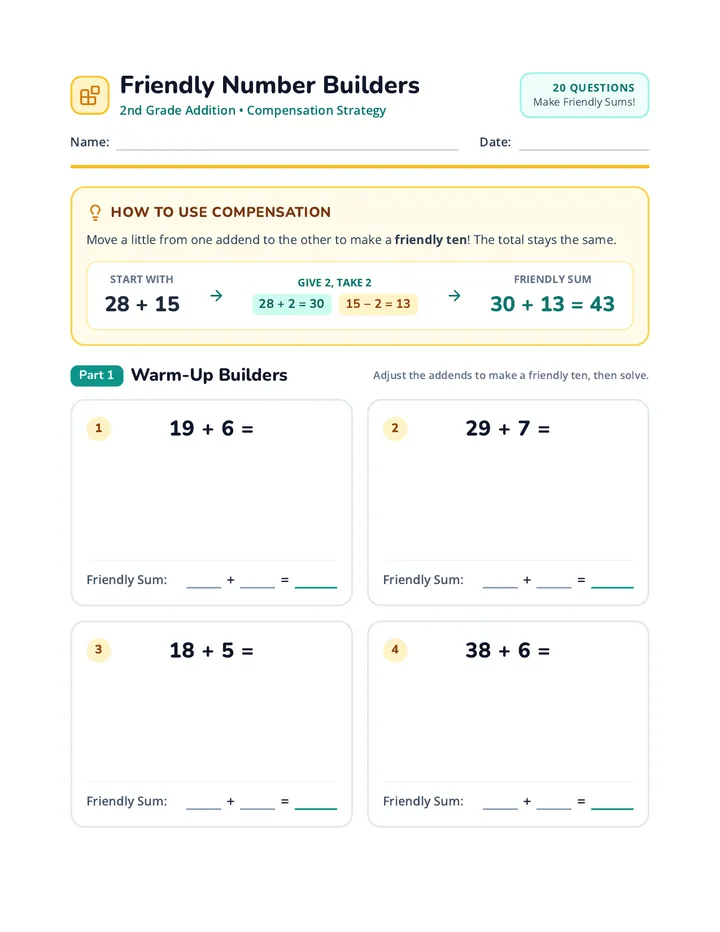
What Fluency Looks Like in Grades 1 & 2
1st
First Grade
- Add and subtract within 20.
- Demonstrate fluency within 10.
- Use strategies like counting on, making ten, and related facts.
2nd
Second Grade
- Add and subtract within 20 fluently using mental math strategies.
- By year's end, know all single-digit addition facts from memory.
Notice how 1st grade builds the strategy foundation so 2nd graders reach automaticity with understanding!
Fundamental 2
Fluency Develops in Three Phases
PHASE 1
Counting
Kids use objects, fingers, or mental counting to find the answer.
Example: Counting on from 5 to solve 5 + 3 (6, 7, 8).
PHASE 2
Deriving
Kids use facts they already know to figure out harder problems.
Example: Knowing 5 + 5 = 10 helps solve 5 + 6 = 11.
PHASE 3
Mastery
Kids quickly solve facts using recall or strategies without stopping to think through each step.
Example: Seeing 5 + 6 and knowing 11 right away.
1. Counting 2. Deriving 3. Mastery
Fundamental 2
The Phase Most Often Rushed: Phase 2
What Happens When We Rush?
When kids jump straight from counting to memorizing, they may remember facts for a short time—but eventually fall right back into counting on their fingers.
What Works Better Instead
Give kids plenty of time in Phase 2 (Deriving) to practice strategies through math games, hands-on activities, and conversation before expecting automatic recall.
Parent Tip: If your child is still using fingers or thinking through a strategy, celebrate it! They are building the bridge to mastery.
Fundamental 3
Foundational Facts Come First
Foundational facts are easier facts kids learn first—so they can derive (figure out) harder facts from what they already know.
+ / − 0, 1, and 2
Helps kids understand basic counting patterns and how numbers relate.
Doubles (e.g., 4+4, 6+6)
Easy to remember and unlocks harder "near doubles" problems.
Combinations of 10
Helps kids spot pairs that make 10 (like 7 + 3), making larger problems easier.
10 Plus (e.g., 10+4, 10+7)
Builds place value understanding so kids solve teen facts efficiently.
Fundamental 3
3 Reasoning Strategies Kids Use
Once kids know foundational facts, they can derive harder facts with these strategies:
STRATEGY 1
Near Doubles
5 + 6 = ?
"I know 5 + 5 = 10, so I just add 1 more to get 11!"
STRATEGY 2
Making 10
8 + 5 = ?
"Break 5 into 2 and 3. 8 + 2 = 10, and 10 + 3 = 13!"
STRATEGY 3
Pretend-a-10
9 + 6 = ?
"Pretend 9 is 10. 10 + 6 = 16, then subtract 1 to get 15!"
Fundamental 4
Why Timed Tests Don't Measure Fluency
Only Half the Picture
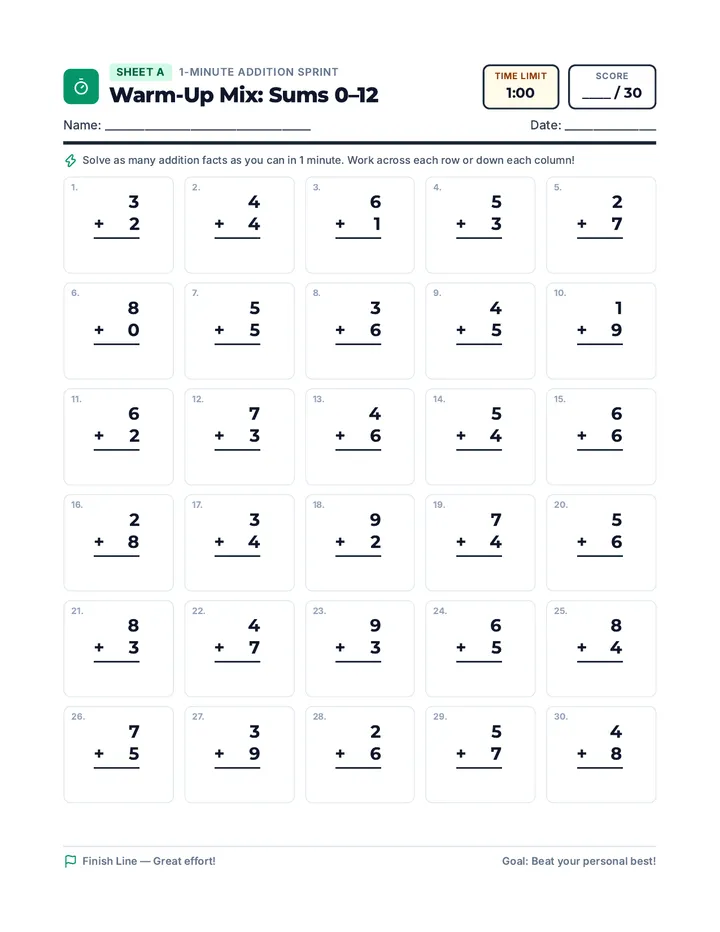
Timed tests only check accuracy and efficiency—they miss flexibility and strategy use.
An "Illusion of Mastery"
Kids can get right answers by counting quickly or skipping hard facts—hiding where they still struggle.
What Research Says
Timed tests can spark math anxiety, slow down fact mastery, and hurt a child's confidence.
Why Are They Still Around?
They're familiar and quick to grade, and many schools haven't seen better ways to track fluency yet.
Fundamental 5
Substantial & Enjoyable Practice
Why Fluency Games Work
- Provide low-stress, joyful practice.
- Encourage kids to think aloud and learn from peers.
- Let teachers observe strategies in real time.
How We Track Progress
Instead of timed tests, teachers use a progress monitoring tool during games and conversations to record:
- • Which facts a student knows
- • Which strategies they use
- • Where they need extra support
Try This at Home
Great Questions to Ask During Games
Whether in the classroom or at the kitchen table, open-ended questions help kids explain their thinking:
"How did you get that answer?"
"What strategy did you use?"
Thank you for partnering with us to build joyful, confident math learners!
Questions?