A comprehensive guide for teachers to facilitate the Shape Detectives lesson. Includes pacing, key vocabulary, material checklists, and specific differentiation strategies for students in Essential Skills classes.
Day 2 homework assignment where students convert tally marks into numerical data and complete a partially constructed bar graph. Includes a reflection question on data-driven decision making.
A worksheet for Day 2 where students conduct a class survey, tally the results, and construct their own bar graph from scratch. Includes a checklist for essential graph components.
A creative spring-themed foldable craft for the interactive notebook. Includes pop-up bar graph elements stylized as sports equipment and a garden-themed background for mounting.
Instructional slides for Day 2: Building the Box Score. Guides students through the process of surveying classmates, tallying data, and constructing their own bar graphs, ending with instructions for a spring-themed craft.
Day 1 homework assignment featuring a bar graph analysis task with a scale of 2. Includes questions on data interpretation, comparison, and a challenge problem.
Interactive notebook guided notes and a data analysis worksheet focused on interpreting a spring-themed bar graph. Includes fill-in-the-blank terminology and comparative questions.
Instructional slides for Day 1: Analyzing Action. Covers the anatomy of a bar graph, understanding scales and intervals, and comparative data analysis.
An answer key for the Five Minute Flyers worksheet, providing solutions for elapsed time problems in 5-minute increments.
An answer key for the Quarter Time Quest worksheet, providing solutions for elapsed time problems in 15-minute increments.
A Level 2 worksheet centered on calculating elapsed time in 5-minute increments. Features visual clock support with all 12 numbers and flight-themed word problems.
A Level 1 worksheet focused on calculating elapsed time in 15-minute increments. Includes visual clock comparisons with all numbers 1-12 and thematic word problems.
An answer key for the Time Facts Worksheet, providing correct answers for basic time units, clock anatomy, and the conceptual time challenge.
A conceptual worksheet covering basic time facts, including units of time (seconds, minutes, hours, days, weeks, years) and functional clock knowledge. Includes fill-in-the-blank and short explanation questions.
An answer key for the Giant Clock Worksheet, providing a clearly labeled example of all hour and minute positions. Includes key concepts and next step suggestions for teachers.
A full-page clock worksheet featuring one large clock face. Students fill in the 12 hour circles and 12 five-minute increment boxes, perfect for initial instruction or detailed practice.
An answer key for the Clock Master Worksheet, displaying the correct placement of all 12 hours and 5-minute increments. Includes teaching tips for instruction.
A practice worksheet with four clock faces on a single page. Students fill in color-coded hour circles and enlarged minute boxes to learn clock anatomy and five-minute intervals.
A presentation introducing clock anatomy, hour placement, and minute tracking by fives. Includes visual diagrams with all 12 numbers and step-by-step instructions.
A detailed teacher answer key for the Blueprint Bounds Exit Ticket. It provides definitive step-by-step logic and clear final answers for all 10 problems. All logic has been verified for mathematical consistency based on the updated exit ticket diagrams.
A 5-page exit ticket designed with a clean blueprint theme. It contains 10 problems that challenge students to find missing side lengths and calculate area using formulas for rectangles and complex rectilinear shapes. All diagrams and labels have been optimized for clarity and high contrast. All logic has been verified for mathematical consistency. All label positioning has been refined to prevent overlapping and clipping. Header terminology is consistent across all pages. Workspace layout is uniform. Content is technically complete and solvable without assumptions.
Answer key for the Missing Factor Worksheet.
A worksheet focusing on the relationship between division and multiplication, asking students to find the missing factor to solve division problems.
A teacher's answer key for the Ticket to Time Activity and the Departure Board Worksheet, providing clear, highlighted solutions for easy grading.
A summative assessment worksheet themed around a central transit hub, testing students' ability to read multi-column schedules and solve elapsed time word problems with increasing complexity.
A hands-on activity sheet where students act as "Time Navigators" to calculate elapsed time for various imaginary historical and futuristic stops on the Chronos Line.
A visually engaging slide deck designed for direct instruction on reading schedules and calculating elapsed time using a transit theme and the "Jump Strategy" visual method.
A comprehensive teacher's guide for the Time Travelers Transit lesson, featuring learning objectives, standard alignments, step-by-step procedures, and differentiation strategies.
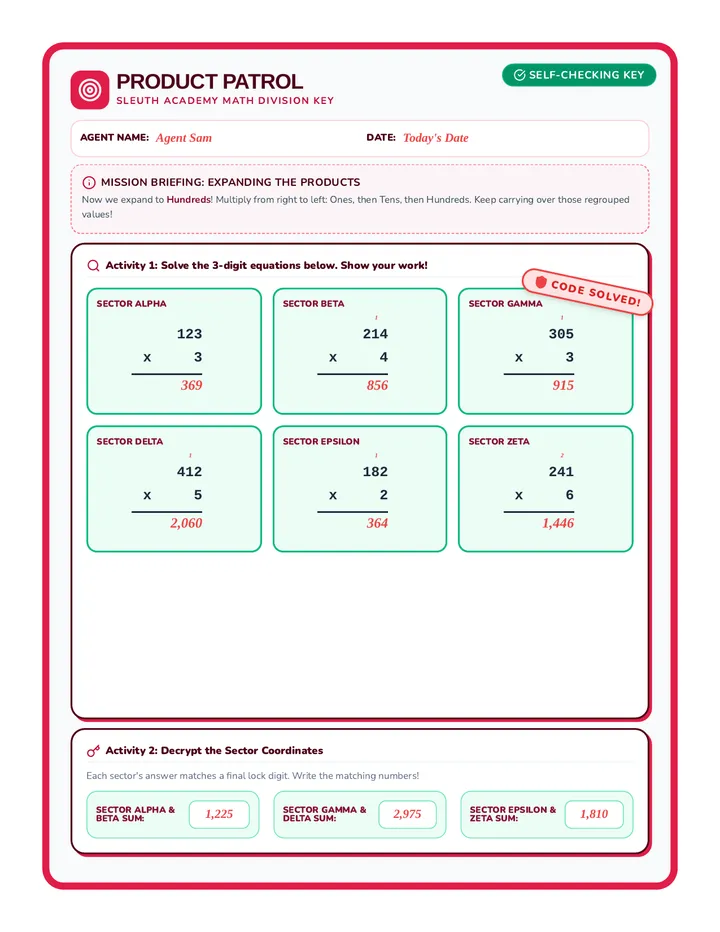
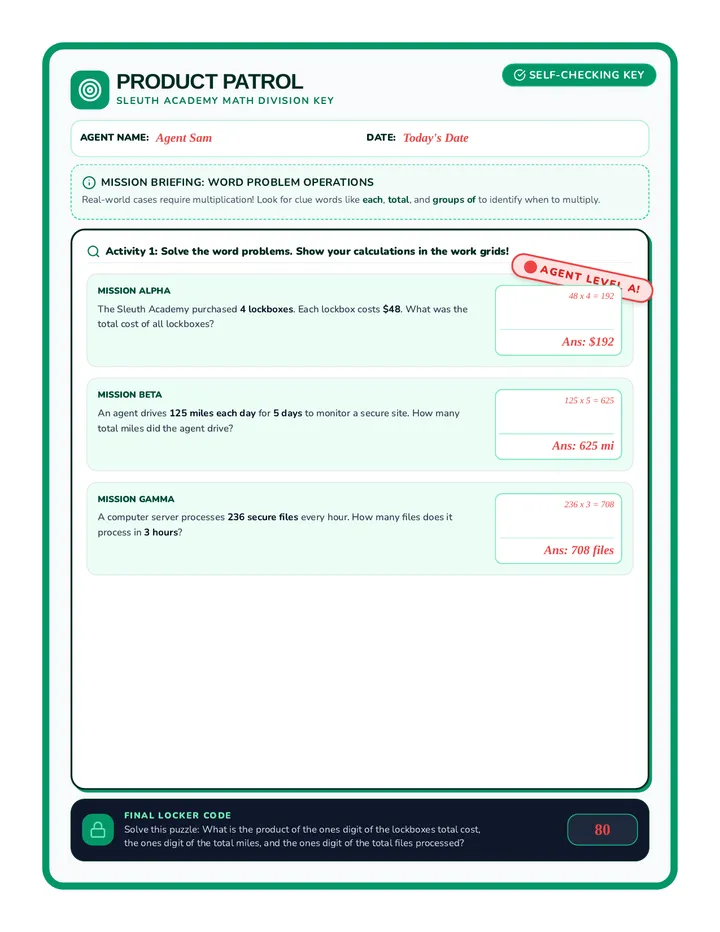
The answer key for the Fact Fusion Worksheet, providing correct solutions for all multiplication and division problems. Designed for quick teacher reference on a single page.
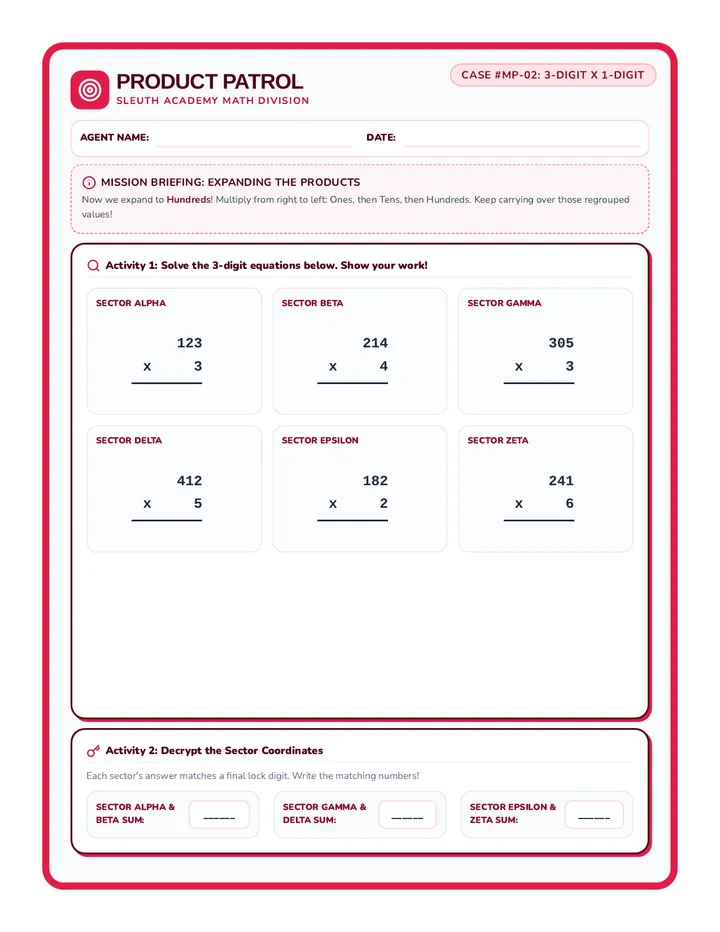
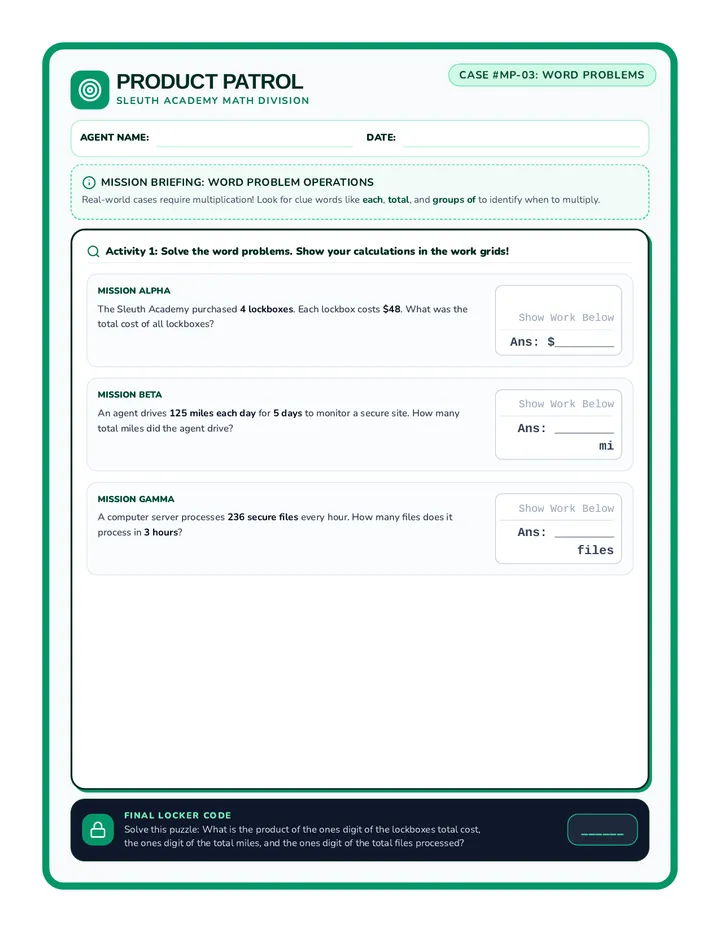
A 4th-grade math worksheet featuring 5 multiplication and 5 division problems up to 12x12. The layout is clean and professional with dedicated work space for each problem.
Updated slide deck for SIFE students that moves beyond the 5/3 example to show halves (3/2), the concept of 'top = bottom' equaling one whole, and multiple number line examples. It maintains high-contrast visuals and minimal text.
A visual anchor chart for SIFE students demonstrating that when the numerator and denominator are the same, the fraction equals one whole. It uses high-contrast models for halves, thirds, and fourths to show the pattern across different denominators.
A visual sorting activity where SIFE students categorize visual fraction models into 'Part' (less than 1), '1 Whole' (exactly 1), and 'More' (greater than 1). The cards use variety in shapes (circles, strips, squares) and denominators (halves, thirds, fourths) to build conceptual understanding beyond a single example.
A visual slide presentation designed for SIFE students to understand fractions greater than one. It uses high-contrast visuals, minimal text (24px+), and clear step-by-step counting animations (implied layout) to show how 5/3 is built from unit fractions.
A large-format work mat for building fractions greater than one. It provides clear, dashed-line slots for physical fraction strips, helping SIFE students see how three 1/3 pieces make one whole, and how five 1/3 pieces require a second whole strip.
An answer key for the Match Makers Homework, providing correct solutions and visual markings for teachers. Revised to fix overlapping labels and layout issues.
A set of high-contrast, visual vocabulary cards specifically designed for SIFE students. Each card features large numerals, clear geometric representations of fractions (like 5/3), and minimal English text to support conceptual understanding without relying on literacy.
A student homework worksheet featuring area models and number lines for identifying and generating equivalent fractions, designed with an architectural blueprint aesthetic. Revised to fix LaTeX rendering, shading issues, and page breaks.
A set of instructional slides introducing equivalent fractions through area models and number lines with an architectural blueprint theme. Revised for better spacing, visual alignment, and includes new practice problems.
Comprehensive answer key for the unit. Revised for clarity, correct data references, and page break efficiency.
Handouts for Lessons 3 and 4. Revised to keep Activity 4 on one page, fix wrapping, and improve work area visibility.
Bilingual slides for Lesson 4 (Interpreting Line Plots). Focuses on analyzing data representations, identifying differences between lists and plots, and verifying statements based on data. Revised for populated data and alignment.
Bilingual slides for Lesson 3 (Equivalence and Mixed Numbers). Explores recording lengths in multiple ways and visualizing mixed number partitioning. Revised for ruler accuracy and visible diagrams.
Bilingual slides for Lesson 2 (Measuring in Fourths). Includes estimation exploration, partitioning activities, and a cool-down involving choosing the right tool for precision. Revised for ruler accuracy and alignment.
Recording sheets for measuring activities in Lessons 1 and 2. Bilingual format. Revised to prevent table splits and improve name/date formatting.
Bilingual slide deck for the Measurement unit, covering Unit Goals, Rubric, and Lesson 1 (Measuring in Halves). Includes specific terminology in both English and Japanese. Revised for ruler accuracy and alignment.
A professional grading rubric for the Blueprint Park Architect project, assessing student performance across calculation accuracy, constraint adherence, design quality, and written reflection.
A student-facing worksheet for the Blueprint Park Architect project, featuring a coordinate grid for park design and a calculation log for tracking area and perimeter requirements.