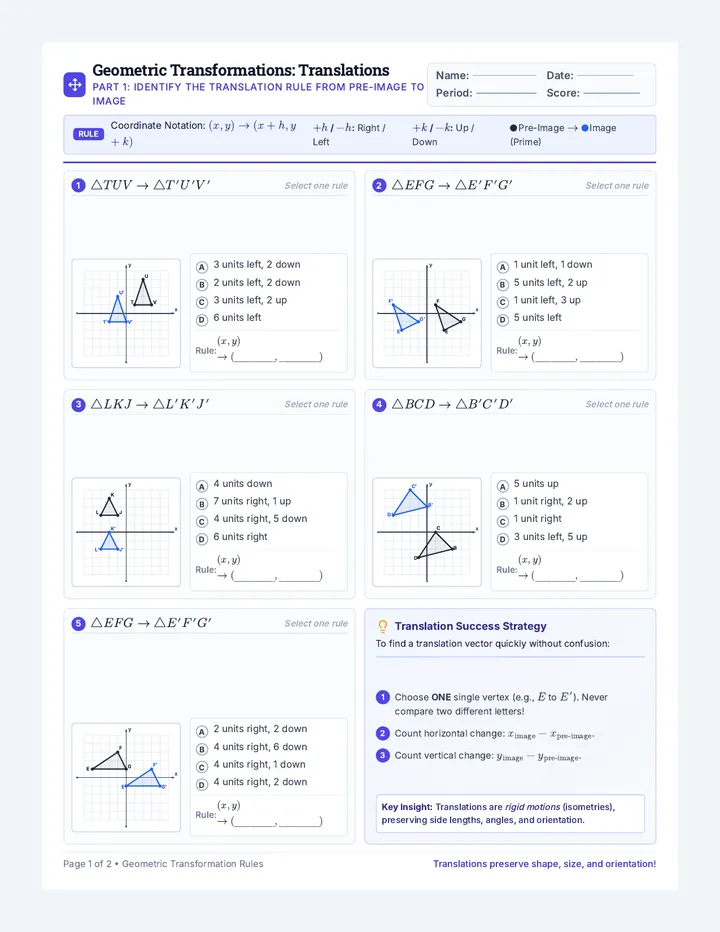
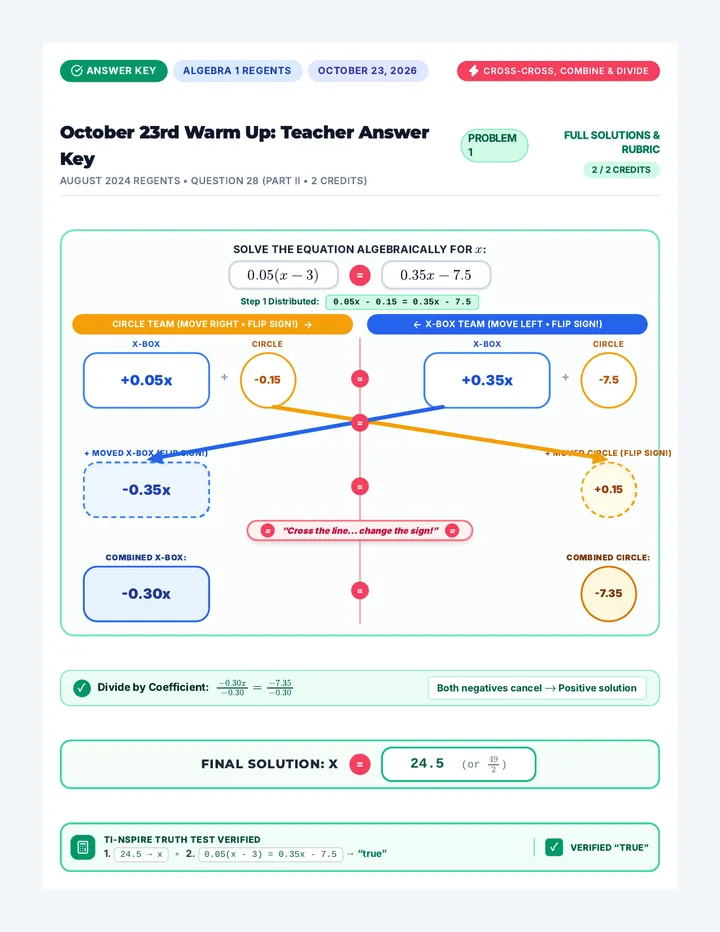
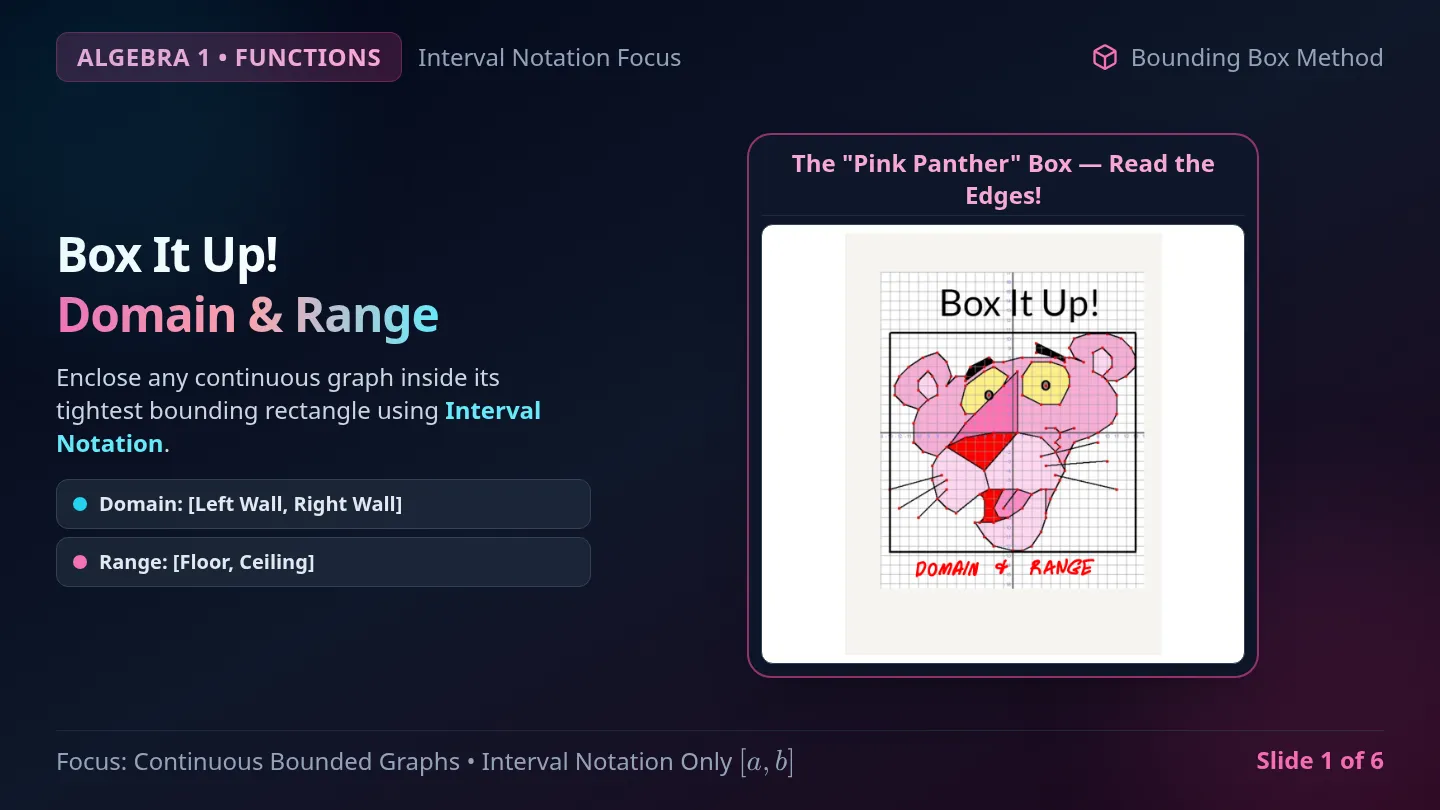
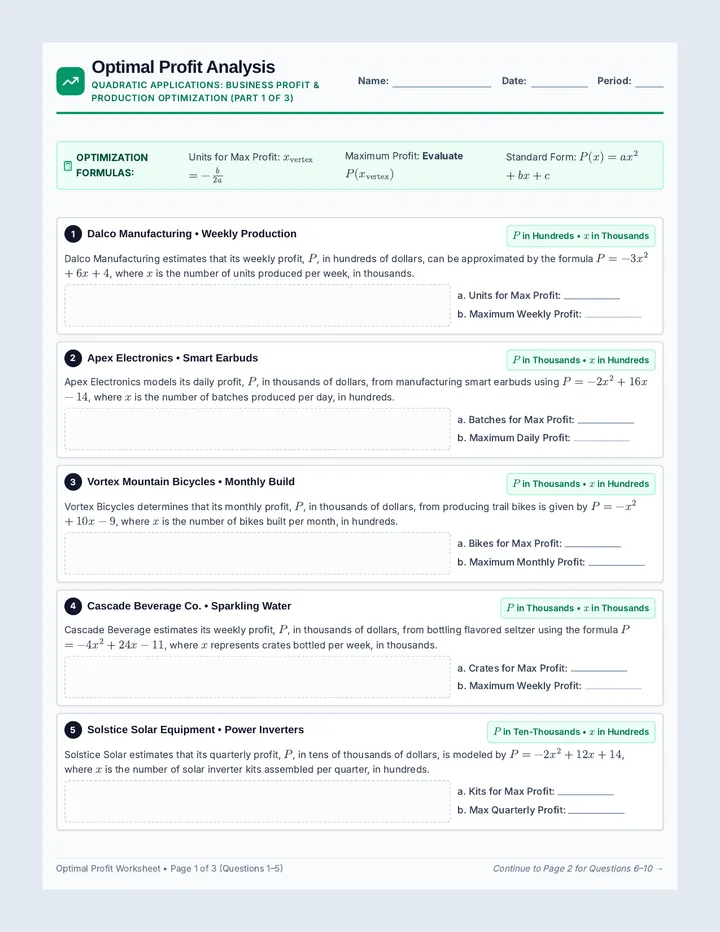
Coordinate Warp Practice Worksheet
Geometry / Coordinate Algebra Rigid & Non-Rigid Motions
Coordinate Warp Practice Worksheet
Determine coordinates algebraically using transformation rules. No graphing required.
Name: ________________
Date: ________
Period: ____
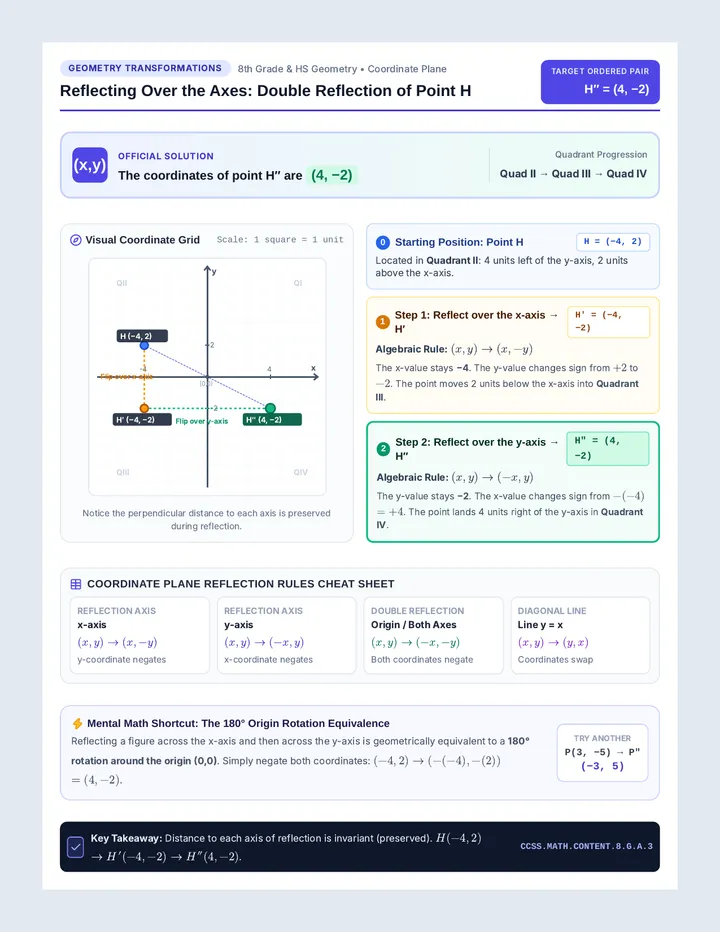
Algebraic Coordinate Transformation Quick Reference
Translation \( (x, y) \to (x+h, y+k) \)
Reflections \( r_x: (x, -y) \) | \( r_y: (-x, y) \)
\( r_{y=x}: (y, x) \)
Origin Rotations (CCW) \( 90^\circ: (-y, x) \)
\( 180^\circ: (-x, -y) \) | \( 270^\circ: (y, -x) \)
Dilation / Stretch \( D_k: (kx, ky) \)
Stretch: \( (a x, b y) \)
A Single Transformations: Calculate the Image Coordinates
Apply each mapping rule directly to the given pre-image.
| # | Pre-Image Point | Transformation Description | Algebraic Rule | Image Point |
|---|
| 1 | \( A(-5, 8) \) | Translate 4 units right, 7 units down | \( (x, y) \to (x+4, y-7) \) | \( A'( \quad , \quad ) \) |
| 2 | \( B(7, -3) \) | Reflection across the \( x \)-axis | \( r_{x\text{-axis}} \) | \( B'( \quad , \quad ) \) |
| 3 | \( C(-4, -9) \) | Reflection across the line \( y = x \) | \( r_{y = x} \) | \( C'( \quad , \quad ) \) |
| 4 | \( D(6, -2) \) | Rotation \( 90^\circ \) counter-clockwise about origin | \( R_{90^\circ} \) | \( D'( \quad , \quad ) \) |
| 5 | \( E(-8, 5) \) | Rotation \( 180^\circ \) about origin | \( R_{180^\circ} \) | \( E'( \quad , \quad ) \) |
| 6 | \( F(-6, 10) \) | Dilation centered at origin with scale factor \( k = \frac{1}{2} \) | \( D_{1/2} \) | \( F'( \quad , \quad ) \) |
| 7 | \( G(3, -4) \) | Dilation centered at origin with scale factor \( k = 3 \) | \( D_3 \) | \( G'( \quad , \quad ) \) |
| 8 | \( H(-2, 7) \) | Horizontal stretch by 4, vertical compression by \( \frac{1}{2} \) | \( (x, y) \to (4x, 0.5y) \) | \( H'( \quad , \quad ) \) |
B Identify the Transformation & Algebraic Rule
Compare pre-image to image and determine the specific rule.
Problem 9 \( M(3, -5) \;\longrightarrow\; M'(-3, -5) \)
Type of Transformation:
Coordinate Mapping Rule: \( (x, y) \to \) ( )
Problem 10 \( N(4, 2) \;\longrightarrow\; N'(-2, 4) \)
Type of Transformation:
Coordinate Mapping Rule: \( (x, y) \to \) ( )
Problem 11 \( P(-6, 9) \;\longrightarrow\; P'(-2, 3) \)
Type of Transformation:
Coordinate Mapping Rule: \( (x, y) \to \) ( )
Problem 12 \( Q(-1, 8) \;\longrightarrow\; Q'(5, 3) \)
Type of Transformation:
Coordinate Mapping Rule: \( (x, y) \to \) ( )
Coordinate Geometry • Rigid & Non-Rigid Transformations Page 1 of 2
Part II
Compositions & Metric Analysis
Student: ____________________
C Multi-Step Transformation Chains (Compositions)
Find the intermediate and final coordinate outputs.
13. Start point: \( J(2, -5) \) Rigid + Rigid Composition
Step 1: Reflect across the \( y \)-axis
\( (x, y) \to (-x, y) \) \( J'( \quad , \quad ) \)
Step 2: Translate \( (x, y) \to (x - 3, y + 6) \)
Apply to \( J' \) \( J''( \quad , \quad ) \)
14. Start point: \( K(-4, 3) \) Rotation + Reflection Composition
Step 1: Rotate \( 180^\circ \) about the origin
\( (x, y) \to (-x, -y) \) \( K'( \quad , \quad ) \)
Step 2: Reflect across the line \( y = x \)
Apply to \( K' \) \( K''( \quad , \quad ) \)
15. Start point: \( L(8, -4) \) Non-Rigid + Rigid Composition
Step 1: Dilate with scale factor \( k = 0.5 \)
\( (x, y) \to (0.5x, 0.5y) \) \( L'( \quad , \quad ) \)
Step 2: Rotate \( 90^\circ \) counter-clockwise
Apply to \( L' \) \( L''( \quad , \quad ) \)
D Polygon Vertex Coordinate Sets
Transform each vertex of the polygon according to the given rule.
16. Triangle \( \Delta ABC \) with vertices: \( A(-6, 2) \), \( B(-2, 8) \), \( C(4, -4) \)
Transformation 1: \( (x, y) \to (-x, -y) \)
Perform a \( 180^\circ \) rotation about the origin.
\( A' = \) ( _____ , _____ )
\( B' = \) ( _____ , _____ )
\( C' = \) ( _____ , _____ )
Transformation 2: \( (x, y) \to \left(\frac{3}{2}x, \frac{3}{2}y\right) \)
Perform a dilation centered at the origin (\( k = 1.5 \)).
\( A'' = \) ( _____ , _____ )
\( B'' = \) ( _____ , _____ )
\( C'' = \) ( _____ , _____ )
E Transformation Properties: Rigid (Isometry) vs. Non-Rigid
Classify and explain coordinate behavior.
17. Classification Check
Circle whether each coordinate mapping produces a Rigid Motion or a Non-Rigid Motion:
\( (x, y) \to (x - 7, y + 2) \) [ Rigid / Non-Rigid ]
\( (x, y) \to (3x, 3y) \) [ Rigid / Non-Rigid ]
\( (x, y) \to (-y, x) \) [ Rigid / Non-Rigid ]
\( (x, y) \to (2x, y) \) [ Rigid / Non-Rigid ]
18. Reasoning & Justification
A point \( P(a, b) \) undergoes the composition \( r_{x\text{-axis}} \) followed by \( r_{y\text{-axis}} \).
\( (a, b) \;\xrightarrow{r_x}\; (\quad\quad , \quad\quad) \;\xrightarrow{r_y}\; (\quad\quad , \quad\quad) \)
Which single transformation produces the exact same image coordinate result?
Hint: Compare the signs of the resulting coordinates with the reference chart.
Coordinate Geometry • Rigid & Non-Rigid Transformations Page 2 of 2