Blueprint Architect Project Guide
Pre-Algebra • Grades 7–8
BLUEPRINT ARCHITECT PROJECT GUIDE
Project Code DP-MODULAR-78
Lead Draftsperson (Name) _________________________
Drafting Firm (Class/Period) ___________________
Project Date ___________________
Total Evaluation ______ / 24 pts
PROJECT MISSION BRIEF: METRO COMMUNITY INNOVATION CENTER
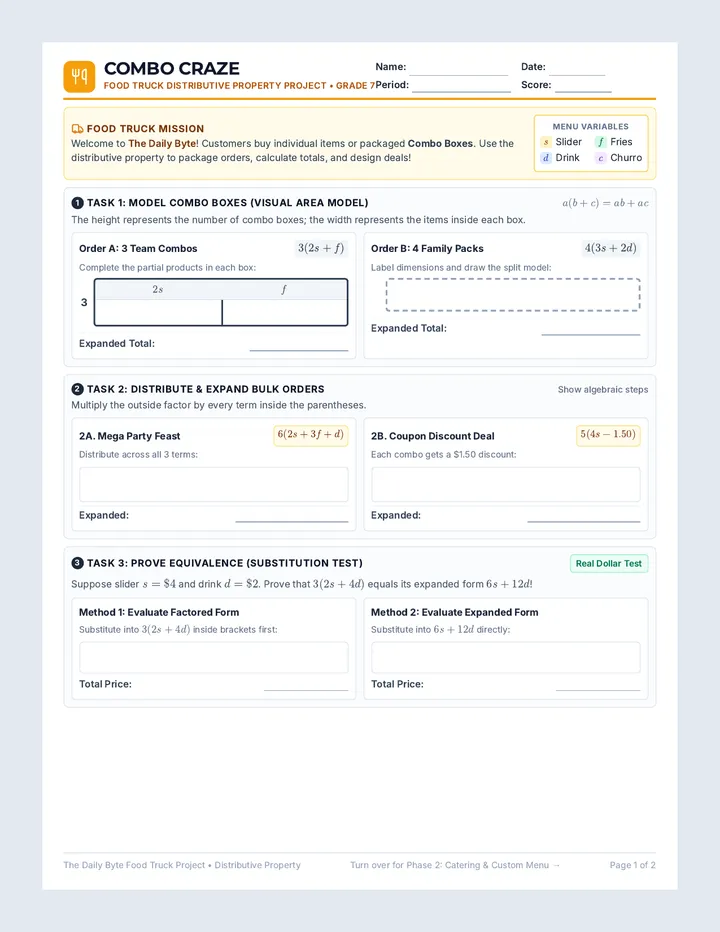
The City Planning Commission has contracted your engineering firm to draft the master floor plan for the new modular innovation complex. All wings are designed using scalable variable modules where total area is determined by expanding dimensions using the Distributive Property: \(a(b + c) = ab + ac\). Complete all phases to deliver certified blueprints and cost formulas.
1 Phase 1: Zone Dimensions & Area Model Expansions (10 pts)
Draw partitioned rectangles & write expanded polynomials.
Zone A: Robotics Lab Width: 6 • Length: \((4x + 7)\)
\(6 \times 4x\) Area = _______
\(6 \times 7\) Area = _______
Expanded Area: \(6(4x + 7) = \) ______________
Zone B: Maker Workshop Width: \(3x\) • Length: \((2x - 5)\)
\(3x \times 2x\) Area = _______
\(3x \times (-5)\) Area = _______
Expanded Area: \(3x(2x - 5) = \) _____________
Zone C: Digital Media Wing Width: \(-4\) • Length: \((3x - 2y + 8)\)
\(-4(3x)\) _______
\(-4(-2y)\) _______
\(-4(8)\) _______
Expanded Multi-Term: \( -4(3x - 2y + 8) = \) ____________
Zone D: Courtyard & Atrium Scale: \(\frac{2}{3}(9x - 15) + 5(2x + 1)\)
Step 1: Expand \(\frac{2}{3}(9x - 15) = \) _____________ Step 2: Expand \(5(2x + 1) = \) _____________
Step 3: Combine like terms: _____________________________________
Simplified Polynomial: Total = ________________
2 Phase 2: Material Cost Modeling & Field Evaluations (6 pts)
Use the Distributive Property to compute structural expenditure.
Cost Model: Terrazzo Flooring $8 / sq ft
The Auditorium floor area expression is \((5x^2 + 3x - 12)\).
a. Write & expand total cost expression:
\(8(5x^2 + 3x - 12) = \) ___________________________
b. If module variable \(x = 4\), calculate total cost:
Show substitution steps:
Total Material Cost: $ ____________
Cost Model: Acoustic Baffle Deduction Rebate Voucher
The city receives a bulk supplier rebate of \(-3(4x - 15)\) dollars.
a. Expand the negative coefficient rebate formula:
\(-3(4x - 15) = \) ____________________________
b. Explain how the constant term's sign changed:
(Explain why multiplying two negatives creates a positive credit)
METRO DRAFTING GROUP • ARCHITECTURAL BLUEPRINT SPECIFICATION SHEET PAGE 1 OF 2 • CONTINUE TO REVERSE
MASTER BLUEPRINT: DRAFTING & DECONSTRUCTION
PAGE 2: DESIGN & REVERSE FACTORING
3 Phase 3: Custom Modular Pavilion Design (Draft Your Own) (4 pts)
Create a 2-room compound wing with algebraic dimensions.
ARCHITECTURAL GRID • 1/4" SCALE PARTITIONED RECTANGLE
← Room 1 Length: _________ → ← Room 2 Length: _________ →
[ Draw your partitioned floor plan boundary here • Label all dimensions • Show room names ]
↑ Shared Width: _________ ↓
Pavilion Specifications
Room 1 Purpose: _____________________________
Room 2 Purpose: _____________________________
Factored Form \(W(L_1 + L_2)\):
______ ( ____________ + ____________ )
Expanded Form (Total Area):
Area = _________________________
4 Phase 4: Reverse Engineering • Factoring Out the GCF (4 pts)
Identify original modular dimensions from expanded areas.
Civic Gallery Area:
\(18x + 42\)
Greatest Common Factor:
GCF = ______
Factored Dimensions:
_____ ( _____ + _____ )
Aquatics Center Area:
\(24x^2 - 16x\)
Greatest Variable Factor:
GCF = ______
Factored Dimensions:
_____ ( _____ - _____ )
Tri-Zone Terrace:
\(15a - 25b + 35\)
Greatest Common Factor:
GCF = ______
Factored Dimensions:
___ ( ___ - ___ + ___ )
5 Phase 5: Architectural Defense Reflection (2 pts)
Mathematical Reasoning & Equivalence Defense
City Council Question: "Why does partitioning a compound wing with an area model visually prove that the algebraic expression \(a(b + c)\) is equivalent to \(ab + ac\) for any rational value?"
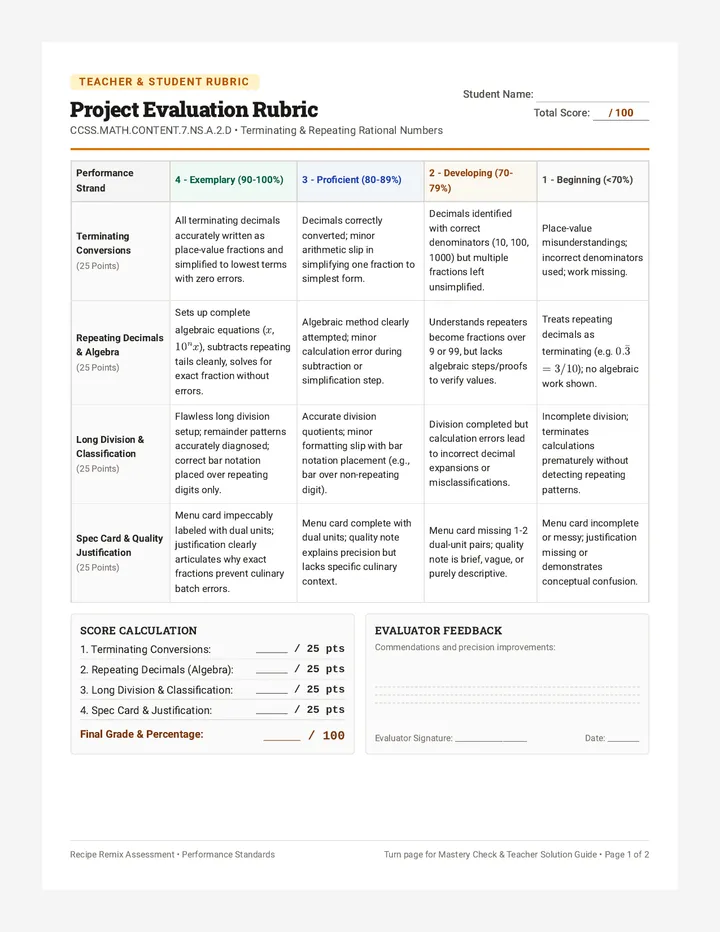
Architectural Review Board Scoring Rubric Total Max: 24 Points
| Criteria | Exemplary (4 pts) | Proficient (3 pts) | Developing (1–2 pts) |
|---|
| 1. Algebraic Expansions | All terms, rational coefficients, & signs correctly multiplied. | Minor computational error with integer signs or fractions. | Multiple errors applying distribution to inner terms. |
| 2. Cost Modeling & Evaluation | Cost expressions correctly scaled & evaluated with proper units. | Correct expansion but calculation slip during variable substitution. | Incomplete cost models or misapplied order of operations. |
| 3. Blueprint & Factoring | Creative design with accurate factored/expanded forms & GCFs. | Accurate blueprint; partial factor extracted in reverse phase. | Grid unlabeled or failure to extract common numerical/variable factors. |
| 4. Conceptual Defense | Thoroughly explains geometric equivalence of total vs. sub-areas. | Clear connection made but lacks mathematical vocabulary. | Restates the property without geometric justification. |
METRO COMMUNITY INNOVATION CENTER PROJECT • MATHEMATICAL SPECIFICATIONS PAGE 2 OF 2 • FINAL SUBMISSION