Recipe Remix Project Guide Grade 7 Culinary Math Project
Recipe Remix Project Guide
Digital Scale Calibration & Kitchen Fraction Engineering
Chef Analyst:
Date: Period:
Culinary Mission Scenario
Artisan Bake Lab is installing computer-calibrated digital scales. While our heirloom recipe books record quantities in standard kitchen fractions (cups, tablespoons, ounces), the digital sensors output raw decimals. As Lead Culinary Analyst, you must calibrate the ingredient tables, decode repeating sensor readings with algebra, and engineer an original signature recipe card.
Phase 1
Scale Calibration
Terminating Decimals
Phase 2
Repeating Decimals
Algebraic Proofs
Phase 3
Signature Recipe
Long Division & Specs
Phase 4
Menu Spec Card
Dual-Unit Showcase
Phase 1: Calibrate Terminating Scale Readings
Convert decimals to simplified fractions
Ingredient Digital Reading Place-Value Fraction Simplest Form & Measuring Cup Vanilla Extract 0.375 tbsp 375 / 1000 3/8 tbsp Cane Sugar 0.65 cup Almond Flour 1.875 cups Sea Salt 0.08 tsp
Phase 2: Repeating Decimal Sensor Proofs
Use algebraic elimination to find exact fractions
The precision syrup dispenser outputs repeating sensor values. Set up an equation letting \(x\) equal the decimal, multiply by \(10^n\) to align repeaters, subtract, and isolate \(x\).
Batch A: Agave Nectar 0.777... = \(0.\bar{7}\) cup
Show algebraic steps:
Let \(x = 0.\bar{7}\)
Exact Fraction: ________
Batch B: Cinnamon Infusion 0.4545... = \(0.\overline{45}\) oz
Show algebraic steps:
Let \(x = 0.\overline{45}\)
Exact Fraction: ________
Recipe Remix Project • Culinary Analyst Guide Turn page for Phase 3 Recipe Engineering & Menu Card • Page 1 of 2
Phase 3 & 4: Recipe Engineering
Fraction-to-Decimal Division and Commercial Menu Presentation Card
Lead Analyst: ________
Phase 3: Engineer 4 Signature Ingredients
Convert fractions to decimals via division • Classify type
Choose or assign 4 ingredients for your bakery creation. Each must use a fraction (include at least one terminating and at least two repeating fractions). Perform long division to compute digital scale equivalents.
Ingredient Name Fraction Long Division Work / Quotient Digital Decimal Type (Term / Rep) 1. Dark Cocoa 5/6 cup Repeating (\(0.8\bar{3}\)) 2. Clarified Butter 3/16 lb 3. Molasses 4/11 cup 4. Rolled Oats 7/8 cup
Phase 4: Final Menu Spec Showcase Card
Ready for kitchen digital display
Artisan Bake Lab • Commercial Spec Sheet
Recipe Creation:
Standard Yield: servings
Dual-Unit Measurement Roster
1. ___________________ ____ cup = ____
2. ___________________ ____ cup = ____
3. ___________________ ____ cup = ____
4. ___________________ ____ cup = ____
Chef's Quality & Precision Note
Explain why using the exact fraction is superior to rounding a repeating decimal in baking:
Project Submission Quality Checklist
All 4 Phase 1 decimals simplified to lowest terms Phase 2 algebraic equations show \(10^n x\) & subtraction Phase 3 includes clear long division setups Repeating decimals correctly marked with bar notation Showcase card displays matching fraction & decimal Quality note justifies exact mathematical representations
Recipe Remix Project • Deliverables & Evaluation Ready Page 2 of 2
Conversion Lab Worksheet Skills Practice Lab
Conversion Lab Worksheet
Mastering Terminating Decimals, Repeating Decimals & Rational Numbers
Name:
Date: Period:
1 Terminating Decimals to Simplified Fractions
Read place value • Divide numerator & denominator by GCF
Core Strategy: Identify the last decimal place value (tenths = \(/10\), hundredths = \(/100\), thousandths = \(/1000\)). Write as a fraction, then divide by common factors until simplified. Example: \(0.35 = \frac{35}{100} = \frac{7}{20}\)
1. Convert \(0.4\)
Place value fraction: Simplest: _____
2. Convert \(0.75\)
Place value fraction: Simplest: _____
3. Convert \(0.125\)
Place value fraction: Simplest: _____
4. Convert \(0.08\)
Place value fraction: Simplest: _____
5. Convert \(2.4\)
Mixed number fraction: Simplest: _____
6. Convert \(0.024\)
Place value fraction: Simplest: _____
2 Fractions to Decimals: Long Division & Repeating Patterns
Divide numerator by denominator • Use bar notation for repeating digits
Set up numerator ÷ denominator. Add a decimal point and trailing zeros. Stop when the remainder is 0 (terminating) or when a remainder repeats (repeating decimal).
7. Convert \(\frac{3}{8}\) Setup: \(8 \overline{) 3.000}\)
Type: [ ] Terminating [ ] Repeating Decimal: _______
8. Convert \(\frac{2}{3}\) Setup: \(3 \overline{) 2.000}\)
Type: [ ] Terminating [ ] Repeating Decimal: _______
9. Convert \(\frac{7}{20}\) Setup: \(20 \overline{) 7.000}\)
Type: [ ] Terminating [ ] Repeating Decimal: _______
10. Convert \(\frac{5}{11}\) Setup: \(11 \overline{) 5.0000}\)
Type: [ ] Terminating [ ] Repeating Decimal: _______
Conversion Skills Lab • Part 1 & 2 Turn page for Repeating Decimal Proofs & Error Analysis • Page 1 of 2
Algebraic Proofs & Precision Analysis
Converting Repeating Decimals using Equations • Quality Control
Lab Part 3 & 4
3 The Algebraic Elimination Strategy: Step-by-Step Model
Eliminating the infinite repeating tail
Step 1: Define Variable Let \(x = 0.\bar{7} = 0.777...\)
Step 2: Multiply by \(10^n\) \(10x = 7.777...\) (1 repeating digit \(\rightarrow 10^1\))
Step 3: Subtract Equations \(10x - x = 7.777... - 0.777...\)
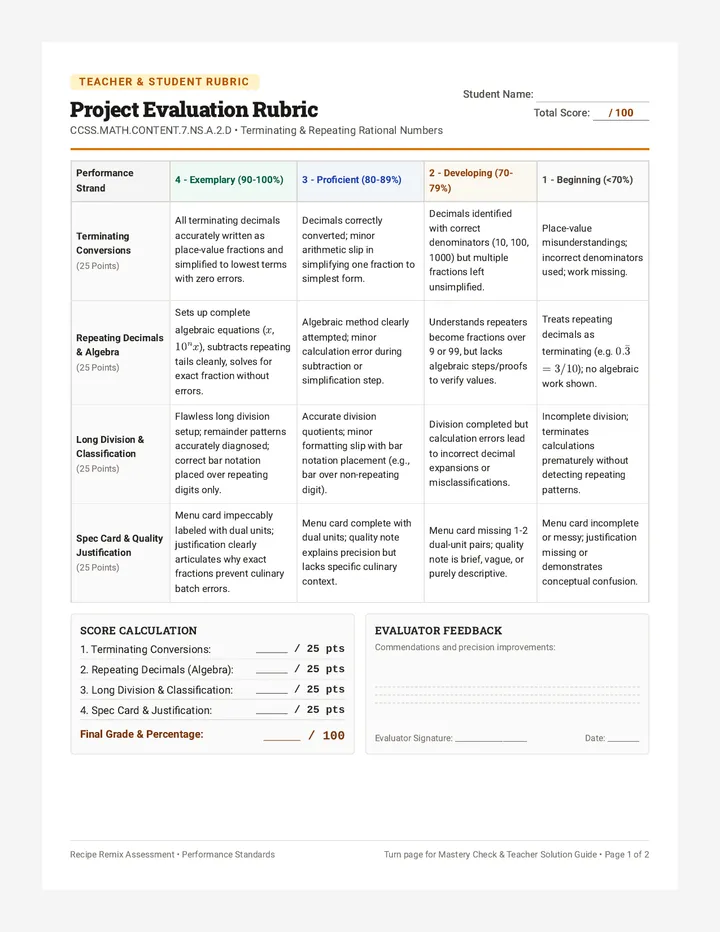
Recipe Remix Assessment Rubric Teacher & Student Rubric
Project Evaluation Rubric
CCSS.MATH.CONTENT.7.NS.A.2.D • Terminating & Repeating Rational Numbers
Student Name:
Total Score: / 100
Performance Strand 4 - Exemplary (90-100%) 3 - Proficient (80-89%) 2 - Developing (70-79%) 1 - Beginning (<70%) Terminating Conversions (25 Points) All terminating decimals accurately written as place-value fractions and simplified to lowest terms with zero errors. Decimals correctly converted; minor arithmetic slip in simplifying one fraction to simplest form. Decimals identified with correct denominators (10, 100, 1000) but multiple fractions left unsimplified. Place-value misunderstandings; incorrect denominators used; work missing. Repeating Decimals & Algebra (25 Points) Sets up complete algebraic equations (\(x\), \(10^n x\)), subtracts repeating tails cleanly, solves for exact fraction without errors. Algebraic method clearly attempted; minor calculation error during subtraction or simplification step. Understands repeaters become fractions over 9 or 99, but lacks algebraic steps/proofs to verify values. Treats repeating decimals as terminating (e.g. \(0.\bar{3} = 3/10\)); no algebraic work shown. Long Division & Classification (25 Points) Flawless long division setup; remainder patterns accurately diagnosed; correct bar notation placed over repeating digits only. Accurate division quotients; minor formatting slip with bar notation placement (e.g., bar over non-repeating digit). Division completed but calculation errors lead to incorrect decimal expansions or misclassifications. Incomplete division; terminates calculations prematurely without detecting repeating patterns. Spec Card & Quality Justification (25 Points) Menu card impeccably labeled with dual units; justification clearly articulates why exact fractions prevent culinary batch errors. Menu card complete with dual units; quality note explains precision but lacks specific culinary context. Menu card missing 1-2 dual-unit pairs; quality note is brief, vague, or purely descriptive. Menu card incomplete or messy; justification missing or demonstrates conceptual confusion.
Score Calculation
1. Terminating Conversions: _____ / 25 pts
2. Repeating Decimals (Algebra): _____ / 25 pts
3. Long Division & Classification: _____ / 25 pts
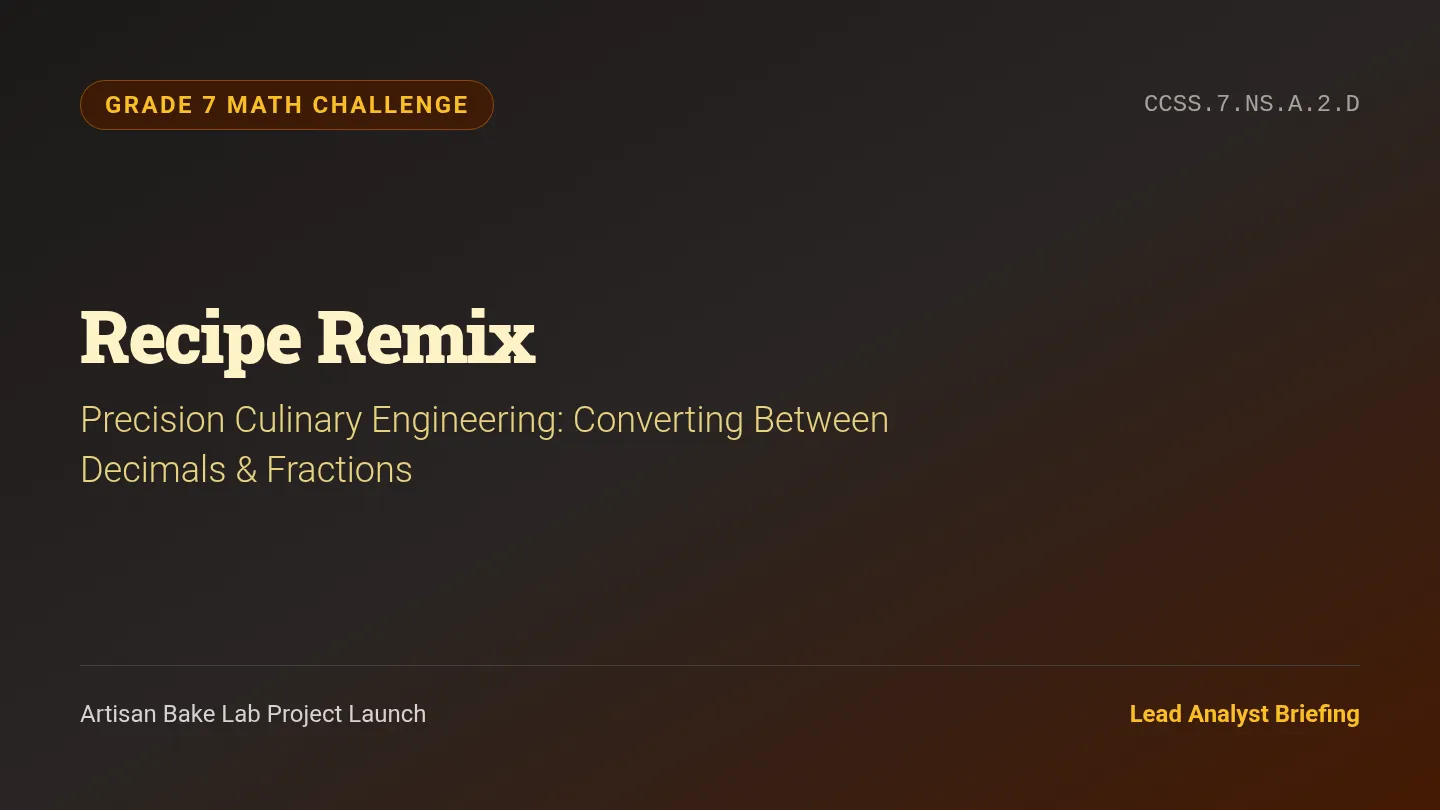
Recipe Remix Slides Grade 7 Math Challenge CCSS.7.NS.A.2.D
Recipe Remix
Precision Culinary Engineering: Converting Between Decimals & Fractions
Artisan Bake Lab Project Launch Lead Analyst Briefing
The Culinary Scenario
The Digital Scale Dilemma
New Computer Scales
The new commercial sensors read measurements strictly in decimals :
0.375 cup • 0.65 lb • 0.333... oz
Heirloom Bakery Recipes
Our master bakers prepare ingredients using standard kitchen fractions :
3/8 cup • 13/20 lb • 1/3 oz
Your mission: Calibrate recipes so bakers and sensors speak the exact same mathematical language!
Method 1
Terminating Decimals to Fractions
STEP 01
Identify Place
Find the place value of the final decimal digit.
0.375 → thousandths
STEP 02
Write Fraction
Place digits over 10, 100, or 1000.
\( \frac{375}{1000} \)
STEP 03
Simplify Fully
Divide numerator & denominator by GCF (125).
\( \frac{3}{8} \) cup
Always verify that the resulting fraction is in simplest form!
Method 2
Fractions to Decimals: Long Division
Terminating Case
When the remainder reaches zero , the decimal terminates.
\( \frac{7}{8} = 7 \div 8 \)
\(= 0.875\) (Remainder: 0)
Repeating Case
When remainders begin to repeat in a cycle , place a bar over only repeating digits.
\( \frac{5}{6} = 5 \div 6 = 0.8333... \)
\(= 0.8\bar{3}\) (Bar over 3 only!)
Watch out: Never place the repeat bar over non-repeating digits like the 8 in \(0.8\bar{3}\)!
Method 3 • The Algebraic Power Move
Converting Repeating Decimals
Step 1
Set variable
\(x = 0.\bar{7}\)
Step 2
Multiply by 10
\(10x = 7.\bar{7}\)
Step 3
Subtract equations
\(9x = 7\)
Step 4
Solve for \(x\)
\(x = \frac{7}{9}\)
If 2 digits repeat (like \(0.\overline{45}\)), multiply by 100 so that \(99x = 45 \rightarrow x = \frac{45}{99} = \frac{5}{11}\)!