A specialized graph paper worksheet for the Area 12 challenge. Includes a grid for drawing shapes, a data table for recording area and perimeter, and a final analysis section for comparing smallest and largest perimeters.
The answer key for the Fraction Factory worksheet, providing complete visual models and worked-out solutions. Corrected for page breaks, standardized color schemes (blue for source, orange for answer), and improved contrast.
A teacher's facilitation guide for the Fraction Factory lesson, including learning objectives, a detailed instructional sequence, common student misconceptions, and practical teaching tips. Corrected to ensure callout sections stay on a single page.
A blueprint-themed worksheet for 4th-grade students to practice equivalent fractions. It includes sections for visual modeling with fraction bars, applying multiplication and division rules, and a final word problem challenge.
A visually engaging 6-slide presentation for teaching 4th graders about equivalent fractions. It features "The Fraction Factory" theme, with corrected visual models, improved contrast for mathematical operators, and clear step-by-step examples.
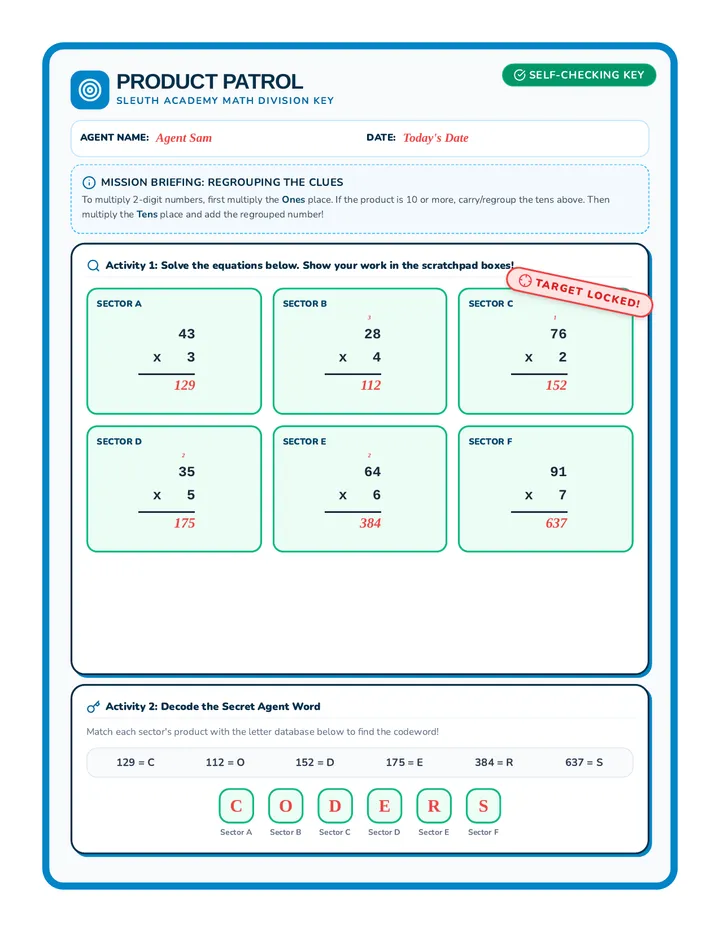
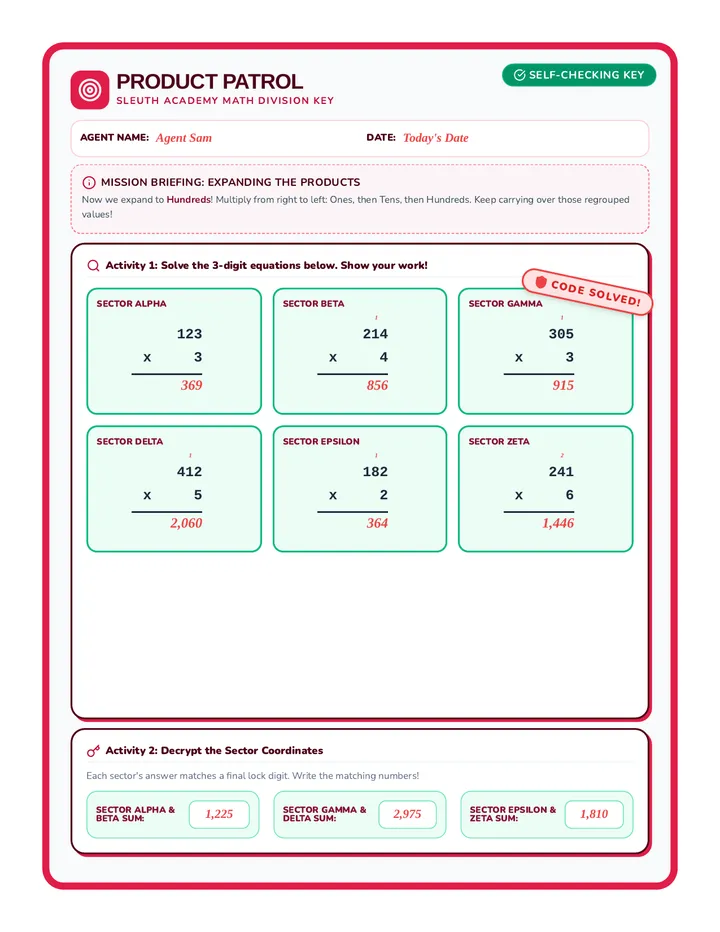
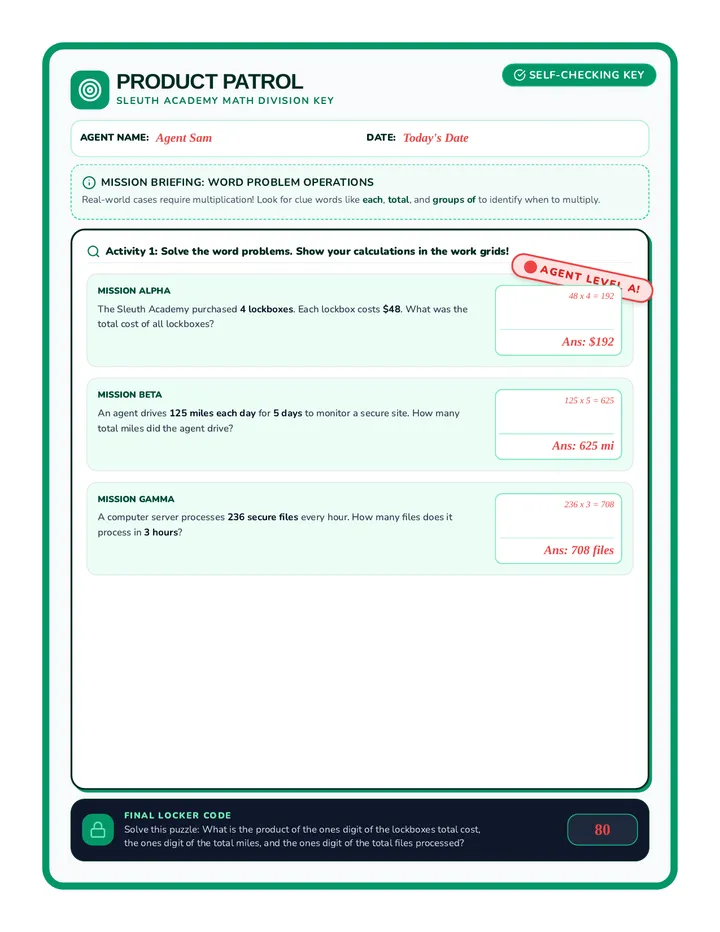
The answer key for the Fact Fusion Worksheet, providing correct solutions for all multiplication and division problems. Designed for quick teacher reference on a single page.
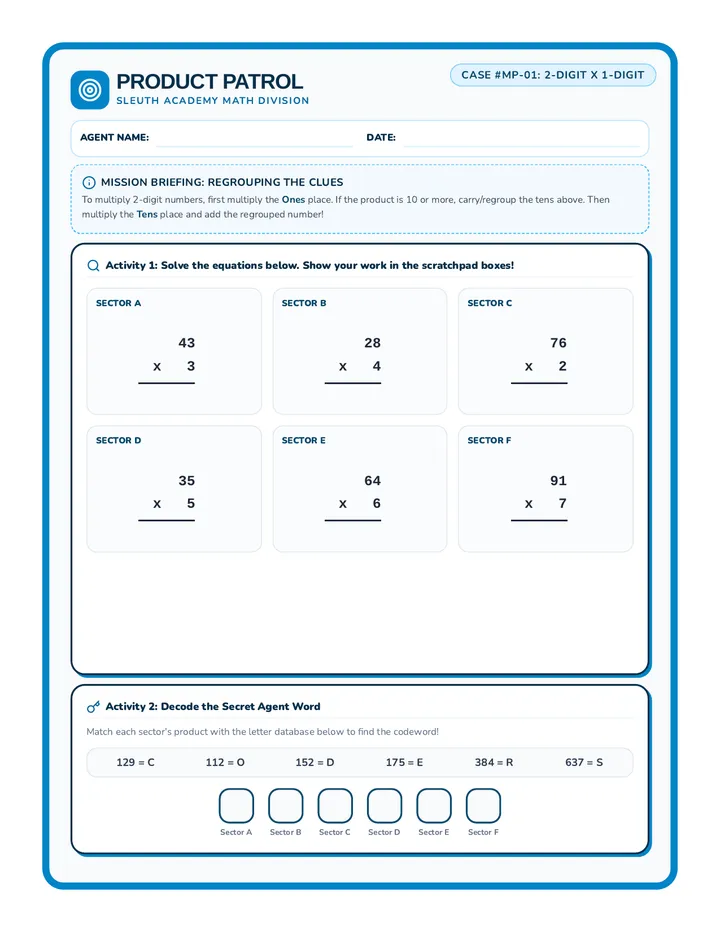
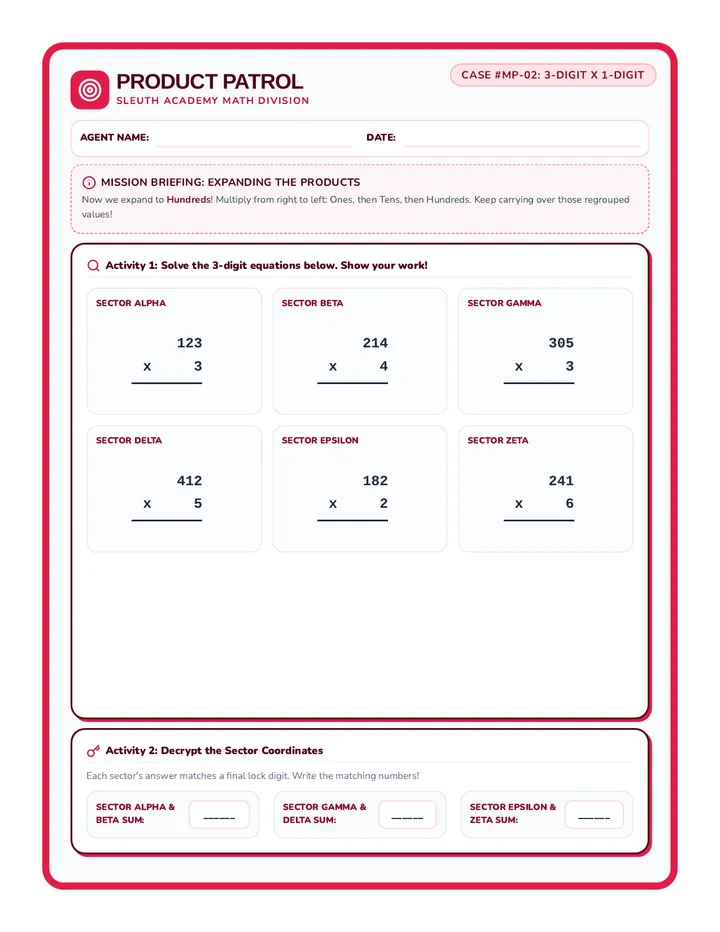
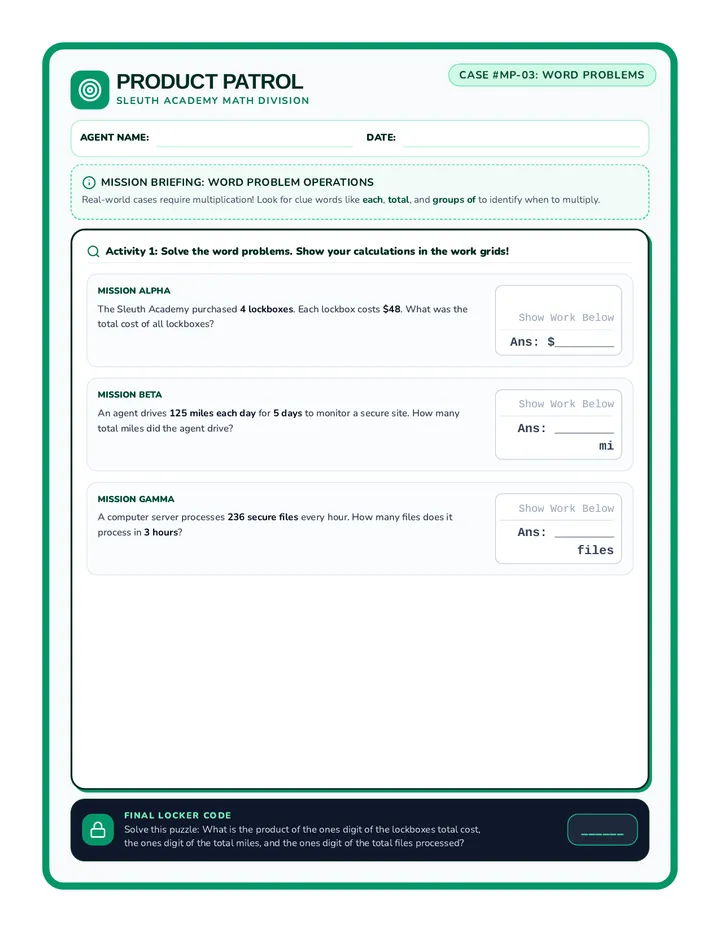
A 4th-grade math worksheet featuring 5 multiplication and 5 division problems up to 12x12. The layout is clean and professional with dedicated work space for each problem.
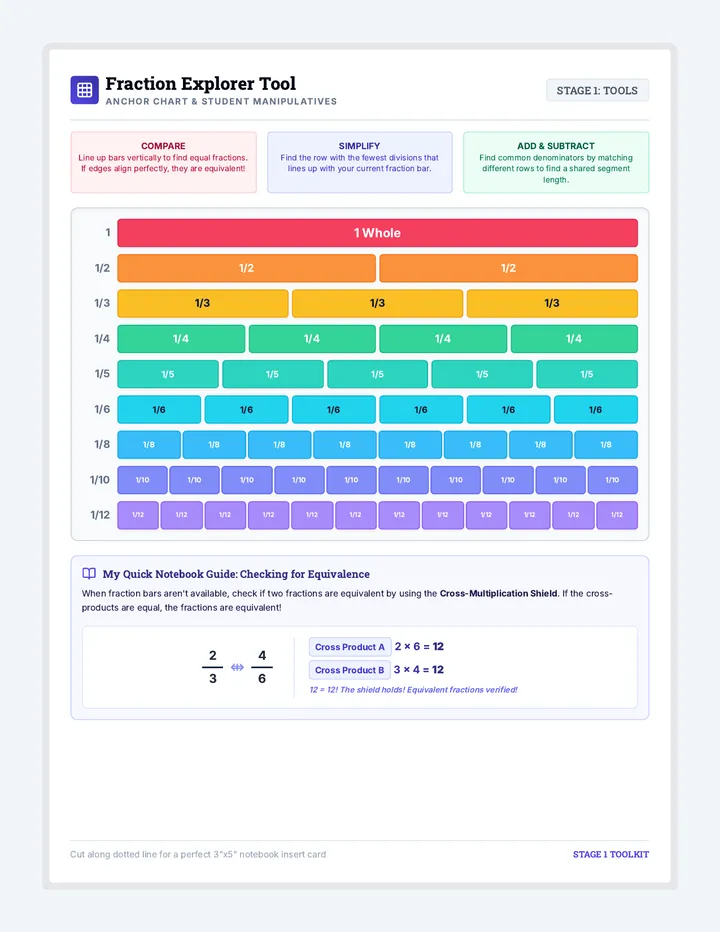
A revised answer key for the Fraction Blueprint Worksheet. Features explicit legend for notation, better space utilization, and page-break avoidance to keep problems intact.
A revised structured worksheet for adding and subtracting fractions with unlike denominators. Improved layout with page-break avoidance, better problem distribution (5/5 split over 2 pages), and box-style student work areas for better organization and legibility.
A set of printable "Spec Cards" for an angle scavenger hunt, challenging students to find and measure specific angle types in their environment.
A student worksheet for recording shadow angle measurements at different times of day, including sketching areas and analysis questions.
A project guide for students to create geometric nature mosaics. It includes a design canvas with a center line, a checklist for success, and clear instructions for maintaining mathematical balance in their artwork.
An instructional slide deck for introducing angle measurement and the shadow investigation mission. Includes visual aids for protractor use and angle types.
A hands-on student worksheet where fourth graders identify and draw lines of symmetry on Indiana-specific flora and fauna icons, including a drawing challenge to complete a symmetrical feather.
A visually engaging slide deck introducing line symmetry using Indiana icons like the Northern Cardinal and Peony. Includes definitions, visual examples of symmetry lines, and a project call-to-action.
A comprehensive teacher facilitation guide for the 'Angle Architects' lesson, including pacing, materials, prep, and differentiation strategies.
A comprehensive teacher guide for the Wild Balance lesson, including instructional steps, Indiana state standards, vocabulary, and differentiation strategies for teaching symmetry through local nature.
Updated slide deck for SIFE students that moves beyond the 5/3 example to show halves (3/2), the concept of 'top = bottom' equaling one whole, and multiple number line examples. It maintains high-contrast visuals and minimal text.
A visual anchor chart for SIFE students demonstrating that when the numerator and denominator are the same, the fraction equals one whole. It uses high-contrast models for halves, thirds, and fourths to show the pattern across different denominators.
A visual sorting activity where SIFE students categorize visual fraction models into 'Part' (less than 1), '1 Whole' (exactly 1), and 'More' (greater than 1). The cards use variety in shapes (circles, strips, squares) and denominators (halves, thirds, fourths) to build conceptual understanding beyond a single example.
A visual slide presentation designed for SIFE students to understand fractions greater than one. It uses high-contrast visuals, minimal text (24px+), and clear step-by-step counting animations (implied layout) to show how 5/3 is built from unit fractions.
A large-format work mat for building fractions greater than one. It provides clear, dashed-line slots for physical fraction strips, helping SIFE students see how three 1/3 pieces make one whole, and how five 1/3 pieces require a second whole strip.
An answer key for the Match Makers Homework, providing correct solutions and visual markings for teachers. Revised to fix overlapping labels and layout issues.
A set of high-contrast, visual vocabulary cards specifically designed for SIFE students. Each card features large numerals, clear geometric representations of fractions (like 5/3), and minimal English text to support conceptual understanding without relying on literacy.

A student homework worksheet featuring area models and number lines for identifying and generating equivalent fractions, designed with an architectural blueprint aesthetic. Revised to fix LaTeX rendering, shading issues, and page breaks.
A set of instructional slides introducing equivalent fractions through area models and number lines with an architectural blueprint theme. Revised for better spacing, visual alignment, and includes new practice problems.
Comprehensive answer key for the unit. Revised for clarity, correct data references, and page break efficiency.
Handouts for Lessons 3 and 4. Revised to keep Activity 4 on one page, fix wrapping, and improve work area visibility.
Bilingual slides for Lesson 4 (Interpreting Line Plots). Focuses on analyzing data representations, identifying differences between lists and plots, and verifying statements based on data. Revised for populated data and alignment.
Bilingual slides for Lesson 3 (Equivalence and Mixed Numbers). Explores recording lengths in multiple ways and visualizing mixed number partitioning. Revised for ruler accuracy and visible diagrams.
Bilingual slides for Lesson 2 (Measuring in Fourths). Includes estimation exploration, partitioning activities, and a cool-down involving choosing the right tool for precision. Revised for ruler accuracy and alignment.