A hands-on cut-and-paste activity where students categorize various examples of figurative language and multiple-meaning words into themed 'canisters'. Revised to fit everything onto a single page.
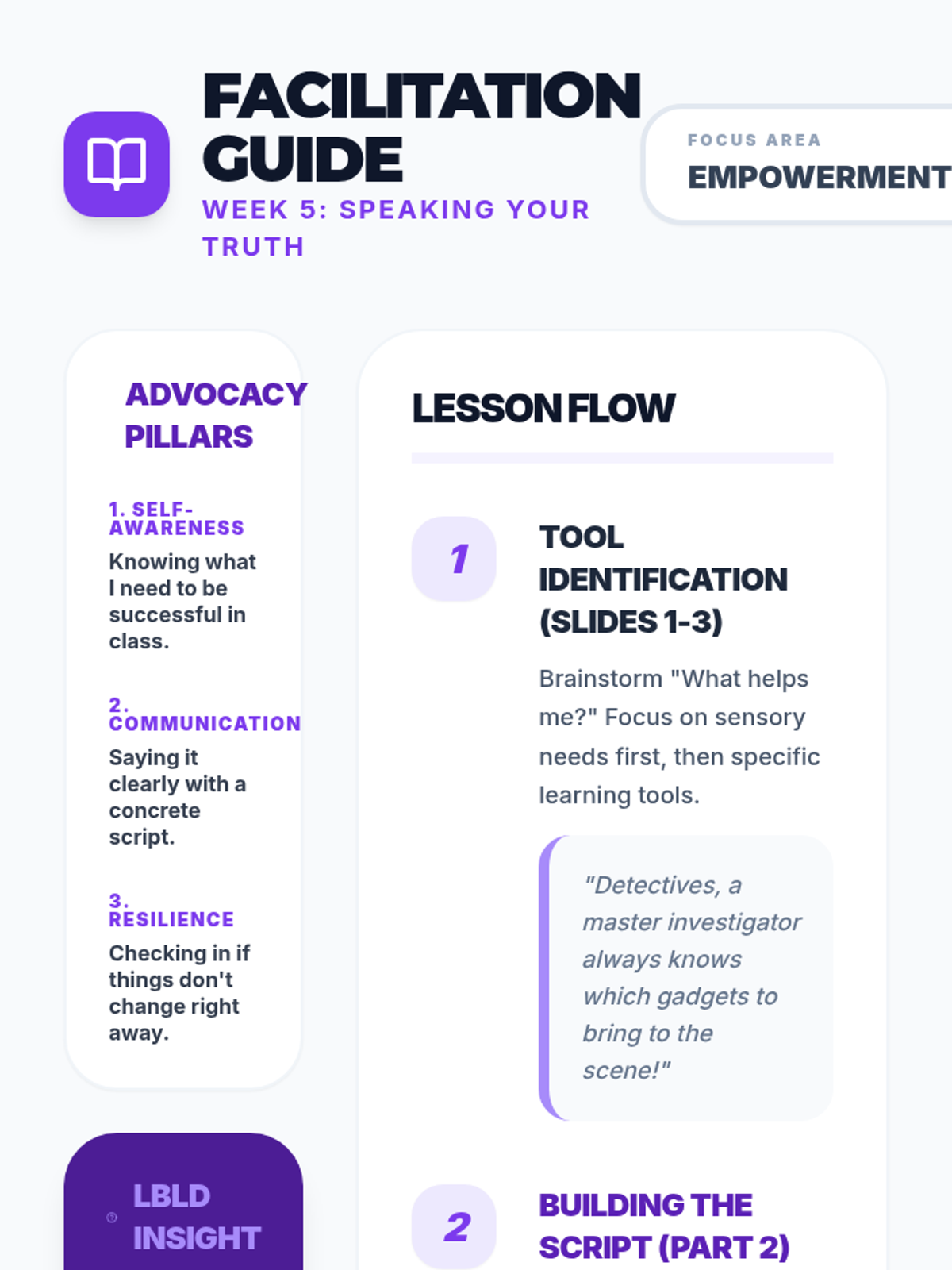
A teacher's facilitation guide for Week 5, providing strategies for empowering LBLD students to advocate for their learning tools and build a supportive classroom culture.
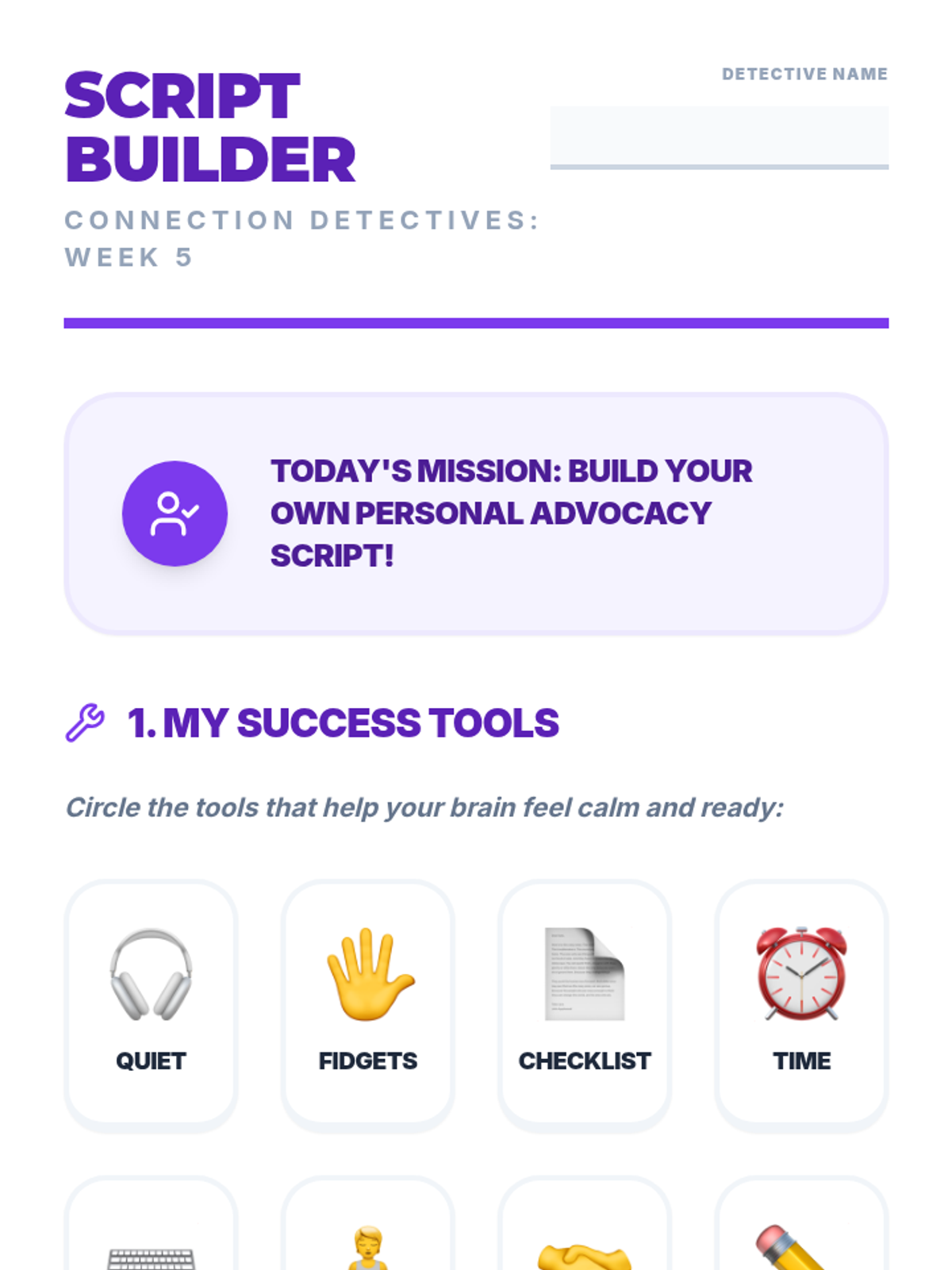
A student self-advocacy worksheet for Week 5, helping students identify their learning tools and build a personalized 'Truth Script' for communicating their needs.
A visual-heavy slide deck for Week 5, focusing on long-term self-advocacy and communicating learning needs to teachers and peers for LBLD students.
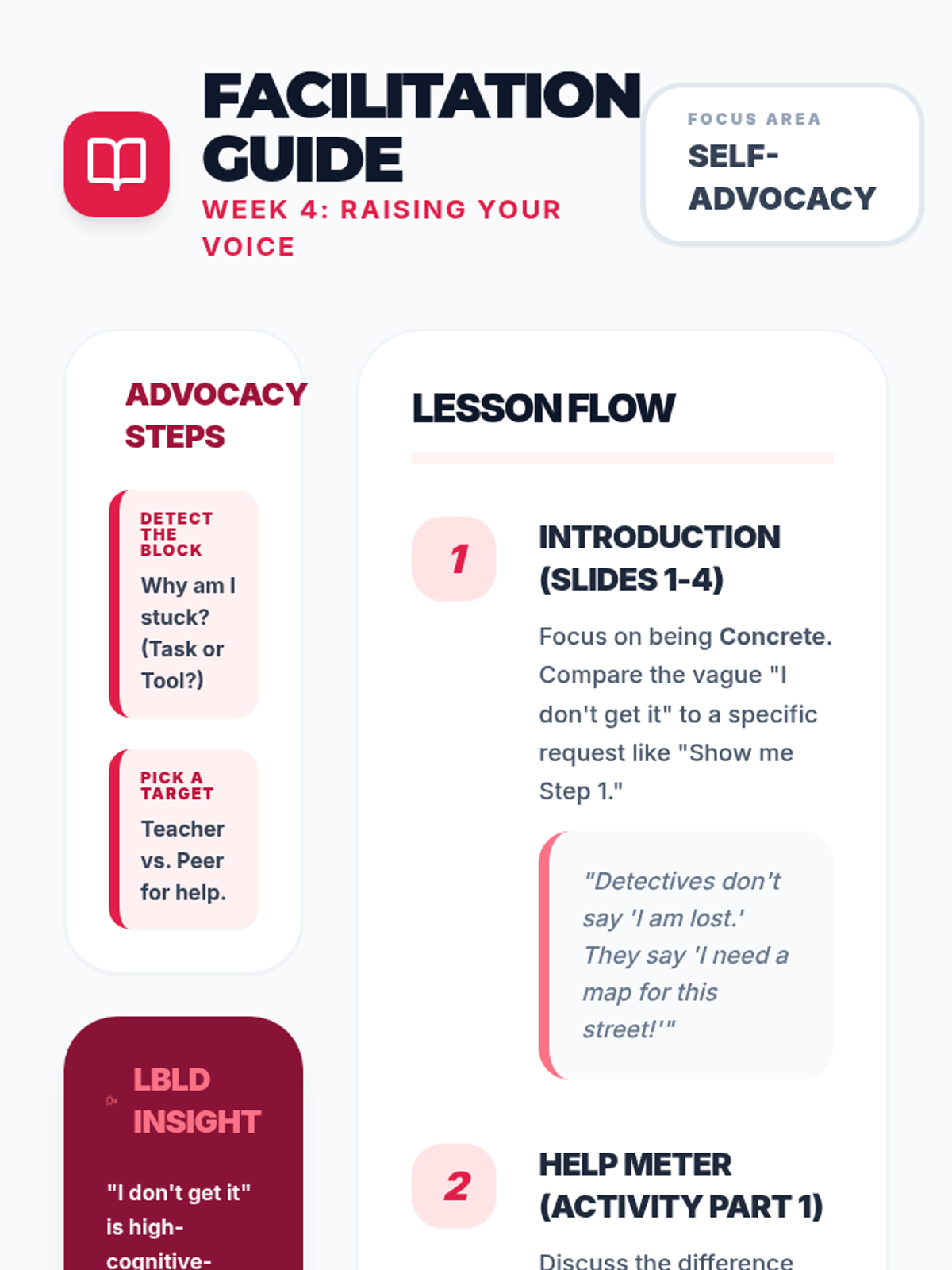
A teacher's facilitation guide for Week 4, focusing on teaching self-advocacy through concrete requests and the use of classroom 'Help Signal' bookmarks.
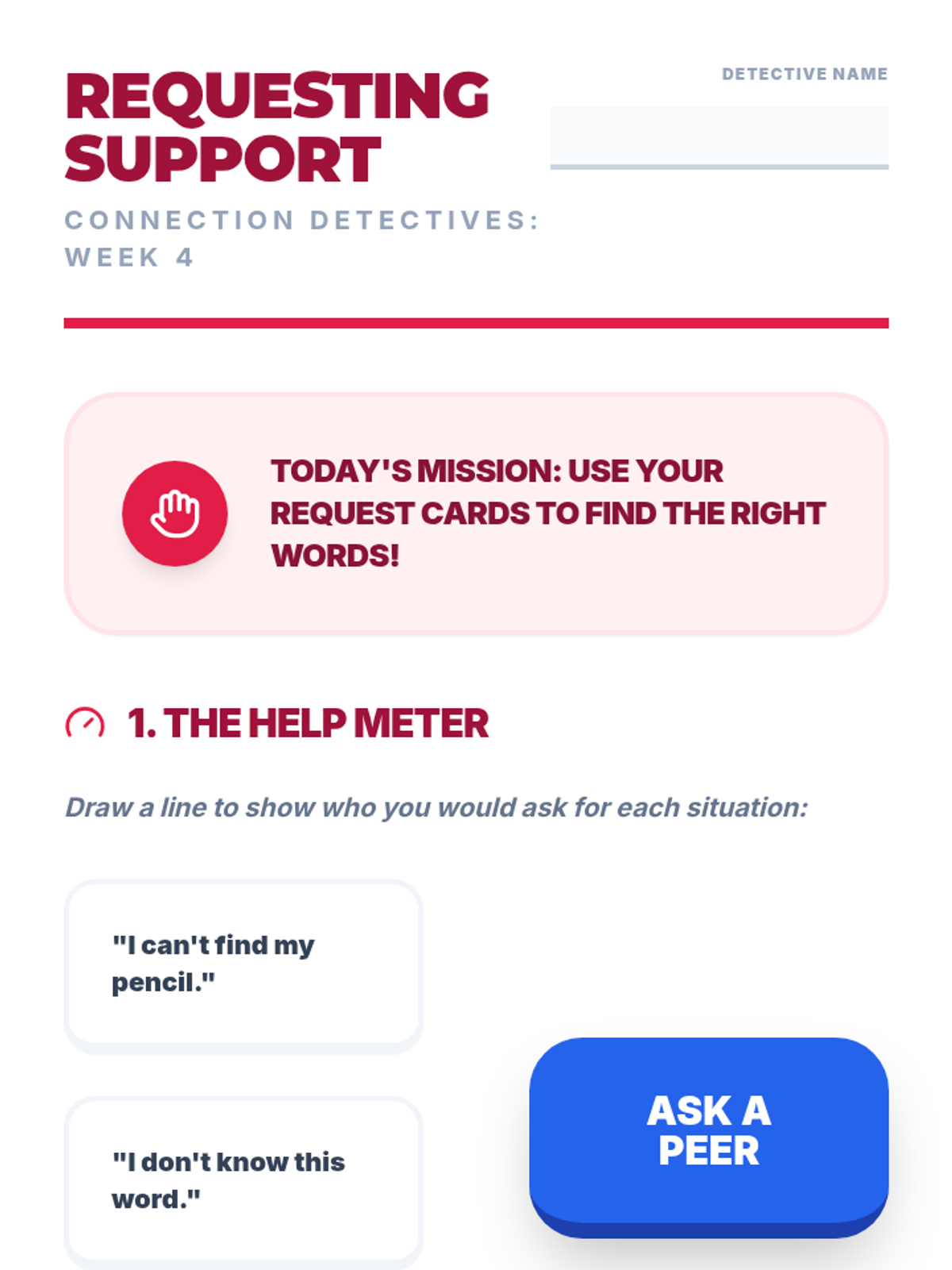
A student role-play worksheet for Week 4, featuring a 'Help Meter', script-building exercises, and a cut-out 'Detective Bookmark' for classroom desk use.
A visual-heavy slide deck for Week 4, focusing on 'Raising Your Voice' by identifying help signals and practicing specific, concrete requests for LBLD students.
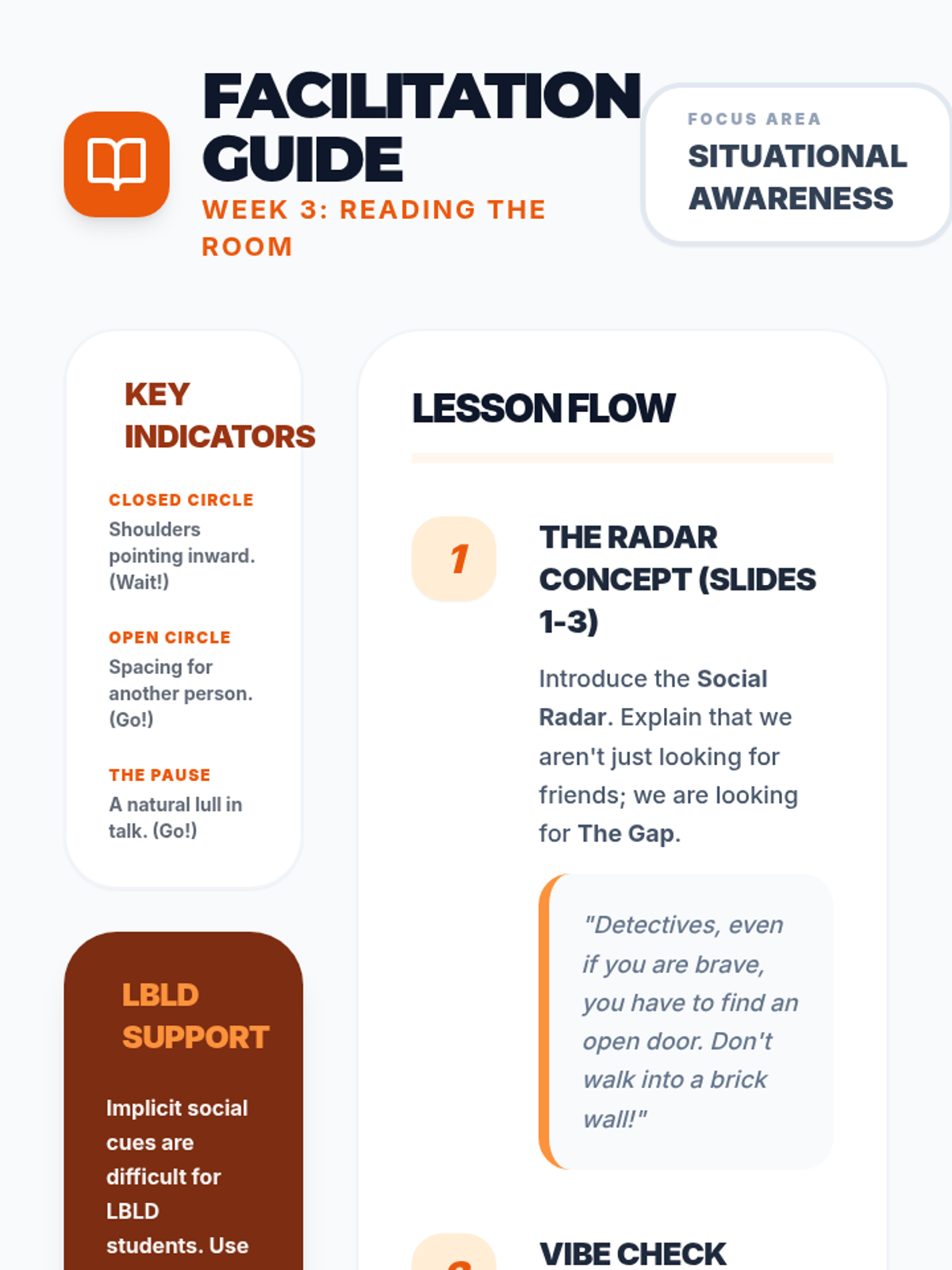
A teacher's facilitation guide for Week 3, focusing on teaching situational awareness and 'Reading the Room' with LBLD-specific 'If-Then' thinking strategies.
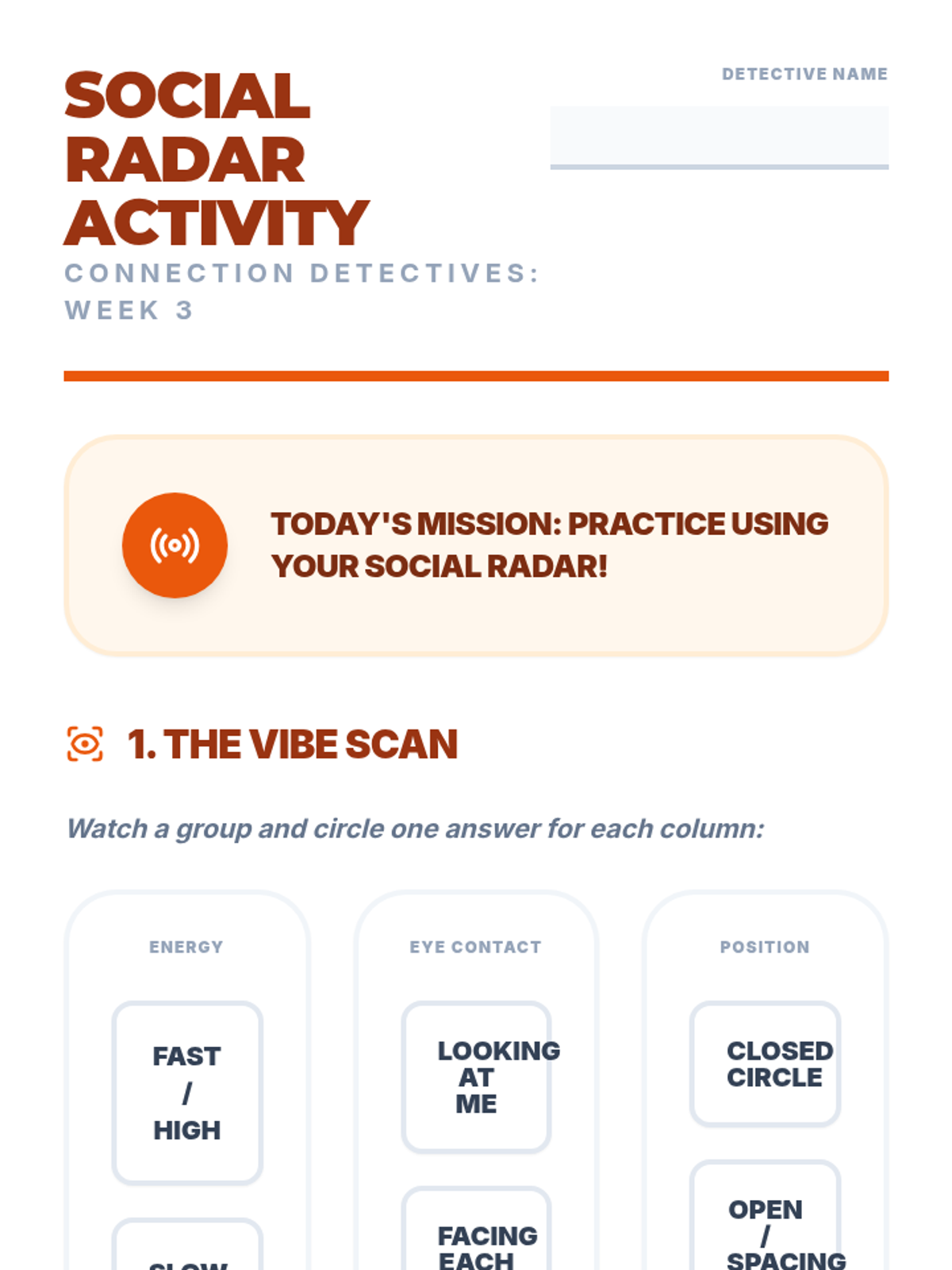
A student role-play worksheet for Week 3, teaching how to scan for social energy and identify entry 'gaps' through visual scenarios and a structured 'Invisible Wait' mission.
A visual-heavy slide deck for Week 3, focusing on 'Reading the Room' by identifying energy, mood, and the 'Entry Gap' using radar imagery and Stop/Go signals.
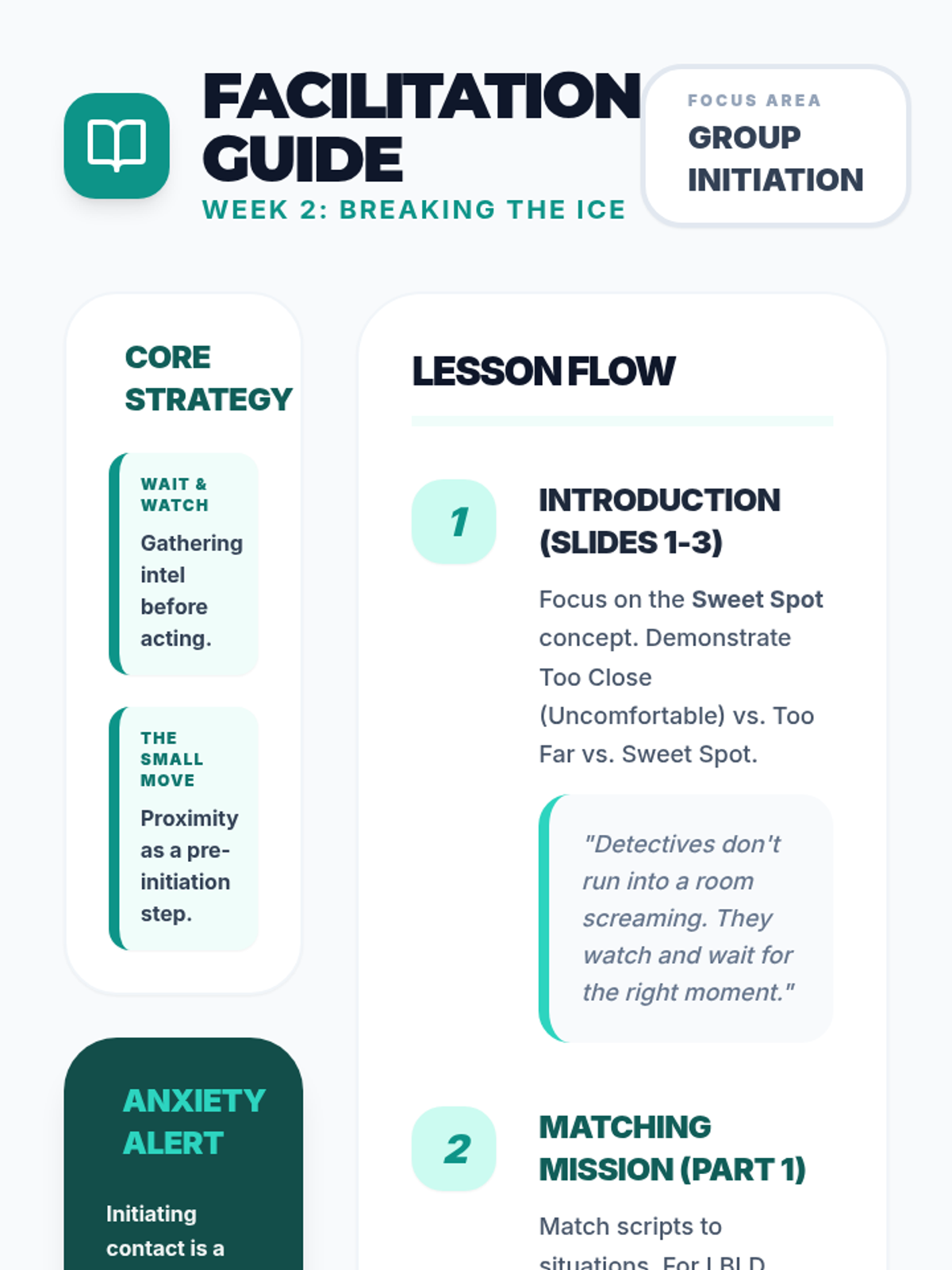
A teacher's facilitation guide for Week 2, offering specific instructional scripts and LBLD-friendly activities for teaching group initiation and the 'Sweet Spot' distance.
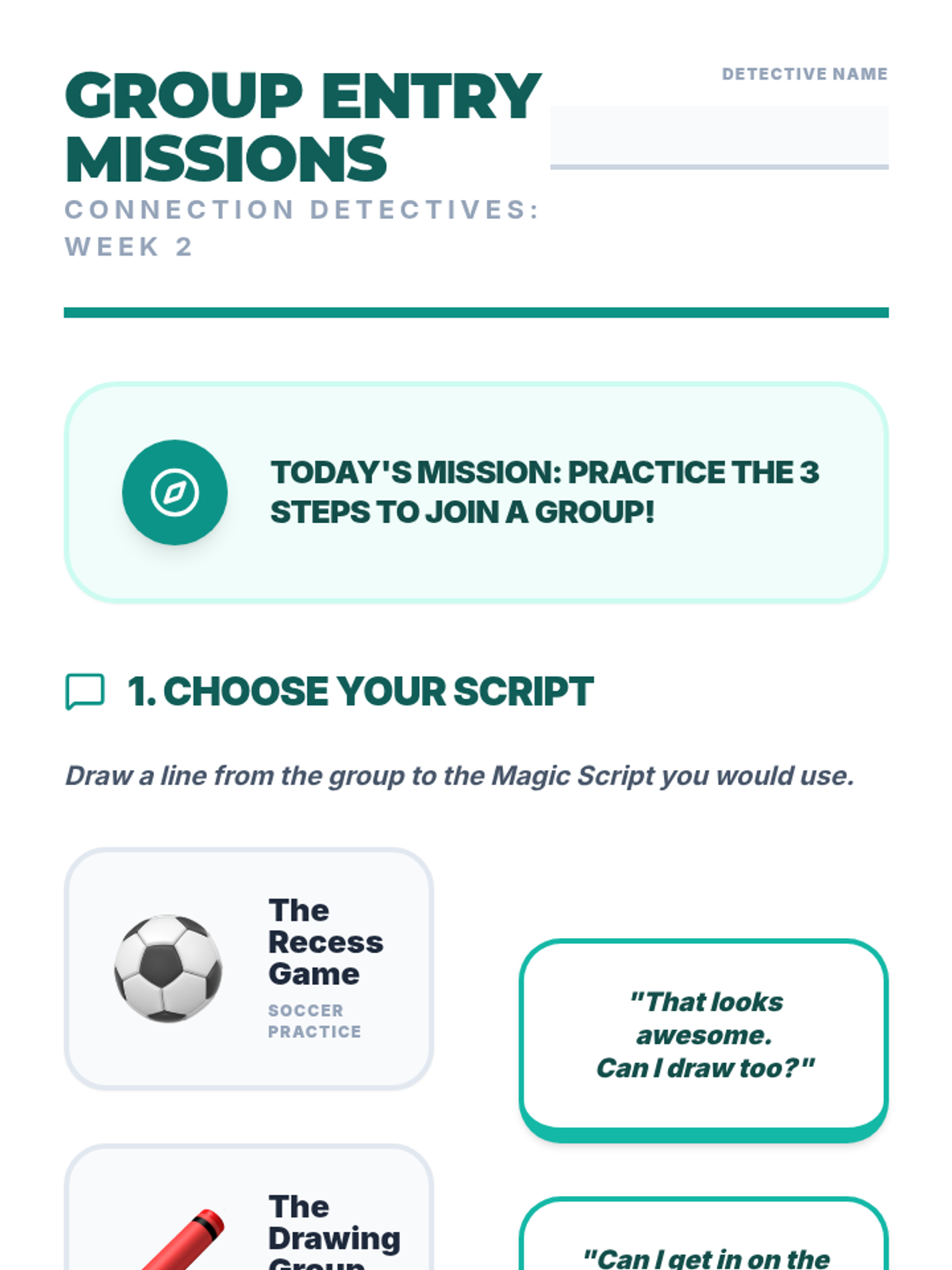
A student role-play worksheet for Week 2, focusing on 'Group Entry Missions' with matching scripts and a visual 'Sweet Spot' distance gauge for LBLD students.
A visual-heavy slide deck for Week 2, teaching 'Breaking the Ice' strategies like 'Wait & Watch' and 'The Small Move' using simple icons and bold scripting for LBLD students.
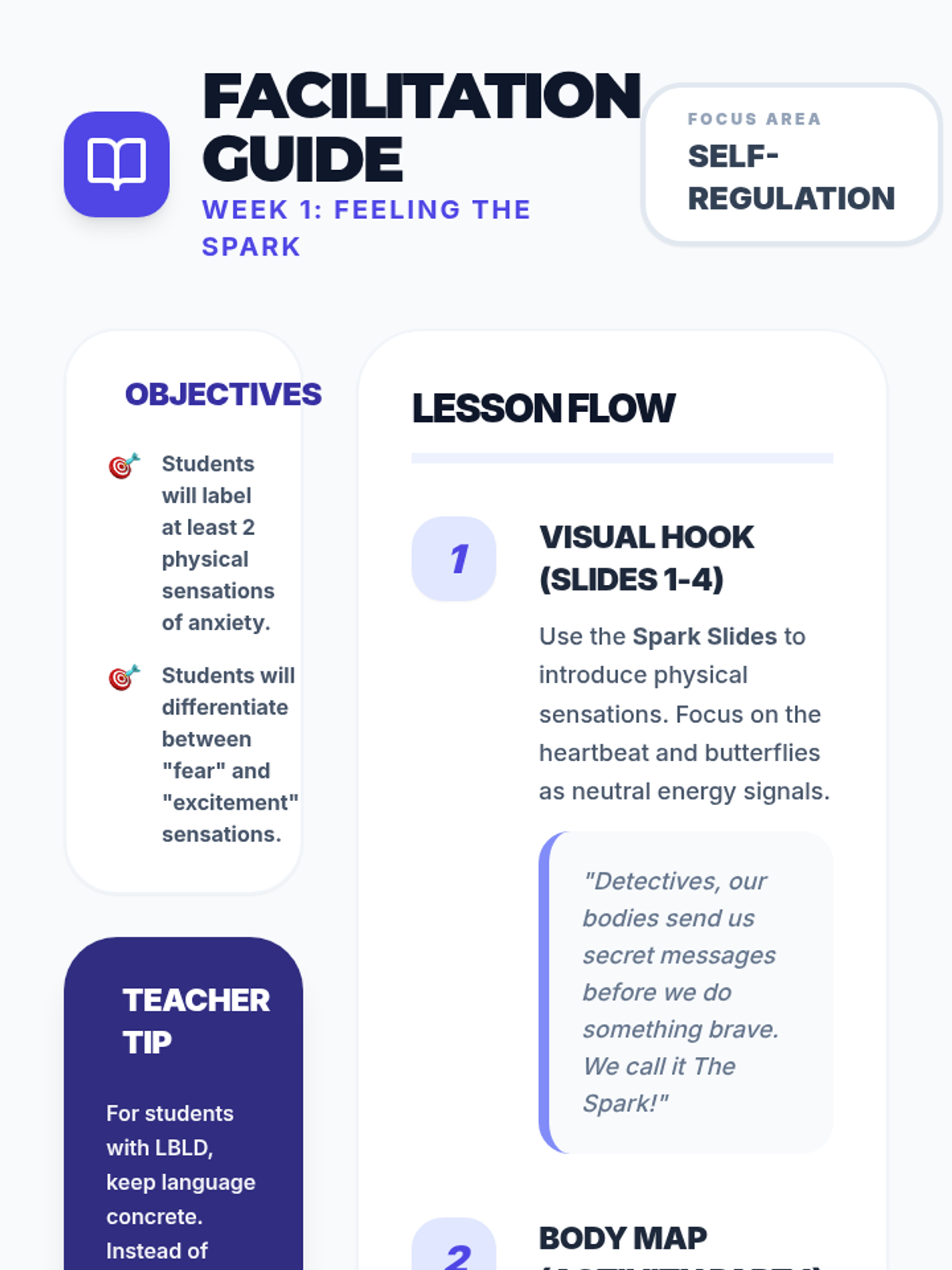
A teacher's facilitation guide for Week 1, providing specific instructional scripts, LBLD-friendly prompts, and differentiation strategies for the 'Feeling the Spark' lesson.
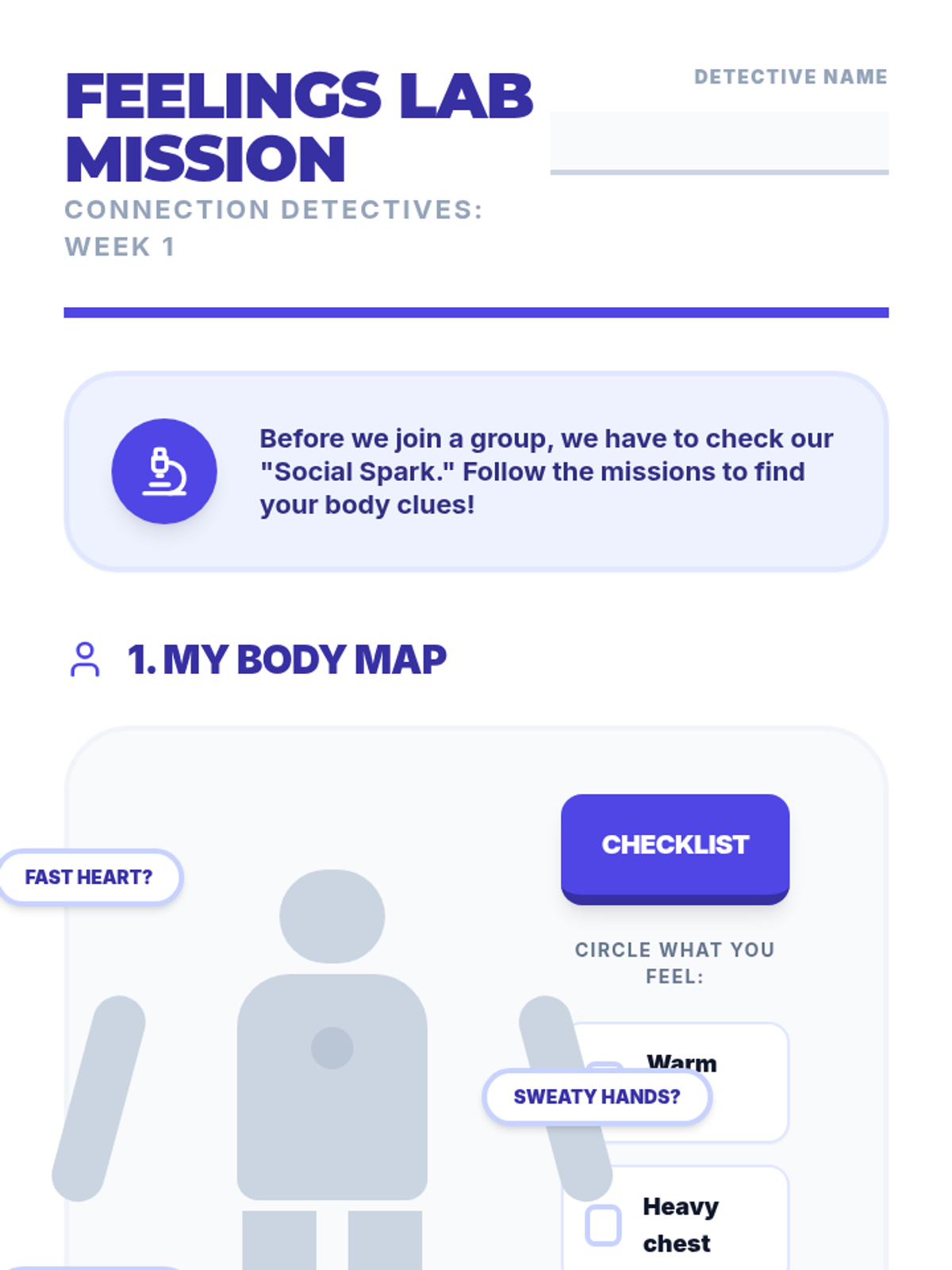
A student-facing role-play worksheet for Week 1, featuring a body scan activity and two structured scenarios to help students identify physical anxiety cues.
A visual-heavy slide deck for Week 1, focusing on identifying physical sensations of anxiety and excitement using high-contrast icons and minimal text for LBLD accessibility.
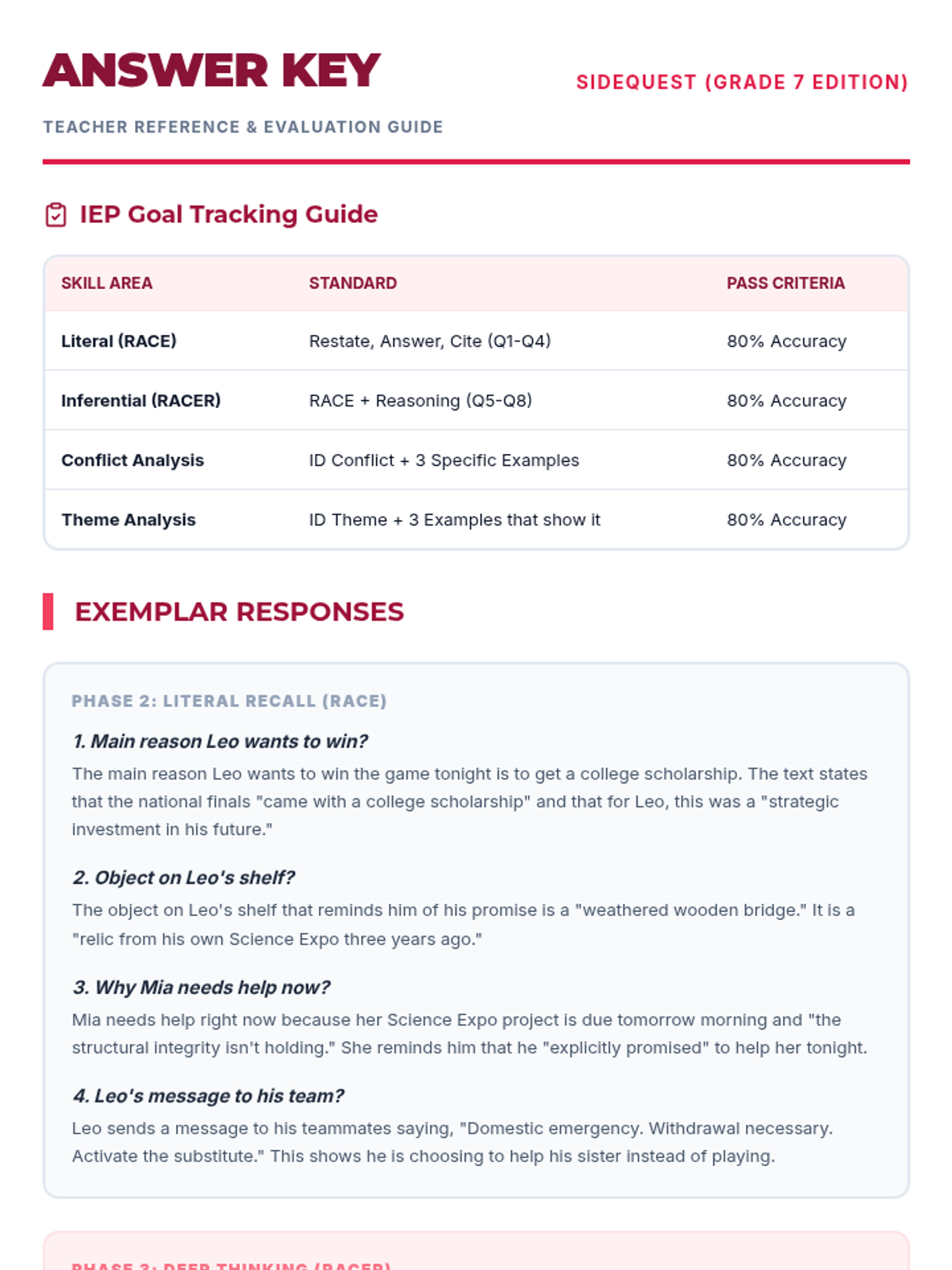
Updated answer key for the 7th-grade Sidequest assessment. Includes exemplar responses for new literal and inferential questions, matching the simplified language of the student document.
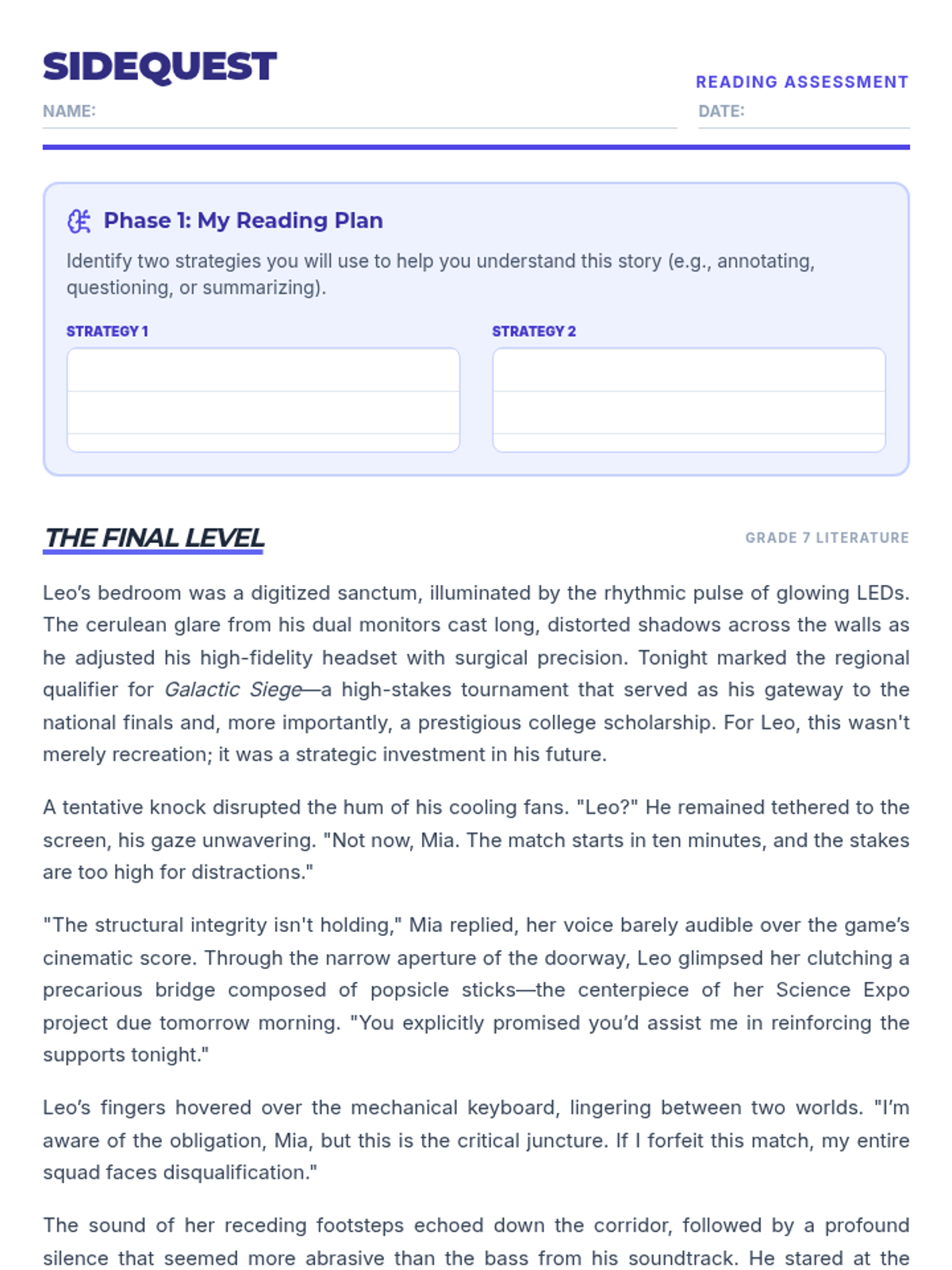
An updated 7th-grade reading assessment featuring a more complex realistic fiction story about a gamer facing a moral dilemma. Includes ruled writing lines and simplified directions for identifying theme examples.
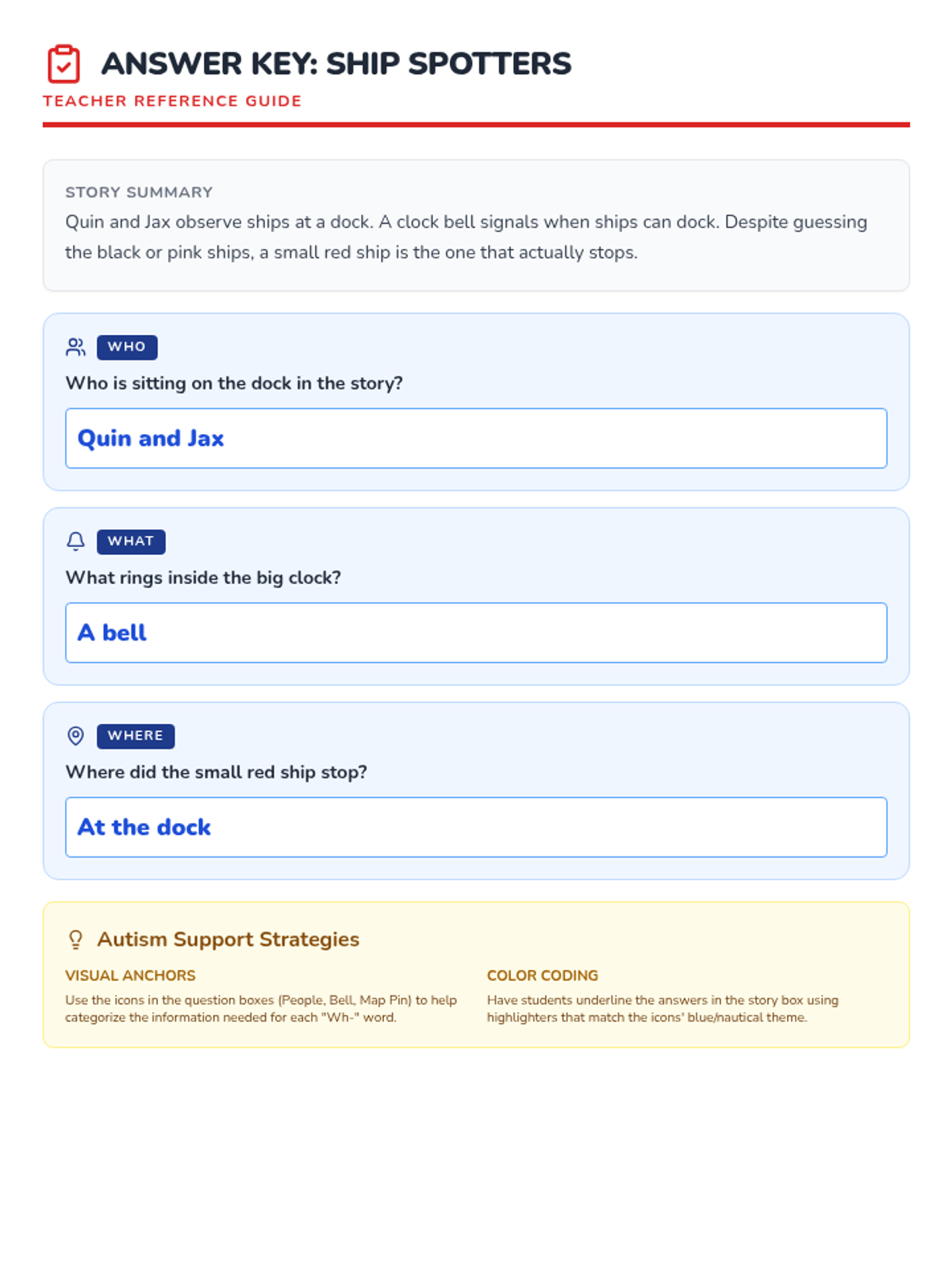
A teacher's answer key for the Ship Spotters Worksheet, providing clear solutions for the 'Who, What, Where' questions and instructional tips for supporting students with autism. Updated for single-page efficiency and icon consistency.
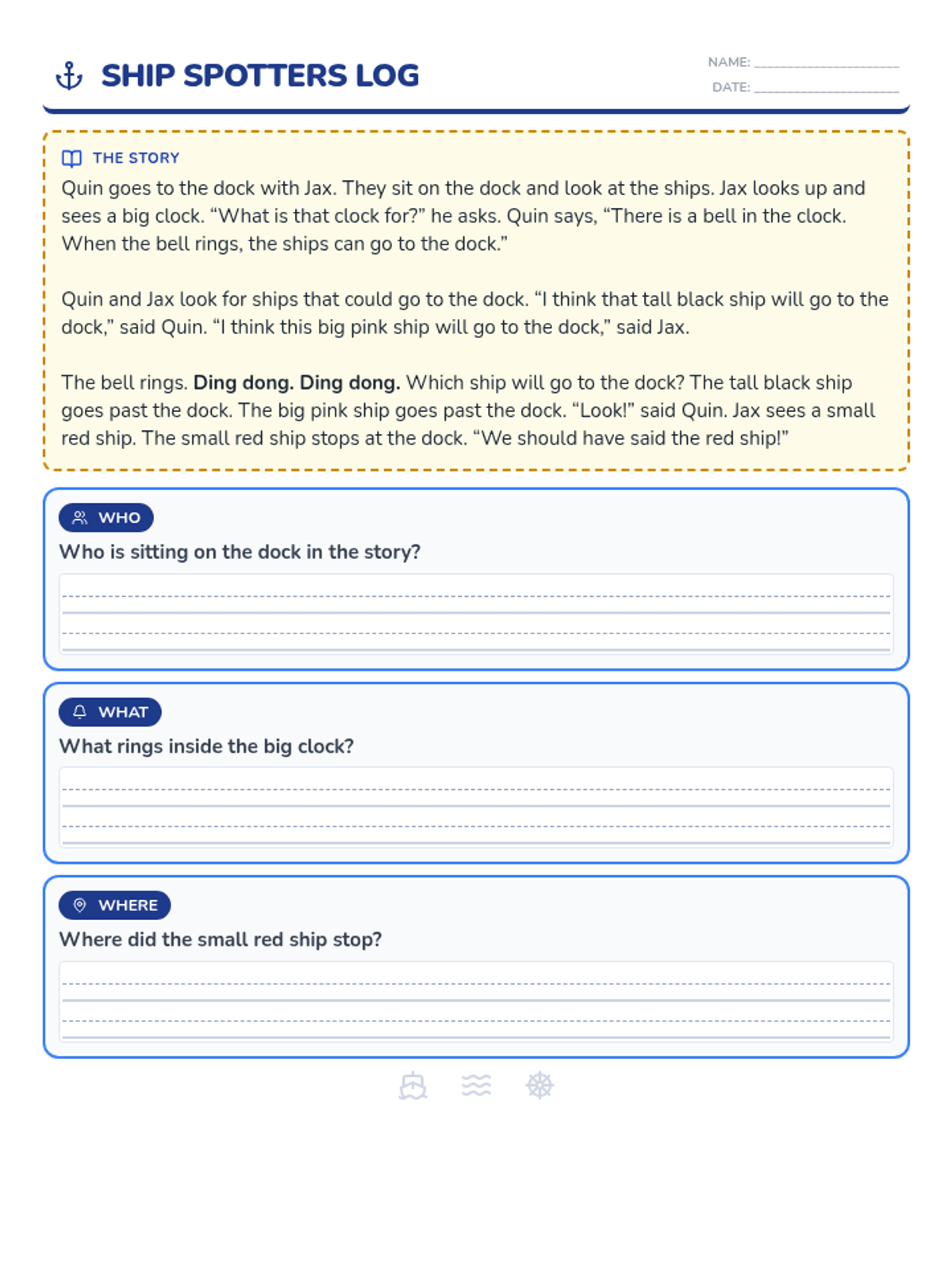
A reading comprehension worksheet featuring the story of Quin and Jax at the dock. It includes three structured 'Wh-' questions (Who, What, Where) with visual icons and primary-style writing lines designed for students with autism. Updated for single-page efficiency and better writing support.
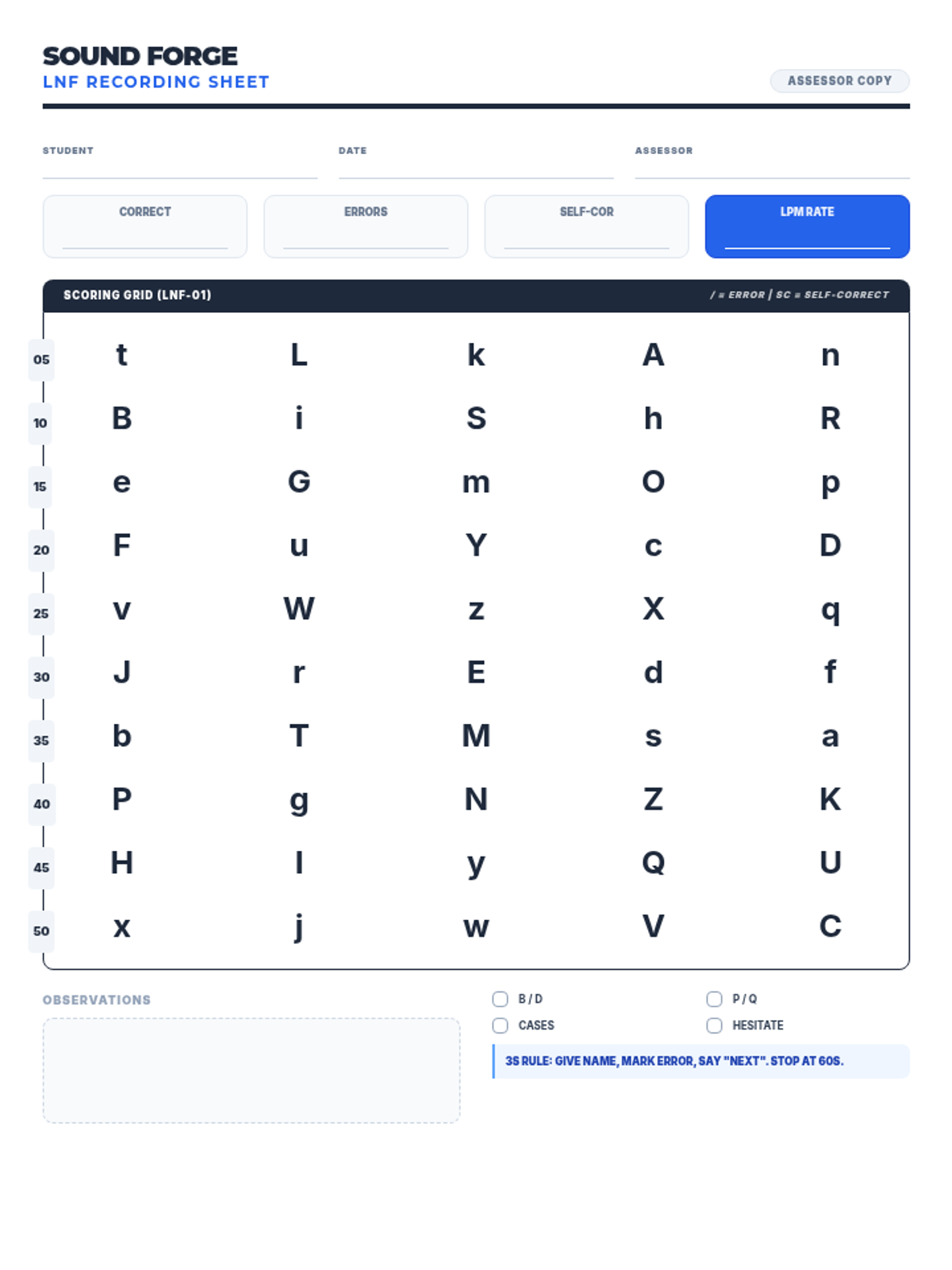
A teacher-facing data recording sheet for the LNF assessment, including a matching scoring grid, performance summary, and qualitative observation tools.
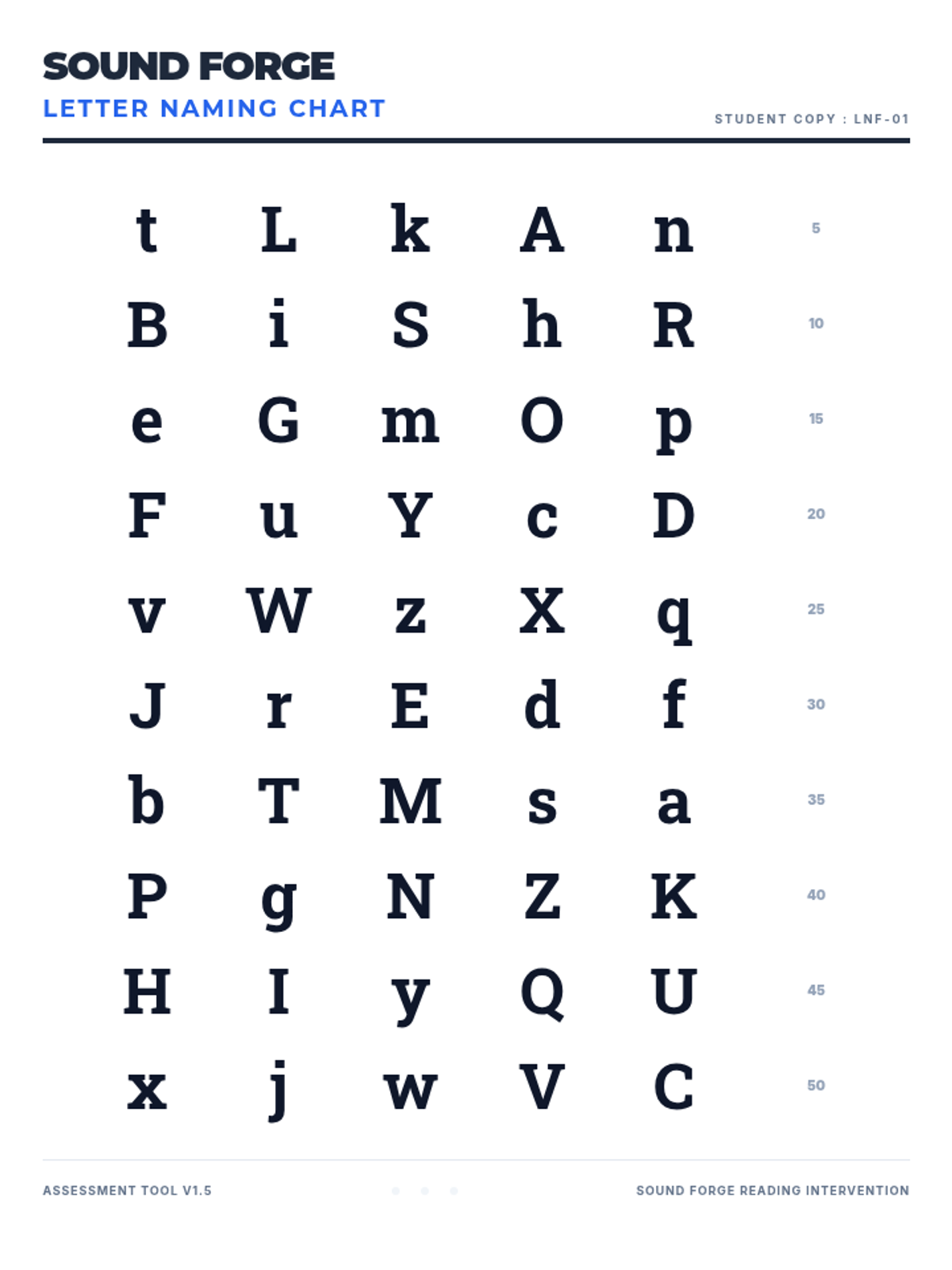
A student-facing letter naming fluency chart featuring a randomized grid of mixed uppercase and lowercase letters for LNF assessment.
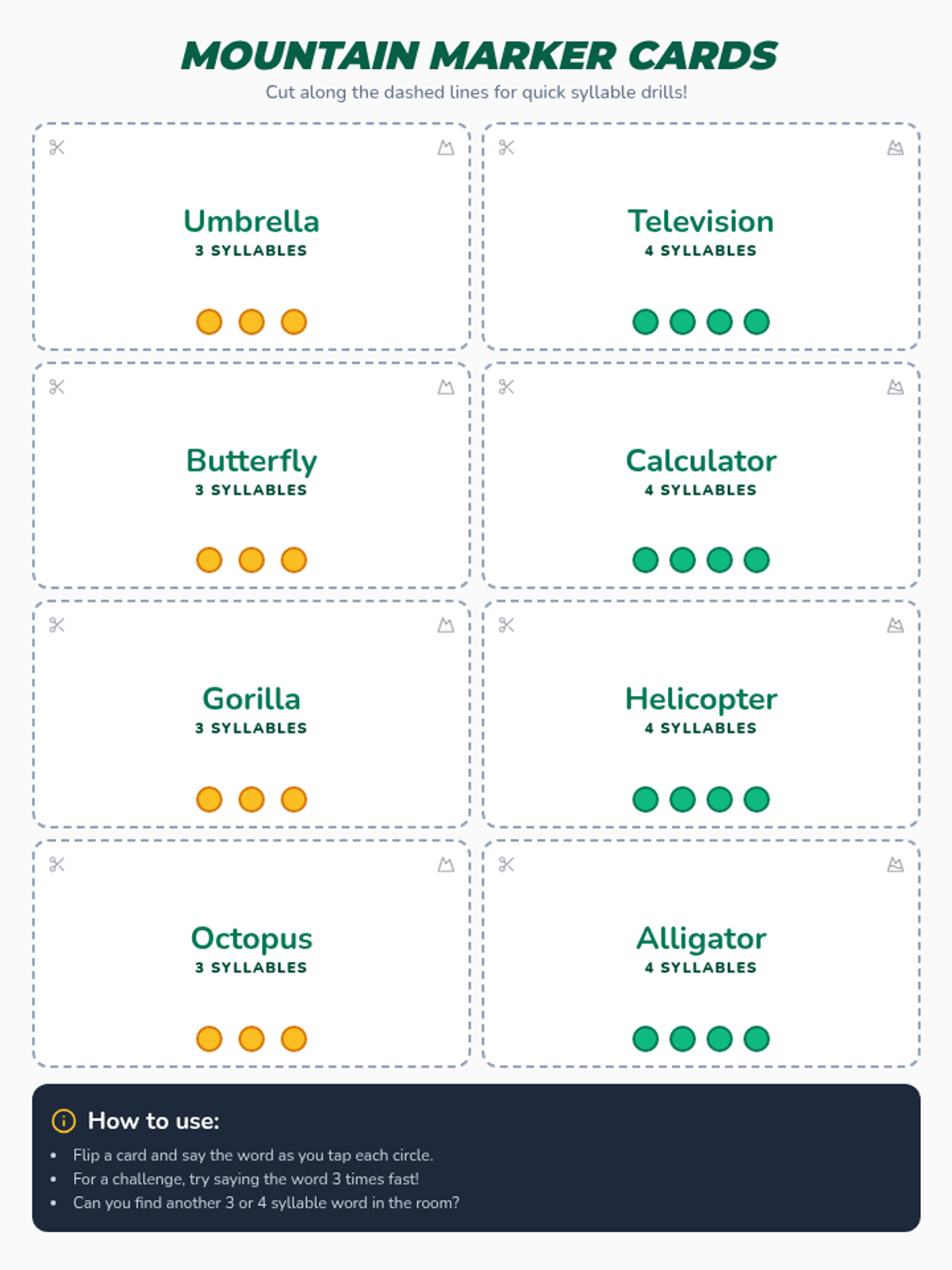
Tactile task cards with visual syllable markers designed for hands-on articulation practice and quick drills.
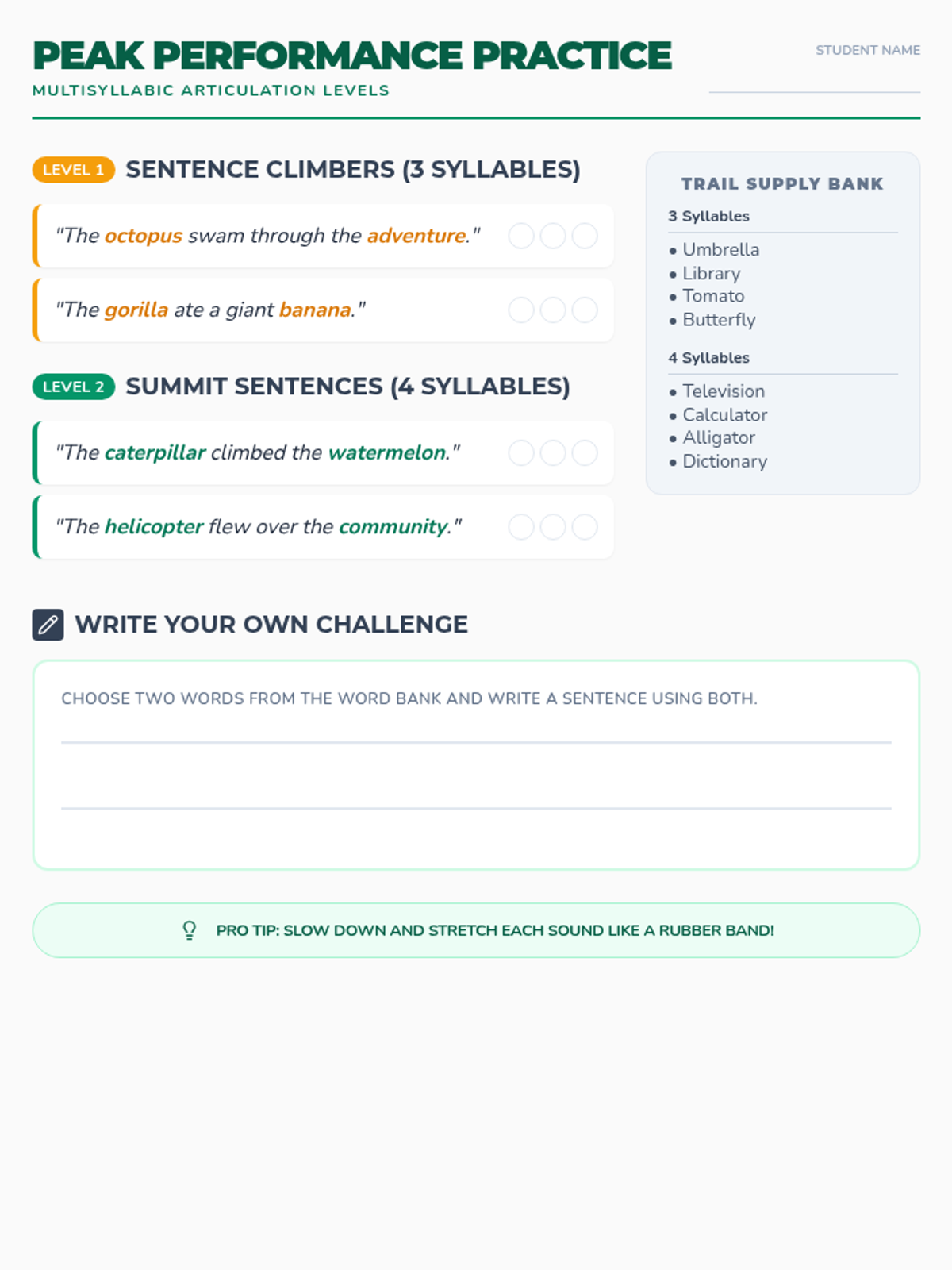
An articulation practice sheet featuring tiered sentence challenges for 3 and 4-syllable words, including tracking markers and a creative writing prompt.
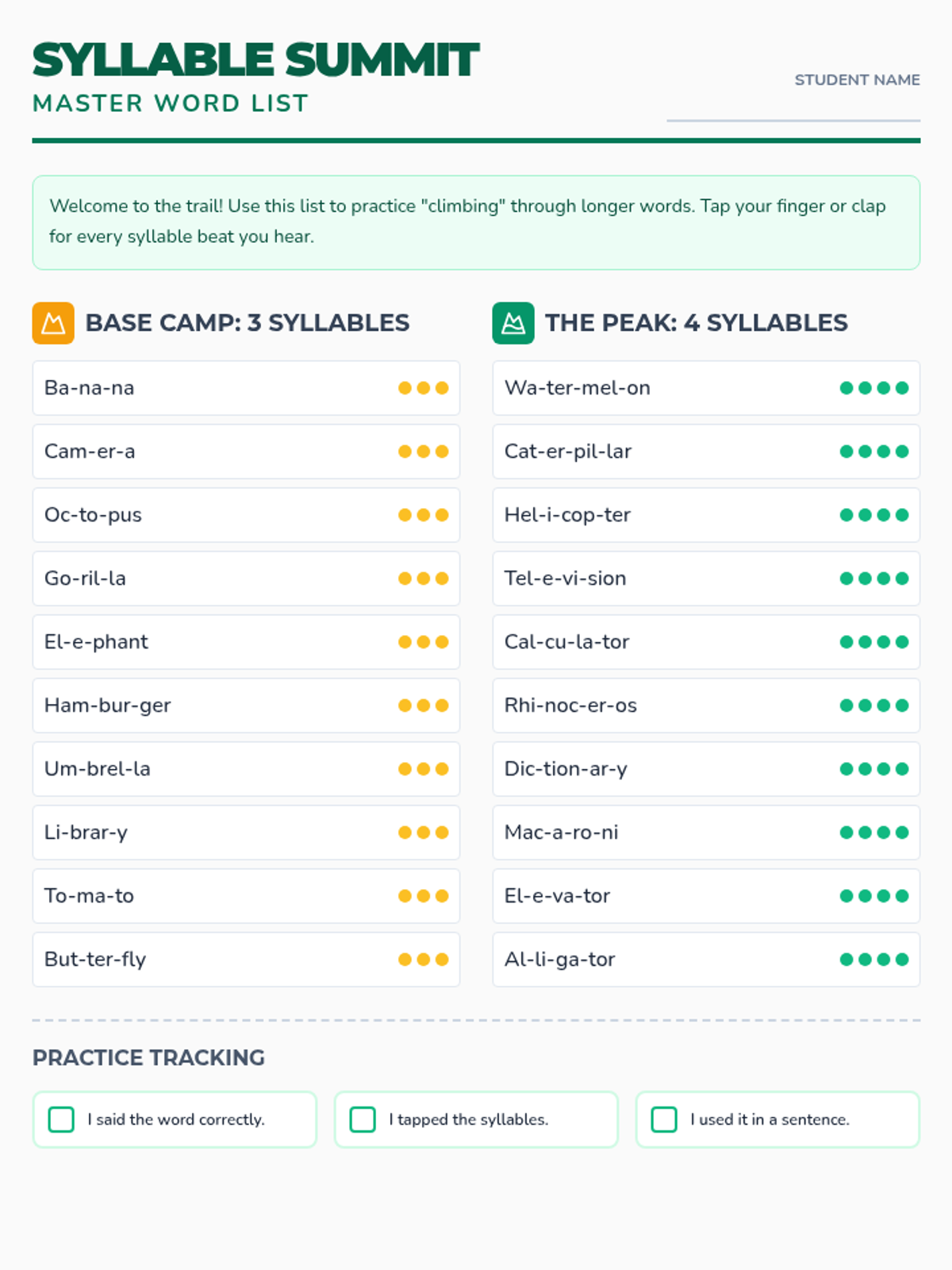
A comprehensive word list featuring 3 and 4-syllable words with visual syllable markers to aid articulation and phonological awareness.
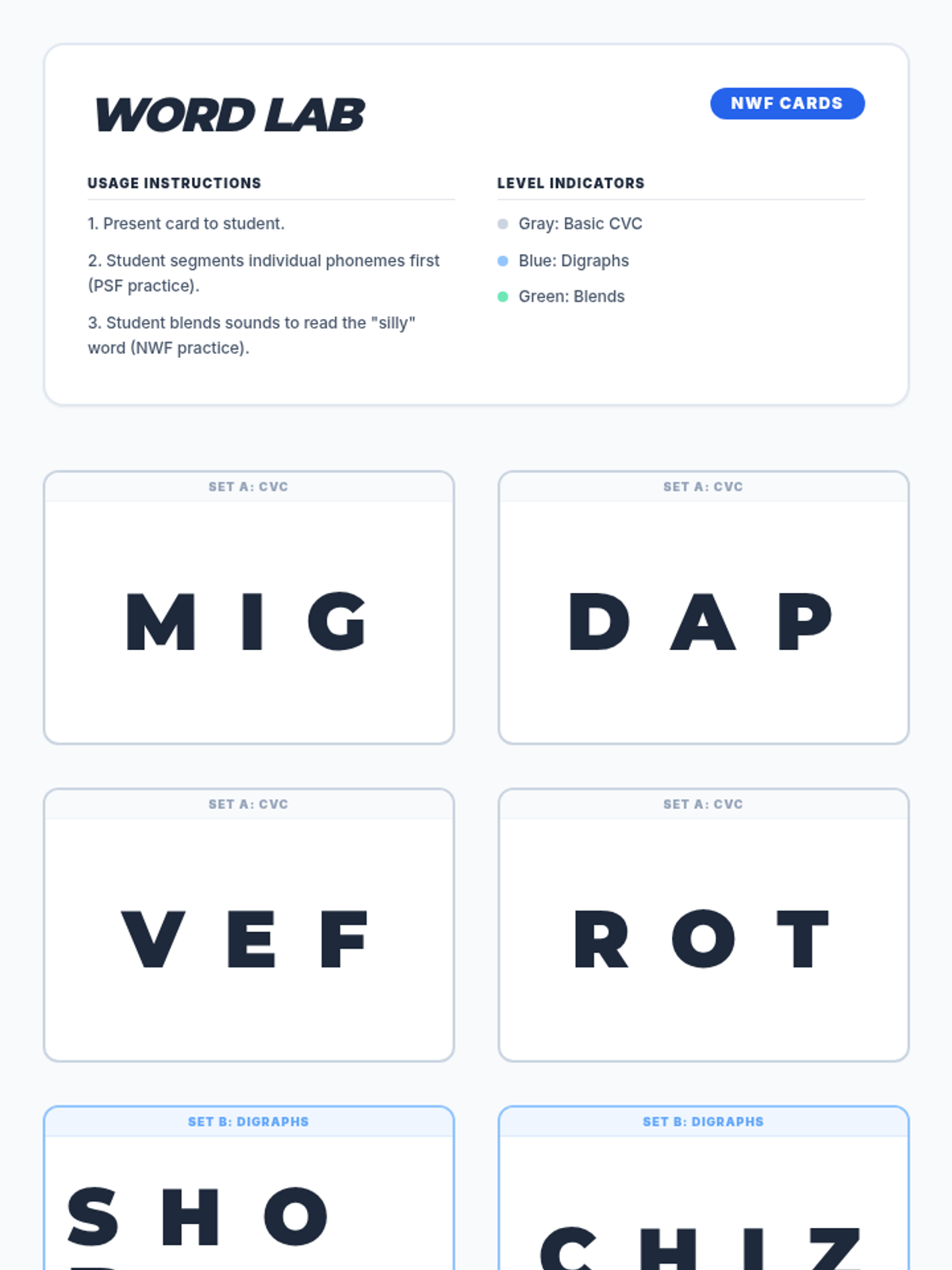
Nonsense word flashcards for NWF practice, categorized by difficulty (CVC, digraphs, and blends) to support decoding and recoding skills.
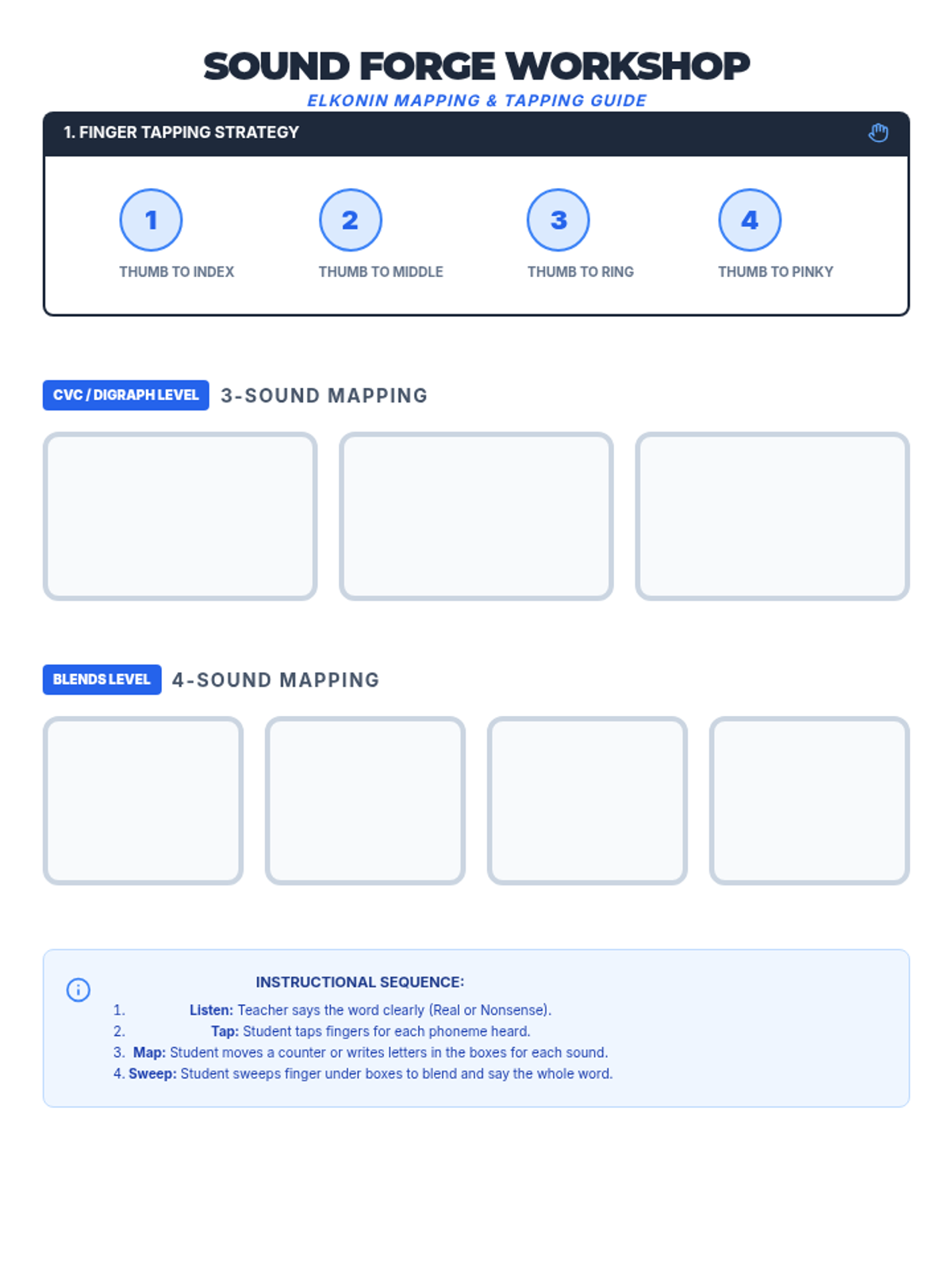
Instructional workshop mats featuring 3- and 4-sound Elkonin boxes and a visual finger-tapping guide for phoneme segmentation scaffolding.
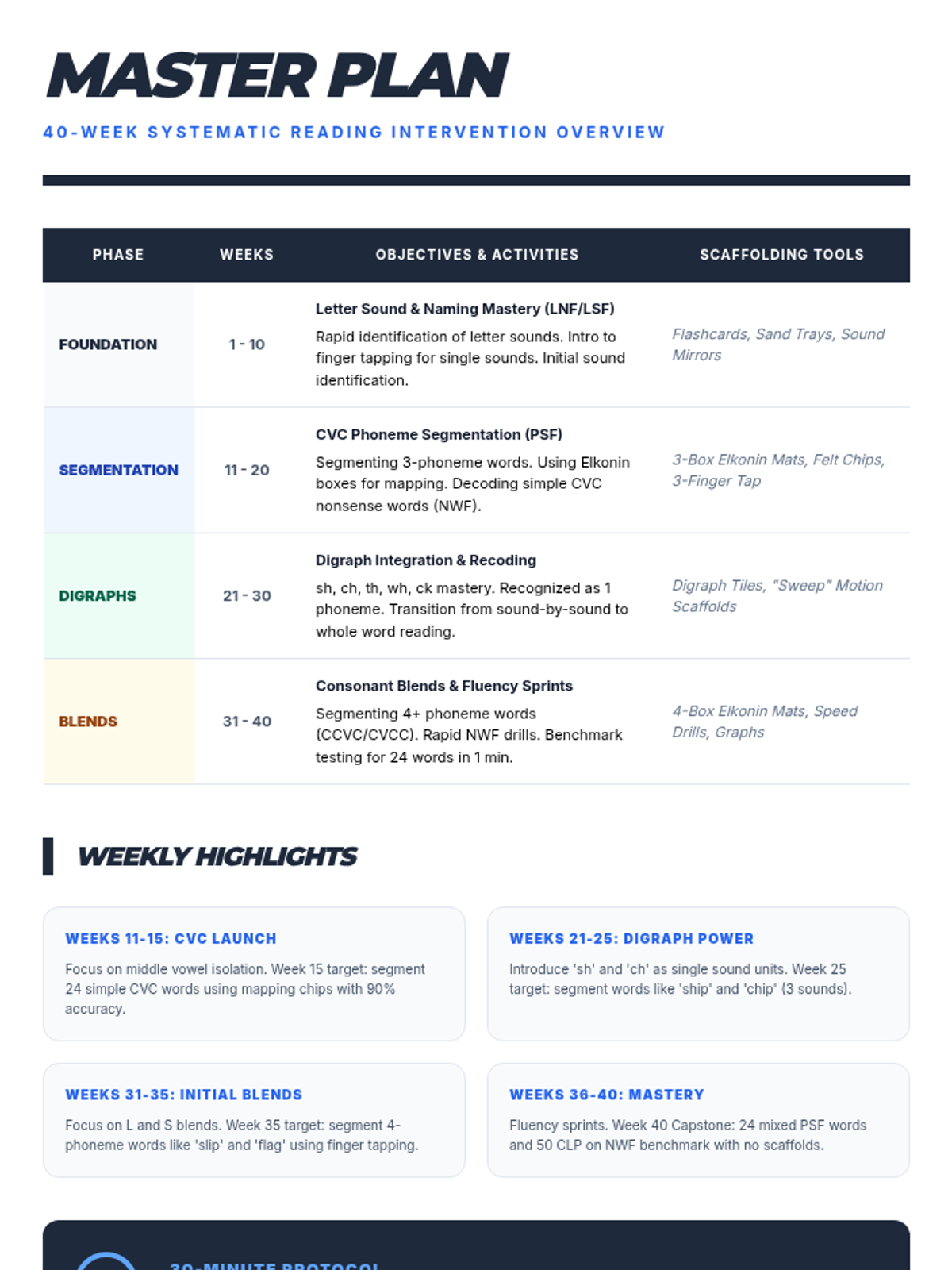
A 40-week master plan for reading intervention, outlining quarterly goals, weekly focuses, and specific scaffolding tools for PSF and NWF.
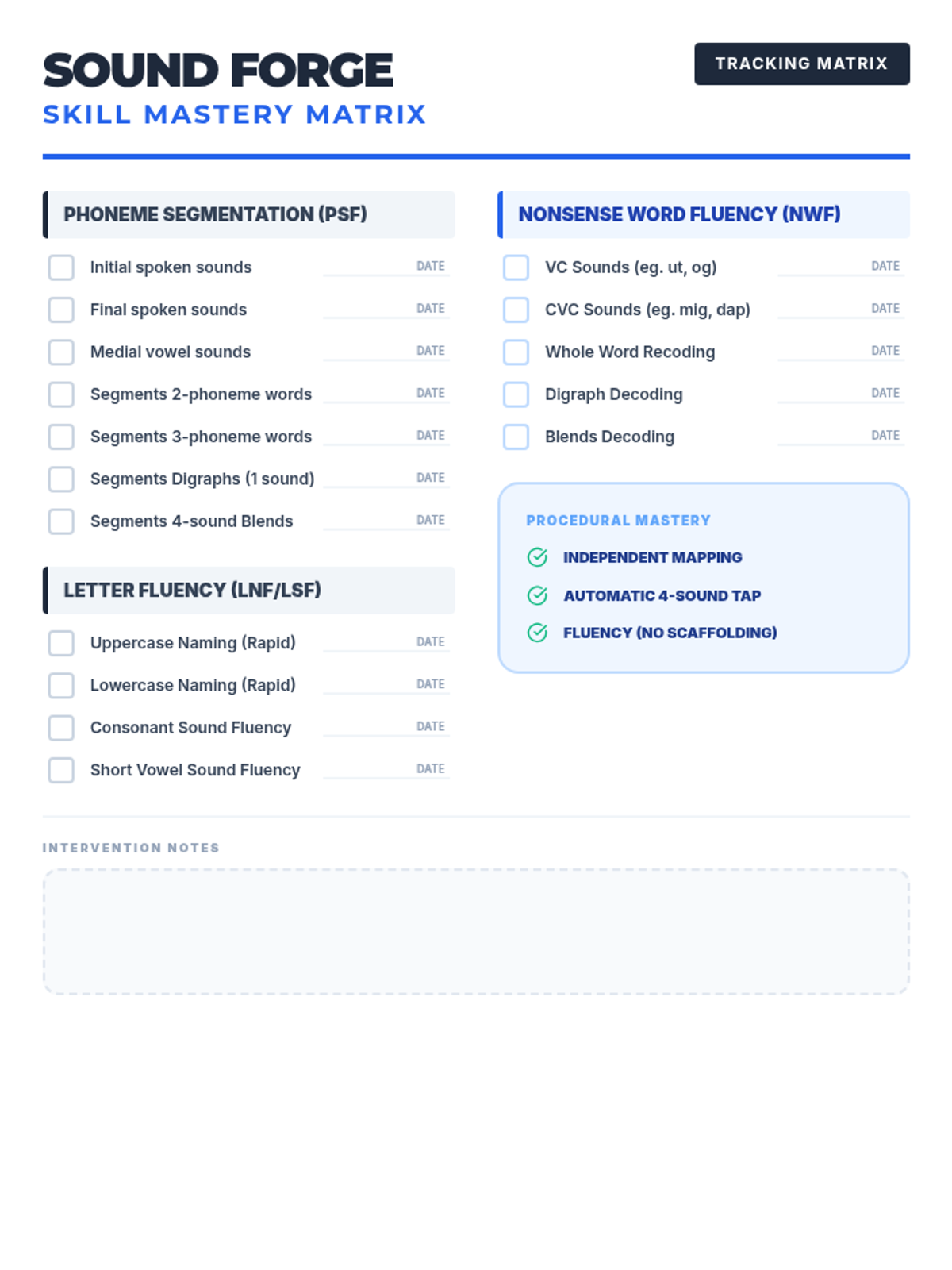
A comprehensive skill checklist for assessing student progress in PSF and NWF, covering letter naming, phoneme segmentation, and decoding levels.
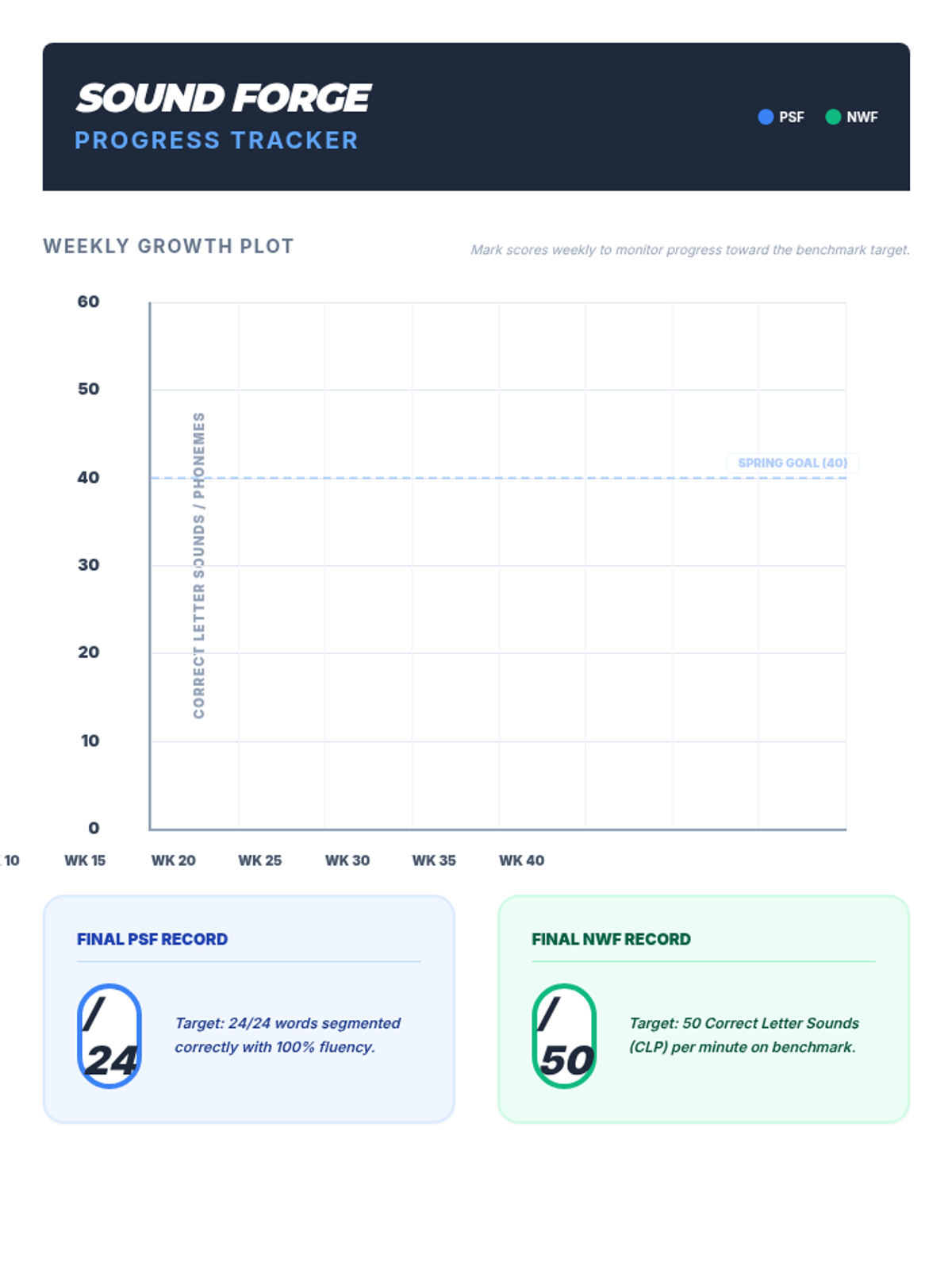
A visual progression chart for tracking growth in Phoneme Segmentation Fluency (PSF) and Nonsense Word Fluency (NWF) over 40 weeks, including milestone goals.
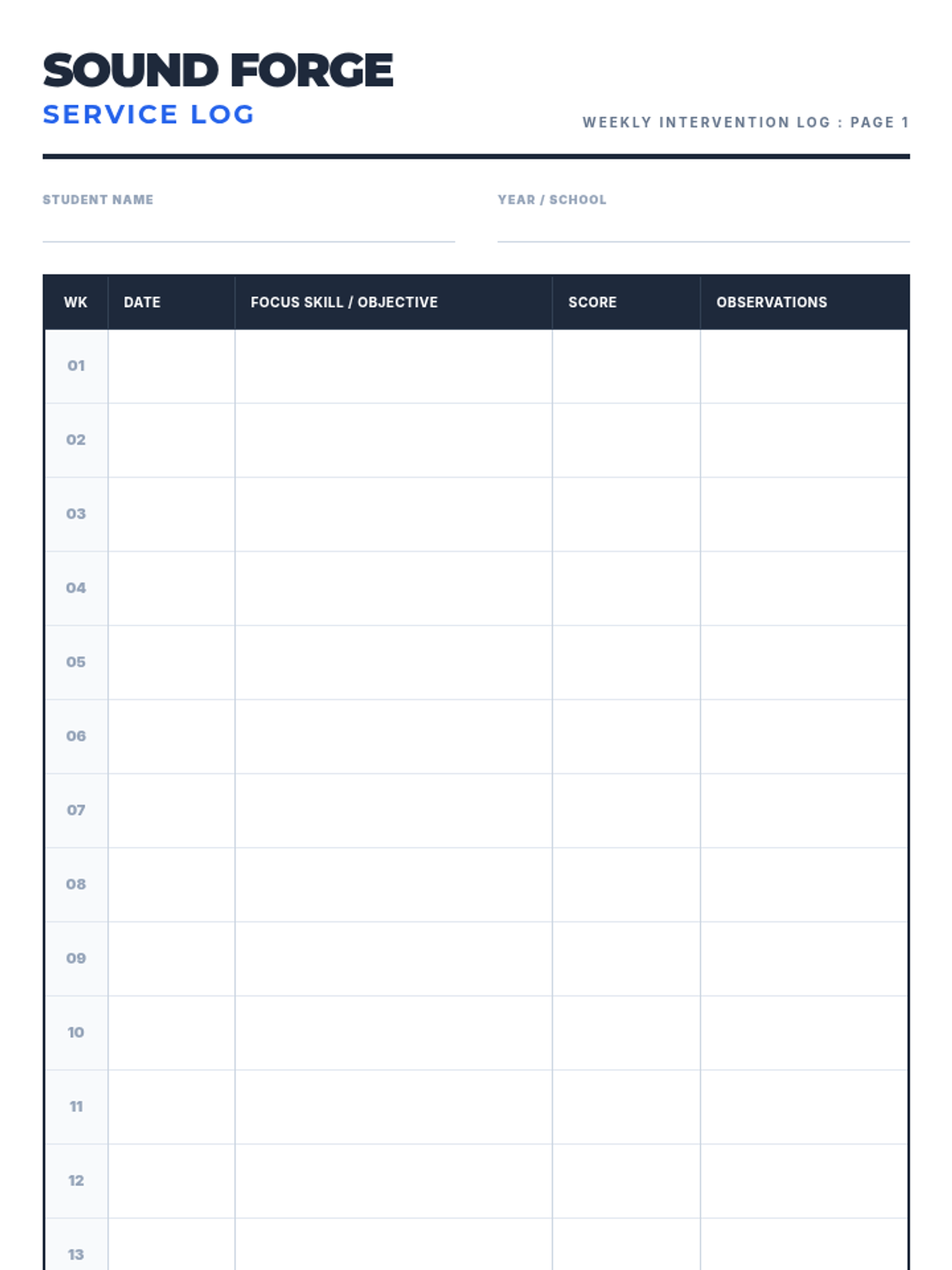
A formal service log for tracking 40 weeks of intervention sessions, including space for dates, objectives, and student performance data.
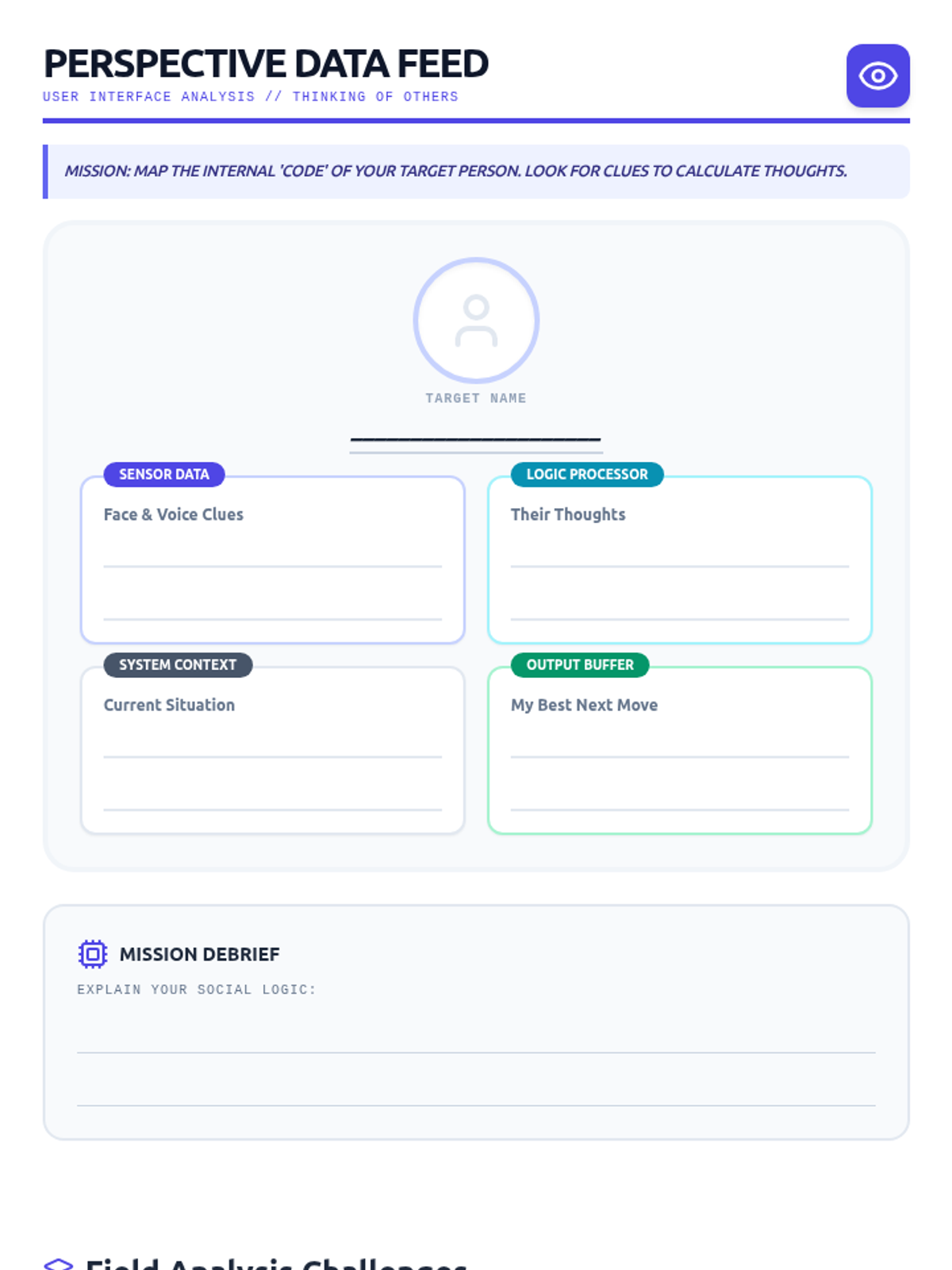
A graphic organizer that helps students map out another person's perspective using a "Heads-Up Display" (HUD) metaphor. Includes sections for Sensor Data (clues), Logic Processor (thoughts/feelings), and Output Buffer (calibrated reaction). Designed to fit on a single page.
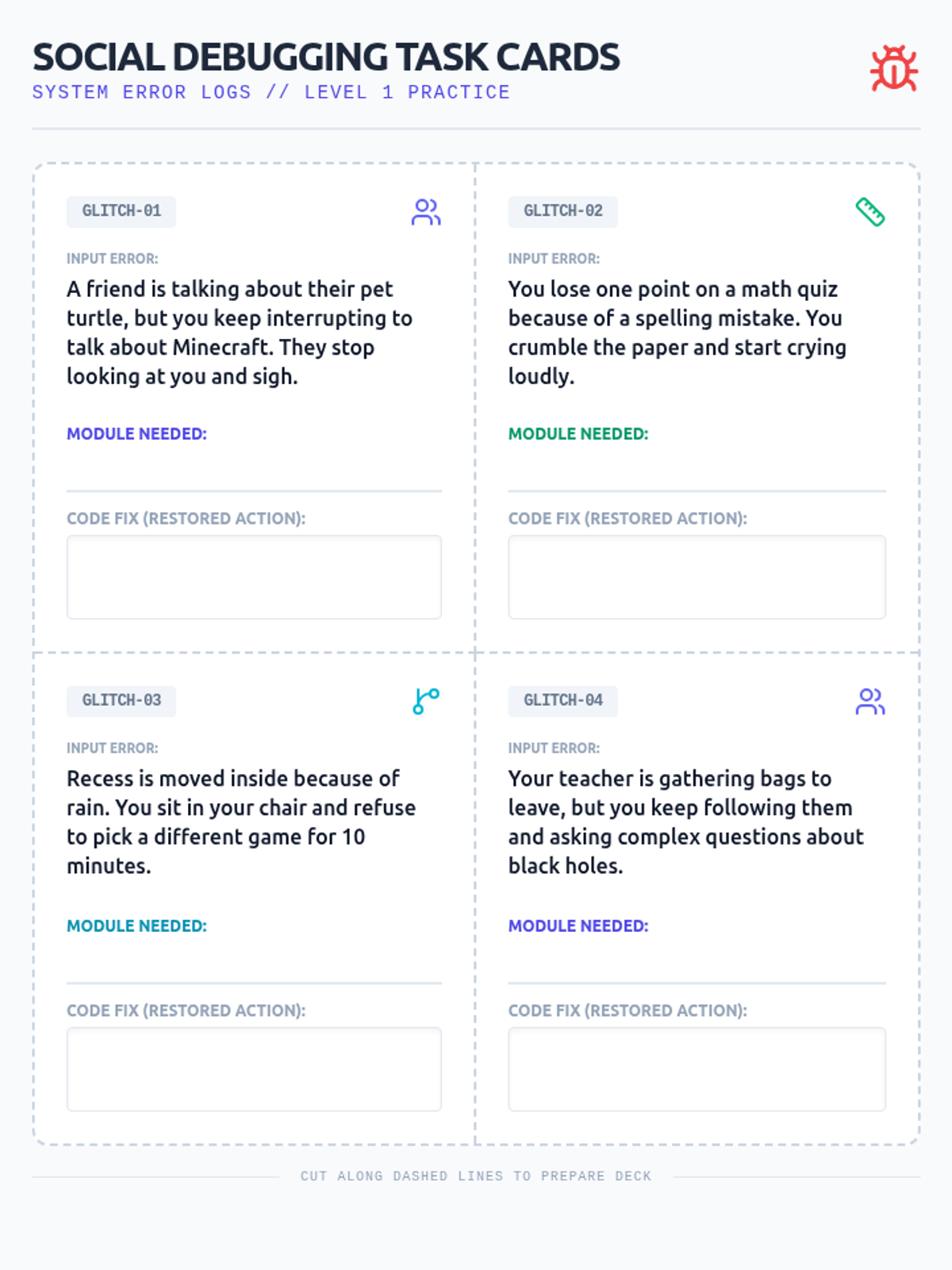
A set of 4 task cards featuring "Social Glitches." Students must identify the core module (Thinking of Others, Size of the Problem, or Flexible Thinking) and suggest a social "Code Fix" to resolve the situation. Designed for printing and cutting.
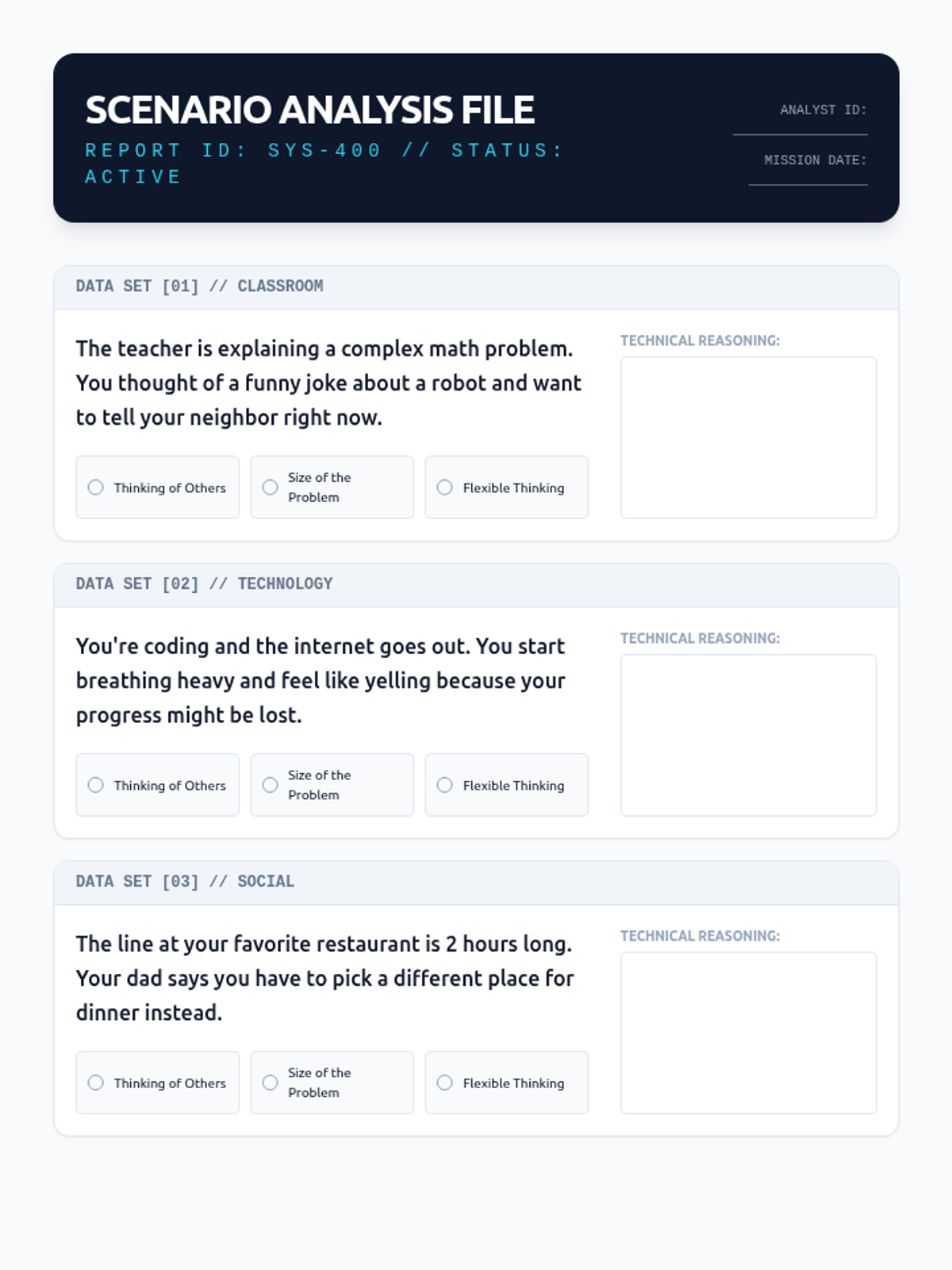
A printable worksheet containing 5 social scenarios. Students must identify the correct Social Thinking concept (Module) for each and provide a verbal or written reasoning. Designed with a "Field Agent" theme.