Word Problem Blueprints Worksheet
Algebra 1 • Assignment 2–7 (WIDA Level 2 Support)
Word Problem Blueprints
Name: ______________________
Date: ____________
Directions (3 Steps)
- Write an equation (use \(=\)) for each story.
- Solve and show all your steps.
- Round decimals to the nearest hundredth (2 decimal places, like \(0.00\)).
Math Word-to-Symbol Key
Sum / more than \(\rightarrow +\) (add)
Times \(\rightarrow \times\) (multiply)
Is / total / goal \(\rightarrow =\) (equals)
Less than \(\rightarrow -\) (switch order!)
Example: “11 less than 4 times \(w\)” → \(4w - 11\)
- Write an equation for the sum of 5 consecutive integers. The sum is 200. What number is the largest of the integers?
consecutive integers: numbers in a row (like \(5, 6, 7\)) largest: biggest number
5 Numbers in a Row
\(n\) + \(n+1\) + \(n+2\) + \(n+3\) + \(n+4\) = 200
Show your equation and steps below:
Equation: ___________________________________ The largest integer is __________.
- The length of a rectangular board is 11 feet less than 4 times the width. The perimeter of the board is 28 feet. What are the dimensions of the board?
perimeter: distance around (\(P = 2l + 2w\)) dimensions: length and width
Rectangle Diagram
\(l = 4w - 11\)
\(w\)
\(P = 28\text{ ft}\)
\(w\)
\(l = 4w - 11\)
Show your equation and steps below:
Width = __________ ft Length = __________ ft
Word Problem Blueprints • Page 2 Name: ______________________
- The Cub Scouts want to collect 143 boxes of clothes to send to flood victims. They collected 26 boxes the first day and 68 boxes the second day. How many must they collect on the third day to meet their goal?
collect: gather together goal: total amount wanted (143)
Total Goal: 143 Boxes
Day 1
26
Day 2
68
Day 3
\(x\)
Write an equation and solve:
Equation: ___________________________ They must collect __________ boxes.
- The sum of three consecutive integers is 279. What are the integers?
sum: add together (\(+\)) consecutive integers: 3 numbers in a row
3 Numbers in a Row
\(n\) + \(n+1\) + \(n+2\) = 279
Write an equation and solve:
The three integers are __________, __________, and __________.
- The width of a rectangle is 4 in. more than its length. The perimeter of the board is 72 in. What are the width and length of the rectangle?
more than: add (\(l + 4\)) perimeter: \(2l + 2w = 72\)
Rectangle Diagram
\(l\)
\(l + 4\)
\(P = 72\text{ in.}\)
\(l + 4\)
\(l\)
Write an equation and solve:
Width = __________ in. Length = __________ in.
Word Problem Blueprints • Page 3 Name: ______________________
- Philip wants to buy a go-kart.
- He has $106 in his savings account.
- His sister owes him $38 (she pays him back).
- He deposits (adds) $56 each week (\(w\)).
- Goal: He needs $735 total. How many weeks will it take?
owes: needs to pay back deposits: puts money in
Go-Kart Goal: $735
Saved
$106
Sister
$38
Weekly
\(56w\)
Round to nearest hundredth (0.00)
Write an equation and solve:
Equation: ___________________________ It will take __________ weeks.
Solve Equations Round any decimals to the nearest hundredth (2 decimal places: \(0.00\)).
- \(0.2t + 4.9 = 7.1 - 2.3t\) Find \(t\)
Show your steps:
\(t =\) ____________
- \(21 + x + 5x = 3(2x + 8)\) Distribute \(3\) first
Show your steps:
Answer: ______________________
Simplify 9) \(36 - (-6)\)
Simplify: find one number • Subtracting a negative = adding!
Show your work:
Answer: ____________
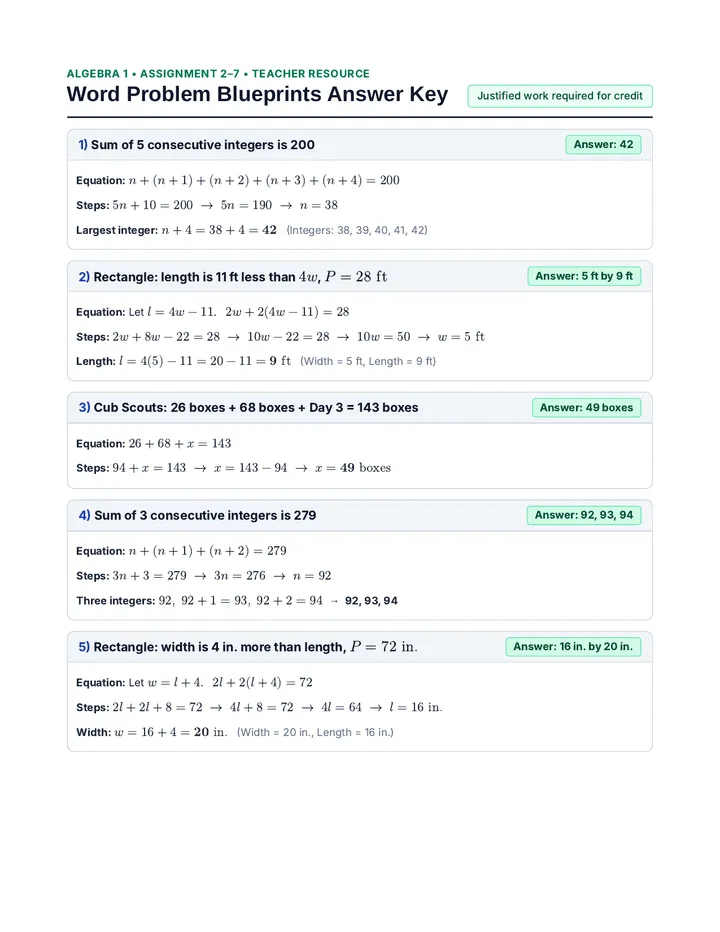
Word Problem Blueprints Answer Key
Algebra 1 • Assignment 2–7 • Teacher Resource
Word Problem Blueprints Answer Key
Justified work required for credit
- Sum of 5 consecutive integers is 200 Answer: 42
Equation: \(n + (n + 1) + (n + 2) + (n + 3) + (n + 4) = 200\)
Steps: \(5n + 10 = 200 \;\rightarrow\; 5n = 190 \;\rightarrow\; n = 38\)
Largest integer: \(n + 4 = 38 + 4 = \mathbf{42}\) (Integers: 38, 39, 40, 41, 42)
- Rectangle: length is 11 ft less than \(4w\), \(P = 28\text{ ft}\) Answer: 5 ft by 9 ft
Equation: Let \(l = 4w - 11\). \(2w + 2(4w - 11) = 28\)
Steps: \(2w + 8w - 22 = 28 \;\rightarrow\; 10w - 22 = 28 \;\rightarrow\; 10w = 50 \;\rightarrow\; w = 5\text{ ft}\)
Length: \(l = 4(5) - 11 = 20 - 11 = \mathbf{9\text{ ft}}\) (Width = 5 ft, Length = 9 ft)
- Cub Scouts: 26 boxes + 68 boxes + Day 3 = 143 boxes Answer: 49 boxes
Equation: \(26 + 68 + x = 143\)
Steps: \(94 + x = 143 \;\rightarrow\; x = 143 - 94 \;\rightarrow\; x = \mathbf{49\text{ boxes}}\)
- Sum of 3 consecutive integers is 279 Answer: 92, 93, 94
Equation: \(n + (n + 1) + (n + 2) = 279\)
Steps: \(3n + 3 = 279 \;\rightarrow\; 3n = 276 \;\rightarrow\; n = 92\)
Three integers: \(92,\; 92 + 1 = 93,\; 92 + 2 = 94\) → 92, 93, 94
- Rectangle: width is 4 in. more than length, \(P = 72\text{ in.}\) Answer: 16 in. by 20 in.
Equation: Let \(w = l + 4\). \(2l + 2(l + 4) = 72\)
Steps: \(2l + 2l + 8 = 72 \;\rightarrow\; 4l + 8 = 72 \;\rightarrow\; 4l = 64 \;\rightarrow\; l = 16\text{ in.}\)
Width: \(w = 16 + 4 = \mathbf{20\text{ in.}}\) (Width = 20 in., Length = 16 in.)
Word Problem Blueprints Answer Key • Page 2 Algebra 1 • Assignment 2–7
- Philip's Go-Kart Savings ($106 + $38 + $56/week = $735) Answer: 10.55 weeks
Equation: \(106 + 38 + 56w = 735\)
Steps:
\(144 + 56w = 735\)
\(56w = 735 - 144\)
\(56w = 591\)
\(w = \frac{591}{56} \approx 10.5535\ldots\)
Rounded to nearest hundredth: 10.55 weeks
- \(0.2t + 4.9 = 7.1 - 2.3t\) \(t = 0.88\)
Add \(2.3t\) to both sides:
\(2.5t + 4.9 = 7.1\)
Subtract \(4.9\) from both sides:
\(2.5t = 2.2\)
Divide by \(2.5\):
\(t = \frac{2.2}{2.5} = 0.88\)
- \(21 + x + 5x = 3(2x + 8)\) no solution
Combine like terms & distribute:
\(21 + 6x = 6x + 24\)
Subtract \(6x\) from both sides:
\(21 = 24\) (False statement)
Answer: no solution
- Simplify: \(36 - (-6)\) Answer: 42
Steps: Subtracting a negative is the same as adding a positive: \(36 + 6 = \mathbf{42}\).
WIDA Level 2 Grading & Feedback Notes
- Equivalent Equations: Accept valid variations such as \(l + w + l + w = 28\) for #2 or \(143 - (26 + 68) = x\) for #3.
- Sentence Frames: Students using the provided sentence frames demonstrate conceptual understanding even if minor spelling/grammar errors appear in units.
- Problem #8 Check: If students write \(21 = 24\) without concluding “no solution,” prompt them: “Can 21 ever equal 24? What does that mean for \(x\)?”