A 5th-grade math lesson that uses a 'string-cutting' analogy to help students visualize and master the division of proper fractions, moving from concrete physical models to the abstract 'flip and multiply' algorithm.
An engaging introduction to multi-digit multiplication, division, and order of operations through a spy-themed decoding challenge. Students act as 'Math Detectives' to solve a series of problems and reveal a hidden message.
A specialized toolkit for navigating mathematical skills in the 211-220 RIT range, with a focus on foundational decimals, fractions, and place value relationships.
A comprehensive guide for parents and students to navigate the mathematical skills expected in the 221-230 NWEA MAP RIT range, featuring actionable checklists and home-based practice ideas.
A comprehensive lesson on dividing decimals by decimals using a 'Decimal Diner' theme. Includes guided instruction, collaborative task cards, and independent practice with alignment grids.
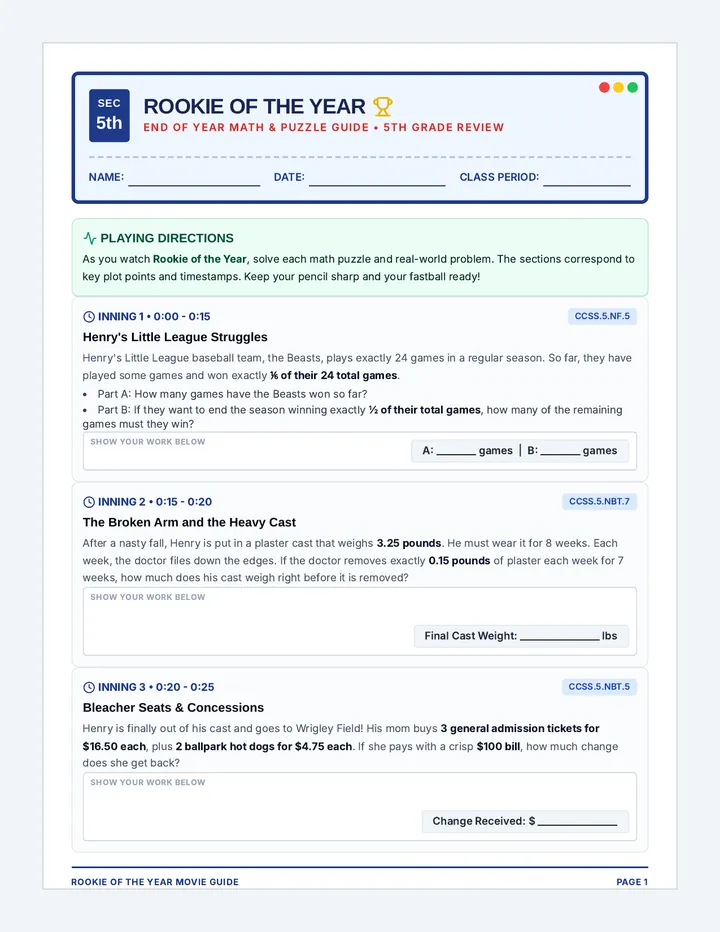
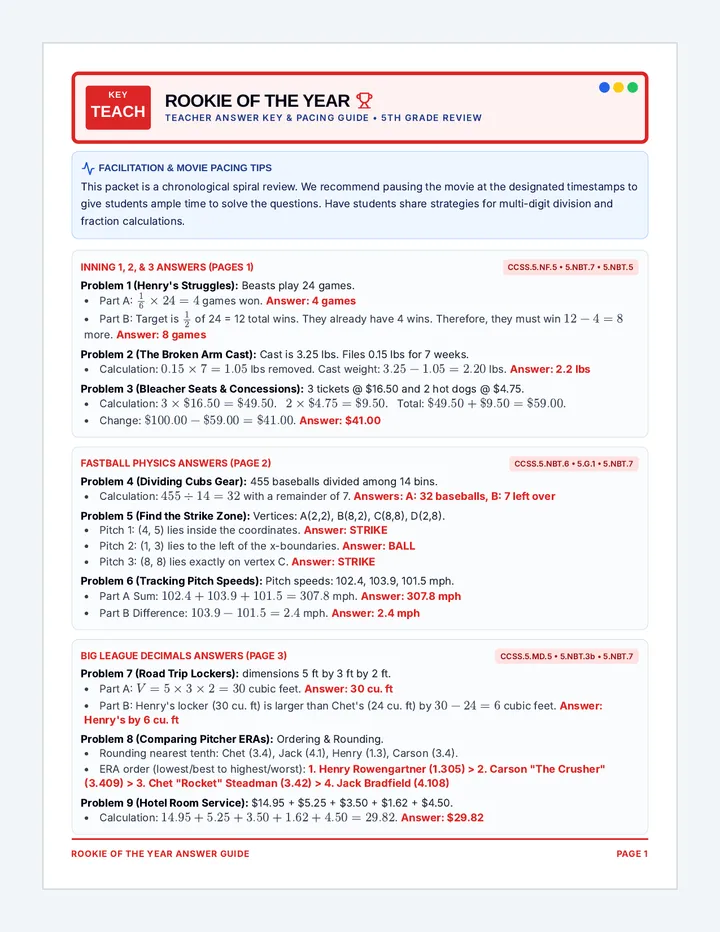
A high-energy 5th-grade review session covering decimal operations (addition, subtraction, multiplication), comparing, ordering, and rounding up to the thousandths place. Designed with a racing theme to engage students in a fast-paced mathematical challenge.
A focused lesson on calculating area and perimeter of complex rectilinear shapes by determining missing side lengths and applying geometric formulas.
A functional math lesson using a transit map metaphor to teach students how to read schedules and calculate elapsed time, designed for grades 3-5.
A focused practice session on basic multiplication and division facts up to 12x12. Students will solve five multiplication and five division equations to build fluency.
A hands-on probability project where students design, build, and test carnival games. They will calculate theoretical probability, collect experimental data, and analyze the results to understand statistical likelihood.
A lesson focused on mastering addition and subtraction of fractions with unlike denominators using the cross-multiplication (butterfly) method. Students use structured graphic organizers to visualize each step of the process.
Advanced applications of central tendency and spread, including algebraic problem-solving, weighted means, and the mathematical impact of outliers for high school students.