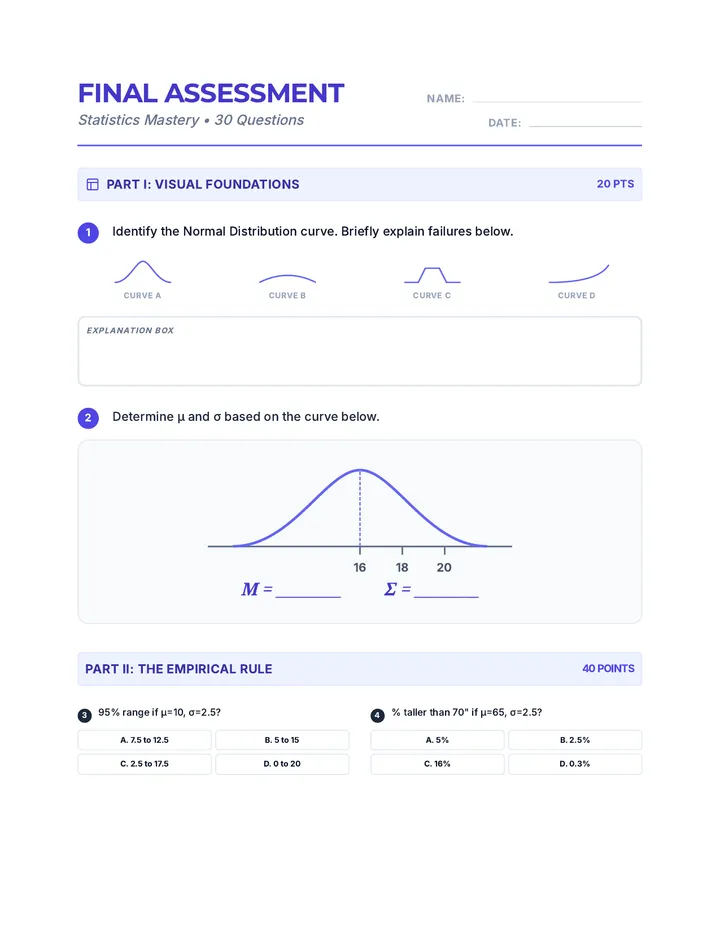
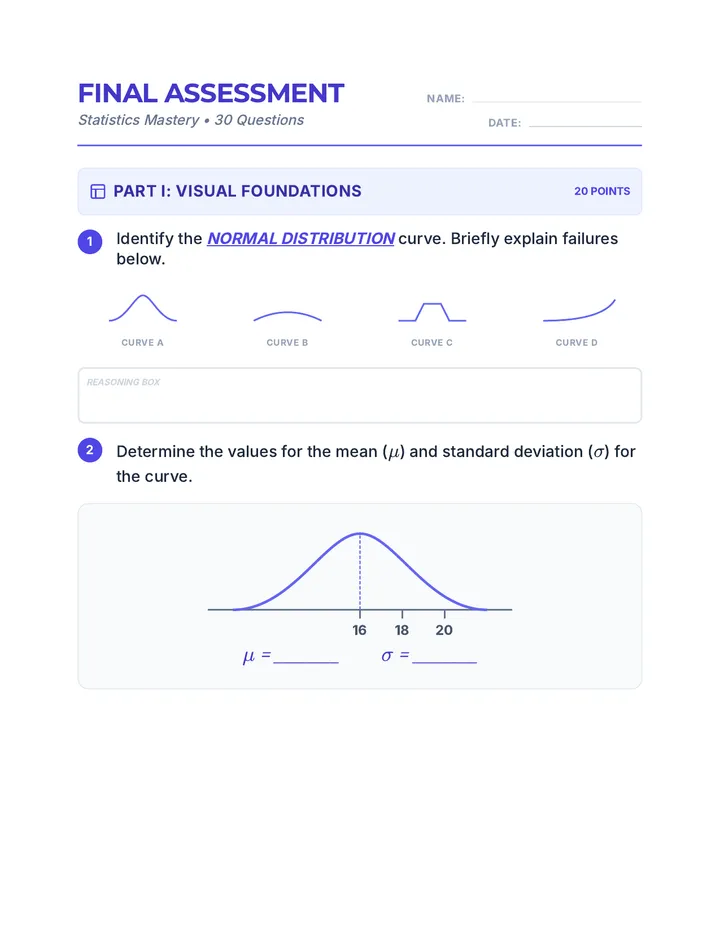
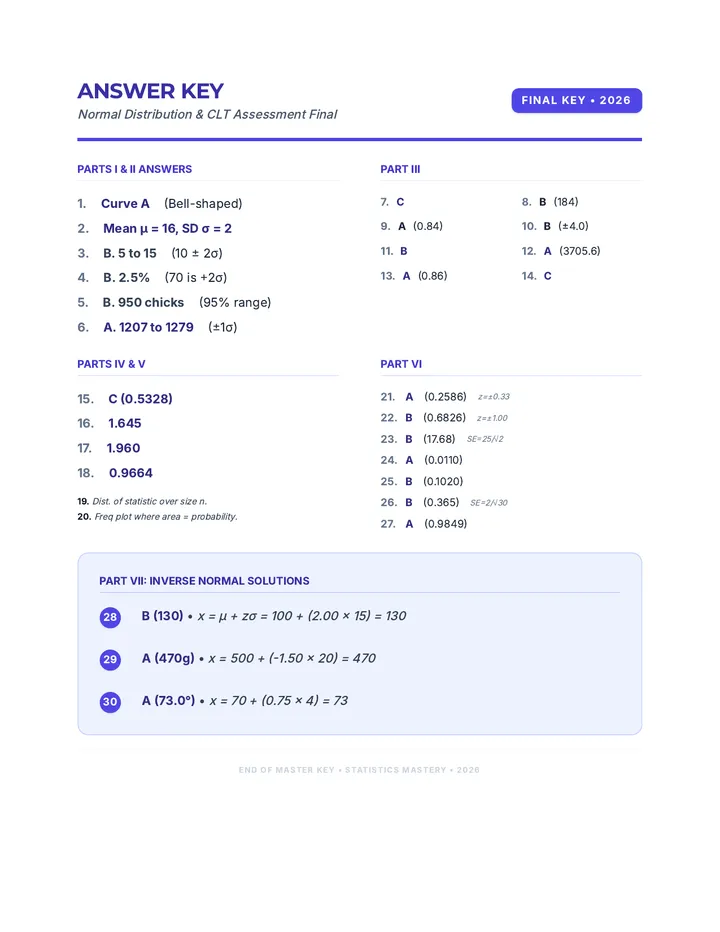
A culminating project where students analyze social media usage rates across generations using the full statistical inference process.
A 15-25 minute exploration into how ancient navigators used fixed points (the North Star) and the repeating patterns of the universe (microcosms, macrocosms, and symmetry) to navigate without modern technology.
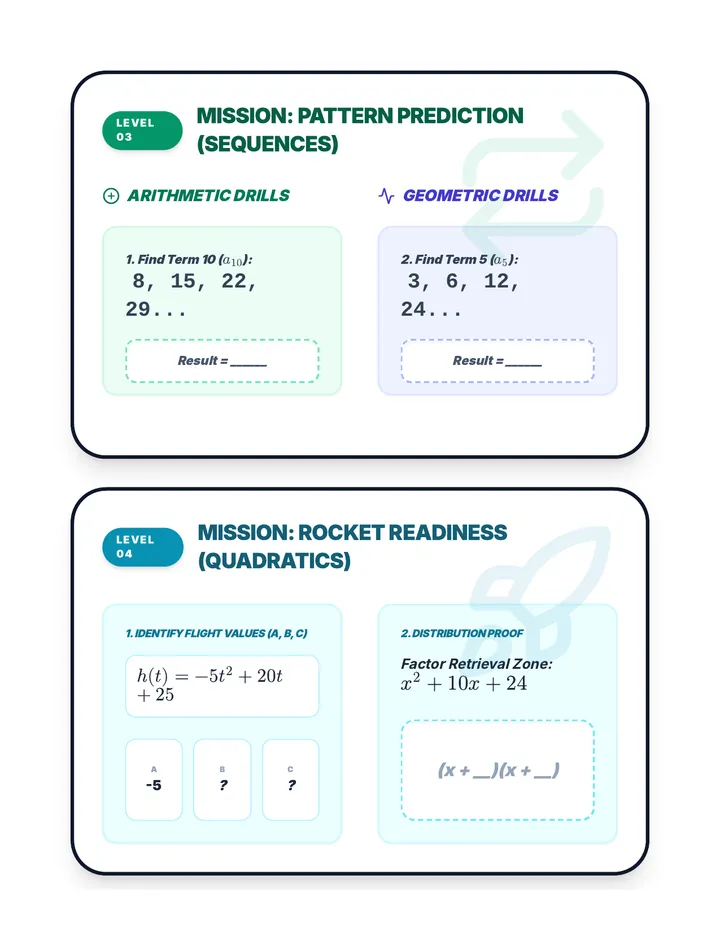
A comprehensive guide to solving quadratic equations using various factoring techniques, including GCF, difference of squares, and trinomials.
A comprehensive review lesson that synthesizes all the skills learned in the Real World Math series. Students will complete a final assessment covering multi-digit operations, decimals, fractions, and percentages through a variety of workplace and financial scenarios.
Understanding the power of percentages in finance and data. Students will solve for parts, wholes, and percentages in contexts like sales tax, interest rates, discounts, and performance statistics.
Developing a strong grasp of fractions in practical contexts such as construction, cooking, and time management. This lesson covers simplifying, adding/subtracting with unlike denominators, and multiplying/dividing fractions.
Mastering decimals through the lens of currency and precise measurements. Students learn to add, subtract, multiply, and divide decimals to calculate unit prices, handle cash transactions, and interpret technical specifications.
A foundational lesson on multi-digit multiplication and division focused on workplace budgeting and large-scale inventory management. Students will practice these operations through realistic scenarios like calculating monthly revenue and distributing supplies across departments.
Teacher answer keys for the Real World Math series.
Instructional slides for the Real World Math series.
Master the art of solving real-world rational function equations, focusing on clinical drug concentration models and rate-based applications. Students will learn to translate verbal scenarios into rational equations and apply algebraic techniques to find precise solutions.
An interactive 'around the room' scavenger hunt where students solve radical equations involving one or two radical terms. students follow a path of answers that lead them through 15 unique challenges.
A March Madness-themed lesson that provides students with a strategic "Game Plan" for deconstructing and solving math word problems. Students use a basketball-themed graphic organizer to scout for data, draft a playbook, and execute their solution.
A hands-on card sort activity focused on identifying domain and range from various representations, aligned with Texas STAAR Algebra 1 standards across all performance levels.
A comprehensive lesson on graphing one-variable inequalities on a number line, using real-world constraints like speed limits and height requirements to anchor the concepts. Students will master open and closed circles and shading directions.
Day 10 of the EOC review focusing on Asymptotes and Correlation Coefficients.
Day 9 of the EOC review focusing on Exponential Growth and Decay.
Day 8 of the EOC review focusing on Roots, Zeros, and Solutions of quadratics.
Day 7 of the EOC review focusing on Quadratic Vertex and Axis of Symmetry.
Day 6 of the EOC review focusing on the Laws of Exponents and Polynomial operations.
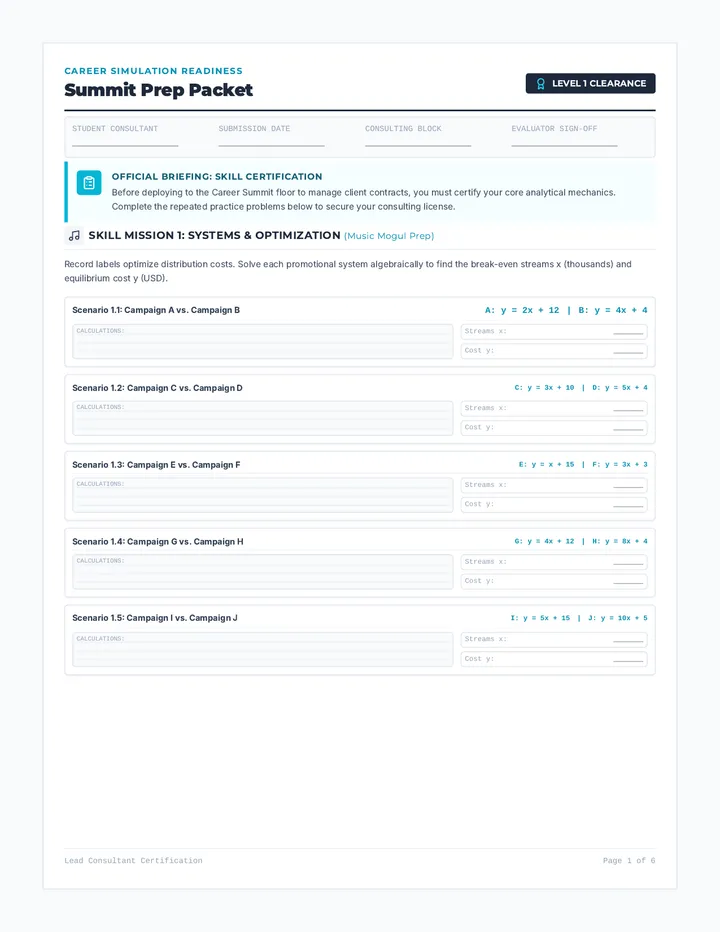
Day 5 of the EOC review focusing on Systems of Equations and finding their Solutions.
Day 4 of the EOC review focusing on Parent Functions and basic Transformations.
Day 3 of the EOC review focusing on identifying Zeros and x-intercepts in various representations.
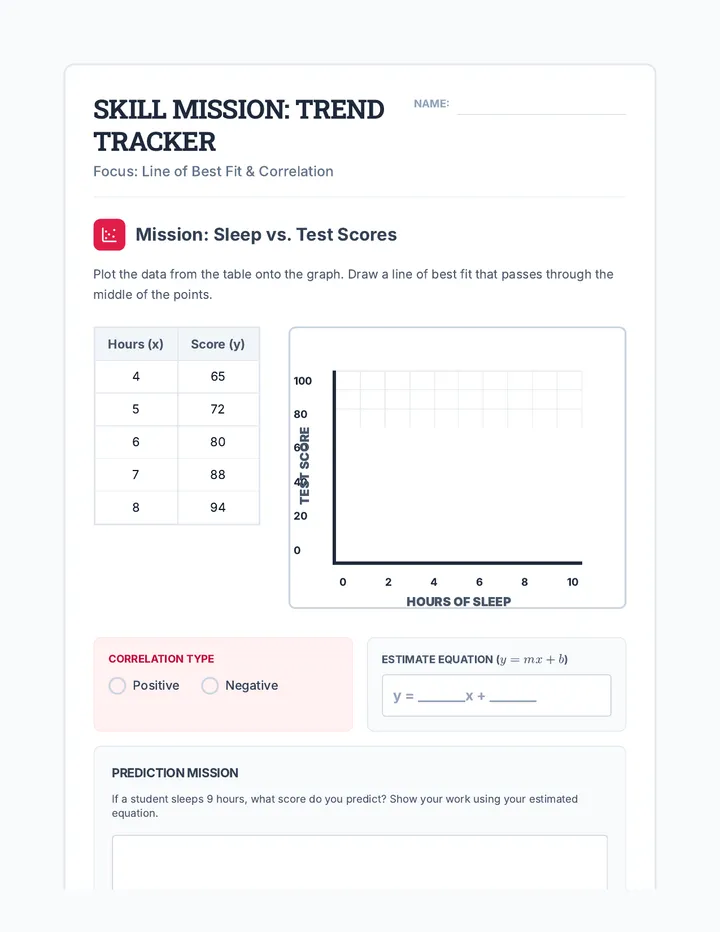
Day 2 of the EOC review focusing on the core components of linear equations: Slope and y-intercept.
Day 1 of the EOC review focusing on the fundamental concepts of Domain and Range.
A high-impact Algebra I STAAR EOC review focused on quadratic functions and equations (TEKS A.7A, A.8A). This lesson covers graphing, finding zeros, and connecting equations to their visual representations using test-taking strategies.
A comprehensive lesson on polynomial operations and factoring higher-degree expressions, aligned to TEKS 2A.7(A-B). Includes scaffolded practice and visual guides for polynomial behavior.
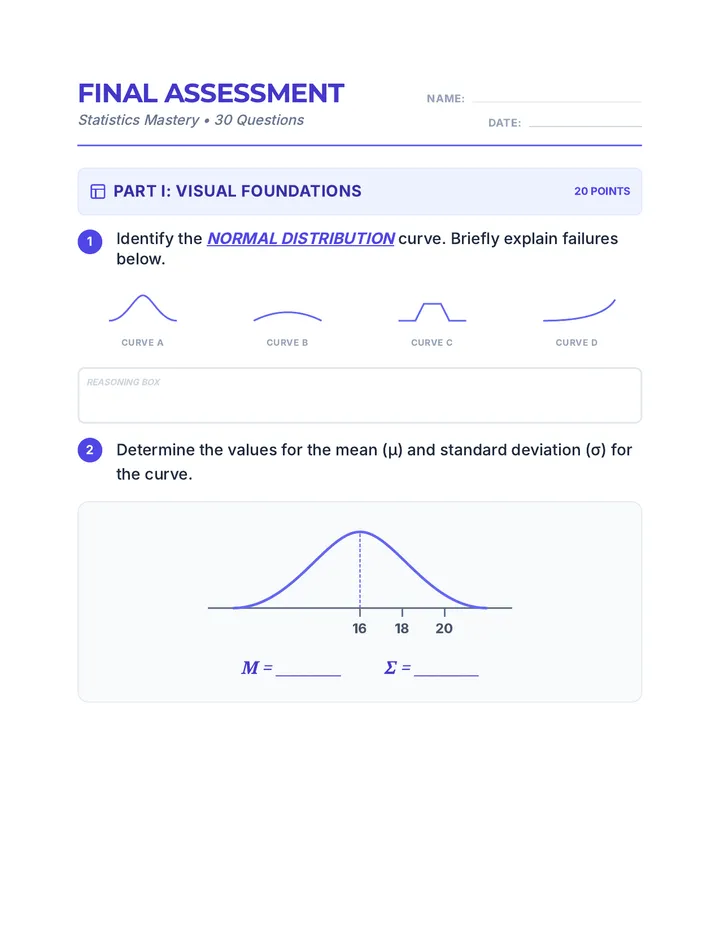
A comprehensive STAAR EOC prep lesson covering quadratic functions, focusing on key features, factoring, and the quadratic formula, aligned to Texas Algebra I TEKS A.6, A.7, and A.8.
A comprehensive STAAR EOC prep lesson for Algebra I focused on linear functions and equations, featuring rural Texas contexts like ranching and agriculture. Includes a slide deck, practice worksheet with gridded responses, reference guide, and self-assessment.
A foundational ACT/SAT prep lesson focusing on high-frequency algebra, geometry, and data questions for students looking to move past the 15-20 score range. Includes strategies for time management and a diagnostic assessment.
A comprehensive review of quadratic functions and equations tailored for the Texas Algebra 1 EOC, covering key attributes, transformations, and solving methods.
A high-energy, collaborative first-day activity for 11th-grade math students designed to foster teamwork and problem-solving through a classroom-wide scavenger hunt.
A foundational geometry lesson focused on identifying the three sides of a right triangle (hypotenuse, opposite, and adjacent) relative to a reference angle, designed for cross-categorical special education settings with high visual support.
A lesson focused on calculating the area of regular polygons by decomposing them into triangles and applying trigonometric ratios to find missing dimensions.
Students practice comparing key features of different function types, including domain, range, and intercepts, by analyzing side-by-side graphs.
A lesson focused on identifying the domain and range of real-world scenarios using linear, quadratic, and exponential graphs. Students will analyze situational constraints to determine the appropriate sets of input and output values.
A thought-provoking 46-minute geometry lesson where students act as urban planners to discover and apply angle relationships created by transversals and parallel lines. Students use SMP 3 and 7 to justify missing angle measures in complex 'city grids'.
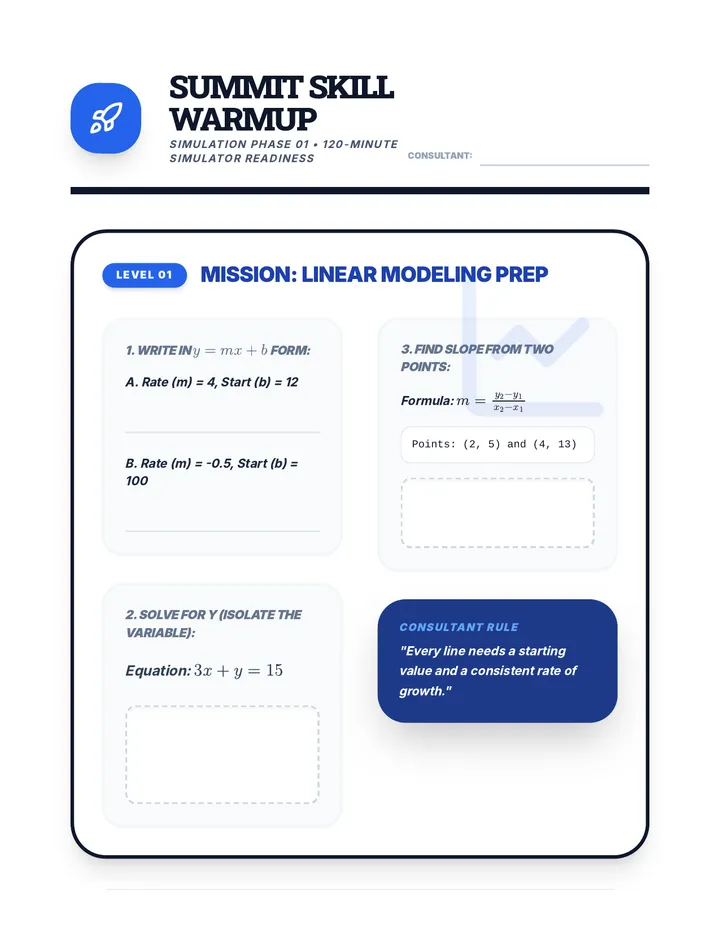
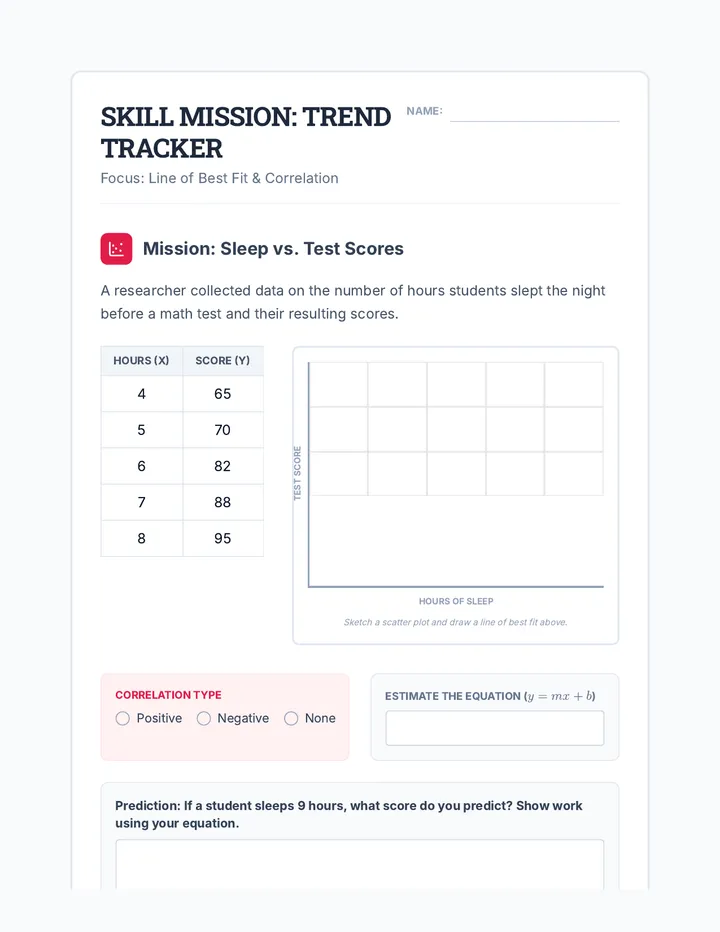
A Tier 2 intervention lesson focused on identifying slope and y-intercept in real-world contexts, translating word problems into linear equations, and graphing them. Designed for high school students with scaffolded supports.
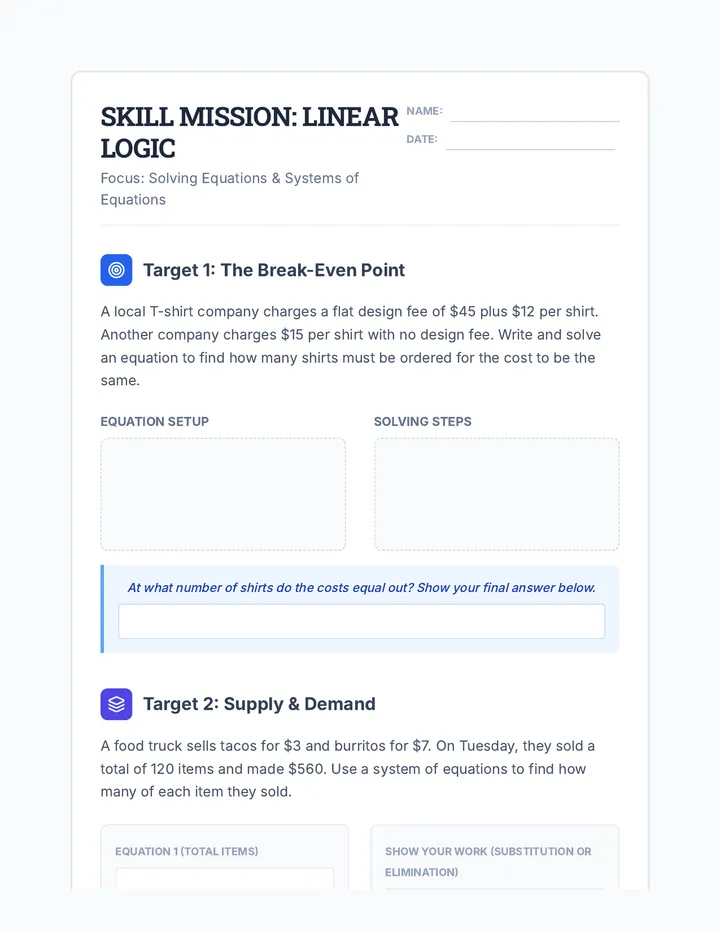
A Tier 2 intervention designed for high school students to master multi-step linear equations, focusing on distributing negatives, combining like terms, and avoiding sign errors. aligned to CCSS A-REI.1 and A-REI.3.