A quick-start lesson focused on mastering the volume formulas for cylinders and cones, emphasizing the relationship between diameter and radius.
A comprehensive lesson on direct and inverse proportionality, featuring exploratory scenarios, pattern recognition, and real-world applications.
Expanding the coordinate plane to all four quadrants, introducing negative numbers and the origin as the starting point.
Introduction to the coordinate plane focusing exclusively on the first quadrant, emphasizing the (x, y) order and 'crawl then climb' analogy.
A comprehensive lesson designed for middle school students to master 3-digit by 3-digit multiplication through visual anchors, technical guides, and complex word problem applications.
Day 1 of the EOC review focusing on the fundamental concepts of Domain and Range.
A delicious introduction to the distributive property using a pizza delivery analogy. Students learn to 'deliver' the outside factor to every term inside the parentheses through multiplication.
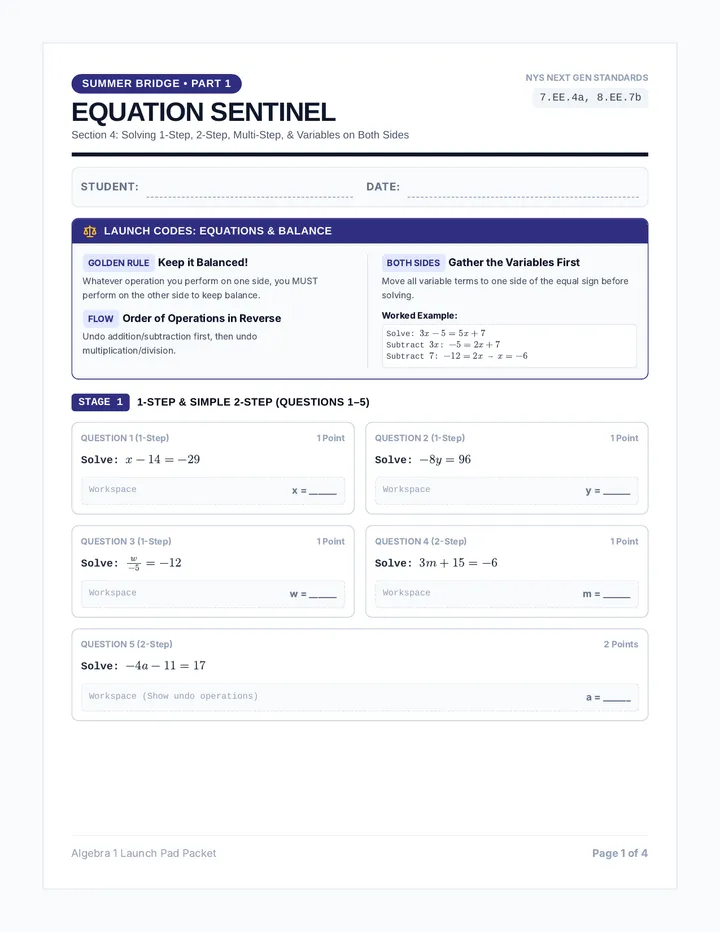
A focused lesson on solving linear equations and inequalities with one variable, emphasizing the balancing method and the specific rules for inequality signs.
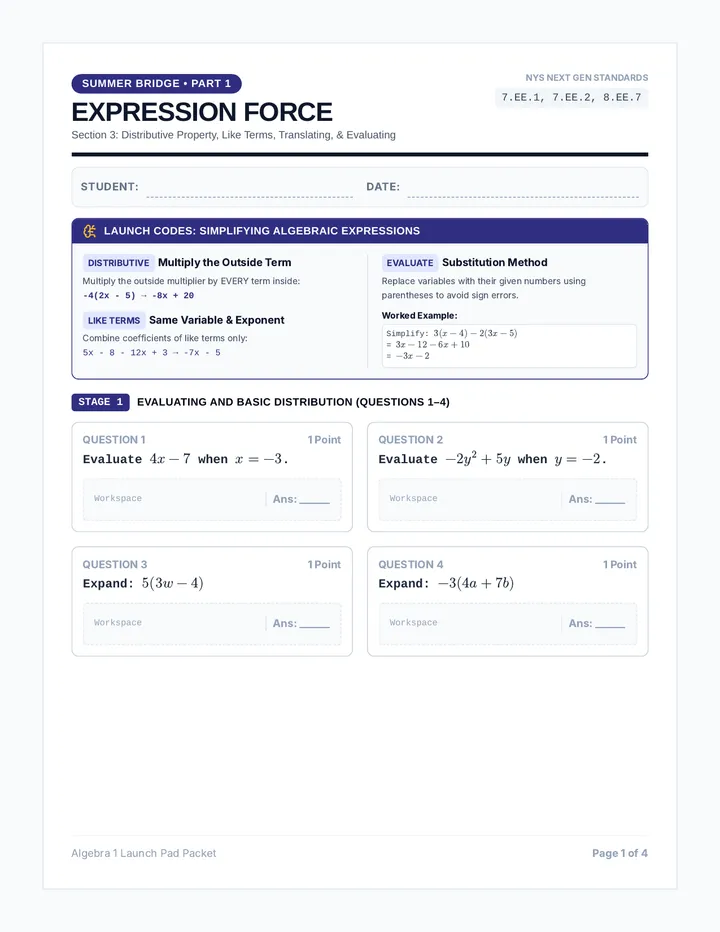
A comprehensive lesson on mastering the distributive property with positive and negative integers through a tiered, blueprint-inspired approach. Students progress from basic distribution to complex expressions involving multiple terms and sign changes.
A focused lesson on solving one-step equations involving multiplication and division with fractional coefficients and terms. Students will master the use of reciprocals to isolate variables.
A project-based learning unit where students apply fraction and decimal operations to design, price, and manage a fictional food truck business. Students move from abstract calculations to real-world financial applications through menu design and budget management.
A focused lesson on solving exponential equations where both sides share the same base. Students learn to apply the property of equality for exponential functions to isolate and solve for variables in exponents.
Students practice simplifying algebraic expressions and identifying equivalent expressions through a collaborative card-matching game. They will combine like terms and use the distributive property to 'decode' complex expressions into their simplest forms.
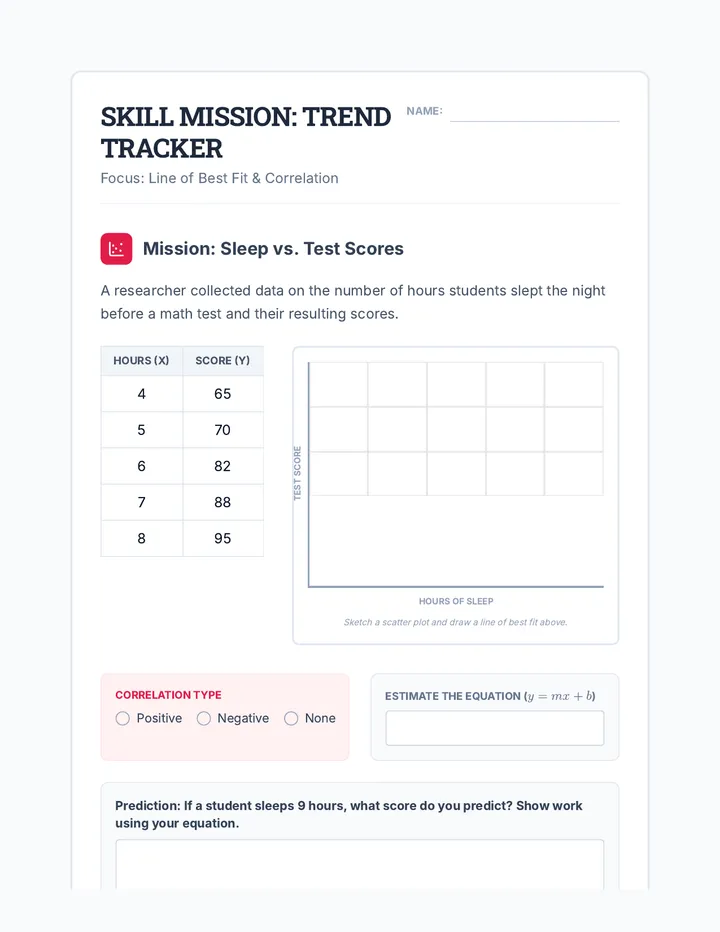
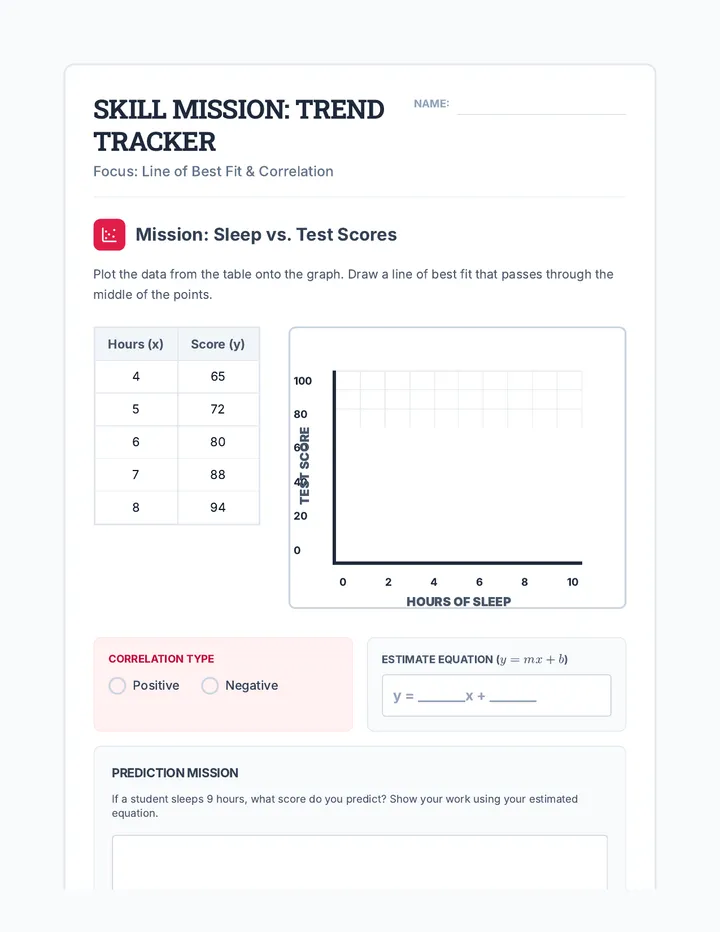
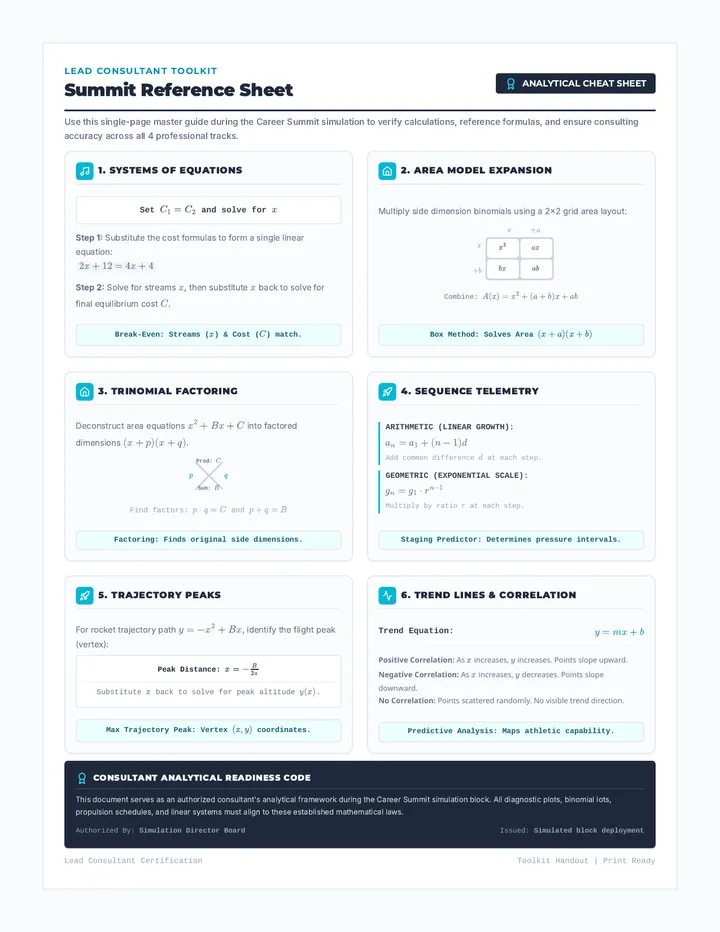
A comprehensive math lesson where students become 'Data Detectives' to explore scatter plots, lines of best fit, and the crucial distinction between correlation and causation through real-world evidence.
A comprehensive lesson on mastering Greatest Common Factor (GCF) and quadratic factoring techniques using a structured, step-by-step blueprint approach.
Students master integer subtraction by conceptualizing it as 'finding the distance' or 'changing direction' in ocean currents. Includes a final comprehensive homework assignment.
Students learn to add integers by visualizing movement above and below sea level using a vertical number line. Focus is on 'rising' (positive) and 'sinking' (negative) movements.
A comprehensive lesson on understanding and performing translations on the coordinate plane, including identifying slides, applying algebraic rules, and mapping new coordinates.
A comprehensive lesson on the distributive property, covering both expression simplification and solving multi-step equations. students will learn to 'distribute' a factor to terms within parentheses through visual models and algebraic practice.
A 45-minute investigation into the interior angles of quadrilaterals, where students discover the 360-degree rule by dividing shapes into triangles and solve for missing 'clue' angles.
The core project lesson where students are introduced to their role as architectural planners and begin calculating the dimensions and constraints of their scale models using algebra.
This lesson focuses on mastering the order of operations (PEMDAS) and evaluating numerical expressions with exponents. Students will practice applying rules systematically to solve multi-step problems without negative numbers.
A comprehensive unit assessment on exponents and the order of operations, designed for a 60-minute testing block with no negative numbers. Includes practice on identifying steps and evaluating complex expressions.
A comprehensive assessment and review lesson covering the Order of Operations (PEMDAS) and exponents, specifically designed for middle schoolers without negative numbers.
A comprehensive assessment and review of order of operations, exponent properties, and scientific notation, designed for middle or high school math students.
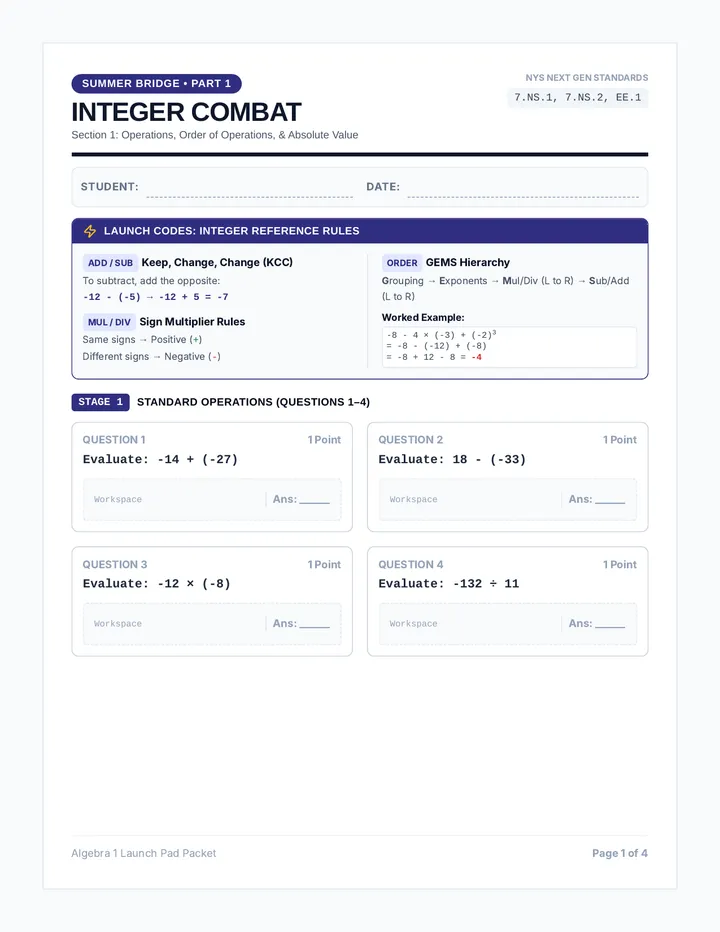
A foundational lesson on performing operations with positive and negative integers, featuring clear rules and visual aids for addition, subtraction, multiplication, and division.
A lesson focused on solving algebraic equations that involve the distributive property, teaching students how to 'unlock' parentheses to find the value of a variable.
A kinesthetic, carnival-themed lesson where 8th-grade students explore the definition of a function by rotating through interactive 'booths'. Students learn to distinguish between functions and relations using mappings, tables, and graphs.
A high-stakes geometry lesson where students apply the Pythagorean Theorem to solve a fictional robbery. Students analyze ladder heights, diagonal escape routes, and footprint distances to identify the culprit among three suspects.
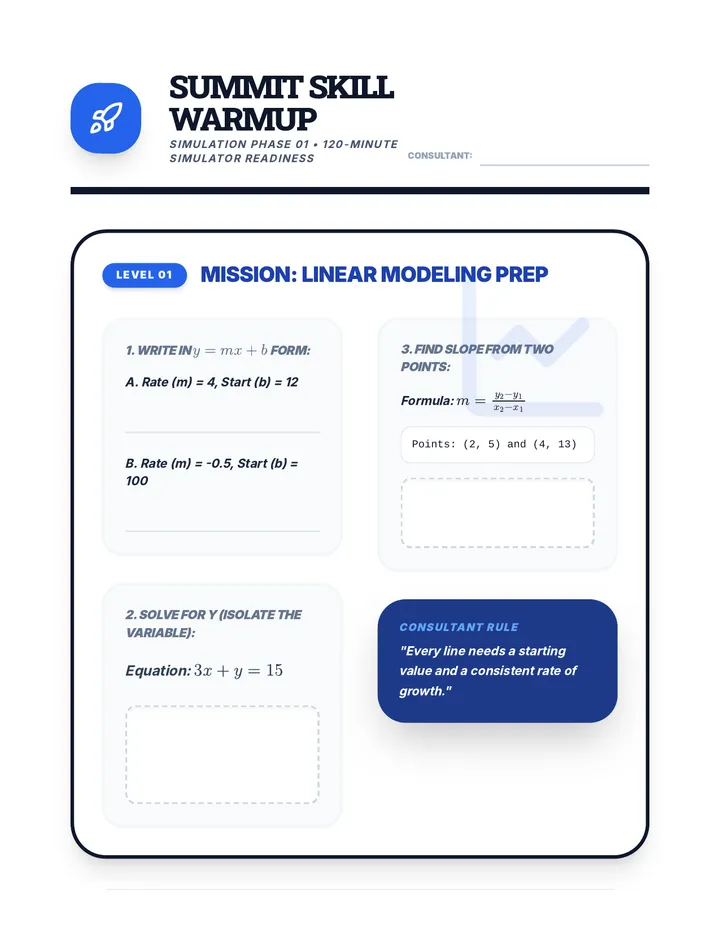
A project-based lesson where students apply their knowledge of linear equations (y = mx + b) to design a geometric city skyline on a coordinate plane, bridging algebra and urban design.
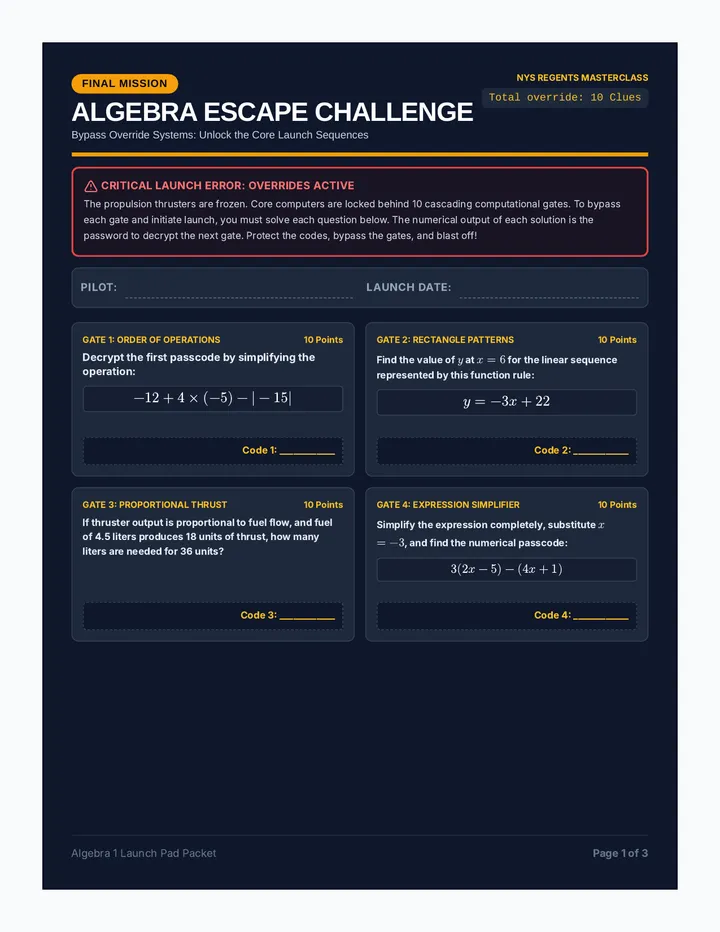
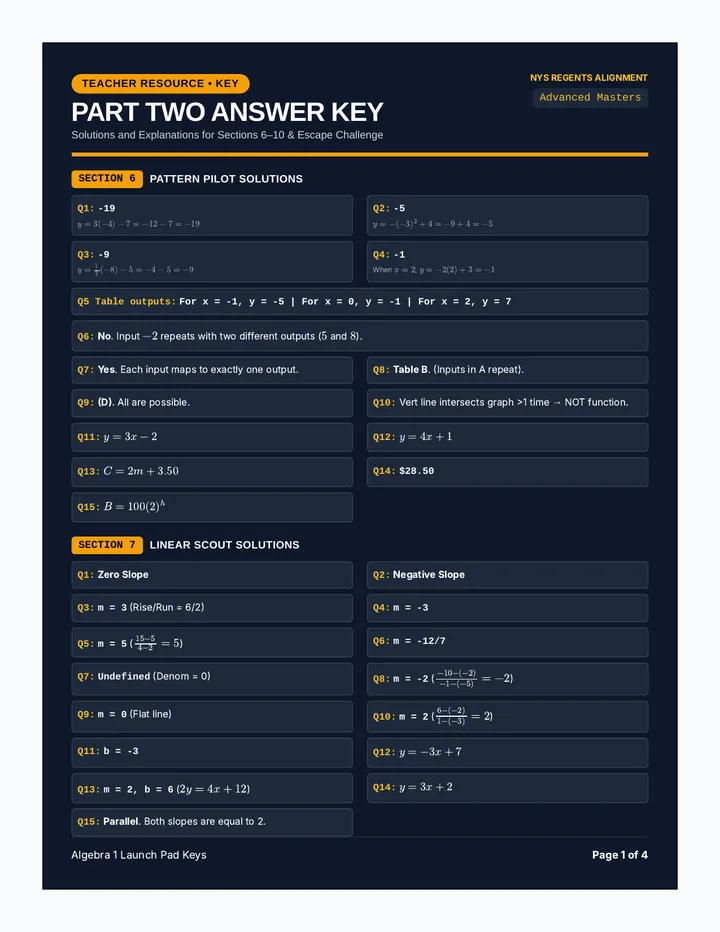
Comprehensive review of high-frequency question types and unit conversions.
Focus on interpreting box plots, mean/standard deviation, and linear regression with correlation coefficients.
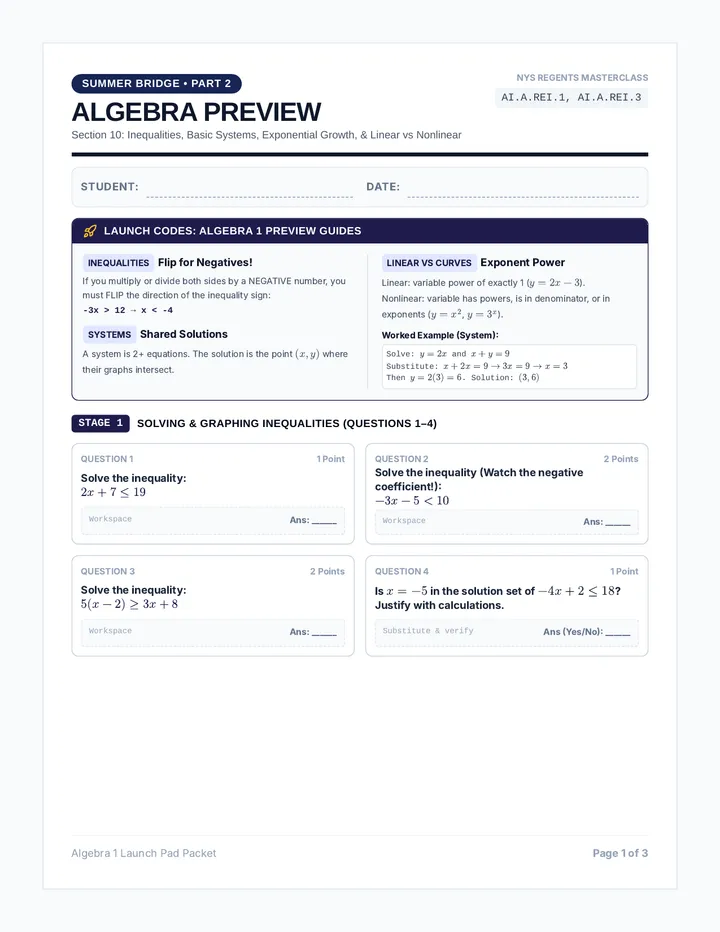
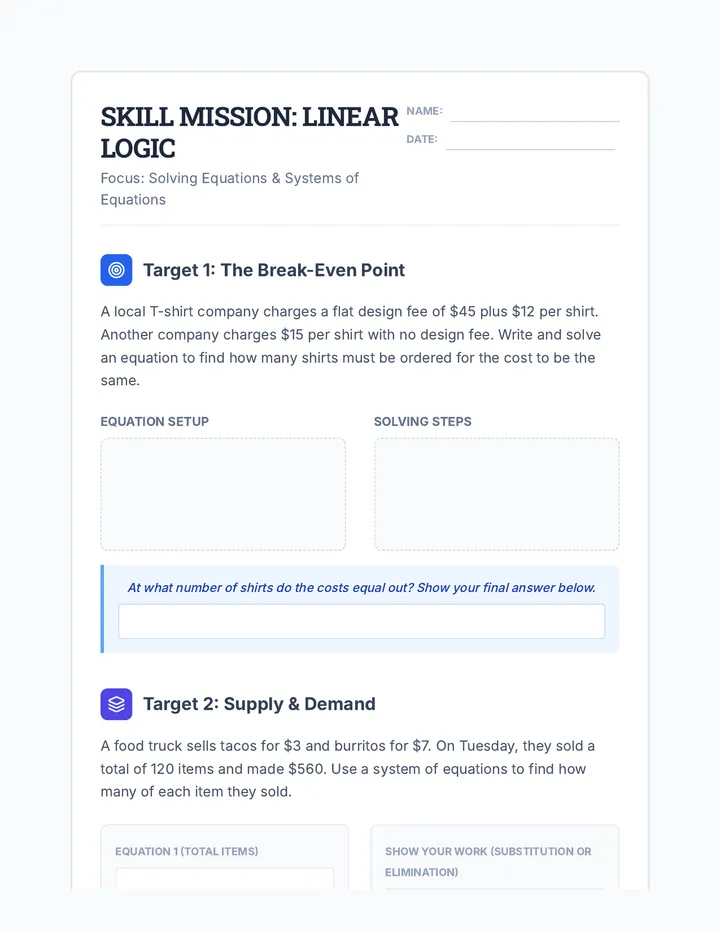
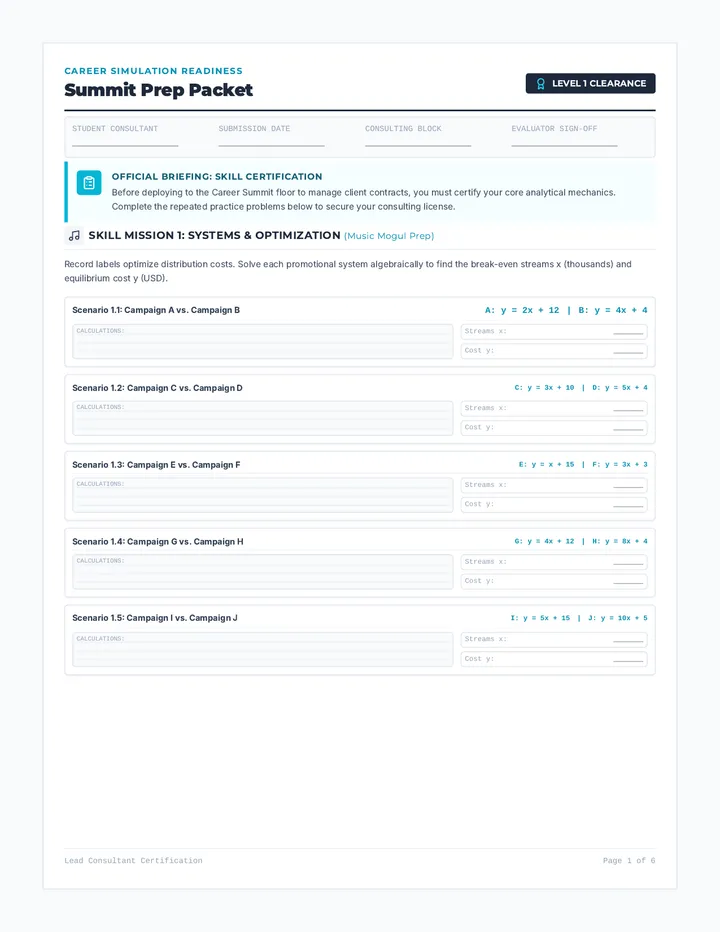
Focus on solving systems of equations algebraically and graphing systems of linear inequalities.
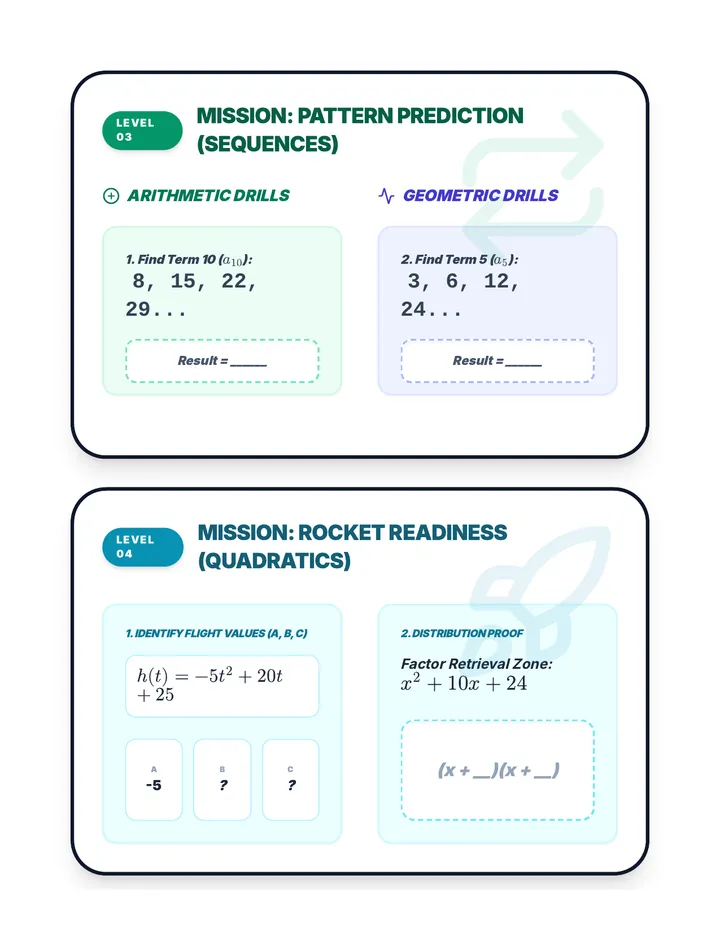
Focus on solving quadratic equations using the quadratic formula and factoring.
Focus on graphing absolute value and quadratic functions, including transformations and the axis of symmetry.
Focus on exponential growth vs. linear growth, and identifying and writing sequence formulas.