Students master skip counting by 4s up to 40 through an interactive space-themed lesson featuring movement, a catchy song, and a rocket-building activity.
A lesson focused on reading analog clocks to the hour and half-hour, designed for 2nd grade students to practice converting analog time to digital format.
A set of four independent practice worksheets themed around springtime growth, focusing on reading comprehension, time-telling, grammar, and geometry.
A hands-on graphing lesson designed for Essential Skills students, focusing on 1:1 pictographs and bar graphs using snack, color, and pet data with heavy visual supports.
Students interpret and create line plots using measurement data involving fractions.
Students combine their knowledge of halves and fourths to measure more precisely and explore fraction equivalence.
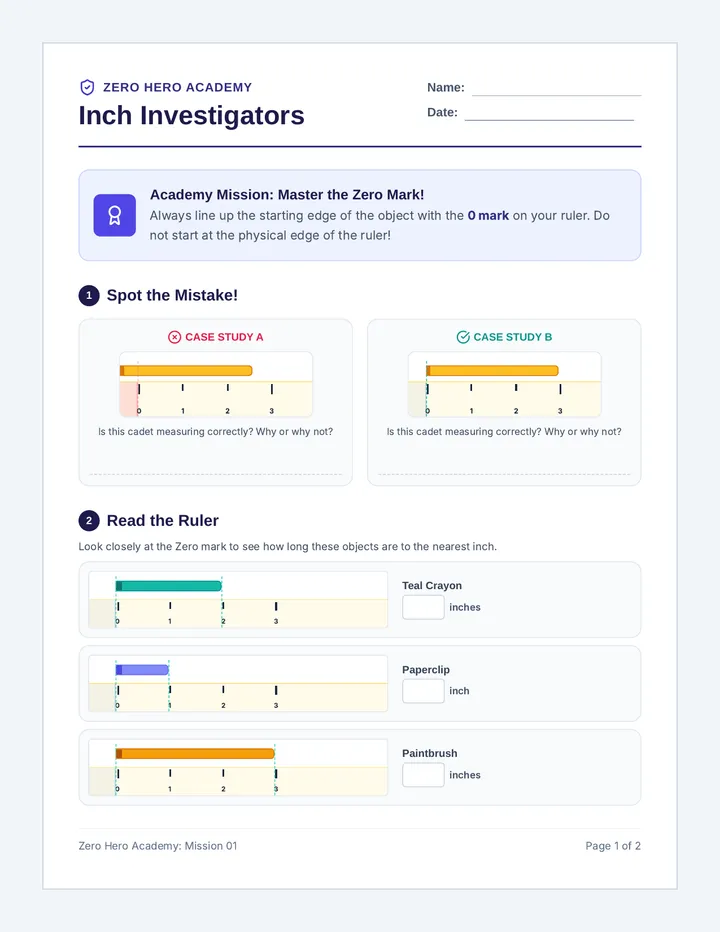
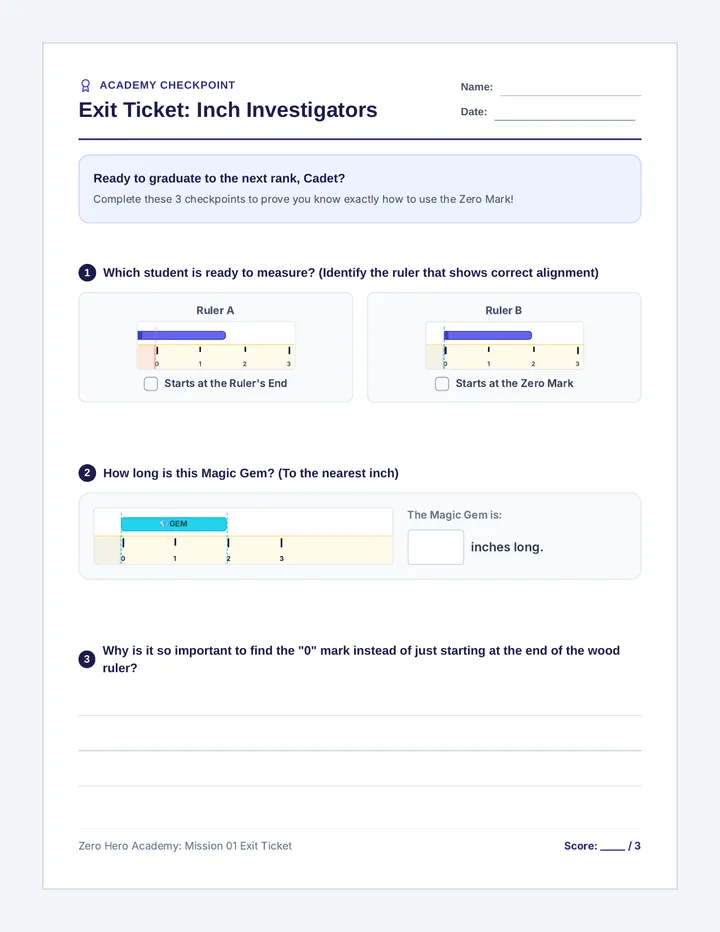
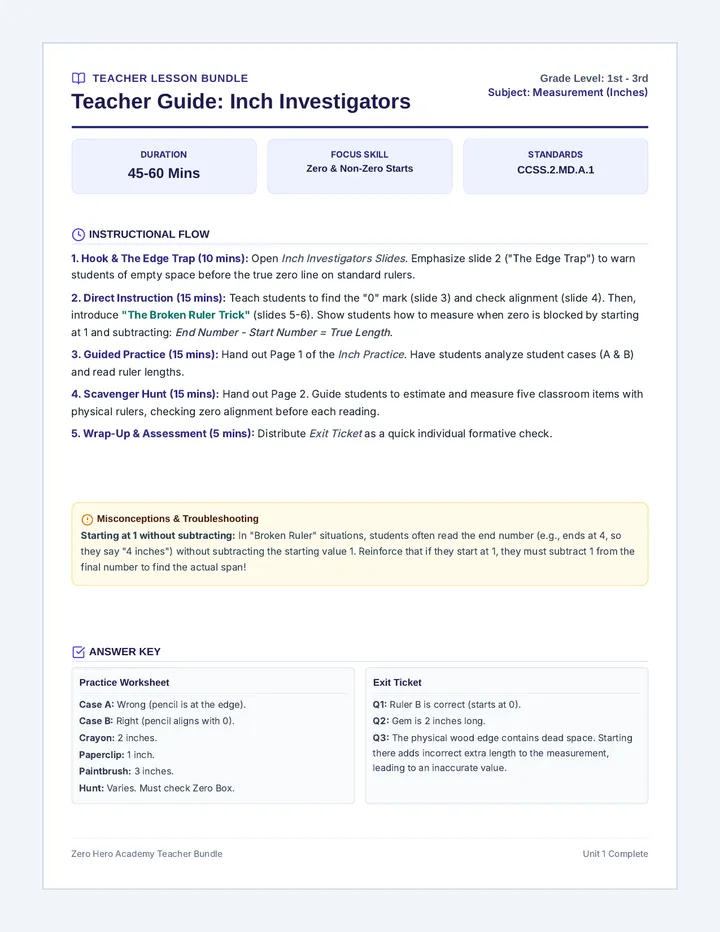
Students learn to measure objects to the nearest fourth of an inch and explore partition logic.
Students learn to measure objects to the nearest half-inch and are introduced to mixed numbers.
A comprehensive sub-plan packet for 2nd grade math, covering telling time, partitioning shapes into fractions, and addition/subtraction within 100 through an engaging jungle exploration theme.
A mini-mystery centered around a kitchen scene where students use observation and logic to solve a visual puzzle.
A foundational lesson on clock anatomy, focusing on identifying hour numbers and five-minute increments. Students practice spatial reasoning and number sequencing within a circular layout.
Analyzing and creating line plots to represent measurement data.
Using fraction equivalence to measure and record lengths accurately.
Expanding measurement skills to fourths of an inch and practicing with mixed numbers.
Introduction to measuring length in halves of an inch and understanding mixed numbers.
A hands-on measurement lesson where students use non-standard units to measure paper plants, fostering number sense and comparison skills through movement-based learning.
A series of math quests where students practice addition and subtraction within 20. Through medieval-themed challenges, students build fluency using ten-frames and number lines.
A series of medieval-themed math challenges focusing on addition and subtraction fluency within 20. Students use visual models like ten-frames and number lines to solve operational problems.
A formative assessment lesson focused on adding up to four two-digit numbers using various place value and operational strategies.
A K-2 math lesson focusing on solving addition and subtraction word problems using part-part-whole mats, bar models, and number lines, while applying counting on/back and making-a-ten strategies.
This lesson introduces addition within 20 through the 'Make Ten' strategy and Number Bonds. Students progress from using physical counters to visual ten frames and finally to abstract equations.
A focused lesson on 3-digit subtraction where students practice regrouping from the tens place to the ones place. includes a visual-heavy worksheet and an answer key.
A comprehensive introduction to 3D geometric shapes including cubes, spheres, rectangular prisms, cones, pyramids, and cylinders. Students will learn to identify these shapes, count their attributes (faces, edges, vertices), and find them in the real world.
A comprehensive math review lesson designed to reinforce key elementary math skills including logical ordering, 2-digit subtraction, geometric attributes, and equal parts/fractions. This lesson uses a repeated "at-bat" structure to build mastery through multiple variations of the same problem format.
A cumulative review and formal assessment of perimeter and area concepts in a shortened Friday block.
Reinforcing the concept of area through counting squares in arrays and understanding the relationship between rows, columns, and total area.
Introduction to area by partitioning rectangles into equal-sized rows and columns. Students will visualize area as the total number of squares inside a boundary.
Advanced perimeter practice including finding missing side lengths and solving real-world word problems involving fences and borders.
Introduction to perimeter as the distance around a shape. Students will learn to measure sides and add them together to find the total perimeter.
A math lesson focused on identifying the correct operation (addition, subtraction, multiplication, or division) to solve arcade-themed word problems using double-digit numbers without regrouping.
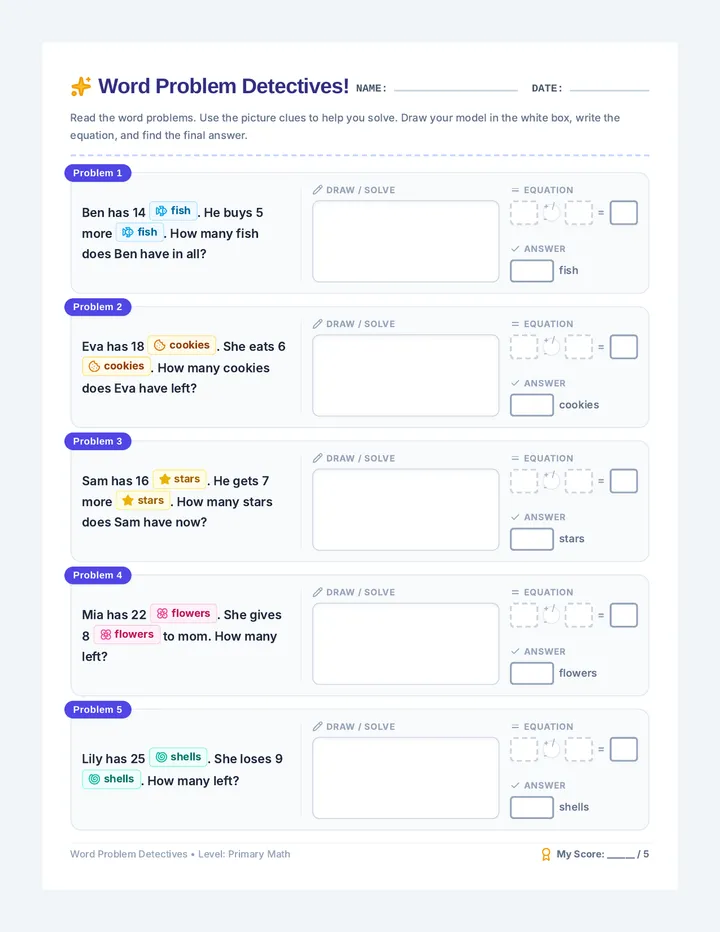
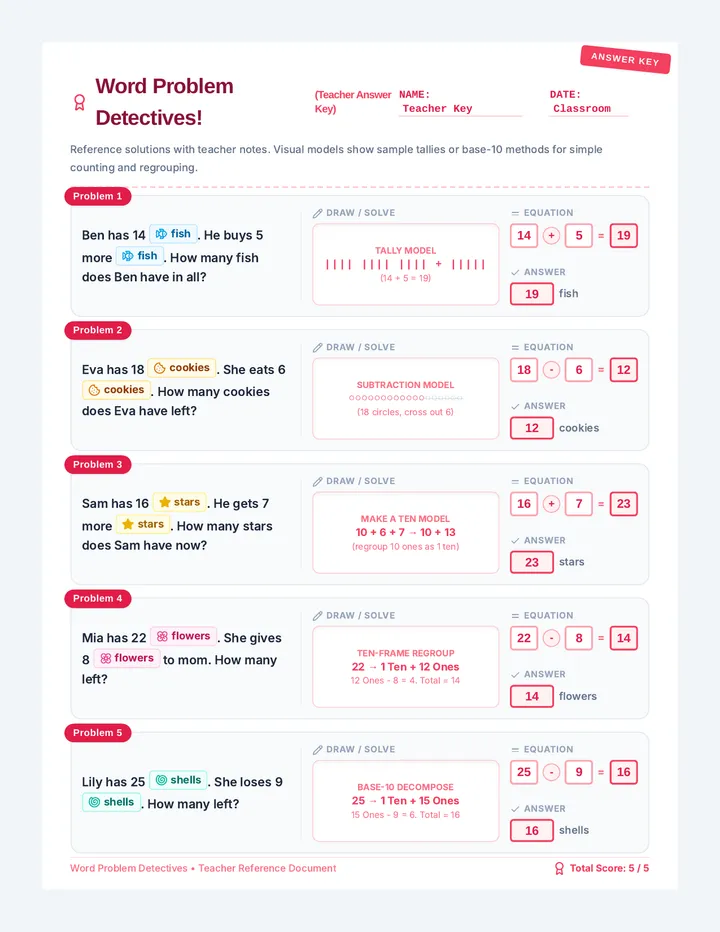
A comprehensive word problem review focusing on addition and subtraction within 200, featuring repetitive practice (at-bats) to build fluency and mastery.
A math review packet focusing on basic addition, subtraction, number combinations, and visual representation of groups, including a student worksheet and an answer key.