A 9th-grade geometry lesson where students derive and apply coordinate notation rules for reflections across the x-axis, y-axis, y=x, and y=-x lines using a video guide and station rotation activity.
A lesson focused on the geometric and algebraic relationships of parallel and perpendicular lines, teaching students how to identify slopes and write new equations using a technical blueprint aesthetic.
Une leçon complète sur les statistiques à une variable, couvrant la collecte de données, l'organisation en tableaux et la représentation graphique à travers divers exercices pratiques et activités d'introduction.
A comprehensive lesson covering geometric transformations (translations, reflections, rotations, and dilations) and the fundamentals of geometric proofs, including logical reasoning and triangle congruence.
A math assessment focusing on basic exponent rules and real-world percentage applications involving sales tax and discounts.
A lesson focused on applying exponent rules, percentage calculations, and basic arithmetic to real-world financial scenarios and budgeting. Includes two differentiated versions of a comprehensive unit test to support varied learning needs.
A quick assessment focusing on solving quadratic equations that result in complex solutions using the Quadratic Formula and Completing the Square.
A lesson focusing on the practical application of the Distance Formula and the logical structure of SAS and ASA congruence proofs.
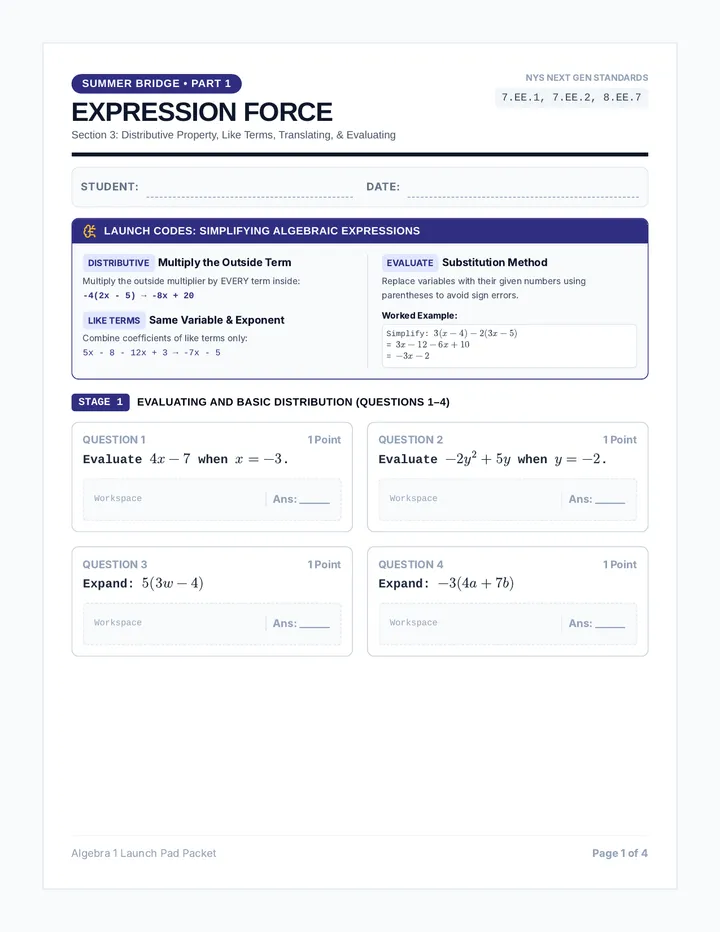
A deep dive into the fundamental properties of operations, focusing on the distributive, commutative, associative, identity, and inverse properties through a comprehensive 35-question extra credit challenge.
A comprehensive 35-minute lesson on graphing quadratic functions in standard form, covering vertex, axis of symmetry, end behavior, and zeros.
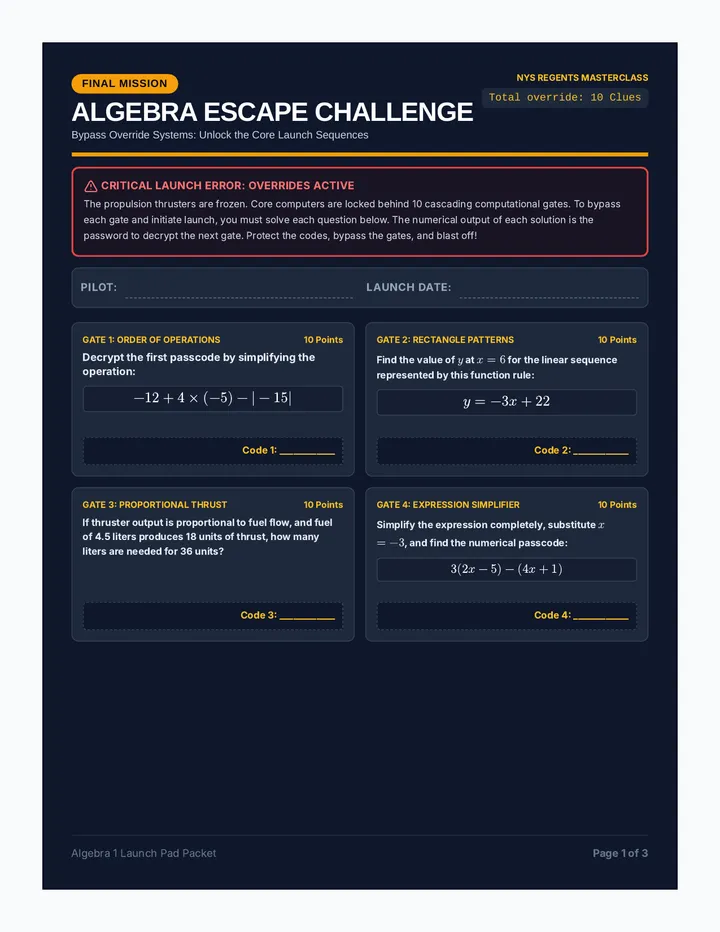
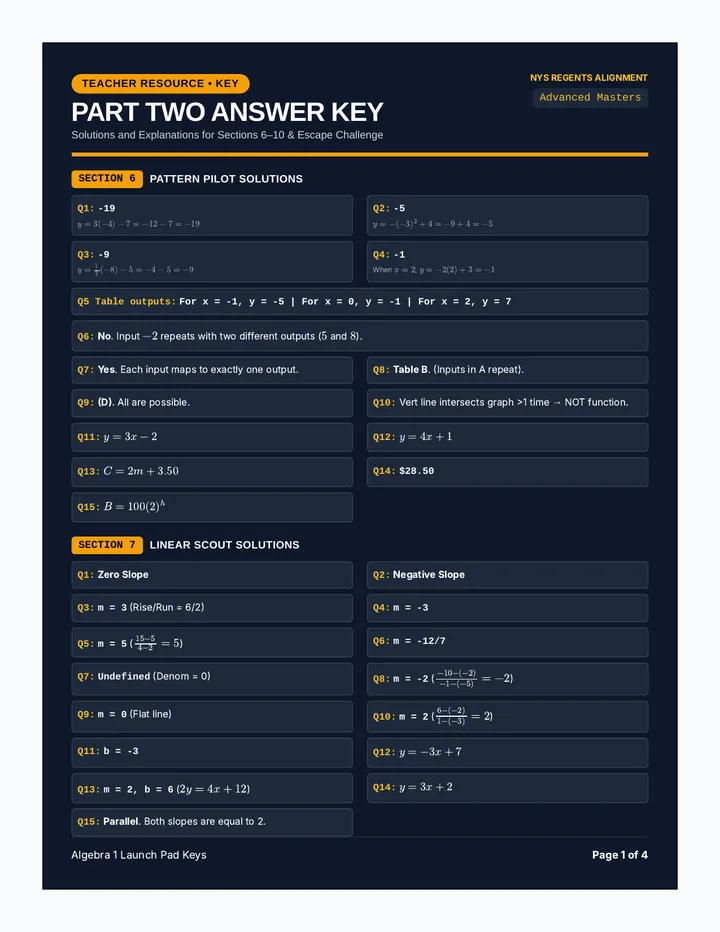
Review and assessment of literal equation mastery through multi-step problems.
A stations-based exploration of physics formulas like force, velocity, and Ohm's law.
Applying formula manipulation to geometric formulas for area, perimeter, and volume.
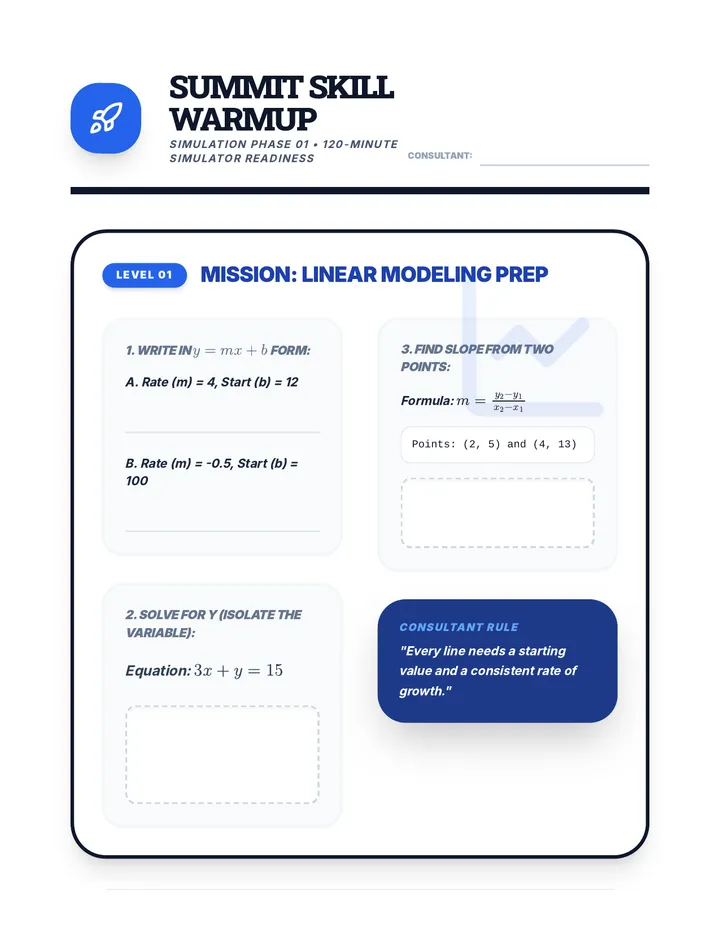
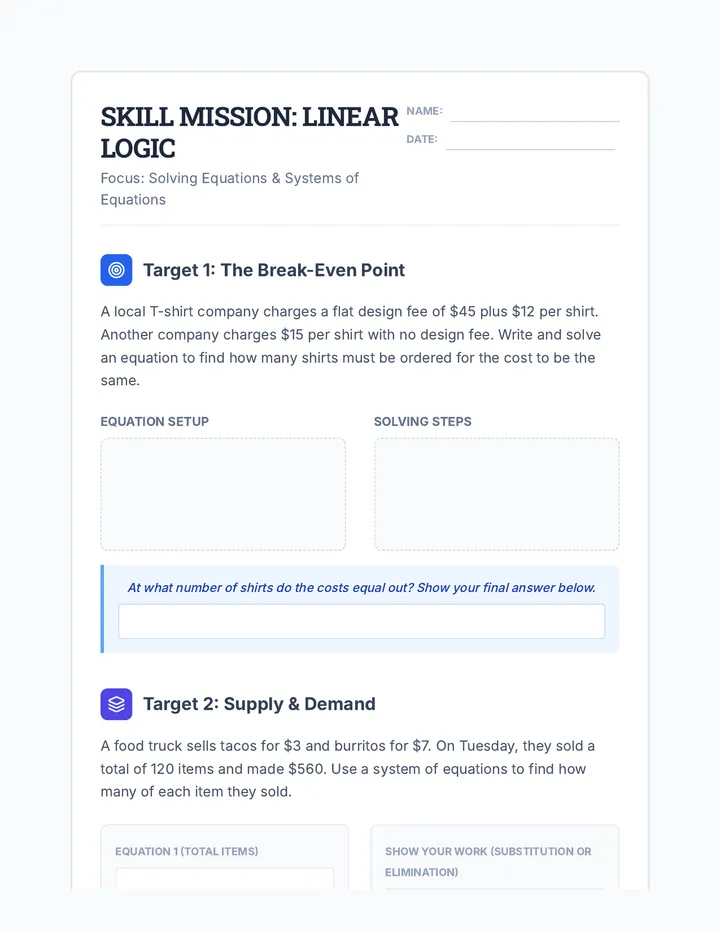
Introduction to literal equations by connecting the logic of solving standard equations to rearranging variables.
Comprehensive assessment of ratio and proportion skills, covering all algebraic complexities introduced in the unit.
Advanced proportion solving involving the distributive property and variables on both sides. Contexts include business comparisons and mixture problems. (Task 3)
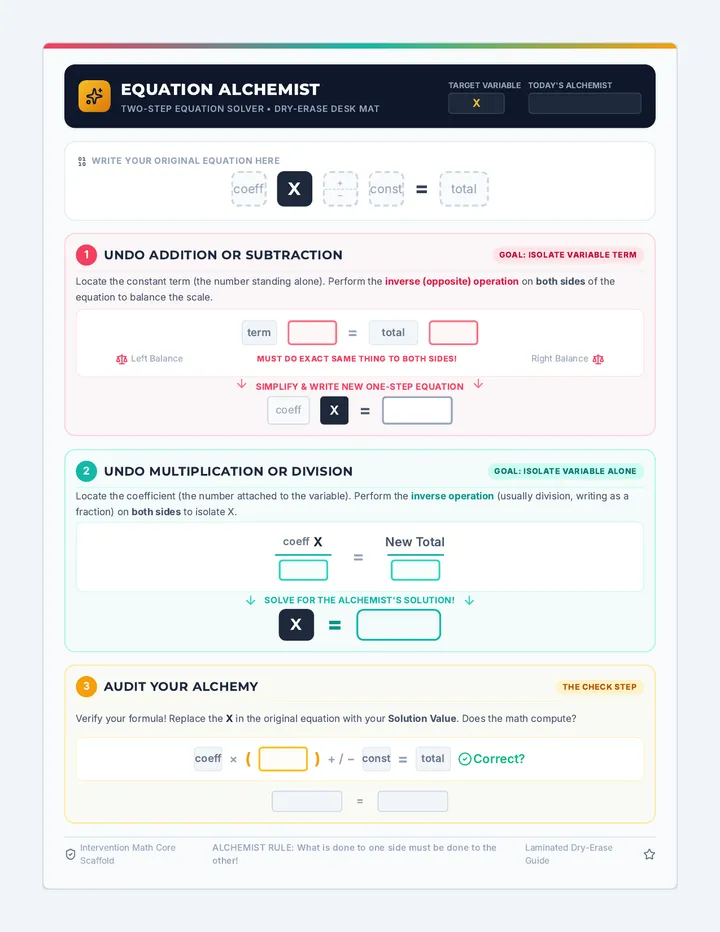
Solving proportions that result in two-step equations. Focuses on contexts like construction, currency conversion, and wage calculations. (Task 2)
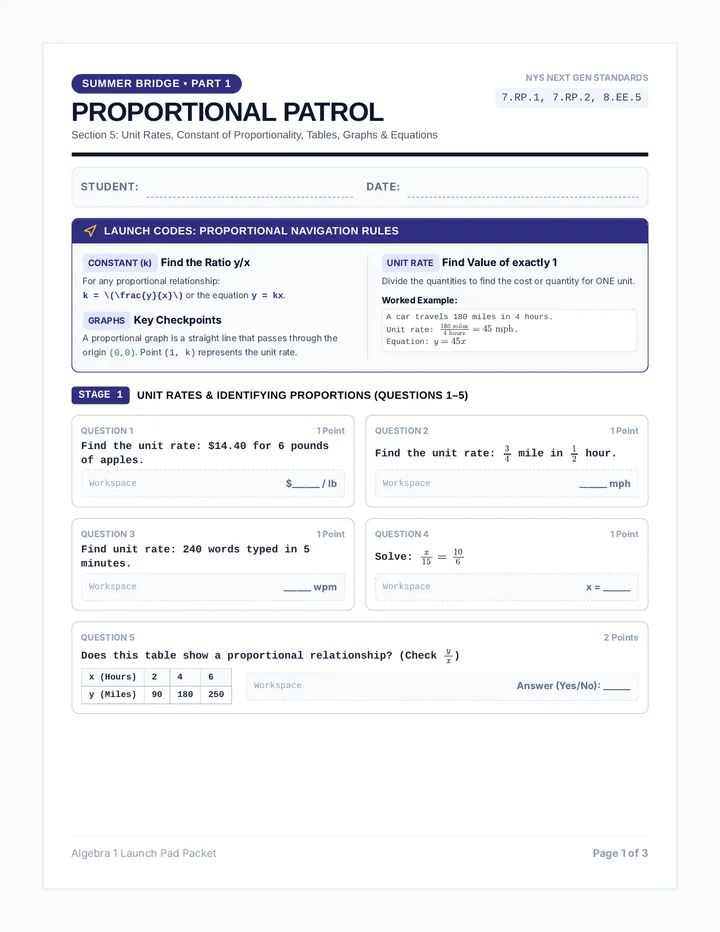
Introduction to proportions and solving one-step equations through cross-multiplication. Real-world contexts include recipe scaling and unit rates. (Task 1)
A lesson focused on the product and quotient properties of logarithms, specifically adding and subtracting logs. Designed with heavy scaffolding for a math resource setting.
This lesson introduces exponential growth and decay functions, focusing on modeling real-life situations, identifying growth and decay factors, and analyzing key attributes of exponential models. Students will transition from Algebra 1 foundations to advanced Algebra 2 applications using the standard model \(y = ab^x\).
A comprehensive review of percentages for HSED learners, covering conversions, visual models, and real-world applications like tipping and discounts.
A comprehensive assessment covering circle geometry, including angle relationships, arc measures, and circle components. Students will identify circle parts, calculate angle and arc measures using various theorems, and determine circumference and arc length.
A comprehensive lesson on circles covering radius, diameter, circumference, and area through a visual slide deck and a summative assessment.
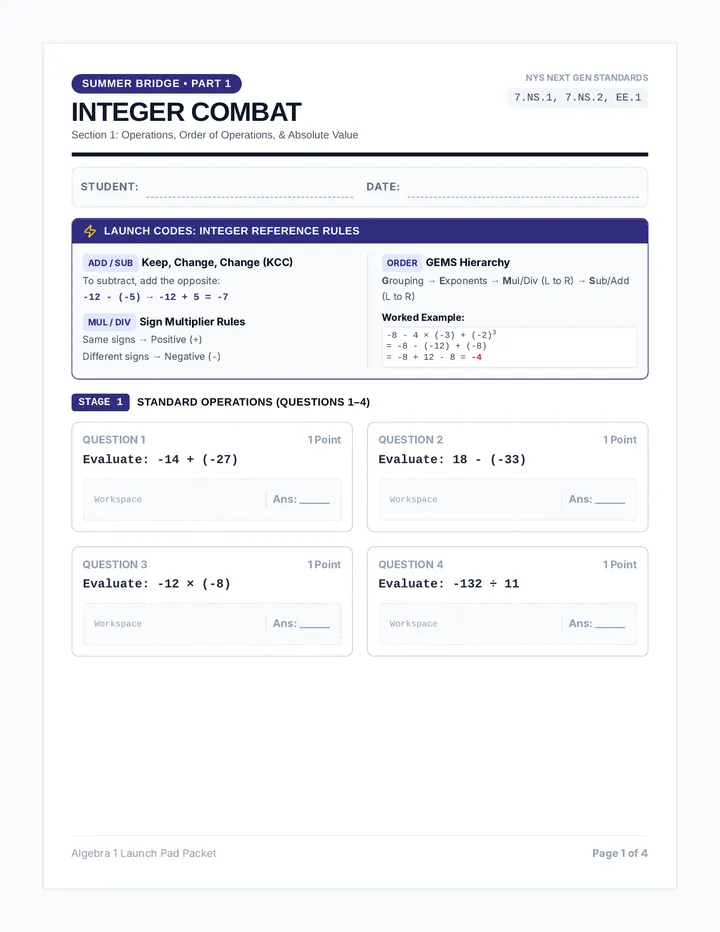
A comprehensive review of integer operations (addition, subtraction, multiplication, and division) using a BINGO game and a classroom scavenger hunt. Designed for minimal prep with student-generated boards and multi-use task cards.
A focused review of volume and surface area concepts for cylinders, cones, and pyramids, featuring open-response practice problems that mirror district assessment standards.
A comprehensive lesson on circle angle relationships, covering central, inscribed, interior, and exterior angles with guided notes and visual examples.
A high-energy collaborative review day. Students participate in a 'Relay Race' of unit rate tasks, moving through stations that cover whole numbers, fractions, consumer math, and measurement to reinforce skills before the final assessment.
A summative assessment covering the identification of graph features and solving quadratic equations using multiple methods.
A comprehensive review of all three methods (graphing, factoring, formula) and identifying key features to prepare for the unit assessment.
Students use the quadratic formula to solve equations that are not easily factorable, with an emphasis on identifying coefficients and simplifying the result.
Students learn to solve quadratic equations by factoring trinomials and using the Zero Product Property, focusing on real roots and equations in standard form.