Lenny.com
Explore
Create
ActivitiesNewMathEnglish Language ArtsScience & EngineeringSocial StudiesGlobal LanguagesHealth & Physical EducationSpecial EducationCounseling & Life SkillsArts & CreativityESL
Lenny.com
Lenny.com
Explore
Create
ActivitiesNewMathEnglish Language ArtsScience & EngineeringSocial StudiesGlobal LanguagesHealth & Physical EducationSpecial EducationCounseling & Life SkillsArts & CreativityESL
Lenny.com
Lenny.com

Solutions

Lenny for EducatorsLenny for SchoolsLenny for Districts

Product

ExploreSign inCreateSupportAbout

Resources

Getting startedMTSS Acceleration Program

© 2026 Lenny Learning Inc.

TermsPrivacyAccessibility
LinkedInInstagramX
Lenny
MathNumbers & CountingCounting ObjectsNumber NamesComparing NumbersNumber OperationsCounting SequenceNumbers 0-10Place Value Understanding and SystemAdd and Subtract Within 20Addition and Subtraction ConceptsAddition and Subtraction EquationsAddition and Subtraction ProblemsFoundations for MultiplicationMultiplication and Division PropertiesMultiply and Divide Within 100Multiplication and Division ProblemsFactors and MultiplesProperties of OperationsPatterns and RelationshipsGenerate and Analyze PatternsMulti-Digit ArithmeticPlace Value OperationsMulti-Digit and Decimal OperationsNumerical ExpressionsFour Operations and PatternsFour Operations Problem SolvingMeasurement & DataMeasurable AttributesMeasuring LengthsMeasure and Estimate Lengths in Standard UnitsRelate Addition and Subtraction to LengthClassifying and Counting ObjectsTime and MoneyArea Concepts and MeasurementPerimeter and Area MeasuresAngle Concepts and MeasurementTime, Volume, and MassMeasurement Unit ConversionsGeometryIdentifying ShapesShapes and AttributesShape Attributes and ReasoningShapes and CompositionClassifying 2D FiguresGeometric Figures and RelationshipsLines, Angles, and ShapesAngle, Area, and VolumeGeometric MeasurementVolume of 3D ShapesCoordinate Plane ApplicationsTransformations in the PlaneCongruence and SimilarityUnderstand congruence in terms of rigid motionsSimilarity and TransformationsProve Theorems Involving SimilarityPythagorean TheoremTrigonometry for General TrianglesMake Geometric ConstructionsProve Geometric TheoremsTheorems About CirclesFind Arc Lengths And Areas of Sectors of CirclesVolume FormulasRelationships Between Two-Dimensional and Three-Dimensional ObjectsProve Simple Geometric Theorems AlgebraicallyTranslate Between Geometric Description and Equation for Conic SectionApply Geometric Concepts in Modeling SituationsFractions & DecimalsFractions as NumbersBuilding FractionsFraction Equivalence and OrderingAdding and Subtracting FractionsMultiplying and Dividing FractionsDividing FractionsDecimal FractionsMulti-Digit Computation and FactorsAdd, Subtract, Multiply, and Divide Rational NumbersRational Number SystemIrrational Numbers and ApproximationsRatiosRatios and ProportionsProportional RelationshipsUnit RateAlgebraAlgebraic ExpressionsGenerate Equivalent ExpressionsQuantitative RelationshipsProportional Relationships and Linear EquationsEquations and InequalitiesEquation Solving and ReasoningLinear Equations and SystemsGraph Equations and InequalitiesSystems of EquationsReal-World Algebraic ProblemsQuantitative Reasoning with UnitsExpression StructureEquivalent Expression FormsRadicals and Integer ExponentsRational ExponentsRational and Irrational NumbersPolynomial OperationsPolynomial IdentitiesPolynomial Zeros and FactorsRational ExpressionsComplex Number OperationsComplex Numbers in PolynomialsComplex Numbers on PlaneStatistics & ProbabilityRepresent and Interpret DataData DistributionsStatistical VariabilityProbability ModelsCompound Event ProbabilitiesStatistical SamplingInterpret Categorical and Quantitative DataBivariate Data PatternsInterpret Linear ModelsComparing Two PopulationsRandom Processes in StatisticsIndependence and Conditional ProbabilityExpected ValuesProbability-Based Decision MakingStatistical Inference and ConclusionsFunctionsFunction Concepts and NotationDefine and Compare FunctionsInterpret Functions in ContextAnalyze Function RepresentationsModel Relationships with FunctionsIdentify Linear vs Exponential GrowthDistinguish Between Function TypesCompare Growth RatesInterpret Function ExpressionsBuild Functions from RelationshipsConstruct and Model FunctionsTransform and Combine FunctionsModel Comparison and SelectionSolve Exponential EquationsTrigonometryTrigonometric Ratios Involving Right TrianglesTrigonometric Functions and Unit CircleModel with Trigonometric FunctionsTrigonometric IdentitiesVectors & MatricesIntroduction to Vectors and MatricesVector QuantitiesVector OperationsMatrix OperationsCalculusLimits and ContinuityDerivative Concepts and NotationDerivative Rules and TechniquesApplications of DerivativesOptimization ProblemsRelated RatesCurve Sketching and AnalysisIntegration Concepts and NotationAntiderivatives and Indefinite IntegralsDefinite Integrals and AreaFundamental Theorem of CalculusIntegration TechniquesApplications of IntegrationDifferential EquationsSequences and SeriesParametric and Polar FunctionsVector-Valued Functions

Rational Number Blueprint

A comprehensive workshop focused on mastering rational number operations and common CCSS 7th grade math misconceptions in preparation for the NYS test.

CWCheyenne Watkins

Rational Number Blueprint

A comprehensive workshop focused on mastering rational number operations and common CCSS 7th grade math misconceptions in preparation for the NYS test.

CWCheyenne Watkins

Reflection: How do you know your answer is reasonable?

Common NYS Trap Question

Q2. Which expression is equivalent to \( -2(4x - 6) - 5x \)?

A \( -13x - 12 \)

B \( -13x + 12 \)

C \( 3x - 12 \)

D \( 3x + 12 \)

Show distribution and sign tracking...

Q3. Midnight temp: \( -4^\circ\text{F} \). Noon: \( +15^\circ\text{F} \). 8 PM: \( -7^\circ\text{F} \). Final temp?

Q4. Recipe: \( 3/4 \) cup sugar for every \( 1/2 \) cup flour. Sugar needed for 1 cup flour?

A \( 3/8 \) cup

B \( 1 \frac{1}{4} \) cups

C \( 1 \frac{1}{2} \) cups

D \( 2 \) cups

Q5. Solve the inequality: \( -5x + 10 > 35 \)

Conceptual Explanation: Does the inequality sign change? Why or why not?

Q6. Bag: 4 red, 6 blue, 2 green. Probability of choosing a marble that is NOT blue?

Part 5: Exit Ticket

E1. Distance between \( -8 \) and \( 5 \) on a number line?

A -13

B -3

C 3

D 13

E2. Calculate: \( -2^4 \) vs \( (-2)^4 \)

Metacognition: Which type of mistake would most likely lead to a wrong answer here?

SIGN ERROR

ORDER OF OPERATIONS

MISREADING THE QUESTION

Blueprint Final Sweep

Check Signs (+/-) Order of Ops Reasonability

Blueprint Answer Key

Do Now:

1: A | 2: -23 ft | 3: Used Subtr. before Mult. | 4: e.g. \( -2-3 = -5 \)

Error Lab:

001: Subtr neg = add (+3) | 002: Distribute to both terms (+20) | 003: Div by time (2 m/hr)

Micro-Drill:

A: 9, 5, -6.8, -5.5 | B: -5/12, 4 | C: -17

Guided Practice:

Q1: $6.75 | Q2: B | Q3: 4°F | Q4: C | Q5: x < -5 (flip for div by neg) | Q6: 1/2

Exit Ticket:

E1: D (13) | E2: -16 vs 16. Power only applies to base; parens include sign.

What is the value of the expression below? \( -8 + 3(-4 + 1) \)

Show steps and sign track here...

Part 4: Guided Practice

Q1. A bank account has a balance of \( -\$15.50 \). A deposit of \( \$45.00 \) is made, followed by a withdrawal of \( \$22.75 \). What is the new balance in the account?

Reasonableness Check: Is your final answer positive or negative? Explain why.

TRAP QUESTION: COMMON NYS ERROR ANALYSIS

Q2. Which expression is equivalent to \( -2(4x - 6) - 5x \)?

A \( -13x - 12 \)

B \( -13x + 12 \)

C \( -3x - 12 \)

D \( -3x + 12 \)

Show your work...

Q3. At midnight, the temperature was \( -4^\circ\text{F} \). By noon, the temperature had increased by \( 15^\circ\text{F} \). By 8:00 p.m., the temperature had decreased by \( 7^\circ\text{F} \). What was the temperature at 8:00 p.m.?

Q4. A recipe calls for \( \frac{3}{4} \) cup of sugar for every \( \frac{1}{2} \) cup of flour. How many cups of sugar are needed for 1 cup of flour?

A \( \frac{3}{8} \text{ cup} \)

B \( \frac{2}{3} \text{ cup} \)

C \( 1 \frac{1}{4} \text{ cups} \)

D \( 1 \frac{1}{2} \text{ cups} \)

Q5. Solve the inequality below. **Explain why the inequality sign changes (or does not change)** during your solution process.

\( -5x + 10 > 35 \)

Conceptual Explanation:

Q6. A bag contains 4 red marbles, 6 blue marbles, and 2 green marbles. If one marble is chosen at random, what is the probability that it is NOT blue?

Part 5: Exit Ticket

E1. Which value represents the distance between \( -8 \) and \( 5 \) on a number line?

A \( -13 \)

B \( -3 \)

C \( 3 \)

D \( 13 \)

E2. Calculate the value of both expressions below: \( -2^4 \) and \( (-2)^4 \)

Metacognition: Which error would most likely lead to a wrong answer on E2?

SIGN ERROR

ORDER OF OPERATIONS

MISREADING THE QUESTION

  • □ Checked my signs (+/-)
  • □ Checked Order of Ops
  • □ My answer makes sense

Blueprint Submission Sweep

Verify Signs Show All Steps Units Included

Blueprint Answer Key

Do Now:

1: A | 2: -23 ft | 3: Used Subtr. before Mult. | 4: e.g., \( -2-3 = -5 \)

Error Lab:

001: Subtr neg = add (\( 3 \)) | 002: Distribute to both (\( -4x + 20 \)) | 003: Div by time (\( 2 \text{ m/hr} \))

Micro-Drill:

A: \( 9, 5, -6.8, -5.5 \) | B: \( -5/12, 4 \) | C: \( -17 \)

Guided Practice:

Q1: \( \$6.75 \) | Q2: B | Q3: \( 4^\circ\text{F} \) | Q4: D | Q5: \( x < -5 \) (flip for div by neg) | Q6: \( 1/2 \) or \( 6/12 \)

Exit Ticket:

E1: D (\( 13 \)) | E2: \( -16 \text{ vs } 16 \). Power only applies to base; parens include sign.

Q2. Which expression is equivalent to -2(4x - 6) - 5x?

A -13x - 12

B -13x + 12

C -3x - 12

D -3x + 12

Q3. At midnight, the temperature was -4°F. By noon, the temperature had increased by 15°F. By 8:00 p.m., the temperature had decreased by 7°F. What was the temperature at 8:00 p.m.?

Q4. A recipe calls for 3/4 cup of sugar for every 1/2 cup of flour. How many cups of sugar are needed for 1 cup of flour?

A 3/8 cup

B 2/3 cup

C 1 1/4 cups

D 1 1/2 cups

Q5. Solve the inequality below. **Explain why the inequality sign changes (or does not change)**.

-5x + 10 > 35

Conceptual Explanation:

Q6. A bag contains 4 red marbles, 6 blue marbles, and 2 green marbles. If one marble is chosen at random, what is the probability that it is NOT blue?

Part 5: Exit Ticket

E1. Which expression represents the distance, in units, between -8 and 5 on a number line?

A | -8 - 5 |

B | -8 + 5 |

C -8 - 5

D -8 + 5

E2. At 6:00 a.m., the temp was -12°F. By noon, it increased by 18°F. From noon to 4:00 p.m., it decreased by 5.5°F. What was the temp at 4:00 p.m.?

Metacognitive Tracking:

Which part was the most challenging?

Increasing Temp

Decreasing Temp

Decimal Signs

  • □ Checked signs
  • □ Shown all steps
  • □ Answer makes sense

Blueprint Submission Sweep

Verify Signs Show Steps Check Units

Blueprint Answer Key

DO NOW :

1: A | 2: -23 ft | 3: Used Subtr. before Mult. | 4: e.g., -2 - 3 = -5

ERROR LAB :

001: Subtr neg = add (3) | 002: Distribute to both (-4x + 20) | 003: Div by time (2 m/hr)

MICRO DRILL :

A: 9, 5, -6.8, -5.5 | B: -5/12, 4 | C: -17

GUIDED PRACTICE :

Q1: $6.75 | Q2: B | Q3: 4°F | Q4: D | Q5: x < -5 (flip for div by neg) | Q6: 1/2 or 6/12

EXIT TICKET :

E1: A (| -8 - 5 | = 13) | E2: 0.5°F (-12 + 18 - 5.5 = 6 - 5.5 = 0.5)

Q5 (The 'Why'):

NYS is moving toward conceptual explanations. If a student can solve but can't explain the sign change, they haven't mastered the concept. **Key Phrase:** "Dividing by a negative reverses the order of the number line."

Metacognitive Debrief

Use the final 5 minutes to discuss the strategy selection and results from the exit ticket.

Check for Understanding (CFU):

  • "If we subtract a negative number, is our result always positive? Why or why not?"
  • "Why is | -8 - 5 | the same as | 5 - (-8) |?"
  • "How did your strategy change when decimals were introduced?"

Rational Number Blueprint Workshop - Teacher Facilitation Edition
You might also like

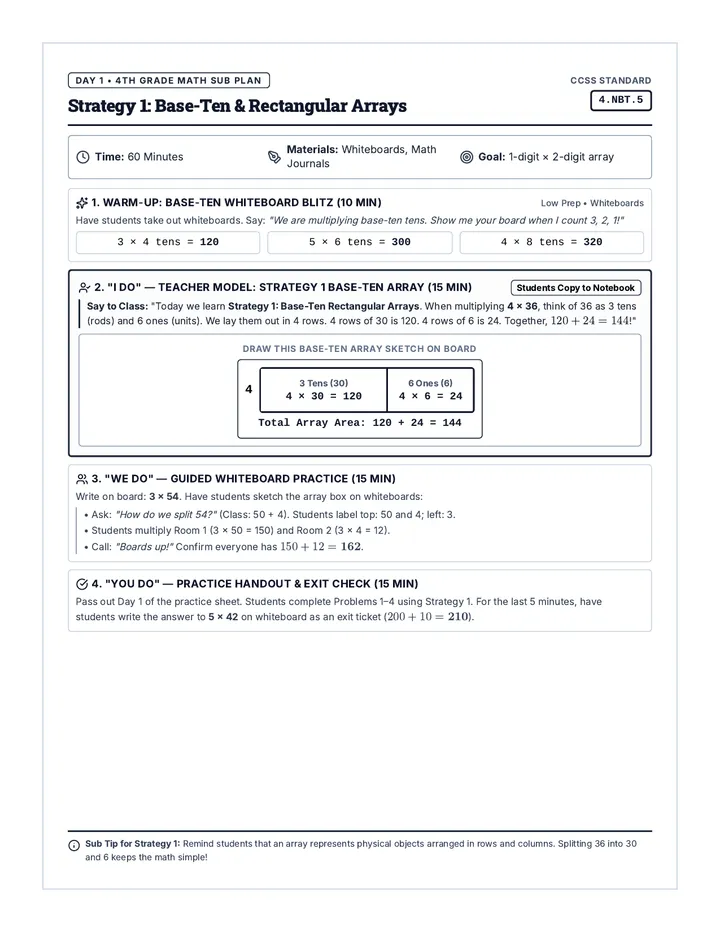
Single Digit Sub Guide

Multiplication Mastery Week

A comprehensive 5-day math curriculum sequence for 4th Grade standard 4.NBT.5, featuring scripted sub plans with gradual release, low-prep whiteboard and manipulative routines, student notebook guides, and a spiraled weekly homework packet.

RM

Rodnesha Minor

7
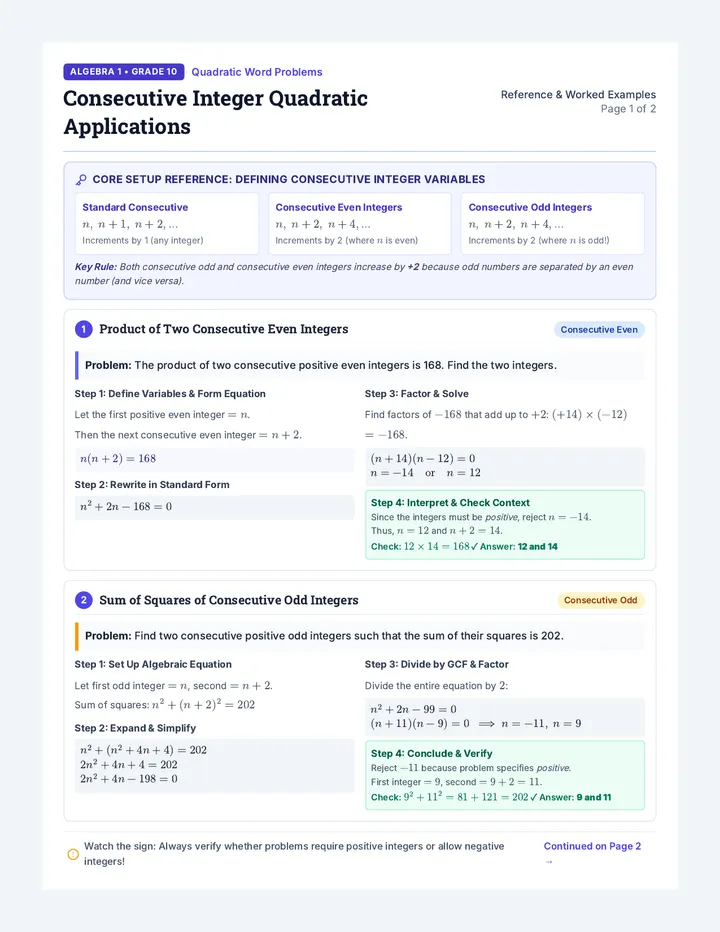
Consecutive Quadratics Practice Guide

Consecutive Integer Quadratics

A focused 10th-grade algebra lesson on modeling real-world and algebraic relationships using quadratic equations with consecutive odd and even integers. Features structured reference materials and an in-depth teacher solutions key.

AR

Angie Rice

4
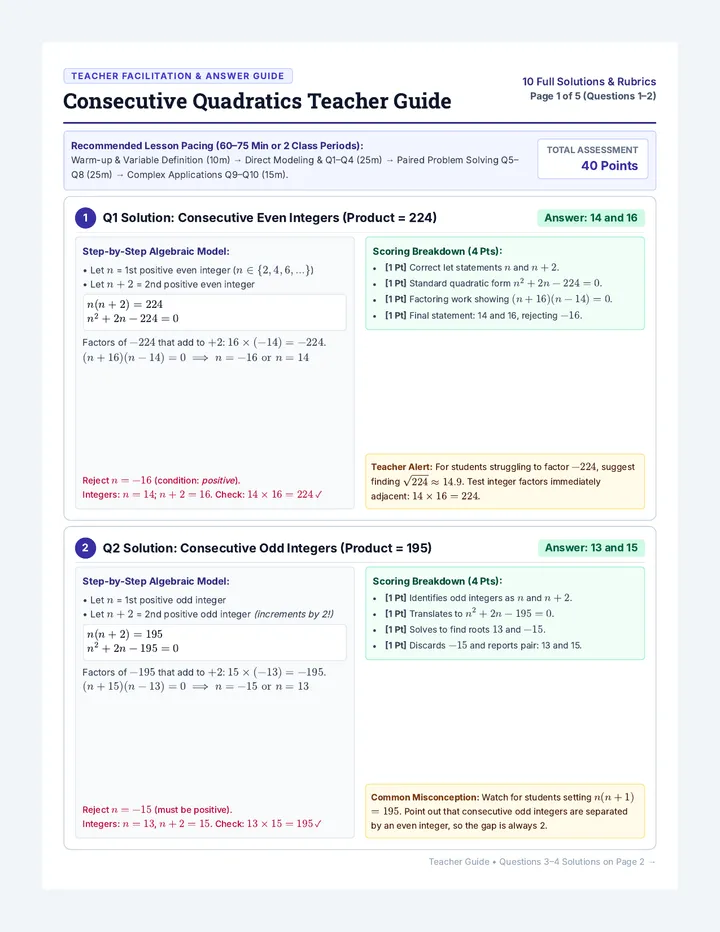
Consecutive Quadratics Teacher Guide

Consecutive Quadratics Teacher Guide

A five-page comprehensive teacher guide and solutions manual matching the ten-problem student worksheet. Provides detailed step-by-step algebraic solutions, 4-point grading rubrics for all 10 problems, pedagogical notes, error diagnostics, and differentiation strategies.

AR

Angie Rice

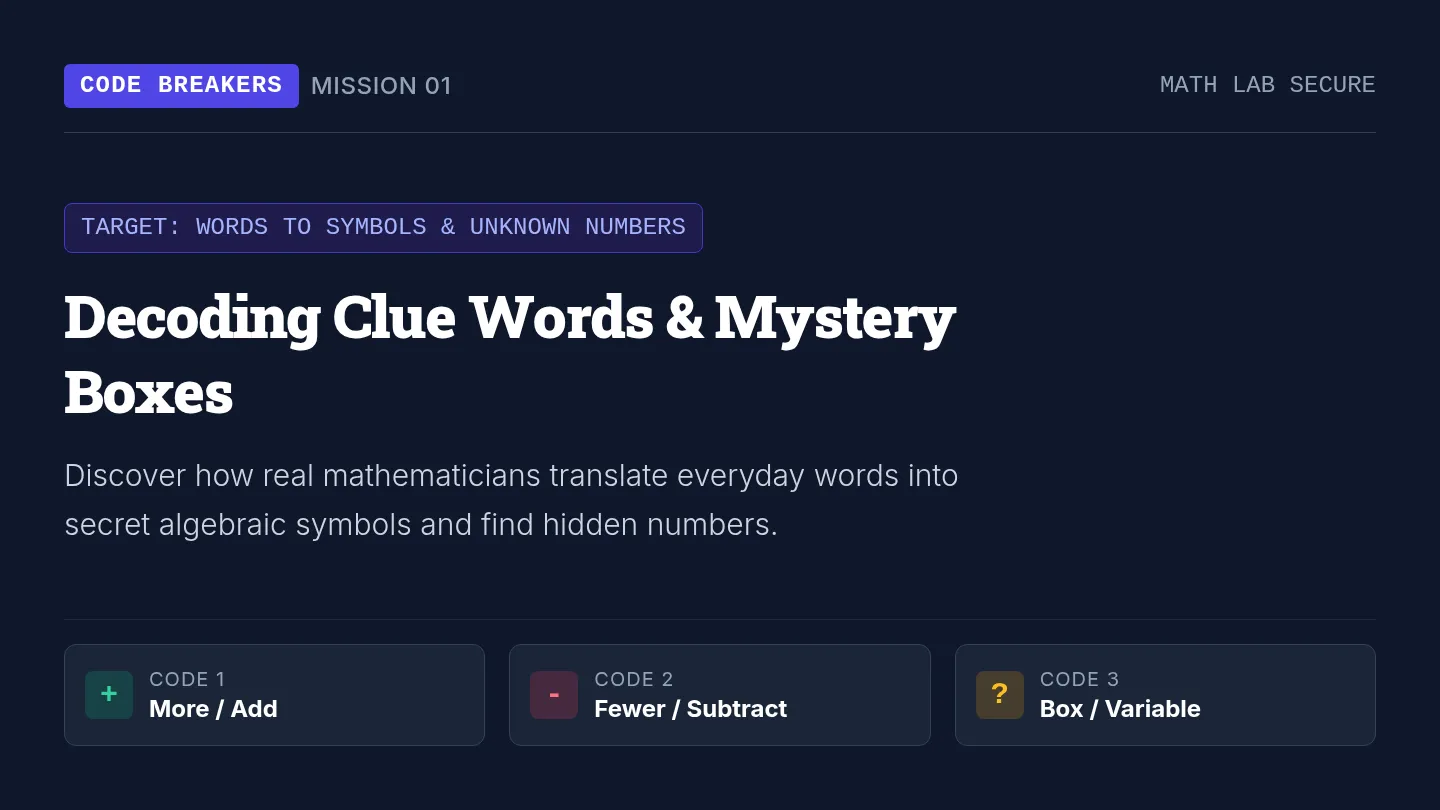
Clue Words Presentation

Code Breakers Squad

A scaffolded pre-algebra sequence designed for sixth graders building confidence from second-grade arithmetic foundations. Students use code-breaking visual models, mystery boxes, number swaps, and equal-group arrays to master algebraic concepts without cognitive overload. Each lesson bridges concrete representations to symbolic expressions with age-respectful styling and supportive pacing.

MJ

Meg Jones

9
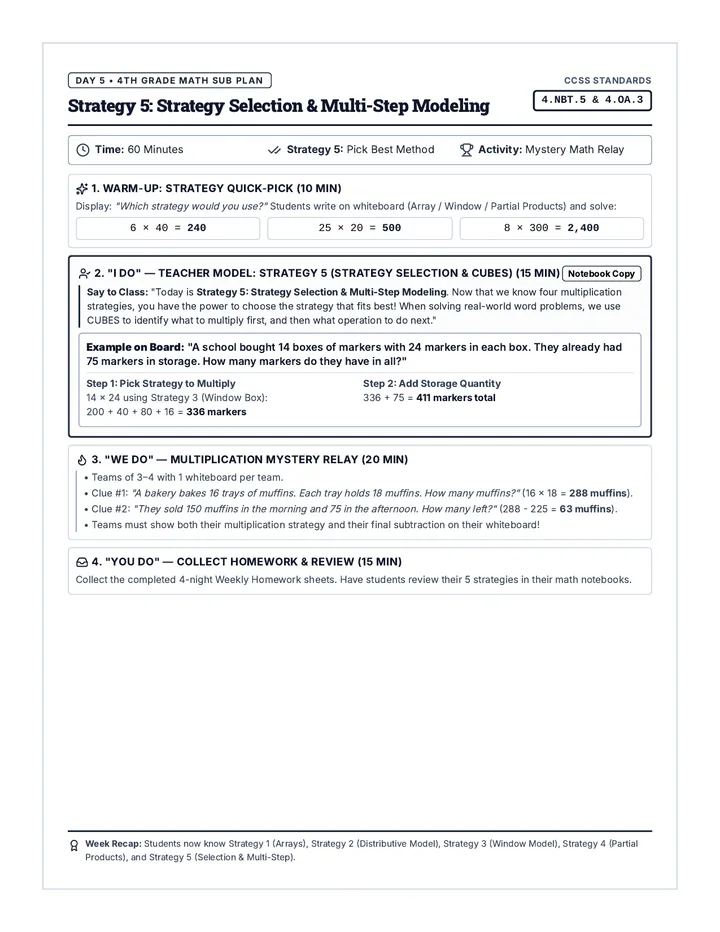
Problem Solving Sub Guide

Spiral And Problem Solving

Day 5 synthesizes multiplication strategies with multi-step word problems, error analysis, and includes the complete 4-night spiraled weekly homework packet and full answer keys.

RM

Rodnesha Minor

3
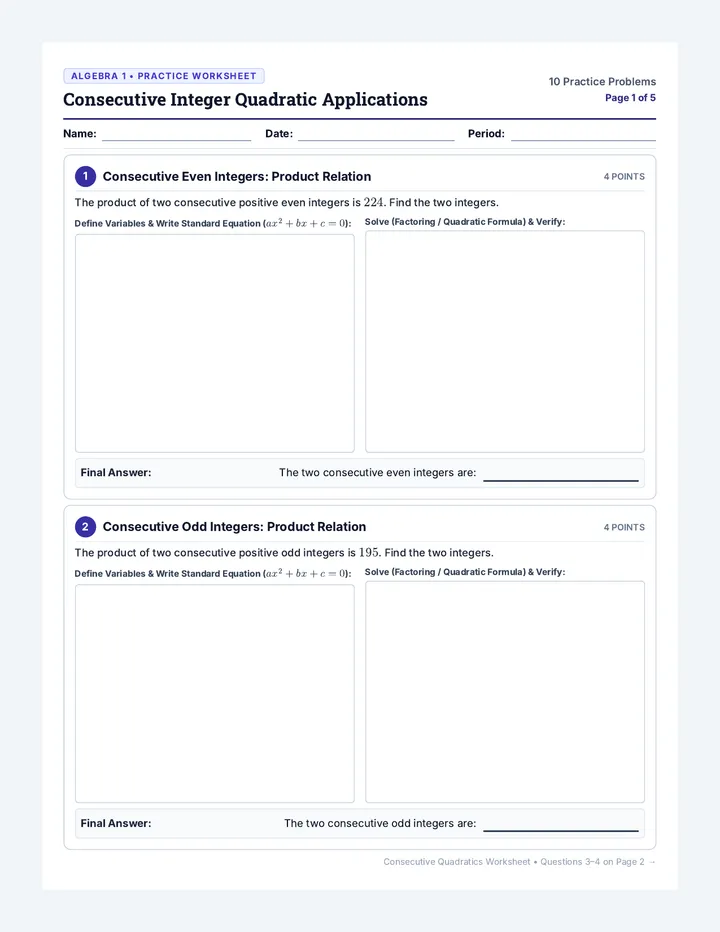
Consecutive Quadratics Worksheet

Consecutive Quadratics Worksheet

A five-page student worksheet containing ten comprehensive quadratic application word problems involving consecutive odd and even integers. Features expanded, extra-large partitioned blank work areas for defining variables, setting up standard-form equations, factoring, and contextual checks.

AR

Angie Rice

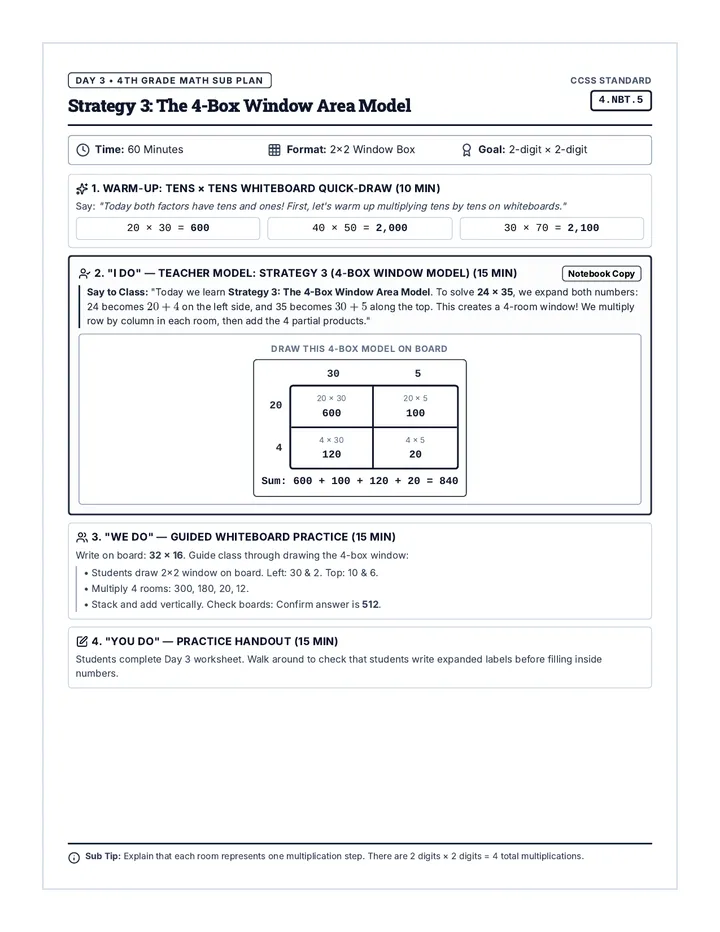
Double Digit Sub Guide

Double Digit Models

Days 3 and 4 tackle multiplying two two-digit numbers using 4-part rectangular area models and partial products, featuring turnkey scripts, whiteboard showdown routines, and student notebook organizers.

RM

Rodnesha Minor

2
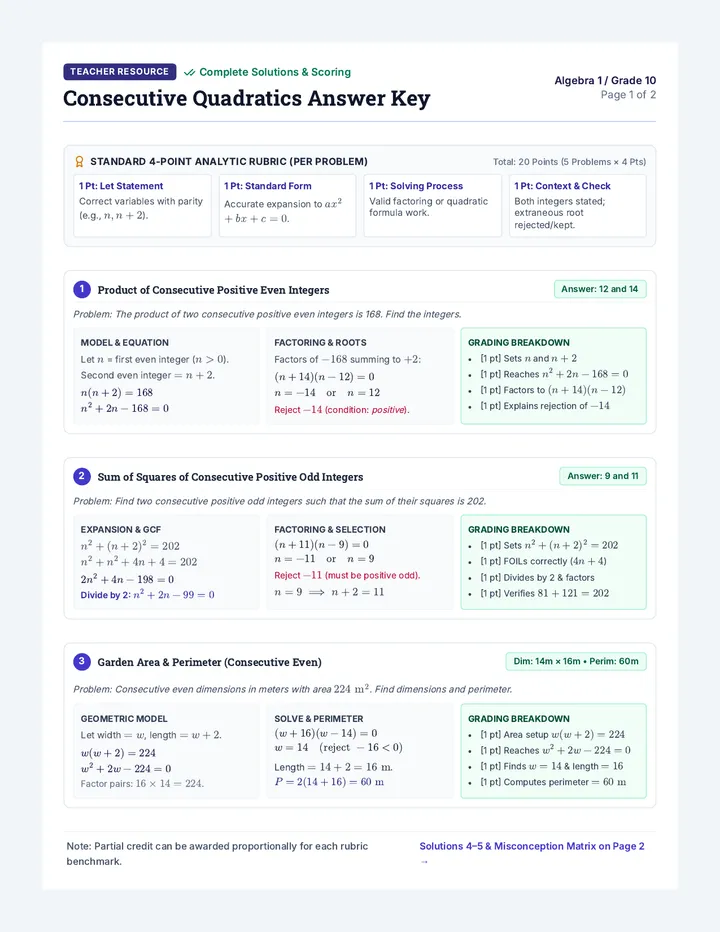
Consecutive Quadratics Answer Key

Consecutive Quadratics Answer Key

A comprehensive two-page teacher answer key and scoring guide for the five consecutive integer quadratic applications. Includes detailed algebraic solutions, standard forms, factorizations, extraneous root justifications, a 4-point scoring rubric per problem, and a teacher misconception diagnostic chart.

AR

Angie Rice