A comprehensive lesson on adding, subtracting, multiplying, and dividing rational expressions with linear and quadratic terms, themed around structural engineering and blueprints.
A high-energy 'Scoot' game where students solve two-step equations with fractional coefficients, using a construction-blueprint theme to build algebraic fluency.
Students synthesize their design and financial data into a final statistical report and presentation for a hypothetical city council.
Focusing on procurement, students manage a complex budget using multi-step decimal operations for material costs, labor, and taxes.
Students translate statistical findings into physical dimensions, applying decimal multiplication and division to manage scale and area calculations.
Students launch the project by analyzing demographic data using decimal operations to identify community needs for their architectural design.
A clear, step-by-step lesson on writing equations for parallel and perpendicular lines in slope-intercept form, featuring visual guides and structured practice.
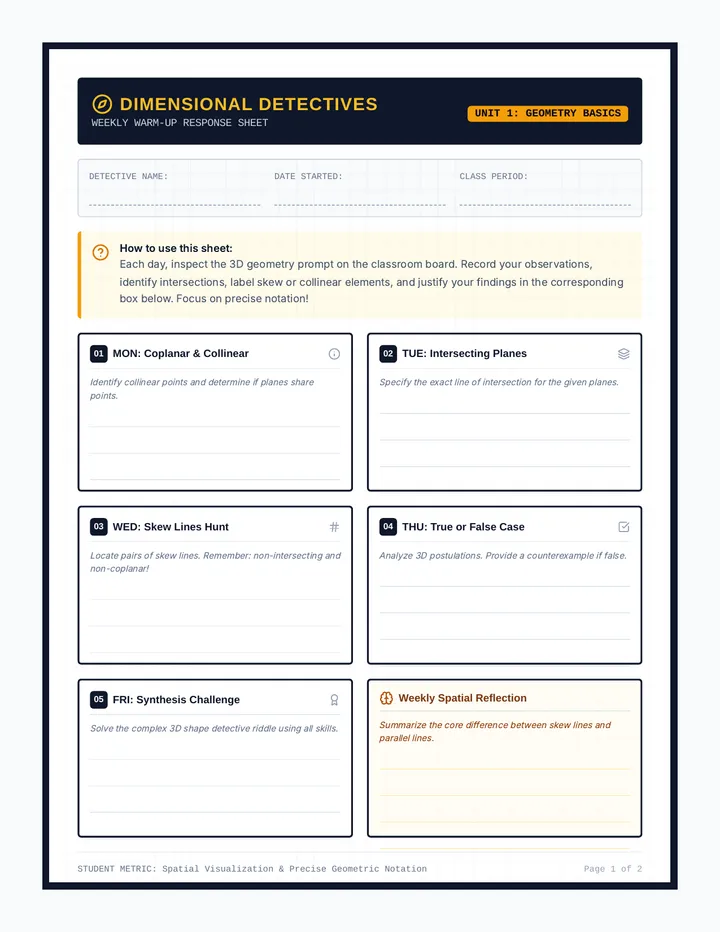
A lesson focused on distinguishing between rigid transformations (isometries) and non-rigid transformations (dilations) using visual diagrams and geometric properties.
A 9th grade Algebra lesson focused on identifying the number of solutions in a system of linear equations (one, none, or infinite), specifically designed for Special Education students with IEP supports.
A comprehensive introduction to graphing quadratic functions using tables of values and identifying key features like the vertex and axis of symmetry.
Covers division of radicals and the essential skill of rationalizing denominators using both monomial and binomial (conjugate) methods.
Focuses on the multiplication of radical expressions, including the distributive property and FOIL with binomial radicals.
Covers the fundamentals of simplifying radical expressions and performing addition and subtraction with like radicals, including variables and higher-order roots.
A targeted practice session focusing on SAT Math's Heart of Algebra section, covering linear equations, systems, and inequalities.
Students master ratios and proportions by scaling recipes for a community feast, applying unit rates to calculate costs and manage kitchen logistics.
Students act as urban planners using systems of linear inequalities and area optimization to design a sustainable city grid. This project-based lesson bridges algebra and real-world infrastructure planning.
This lesson explores the Central Limit Theorem and the impact of sample size on the distribution of sample means, specifically within the context of medical testing and diagnostic accuracy.
A focused one-hour lesson on linear equations, covering slope, various equation forms, and the relationships between parallel and perpendicular lines in the coordinate plane.
A comprehensive introduction to converting between exponential and logarithmic forms, aligned with Texas TEKS 2A.5.C. Students will explore the inverse relationship through guided notes, scaffolded practice, and a formal assessment.
A lesson focused on organizing data using frequency tables and calculating the probability of Tom's trap success and Jerry's escapes.
A lesson focused on visualizing data through dot plots and histograms, themed around Jerry's escape routes and Tom's pursuit durations.
A statistics packet for freshman students themed around the classic chases of Tom and Jerry, covering central tendency, data visualization, and probability.
A lesson exploring sampling distributions, the Central Limit Theorem, and the real-world applications of random sampling as a strategic tool.
A functional math lesson focused on adding two menu items using a calculator within the context of a digital fast food ordering app. Students practice selecting items from a McDonald's-themed menu and totaling their purchases.
A project-based lesson where students master percentages and decimals by calculating discounts, sales tax, and final totals in a simulated shopping environment.
A project-based math lesson where students master percentages and decimals by navigating a simulated marketplace, calculating real-world discounts and sales tax.
A lesson covering the step-by-step process of finding the algebraic inverse of basic logarithmic functions with various bases.
A focused lesson on finding the inverse of basic logarithmic functions using algebraic steps, specifically focusing on base 10 and base 2.
A comprehensive lesson on linear relationships, covering parallel and perpendicular lines, writing equations, and interpreting linear models in real-world contexts, specifically scaffolded for students with IEPs.
The final project phase where students select one of three real-world career paths (Music Mogul, Urban Planner, or Sports Analyst) to apply their mathematical knowledge in a summative assessment.