Planetary Place Value Teacher Guide Teacher Guide
Planetary Place Value
Grade 4 Math • Solar System Distances
60 Minutes
4.NBT.A.2 & 4.NBT.A.1
Objectives
Read, write, and compare multi-digit numbers up to 1,000,000 using standard, expanded, and word forms.
Big Idea
Astronomical data grounds abstract place-value relationships in concrete physical realities.
Materials
Slides, Cadet Worksheets, Distance Matchmaker cards, writing utensils.
Instructional Timeline
10m
Mission Launch (Warm-Up)
Hook students with the vastness of space. Display a mystery astronomical distance: 384,400 km (Earth to Moon). Ask students to turn and talk: How do we say this number? What does each digit represent?
15m
Flight Navigation (Direct Instruction)
Introduce the cosmic scale using the Slide Deck. Teach standard form, word form, and expanded form with the Moon's distance. Emphasize the placeholder zero. Write the distance to Jupiter (778,500 km) to demonstrate comparing numbers based on the greatest place value position.
20m
Cosmic Matchmaker (Collaborative Activity)
Distribute the Cosmic Distance Matchmaker cards to small groups. Students collaborate to sort and match card sets consisting of Planet Names, Standard Forms, and Expanded Forms. Group members must verify matches using their Recording Sheet.
Alert: Common Misconceptions
The Zero Trap: Students often skip zeros in expanded form or omit them in word form. Emphasize that zero is a placeholder indicating there are "no groups" of that specific place value (e.g., in 102,400, there are 0 ten-thousands).Period Mix-ups: Students sometimes get confused when grouping by periods (thousands period vs. ones period). Use a vertical divider on the board to clearly separate thousands from ones.
Planetary Place Value • Lesson Plan Page 1 of 2
Planetary Place Value Guide (Cont.)
Pacing, Assessment, Differentiation, and Key Prompts
10m
Solo Mission (Independent Worksheet)
Students complete the "Planetary Place Value Worksheet" individually. This allows you to check for individual mastery. Circulate the room during this time, specifically targeting students who struggled to form matches during the collaborative task.
5m
Re-Entry Debrief (Closure)
Bring the class together. Pose this final prompt: "A new asteroid was detected at 450,082 km away. Another was detected at 450,802 km away. Which one is closer to Earth? How do you know?" Exit ticket: Ask students to write down the expanded form of 450,802 on a scrap of paper before leaving.
Cosmic Questioning Matrix
To probe understanding:
"Why does the position of the digit '5' in 543,000 make it worth more than the '5' in 145,000?"
To address zero placeholders:
"If we write 304,120 without the zero in the ten-thousands place, what number do we get? How does that change its value?"
To guide comparison logic:
"When comparing 678,000 km and 687,000 km, which place value column do we look at first? Why?"
Differentiation Matrix
Guided Support
Provide a physical Place Value Chart with marked columns (Millions, Hundred Thousands, Ten Thousands, Thousands, Hundreds, Tens, Ones). Have them place physical base-10 block drawings or number cards inside columns before writing.
Cosmic Extension
Have advanced students research a 9-digit astronomical distance (e.g., Earth to Saturn in meters: 1,200,000,000m) and write it in all three formats. Ask them to write a word problem comparing the distance to two different moons.
Success Indicators
Standard to Word Writes numbers like 405,230 without dropping 'thousand' or the zero placeholder.
Expanded Form Represents zeros correctly without adding empty place value items.
Comparing Understands that higher place values dictate number size first, regardless of lower digits.
Planetary Place Value • Lesson Plan Page 2 of 2
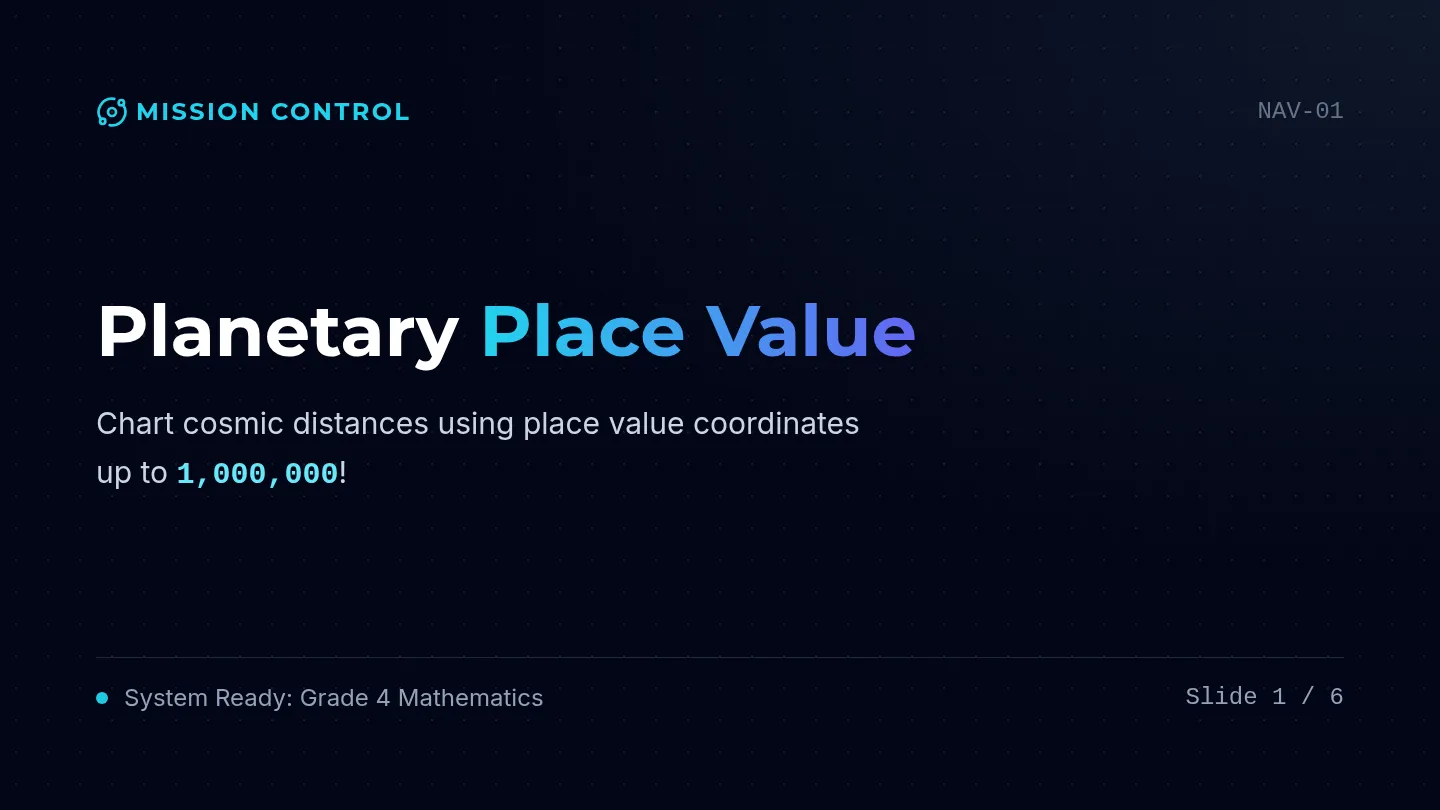
Planetary Place Value Slides Mission Control NAV-01
Planetary Place Value
Chart cosmic distances using place value coordinates up to 1,000,000!
System Ready: Grade 4 Mathematics
Slide 1 / 6
Mission Launch NAV-02
Co-Pilot Briefing
How far is the Moon?
The average distance between Earth and our Moon is exactly:
384,400 km
Turn & Talk
How do we read this cosmic distance out loud?
What does the digit 8 represent in this distance?
How many thousands are in this number?
Planetary Place Value • Slide 2 Slide 2 / 6
Flight Navigation NAV-03
Three Ways to Chart Data
Every cosmic distance can be written in three mathematical formats:
1. Standard Form
Numbers written with digits and periodic commas.
384,400
2. Word Form
The number written out entirely as words.
Three hundred eighty-four thousand, four hundred
3. Expanded Form
Values of each digit stretched out as an addition sentence.
300,000 + 80,000 + 4,000 + 400
Planetary Place Value • Slide 3 Slide 3 / 6
Zero is a Hero NAV-04
The Importance of Zero as a Placeholder
Let's chart the distance from Earth to an passing asteroid: 507,030 km. Notice where zeros are placed!
Hundred Thousands
Ten Thousands
Thousands
Hundreds
Tens
Ones
5
0
7
0
3
0
"Without the placeholder zero in the ten-thousands place, this number would become 57,030—shrinking our distance by nearly 450,000 kilometers!"
Planetary Place Value • Slide 4 Slide 4 / 6
Mission Comparison NAV-05
Comparing Planetary Distances
Which probe traveled further from Earth? Let's compare their coordinate distances.
Probe Alpha (Jupiter) 778,500 km
7 hundred thousands, 7 ten thousands, 8 thousands
Probe Beta (Venus) 108,200 km
1 hundred thousand, 0 ten thousands, 8 thousands
Rule: Compare the values starting from the greatest place value position (hundred thousands).
778,500 > 108,200
Planetary Place Value • Slide 5 Slide 5 / 6
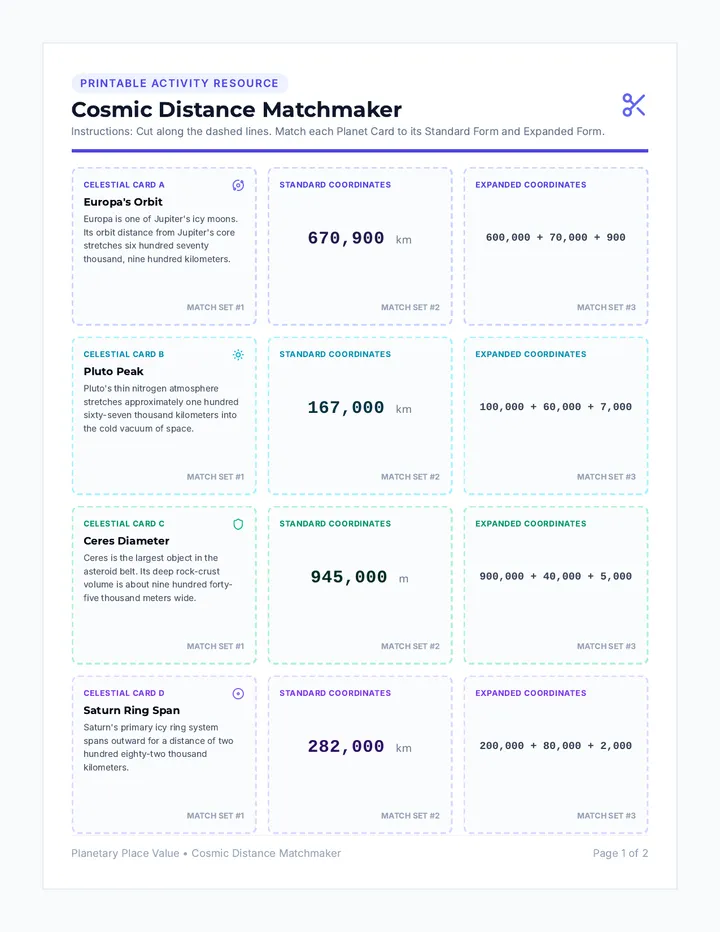
Cosmic Distance Sorting Activity Printable Activity Resource
Cosmic Distance Matchmaker
Instructions: Cut along the dashed lines. Match each Planet Card to its Standard Form and Expanded Form.
Celestial Card A
Europa's Orbit
Europa is one of Jupiter's icy moons. Its orbit distance from Jupiter's core stretches six hundred seventy thousand, nine hundred kilometers.
Match Set #1
Standard Coordinates
670,900 km
Match Set #2
Expanded Coordinates
600,000 + 70,000 + 900
Match Set #3
Celestial Card B
Pluto Peak
Pluto's thin nitrogen atmosphere stretches approximately one hundred sixty-seven thousand kilometers into the cold vacuum of space.
Match Set #1
Standard Coordinates
167,000 km
Match Set #2
Expanded Coordinates
100,000 + 60,000 + 7,000
Match Set #3
Celestial Card C
Ceres Diameter
Ceres is the largest object in the asteroid belt. Its deep rock-crust volume is about nine hundred forty-five thousand meters wide.
Match Set #1
Standard Coordinates
945,000 m
Match Set #2
Expanded Coordinates
900,000 + 40,000 + 5,000
Match Set #3
Celestial Card D
Saturn Ring Span
Saturn's primary icy ring system spans outward for a distance of two hundred eighty-two thousand kilometers.
Match Set #1
Standard Coordinates
282,000 km
Match Set #2
Expanded Coordinates
200,000 + 80,000 + 2,000
Match Set #3
Planetary Place Value • Cosmic Distance Matchmaker Page 1 of 2
Mission Data Sheet
Flight Navigation Log
ACTIVITY RECORDING SHEET
Cadet Name:
Stardate:
Mission Instructions: After matching your celestial card sets, work with your flight crew to write down the matching information in the grid below. Ensure all digits align perfectly in their place value spots!
Celestial Body
Standard Form
Expanded Form
Word Form
Europa
Pluto Peak
Ceres
Saturn Ring Span
Post-Mission Deep Dive
1. Compare the standard distance of Pluto Peak and Saturn Ring Span using <, >, or =. Explain your math reasoning below:
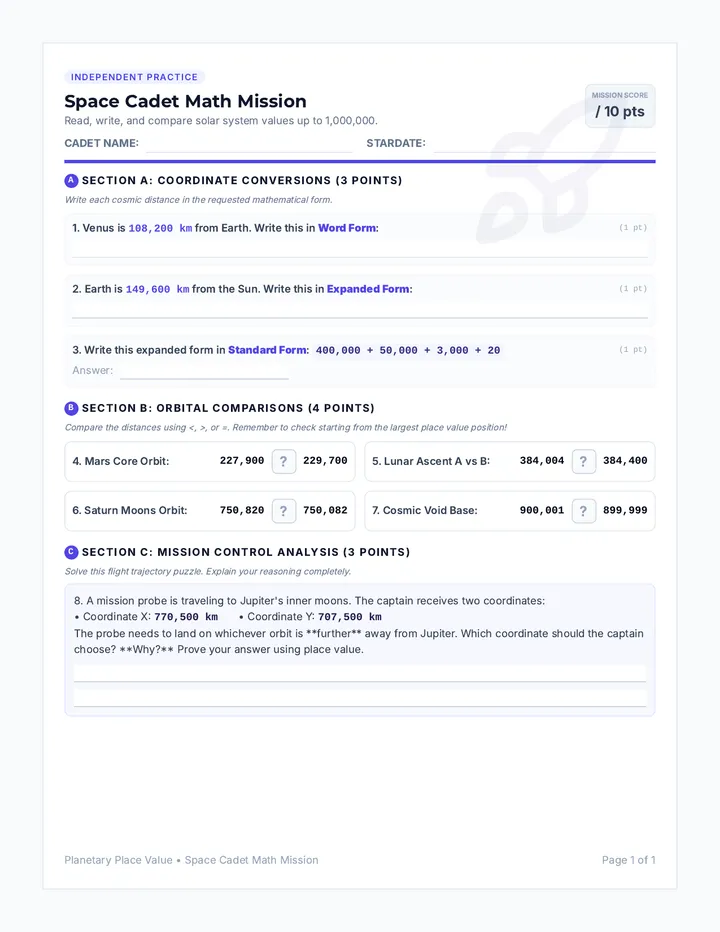
Planetary Place Value Worksheet Independent Practice
Space Cadet Math Mission
Read, write, and compare solar system values up to 1,000,000.
Mission Score / 10 pts
Cadet Name:
Stardate:
A Section A: Coordinate Conversions (3 points)
Write each cosmic distance in the requested mathematical form.
1. Venus is 108,200 km from Earth. Write this in Word Form : (1 pt)
2. Earth is 149,600 km from the Sun. Write this in Expanded Form : (1 pt)
3. Write this expanded form in Standard Form : 400,000 + 50,000 + 3,000 + 20 (1 pt)
Answer:
B Section B: Orbital Comparisons (4 points)
Compare the distances using <, >, or =. Remember to check starting from the largest place value position!
4. Mars Core Orbit:
227,900 ? 229,700
5. Lunar Ascent A vs B:
384,004 ? 384,400
6. Saturn Moons Orbit:
750,820 ? 750,082
7. Cosmic Void Base:
900,001 ? 899,999
C Section C: Mission Control Analysis (3 points)
Solve this flight trajectory puzzle. Explain your reasoning completely.
8. A mission probe is traveling to Jupiter's inner moons. The captain receives two coordinates:770,500 km • Coordinate Y: 707,500 km
Planetary Place Value • Space Cadet Math Mission Page 1 of 1
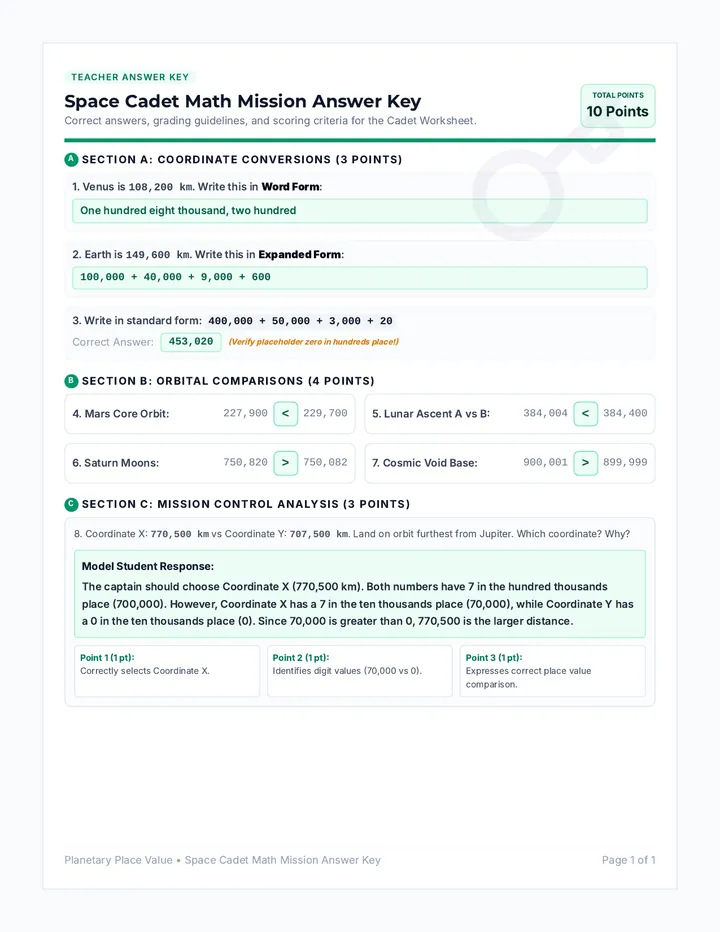
Planetary Place Value Answer Key Teacher Answer Key
Space Cadet Math Mission Answer Key
Correct answers, grading guidelines, and scoring criteria for the Cadet Worksheet.
Total Points 10 Points
A Section A: Coordinate Conversions (3 points)
1. Venus is 108,200 km . Write this in Word Form :
One hundred eight thousand, two hundred
2. Earth is 149,600 km . Write this in Expanded Form :
100,000 + 40,000 + 9,000 + 600
3. Write in standard form: 400,000 + 50,000 + 3,000 + 20
Correct Answer: 453,020 (Verify placeholder zero in hundreds place!)
B Section B: Orbital Comparisons (4 points)
4. Mars Core Orbit:
227,900 < 229,700
5. Lunar Ascent A vs B:
384,004 < 384,400
6. Saturn Moons:
750,820 > 750,082
7. Cosmic Void Base:
900,001 > 899,999
C Section C: Mission Control Analysis (3 points)
8. Coordinate X: 770,500 km vs Coordinate Y: 707,500 km . Land on orbit furthest from Jupiter. Which coordinate? Why?
Model Student Response:
The captain should choose Coordinate X (770,500 km). Both numbers have 7 in the hundred thousands place (700,000). However, Coordinate X has a 7 in the ten thousands place (70,000), while Coordinate Y has a 0 in the ten thousands place (0). Since 70,000 is greater than 0, 770,500 is the larger distance.
Point 1 (1 pt): Correctly selects Coordinate X.
Point 2 (1 pt): Identifies digit values (70,000 vs 0).
Point 3 (1 pt): Expresses correct place value comparison.
Planetary Place Value • Space Cadet Math Mission Answer Key Page 1 of 1