Students will explore the concepts of perimeter and area through the lens of a school architect, using real-world North Carolina classroom and playground scenarios. The lesson covers tiling, formulas, and solving for composite figures.
A functional math lesson using a transit map metaphor to teach students how to read schedules and calculate elapsed time, designed for grades 3-5.
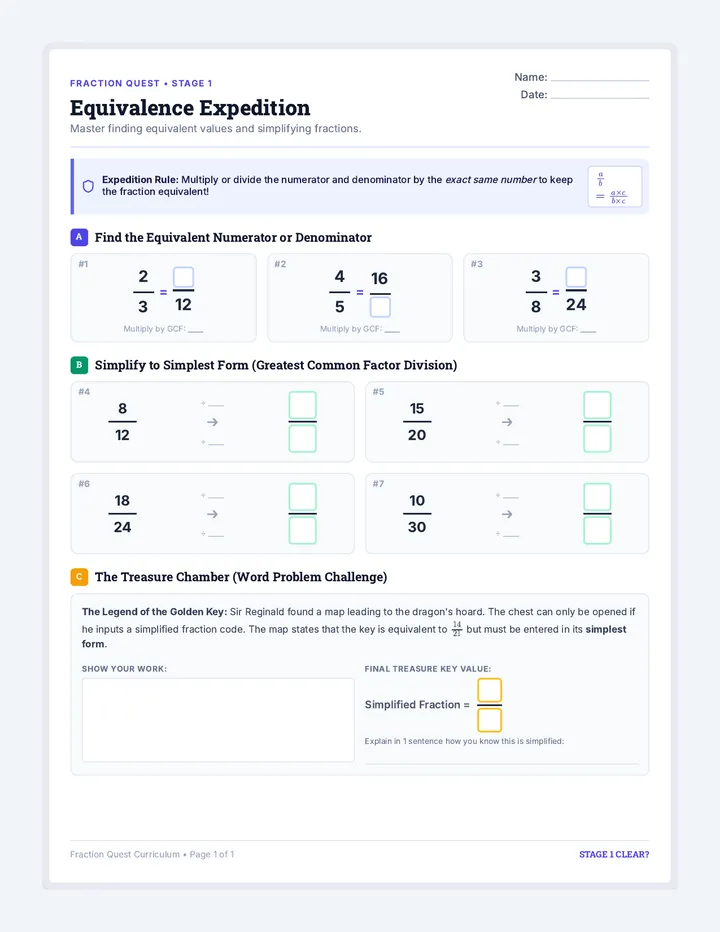
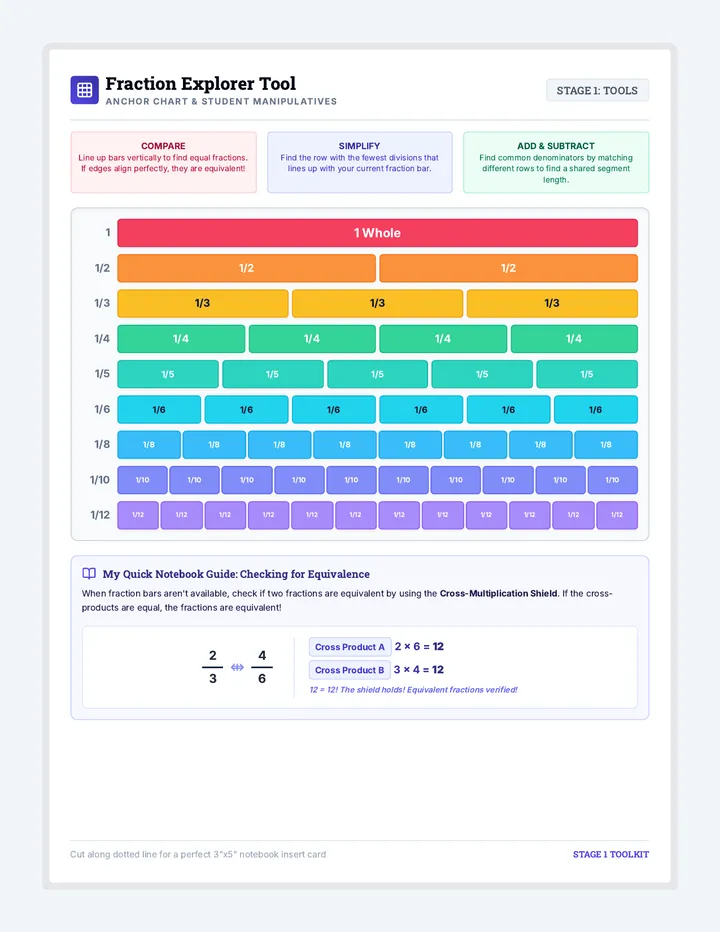
A comprehensive lesson on finding equivalent fractions using multiplication and division, supported by fraction strips and number line models. Students explore how to scale fractions up and down while maintaining the same value.
A geometry lesson focused on identifying and creating multiple lines of symmetry through the lens of traditional quilting patterns. Students explore how geometric shapes can have horizontal, vertical, and diagonal symmetry.
A coordinate plane lesson where students plot integer coordinates in four quadrants to reveal a butterfly. The activity combines math precision with creative coloring for a spring-themed classroom experience.
A 4th-grade math lesson on identifying and generating equivalent fractions using visual models like fraction strips and bars, and applying multiplication and division rules.
A focused practice session on basic multiplication and division facts up to 12x12. Students will solve five multiplication and five division equations to build fluency.
A lesson focused on mastering addition and subtraction of fractions with unlike denominators using the cross-multiplication (butterfly) method. Students use structured graphic organizers to visualize each step of the process.
Advanced applications of central tendency and spread, including algebraic problem-solving, weighted means, and the mathematical impact of outliers for high school students.
A comprehensive assessment covering Level 1, Level 2, and Level 3 data analysis, designed to evaluate mastery of mean, median, mode, and range in both numerical and narrative contexts.
In this hands-on geometry exploration, students venture outside to measure the angles of shadows cast by playground equipment and trees at different times of day. They apply their protractor skills to record data and analyze how the sun's position changes angle measurements.
Fourth graders explore line symmetry through Indiana's local flora and fauna, identifying mathematical patterns in nature and creating original geometric art.
Students interpret and solve word problems involving mean, median, mode, and range, focusing on extracting data from narrative contexts and real-world scenarios.
A foundational lesson designed for SIFE students to understand fractions greater than one using visual models and fraction strips. Focuses on bridging concrete models to number lines with minimal text reliance.
A foundational lesson on equivalent fractions using area models and number lines, styled as architectural blueprints to emphasize precision and measurement.
A collection of extra practice cases for mean, median, mode, and range, ranging from single-digit warmups to double-digit challenges, themed as unsolved detective files.
Students apply their knowledge of mean, median, mode, and range to data sets featuring two-digit numbers, focusing on multi-digit addition and division.
Analyzing and creating line plots to represent measurement data.
Using fraction equivalence to measure and record lengths accurately.
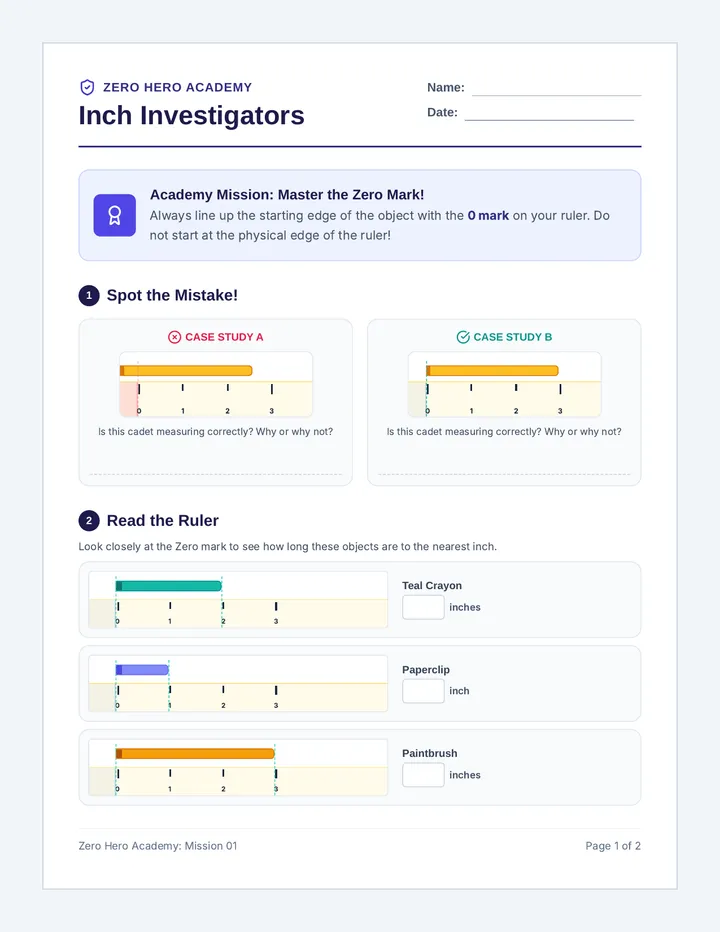
Expanding measurement skills to fourths of an inch and practicing with mixed numbers.