Boundary Break Slides Boundary Break
Intro to Limit Notation & Behavior
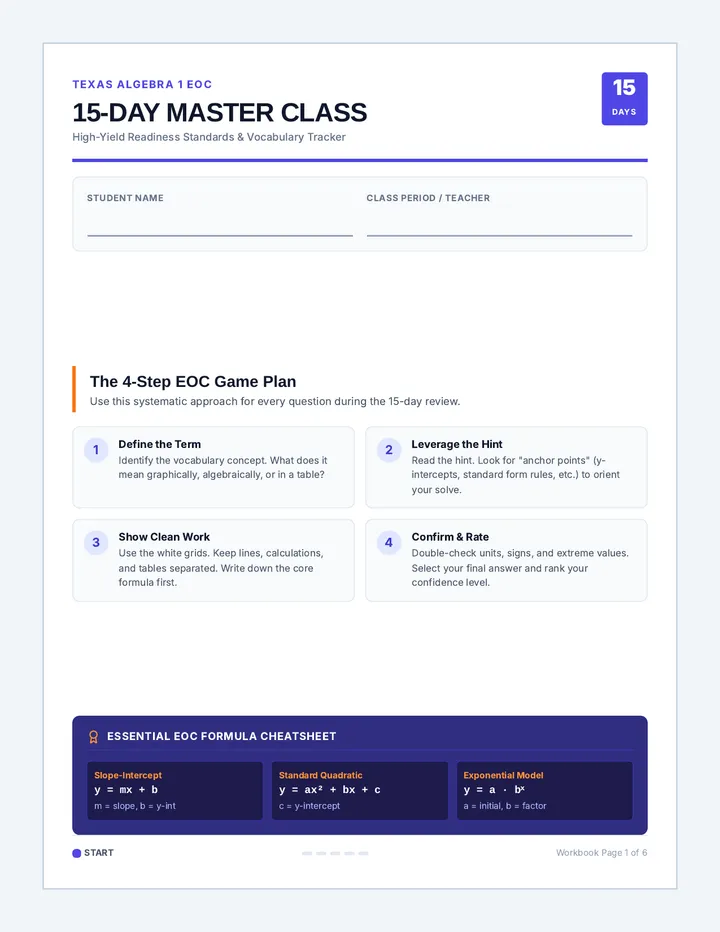
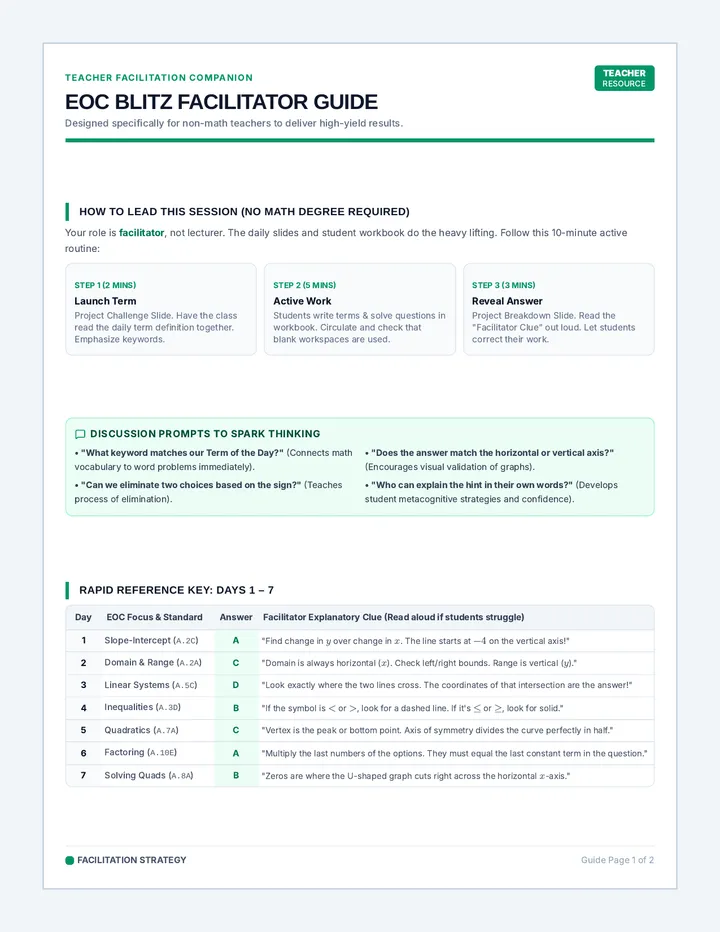
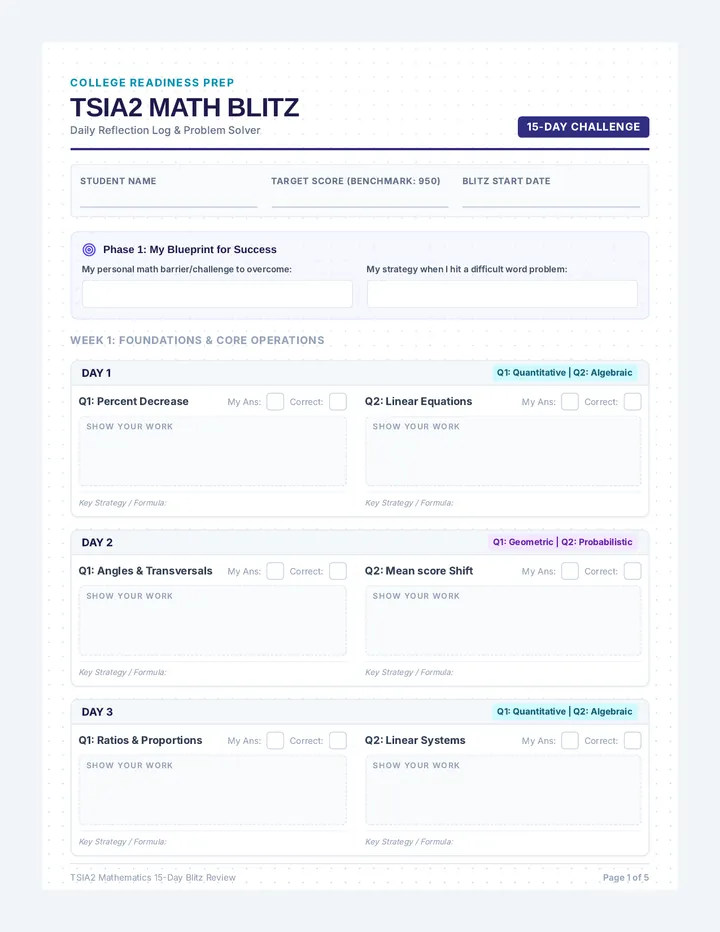
Calculus
Unit 10.1
"Calculus is the art of measuring the nearly impossible."
Video Analysis
Graph Sketching
Warm-up: The Hole Truth
Look closely at the behavior near \(x = 2\).
x y 2
Question 1:
What is the exact value of \(f(2)\)?
Question 2:
What value is the graph approaching as \(x\) gets closer to 2?
Watch & Learn: Notation
Breaking down the math language
4:56 — 7:00
Embedded media
Read
"The limit of \(f(x)\) as \(x\) approaches \(a\)..."
Write
\[\lim_{x \to a} f(x) = L\]
Mean
The y-value the function is heading toward.
Watch & Learn: The Gap
Why limits matter when values don't exist
10:25 — 10:55
Embedded media
Key Concept
A limit is like a prediction. It tells us where the graph is going, even if it never actually gets there.
Don't Mix Them Up
\(f(a)\) is the actual spot.
\(\lim\) is the trajectory.
Your Mission
1
Notation Swap
Use the **Notation Cards**. One side is English, the other is Calculus. Partner up and test each other!
2
The Blueprint
Grab the **Limit Lines Sketchpad**. Translate the limit statements into custom graphs. Watch out for the "Holes"!
Join a partner when you're ready!
Limit Lines Sketchpad Limit Lines Sketchpad
Visualizing Discontinuity & Behavior
Name:
Date:
Translate each calculus statement into a visual graph. Ensure your axes are clearly marked. After drawing, trade your paper with a partner for Peer Review using the boxes at the bottom of each grid.
Scenario A
"The Undefined Limit"
Requirements
\(\lim_{x \to 3} f(x) = 2\)
\(f(3)\) is undefined
f(x)
Review
Limit matches?
f(3) Correct?
Scenario B
"The Displaced Point"
Requirements
\(\lim_{x \to -2} g(x) = 4\)
\(g(-2) = -1\)
Review
Limit matches?
g(-2) Correct?
Scenario C
"The Constant Approach"
Requirements
\(\lim_{x \to 0} h(x) = -3\)
\(h(0) = -3\)
Review
Limit matches?
h(0) Correct?
Notation Swap Cards Notation Swap Cards
Cut along the dashed lines. Use these to practice translating English to Calculus!
English Side
"The limit of \(f(x)\) as \(x\) approaches 5 is 10."
Calculus Side
\[\lim_{x \to 5} f(x) = 10\]
English Side
"As \(t\) gets closer and closer to 0, the function \(g(t)\) approaches infinity."
Calculus Side
\[\lim_{t \to 0} g(t) = \infty\]
English Side
"The function \(h(x)\) has a limit of -2 as \(x\) goes to -2."
Calculus Side
\[\lim_{x \to -2} h(x) = -2\]
English Side
"The limit of \(\sin(\theta)\) as \(\theta\) approaches \(\pi\) is 0."
Calculus Side
\[\lim_{\theta \to \pi} \sin(\theta) = 0\]
Teacher Note:
For a double-sided card effect, print pages back-to-back. If printing single-sided, students can paste the matching pairs onto index cards. Encourage students to cover one side and try to "predict" the notation or English phrasing.
The Near Miss Teacher Guide The Near Miss: Teacher Guide
12th Grade Calculus | Unit 10, Lesson 1
Objectives
Correctly read and write limit notation.
Distinguish between \(f(a)\) (actual point) and \(L\) (intended height).
Analyze and sketch graphs featuring removable discontinuities (holes).
Pacing & Facilitation
05 min
Warm-up: The Hole Truth
Use the Boundary Break Slides . Push students to explain why \(f(2)\) isn't 4. Introduce the concept of "approaching" vs "arriving."
15 min
Video & Discussion
Screen the provided video. Stop at 7:00 to drill the "Limit of f(x) as x approaches a" phrasing. Use the 10:25 mark to reinforce the "Hole" visual.
15 min
Notation Swap Cards
Students work in pairs. One student reads the English side, the other writes the notation on a whiteboard or scratch paper. Reverse roles.
15 min
Limit Lines Sketchpad
Individual work. Students must visualize the statements. Note: Scenario B is the "Tricky One" (Displaced Point).
Sketchpad Answer Key
A
The Undefined Limit
Graph should show a line or curve heading toward the coordinates \((3, 2)\). There must be an open circle at \((3, 2)\) and NO other point at \(x=3\).
B
The Displaced Point
Graph heads toward an open circle at \((-2, 4)\). There must be a solid dot at the point \((-2, -1)\). This is a jump or point discontinuity.
C
The Constant Approach
This is a standard continuous graph. The line/curve passes through \((0, -3)\) as a solid line or dot . The limit and the value are identical.
Common Misconception
Students often think if \(f(a)\) is undefined, the limit doesn't exist. Remind them: The limit doesn't care about the destination, only the path.
Pro-Tip
During the Notation activity, challenge students to use variables other than \(x\) and \(f\). Try \(\lim_{k \to \omega} \Psi(k)\) to build notation flexibility.