A complete, highly visual lesson introducing relations, functions, domain, range, and the vertical line test. Built around a creative transit-map theme where inputs are routed to outputs through functional junctions.
Bring the class back together to discuss the challenge question. Have students complete a quick ticket out the door: "Give an example of a relation that is NOT a function using coordinate points."
Misconceptions Station
The "Repeating Outputs" Myth
Students often think a relation is not a function if outputs repeat (e.g., \( (1, 2) \) and \( (3, 2) \)).
➔ Fix: Reiterate that different passengers can stop at the same station. This is perfectly normal! Only repeating x's fails.
VLT Horizontal Confusion
Students mistakenly draw horizontal lines or perform horizontal scans instead of vertical scans.
➔ Fix: Have them slide an actual pen vertically across their page to show how the line represents \(x = a\).
Conductor's Callouts (Guiding Questions)
"If I tell you the passenger name (input), is there any doubt which train (output) they are on?"
"Why doesn't the vertical line test work for a circle? What input has multiple outputs?"
"If a relation fails to be a function, does that mean it's useless? Or is it still a relation?"
"How can we tell from a mapping diagram instantly if a relation is a function?"
Differentiation Routes
The Local Route (Support)
Provide physically cut-out mapping cards. Use yarn or string to connect input numbers to output numbers so they can touch and trace the paths manually.
The Express Route (Extension)
Challenge students to write equations that represent relations that are not functions (such as \(y^2 = x\) or \(x^2 + y^2 = 9\)) and explain why using graphs.
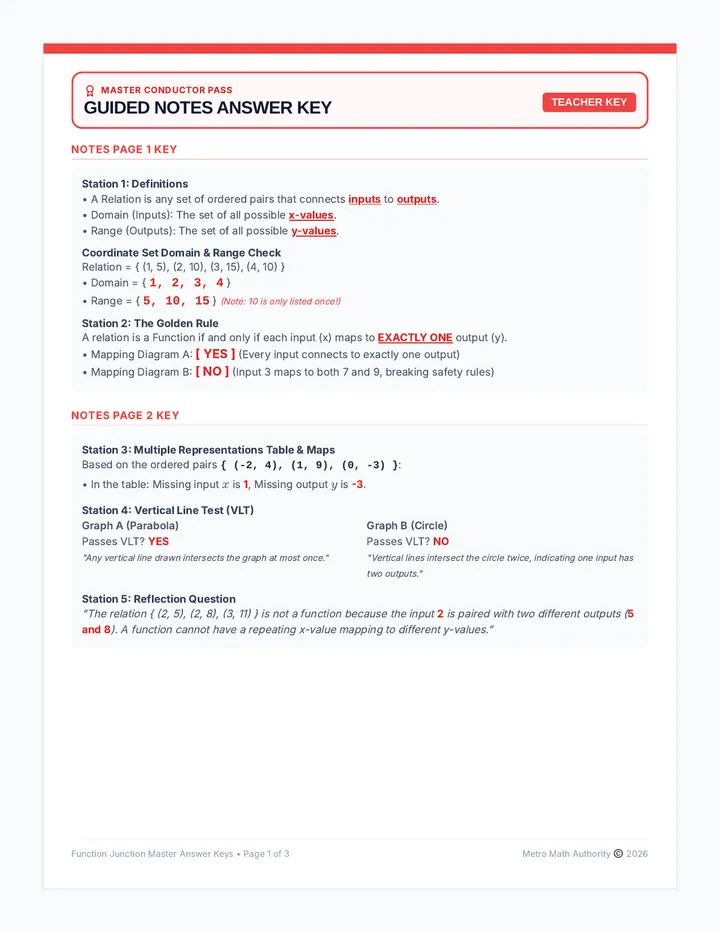
Explain in your own words why a coordinate relation like { (2, 5), (2, 8), (3, 11) } is NOT a function.
Unit 2 • Function Junction Notes Page 2 of 2
PART D
Express Track Challenge
Construct Your Own Train Track
Draw a mapping diagram for a relation that contains at least four different points, but is NOT a function. Ensure you clearly label your Inputs (x) and Outputs (y).
Your Mapping Diagram
INPUTS (x)
➔
OUTPUTS (y)
Your Proof
List the coordinates of your custom relation: Relation = { ______________________ }
Explain exactly why this relation is NOT a function:
Unit 2 • Practice Worksheet: Relations and Functions Page 2 of 2
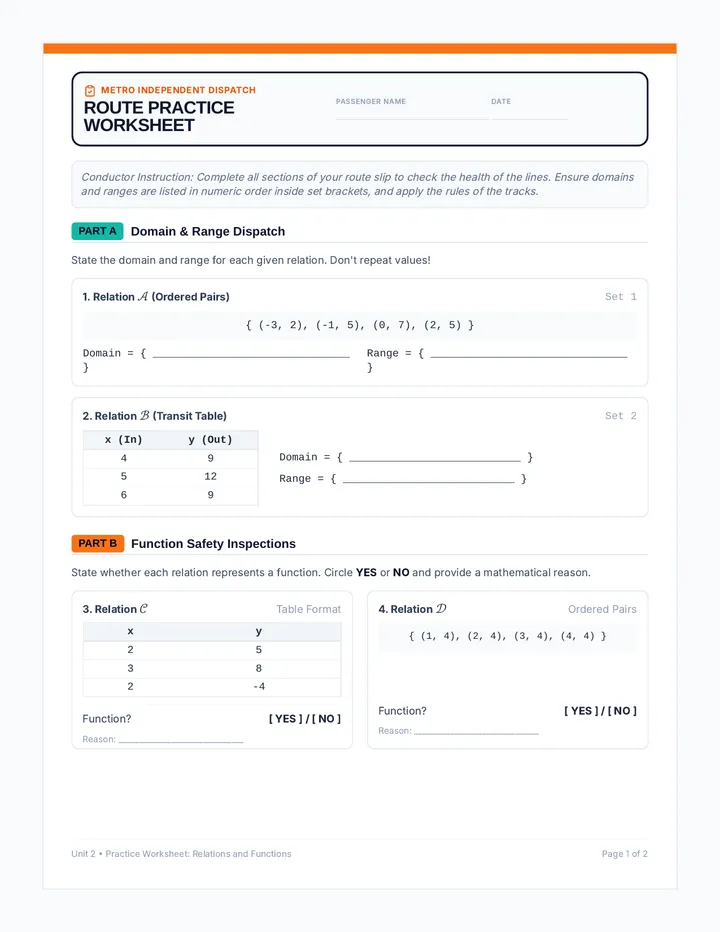
Part B: Function Safety Inspections
3. Relation \(\mathcal{C}\) (Table)
Function? [ NO ]
Reason: Input 2 has two different outputs (5 and -4).
4. Relation \(\mathcal{D}\) (Set of Points)
Function? [ YES ]
Reason: Each input (1, 2, 3, 4) matches exactly one output (4).
Worksheet Page 2 Key
Part C: Graphical Rail Tests (VLT)
5. Continuous Curve (Parabola)
Function? [ YES ]
Reason: Passes the VLT; vertical lines cross the graph only once.
6. Closed Oval Shape (Ellipse)
Function? [ NO ]
Reason: Fails the VLT; vertical lines intersect the loop in two places.
Part D: Express Track Challenge
Sample Solution Criteria:
• Diagram: Student should map one input bubble number with two arrows pointing to different output bubble numbers.
• Coordinates: E.g., { (5, 10), (5, 11), (6, 12), (7, 13) }.
• Explanation: Must state that input 5 repeating with different outputs violates the rule of a function.
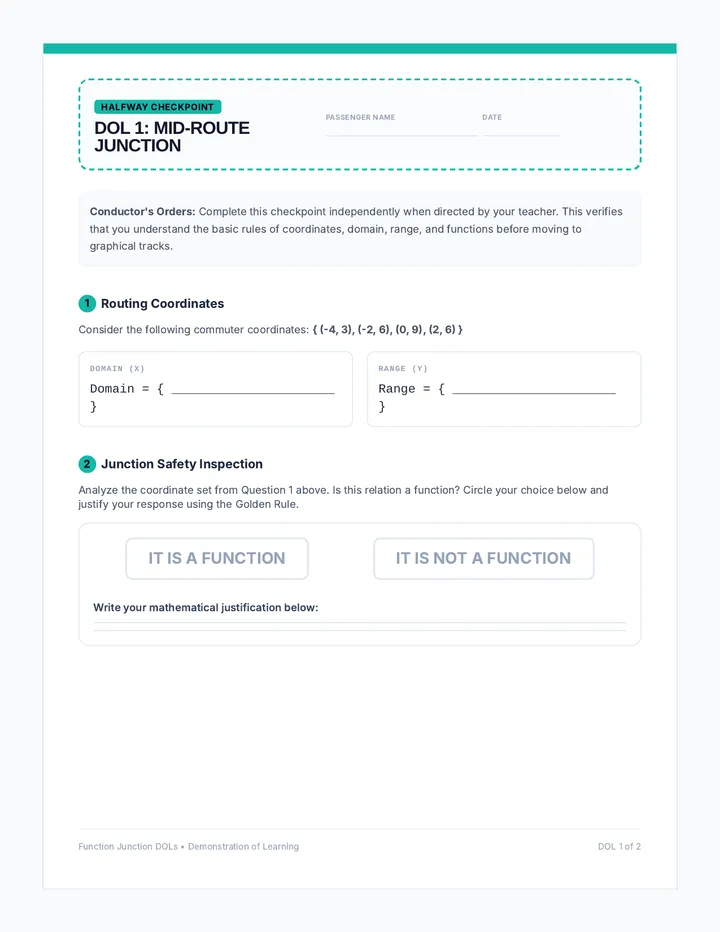
Justification: "Every input (\(x\)-value) is paired with exactly one output (\(y\)-value). No \(x\)-values repeat. Although the inputs -2 and 2 both map to the output 6, this is allowed as long as each unique input only maps to one partner."
DOL 2: Final Stop Clearance Key
1. Graphical Track Check (Sideways Curve)
Function Choice: [ NO ]
VLT Justification: "Fails the Vertical Line Test. If you draw a vertical line on the right side of the y-axis, it will cross the curve twice. This shows that a single input \(x\) has two different output \(y\) coordinates."
2. Real-World Transit Routing Scenario
Function Choice: YES, it is a function.
Justification: "Each individual destination has exactly one ticket price. If a single destination could cost two different random prices, it would not be a predictable, working system (which is what a function is)."