Students explore how insurance companies use compound probability to predict claims and calculate premiums based on risk pooling.
A first-grade lesson focused on partitioning shapes and identifying equal parts as halves and fourths (quarters). Students will practice shading partitioned shapes and completing descriptive sentences using fraction vocabulary.
A collection of four double-sided homework assignments focusing on foundational 7th-grade math skills. Each "Sprint" contains seven standardized questions covering all major test categories to build stamina and accuracy.
Une évaluation complète sur les équations et inéquations du premier degré pour les élèves de seconde professionnelle, incluant les exercices de base et des problèmes contextualisés.
Leçon focalisée sur les bases des statistiques à une variable : du recueil de données brutes à leur analyse graphique, avec un focus sur l'utilisation de LibreOffice Calc.
Une leçon complète sur les statistiques à une variable, couvrant la collecte de données, l'organisation en tableaux et la représentation graphique à travers divers exercices pratiques et activités d'introduction.
A comprehensive lesson covering geometric transformations (translations, reflections, rotations, and dilations) and the fundamentals of geometric proofs, including logical reasoning and triangle congruence.
Students will learn to decompose numbers into prime factors, identify the greatest common factor between numbers, and apply these skills to factor simple algebraic expressions.
A comprehensive 90-minute math lesson focused on organizing data into intervals and creating/interpreting histograms using test score data. Students act as 'Data Detectives' to uncover trends in numerical information.
A comprehensive review of exponential and logarithmic functions, focusing on graphing attributes, transformations, inverse relationships, solving equations, and data modeling based on Texas Algebra 2 standards.
A quick assessment focusing on solving quadratic equations that result in complex solutions using the Quadratic Formula and Completing the Square.
A 6th-grade math review lesson designed specifically for students with IEPs, focusing on foundational concepts in ratios, the number system, expressions, geometry, and statistics with visual scaffolds and simplified language.
A lesson focusing on the practical application of the Distance Formula and the logical structure of SAS and ASA congruence proofs.
A comprehensive 35-minute lesson on graphing quadratic functions in standard form, covering vertex, axis of symmetry, end behavior, and zeros.
A lesson focused on the product and quotient properties of logarithms, specifically adding and subtracting logs. Designed with heavy scaffolding for a math resource setting.
This lesson introduces exponential growth and decay functions, focusing on modeling real-life situations, identifying growth and decay factors, and analyzing key attributes of exponential models. Students will transition from Algebra 1 foundations to advanced Algebra 2 applications using the standard model \(y = ab^x\).
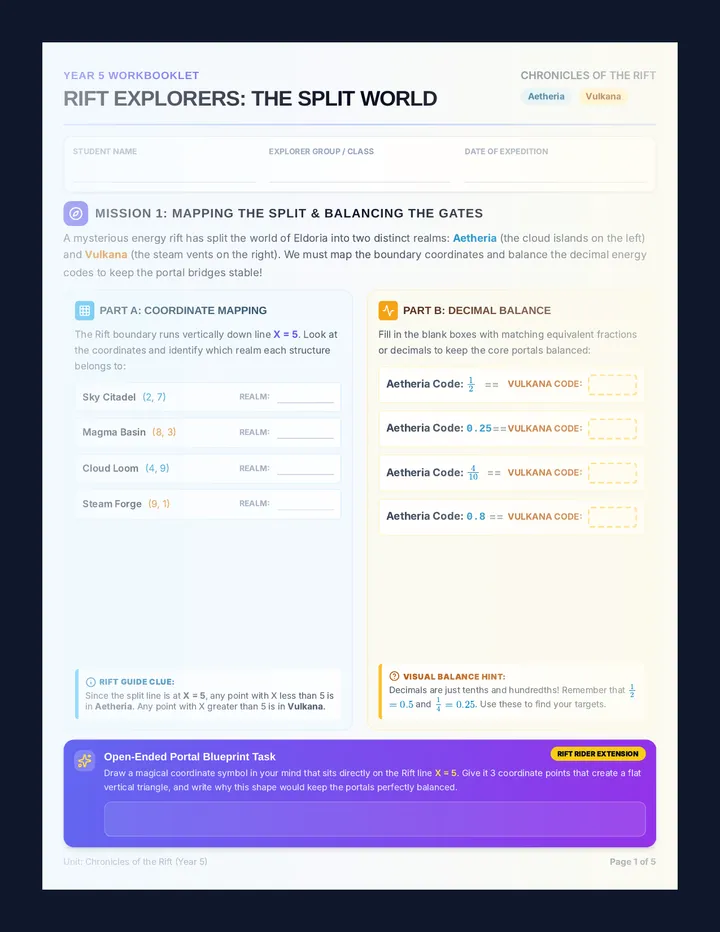
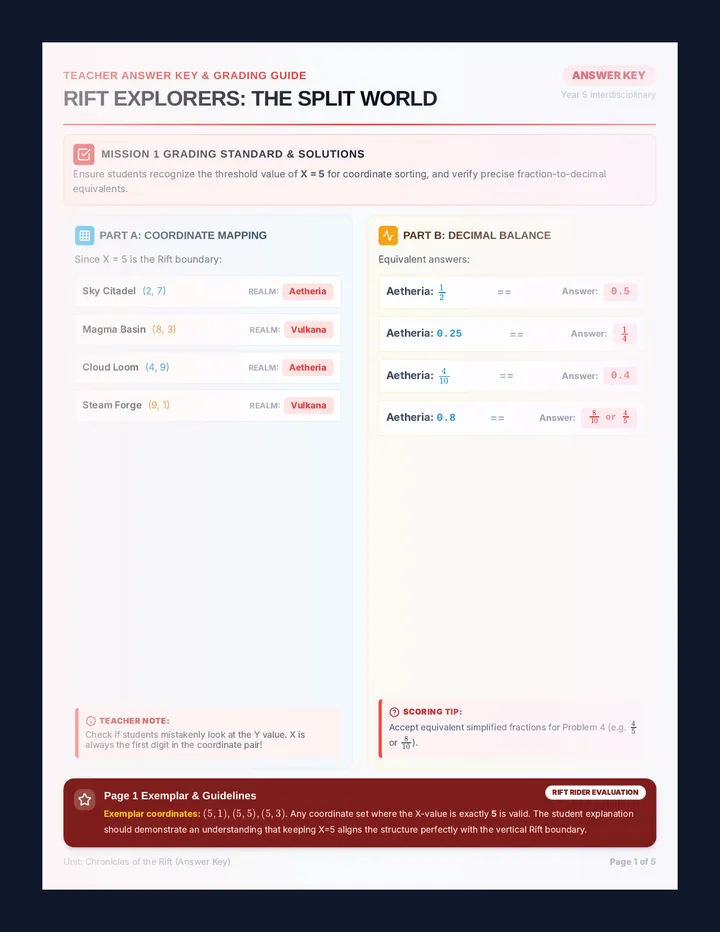
A scaffolded introduction to the four-quadrant coordinate plane, using a navigation theme to help students master plotting points with visual aids and step-by-step guides.
Students will explore the concepts of big, medium, and small by comparing various objects in the museum exhibits, promoting vocabulary development and visual discrimination.
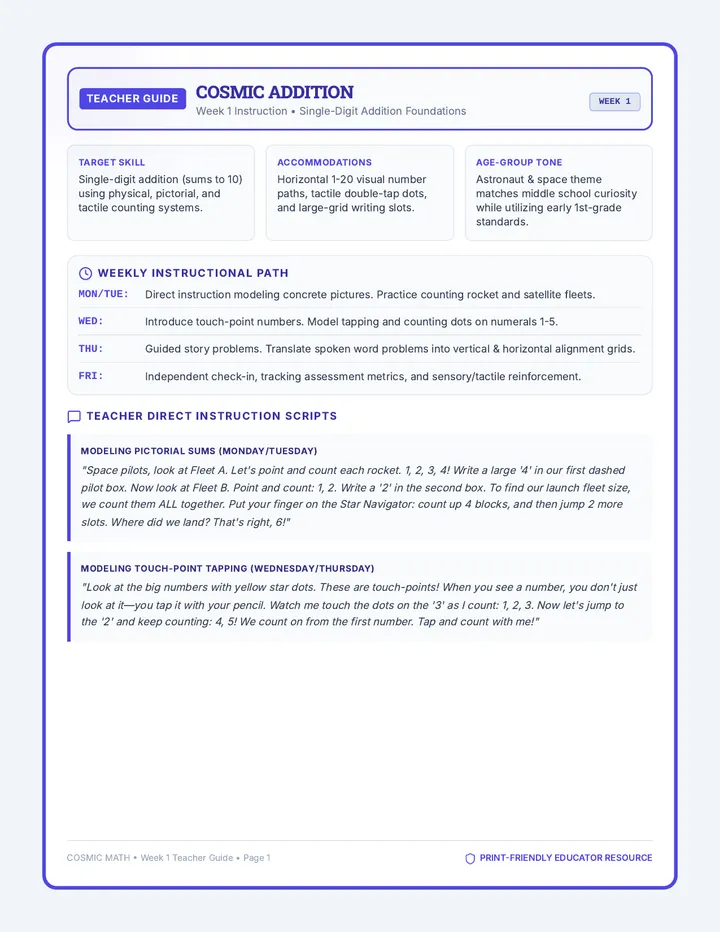
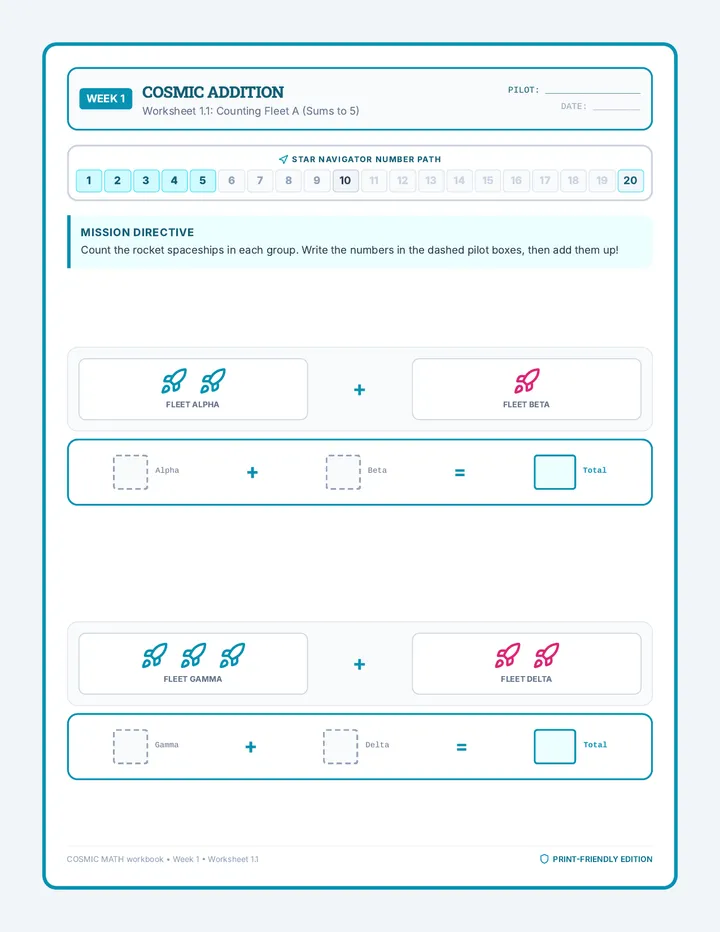
An introduction to simple addition by combining groups of museum objects, focusing on the concept of 'putting together' using visual aids and tactile play scenarios.
Students will practice identifying and counting numbers 1-10 using common items found in a play museum setting, such as grocery items, toy cars, and house windows.
Summative assessment covering intercepts, vertex, AOS, and solving quadratic equations using various methods.
Comprehensive review of unit targets including graphing features and all solving methods.
Synthesizing solving methods (graphing, factoring, formula) and choosing the most efficient strategy for different quadratic forms.
Using the quadratic formula to solve equations and the discriminant to determine the nature of the roots.
Solving quadratic equations by factoring and identifying x-intercepts using the Zero Product Property.
Finding the vertex, axis of symmetry, and intercepts of quadratic functions from standard form equations and graphs.
A high-speed reconnaissance of basic function families, including linear, quadratic, cubic, quartic, absolute value, and radical parent functions.
Students count sets of pennies and nickels and analyze data from bar graphs to solve comparison problems. Subtraction skills are reinforced through data-based word problems.
Students identify pennies, nickels, and dimes, sort objects into categories, and record data using tally charts. The lesson also introduces subtraction by counting back on a number line.
A comprehensive review of percentages for HSED learners, covering conversions, visual models, and real-world applications like tipping and discounts.
A fourth-grade math lesson focused on translating real-world adventure scenarios into numerical expressions using addition, subtraction, multiplication, and division. Students practice identifying key operations and solving multi-digit problems.
A comprehensive review of 3rd Grade North Carolina Standard Course of Study (NCSCOS) fraction standards, featuring EOG-style questions covering partitioning, number lines, and equivalence.
A quick assessment focusing on simplifying fractions with numerators and denominators up to 100 into their simplest form.
A preschool-focused lesson based on 'Benny's Pennies' by Pat Brisson, targeting one-to-one correspondence and rhyming through hands-on play.
Cette leçon porte sur la compréhension et la manipulation des nombres de 0 à 20 en utilisant les principes de la Conception Universelle de l'Apprentissage (CUA). Elle propose des parcours différenciés pour permettre à chaque élève de progresser à son rythme.
A numeracy lesson helping students distinguish the number 12 from 20 and 21 using place value visualization (one ten, two ones) and 'Architect' inspection strategies.
A visual math lesson focused on finding missing addends up to 20 using double ten frames and decomposition strategies. Students act as 'Number Architects' to fill gaps in blueprints.
A foundational lesson on the 4-quadrant coordinate plane, specifically designed for students with IEPs. Includes visual-heavy instruction on identifying and plotting ordered pairs using color-coded axes and step-by-step strategies.
A high-energy collaborative review day. Students participate in a 'Relay Race' of unit rate tasks, moving through stations that cover whole numbers, fractions, consumer math, and measurement to reinforce skills before the final assessment.
A summative assessment covering the identification of graph features and solving quadratic equations using multiple methods.
A comprehensive review of all three methods (graphing, factoring, formula) and identifying key features to prepare for the unit assessment.
Students use the quadratic formula to solve equations that are not easily factorable, with an emphasis on identifying coefficients and simplifying the result.
Students learn to solve quadratic equations by factoring trinomials and using the Zero Product Property, focusing on real roots and equations in standard form.
Students explore the quadratic parent function, identify key features of parabolas (vertex, axis of symmetry, zeros), and learn to graph by plotting points.
A comprehensive lesson on core parent functions for Algebra 2, focusing on identification, key features, and visual recognition using a blueprint theme.