Students are introduced to the x-axis and y-axis using the analogy of a city map. They practice the 'crawl before you climb' method to understand the order of coordinate pairs. Activities focus on locating existing objects at specific grid points.
A comprehensive lesson on dividing decimals by decimals using a 'Decimal Diner' theme. Includes guided instruction, collaborative task cards, and independent practice with alignment grids.
A high-energy, amusement park-themed packet for calculating the area of a circle. Students explore the Midway and Thrill Rides while solving radius and diameter problems using visual aids and calculators.
A high-energy 5th-grade review session covering decimal operations (addition, subtraction, multiplication), comparing, ordering, and rounding up to the thousandths place. Designed with a racing theme to engage students in a fast-paced mathematical challenge.
A mini-mystery centered around a kitchen scene where students use observation and logic to solve a visual puzzle.
A comprehensive wrap-up lesson for 4th-grade math, focusing on applying multiplication, division, area, and perimeter skills to real-world word problems through a galactic exploration theme.
A comprehensive 4th-grade math review using a Jeopardy-style game format covering all Common Core domains: Operations, Base Ten, Fractions, Measurement, and Geometry.
A collection of high-energy 4th-grade math games focused on decimal place value, comparison, and equivalent fractions. These games utilize 10-sided dice and spinners to make reviewing tenths and hundredths engaging and hands-on.
A focused lesson on solving one-step addition and subtraction equations using a variety of number types including whole numbers, decimals, and fractions.
A comprehensive assessment lesson focusing on mastering one-step equations involving multiplication, division, and basic addition/subtraction.
A comprehensive lesson on solving one-step equations using addition, subtraction, multiplication, and division, featuring visual models and real-world applications.
A comprehensive lesson on measures of center (mean, median, mode) where students learn to summarize numerical data and find missing values using time, temperature, and group size data.
A hands-on math project where students design carnival games to explore theoretical versus experimental probability through data collection and analysis.
A comprehensive lesson on calculating the area of composite figures by decomposing them into simpler shapes like rectangles, triangles, and semi-circles using integer-based measurements.
A focused lesson on calculating area and perimeter of complex rectilinear shapes by determining missing side lengths and applying geometric formulas.
A functional math lesson using a transit map metaphor to teach students how to read schedules and calculate elapsed time, designed for grades 3-5.
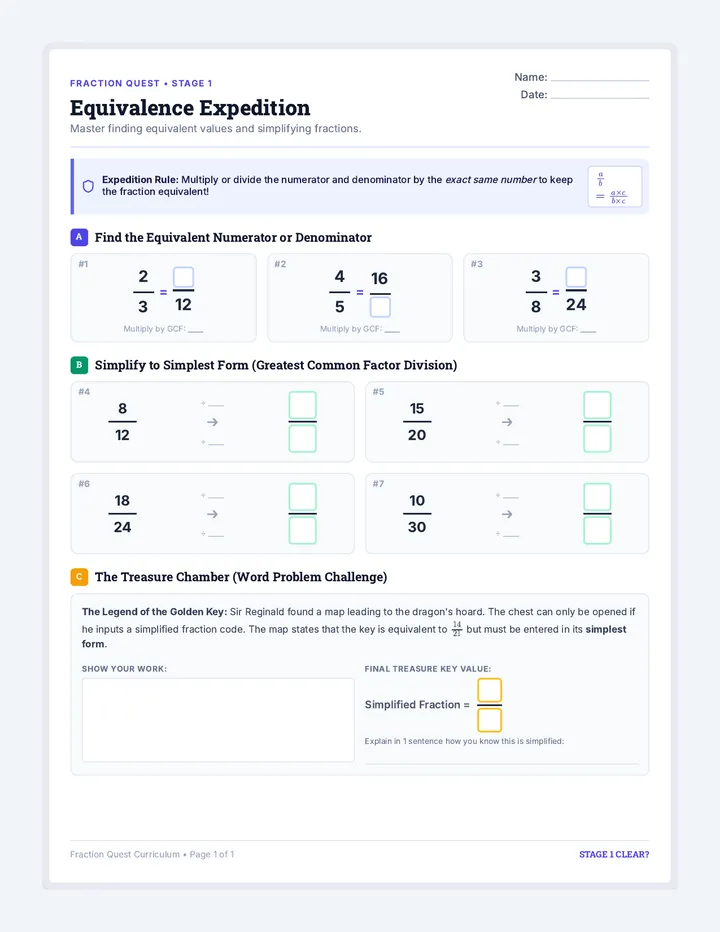
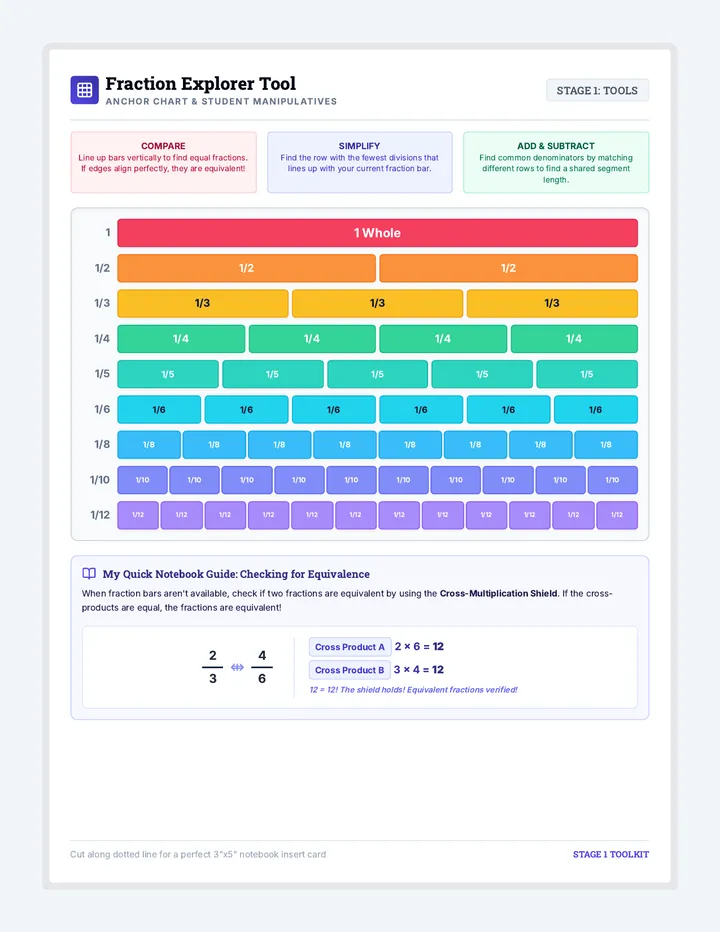
A comprehensive lesson on finding equivalent fractions using multiplication and division, supported by fraction strips and number line models. Students explore how to scale fractions up and down while maintaining the same value.
A geometry lesson focused on identifying and creating multiple lines of symmetry through the lens of traditional quilting patterns. Students explore how geometric shapes can have horizontal, vertical, and diagonal symmetry.
A coordinate plane lesson where students plot integer coordinates in four quadrants to reveal a butterfly. The activity combines math precision with creative coloring for a spring-themed classroom experience.
A 4th-grade math lesson on identifying and generating equivalent fractions using visual models like fraction strips and bars, and applying multiplication and division rules.
A focused practice session on basic multiplication and division facts up to 12x12. Students will solve five multiplication and five division equations to build fluency.
A comprehensive lesson on calculating and interpreting mean, median, mode, and range using real-world shopping and pricing data. Students will analyze price lists for various items to master basic statistics.
A hands-on probability project where students design, build, and test carnival games. They will calculate theoretical probability, collect experimental data, and analyze the results to understand statistical likelihood.
A lesson focused on mastering addition and subtraction of fractions with unlike denominators using the cross-multiplication (butterfly) method. Students use structured graphic organizers to visualize each step of the process.