Fraction Masters Slides
FRACTION MASTERS
Grade 5 Math Masterclass
Become a Fraction Master:
Step-by-Step Operations
Learn simple rules, easy shortcuts, and helpful models to convert, add, subtract, multiply, and divide fractions.
Slide 1 of 12 Visual Presentation Deck
Let's get started!
VOCABULARY BOOST
The Basics
Parts of a Fraction
Before we calculate, we must name the parts of a fraction so we can talk about them clearly.
3
4
Numerator:
How many parts we are counting (the top number)
Denominator:
Total parts in one whole container (the bottom number)
Types of Fractions
Improper Fraction 7/4
The top number is larger than or equal to the bottom number. (More than 1 whole!)
Mixed Number 1 ¾
A whole number combined with a proper fraction. (Completely full wholes + extra pieces!)
Slide 2 of 12 Turn & Talk: Why are 7/4 and 1 3/4 showing the exact same amount?
CONVERTING PARTS
Mixed to Improper
How to Convert: Mixed to Improper
Use the "M.A.D. Method" to write a mixed number as an improper fraction.
M
Multiply
Multiply the whole number by the bottom number (denominator).
A
Add
Add the top number (numerator) to your multiplication result.
D
Denominator stays the same
Keep the original bottom number exactly the same.
Let's Try: 3 ⅔
Start Mixed 3 ⅔
M → A → D 11/3
The Arithmetic: (3 × 3) + 2 = 11
New top is 11. Bottom stays 3.
Slide 3 of 12 Quick Check: Multiply bottom, add top, keep the bottom!
CONVERTING PARTS
Improper to Mixed
How to Convert: Improper to Mixed
Use simple division to find out how many wholes are hidden in the fraction.
1
Divide
Divide the top number by the bottom number.
2
Remainder = New Top Number
The leftover remainder becomes the top number of your fraction.
3
Keep Bottom Number Same
Keep the original bottom number completely unchanged.
Let's Try: 14/3
14 ÷ 3 = 4 R 2
Whole Number 4
Remainder (Top) 2
Original Bottom 3
14/3 4 ⅔
Slide 4 of 12 Think: Division tells us how many complete "wholes" we can make!
ADDING & SUBTRACTING
Same Denominators
Same Bottom Numbers
Rule #1: Only combine fractions of the same size!
If the bottom numbers (denominators) are already matching, adding and subtracting is as simple as can be:
Add or subtract ONLY the top numbers.
NEVER add or subtract the bottom numbers!
Keep the bottom number identical, then simplify if needed.
Tape Diagram: 1/5 + 2/5
1/5
1/5
2/5
1/5
1/5
=
Total Shaded: 3/5
1/5
1/5
1/5
Slide 5 of 12 Understand: Why didn't we change the 5 on the bottom to 10?
ADDING & SUBTRACTING
Different Denominators
Different Bottom Numbers
What if the pieces are different sizes? We must change them to matching sizes using the Least Common Multiple (LCM).
1
Find the Least Common Multiple (LCM) of the bottom numbers to find your matching size.
2
Multiply top & bottom of each fraction by the same number to write equivalent fractions.
3
Add or subtract top numbers. Keep bottom numbers exactly the same!
Let's Solve: ½ + ⅓
Step 1: LCM of 2 and 3 6
½ becomes
½ × (3/3) = 3/6
⅓ becomes
⅓ × (2/2) = 2/6
3/6 + 2/6 = 5/6
Slide 6 of 12 Golden Rule: Whatever you multiply the bottom by, you MUST multiply the top by!
ADDING & SUBTRACTING
With Mixed Numbers
Operations with Mixed Numbers
Two smart strategies to solve mixed number addition or subtraction:
Strategy A: Separating (Best for Addition)
Add or subtract whole numbers first, then combine the fractions. (Watch out for regrouping!)
Strategy B: Convert First (Best for Borrowing!)
Convert both mixed numbers to improper fractions first. Find common denominators, calculate, and convert back at the end.
Example Borrowing: 3 ¼ - 1 ¾
Using Strategy B makes this foolproof!
Convert 3 ¼: 13/4
Convert 1 ¾: 7/4
13/4 - 7/4 = 6/4
Convert back → 1 2/4 = 1 ½
Slide 7 of 12 Ask: Why is Strategy B easier for subtraction than borrowing wholes?
MULTIPLYING FRACTIONS
Step-by-Step
Multiplying Fractions
No common denominators needed!
Multiplying fractions is incredibly simple: we just multiply straight across!
Rule 1: Multiply Top × Top
This becomes the new top number (numerator).
Rule 2: Multiply Bottom × Bottom
This becomes the new bottom number (denominator).
Note: Always convert mixed numbers to improper fractions first!
Area Model: ½ × ⅔
Finding ½ of ⅔ using a grid
Overlap
Overlap
Shaded
Shaded
½ row
⅔ columns
½ × ⅔ = 2/6 = 1/3
Slide 8 of 12 Why does multiplying two proper fractions make a smaller number?
DIVIDING FRACTIONS
Step-by-Step
Dividing Fractions
To divide fractions, we use the simple law of Keep, Change, Flip (K.C.F.).
K
Keep
Keep the first fraction exactly the same.
C
Change
Change the division sign (÷) to a multiplication sign (×).
F
Flip
Flip the second fraction upside down. (This is the reciprocal!).
Example: ¾ ÷ ½
KEEP ¾
CHANGE ×
FLIP 2/1
¾ × 2/1 = 6/4
Simplify → 3/2 or 1 ½
Slide 9 of 12 Note: Flipping a fraction is called finding its reciprocal!
CLASS DISCUSSION
Under the Hood
Why do we flip the second fraction?
If you have 3 candy bars and you divide each bar into halves, how many total pieces do you have?
Math Expression
3 ÷ ½
Multiplying Shortcut
3 × 2 = 6
Dividing by ½ is the exact same as multiplying by 2!
Slide 10 of 12 Turn & Talk: Try explaining this to a partner using pieces of cookies!
REAL-WORLD APPLICATION
Let's Apply It
Problem 1: Multiplying Recipe Math
Baking Cookies
A baker is making a batch of cookies that requires 2 ½ cups of sugar. They only want to make ⅓ of the batch.
How many cups of sugar should they use?
Convert first, then multiply:
5/2 × 1/3 = 5/6 cups
Problem 2: Dividing Sharing Equally
Sharing Apple Juice
A physical education teacher has a jug holding 4 ½ cups of apple juice. If each small cup holds ¾ of a cup, how many full cups can they fill?
How many cups can they fill total?
Convert, Keep, Change, Flip:
9/2 ÷ 3/4 = 9/2 × 4/3 = 36/6 = 6 cups
Slide 11 of 12 Notice how turning mixed numbers to improper fractions makes word problems simple!
SUMMARY CHALLENGE
Mastery Check
You are a Fraction Master!
Now that you know the rules of fraction operations, let's complete our guided notes packet. Try solving these final equations with your group:
1. Convert Mixed Number: 4 ⅖ → 22/5
2. Find Matching Size & Add: ¾ + ⅙ → 11/12
3. Keep-Change-Flip: ⅔ ÷ ¼ → 8/3 or 2 ⅔
Open your Guided Notes packet and show your work!
Slide 12 of 12 Classroom notes are ready to complete. Excellent work!
Fraction Masters Student Notes
STUDENT GUIDED NOTES
FRACTION MASTERS
NAME:
DATE:
Topic 1: Converting Fractions STUDENT EDITION
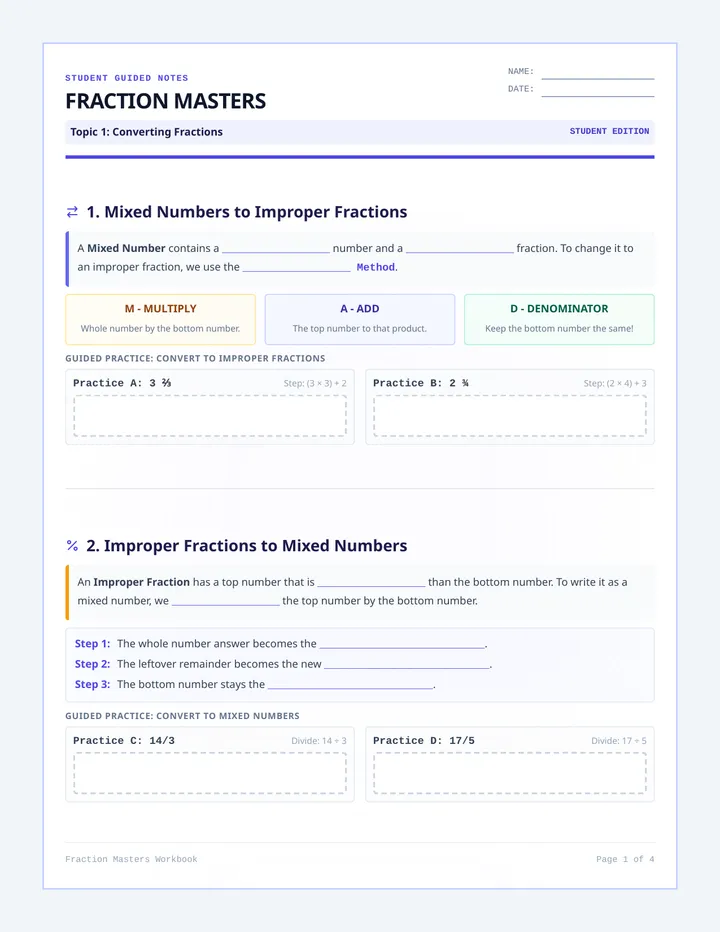
1. Mixed Numbers to Improper Fractions
A Mixed Number contains a _________________ number and a _________________ fraction. To change it to an improper fraction, we use the _________________ Method.
M - MULTIPLY Whole number by the bottom number.
A - ADD The top number to that product.
D - DENOMINATOR Keep the bottom number the same!
Guided Practice: Convert to Improper Fractions
Practice A: 3 ⅔ Step: (3 × 3) + 2
Practice B: 2 ¾ Step: (2 × 4) + 3
2. Improper Fractions to Mixed Numbers
An Improper Fraction has a top number that is _________________ than the bottom number. To write it as a mixed number, we _________________ the top number by the bottom number.
Step 1: The whole number answer becomes the __________________________.
Step 2: The leftover remainder becomes the new __________________________.
Step 3: The bottom number stays the __________________________.
Guided Practice: Convert to Mixed Numbers
Practice C: 14/3 Divide: 14 ÷ 3
Practice D: 17/5 Divide: 17 ÷ 5
Fraction Masters Workbook Page 1 of 4
STUDENT GUIDED NOTES
FRACTION MASTERS
NAME:
DATE:
Topic 2: Adding & Subtracting fractions STUDENT EDITION
3. Adding & Subtracting with Same Denominators
When fractions have the SAME bottom number, we simply _________________ or _________________ the top numbers. We NEVER add or subtract the _________________.
Tape Model Practice: Shade & Add: 1/5 + 2/5
1/5
1/5
1/5
1/5
1/5
Directions: Shade 1 box with a pencil. Shade 2 more boxes with a colored pencil. How many boxes are shaded? _____/5
4. Adding & Subtracting with Different Denominators
If bottom numbers do not match, we must find a __________________________________________ (LCM). Then we multiply the top and bottom by the same number to write equivalent fractions.
Guided Practice: Solve ½ + ⅓
Step 1: Multiples of Denominators
2: 2, 4, ___, 8
3: 3, ___, 9, 12
LCM = ___
Step 2: Equivalent Fractions
½ × (3/3) = ___ / 6
⅓ × (2/2) = ___ / 6
Fraction Masters Teacher Notes
STUDENT GUIDED NOTES
FRACTION MASTERS
NAME: TEACHER KEY / ACCOMMODATIONS
DATE: CLASSROOM READY
Topic 1: Converting Fractions TEACHER EDITION
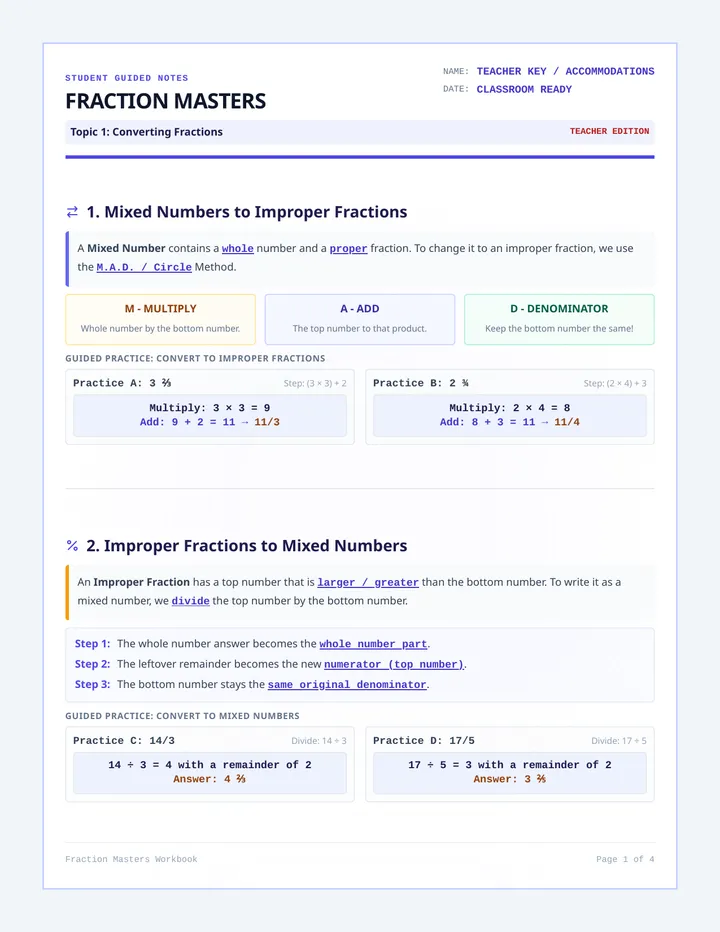
1. Mixed Numbers to Improper Fractions
A Mixed Number contains a whole number and a proper fraction. To change it to an improper fraction, we use the M.A.D. / Circle Method.
M - MULTIPLY Whole number by the bottom number.
A - ADD The top number to that product.
D - DENOMINATOR Keep the bottom number the same!
Guided Practice: Convert to Improper Fractions
Practice A: 3 ⅔ Step: (3 × 3) + 2
Multiply: 3 × 3 = 9
Add: 9 + 2 = 11 → 11/3
Practice B: 2 ¾ Step: (2 × 4) + 3
Multiply: 2 × 4 = 8
Add: 8 + 3 = 11 → 11/4
2. Improper Fractions to Mixed Numbers
An Improper Fraction has a top number that is larger / greater than the bottom number. To write it as a mixed number, we divide the top number by the bottom number.
Step 1: The whole number answer becomes the whole number part.
Step 2: The leftover remainder becomes the new numerator (top number).
Step 3: The bottom number stays the same original denominator.
Guided Practice: Convert to Mixed Numbers
Practice C: 14/3 Divide: 14 ÷ 3
14 ÷ 3 = 4 with a remainder of 2
Answer: 4 ⅔
Practice D: 17/5 Divide: 17 ÷ 5
17 ÷ 5 = 3 with a remainder of 2
Answer: 3 ⅖
Fraction Masters Workbook Page 1 of 4
STUDENT GUIDED NOTES
FRACTION MASTERS
NAME: TEACHER KEY / ACCOMMODATIONS
DATE: CLASSROOM READY
Topic 2: Adding & Subtracting fractions TEACHER EDITION
3. Adding & Subtracting with Same Denominators
When fractions have the SAME bottom number, we simply add or subtract the top numbers. We NEVER add or subtract the bottom numbers.
Tape Model Practice: Shade & Add: 1/5 + 2/5
1/5 (Shaded)
1/5 (Shaded)
1/5 (Shaded)
1/5
1/5
Directions: Shade 1 box with a pencil. Shade 2 more boxes with a colored pencil. How many boxes are shaded?