Students compute slopes of secant lines over increasingly small intervals to approximate the slope of the tangent. This lesson bridges the visual concept of a limit with numerical precision and convergence.
A 15-25 minute exploration into how ancient navigators used fixed points (the North Star) and the repeating patterns of the universe (microcosms, macrocosms, and symmetry) to navigate without modern technology.
A middle school math lesson exploring proportional reasoning through real-world scaling, mapping, and budgeting scenarios. Students use visual models and multiple pathways to solve authentic problems.
A collection of 4th-grade Illustrative Mathematics center planning resources, including a visual reference and a CSV data export.
A comprehensive guide to solving quadratic equations using various factoring techniques, including GCF, difference of squares, and trinomials.
A collection of ocean-themed math activities focused on counting, identifying numbers 1-20, and developing one-to-one correspondence through task cards and a matching game.
A comprehensive review lesson that synthesizes all the skills learned in the Real World Math series. Students will complete a final assessment covering multi-digit operations, decimals, fractions, and percentages through a variety of workplace and financial scenarios.
Understanding the power of percentages in finance and data. Students will solve for parts, wholes, and percentages in contexts like sales tax, interest rates, discounts, and performance statistics.
Developing a strong grasp of fractions in practical contexts such as construction, cooking, and time management. This lesson covers simplifying, adding/subtracting with unlike denominators, and multiplying/dividing fractions.
Mastering decimals through the lens of currency and precise measurements. Students learn to add, subtract, multiply, and divide decimals to calculate unit prices, handle cash transactions, and interpret technical specifications.
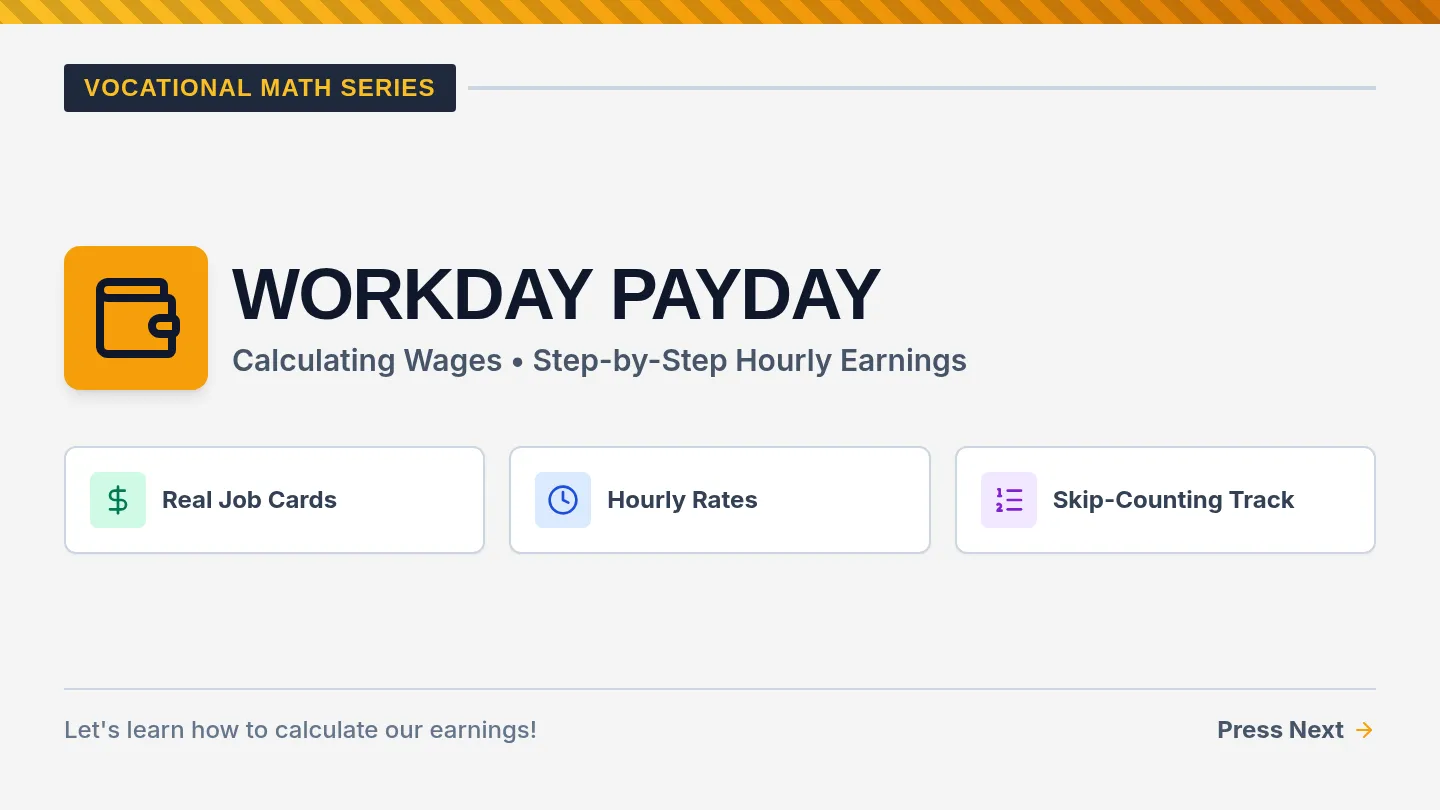
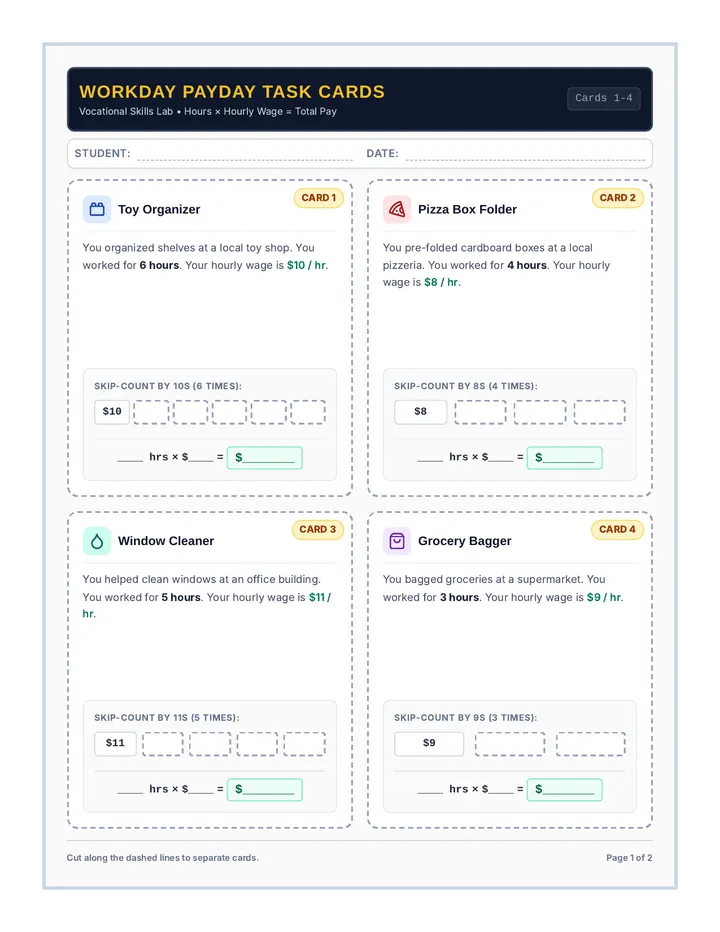
A foundational lesson on multi-digit multiplication and division focused on workplace budgeting and large-scale inventory management. Students will practice these operations through realistic scenarios like calculating monthly revenue and distributing supplies across departments.
Teacher answer keys for the Real World Math series.
Instructional slides for the Real World Math series.
Extends number sense to 100, emphasizing place value (tens and ones), magnitude comparison, and identifying patterns in the 100-chart.
Develops the ability to compose and decompose numbers within 20, focusing on the power of 10 and building basic addition/subtraction fact fluency.
Focuses on identifying numbers to 20, mastering 1:1 correspondence through physical and visual counting, and developing perceptual subitizing skills.
A comprehensive lesson on 3-digit by 1-digit division using the standard algorithm, themed around a detective investigation. includes a lesson plan, slides, anchor chart, and tiered worksheets.
Master the art of solving real-world rational function equations, focusing on clinical drug concentration models and rate-based applications. Students will learn to translate verbal scenarios into rational equations and apply algebraic techniques to find precise solutions.
A collection of teacher-facing tools including scoring keys, result interpretation guides, and class-wide data tracking charts to help educators act on diagnostic findings.
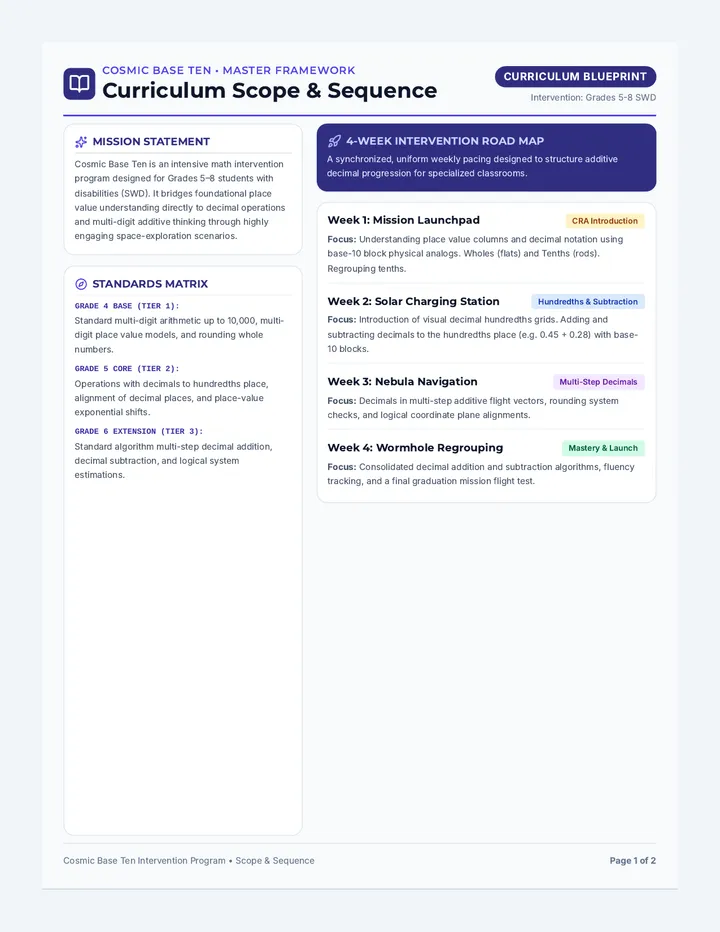
A diagnostic assessment for 5th-grade students focusing on decimal operations, powers of 10, multi-digit division, and adding/subtracting fractions with unlike denominators.
A diagnostic assessment for 4th-grade students targeting multi-digit multiplication and division, place value to 1,000,000, fraction equivalence, and basic decimal notation.
A diagnostic assessment for 3rd-grade students covering rounding, multi-digit addition/subtraction, multiplication and division concepts, and introductory fraction understanding.
A diagnostic assessment for 2nd-grade students focusing on place value to 1,000, addition and subtraction within 100, and early foundations of multiplication through arrays.
A collection of 9 standardized probes and tracking tools to monitor student growth in number sense and fractions.
An interactive 'around the room' scavenger hunt where students solve radical equations involving one or two radical terms. students follow a path of answers that lead them through 15 unique challenges.
A March Madness-themed lesson that provides students with a strategic "Game Plan" for deconstructing and solving math word problems. Students use a basketball-themed graphic organizer to scout for data, draft a playbook, and execute their solution.
A comprehensive set of materials for mastering two-digit by two-digit multiplication, designed to support an IEP goal of increasing accuracy from 40% to 80%. Includes a progress tracker, instructional slides, practice worksheets, and assessments.
A comprehensive lesson focused on mastering 2-digit by 2-digit multiplication through the 'Blueprint' method, including instructional slides, student practice, and progress monitoring tools.
A comprehensive lesson focused on mastering 2-digit by 2-digit multiplication, designed to help students bridge the gap from 40% to 80% accuracy through scaffolded instruction and weekly progress monitoring.
A hands-on card sort activity focused on identifying domain and range from various representations, aligned with Texas STAAR Algebra 1 standards across all performance levels.
La séance d'inspection finale conçue comme un laboratoire de recherche collaborative où les élèves décortiquent des problèmes complexes en petits groupes.
Une série de 7 séances d'entraînement intensif et stratégique pour couvrir les domaines clés du concours Kangourou : calcul, logique et géométrie.
A comprehensive lesson on graphing one-variable inequalities on a number line, using real-world constraints like speed limits and height requirements to anchor the concepts. Students will master open and closed circles and shading directions.
Day 10 of the EOC review focusing on Asymptotes and Correlation Coefficients.
Day 9 of the EOC review focusing on Exponential Growth and Decay.
Day 8 of the EOC review focusing on Roots, Zeros, and Solutions of quadratics.
Day 7 of the EOC review focusing on Quadratic Vertex and Axis of Symmetry.
Day 6 of the EOC review focusing on the Laws of Exponents and Polynomial operations.
Day 5 of the EOC review focusing on Systems of Equations and finding their Solutions.
Day 4 of the EOC review focusing on Parent Functions and basic Transformations.
Day 3 of the EOC review focusing on identifying Zeros and x-intercepts in various representations.
Day 2 of the EOC review focusing on the core components of linear equations: Slope and y-intercept.
Day 1 of the EOC review focusing on the fundamental concepts of Domain and Range.
A high-impact Algebra I STAAR EOC review focused on quadratic functions and equations (TEKS A.7A, A.8A). This lesson covers graphing, finding zeros, and connecting equations to their visual representations using test-taking strategies.
A comprehensive lesson on polynomial operations and factoring higher-degree expressions, aligned to TEKS 2A.7(A-B). Includes scaffolded practice and visual guides for polynomial behavior.
A comprehensive STAAR EOC prep lesson covering quadratic functions, focusing on key features, factoring, and the quadratic formula, aligned to Texas Algebra I TEKS A.6, A.7, and A.8.
A comprehensive STAAR EOC prep lesson for Algebra I focused on linear functions and equations, featuring rural Texas contexts like ranching and agriculture. Includes a slide deck, practice worksheet with gridded responses, reference guide, and self-assessment.
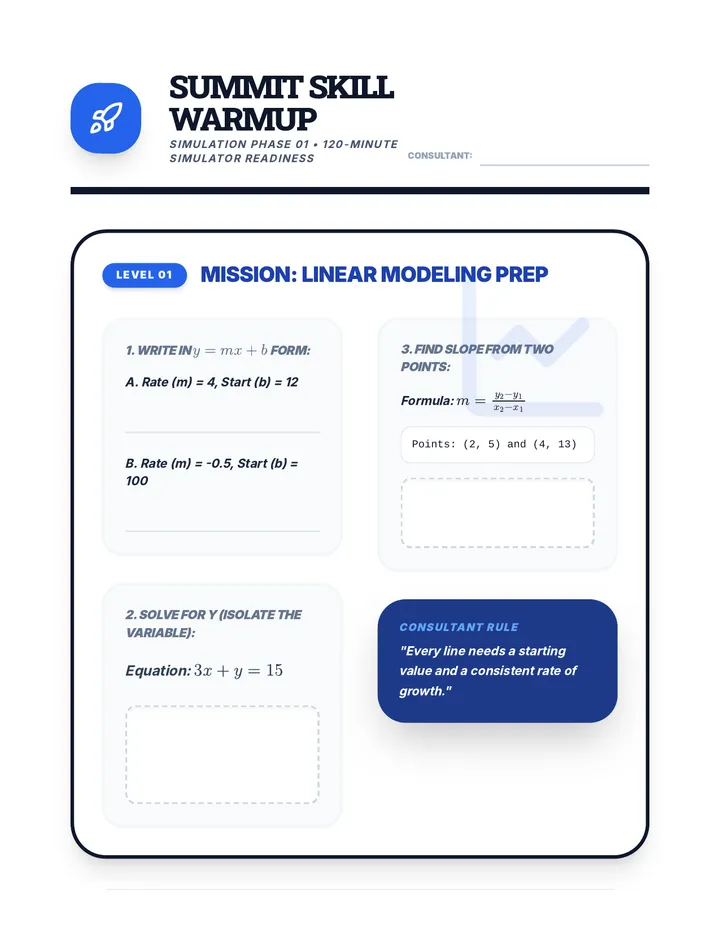
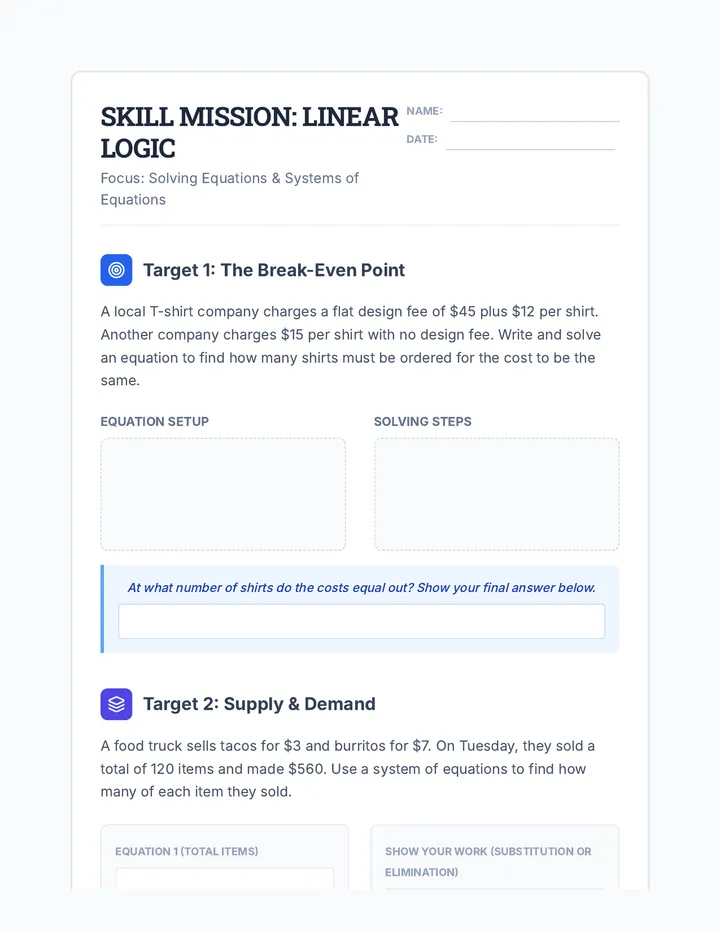
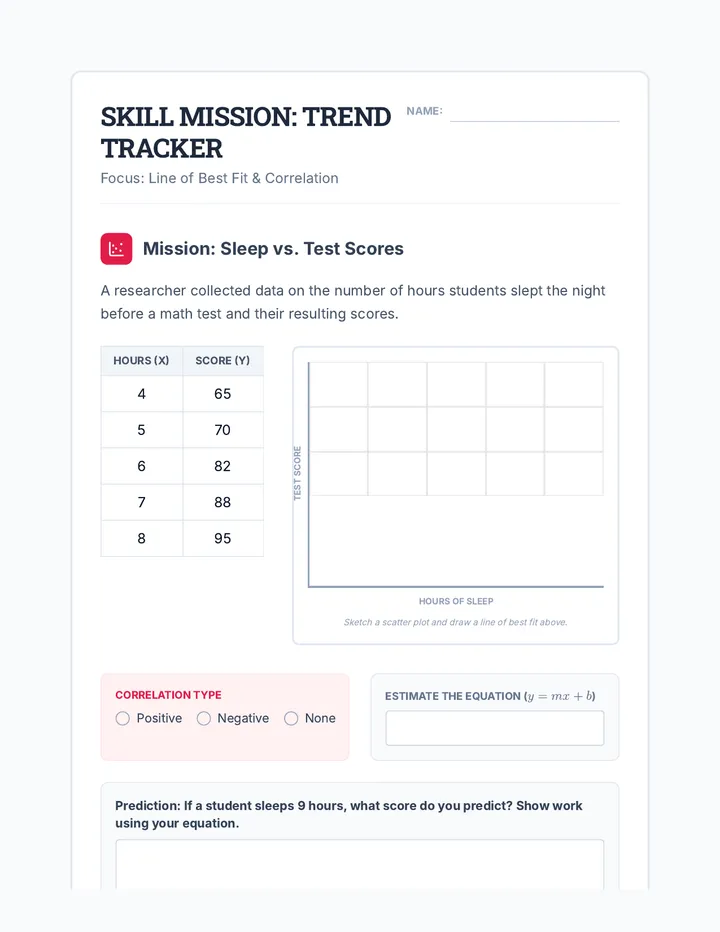
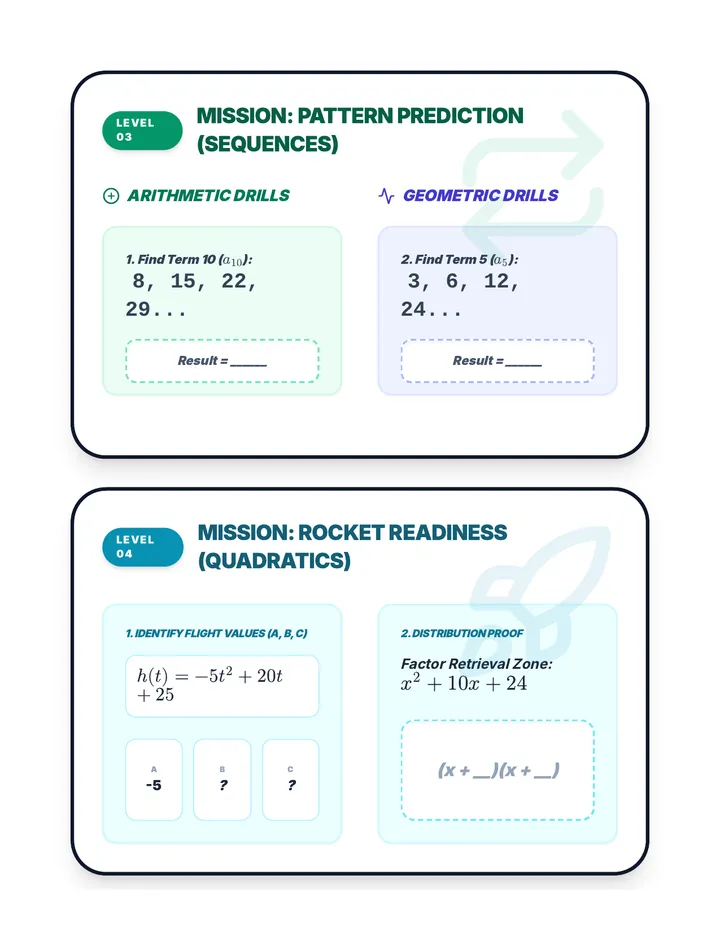
A foundational ACT/SAT prep lesson focusing on high-frequency algebra, geometry, and data questions for students looking to move past the 15-20 score range. Includes strategies for time management and a diagnostic assessment.
A comprehensive review of quadratic functions and equations tailored for the Texas Algebra 1 EOC, covering key attributes, transformations, and solving methods.
A set of high-interest extension activities for 6th graders to master finding the percent of a number through real-world business scenarios and creative design.
A focused lesson on standard 6.EE.A.2: writing, reading, and evaluating algebraic expressions. Students will identify terms and coefficients, translate phrases to expressions, and evaluate expressions at specific variable values using the order of operations.