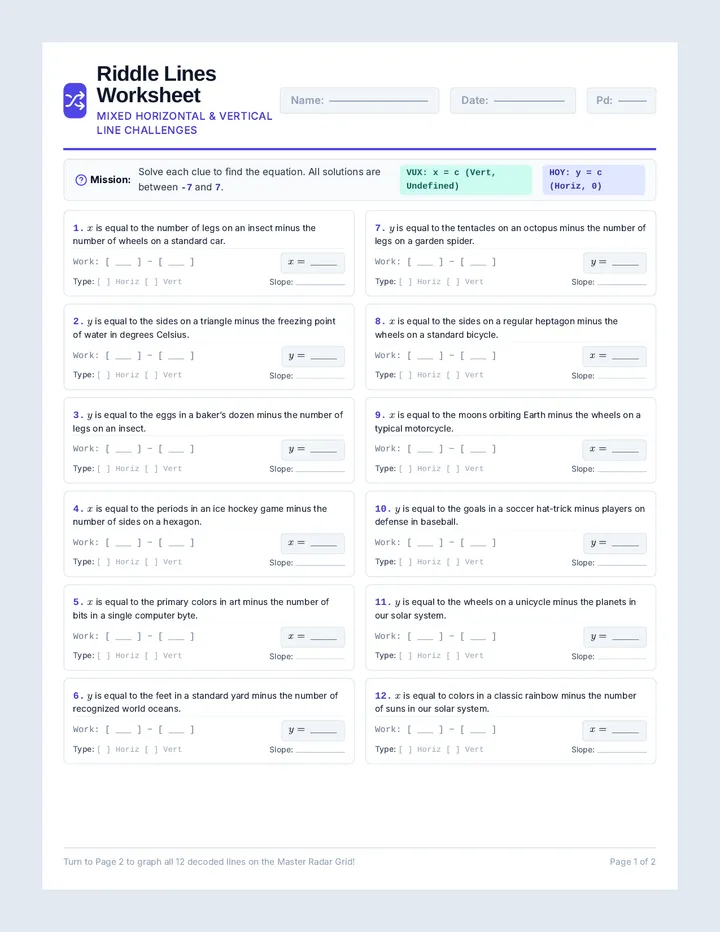
A specialized progress monitoring toolkit designed to assess and track student mastery of solving multi-step equations toward an 80% (8 of 10) IEP/RTI criterion. Includes standardized student probes, an aimline data tracking sheet, teacher diagnostic solutions, and a strategy review slide deck.
1. Distributive Property Errors (DP) • Items #1, #4, #6, #7, #9, #10 Area Model Intervention
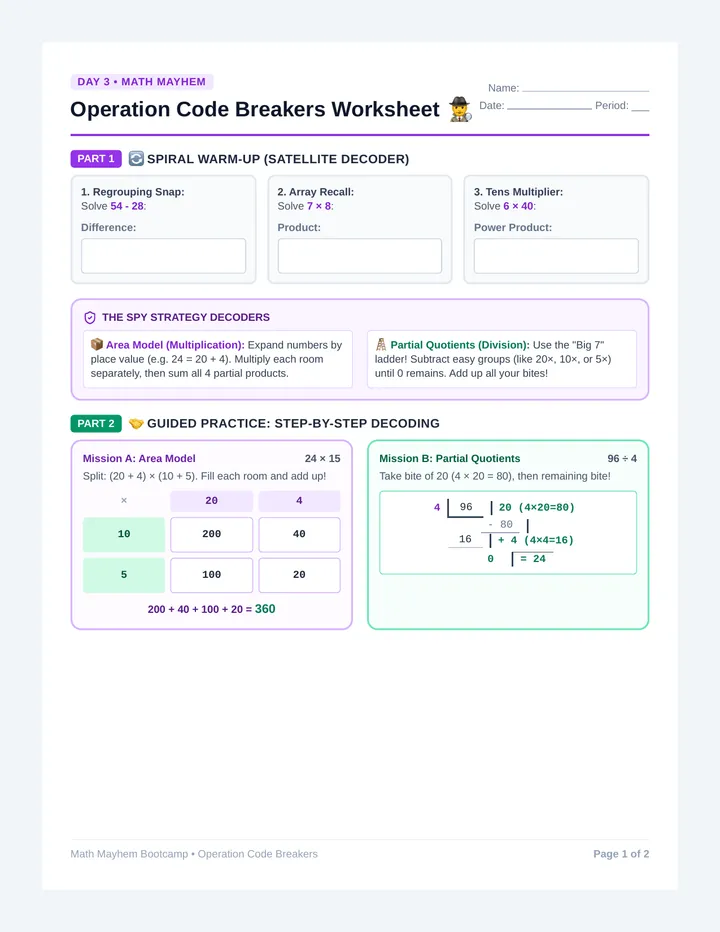
Diagnosis: Student multiplies outer term only by the first term (e.g., \( 3(x+5) = 3x + 5 \)) or forgets negative signs. Prescriptive Strategy: Implement the 2x1 visual box method (area model) to physically write both products before writing on the equation line. Have student draw distribution rainbow arrows.
Diagnosis: Student performs inverse operations across the equal sign when terms are on the same side. Prescriptive Strategy: Teach "Clean up your side before visiting neighbors." Have student draw boxes around variable terms and circles around constants (including sign) prior to combining.
3. Variables on Both Sides Confusion (VBS) • Items #3, #6, #8, #9 River / Balance Line
Diagnosis: Student combines terms across the equals sign without using inverse operations. Prescriptive Strategy: Require drawing a vertical line down the equals sign ("the river"). Apply the rule: "Smaller coefficient moves first to keep variable positive."
Diagnosis: Confusing subtraction with negative signs; dropping negative on division (\( -6x = 18 \rightarrow x = 3 \)). Prescriptive Strategy: Provide a laminated desk reference for integer rules. Require circling the sign in front of each number as part of the term.
IEP Quarterly Progress Reporting Sentence Stem:"During this monitoring period, [Student] completed [X] standardized 10-item multi-step equation probes, achieving an average accuracy of [Y]% (mastery criterion: 80% / 8 of 10). Current performance indicates [student is on track / requires targeted intervention in combining like terms]."
Multi-Step Equation Monitoring System • Scoring Guide & Matrix Classroom & Special Education Resource
Combining variables across the equals sign without using inverse signs.